EFFECTS OF TRANSDERMAL MAGNESIUM CHLORIDE ON RECOVERY OF FORCE PRODUCTION AND PERCEIVED MUSCLE SORENESS AFTER ECCENTRIC EXERCISE
Michael Bass
A thesis submitted to the faculty at the University of North Carolina at Chapel Hill in fulfillment of the requirements for the degree of Master of Arts in the Department of Exercise and Sport
Science (Exercise Physiology) in the College of Arts and Sciences.
Chapel Hill 2019
Approved by: Erik Hanson
iii ABSTRACT
Michael Henry Bass: Effects of Transdermal Magnesium Chloride on Recovery of Force
Production and Perceived Muscle Soreness after Eccentric Exercise (Under the Direction of Erik Hanson)
iv
ACKNOWLEDGEMENTS
v
TABLE OF CONTENTS
LIST OF TABLES ... vii
LIST OF ABBREVIATIONS ... viii
CHAPTER I: Introduction ... 1
Purpose Statement ... 4
Research Questions ... 4
Hypotheses ... 4
Operational Definitions ... 5
Delimitations ... 5
Limitations ... 6
Assumptions... 6
Significance of Study ... 6
CHAPTER II: Literature Review ... 8
Eccentric Exercise and Exercise induced muscle damage (EIMD) ... 8
Eccentric Mechanisms of Muscle Damage ... 8
Force Production ... 9
Delayed Onset Muscle Soreness (DOMS) ... 10
vi
Mg2+ in Cellular metabolism ... 10
Magnesium’s role in muscle contraction... 12
Magnesium’s role in pain response ... 13
Magnesium supplementation/concentration’s influence on performance ... 14
Transdermal MgCl2 Treatment ... 15
CHAPTER III: Methodology ... 17
Body Composition Assessment ... 18
Blood Draw ... 19
Cycle Ergometer Warm-up ... 20
Isometric Muscle Strength ... 20
Eccentric Muscle Damage Protocol ... 21
Visit One ... 21
Visit Two ... 22
Visit Three, Four, and Five ... 22
Washout period: ... 23
Visits 6-9 ... 23
Timing ... 23
Sample Size ... 23
Statistical Analysis ... 24
vii
Participants ... 25
Whole Blood Markers and Hydration Status ... 25
tMgCl2 Application ... 26
Isometric Knee Extensor Muscle Strength ... 27
Muscle Soreness ... 30
CHAPTER V: Discussion ... 31
Limitations and Strengths ... 32
Comparisons with Previous Literature ... 33
Muscle Force Recovery ... 33
Perceived Muscle Soreness ... 35
Implications and Future Studies ... 36
Conclusion ... 37
vii
LIST OF TABLES
Table 1. Participant Characteristics (n=19)………29
Table 2. Blood Marker for Illness and Hydration during Testing (n=19)………30
Table 3. Total Application Quantity for tMgCl2 Oil and Balm (n=19)………...31
Table 4. Absolute Isometric Force Production of the Knee Extensors (n=19)……….31
Table 5. Full Model for Maximal Knee Extensor Isometric Force Production Adjusted for Leg Dominance (n=19)………....32
Table 6. Reduced Model for Maximal Knee Extensor Isometric Force Production Adjusted for Leg Dominance (n=19) ………....33
Table 7. Normalized Model for Maximal Knee Extensor Isometric Force Production (n=19) ………...34
viii
LIST OF ABBREVIATIONS
ATP: Adenosine triphosphate Ca2+: Calcium ions
CK: Creatine Kinase
DOMS: Delayed Onset Muscle Soreness EIMD: Exercise Induced Muscle Damage
Mg: Magnesium Mg2+: Magnesium ions
NMDA: N-methyl-D-aspartate MB: Myoglobin
MgCl2: Magnesium Chloride
1
CHAPTER I: Introduction
Athletic success is often decided by the slimmest of margins, with the slightest advantage in performance being the difference between victory and defeat. To maximize performance, athletes may elicit extraneous sources of aid, which can be in the form of supplementation. It is common for athletes to turn to supplementation and other ergogenic aids to help them reach their maximum potential during events (Knapik 2016). From 2013-2018, supplement sales in the U.S. have almost grown by 14 billion dollars and is projected to reach 52 billion dollars by the end of 2019 (Statista). There is a multitude of different vitamins, minerals, and other herbal products available that claim to boost baseline levels within the body or, to minimize or reverse potential deficiencies, and theoretically providing athletes with physiologically optimal conditions to perform and compete. Because supplements are unregulated and often lack scientific evidence to support such claims, data are necessary to support or refute purported benefits. While some nutritional supplements have evidence to support their effectiveness (Peeling et al., 2018), many products have nothing more than anecdotal evidence or manufacturer claims.
2
and muscle force production during in the contraction cycle (Newhouse et al, 2000, Bohl et al, 2002). Magnesium also plays a pivotal role in protein synthesis, proper muscle and nerve function, blood pressure and glucose maintenance (Institute of Medicine 1997, Rude RK 2010, Rude RK 2012). This mineral is also necessary for different metabolic processes and the subsequent energy production, including oxidative phosphorylation and glycolysis. Magnesium is also a key factor in developing bone, genetic coding, and the maintaining of structure and function of the cellular membrane (Rude RK 2012). Proper functioning is imperative to adequate force output necessary for many athletic competitions, especially in those that require sustained high levels of lower body power output. The ability to maintain force production during high intensity efforts may help prevent fatigue and improve athletic performance.
3
The majority of dietary magnesium is absorbed through the small intestine, with approximately 24–76% is absorbed in the gut and the rest is eliminated in the feces (Jahnen-Dechent 2012). This less than optimal absorption may be accompanied by some of the more common side effects of oral supplementation like nausea and mild diarrhea (Venturini 2015). Transdermal application may provide a more optimal delivery for use in sport, by circumventing the digestion track and avoiding the gastrointestinal absorption.
Transdermal magnesium chloride (tMgCl2) is an alternative application method that may reduce some of the limitations seen with oral intake. Transdermal application provides a more direct localized approach by applying the supplemental magnesium as a topical agent and allowing the magnesium ions to diffuse through the epidermis layer (Sircus 2007, Chandrasekaran et al 2016). As such, this application style directly targets the muscles after being absorbed through the epidermal layer without having to enter into circulation. There has been evidence of oral supplementation having a positive effect on performance, but the effectiveness of transdermal delivery showing the same result has yet to be shown, thus recommending this application method currently lacks support (Gröber 2017).
4
application protocol. The use of repeated tMgCl2 over multiple time points (chronic supplementation) allows for a more direct comparisons to the use of oral supplementation. Moreover, with the anti-inflammatory properties of magnesium in regards to cellular maintenance, it is possible that tMgCl2 may be suitable to examine during the on recovery process. With increased recovery from strenuous bouts of exercise, athletes may be able to train harder in terms of intensity and volume during the microcycle, thus allowing for greater adaptations during the macrocycle. These small adaptations throughout the training program may be the difference in victory and defeat.
Purpose Statement
Purpose of this study was to examine the effects of tMgCl2 application on recovery in isometric force production and perceived muscle soreness following a bout of lower body eccentric leg extensions.
Research Questions
RQ1: Does tMgCl2 enhance recovery and subsequently increase isometric force production after a bout of eccentric leg extensions on an isokinetic dynamometer?
RQ2: Does tMgCl2 decrease muscle soreness after a bout of eccentric leg extensions?
Hypotheses
1) There would be a significant interaction of time and condition, and applying tMgCl2
oil and balm three times daily following eccentric leg extensions will increase rates of
5
2) There would be a significant interaction of time and condition, and application of tMgCl2
oil and balm will decrease perceived muscle soreness following eccentric leg extensions
compared to a placebo
Operational Definitions
Familiarization: Session that occurred prior to the pre-testing session to introduce and prepare
the participants to successfully complete the protocols and equipment being used in this study. Isokinetic dynamometer: A device that resisted applied forces and controlled the speed of
exercise at a predetermined rate.
Isometric force production: Muscular force measured from an isometric contraction
Delimitations
All participants were males between the ages of 18 and 35 and were recreationally active (30 minutes of exercise at least 2 times per week) for at least 2 months prior to enrollment All participants had previous experience (at least 2 months) with resistance exercises Participants had no history of knee injuries with surgery in the past year
Participants must not have previously had any known magnesium deficiency, magnesium supplementation therapy or multi-vitamin use
Participants were not taking chronic pain medication
6 Limitations
The results of this study were only applicable to those who are men, recreationally active and between the ages of 18-35 years old. Results may not be applied to males of all ages and females
It is possible that subjects did not adhere to supplement application or exercise guidelines during the trail weeks as researchers were not with them during the hours in-between testing sessions
It was not feasible for our lab to measure magnesium levels delivered by application. Assumptions
All participants followed the pre-assessment guidelines.
All participants followed supplement application protocol during the testing period. All participants refrained from all other forms of exercise during the testing period. Significance of Study
7
8
CHAPTER II: Literature Review
Eccentric Exercise and Exercise induced muscle damage (EIMD)
Eccentric Mechanisms of Muscle Damage
Exercise induced muscle damage (EIMD) can be categorized as the loss of muscle strength, and increase in muscle damage biomarkers and subsequent muscle soreness. (Nosaka et al., 1996, Byrne et al., 2004, Tee et al., 2007). Previous literature has suggested that failure of excitation-contraction and sarcomere over-extension is the factor driving eccentrically induced EIMD (Morgan et al., 1990, Warren et al., 2001, Raastad T, et al., 2010). Calcium overload is believed to also be an enabler of EIMD (Armstrong et al., 1991) Excess calcium within cells impedes cellular respiration in the mitochondria (Cullen et al,1979), thus slowing ATP production and inhibiting the ability of the tissue to discard calcium (Wrogemann and Penna 1976, Zulian et al., 2016). High calcium concentrations within the cell has been linked to
structural and functional damaging of the mitochondria, cellular necrosis, z-disc degradation and energy shortage (Busch et al., 1972, Wrogemann and Penna 1976, Zulian et al., 2016).
9
lengthening during activation (Armstrong et al., 1991, Proske et al., 2001, Warren et al., 2001). Eccentric contractions has also been believed to create higher local temperatures than concentric contractions (Daves and Barnes 1972). A rise in localized muscle temperature from exercise can possibly increase EIMD by breaking down of muscle fibers and connective tissues (Armstrong, 1984) It has been shown that 3 sets of 30 maximal eccentric contractions of the knee extensors created a muscle damage response via significant increases in muscle damage biomarkers (Hody, 2013). The proposed study utilized a randomized crossover placebo design with 6 sets of 12 maximal eccentric contractions of knee extensors at 60o per/second utilizing a isokinetic dynamometer, which in theory would elicit a muscle damage response.
Force Production
Eccentric muscle contractions have been shown to cause greater fatigue and muscle soreness in comparison to isometric and concentric contractions (Jones et al., 1986). It has also been suggested that eccentric contractions cause the most soreness and damage at the tissue level (McCully and Faulkner, 1985). Microscopic evidence has shown muscle damage via
10 Delayed Onset Muscle Soreness (DOMS)
Delayed Onset Muscle Soreness (DOMS) is known as the development of pain, stiffness, and swelling of activated tissue from muscle micro trauma (Lewis et al., 2012) Previous literature has indicated that the swelling seen in DOMS is a result of EIMD and its consequent inflammatory response (Connolly et al., 2003). Input from mechanoreceptors may contribute to muscle soreness post eccentric exercise (Weekrakkoday et al 2001). It has been proposed that exercise-induced release of chemical substances that elicit pain such may be the mechanism causing DOMS (Fock and Mense 1976). These same chemicals are thought to innervate the pressure receptors of afferent nerve endings sending sensations of pain upon touch (Hiss and Mense, 1976). DOMs has been positively correlated with loss of force output and range of motion (Saxton et al., 1996, Prasarthwuth et al., 2006). Yet, there is evidence that DOMS has weak relationship with actual muscle damage (Rodenburg et al., 1993, Nosaka et al., 2002). DOMS appears to peak between 24 and 96 hours post exercise (Cheung et. Al, 2003). There has been work done with the visual analog scale (VAS) to effectively identify soreness in DOMS timelines (Lau et al., 2015, Kanda K et al., 2013). This proposed study evaluated muscle soreness using a VAS at 0, 24, 48 and 96 hours post eccentric exercise.
Magnesium’s Role in Physiological Processes Relevant to Exercise Mg2+ in Cellular metabolism
11
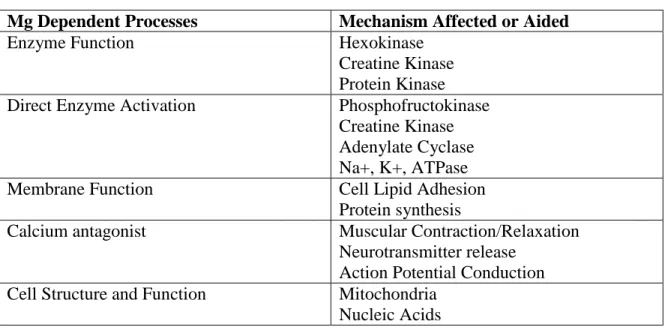
Table 1 coveys the different enzymes, structures, and processes of energy metabolism that depend on Mg2+.
Table 1: Physiological Functions of Magnesium (Swaminthan R, 2003)
Mg Dependent Processes Mechanism Affected or Aided
Enzyme Function Hexokinase
Creatine Kinase Protein Kinase Direct Enzyme Activation Phosphofructokinase
Creatine Kinase Adenylate Cyclase Na+, K+, ATPase
Membrane Function Cell Lipid Adhesion
Protein synthesis
Calcium antagonist Muscular Contraction/Relaxation Neurotransmitter release
Action Potential Conduction Cell Structure and Function Mitochondria
Nucleic Acids
12
Figure 1: Magnesium is required for ATP to release stored energy to drive biological
reactions within the cells (Rosanoff, 2015)
Collectively, these studies suggest that the effects of Mg2+ on cell lipid stabilization and protein synthesis are benefits to maintaining membrane integrity, which is often compromised during different forms of resistance exercise. There has been evidence that showcased that the electrical effects of magnesium ions provide a stabilizing effect (Bara et. Al, 1990) Magnesium ions in the cell has been theorized to help stabilize the cell with its inhibition of calcium ion uptake (Kowaltowski et al., 1998, Iseri et al., 1984). It has also been suggested that magnesium helps to boost membrane function by binding to cellular phospholipids and organelle membranes (Golf et Al, 1998). Cellular lipid stabilization and protein synthesis are usually inhibited during resistance exercise, thus effecting the membrane integrity. This aforementioned evidence points to magnesium being a key factor in alleviating this issue.
Magnesium’s role in muscle contraction
13
oxygenated blood could allow for greater nutrient availability and repair post EIMD. There has been a research showing that a rise in the presences of magnesium ions prior to exercise results in increased blood flow allowing greater cross bridge formation (Haddy et. al, 1975). It has been theorized that since magnesium functions as an counteractant to calcium channels via blocking channels and decreasing intracellular calcium and consequent contractibility, which lowers peripheral vascular resistance and lowering the chance of overloading of calcium (Altura et al., 1987). This inhibition of calcium channels by magnesium ions may promote more efficient contractions of working muscles by reducing the probability of calcium overload within the cell (Swaminathan R, 2003). It is also believed that magnesium ions enable efficient muscular contractions by allowing greater cross bride formation (Carvil P, Cronin J, 2010). All of these possible enhancements of muscular contraction has yet to be examined through the scope of local application of transdermal magnesium.
Magnesium’s role in pain response
Magnesium is voltage dependent blocker of N-methyl-D-aspartate (NMDA) receptor channels (Iseri and French, 1984, Ken and Kemp, 2005). NMDA receptor activation causes the spinal neurons to be more sensitive to inputs, causing a heightened pain stimulus through central sensitization (Bennett, 2000). There has been evidence that magnesium ions reduce
14
To our knowledge there has been no clinically controlled trials date investigating the effects of magnesium supplementation and DOMS from EIMD. However, there is a number of studies examining decreases in pain in clinical populations with oral supplementation. There has been evidence that oral supplementation of magnesium citrate in patients with coronary artery disease reduces exercise induced chest pain (Schester et al 2003). There has also been evidence that 1 month of daily oral magnesium oxide supplementation (300 mg) decreased chronic low back pain with a neuropathic component (Yousef and Al-deeb, 2013). In terms of magnesium
chloride, there has been evidence that transdermal application minimized chronic pain in patients with fibromyalgia (Engen et al., 2015).
Magnesium supplementation/concentration’s influence on performance
There has been conflicting evidence on the effects of oral magnesium supplementation and exercise performance (Zhang 2017). It has been shown that there is a positive association with dietary magnesium intake and maximal isokinetic knee extension and flexion torque in “elite” level basketball and handball players (Santos et al. 2011) (See figure 2 & 3). In
15
The benefits of magnesium supplementation has also been seen in non-athletic populations. In untrained individuals, oral supplementation of magnesium oxide (8mg/kg) increased quadriceps torque in comparison to the placebo group (Brilla et al., 1992). The InCHIANTI study examined the effects of magnesium on muscle performance in an elderly population. This examination showcased a positive correlation between serum magnesium levels and maximal handgrip strength and knee extension torque (Dominguez et al., 2006). It is
imperative to note that the InCHIANTI study did not utilize supplementation. However, this data does suggest that higher circulating levels of magnesium ions may be linked to having greater force production. The aforementioned research suggest that magnesium’s role in metabolism and structure at the cellular level may impact muscular contraction and subsequent force production. Transdermal MgCl2 Treatment
For years there have been anecdotal evidence for the use of mineral based theories, majority of which pointing to the potential health benefits. There has been conflicting evidence on the effectiveness of magnesium ion penetration via transdermal application. One study found
Figure 2: Dietary Magnesium Intake Correlation w/ Isokinetic Strength (Santos et al. 2011).
16
that transdermal magnesium chloride supplementation penetrated the skin rapidly, and achieved significant permeation in 15 minutes (Chandrakanth et al 2016). However, there was no mention of the amount of magnesium that was able absorbed (Gröber 2017). After magnesium ions have crossed the stratum corneum, transmembrane proteins assist the transport of ions into the organ systems (Sahni et al. 2007). One study showcased that transdermal magnesium had greater effects than topical magnesium sulfate, which commonly used to treat pain (Bara et al., 1994). Transdermal magnesium chloride has also been favored in comparison to other topical agents, such as magnesium sulfate, because of its lower tissue toxicity (Durlach et al, 2005).
17
CHAPTER III: Methodology
Participants
20 male subjects between the ages of 18-35 were recruited from a university in the southeast region of the United States. Due to the scarcity of previous literature regarding this particular application method in the desired population (Gulick et al, 2012), a sample size of 20 was collected. In order to be included in this study, participants had to be recreationally active, 30 or more minutes of exercise at least twice per week for a minimum of 2 months prior to enrollment. Each participant must also have had a previous history, within the past 3 months prior to enrollment, of resistance exercise. Each participant had to be free of any
contraindications to exercise, acute knee injuries within the previous year, known magnesium deficiency, or utilizing magnesium supplementation and/or chronic pain medication in order to be enrolled. Females were excluded from this study due to there is a high degree of performance variability within women that appears to occur due to the menstrual cycle (Tenan et al 2015). To minimize those confounding factors and potential variation in muscle soreness and isometric force production, this initial pilot study was performed in males only.
18
This study used a double blind, repeated measures crossover design. Participants were advised to abstain from any exercise or alcohol consumption 24-hours prior to arriving to the Exercise Oncology Lab for testing. Also, participants were instructed to not use an over the counter analgesics throughout the duration of the study.
Testing Methods
All testing and evaluations were performed in the Department of Exercise and Sport
Science at the University of North Carolina in the Neuromuscular, Sports Medicine, and
Exercise Oncology Laboratories located in Fetzer Hall.
Body Composition Assessment
Dual-energy X-Ray absorptiometry (DEXA; Hologic Discovery DXA System QDR Series, Hologic Breast and Skeletal Health Solutions, Marlborough, MA, USA) was used to estimate lean mass (LM), fat mass (FM), and bone mineral content to calculate total body composition. All scans were performed by a trained DEXA technician. Before each scan, the trained technician entered the required subject information including height (in), weight (lbs.), ethnicity, age, sex, and identification code. The participant was instructed to remove all metal jewelry and any other objects from their pockets, and then lie supine on the DEXA scanner. Once on the DEXA table, the technician adjusted the participant’s head, hips, shoulders, and limbs to center the participant within the DEXA’s measurement area. The participant was
19 Blood Draw
All blood draws occurred in the Exercise Oncology Laboratory and was conducted by an individual trained in phlebotomy. ~10mL of blood was obtained. 4mL of blood was collected in an EDTA tube and complete blood counts with differential were determined in duplicate (XP-300 Automated Hematology Analyzer, Sysmex America Incorporated, Lincolnshire, Illinois, USA), along with hemoglobin and hematocrit for determination of plasma volume shifts (Dill and Costill, 1973). A 6mL serum sample was allowed to clot for 30 minutes at room
temperature, then centrifuged (1200 rpm X 10 min. at room temperature) and serum was obtained and aliquoted. These serum samples were stored at -80°C in a freezer (Thermo Scientific XBF40D-MD-Blast Freezer for Plasma, Waltham, MA, USA).
Application of Condition- Placebo vs. Supplement
Technicians used an analytic balance (Fisher Scientific XA Analytic Balance, Fisher
Scientific, Hampton, New Hampshire, USA) to measure the mass (g) of both the balm and oil of
the specified condition, and recorded this on the data sheet. Technicians then provided the
condition to the participants post final isometric strength test on visit 2 and 6. Participants was
instructed to apply their condition (placebo or supplement) by spraying 5 sprays from their bottle
onto their quadriceps muscle of the tested leg. Once the participant felt that the spray had dried
on their leg, they applied a quarter size dollop of the balm given to their quadriceps muscle on
the tested leg. The participants were instructed to apply their condition after each visit to the lab,
and during the evening and morning throughout the entire duration weeks of testing. After visit 5
20
balance to measure the remaining mass of both the balm and oil of the specified condition, and
recorded this on the data sheet.
Gravity Correction
Participants remained buckled in the dynamometer while the technician began the
program “Research Toolkit”. The technician ensured the participant was comfortable before
running the program. Once the participant was comfortable, the technician used the
dynamometer to bring the participant’s knee to ~90 degrees flexion. A level was used to ensure
that lower limb was vertical. The technician started the recording on the biopac (Biopac MP150,
BIOPAC Systems Incorporated, Goleta, California, USA) and allowed the recording to run for 5
seconds. The participant was then unbuckled from the dynamometer.
Muscle Soreness: Visual Analogue Scale (VAS)
A 100cm line in which participants indicated the level perceived of soreness between 0 –
10. Each mark made on the analog line was examined to determine perceived muscle soreness
for both the experimental and control supplements.
Cycle Ergometer Warm-up
Participants pedaled at light (25-50 watts) resistance for five minutes on the cycle
ergometer prior to completing any exercise testing.
Isometric Muscle Strength
Participants were fitted to the isometric dynamometer (HUMAC Norm Testing and
Rehabilitation System, Computer Sports Medicine Incorporated, Stoughton, MA, USA) and
asked to perform single leg extension contractions at 50%, 75% and 90% of their perceived
maximal effort with a knee angle of 90 degrees of flexion. Participants were given 1 minute to
21
extension efforts lasting 2-3 seconds, with 2 minutes of rest between each effort. The peak force
from each trial was determined from the dynamometer and the highest value was used for
calculations.
Eccentric Muscle Damage Protocol
To test the effects of the tMgCl2 on muscle recovery, it was decided to use an eccentric leg extensions. Eccentric training, as a model of unaccustomed exercise, has been shown to decrease force output and increase soreness. (Cheung et al 2003, Newham et al 1986: Proske et
al 2001). Participants remained seated in the isometric dynamometer for 3 minutes after the
isometric strength testing and prior to the eccentric protocol. Participants then performed 6 sets
of 12 consecutive unilateral eccentric isokinetic knee extension contractions at a speed of 60
degrees per second. Participants were asked to resist the downward movement of the
dynamometer for all repetitions for a full range of motion, from ~0 degrees flexion through to 90
degrees of flexion.
Visit One
Participants were screened for participation in the study, which included a medical
history questionnaire. If all inclusion criteria were met, participants were asked to sign the
informed consent. Participants underwent a dual-energy x-ray absorptiometry scan to determine
body and bone mineral composition. Then participants were taken to the neuromuscular lab to
have the opportunity to practice and become familiar with all study procedures including knee
extension strength testing, and eccentric leg extension protocol under submaximal conditions. As
participants left the familiarization session, participants were reminded of the pre-exercise
22 Visit Two
Participants returned to the testing site 3-7 days after the familiarization session. Before
performing exercise testing, participants filled out the baseline muscle soreness VAS and the
research performed a blood draw. Following this, participants completed the cycle ergometer
warm up. Participants were then fitted into the dynamometer before beginning the isometric
strength testing portion of the visit. Post isometric strength testing and 3 minute rest period,
participants completed the eccentric muscle damage protocol. Following this, participants were
given another muscle soreness VAS, before completing another isometric strength test bout.
Upon completion of the final strength test, participants were fitted for the gravity correction.
After the gravity correction, participants were taken back to the Oncology Lab where they had
another blood draw and were given their condition. Researchers showed the participant how to
apply to the quadriceps. After application, they were reminded of both the application times
before the next visit and the pre-assessment guidelines.
Visit Three, Four, and Five
Participants were asked to return to the lab for follow up muscle strength and soreness
testing at 24h, 48h, and 96h after the eccentric exercise bout. Upon arrival to the lab, participants
had their blood drawn and given a muscle soreness VAS. Participants were then taken to
neuromuscular lab. In the lab they completed the cycle ergometer warm up before being fitted
into the dynamometer for strength testing. Once fitted, the participants completed 1 bout of the
isometric strength testing protocol before completing a gravity correction. After the gravity
correction, the participant was unbuckled from the dynamometer and instructed to apply both
their balm and oil to the tested leg. Before leaving, they were reminded of both the application
23
session (96 hr), participants were asked to return all supplements, to the researchers to estimate
the amount of magnesium you received during the treatments.
Washout period:
2 weeks. During the washout period, participants were allowed and encouraged to resume
their normal exercise routines. After the two-week washout period, participants returned to the
laboratory and repeated the testing procedures using their opposite leg and the supplement
condition.
Visits 6-9
Participants repeated testing (visits 2-5) from week 1 using the opposite supplementation
condition. Participants used the opposite leg from week one to avoid a training or supplement
effect from the first week of testing.
Timing
All participants were tested within ±1 hour of visit 2 for week 1 and visit 6 for week 2, as a means of controlling for variability in performance throughout the day.
Sample Size
To our knowledge, only one other study had investigated transdermal magnesium on muscle performance (Gulick et al, 2012) and the authors reported that in 18 healthy men and women, there was no effect on muscle endurance performance. Oral magnesium
24
approached this initial study as a pilot project in which we intended to improve upon existing knowledge by examining a different role for transdermal magnesium supplementation in a longitudinal manner, while restricting this initial study to males only. This initial project allowed for more appropriate power analyses to be conducted based on effect sixes calculated for this specific product in a more controlled population across a longer application period.
Statistical Analysis
Data will be analyzed using mixed-effects linear modeling (Jamovi 0.9.6.9) with repeated
measures for the 2x5 crossover design. Magnesport and placebo condition effects was analyzed
over time against perceived muscle soreness and maximal isometric force production. Potential
covariates, such as leg dominance, were explored using descriptive statistics and the presence of
an association with the dependent variables prior to being included in any statistical models. The
potential order effect of the dominant vs. non-dominant leg were tested by comparing time x leg
interaction of the dependent variable across time. The dominant leg was defined as the leg a
participant would use to kick a ball for maximal distance. All statistical analyses were performed
25
CHAPTER IV: Results
Participants
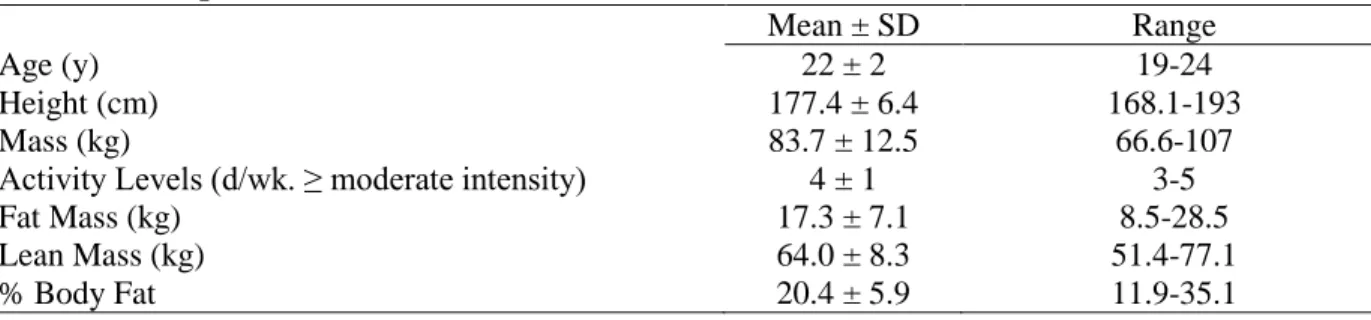
Participants were young, healthy, and recreationally active males with no history of lower extremity injuries within a year previous to testing (Table 1). All participants had at least two months of prior experience with resistance training. All participants considered themselves to be at least moderately active and partook in various modes of both aerobic and resistance exercise. Of the 20 participants that were recruited, one was lost to follow up due to a mild allergic reaction to compounds within the product.
Table 1. Participant characteristics (n=19).
Mean ± SD Range
Age (y) 22 ± 2 19-24
Height (cm) 177.4 ± 6.4 168.1-193
Mass (kg) 83.7 ± 12.5 66.6-107
Activity Levels (d/wk. ≥ moderate intensity) 4 ± 1 3-5
Fat Mass (kg) 17.3 ± 7.1 8.5-28.5
Lean Mass (kg) 64.0 ± 8.3 51.4-77.1
% Body Fat 20.4 ± 5.9 11.9-35.1
Whole Blood Markers and Hydration Status
26 Table 2. Whole Blood Markers (n=14)
WBC (x103/uL) Baseline 0H 24H 48H 96H
tMgCl2 7.1 ± 1.9 6.8 ± 1.4 6.1 ± 1.4 6.3 ± 1.1 6.6 ± 1.7 Placebo 6.4 ± 0.7 6.7 ± 1.4 6.3 ± 0.7 6.1 ± 1.0 6.8 ± 0.8 LYM (x103/uL)
tMgCl2 2.2 ± 0.5 2.0 ± 0.5 2.3 ± 0.6 2.3 ± 0.4 2.2 ± 0.6 Placebo 2.1 ± 0.4 2.1 ± 0.6 2.3 ± 0.5 2.0 ± 0.5 2.1 ± 0.5 MXD (x103/uL)
tMgCl2 0.8 ± 0.2 0.7 ± 0.3 0.5 ± 0.2 0.6 ± 0.3 0.7 ± 0.3 Placebo 0.6 ± 0.1 0.6 ± 0.2 0.6 ± 0.2 0.6 ± 0.2 0.5 ± 0.1 NEUT
(x103/uL)
tMgCl2 4.1 ± 1.8 4.1 ± 1.4 3.3 ± 1.0 3.5 ± 1.0 3.7 ± 1.4 Placebo 3.7 ± 0.6 3.9 ± 1.1 3.3 ± 0.7 3.5 ± 0.9 4.2 ± 1.2 HGB (g/dL)
tMgCl2 14.8 ± 0.7 14.8 ± 0.7 15 ± 1.2 14.8 ± 1.0 15.0 ± 0.7 Placebo 14.9 ± 0.5 15.3 ± 2.0 14.8 ± 1.1 14.5 ± 1.0 14.7 ± 0.5 HCT (%)
tMgCl2 43.3 ± 2.0 43.2 ± 2.4 43.6 ± 2.3 43.1 ± 2.3 43.3 ± 2.1 Placebo 43.3 ± 1.5 44.9 ± 6.0 43.1 ± 2.4 42.4 ± 2.1 43.0 ± 1.3 PV (%)
tMgCl2 0.5 ± 5.9 -1.7 ±8.9 1.9 ± 12.5 -1.6±10.1 Placebo 7.8 ± 19.8 -4.4 ± 13.0 0.2 ± 6.8 2.9±5.8 Mean ± SD
* p<0.05 compared to baseline; ** p<0.01 compared to baseline
tMgCl2 Application
27
Table 3. Total Application Quantity for tMgCl2 Oil and Balm (n=19).
tMgCl2 Placebo P-Value
tMgCl2 Oil (g) 8.0 ± 1.7 8.4± 2.6 0.805
tMgCl2 Balm (g) 10.8 ± 8.5 11.2 ± 7.1 0.700 Mean ± SD
Isometric Knee Extensor Muscle Strength
Immediately following eccentric exercise muscle contractions (0H), knee extensor isometric raw torque decreased by ~12% (-36.5 N*m, 95%CI [-6.3, 39.3], p<0.001) relative to baseline (Table 4). Torque tended to be lower than baseline at 24H (-10%, -15.9 N*m, 95%CI [-31.9, 0.2], p=0.055), was similar to baseline at 48H (1.3 N*m, 95%CI [-14.8, 17.4], p=0.877) before increasing by 16% at 96H (34.98 N*m, 95%CI [18.6, 51.3], p<0.001). There was no group x time interaction or condition main effect.
Table 4. Absolute Isometric Force Production of the Knee Extensors (n=19).
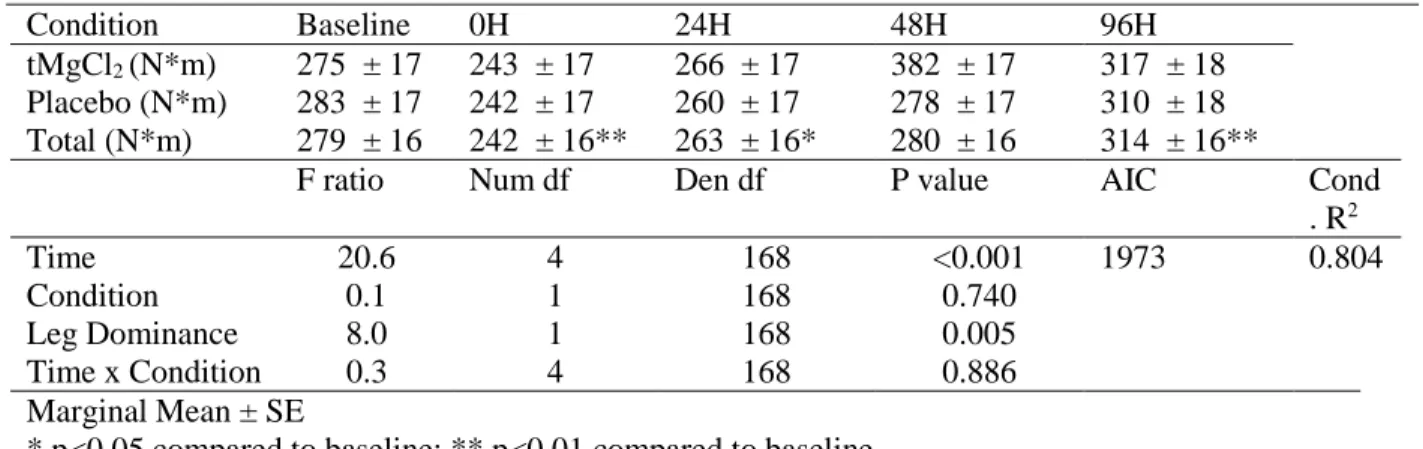
Visual inspection of the raw torque between placebo and tMgCl2 indicated a difference at baseline (Table 4). As such, leg dominance was added to the analysis and the full model was presented below (Table 5). The time x condition interaction was not significant (p=0.886), but the condition x leg dominance was significant (p=0.045). The full model had a slightly larger conditional R2 and lower AIC, indicating a better model for these data.
Condition Baseline 0H 24H 48H 96H
tMgCl2 (N*m) 271 ± 83 239 ± 72 261 ± 68 278 ± 85 314 ± 90 Placebo (N*m) 287 ± 73 246 ± 66 265 ± 73 274 ± 76 297 ± 85 Total (N*m) 279 ± 78 243 ± 68** 263 ± 70 276 ± 80 305 ± 87**
F ratio Num df Den df P value AIC Cond. R2
Time 20 4 169 <0.001 1977 0.7961
Condition 2.0 1 169 0.229
Time x Condition 0.3 4 169 0.888 Mean ± SD
28
Table 5. Full Model for Maximal Knee Extensor Isometric Force Production Adjusted for Leg Dominance (n=19).
There was a 12% decrease in torque when adjusting for leg dominance the 0H (-36.5, 95%CI [-52.1, -20.8], p<0.001) relative to baseline. At 24H, torque decreased by 5% in
comparison to baseline (-15.9, 95%CI [-31.5, -0.2], p=0.049); but was similar to baseline at 48H (1.3, 95%CI [-14.4, 16.9], p=0.873) before a 12% increase by 96H (34.9, 95%CI [19.1, 50.8], p<0.001).
Because this was a pilot study and to maximize degrees of freedom, any non-significant group x condition interaction were removed and the reduced model was presented (Table 6). In the reduced model, there was a significant difference seen at the 0H (-36.5, 95%CI [-52.1,-20.8], p<0.001), 24H (-15.9, 95%CI [-31.5,-0.2], p =0.049), and 96H (35.0, 95%CI [19.1, 50.9],
p<0.001) continued.
The marginal means between the full and reduced model did not greatly vary, which could be seen in the similar trend of the data between models. In comparison to the raw and full model, there was no difference in conditional R2.
Condition Baseline 0H 24H 48H 96H
tMgCl2 (N*m) 275 ± 17 243 ± 17 266 ± 17 382 ± 17 317 ± 18 Placebo (N*m) 283 ± 17 242 ± 17 260 ± 17 278 ± 17 310 ± 18 Total (N*m) 279 ± 16 242 ± 16** 263 ± 16* 280 ± 16 314 ± 16**
F ratio Num df Den df P value AIC Cond . R2
Time 20.6 4 168 <0.001 1973 0.804
Condition 0.1 1 168 0.740
Leg Dominance 8.0 1 168 0.005
Time x Condition 0.3 4 168 0.886 Marginal Mean ± SE
29
Table 6. Reduced Model for Maximal Knee Extensor Isometric Force Production Adjusted for Leg Dominance (n=19).
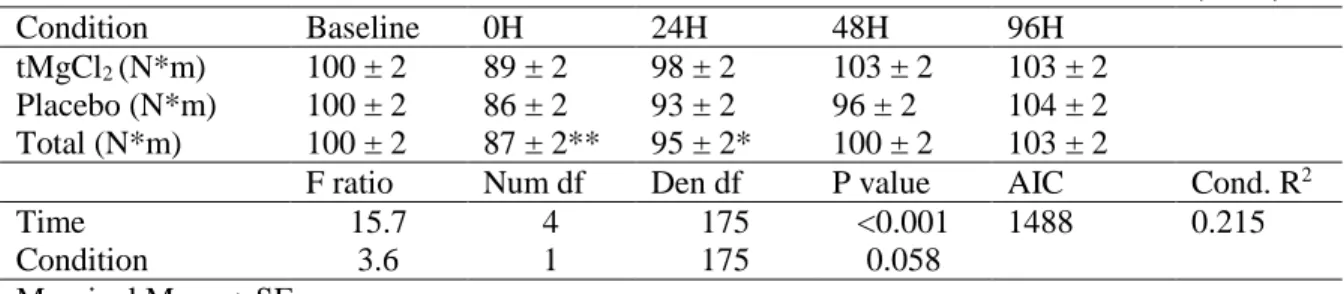
To confirm the influence of leg dominance on torque, peak torque values were normalized to baseline within subjects. The interaction of time x condition remained non-significant
(p=0.375), confirming the full and reduced torque models. As expected, leg dominance was no longer a significant factor in the model (p=0.789). There was a trend for an effect of condition (2.7%, 95% CI [-0.1, 5.5], p= 0.058). There were significant decreases in relative torque at 0H (-12.8%, 95% CI [-17.2, -8.4], p<0.001) and 24H (-4.6%, 95% CI [-8.9, -0.2], p= 0.043); but no difference at 48H, as participants had returned to baseline output (-0.3, 95% CI [-4.7, 4.1], p= 0.888). At 96H, relative torque exceed baseline by nearly 4% (Table 6), but was not statistically significant (3.4, 95% CI [-0.9, 7.8], p= 0.125).
Table 7. Normalized Model for Maximal Knee Extensor Isometric Force Production (n=19)
Condition Baseline 0H 24H 48H 96H
tMgCl2 (N*m) 275 ± 16 243 ± 16 266 ± 16 282 ± 16 317 ± 16 Placebo (N*m) 283 ± 16 242 ± 16 260 ± 16 278 ± 16 310 ± 16 Total (N*m) 279 ± 16 242 ± 16** 263 ± 16* 280 ± 16 314 ± 16**
F ratio Num df Den df P value AIC Cond. R2
Time 20.9 4 172 <0.001 2004 0.807
Condition 0.1 1 172 0.742
Leg Dominance 8.2 1 172 0.005 Marginal Mean ± SE
* p<0.05 compared to baseline; ** p<0.01 compared to baseline
Condition Baseline 0H 24H 48H 96H
tMgCl2 (N*m) 100 ± 2 89 ± 2 98 ± 2 103 ± 2 103 ± 2 Placebo (N*m) 100 ± 2 86 ± 2 93 ± 2 96 ± 2 104 ± 2 Total (N*m) 100 ± 2 87 ± 2** 95 ± 2* 100 ± 2 103 ± 2
F ratio Num df Den df P value AIC Cond. R2
Time 15.7 4 175 <0.001 1488 0.215
Condition 3.6 1 175 0.058
Marginal Mean ± SE
30 Muscle Soreness
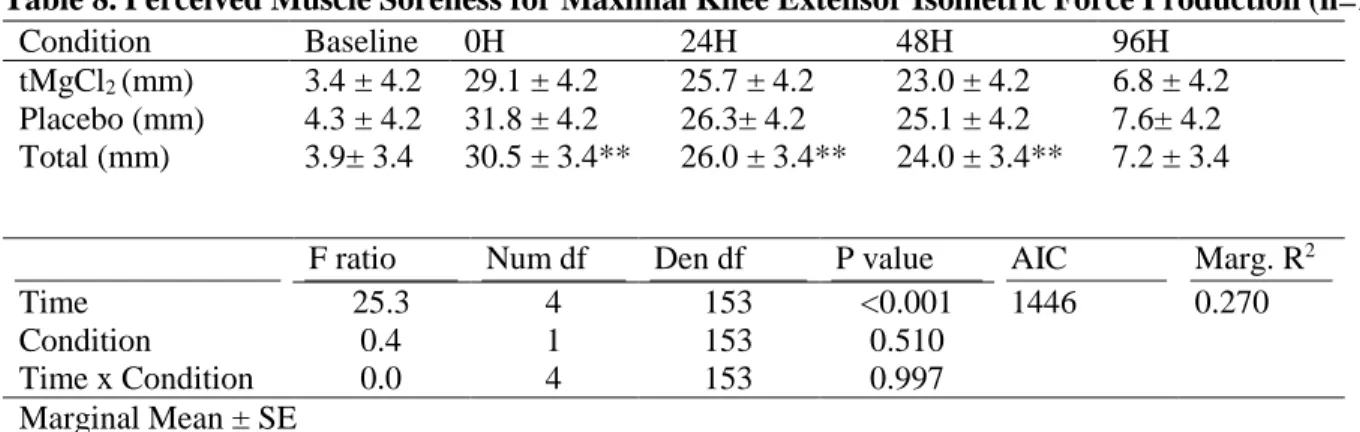
Following eccentric exercise, muscle soreness increased at 0H (26.6mm, 95% CI [20.1, 33.1], p<0.001) that remained elevated above baseline at 24H (22.1, 95% CI [15.6, 28.6], p<0.001) and 48H time points (20.2, 95% CI [13.7, 26.7], p<.001). By the 96H time point, participants had returned to baseline soreness (3.3, 95% CI [-5.5, 2.7], p = 0.510). tMgCl2 slightly attenuated perceived degree of soreness (17.6, 95%CI [11.7, 23.6]) in comparison to placebo (19.0, 95%CI [13.0, 25.0]); however, this difference was not statistically significant (p = 0.510) (Figure 1). Table 8. Perceived Muscle Soreness for Maximal Knee Extensor Isometric Force Production (n=19)
Condition Baseline 0H 24H 48H 96H
tMgCl2 (mm) 3.4 ± 4.2 29.1 ± 4.2 25.7 ± 4.2 23.0 ± 4.2 6.8 ± 4.2 Placebo (mm) 4.3 ± 4.2 31.8 ± 4.2 26.3± 4.2 25.1 ± 4.2 7.6± 4.2 Total (mm) 3.9± 3.4 30.5 ± 3.4** 26.0 ± 3.4** 24.0 ± 3.4** 7.2 ± 3.4
F ratio Num df Den df P value AIC Marg. R2
Time 25.3 4 153 <0.001 1446 0.270
Condition 0.4 1 153 0.510
Time x Condition 0.0 4 153 0.997 Marginal Mean ± SE
31
CHAPTER V: Discussion
32 Limitations and Strengths
To contextualize this study, the limitations and strengths of the study are described initially. We used recreationally active young males and these results and the application protocols used may not be generalizable to other populations. We were not able to determine if tMgCl2 altered circulating levels. As only ~1% of the body’s Mg is detectable in extracellular stores (Dean 2017, Jahnen-Dechent 2012 ), extensive tests must be used to assess total body Mg
levels but were beyond the scope of this study. Besides subjective measures, we were not able to
control dietary intake throughout the course of the study nor verify (other than verbal
confirmation) that the participants were not active during the weeks of testing. We assessed the
different conditions on opposite legs, which led to a difference in baseline strengths most likely
due to leg dominance. While leg dominance was used as a covariate to adjust for this difference,
the use of different limbs was deemed necessary as delayed onset muscle soreness and peak
torque are both attenuated following even a single session (McHugh 2003, Nikolaidis et al.
2007). Being a pilot study, it now seems we were underpowered to discover this interaction
effect. While we saw a trend, more subjects would be needed for these observations to be
statistically significant.
Strengths of this study include the design, being a double-blind, randomized control trial performed in healthy men with previous resistance training experience. The use of a
33 Comparisons with Previous Literature
Muscle Force Recovery
We found that the use of tMgCl2 provided no additional benefit in increasing muscle force recovery. In all three of the statistical models run (raw, full, reduced), the response
following eccentric exercise was similar. There was a significant decrease in force production at the 0H and 24H time point that was gone by 48H. By 96H, a super compensation phase is apparent, as torque values exceeded baseline.
The reason for employing multiple models is that distinct difference between conditions for the baseline torque were observed. While there are several potential explanations, leg dominance seemed to be most likely. To fully test the effects of tMgCl2 on recovery and soreness, it was necessary to use different legs for each condition. While rapid eccentric knee extensions were likely to be an unaccustomed stimulus, a second exposure to the same limb potentially confounds the results as soreness and muscle damage are attenuated following exposure (Clarkson 1992, Nikolaidis et al. 2007). These differences were better managed
through normalization to baseline or including leg dominance as a covariate. In both the full and reduced models, leg dominance was a significant factor and when the data were normalized to baseline, the confounding effect of leg dominance was removed, as expected. Interestingly when compared to placebo, tMgCl2 had a 4% increase in normalized peak torque by the 96H. While not statistically significant, an increase in force output of this magnitude in response to a single exercise session has potential to translate into improved athletic performance if these differences were sustained across multiple training sessions.
34
12%, which may be due to a number of factors. The previously studied population was similar in age and being recreationally active, but they did not have a resistance training background (Hicks et. al 2016). Therefore, our population may have been more prepared to handle the rapid, lengthening contractions due to previous exposure to eccentric loading conditions during
resistance training, thus producing an attenuated response. Also it is noteworthy to mention that while we attempted to account for leg dominance by utilizing a crossover design, this pilot study having a small sample size did not allow us to tease out the variability of this covariate. Thus when we examined the 96H time point for the full and reduced model we still saw a significant difference in comparison to baseline, but once we normalized the values the 96H time point was no longer statistically significant. This is not to say we did not see an increase in the marginal mean for tMgCl2. Which eludes to there may be a slight increase in force production recovery at that time point, but we were too underpowered to detect it.
35
with oral magnesium supplementation, but in untrained and/or older individuals (Brilla et al. 1992, Dominguez et al. 2006). The trend stays the same that higher Mg intake is linked to higher force outputs. Our investigation enabled the perspective of a transdermal approach to increasing force production with Mg supplementation.
Perceived Muscle Soreness
There is limited work on perceived muscle soreness and the use of magnesium
supplementation, with this study being the first to our knowledge to examine this link. While Mg is known to be beneficial in alleviating pain in clinical populations (Schester et al. 2003, Yousef and Al-deeb 2013, Engen et al. 2015), it has not been investigated in a healthy and recreationally active populations. tMgCl2 was shown to be not effective in minimizing perceived muscle soreness in our chosen population. As stated earlier, this could be due to the population’s acclimatization to the severity of the protocol from their resistance training background.
36 Implications and Future Studies
Supplementation is a known aid for competitive performance (Peeling et al. 2018). There are numerous supplements available to the general public, and it is estimated to continue to grow exponentially (Gabriels 2013). As such, it is important that scientific evidence is available to investigate the claims being made by supplement manufacturers. Mg is necessary for various enzymatic process (Jahnen-Dechent et al. 2012) and has been thoroughly researched in terms of performance and oral intake and oral supplementation. It was hypothesized that transdermal supplementation would follow suit of its oral counterpart and increasing the amount of Mg available would enhance our desired outcomes of muscle force recovery and perceived muscle soreness by applying the Mg directly to the muscle. However, our results were statistically non-significant for conditions. While our findings were not what we hypothesized, we were able to provide a deeper knowledge to the anecdotal claims of tMgCl2. While not statistically
significant, we did see a slight favoring of tMgCl2. These findings suggest that there is potential benefit in the micro-cycle of training, which could possibly lead to greater gains in the
mesocycle and macrocycle. While we did not find a significant effect of utilizing ~100 mg per application of tMgCl2, it may be necessary to examine higher dosages in the future. As stated earlier, while there has been research that has examined the effects of dietary or magnesium intake or oral supplementation on performance, there is a paucity of research on the effects of transdermal application on performance such that firm conclusions are not possible at this stage. Under the current conditions, tMgCl2 does not appear to be as beneficial as previously
37 Conclusion
38 REFERENCES
1. Altura, B. M., & Altura, B. T. (1996). Role of magnesium in patho-physiological processes and the clinical utility of magnesium ion selective electrodes. Scand J Clin Lab Invest Suppl, 224, 211-234.
2. Altura, B. M., Altura, B. T., Carella, A., Gebrewold, A., Murakawa, T., & Nishio, A. (1987). Mg2+-Ca2+ interaction in contractility of vascular smooth muscle: Mg2+ versus organic calcium channel blockers on myogenic tone and agonist-induced responsiveness of blood vessels. Can J Physiol Pharmacol, 65(4), 729-745.
3. Andrea Rosanoff, P. D. (2015) The Magnesium Factor: Health and Wellness Depends
Largely on this Important Nutrient, Yet it is Usually Overlooked/Interviewer: P. D. Richard A. Passwater. Wholefoods, WholeFoods, Wholefoods Magazine.
4. Armstrong, R. B. (1984). Mechanisms of exercise-induced delayed onset muscular soreness: a brief review. Med Sci Sports Exerc, 16(6), 529-538.
5. Armstrong, R. B., Warren, G. L., & Warren, J. A. (1991). Mechanisms of exercise-induced muscle fibre injury. Sports Med, 12(3), 184-207.
6. Bara, M., Guiet-Bara, A., & Durlach, J. (1988). Analysis of magnesium membraneous effects: binding and screening. Magnes Res, 1(1-2), 29-34.
7. Bara, M., Guiet-Bara, A., & Durlach, J. (1994). Comparative effects of MgCl2 and MgSO4 on the ionic transfer components through the isolated human amniotic membrane. Magnes Res, 7(1), 11-16.
8. Bennett, G. J. (2000). Update on the neurophysiology of pain transmission and modulation: focus on the NMDA-receptor. J Pain Symptom Manage, 19(1 Suppl), S2-6.
9. Bohl, C. H., & Volpe, S. L. (2002). Magnesium and exercise. Crit Rev Food Sci Nutr, 42(6), 533-563. doi:10.1080/20024091054247
10. Brilla, L. R., & Haley, T. F. (1992). Effect of magnesium supplementation on strength training in humans. J Am Coll Nutr, 11(3), 326-329.
11. Busch, W. A., Stromer, M. H., Goll, D. E., & Suzuki, A. (1972). Ca 2+ -specific removal of Z lines from rabbit skeletal muscle. J Cell Biol, 52(2), 367-381.
39
13. Chandrasekaran, N. C., Sanchez, W. Y., Mohammed, Y. H., Grice, J. E., Roberts, M. S., & Barnard, R. T. (2016). Permeation of topically applied Magnesium ions through human skin is facilitated by hair follicles. Magnes Res, 29(2), 35-42. doi:10.1684/mrh.2016.0402
14. Chen, T. C., Chen, H. L., Lin, M. J., Yu, H. I., & Nosaka, K. (2016). Contralateral Repeated Bout Effect of Eccentric Exercise of the Elbow Flexors. Med Sci Sports Exerc, 48(10), 2030-2039. doi:10.1249/MSS.0000000000000991
15. Cheung, K., Hume, P., & Maxwell, L. (2003). Delayed onset muscle soreness : treatment strategies and performance factors. Sports Med, 33(2), 145-164.
16. Clarkson, P., Nosaka, K., & Braun, B. (1992). Muscle function after exercise-induced muscle damage and rapid adaptation. Medicine & Science In Sports & Exercise, 24(5), 512???520. doi: 10.1249/00005768-199205000-00004
17. Connolly, D. A., Sayers, S. P., & McHugh, M. P. (2003). Treatment and prevention of delayed onset muscle soreness. J Strength Cond Res, 17(1), 197-208.
18. Cullen, M. J., Appleyard, S. T., & Bindoff, L. (1979). Morphologic aspects of muscle breakdown and lysosomal activation. Ann N Y Acad Sci, 317, 440-464.
19. Davies, C. T., & Barnes, C. (1972). Negative (eccentric) work. I. Effects of repeated exercise. Ergonomics, 15(1), 3-14. doi:10.1080/00140137208924402
20. Dean, C. (2017). The Magnesium miracle. New York: Ballantine.
21. Dill, D. and Costill, D. (1974). Calculation of percentage changes in volumes of blood, plasma, and red cells in dehydration. Journal of Applied Physiology, 37(2), pp.247-248. 22. Dominguez, L. J., Barbagallo, M., Lauretani, F., Bandinelli, S., Bos, A., Corsi, A. M., . . .
Ferrucci, L. (2006). Magnesium and muscle performance in older persons: the InCHIANTI study. Am J Clin Nutr, 84(2), 419-426.
23. Douglas, J., Pearson, S., Ross, A., & McGuigan, M. (2016). Eccentric Exercise: Physiological Characteristics and Acute Responses. Sports Med. doi:10.1007/s40279-016-0624-8
24. Duncker, D. J., & Bache, R. J. (2008). Regulation of coronary blood flow during exercise. Physiol Rev, 88(3), 1009-1086. doi:10.1152/physrev.00045.2006
40
26. Engen, D. J., McAllister, S. J., Whipple, M. O., Cha, S. S., Dion, L. J., Vincent, A., . . . Wahner-Roedler, D. L. (2015). Effects of transdermal magnesium chloride on quality of life for patients with fibromyalgia: a feasibility study. J Integr Med, 13(5), 306-313.
doi:10.1016/S2095-4964(15)60195-9
27. Fock, S., & Mense, S. (1976). Excitatory effects of 5-hydroxytryptamine, histamine and potassium ions on muscular group IV afferent units: a comparison with bradykinin. Brain Res, 105(3), 459-469.
28. Friden, J., Sjostrom, M., & Ekblom, B. (1981). A morphological study of delayed muscle soreness. Experientia, 37(5), 506-507.
29.Gabriels, G., & Lambert, M. (2013). Nutritional supplement products: Does the label information influence purchasing decisions for the physically active?. Nutrition journal, 12, 133. doi:10.1186/1475-2891-12-133
30.Golf, S. W., Bender, S., & Gruttner, J. (1998). On the significance of magnesium in extreme physical stress. Cardiovasc Drugs Ther, 12 Suppl 2, 197-202.
31.Gröber, U., Werner, T., Vormann, J., & Kisters, K. (2017). Myth or Reality- Transdermal Magnesium? . Nutrients, 9(8), 813. doi:10.3390/nu9080813
32.Gulick, D., Agarwal, M., Josephs, J., Reinmiller, A., & Zimmerman, B. (2012). Effects of MagPro™ on Muscle Performance. Journal Of Strength And Conditioning Research, 26(9), 2478-2483. doi: 10.1519/jsc.0b013e31823f2863
33.Haddy, F. J., & Scott, J. B. (1975). Metabolic factors in peripheral circulatory regulation. Fed Proc, 34(11), 2006-2011.
34.Hartmann, H., Wirth, K., Keiner, M. et al. Sports Med (2015) 45: 1373. doi:10.1007/s40279-015-0355-2
35.Hawker, G., Mian, S., Kendzerska, T., & French, M. (2011). Measures of adult pain: Visual Analog Scale for Pain (VAS Pain), Numeric Rating Scale for Pain (NRS Pain), McGill Pain Questionnaire (MPQ), Short-Form McGill Pain Questionnaire (SF-MPQ), Chronic Pain Grade Scale (CPGS), Short Form-36 Bodily Pain Scale (SF. Arthritis Care & Research, 63(S11), S240-S252. doi: 10.1002/acr.20543
41
37. Hody, S., Rogister, B., Leprince, P., Wang, F., & Croisier, J. L. (2013). Muscle fatigue experienced during maximal eccentric exercise is predictive of the plasma creatine kinase (CK) response. Scand J Med Sci Sports, 23(4), 501-507.
doi:10.1111/j.1600-0838.2011.01413.x
38. Institute of Medicine (IOM). Food and Nutrition Board. (1997) Dietary Reference Intakes:
Calcium, Phosphorus, Magnesium, Vitamin D and Fluoride. Washington, DC: National Academy Press
39. Iseri, L. T., & French, J. H. (1984). Magnesium: nature's physiologic calcium blocker. Am Heart J, 108(1), 188-193.
40. Ishibashi, Y., Duncker, D. J., Zhang, J., & Bache, R. J. (1998). ATP-sensitive K+ channels, adenosine, and nitric oxide-mediated mechanisms account for coronary vasodilation during exercise. Circ Res, 82(3), 346-359.
41. Jahnen-Dechent, W., & Ketteler, M. (2012). Magnesium basics. Clinical kidney journal, 5(Suppl 1), i3-i14
42. Jones, D. A., Newham, D. J., Round, J. M., & Tolfree, S. E. (1986). Experimental human muscle damage: morphological changes in relation to other indices of damage. J Physiol, 375, 435-448.
43. Kanda, K., Sugama, K., Hayashida, H., Sakuma, J., Kawakami, Y., Miura, S., . . . Suzuki, K. (2013). Eccentric exercise-induced delayed-onset muscle soreness and changes in markers of muscle damage and inflammation. Exerc Immunol Rev, 19, 72-85.
44. Kazimierz Pasternak, J. K., Anna Horecka. (2010).
BIOCHEMISTRY OF MAGNESIUM. Journal of Elementology, 15(3), 601-616.
Kew, J. N., & Kemp, J. A. (2005). Ionotropic and metabotropic glutamate receptor structure and pharmacology. Psychopharmacology (Berl), 179(1), 4-29. doi:10.1007/s00213-005-2200-z
45. Kimura, Y., Murase, M., & Nagata, Y. (1996). Change in glucose homeostasis in rats by long-term magnesium-deficient diet. J Nutr Sci Vitaminol (Tokyo), 42(5), 407-422.
46. Knapik, J. J., Steelman, R. A., Hoedebecke, S. S., Austin, K. G., Farina, E. K., & Lieberman, H. R. (2015). Prevalence of Dietary Supplement Use by Athletes: Systematic Review and Meta-Analysis. Sports medicine (Auckland, N.Z.), 46(1), 103-23.
47. Kowaltowski, A. J., Naia-da-Silva, E. S., Castilho, R. F., & Vercesi, A. E. (1998). Ca2+-stimulated mitochondrial reactive oxygen species generation and permeability transition are inhibited by dibucaine or Mg2+. Arch Biochem Biophys, 359(1), 77-81.
42
48. Lau, W. Y., Blazevich, A. J., Newton, M. J., Wu, S. S., & Nosaka, K. (2015). Assessment of Muscle Pain Induced by Elbow-Flexor Eccentric Exercise. J Athl Train, 50(11), 1140-1148. doi:10.4085/1062-6050-50.11.05
49. Lewis, E. J., Ramsook, A. H., Locke, M., & Amara, C. E. (2013). Mild eccentric exercise increases Hsp72 content in skeletal muscles from adult and late middle-aged rats. Cell Stress Chaperones, 18(5), 667-673. doi:10.1007/s12192-013-0412-4
50. Lewis, P. B., Ruby, D., & Bush-Joseph, C. A. (2012). Muscle soreness and delayed-onset muscle soreness. Clin Sports Med, 31(2), 255-262. doi:10.1016/j.csm.2011.09.009
51. Lukaski, H. C. (2004). Vitamin and mineral status: effects on physical performance. Nutrition, 20(7-8), 632-644. doi:10.1016/j.nut.2004.04.001
52. Maguire, M. E. (2006). Magnesium transporters: properties, regulation and structure. Front Biosci, 11, 3149-3163.
53. Margaritelis, N. V., Theodorou, A. A., Baltzopoulos, V., Maganaris, C. N., Paschalis, V., Kyparos, A., & Nikolaidis, M. G. (2015). Muscle damage and inflammation after eccentric exercise: can the repeated bout effect be removed? Physiol Rep, 3(12).
doi:10.14814/phy2.12648
54. McCully, K. K., & Faulkner, J. A. (1985). Injury to skeletal muscle fibers of mice following lengthening contractions. J Appl Physiol (1985), 59(1), 119-126.
55. McHugh, M. (2003). Recent advances in the understanding of the repeated bout effect: the protective effect against muscle damage from a single bout of eccentric
exercise. Scandinavian Journal Of Medicine And Science In Sports, 13(2), 88-97. doi: 10.1034/j.1600-0838.2003.02477.x
56. Morgan, D. L. (1990). New insights into the behavior of muscle during active lengthening. Biophys J, 57(2), 209-221. doi:10.1016/S0006-3495(90)82524-8
57. Morgan, D. L., & Proske, U. (2004). Popping sarcomere hypothesis explains stretch-induced muscle damage. Clin Exp Pharmacol Physiol, 31(8), 541-545.
doi:10.1111/j.1440-1681.2004.04029.x
58. Moshfegh, Alanna, Goldman, Joseph; Ahuja, Jaspreet; Rhodes, Donna; and LaComb, Randy. (2009). What We Eat in America, NHANES 2005-2006: Usual Nutrient Intakes from Food and Water Compared to 1997 Dietary Reference Intakes for Vitamin D, Calcium, Phosphorus, and Magnesium. U.S. Department of Agriculture, Agricultural Research Service.
43
60. Nechifor, M. (2011). Magnesium involvement in pain. Magnes Res, 24(4), 220-222. doi:10.1684/mrh.2011.0296
61. Newhouse, I. J., & Finstad, E. W. (2000). The effects of magnesium supplementation on exercise performance. Clin J Sport Med, 10(3), 195-200.
62. Nielsen, F. H., & Lukaski, H. C. (2006). Update on the relationship between magnesium and exercise. Magnes Res, 19(3), 180-189.
63. Nikolaidis, M., Paschalis, V., Giakas, G., Fatouros, I., Koutedakis, Y., Kouretas, D., & Jamurtas, A. (2007). Decreased Blood Oxidative Stress after Repeated Muscle-Damaging Exercise. Medicine & Science In Sports & Exercise, 39(7), 1080-1089. doi:
10.1249/mss.0b013e31804ca10c
64. Nosaka, K., & Clarkson, P. M. (1996). Changes in indicators of inflammation after eccentric exercise of the elbow flexors. Med Sci Sports Exerc, 28(8), 953-961.
65. Nosaka, K., Newton, M., & Sacco, P. (2002). Delayed-onset muscle soreness does not reflect the magnitude of eccentric exercise-induced muscle damage. Scand J Med Sci Sports, 12(6), 337-346.
66. Peeling, P., Binnie, M., Goods, P., Sim, M., & Burke, L. (2018). Evidence-Based Supplements for the Enhancement of Athletic Performance. International Journal Of Sport Nutrition And Exercise Metabolism, 28(2), 178-187. doi: 10.1123/ijsnem.2017-0343
67. Petrenko, A. B., Yamakura, T., Baba, H., & Shimoji, K. (2003). The role of N-methyl-D-aspartate (NMDA) receptors in pain: a review. Anesth Analg, 97(4), 1108-1116.
68. Petrovic, J., Stanic, D., Dmitrasinovic, G., Plecas-Solarovic, B., Ignjatovic, S., Batinic, B., . . . Pesic, V. (2016). Magnesium Supplementation Diminishes Peripheral Blood Lymphocyte DNA Oxidative Damage in Athletes and Sedentary Young Man. Oxid Med Cell Longev, 2016, 2019643. doi:10.1155/2016/2019643
69. Prasartwuth, O., Allen, T. J., Butler, J. E., Gandevia, S. C., & Taylor, J. L. (2006). Length-dependent changes in voluntary activation, maximum voluntary torque and twitch responses after eccentric damage in humans. J Physiol, 571(Pt 1), 243-252.
doi:10.1113/jphysiol.2005.101600
70. Proske, U., & Morgan, D. L. (2001). Muscle damage from eccentric exercise: mechanism, mechanical signs, adaptation and clinical applications. J Physiol, 537(Pt 2), 333-345. 71. Raastad, T., Owe, S. G., Paulsen, G., Enns, D., Overgaard, K., Crameri, R., . . . Hallen, J.
44
72. Rude RK. Magnesium. In: Coates PM, Betz JM, Blackman MR, Cragg GM, Levine M, Moss J, White JD, eds. (2010) Encyclopedia of Dietary Supplements. 2nd ed. New York, NY: Informa Healthcare; 527-37
73. Rude RK. Magnesium. In: Ross AC, Caballero B, Counsins RJ, Tucker KL, Ziegler TR, eds. (2012) Modern Nutrition in Health and Disease. 11th ed. Baltimore, Mass: Lippincott
Williams & Wilkins; 159-75.
74. Rodenburg, J. B., Bar, P. R., & De Boer, R. W. (1993). Relations between muscle soreness and biochemical and functional outcomes of eccentric exercise. J Appl Physiol (1985), 74(6), 2976-2983.
75. Sahni, J., Nelson, B., & Scharenberg, A. M. (2007). SLC41A2 encodes a plasma-membrane Mg2+ transporter. Biochem J, 401(2), 505-513. doi:10.1042/BJ20060673
76. Santos, D. A., Matias, C. N., Monteiro, C. P., Silva, A. M., Rocha, P. M., Minderico, C. S., . . . Laires, M. J. (2011). Magnesium intake is associated with strength performance in elite basketball, handball and volleyball players. Magnes Res, 24(4), 215-219.
doi:10.1684/mrh.2011.0290
77. Saris, N. E., Mervaala, E., Karppanen, H., Khawaja, J. A., & Lewenstam, A. (2000). Magnesium. An update on physiological, clinical and analytical aspects. Clin Chim Acta, 294(1-2), 1-26.
78. Saxton, J. M., Clarkson, P. M., James, R., Miles, M., Westerfer, M., Clark, S., & Donnelly, A. E. (1995). Neuromuscular dysfunction following eccentric exercise. Med Sci Sports Exerc, 27(8), 1185-1193.
79. Setaro, L., Santos-Silva, P. R., Nakano, E. Y., Sales, C. H., Nunes, N., Greve, J. M., & Colli, C. (2014). Magnesium status and the physical performance of volleyball players: effects of magnesium supplementation. J Sports Sci, 32(5), 438-445.
doi:10.1080/02640414.2013.828847
80. Shechter, M., Bairey Merz, C. N., Stuehlinger, H. G., Slany, J., Pachinger, O., & Rabinowitz, B. (2003). Effects of oral magnesium therapy on exercise tolerance, exercise-induced chest pain, and quality of life in patients with coronary artery disease. Am J Cardiol, 91(5), 517-521.
81. Sircus, M. (2007). Transdermal magnesium therapy. Chandler, AZ: Phaelos Books.
82. Smith, L. L. (1991). Acute inflammation: the underlying mechanism in delayed onset muscle soreness? Med Sci Sports Exerc, 23(5), 542-551.
45
84. Tee, J. C., Bosch, A. N., & Lambert, M. I. (2007). Metabolic consequences of exercise-induced muscle damage. Sports Med, 37(10), 827-836.
85. Touyz, R. M. (2004). Magnesium in clinical medicine. Front Biosci, 9, 1278-1293.
86. U.S. sales of supplements, 2009-2019 | Statistic. (n.d.). Retrieved from https://www.statista.com/statistics/548918/us-sales-of-supplements/
87. Venturini, M.A., Zappa, S., Minelli, C., Bonardelli, S., Lamberti, L., Bisighini, L., Zangrandi, M., Turin, M., Rizzo, F., Rizzolo, A.,…. Latronico, N. (2015). Magnesium-oral
supplementation to reduce pain in patients with severe peripheral arterial occlusive disease: the Mag-Paper randomised clinical trial protocol. BMJ open, 5(12), e009137.
doi:10.1136/bmjopen-2015-009137
88. Warren, G. L., Ingalls, C. P., Lowe, D. A., & Armstrong, R. B. (2001). Excitation-contraction uncoupling: major role in contraction-induced muscle injury. Exerc Sport Sci Rev, 29(2), 82-87.
89. Warren, G. L., Lowe, D. A., & Armstrong, R. B. (1999). Measurement tools used in the study of eccentric contraction-induced injury. Sports Med, 27(1), 43-59.
90. Weerakkody, N. S., Whitehead, N. P., Canny, B. J., Gregory, J. E., & Proske, U. (2001). Large-fiber mechanoreceptors contribute to muscle soreness after eccentric exercise. J Pain, 2(4), 209-219. doi:10.1054/jpai.2001.22496
91. Wrogemann, K., & Pena, S. D. (1976). Mitochondrial calcium overload: A general mechanism for cell-necrosis in muscle diseases. Lancet, 1(7961), 672-674.
92. Yousef, A. A., & Al-deeb, A. E. (2013). A double-blinded randomised controlled study of the value of sequential intravenous and oral magnesium therapy in patients with chronic low back pain with a neuropathic component. Anaesthesia, 68(3), 260-266. doi:10.1111/anae.12107
93. Zhang, Y., Xun, P., Wang, R., Mao, L., & He, K. (2017). Can Magnesium Enhance Exercise Performance? . Nutrients, 9(9), 946. doi:10.3390/nu9090946
94. Zulian, A., Schiavone, M., Giorgio, V., & Bernardi, P. (2016). Forty years later: Mitochondria as therapeutic targets in muscle diseases. Pharmacol Res, 113(Pt A), 563-573.