OVERUSE INJURIES IN COLLEGE AND HIGH SCHOOL POPULATIONS: OCCURRENCE AND METHODOLOGICAL ISSUES IN SURVEILLANCE
Karen Gayle Roos
A dissertation submitted to the faculty of the University of North Carolina at Chapel Hill in partial fulfillment of the requirements for the degree of Doctor of Philosophy in the
Department of Epidemiology.
Chapel Hill 2015
Approved by:
Stephen Marshall
Yvonne Golightly
Kristen Kucera
ABSTRACT
Karen Gayle Roos: Overuse injuries in college and high school populations: occurrence and methodological issues in surveillance
(Under the direction of Stephen Marshall)
Overuse injuries are difficult to define, can have long term effects and are
ACKNOWLEDGEMENTS
I would like to express my deep gratitude and profound appreciation to my mentors, teachers, family and friends, all of whom have been in this process with me. This would not have been even slightly possible without the help of the wonderful and brilliant members of my committee, Stephen Marshall, Kristen Kucera, Yvonne Golightly, Joseph Myers and Wayne Rosemond, who so generously shared their time and expertise.
TABLE OF CONTENTS
LIST OF TABLES ... xii
LIST OF FIGURES ... xiv
LIST OF ABBREVIATIONS ... xv
1. INTRODUCTION ... 1
2. REVIEW OF THE LITERATURE ... 3
2.1 Overuse injuries ... 3
2.1.1 Biomechanics/nature of overuse injuries ... 3
2.1.2 Clinical diagnosis of overuse injuries ... 4
2.2 Public health impact of overuse injuries ... 4
2.3 Overuse injuries in the literature ... 6
2.3.1 Incidence of overuse injury from case series and prospective cohort studies ... 6
2.3.2 Incidence of overuse injury from injuey surveillance studies ... 7
2.4 Injury surveillance and public health ... 9
2.5 Current sports injury surveillance systems ... 9
2.5.1 National Collegiate Athletic Association's (NCAA) Injury Surveillance System/Program (ISS/ISP) ... 10
2.5.1.1 Impact and sucesses of the National Collegiate Athletic Association's (NCAA) Injury Surveillance System/Program (ISS/ISP)... 11
2.5.2.1 Impact and sucesses of the High School RIO ... 13
2.6 Challenges in using the National Collegiate Athletic Association's Injury Surveillance System/Programand High School RIO for surveillance of overuse injuries ... 13
2.6.1 There is currently no consensus on a definition for overuse injuries within injury surveillance ... 14
2.6.2 Use of a time-loss definition ... 14
2.6.3 Overuse as a mechanism of injury vs. injury diagnosis ... 16
2.6.4 Potential misclassification of overuse ... 17
2.7 Alternate methods for measuring overuse injuries ... 17
2.6.1 Oslo Sport Trauma Research Center Overuse Injury Questionnaire (OSTRC/OIC)... 18
2.6.2 Occupational models ... 19
2.6.3 Qualitative studies ... 20
2.8 Summary ... 20
2.9 Figures... 22
3. STATEMENT OF SPECIFIC AIMS... 24
4. METHODS ... 32
4.1 Data sources ... 32
4.1.1 Data sources for Aim 1 ... 32
4.1.1.1 National Collegiate Athletic Association's (NCAA) Injury Surveillance System (ISS)... 32
4.1.1.2 High School RIO (Reporting Information Online) ... 33
4.1.2 Data source for Aim 2: National Collegiate Athletic Association (NCAA) Validation Study ... 35
4.2.1 Analysis for Aim 1 ... 37
4.2.2 Anaysis for Aim 2 ... 38
4.2.2.1 Parent study ... 38
4.1.1.2 Overuse study... 38
4.2.3 Analysis for Aim 3 ... 41
4.2.4 Tables ... 42
5. RESULTS FOR AIM 1: Descriptive epidemiology of overuse injuries in US college and high school athletes ... 44
5.1 Introduction ... 44
5.2 Methods... 46
5.2.1 Data collection ... 46
5.2.2 Injury and exposure definitions ... 47
5.2.3 Data exclusions ... 47
5.2.4 Statistical methods ... 48
5.3 Results ... 48
5.3.1 Rates of overuse injury ... 48
5.3.2 Characteristics of overuse injuries ... 50
5.3.3 Injury severity ... 51
5.4 Discussion ... 52
5.4.1 Strengths and limitations... 54
5.5 Conclusion ... 55
5.6 Tables and figures ... 56
6. RESULTS FOR AIM 2: A comparision of the identification and reporting of overuse injuries between the National Collegiate Athletic Association's Injury Surveillance System and medical records ... 63
6.2 Methods... 64
6.2.1 Parent study ... 64
6.2.2 Overuse injury study ... 65
6.3 Results ... 67
6.3.1 Capture-recapture analysis ... 67
6.3.2 Agreement ... 68
6.3.2 Characteristics of overuse injury events and data abstraction records ... 69
6.4 Discussion ... 70
6.4.1 Capture-recapture analysis ... 70
6.4.2 Effective agreement and Kappa ... 72
6.4.3 Characteristics of overuse injury events and data abstraction records ... 73
6.4.4 Limitations ... 74
6.5 Conclusion ... 74
6.6 Tables and figures ... 76
7. RESULTS FOR AIM 3: Identification and reporting of overuse injuries among Athletic Trainers who participate in injury surveillance ... 82
7.1 Introduction ... 82
7.2 Methods... 84
7.2.1 Research design and participants ... 84
7.2.2 Instrumentation - clinical scenarios ... 85
7.2.3 Instrumentation - assessment of clinical decision-making ... 86
7.2.3.1 Role construct ... 86
7.2.4 Recruitment and data collection ... 87
7.2.5 Assessment of discordance ... 87
7.2.5.1 Discordance... 88
7.2.5.2 Majority opinion ... 89
7.2.5.3 Global classification system ... 89
7.2.6 Analysis of open ended responses ... 90
7.3 Results ... 90
7.3.1 Survey participants... 90
7.3.2 Scenarios generating concordance ... 91
7.3.3 Scenarios generating minor disconcordance ... 91
7.3.4 Scenarios generating major disconcordance ... 93
7.4 Discussion ... 94
7.4.1 Strengths and limitations... 97
7.5 Implications for injury surveillance and clinical documentation ... 98
7.6 Conclusion ... 99
7.7 Acknowledgements ... 99
7.8 Tables and figures ... 100
8. DISCUSSION ... 103
8.1 Summary of findings... 103
8.2 Strengths ... 108
8.3 Limitations ... 109
8.4 Alternate methods ... 109
LIST OF TABLES
Table 3.1. Summary of Aim 1 for Dissertation ... 26 Table 3.2. Summary of Aim 2 for Dissertation ... 28 Table 3.3. Summary of Aim 3 for Dissertation ... 31 Table 4.1. National Collegiate Athletic Association's Injury Surveillance
System data included in Aim 1 by sport and academic year ... 42 Table 4.2. National Collegiate Athletic Association's Injury Surveillance
System injury mechanism and injury diagnoses considered for inclusion into Aim1... 43 Table 4.3. High School RIO (Reporting Information Online) data included
in Aim 1 by sport and academic year... 43 Table 5.1. Overuse injury count and years of data collection by sport and
data source ... 56 Table 5.2. Overuse injury rate and injury rate ratio (95% confidence
interval) by sport and data source ... 57 Table 5.3. Distribution of overuse injuries by population, sport and body
part ... 58 Table 5.4. Circumstances and outcomes for overuse injuries ... 61 Table 6.1. Capture-recapture analysis for injurie with an overuse
mechanism in one or both sources ... 77 Table 6.2. Effective agreement between medical records and National
Collegiate Athletic Association' Injury Surveillance System for event, injury and return-to-play details ... 79 Table 6.3. Kappa agreement between medical records and National
Collegiate Athletic Association' Injury Surveillance System for event, injury and return-to-play details ... 80 Table 6.4. Characteristics of data abstraction records ... 82 Table 7.1. Criteria for categorizing individual injury scenarios into levels
Table 7.2. Criteria for categorizing individual injury scenarios into overuse or not overuse (Role construct) ... 100 Table 7.3. Responses to Question 1 (Role construct), regarding the role of
overuse in each scenario ... 101 Table A.1. Inclusion and exclusion criteria ... 135 Table A.2 U.S. studies reporting results on overuse injuries, using data
sources other than the National Collegiate Athletics Association's Injury Surveillance System and High School RIO (Reporting Information Online) ... 136 Table A.3 U.S. studies reporting results on overuse injuries using data the
National Collegiate Athletics Association's Injury Surveillance System ... 140 Table A.4 U.S. studies reporting results on overuse injuries using from the
High School RIO (Reporting Information Online) ... 144 Appendix 6.3 Characteristics of injuries where the mechanism of injury is
LIST OF FIGURES
Figure 2.1. Timeline of National Collegiate Athletics Association's Injury Surveillance System/Program milestones ... 22 Figure 2.2. Timeline of High School RIO (Reporting Information Online)
milestones ... 23 Figure 5.1. Percentage of college and high school overuse injuries by
diagnosis ... 62 Figure 6.1. Distribution of injuries with a mechanism of injury of overuse
in one or more sources ... 76 Figure 7.1. Distribution of the probability of reporting (Report construct)
an overuse mechanism of injury by scenario, with designation of discordance classsification ... 102 Figure A.1. PRISMA diagram for inclusion ... 134
Appendix 7.2. Distribution of the probability, means and medians of reporting an overuse mechanism of injury by scenario ... 155
LIST OF ABBREVIATIONS
AE Athlete Exposure
AT Athletic Trainer / Certified Athletic Trainer
CI Confidence Interval
HS High School
IRR Injury Rate Ratio
ISP Injury Surveillance Program ISS Injury Surveillance System
ISS/ISP Injury Surveillance System/Program
MD Medical Doctor
n/a Not applicable
NCAA National Collegiate Athletic Association OIC Overuse Injury Questionnaire
OOS Occupational Overuse Syndrome
OSTRC Oslo Sport Trauma Research Center
PT Physical Therapist
RIO High School RIO (Reporting Information Online) RSI Repetitive Stress Injury
UNC University of North Carolina at Chapel Hill
US United States
CHAPTER 1
INTRODUCTION
Injuries resulting from sport participation have can have profound immediate and long term effects. [1] The initial injury may result in pain and dysfunction which limits current athletic participation. The long term effects can result in symptoms beyond the resolution of the immediate injury, such as chronic pain and prolonged limitations in function that impedes maintenance of healthy physical activity in later life. [2-4] Thus, preventing sport related injury, particularly in youth can contribute to better health throughout the athlete’s life. [5]
Overuse injuries have been reported to account for up to 30% of total athletic injuries in a college setting and 7.7% of high school sports injury. [6, 7] These injuries are classically
characterized by a repetitive nature and gradual progression with the absence of a distinct injury event. [8, 9] Due to the gradual onset and accumulation of symptoms, athletes with overuse injuries may initially delay seeking care. When care is sought, it often does not result in time- loss from sport. [10, 11] Most sports injury surveillance systems are limited to time-loss injuries only, which often result in an underrepresentation of overuse injuries within surveillance data. [8, 12]
such a definition is widely suspected to contribute to variability between clinicians regarding the assessment and reporting of overuse injuries to injury surveillance systems, although this has not previously been formally investigated in the scientific peer-reviewed literature.
CHAPTER 2
REVIEW OF THE LITERATURE
2.1 Overuse injuries
Overuse injuries are generally defined as injuries which progress over time and result from repetitive stresses. [16, 17] They result from the accumulation of microtrauma on the cellular level in a variety of tissues (bone, muscle, tendon, ligament). [8, 18]
2.1.1 Biomechanics/nature of overuse injuries
Overuse injuries typically do not have a specific onset incident, but instead progress with continued activity, particularly if there is insufficient time for recovery between episodes of physical activity. [19-21] As these stresses are individually small, the injured person may not be aware of the presence or seriousness of the injury, until severe tissue damage has occurred. [16, 22] It is the repetitive nature of the stress, not the activity itself, which results in the injury. [14, 23] The repetitive stresses that contribute to the microtrauma of overuse injuries may be of any magnitude and can result from any repetitive activity, ranging from powerlifting to typing.
2.1.2 Clinical diagnosis of overuse injuries
There is a general understanding within the sports medicine community that an overuse injury has a gradual onset, progresses over time and results in pain and dysfunction. [28]
However, there are no widely accepted diagnostic tests which are used to determine the presence of an overuse injury. [14, 15] There are specific diagnostic tests which are accepted for particular types of overuse injuries, such as bone scans for stress fractures. However, these do not exist for all overuse diagnoses and there is no universal diagnostic test for the larger category of “overuse injury”. [13] The absence of diagnostic tests leaves the identification and determination of
overuse to the individual evaluator. [29] Each evaluator is influenced by his or her education and experiences, as well as local practices for diagnosis. The lack of a gold standard test leaves much room for between-clinician variability in the individual diagnosis of overuse, and ultimately, the individual clinician as the arbiter of the presence or absence of overuse. [12, 29, 30]
2.2 Public health impact of overuse injuries
Overuse injuries, particularly in sports, are preventable. [18, 23]The biomechanical stress from repetitive activity is much less likely to result in injury if there is enough time for the tissue to recover. [31-33] However, young athletes are exposed to many factors which limit “down-time” from sports. [19] These include pressure for young athletes to excel, from parents, coaches,
Overuse injuries include a variety of diagnoses and injury severity, and can result in a variety of outcomes. [36, 37] These diagnoses range from exercise related leg pain associated with running, to ACL tears associated with playing football. [38, 39] In the early stages of progression, overuse injuries often do not result in time-loss from sports. [7] Many athletes with these injuries can continue to participate on some level by compensating with alterations to the skills performed, body mechanics, or training volume to accommodate the injury. However, the outcomes of overuse injuries are not limited to the time period immediately following injury, but instead can last throughout the lifetime. This can result in chronic pain and limitations in activity in later life, even from injuries which did not result in immediate time-loss from sport. [2, 4]
As the US population lives longer and remains active longer, the impact of chronic injury on the population grows. This includes not merely the acute treatment of injury, but also the care for the long-term effects, such as musculoskeletal disorders (e.g. post-injury osteoarthritis). [40] This accumulating burden of injury and sequellae will increase demand on the health care
system. [1, 40] Identifying the role of repetitive sports activity in injury will assist in the creation of appropriate interventions and guidelines to protect young athletes from the effects of injury, not only in youth, but from the sequella of injury later in life.
term effects of withdrawal from sports on the individual athletes and the health care system will likely increase with time. [1, 2] Interventions implemented in high school and college athletic populations have the potential to decrease the burden of overuse injuries both in the individual athlete during sports participation and health care system as these athletes age.
2.3 Overuse injuries in the literature
The literature regarding overuse injuries is varied as to the nature of the study, injuries investigated, source populations and statistics (if any) reported. The majority of studies regarding overuse injuries are clinical in nature, describing the pathomechanics, diagnosis, treatment and interventions for specific injuries. Such studies often describe a distinct injury or injuries which occur in one sport, or to one body part. These studies may not include statistics regarding the incidence of these injuries, but instead focus on the description of the injury, mechanics, diagnosis, treatment or outcome related to that injury. [48]
2.3.1 Incidence of overuse injury from case series and prospective cohort studies
Certain studies of specific overuse injuries or interventions, including case series and prospective cohort studies, include measures of incidence. Within these studies, the reported incidence of overuse can be quite high, as these studies are specifically designed to capture these injures and use specialized case definitions or populations at high risk for overuse injury.
studies, such as reviews of sports injury in youth, and various position statements regarding sports injuries to young athletes and overuse injuries have reported that overuse injuries account for 33% of total injuries to elite English adolescent athletes, and it has been suggested that overuse injuries could account for more than 50% of total childhood sports injuries.[18, 36, 53]
2.3.2 Incidence of overuse injury from injury surveillance studies
Overall, male sports had lower rates of overuse injury than female, and overuse injuries occurred most often in the lower extremities (college: 49.0%, high school: 69.5%). [6, 7]
Aside from Yang et al (2012) [7], and Schroeder et al (2014) [6] the majority of sports injury publications, which include overuse injuries at all, only superficially discuss these injuries. [48] Surveillance studies of US school populations report that overuse injuries account for
between 1% and 11% of total college sports practice injuries. [47, 48, 53-63] [54-65] In the high school setting, overuse injuries were reported to account for 5% to 10% of total soccer and baseball injuries, and 25% of lower extremity and knee injuries. [31, 66-68] Swenson et al (2013) [69] used US surveillance data regarding knee injuries in high school athletes, and provided the percentage of knee injuries with an overuse mechanism of injury. Of the 20 sports studied, 39% of 75 girls field hockey knee injuries, 56% of 68 boys track and field and 38% of 81 girls track and field knee injuries were due to overuse mechanisms. [69]
2.4 Injury surveillance and public health
Public health surveillance is traditionally defined as “the ongoing systemic collection,
analysis, and interpretation of health data essential to the planning, implementation, and evaluation of public health practice, closely integrated with the timely dissemination of these data to those who need to know.” (Thacker et al, 1988) [71] The definition of surveillance is
expanding in response to technological advances in data collection and analysis to include an a priori purpose of preventing or controlling disease or injury, in order to differentiate surveillance from data mining. [72] The data collected in traditional surveillance systems is usually minimal, and is collected to identify and control a health problem or improve a public health program or service. While surveillance is informed by an a priori purpose, it is not designed to test
hypotheses, or apply its findings to a separate population. [71, 72] This is what differentiates surveillance from research, as the purpose of research is to generate generalizable knowledge, often through hypothesis testing. [73, 74] However, as the quality and quantity of surveillance data increases, similarities between the quality, utility and application of research and
surveillance data within the literature increase as well.
2.5 Current sports injury surveillance systems
mechanism of injury, and activity at time of injury, injury outcome, if surgery was required, the amount of time lost to sports, the presence of protective equipment, and the position played by the athlete among others. [75]
Sports injury surveillance systems also collect data beyond what traditional surveillance systems require. An example of such data is information about the individual AEs. The major sports injury surveillance systems in use in the US collect data on the number of athletes participating in each athletic event, as well as the type, location, sport, seasonality and playing surface of each event among others, regardless of any injuries which may occur. [75, 77] This allows for the calculation of injury rates for the populations of total athlete exposures, as well as within specific sports exposures, game or practice exposures, or pre, in, or post season
exposures.
There are several school based injury surveillance systems in the US collecting data on sports related injuries. The largest are the National Collegiate Athletic Association’s (NCAA)
Injury Surveillance System/Program (ISS/ISP) for college sports injuries and the High School RIO (Reporting Information Online) (RIO; Nationwide Children’s Hospital, Columbus OH) for
high school sports injuries. Both injury surveillance systems use ATs to collect data, and frequently publish reports of their findings. ATs are medical professionals who are specifically trained in the evaluation of sports injury, and have shown great reliability as data reporters in validation studies of both the RIO and ISS/ISP. [77-79]
2.5.1 National Collegiate Athletic Association’s (NCAA) Injury Surveillance System/Program (ISS/ISP)
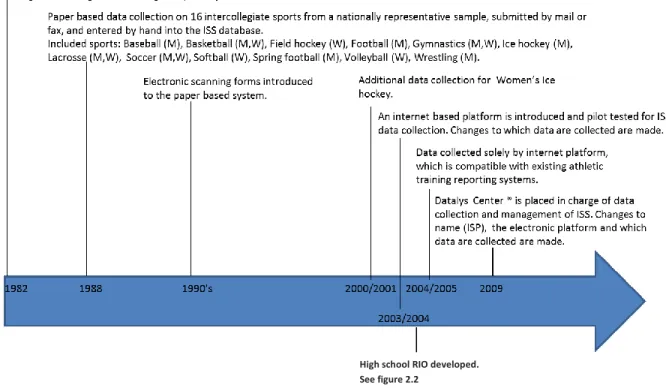
volunteer sample of NCAA institutions to collect injury and exposure data in a variety of sports. ATs collect data from all formal team activities for all college sports with a championship. There have been many changes to the ISS since its inception in 1982, such as advancing from a paper to online platform, and transferring the system to an external vendor, the Datalys Center for Sports Injury Research and Prevention, Inc. (Datalys Center) in 2008/2009. [75, 76, 80] These milestones are presented in Figure 2.1. In 2009, the Injury Surveillance System (ISS) was
renamed the Injury Surveillance Program (ISP), coinciding with significant changes to the online platform, such as collecting data on non-time-loss injuries. [75] For the purposes of this
dissertation, ISS refers to the system, or data from the system from 1982 through 2009, ISP refers to the system or data from the system from 2009 on. ISS/ISP refers to the system in general (regardless of timeframe).
The ISS/ISP is a voluntary system, where ATs at NCAA institutions volunteer to participate in data collection. [75] This can result in the underrepresentation of certain types of institutions within the data. The institution sampling scheme can also underreport rare, but important injuries and injury phenomena. For example, an individual catastrophic injury that receives widespread media attention and results in policy changes may not be present in the ISS/ISP data if the involved school does participate in data collection.
2.5.1.1 Impact and successes of the ISS/ISP
allowable equipment, and level of contact in spring football. In 2003, rule changes required protective eye equipment in womens field hockey, and changes to allowable equipment and practice days in preseason fall football. In 2010 the NCAA legislated that all school must have a management plan for concussions, and in 2012, the rules regarding kickoffs in football were modified for injury prevention. [75] Data from the ISS/ISP have also been used for practical applications, such as identifying sports with increased injury risk for increased medical coverage and monitoring the results of rule changes and other injury prevention interventions. ISS/ISP data have also been used in numerous peer reviewed journal articles, including one entire issue of the Journal of Athletic Training in 2007. [75]
2.5.2 High School RIO (Reporting Information Online) (Nationwide Children’s Hospital, Columbus OH)
The RIO is an online surveillance system developed in 2004 by Dr. R. Dawn Comstock as part of the National High School Sports-Related Injury Surveillance Study. This surveillance system was designed after the online ISS platform, with help from the National Federation of State High School Associations, National Collegiate Athletic Association, National Athletic Trainers’ Association Secondary School Athletic Trainers Committee, US Consumer Product
Safety Commission, and The Centers for Disease Control and Prevention, National Center for Injury Prevention and Control. [81]
participate in data collection. Not all high schools provide AT coverage for athletic events, and those with and without ATs may be fundamentally different, which may impact the
generalizability of RIO results to schools without ATs.
2.5.2.1 Impact and successes of the RIO
The RIO began collecting data from a nationally representative sample of nine sports, in the 2005/2006 academic years. It continues to collect representative data on those sports, and has increased the number of sports it collects data on via convenience sampling. (Figure 2.2) The RIO system has established baselines and trends of high school sports injury, as well as identified emerging issues and evaluated interventions and policy changes. Twenty two
manuscripts in peer reviewed journals have been published or accepted for publication. Specific reports on football blocking injuries, skin infections in wrestlers, dental injuries in soccer players and baseball injuries from being struck by a batted ball have been provided to the National Federation of State High school Association’s Sports Medicine Advisory Committee and individual sport Rules Committees. [81]
2.6 Challenges in using the ISS/ISP and RIO for surveillance of overuse injuries
Sports injury surveillance has been successful in identifying targets for specific
intervention and further research. Successes have been investigations into severe injuries to pole-vaulters and current research regarding concussions. [83, 84] A common factor for these
2.6.1 There is currently no consensus on a definition for overuse injuries within injury surveillance
As stated previously, there is no clinical consensus definition to determine the presence of an overuse injury. There is also no current consensus definition for overuse injuries within injury surveillance. In fact, overuse is defined differently between ISS/ISP and RIO (as
“overuse/gradual onset” in the ISS/ISP, and as “overuse/chronic” within the RIO). While it has
been suggested that a consensus definition should be used in injury surveillance, thus far, one has not been provided. [29]
In the absence of consensus definitions or precise diagnostic testing, the best option is likely the opinion of an expert clinician. [85] With this form of classification, clinicians use data from the history, including patient symptoms and dysfunction, physical examination and
radiographic tests to assign a label of “overuse” based on guidelines set by an expert panel or
Delphi committee. [85, 86] As of yet, no committee has addressed the operational definition of overuse injuries.
2.6.2 Use of a time-loss definition
Despite the strength of consistency, the time-loss only definition for a reportable injury is not comprehensive when specifically investigating overuse injuries, as many overuse injuries are not time-loss injuries. [7] In the ISS (1982 through 2009) and RIO system a severe muscle cramp which removes and athlete from participation for one additional day and requires minimal
medical attention will be recorded in injury surveillance, but a tendonitis which requires daily attention from the medical staff for several weeks and results in altered participation for that whole time frame will not. Thus, a time-loss only criteria for sports injury surveillance will underrepresent the incidence and prevalence of overuse injuries. [12] It will also underrepresent the health care costs, in money and in attention from the medical staff, associated with overuse injuries. While the ISP (2010 through present) currently has the ability to record all treated injuries, it is expected that the history of a time-loss definition within the ISS continues to influence the data. Specifically, all non-time-loss injures may not be reported to the ISP, due to the AT’s previous history with a time-loss definition. ATs also just may not report all treated
injuries due to other priorities or duties in their jobs. [87]
Recently epidemiologists and clinicians in several sports have developed consensus statements for the standardization of injury surveillance methods within those sports. Consensus statements for soccer and rugby proposed an adapted model for the definition of injury within surveillance systems. This model separates “injury” into three different operational definitions:
1) events which result in any physical complaint, 2) events which required any medical attention, and 3) events which result in any time-loss. [12, 16, 20] Of those definitions, there is growing support for using the first definition, as it is the most inclusive. [88] A separate consensus statement for track and field recommends an injury definition of “A physical complaint or
an athlete during participation in Athletics training or competition, regardless of whether it received medical attention or its consequences with respect to impairments in connection with competition or training.” [11] Others argue that consistent injury definitions may not be the
solution, and rather the definition should be specific to the research question being studied. [10] While this remains a contentious issue with increasingly divergent viewpoints, it is encouraging that these methodological challenges are receiving attention. [89]
2.6.3 Overuse as a mechanism of injury vs. injury diagnosis
A major methodologic issue in injury surveillance systems is the lack of consensus about the application of the term “overuse”. Within the ISS (1982 through 2009) and currently with cross country injuries in the RIO, “overuse” can refer to a mechanism of injury, an injury diagnosis, and at times, both. When used as a mechanism of injury, “overuse” refers to the
causation, the repetitive or cumulative activity which led to the injury. [35, 90, 91] When used as a diagnosis, “overuse” often refers to a family of injuries classified by slowly progressing
inflammation, pain and loss of function. [17, 92, 93] Thus, as a mechanism of injury “overuse” is the cause, as a diagnosis “overuse” is the effect.
Our systematic literature review [48] of the use of the term “overuse” within US
epidemiological studies found that of 35 articles of college and high school sports injury which also reported overuse injuries, 14 articles reported overuse as a mechanism of injury, seven reported overuse as a category of injury diagnoses, and eight reported overuse as both. The use of “overuse” as a mechanism of injury or injury diagnosis was also inconsistent within data
Similarly, among articles which used data from the RIO, eight reported overuse as a mechanism of injury, two reported it as a category of injuries and three reported it as both. The multiple uses of the term “overuse” in the literature limits comparability between studies, even studies which
use the same data source. This complicates interpretation of the data, and may impact the development of interventions from these studies.
2.6.4 Potential misclassification of overuse
The diagnosis of an overuse injury is often dependent on when and whether the athlete seeks care. [22] As these injuries may initially present as small, nagging pains which can be initially ignored, they may not be addressed until significant pain or deficit in function is present. [22] If the athlete presents only the current state of the injury, it may appear to be from acute, rather than overuse, mechanisms. This can affect the diagnosis the athlete receives and the mechanism assigned to the injury, which can result in misclassification when this injury is submitted to surveillance systems. [12, 60, 64] Misclassification may result in an
underestimation of the incidence of overuse, and will affect the estimates that injury surveillance produces. [48] The athlete may also withdraw from sports rather than seek treatment thus
avoiding diagnosis altogether, further underestimating the incidence of overuse. [1, 3]
2.7 Alternate methods for measuring overuse injuries
Additionally established methods of studying repetitive stress injury in occupational research, may be applicable to sport injury.
2.7.1 Oslo Sports Trauma Research CenterOveruse Injury Questionnaire (OSTRC/OIQ)
The OSTRC/OIQ, [16, 20] relies on athletes to self-report levels of difficulty with
participation, reduced training volume, affected performance and pain due to sports participation to capture overuse injuries. The OIQ is a questionnaire which asks four questions per body part included in the study, and is intended to be administered serially to athletes (e.g. weekly, biweekly or monthly). [20] The OIQ operationally defines overuse injury as a limit in function regardless of time-loss from sports. The outcome of these systems is prevalence of substantive overuse injury and average injury severity scores. [16, 20]
The nature of this method remains subjective, but the onus shifts from the clinician to the athlete, and, it has the advantage of capturing the burden of overuse injuries in a more thorough manner than the currently used surveillance systems. This data will not be limited to information on time-loss injuries, and is not subject to bias in injury definitions from injury evaluators, data reporters or analysts. However, it is difficult to compare the results of the OIQ to the traditional injury surveillance as they use different injury definitions and paradigms. Furthermore, the effect of varying thresholds for personal pain and variations in function remain a concern.
2.7.2 Occupational models
are a subset of work-related musculoskeletal disorders (WRMSDs). [94-99] WRMSDs encompass a diverse range of diagnoses and musculoskeletal impairments, which results in a category of disorders rather than one specific operational definition. All WRMSDs involve an occupational component, indicating that the injurious incident is, in some way related to
occupational exposure. [94, 95] For overuse-type WRMSDs, this occupational exposure is often repetitive tasks. [99, 100]
Occupational studies often define RSI or OOS much like the biomechanical definition of sports overuse injury: as injuries which develop progressively over time and do not have a
specific onset incident. [98] These studies also have various methods of quantifying occupational exposure to overuse. Occupational exposure can be quantified by minutes of repetitive activity using both subjective and objective measures. [100, 101] While subjective surveys rely on participant recall regarding minutes of exposure, objective methods rely on direct observation and documentation of time spent at specific tasks.
One method of observation involves a multistep process that resembles a job exposure matrix: 1) workers are observed in order to identify tasks which are repetitive, 2) repetitive tasks with similar physical demands are categorized and placed into task groups , 3) a number of workers from each task group (1 – 10) are video-taped or observed for a period of time (10-15 minutes) and the number of repetitions of specific tasks are counted, 4) the count of repetitive tasks are weighted to produce a total repetitive task exposure for the work week. The weighted exposure is then applied to each member of that specific task group, which allows for
comparisons between task groups in regard to cumulative exposure. [101, 102]
surveillance can collect exposure data with covariates related to event type, location, field and weather conditions no sport injury researchers to date have sought to quantify the time that an individual athlete spends on repetitive skills or drills. [80, 103] The adoption of objective exposure methods in sports injury research would advance the field and address the role of cumulative sports participation as a causal factor in injury incidence, and the role of repetition of specific activities in specific injury outcomes. Data on recovery time (time between scheduled team activities) could also be captured and investigated for its role in the onset and prevention of overuse injuries.
2.7.3 Qualitative studies
Qualitative studies also have the potential to influence overuse injury assessment and intervention. van Wilgen and Verhagen (2011) [104] interviewed athletes and coaches about their beliefs on the etiology and risk factors for overuse injuries. Both athletes and coaches believed that overuse injuries were due to behaviors and activities rather than physiological causes. [104] This study suggests that there is the potential for effective behavioral interventions, and that athletes and coaches have similar beliefs about overuse injuries. While qualitative studies cannot measure injury incidence, they are effective for studying personal conceptual paradigms of overuse injuries in athletes, coaches and health care providers.
2.8 Summary
consistency in the application of the term “overuse”. This is likely due to their mechanism of
repetitive stress and their slow, progressive nature. Recently there has been an increased awareness of, and investigation into, measuring overuse injuries in both surveillance and
alternative systems. With this increased attention, there is opportunity to address the current state of injury surveillance for overuse injuries, including the role of the data collector in this process. Improved knowledge of the variation in how data collectors define and report overuse injuries will enhance the interpretation of the statistics regarding overuse injuries they produce, and can lead to improvements in the methods of these systems in regard to capturing overuse injuries.
This dissertation is a start towards improving our understanding of how overuse injuries are captured within injury surveillance. These results may aid the creation of a single operational definition for overuse that could be universally applied within injury surveillance systems in the future. This methodological advance would likely also inform and stimulate creation of future overuse interventions. While a consensus operational definition of overuse is not achievable within the scope of this dissertation, the work in this dissertation is an important step towards that goal.
The proposed dissertation examined the following general research questions: RQ1: What is the current incidence and distribution of overuse injuries in college and high school athletes?
RQ2: How effective is the ISS at capturing overuse injuries, and what factors are associated with the reporting of overuse injuries?
This dissertation used de-identified surveillance data from the ISS and RIO, pre-existing data from a validity study (including data abstracted from medical records and data associated with the abstraction process) and survey data from ATs who participate in the ISP.
2.9 Figures
Figure 2.1. Timeline of NCAA ISS/ISP milestones
CHAPTER 3
STATEMENT OF SPECIFIC AIMS
This dissertation describes the incidence of college and high school overuse injuries determined from injury surveillance data, as well as the methodological implications of using surveillance data for these measures of incidence. The work has three specific aims. (Tables 3.1 – 3.3)
Aim 1: Describe and compare the distribution of time-loss overuse injuries in college and
high school athlete populations using existing injury surveillance data. (Table 3.1)
Aim 1a: Estimate and compare the overall rate of overuse injury (defined as an overuse mechanism of injury) reported to college (ISS) and high school (RIO) injury surveillance systems.
Aim 1b: Describe the distribution of injury diagnosis, body part injured, time-loss to injury and injury severity in both college and high school overuse injuries.
Hypotheses:
H1: Overuse injury rates and patterns differ across college and high school populations, sport and gender.
Rationale: As of yet, there is no published comparison of the incidence of overuse injuries in college and high school populations. In fact, there is currently only one published study of college overuse injuries, and only one study of high school overuse injuries. [6, 7, 48] The term “overuse” has been used in the literature in three ways: 1) to refer to a mechanism of
injury; 2) to refer to injury diagnosis, and 3) in some studies, to refer to both mechanism and diagnosis. [8, 48]
“Overuse” was conceptually defined and analyzed as a mechanism of injury for the
purposes of this aim. Therefore inclusion into these analyses required a mechanism of injury of “overuse/gradual onset” (ISS) or “overuse/chronic” (RIO). The use of a mechanism of injury
definition is analogous to the published studies in college and high school populations, who also defined overuse as a mechanism of injury. [48] Injuries with a mechanism of injury of acute non-contact or a diagnosis of overuse (regardless of mechanism of injury) were also investigated as part of the Aim 1 analyses, to explore whether there was evidence that the mechanism of injury was overuse. Aside from the injuries with an overuse diagnosis that were already included due to their overuse mechanism of injury, no other injuries were determined to be appropriate for inclusion.
that sport through their high school careers, and may have started their sport long before that. [3, 24] This fact likely underlies the hypothesized differences in rates and patterns of overuse injury between college and high school populations.
Table 3.1. Summary of Aim 1 for Dissertation
# Aim Data Analysis
1 Describe and compare the distribution of time-loss overuse injuries in college and high school athlete populations using existing injury surveillance data.
1a Estimate and compare the overall rate of overuse injury (defined as an overuse mechanism of injury) reported to college (ISS) and high school (RIO) injury surveillance systems.
De-identified injury surveillance data from the ISS for 16 sports (n=3,569 injuries from 2004/5 through 2008/9) and data from the RIO for 14 sports (n=3,168 injuries from 2006/7 through 2012/13).
1) Calculate overuse injury rates for each system, each sport for each system and
by gender for each system. 2) Calculate injury rate
ratios comparing the rates of overuse injuries of the two systems in total, by sport and by gender. 1b Describe the distribution of
injury diagnosis, body part injured, time-loss to injury and injury severity in both college and high school overuse injuries.
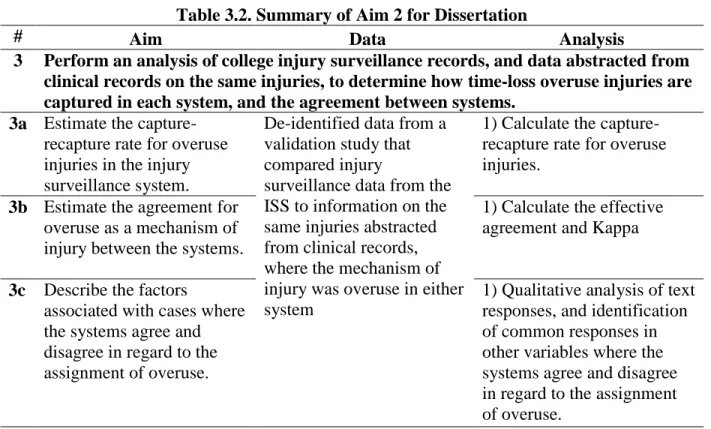
Aim 2: Perform an analysis of college injury surveillance records, and data abstracted
from clinical records on the same injuries, to determine how time-loss overuse injuries are
captured in each system, and the agreement between systems. (Table 3.2)
Aim 2a: Estimate the capture-recapture rate for time-loss overuse injuries in the injury surveillance system.
Aim 2b: Estimate the agreement between the two systems for overuse as a mechanism of injury.
Aim 2c: Describe the factors associated with cases where the systems agree and disagree in regard to the assignment of overuse.
Rationale: Overuse injuries are assumed to be difficult to classify and underrepresented in surveillance data, but the extent of the underascertainment is unknown. [8] Knowledge about the practice of reporting overuse injuries to surveillance systems can be gained by comparing time-loss overuse injuries which appear in the ISS and/or the medical records. An understanding of the differences in reporting between clinical records and the ISS may assist in the
interpretation of existing overuse injury data from the ISS. Identifying factors associated with cases where the two systems agree or disagree may be used to improve the ISS to better capture overuse injuries in the future.
Table 3.2. Summary of Aim 2 for Dissertation
# Aim Data Analysis
3 Perform an analysis of college injury surveillance records, and data abstracted from clinical records on the same injuries, to determine how time-loss overuse injuries are captured in each system, and the agreement between systems.
3a Estimate the capture-recapture rate for overuse injuries in the injury surveillance system.
De-identified data from a validation study that compared injury
surveillance data from the ISS to information on the same injuries abstracted from clinical records, where the mechanism of injury was overuse in either system
1) Calculate the capture-recapture rate for overuse injuries.
3b Estimate the agreement for overuse as a mechanism of injury between the systems.
1) Calculate the effective agreement and Kappa
3c Describe the factors
associated with cases where the systems agree and disagree in regard to the assignment of overuse.
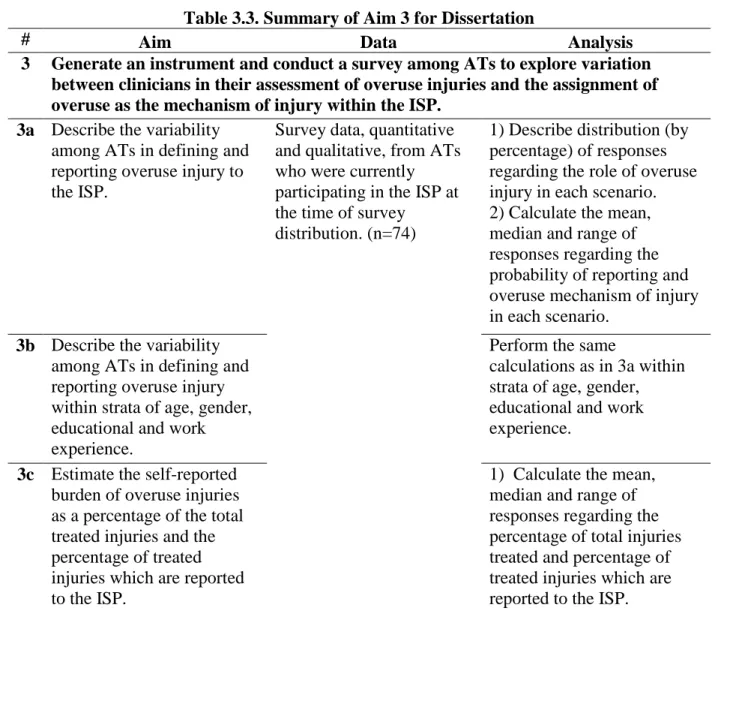
Aim 3: Generate an instrument and conduct a survey among ATs to explore variation
between clinicians in their assessment of overuse injuries and the assignment of overuse as
the mechanism of injury within the ISP. (Table 3.3)
Aim 3a: Describe the variability among ATs in defining and reporting overuse injury to the ISP.
Aim 3b: Describe the variability among ATs in defining and reporting overuse injury within strata of age, gender, educational and work experience.
Aim 3c: Estimate the self-reported burden of overuse injuries as a percentage of the total treated injuries and the percentage of treated injuries which are reported to the ISP. Aim 3d: Perform a qualitative analysis of AT responses regarding their processes for assigning overuse and reporting overuse as the mechanism of injury within the ISP. Hypotheses:
H1: There is variability between ATs in determining the role of overuse and the probability of assigning an overuse mechanism of injury for each scenario. H2: There is variability in the role and reporting of overuse injuries between strata of age, gender, level of education and years of experience.
Rationale: There is currently no consensus about the definition of overuse injuries in general and in the context of injury surveillance. [8] An understanding of how individual ATs diagnose and report overuse injuries to the ISP, and the strategies that they employ, may ultimately lead to the establishment of an operational definition of overuse within injury
The survey instrument was developed to describe the AT’s opinion of the role of overuse in seven hypothetical injury scenarios, as well as, the probability of assigning overuse as the mechanism of injury to each scenario, followed by an open ended question about how the AT reached that decision. The survey instrument was developed by the candidate with guidance from the five committee members and five AT clinicians working in college settings. In-depth
qualitative interviews were conducted with five AT graduate students to investigate how the scenarios were understood, and the processes these ATs used to complete the survey. Additional interviews were conducted with five other ATs regarding the understanding of the subject matter and facility with the survey. The survey was pilot tested by eight graduate students unaffiliated with the target population. The extent to which the cases presented in the instrument actually represent a typical case load in real clinical practice has not been assessed.
Table 3.3. Summary of Aim 3 for Dissertation
# Aim Data Analysis
3 Generate an instrument and conduct a survey among ATs to explore variation between clinicians in their assessment of overuse injuries and the assignment of overuse as the mechanism of injury within the ISP.
3a Describe the variability among ATs in defining and reporting overuse injury to the ISP.
Survey data, quantitative and qualitative, from ATs who were currently participating in the ISP at the time of survey
distribution. (n=74)
1) Describe distribution (by percentage) of responses regarding the role of overuse
injury in each scenario. 2) Calculate the mean,
median and range of responses regarding the probability of reporting and overuse mechanism of injury in each scenario.
3b Describe the variability among ATs in defining and reporting overuse injury within strata of age, gender, educational and work experience.
Perform the same
calculations as in 3a within strata of age, gender, educational and work experience.
3c Estimate the self-reported burden of overuse injuries as a percentage of the total treated injuries and the percentage of treated injuries which are reported to the ISP.
CHAPTER 4
METHODS
4.1 Data sources
This dissertation used four distinct data sources to address the incidence of overuse injuries and methodological issues related to surveillance of overuse injuries. Previously
collected sports injury surveillance data from college and high school overuse injuries was used for Aim 1. Aim 2 used existing data previously collected as part of a validation study of the ISS. Primary data was collected from an online survey for Aim 3. All data sources and the use thereof in statistical and qualitative analyses were considered exempt by the Institutional Review Board at the University of North Carolina at Chapel Hill.
4.1.1 Data sources for Aim 1
Previously collected de-identified sports injury surveillance data from college and high school overuse injuries was used for this aim.
4.1.1.1 National Collegiate Athletic Association’s (NCAA) Injury Surveillance System (ISS)
2003/2004 academic year about 250 schools participated in ISS data collection, with a target enlistment sample of 10% of the number of schools that participate in an individual sport. [80] ISP participation from the 2009/10 through 2013/14 academic years was lower with <1% of the qualified teams participating for 10 sports. [75]
The Datalys Center, which currently runs the ISS/ISP, provided de-identified data from the 2003/4 through 2008/9 academic years for the analysis of Aim 1. In the 2004/5 through 2013/2014 academic years the ISS/ISP collected data on 29 injury variables, and 13 exposure variables. Injury data is collected as injuries occur and exposure information, including the number of athletes participating in each sport exposure, is collected weekly. [76] At the time of data collection for this analysis, the ISS employed a time-loss injury definition. Therefore in order for an injury to be reported, it must have resulted in one additional day lost from sport after the athlete seeks care.
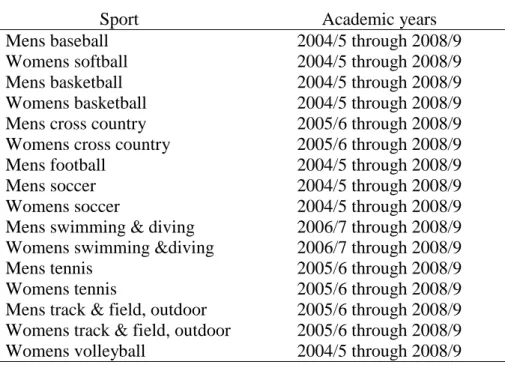
Line item data, including all variables for all injuries with a “basic mechanism of injury” of “overuse/gradual” (from 16 selected sports) were included in the analysis of Aim 1. These
sports represent a variety of contact and endurance levels (Table 4.1).
Data on injuries with a diagnosis of overuse, and injuries with a mechanism of acute non-contact for selected diagnoses, were assessed for potential inclusion in to the analyses for Aim 1. The mechanism of injury and injury diagnoses of the additional injuries which were considered for inclusion are presented in Table 4.2.
4.1.1.2 High School RIO (Reporting Information Online)
included in the data analysis for the annual report. These schools were sampled by geographic region and school size. In the 2013/2014 academic year, 260 ATs were invited to participate in data collection. [82, 105] Data is only collected by ATs, in high schools which provide medical coverage by ATs. While this facilitates reliable information, it limits the generalizability of these data as not all high schools have access to certified athletic trainers. [77, 78, 106]
High School RIO collects data on athlete demographics, injury information, injury event information, sport-specific information and medical notes. Within these categories, there are variables for the sport, body part injured, primary type of injury, factors relating to injury incidence (general and specific mechanism of injury), injury outcome (including return to sport, amount of time lost, and any surgery required). Exposure data reports the number of athletes participating in every individual sport exposure, the type of exposure (such as practice, game, or other sport activity), location of event (home, away) and season (pre, in, post). [82, 105] As with the ISS, injury information is collected as they occur and exposure information is collected weekly. The RIO uses a time-loss injury definition, as the ISS/ISP does, which facilitates comparisons between these systems.
Line item data, including all variables for all injuries with a “basic injury mechanism” of “overuse/chronic” (from 14 selected sports) were included in the analysis of Aim 1. Data from
4.1.2 Data source for Aim 2:NCAA Validation Study [5]
This aim used existing data, previously collected as part of a validation study of the ISS. [78] In this parent study, “A validation study of the ISS comparing data from the NCAA mens and womens soccer teams” data were collected from 15 institutions which participate in ISS
surveillance, which also maintained separate injury tracking and medical records in the 2005/6 through 2007/8 academic years as part of a study to validate the ISS system for mens and womens soccer injury reports. The procedures for the parent study were approved by the Duke University Medical Center Institutional Review Board
Inclusion requirements necessitated each participating school have both mens and womens soccer teams, and have participated in the online ISS for a minimum of two years. All athletes whose medical records were included in the original data collection signed individual consent forms before their data could be included in the study. [78].
At the time of data collection, the ISS required that an injury result in one additional day lost to participation after reporting the injury. Therefore, for inclusion into the parent study, an injury had to occur during a school sanctioned event, require medical attention and result in a loss of participation for at least one day after the injury (time-loss, medical attention definition). All ISS and medical records were collected for the parent study. The various sources for the medical records and methods for data abstraction are discussed in Chapter 6.
Covariate data included, but was not limited to: event type, event season, event location, basic and specific mechanism of injury, activity at time of injury, injury type, body part injured, injury assessor, and information regarding the injury outcome (including date of return to activity and total days lost to injury) were also analyzed. In the abstractors notes, there was an additional question of whether the data in the medical records agreed with the data in the ISS. If there was no agreement between sources for a specific question, the data abstractor was to provide an explanation why these did not agree.
4.1.3 Data sources for Aim 3: “Overuse injuries in collegiate populations” online survey
To ascertain the extent of personal practices among ISS data collectors in regard to overuse injuries, a survey containing injury scenarios with various levels of overuse involvement was created and implemented among ATs who were currently contributing to the ISP in October 2014. These injury scenarios were created with input from ATs with college athletic training experience, to represent a variety of injuries, body parts injured, and levels of overuse (scenario development is discussed in Chapter 7). These scenarios simulated real world injuries but were purposely vague, which are likely similar to events which have been encountered by
4.2 Statistical analyses
To address the distinct specific aims of this dissertation, each aim employed separate and individual statistical approaches. The statistical analyses for Aims 1, 2 and 3 are described in detail in their results chapters (Chapters 5, 6 and 7 respectively). Please refer to the methods sections of those chapters for full details.
4.2.1 Analysis for Aim 1
Descriptive statistics including, counts, percentages, and rates were calculated for overuse injuries in the ISS and RIO separately. These statistics were also calculated in strata of sport, gender, body part and injury diagnosis. Injury rate ratios (IRRs) were calculated to compare the rate of overuse injury in college to that in high school sports, and to compare the rate of overuse injury in female vs. male sports.
Injuries with a diagnosis of overuse (as opposed to a mechanism of overuse) were also available in the ISS data from the time frame of the study, and were considered for this investigation. Over 75% (200 of 266) of injuries with a diagnosis of overuse also had a
mechanism of injury of overuse. The remaining 66 injuries had mechanisms of injury of acute non-contact, (n=59), contact with player (n=4) and contact with playing surface (n=3). There were 10,179 injuries with a mechanism of injury of acute non-contact considered for inclusion of this study. Data regarding the activity at time of injury, type of injury, and specific injury
designation of overuse was not possible. Therefore these injuries were not included in the analysis, and the operational definition of overuse as a mechanism of injury for this aim was used.
4.2.2 Analysis for Aim 2
4.2.2.1 Parent study
The parent study [78], used the formulas originally presented by Hook and Regal (1995) [107] to estimate the capture rate of the ISS, the capture rate of injuries within both sources, and the estimated number of injuries not captured by both sources. Effective agreement and Kappa were estimated as well.
4.2.2.2 Overuse study
The original study was focused on time-loss, medical attention injuries. The Aim 2 study was limited to the subset of injuries with a reported injury mechanism of overuse in either the ISS or other medical records. Therefore all injuries included in the Aim 2 analysis had a reported injury mechanism of overuse in at least one of the two data sources.
the total number of overuse injuries in this population. Thus, the Aim 2 analyses describe the variability between sources, rather than finding a true incidence estimate.
For example, the capture rate for overuse injury in the ISS can still be calculated by (a + b)/N (Appendix 4.1). However the interpretation is slightly changed. In Appendix 6.1, Cell A represents the events where the mechanism of injury was overuse in both the ISS and medical record sources, Cell B represents events where the mechanism of injury was overuse in the ISS, but not the medical records, Cell C represents events where the mechanism of injury was overuse in the medical records, but not the ISS, and Cell D are the hypothetical overuse mechanisms of injury which were missed, or misclassified by both the ISS and medical records. The formula for the capture-recapture estimations remains the same but the interpretation is subtly different. It is interpreted as the percentage of overuse injuries captured by the ISS, medical records and both, rather than the percentage of injuries alone. These capture rates were also calculated in strata of covariates (year, division, sport, electronic database, presence of undergraduate athletic training education program and AT supervised entry of surveillance data by an AT student).
Chi-square tests were conducted to determine differences in percentage of overuse mechanisms captured between strata of covariates (year, division, sport, electronic database, presence of undergraduate athletic training education program and AT supervised entry of surveillance data by an AT student), for the null hypothesis of the percentage of capture of overuse mechanisms is equal between strata. These chi-square tests were performed in strata of the covariates for the percentage capture in ISS, medical records and both the ISS and medical records (see Table 6.3).
was calculated for these variables (injury date, activity, event type, event season, chronic, diagnosis code, incident/recurrent, body part, side, surgery, injury type, outcome and injury severity) for all injuries that appeared in both sources, and in strata of overuse mechanism. Injury events that appeared in both records were stratified into those where the mechanism of injury was overuse in both sources and those where the mechanism of injury was overuse in only one source. The effective agreement was calculated for each covariate within these strata.
Kappa analyses were performed to estimate agreement between the ISS and medical records for the above covariates, and also for the mechanism of injury. Kappa statistics were calculated for total records which appeared in both sources, records where there was an overuse mechanism in both sources, and where there was an overuse mechanism in only one source. The null hypothesis for the Kappa agreement is that the probability of each source (ISS and medical records) classifying a variable into any category is equal.
4.2.3 Analysis for Aim 3
Initially, descriptive statistics, including box and whiskers plots were used. The n and % was calculated for the responses to question regarding the role of overuse. The mean, median, range and distribution of responses for the question regarding the probability of reporting an overuse mechanism to injury surveillance were calculated.
The responses to the question regarding the role of overuse were then classified into three categories. The responses from the “overuse is not a major contributor” and “not overuse
related” were combined into one category of “not overuse”. The category of “overuse is the major contributor” remained intact, and was renamed “overuse” and the “not enough information” category remained the same for these analyses. The purpose of collapsing
responses of “overuse was not a major contributor” and “not overuse related” was that ATs who
chose these responses regarding the role of overuse in the injury would be unlikely to report an overuse mechanism of injury for that scenario. We were most interested in the differences in reporting between ATs who would report an overuse mechanism of injury to a scenario and those who would not, which was aided by collapsing these two categories.
The distribution of the responses regarding the role of overuse in each scenario was described by calculating the percentage of ATs for these new categories. The mean, median and interquartile ranges were calculated for the self-reported probability (0-100%) of assigning overuse as the mechanism of injury for each scenario. These two variables (role and reporting) were then combined to create a classification system to describe the level of discord between respondents in each scenario. This new classification system is fully discussed in Chapter 7.
investigator (KR) analyzed the qualitative data using previously identified themes, and iteratively added to and/or adapted those themes as the analysis progressed. [109]
4.3 Tables
Table 4.1. ISS data included in Aim 1 by sport and academic year
Sport Academic years
Mens baseball 2004/5 through 2008/9
Womens softball 2004/5 through 2008/9
Mens basketball 2004/5 through 2008/9
Womens basketball 2004/5 through 2008/9
Mens cross country 2005/6 through 2008/9
Womens cross country 2005/6 through 2008/9
Mens football 2004/5 through 2008/9
Mens soccer 2004/5 through 2008/9
Womens soccer 2004/5 through 2008/9
Mens swimming & diving 2006/7 through 2008/9 Womens swimming &diving 2006/7 through 2008/9
Mens tennis 2005/6 through 2008/9
Womens tennis 2005/6 through 2008/9
Mens track & field, outdoor 2005/6 through 2008/9 Womens track & field, outdoor 2005/6 through 2008/9
Table 4.2. ISS injury mechanisms and injury diagnoses considered for inclusion to Aim 1 Mechanism of injury Injury Diagnosis All mechanisms Overuse
Acute non-contact Arthritis / chondromalacia Acute non-contact Bursitis
Acute non-contact Capsulitis Acute non-contact Cartilage injury
Acute non-contact Compartment syndrome Acute non-contact Disc injury
Acute non-contact Effusion Acute non-contact Impingement Acute non-contact Inflammation Acute non-contact Miscellaneous Acute non-contact Plantar fasciitis Acute non-contact Osteochondritis Acute non-contact Sprain
Acute non-contact Strain – muscle / tendon Acute non-contact Stress fracture
Acute non-contact Synovitis Acute non-contact Tendinosis
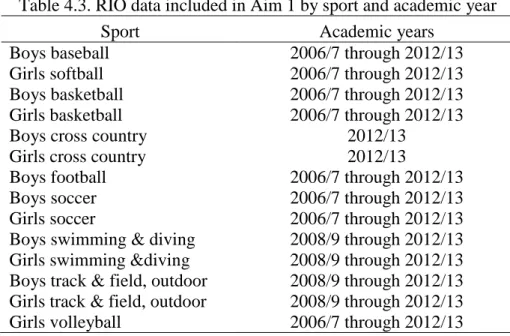
Table 4.3. RIO data included in Aim 1 by sport and academic year
Sport Academic years
Boys baseball 2006/7 through 2012/13
Girls softball 2006/7 through 2012/13
Boys basketball 2006/7 through 2012/13
Girls basketball 2006/7 through 2012/13
Boys cross country 2012/13
Girls cross country 2012/13
Boys football 2006/7 through 2012/13
Boys soccer 2006/7 through 2012/13
Girls soccer 2006/7 through 2012/13
Boys swimming & diving 2008/9 through 2012/13 Girls swimming &diving 2008/9 through 2012/13 Boys track & field, outdoor 2008/9 through 2012/13 Girls track & field, outdoor 2008/9 through 2012/13
CHAPTER 5
RESULTS FOR AIM 1: DESCRIPTIVE EPIDEMIOLOGY OF OVERUSE INJURIES IN US COLLEGE AND HIGH SCHOOL ATHLETES
5.1 Introduction
Overuse injuries are traditionally defined as injuries which present in a gradual manner and do not have a single definable event associated with their onset. [8, 18] They result from the accumulation of microtrauma on the cellular level in a variety of tissues (e.g., bone, muscle, tendon, ligament). [17, 23, 35, 110] This microtrauma results from repetitive activity that would not necessarily result in injury, if sufficient time was allowed for the affected tissue to recover between episodes of activity [31, 32]. Due to their progressive nature an injured person may not be aware of the presence or seriousness of the injury, or seek treatment, until severe tissue damage has occurred, which makes the identification and diagnosis of overuse injuries challenging. [23]
sports), as well as long-term musculoskeletal disorders (e.g. chronic tendonosis, arthritis)[1, 4]. Prevention and early intervention for overuse sports injuries will promote both healthy
participation in athletics in youth, and participation in an active lifestyle beyond the athlete’s
competitive playing career.
Overuse injuries may account for more than 50% of total childhood sports injuries [31, 32]. Specifically, two studies of high school (HS) cross country runners indicated a self-reported lifetime prevalence of overuse injuries in 59-68% of runners (n=708) [50], and overuse leg pain in 48% of runners over one season (n=125) [49]. Furthermore a study of Swedish school age tennis players (n=55) reported 54% of total injuries were “overuse type” [51].
Although current injury surveillance systems in US college and HS institutions provide data on overuse injuries, these data are frequently reported in a cursory manner in the literature, listing specific diagnoses, or combining overuse injuries within the uninformative “other”
category [48]. Little research is available on the overall incidence and characteristics of overuse injuries in college and HS populations [48]. There is only one published epidemiologic study of US college athletes that focused on overuse injuries which reported that they account for 30% of total college athletic injuries at one institution [7].