EMOTIONAL FRAMING: HOW DO EMOTIONS CONTRIBUTE TO FRAMING EFFECTS?
Mark Yacoub
A thesis submitted to the faculty of the University of North Carolina at Chapel Hill in partial fulfillment of the requirements for the degree of Master of Arts in the Department of Political Science.
Chapel Hill 2012
ABSTRACT
MARK YACOUB: Emotional Framing: How Do Emotions Contribute to Framing Effects?
(Under the direction of Pamela J. Conover.)
ACKNOWLEDGMENTS
TABLE OF CONTENTS
LIST OF TABLES . . . v
LIST OF FIGURES . . . vi
Introduction . . . 1
The Psychology of Framing Effects . . . 2
The Framing Process . . . 2
Limits to Framing . . . 3
Emotions and Framing . . . 5
Extant Research and Its Limitations . . . 6
A More Complete Framing Model . . . 8
How Frames Elicit Emotions . . . 13
Expectations . . . 16
An Experimental Test . . . 17
Participants, Design, and Procedure . . . 17
Results . . . 19
Discussion . . . 27
APPENDIX . . . 31
Experimental Articles . . . 31
Opinion Questions . . . 39
LIST OF TABLES
Table
1 Libya Anger Emotional Intensity Effects . . . 21
2 Libya Compassion Emotional Intensity Effects . . . 22
3 Social Security Anger Emotional Intensity Effects . . . 23
4 Social Security Compassion Emotional Intensity Effects . . . 24
5 Differences in Means Based on Valence for Libya . . . 26
LIST OF FIGURES
Figure
1 The Traditional Framing Model . . . 3
2 An Updated Framing Model Accounting for Emotions . . . 12
3 Libya Anger Low Intensity Frame . . . 31
4 Libya Anger High Intensity Frame . . . 32
5 Libya Compassion Low Intensity Frame . . . 33
6 Libya Compassion High Intensity Frame . . . 34
7 Social Security Anger Low Intensity Frame . . . 35
8 Social Security Anger High Intensity Frame . . . 36
9 Social Security Compassion Low Intensity Frame . . . 37
Introduction
Interest in framing has grown because of its implications for political commu-nication, behavior, and public policy. Framing theory is built on the premise that the way an issue is presented influences how people perceive it. Years of research have, in fact, confirmed that frames do shape citizen opinions (Iyengar 1991; Zaller 1992; Nelson, Clawson and Oxley 1997). In explaining these effects, researchers have mainly focused on the cognitive processes behind framing, when it occurs, and its impact on citizens. However, we know little about how emotions fit into the framing process, a limitation this paper aims to address.
Early research documented framing effects on many issues, leading researchers to believe that framing effects were ubiquitous. If elites could use framing to alter the beliefs and opinions of ordinary citizens, what were the implications for deliberative democracy and the competency of those who elect our national leaders? While early research suggested that citizens passively accept frames from elites and the media that influence their views (Nelson and Kinder 1996, p. 1072; Entman 1993; Iyengar 1991; Zaller 1992), more recent studies have shown that citizens consciously examine and evaluate frames before drawing opinions (Brewer 2001; Chong 1996; Nelson, Clawson and Oxley 1997; Nelson, Oxley and Clawson 1997). Subsequent work has also documented the many limits of framing and painted a much more nuanced picture of how the process may work in the presence of constraints that often exist in the real world.
effects, essentially mediating the impact of the frames. Or are they exogenous factors that affect how frames are perceived? Finally, how do the emotions that frames elicit affect attitudes? This paper represents an initial effort toward ad-dressing these questions. I begin by analyzing the state of the literature on the psychology of framing in order to demonstrate how emotions have received little coverage. I then lay out a theory of emotional intensity as a crucial part of the framing process—the intensity of emotional reactions to a frame influence how im-portant beliefs brought up by the frame are viewed, affecting subsequent opinions. An experiment tests my specific expectations. I conclude with a discussion of my results, the potential drawbacks and limitations of my experimental design, and directions for future research.
The Psychology of Framing Effects
The Framing Process
Framing can be used by either political elites or the news media to shape the debate on an issue. By emphasizing certain aspects of an issue or presenting it in a specific way, the media can influence—or frame—how audiences perceive it (Scheufele and Tewksbury 2007). Effective frames alter belief importance (Nelson, Clawson and Oxley 1997; Nelson, Oxley and Clawson 1997; Nelson and Kinder 1996; Druckman 2001a) and shape opinions because they activate new or existing beliefs and feelings, increase the importance of certain considerations, and affect the way people evaluate issues (Nelson, Oxley and Clawson 1997; Nelson, Willey and Oxley 1998; Chong and Druckman 2007c).
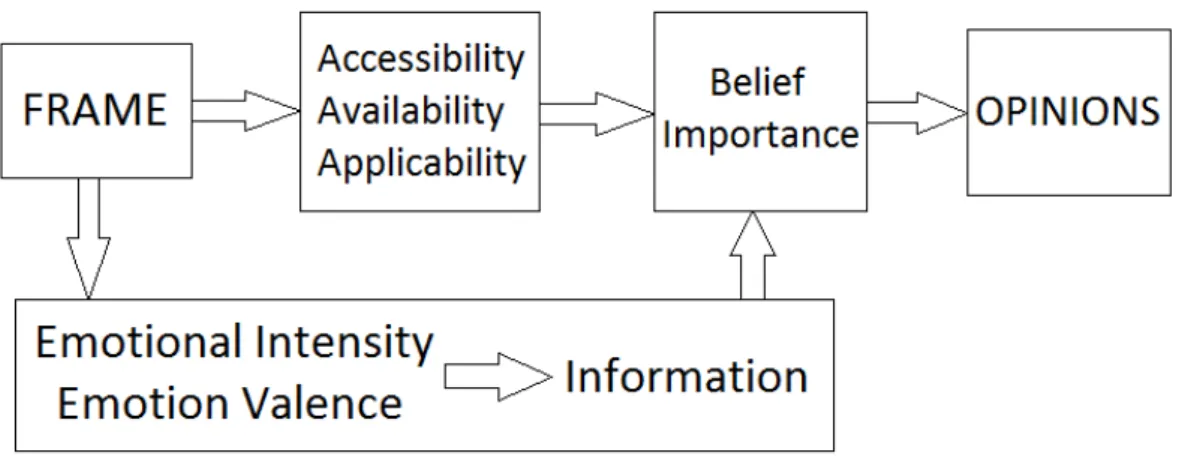
to be retrieved and applied to the frame (Chong and Druckman 2007a, p. 110). So, a person must understand the meaning of a consideration before it can be con-nected to an issue. An accessible consideration is one that has been retrieved from long-term memory. The more a person is exposed to or thinks about a considera-tion, the more accessible it will be. Finally, applicability refers to the relevance of a consideration to the issue at hand. More applicable considerations are weighted more heavily when forming opinions. So, framing effects occur by making a belief available in someone’s memory, easily accessible, and applicable to the considera-tions at hand. Thus, a frame does not directly alter opinions about an issue but does so indirectly. As illustrated in Figure 1, the degree to which a frame makes beliefs brought up by the frame available, accessible, and applicable determines how important those beliefs will be viewed—meaning belief importance can be thought of as a function of these cognitive processes (Nelson, Oxley and Clawson 1997; Nelson, Willey and Oxley 1998; Nelson and Kinder 1996). It is the impor-tance assigned to relevant beliefs that then shapes attitudes. Critically, though, this model only includes the cognitive factors that influence considerations brought up by a frame, failing to account for how emotions can affect these considerations.
Fig. 1: The Traditional Framing Model
Limits to Framing
different ways individuals examine frames has led to research on the moderators of framing effects—factors affecting the power of frames to shift opinions. However, just as the examination of how framing works has focused on cognitive factors, analyses of moderators have focused on the cognitive limitations to framing while largely ignoring the influence of emotions.
Competition among frames is one critical moderator (Sniderman and Theriault 2004; Druckman 2004; Brewer and Gross 2005; Edy and Meirick 2007; Chong and Druckman 2007a,c). As Sniderman and Theriault (2004) note, people are rarely presented with one frame in isolation but must contend with competing frames. When this occurs, they find that the competing frames have no effect on individuals; instead, people use preexisting beliefs to form their opinions. When individuals are presented with multiple competing frames, framing effects tend to weaken significantly (Druckman 2004; Sniderman and Theriault 2004). Competing frames tend to cancel one another out, especially when both frames are strong, and strong frames tend to dominate weak ones (Chong and Druckman 2007a).
Discussion between individuals has also been shown to moderate framing effects (Druckman and Nelson 2003; Druckman 2004; Sniderman and Theriault 2004). After being presented with a frame, deliberation with citizens who hold differing views diminishes framing effects, although it does not eliminate them (Druckman and Nelson 2003; Druckman 2001b).
Studies also show that citizens with low political knowledge are more suscepti-ble to framing (Kinder and Sanders 1990; Haider-Markel and Joslyn 2001), though other research indicates the opposite is true (Druckman and Nelson 2003; Nelson, Oxley and Clawson 1997; Miller and Krosnick 2000). However, Chong and Druck-man (2007b) find that, after controlling for prior attitudes, framing has a greater impact on knowledgeable people because knowledge “increases the likelihood that the considerations emphasized in a frame will be available or comprehensible to the individual” (Chong and Druckman 2007b, p. 112).
strong (Chong and Druckman 2007a; Druckman 2001a). Though focusing their efforts on priming and agenda setting, Miller and Krosnick (2000) note that “trust-worthy sources are more persuasive than more dubious sources” (p. 303). For example, framing effects are stronger when an individual identifies ideologically with the source of the frame (Hartman and Weber 2009). In addition, frames are more effective if they are sponsored by a political party that a person supports. These effects become more pronounced for issues on which the parties are divided and when a person is more politically attentive (Slothuus and de Vreese 2010).
Again, while past research has revealed a great deal about the psychology of framing effects, almost all of this work focuses on the cognitive processing of frames. Both the traditional model of framing and research on the major moder-ators of framing effects only take into account the cognitive factors that influence information processing. For a more complete understanding of the framing pro-cess, it is necessary to examine whether an individual’s emotions contribute to how frames are viewed and what the consequences of this are for framing effects.
Importantly, an examination of the factors that moderate framing effects shows that they are conceptualized as exogenous factors that are separate from the frames themselves. Emotions, on the other hand, arise as reactions to a frame and can be a core part of what makes an effective frame. This indicates that emotions contribute to framing effects in a way the traditional framing model—which focuses on cognitive processes—fails to explain. The next section seeks to place emotions in the framing process and develop a more precise theory of their role.
Emotions and Framing
types of frames. However, what has yet to be developed is a coherent and com-prehensive theory of how emotions influence the framing process as a whole. In this section, I begin by critically assessing the contributions of previous research. I then present my own theoretical account of the place of emotions in the framing process, focusing on the role of emotional intensity. Finally, I explore the particular aspects of frames that elicit emotions and present my specific expectations.
Extant Research and Its Limitations
In an experimental test of value frames, Brewer (2001) found that frames pro-duced either a cognitive or an emotional response—but not both—that depended on the respondent’s favorability toward the frame. However, given the complex-ity of most frames and the environment in which they occur, it is more likely that frames are processed both cognitively and affectively, with each response contributing to how a frame operates.
Gross and D’Ambrosio (2004) treat emotional responses as framing effects—so they view emotions as a consequence of the framing process rather than an integral part of it. They find that frames affect the cognitive explanations people give for their emotions more than their specific emotional reactions. While opposing frames may cause respondents to feel the same emotions, these feelings are cognitively justified in different ways and directed differently. In addition, predispositions such as ideology and racial resentment mediate these effects (Gross and D’Ambrosio 2004). While the authors show that frames can affect emotional responses, they do not go further and examine how emotions influence opinions. In addition, they focus on the effects of individual predispositions on emotional reactions, ignoring the role that the frame itself can play.
These are contrasted with thematic frames—which use a broader context to define issues. But while thematic frames are less emotional than episodic frames, they do trigger emotions, meaning that the same indirect effect on opinions should hold for episodic frames. Examining frames generally, instead of focusing on specific types of frames, should provide a deeper understanding of the role of emotions. Negative emotions, particularly their intensity and placement within a message, also mediate persuasive appeals and can affect information recall and opinions (Nabi 1999). This work, though, focuses not on framing but persuasive appeals. Framing attempts to influence the way people understand an issue, which does not necessarily involve persuasion.
Nabi (2003) argues that emotions themselves can function as frames, guiding information processing and affecting belief availability and accessibility as well as subsequent judgments. She uses emotions as frames by asking people how they feel about an issue. This essentially creates an emotional lens through which people view the issue, hence turning the emotion itself into a frame and influencing subsequent opinions. This research is limited because it assumes that frames are purely emotional and that priming an emotional response is equivalent to framing. However, frames are often more nuanced—using stories, examples, and values to evoke emotions. As a result, Nabi’s approach is only a specific case of what can constitute a frame.
Taken together, past work on emotions and framing reveals that emotions do influence attitudes. However, this work only explores a small aspect of the framing process and reveals little about the systematic influence emotions have on fram-ing effects. What previous research does indicate is that emotions can serve as mediators between the message—or frame—and opinion formation. Frames can elicit emotional reactions that aid in information processing and influence subse-quent opinions. More recent work has begun to examine this mediational role of emotions. Anger and sadness-inducing frames have been found to influence the type of information processing individuals engage in—systematic and heuristic, respectively—which in turn affects opinions (Kim and Cameron 2011). This work builds on Nabi (1999, 2003) and conceptualizes emotions as frames while focusing only on the effects of specific emotions—sadness and anger. As noted previously, this conceptualization is problematic because it restricts the types of frames that can be examined. The authors also focus on organizational crisis and response, an area with limited political applicability. Aaroe (2011) shows that emotional intensity can influence the framing process. Episodic frames become more effec-tive—and therefore stronger—than thematic frames as the intensity of emotional reactions increases. Again, however, this theory is only applied to particular types of frames, limiting what we can conclude about frames generally.
A More Complete Framing Model
conceptualization, but it actually differs in key ways. Aaroe argues that emotional intensity is inextricably linked to the type of frame; episodic frames are essential to generating emotional responses. In contrast, I expect emotional intensity to be influential for frames generally. Additionally, and importantly, I argue that emo-tional intensity is a mediator of the framing process, not a moderator. In order to do so, I draw upon theories of cognitive appraisal as well as affect and arousal as information. These theories indicate precisely how and why the intensity of emotional reactions to frames alters belief importance and affects opinions.
Cognitive appraisal theories of emotion hold that emotions are “cognitively elaborated affective states” that arise from appraisals of the surrounding environ-ment (Clore and Ortony 2008, p. 629; Smith and Ellsworth 1985; Roseman 1991; Ortony, Clore and Collins 1988). Appraisals refine these undifferentiated affective states into emotion. Certain situations tend to elicit particular appraisals that cor-respond to underlying affective dimensions. This then gives rise to a corcor-responding emotion (Clore and Ortony 2008). Appraisal theories indicate that expressions, experiences, and cognition are components rather than causes of emotion. There-fore, these factors combine to create appraisals that correspond to certain emotions (Barrett, Ochsner and Gross 2006; Clore and Ortony 2000). So, for example, we get angry at people who we blame for bad events, or we are hopeful in situations where we anticipate positive events.
dimensions and themes that affect subsequent cognitions—including the content and depth of thought—in line with the appraisal tendencies the emotion brings up. Importantly, the ATF not only shows that emotions are defined by certain appraisal dimensions, but that emotions affect judgments in a way that directly corresponds to the dimensions at hand. The ATF indicates that differentiating emotions beyond valence is important, and that an emotion-specific approach may be more reasonable. So, emotions of the same valence should have different effects on judgments because they are based on unique appraisal tendencies.
affective reaction (Clore et al. 2001; Clore and Huntsinger 2007).
While affect provides information about experienced stimuli, research has shown that emotional arousal—or intensity—can also serve a similar role. Stor-beck and Clore (2008) note that while affect provides information about the value of a stimulus, arousal serves as information about its urgency, importance, or per-sonal relevance. Importantly, arousal cues can be transferred from unrelated or irrelevant sources and affect judgments toward a relevant consideration, especially if the cue occurs in close temporal proximity to the judgment at hand (Zillman 1971; Dutton and Aron 1974). Arousal can lead to more intense, polarized eval-uations (Paulhus and Lim 1994) while also causing positive advertisements to be viewed more positively and negative ads more negatively (Gorn, Pham and Sin 2001). This indicates that arousal influences a person’s reaction to a target in addition to the evaluation of the target itself. It has also been shown that arousal stimulates amygdala activity—the area of the brain associated with the evaluation of stimuli (Atchley et al. 2007). Moreover, arousal activates accessible judgments and increases stereotypic judgments through increased amygdala activity (Boden-hausen 1993; Phelps et al. 2000). Because the amygdala is more responsive to arousal than valence, high arousal stimulates activity and intensifies evaluations (Storbeck, Robinson and McCourt 2006). Arousal is also important because it draws attention to the arousing stimuli, discounting remaining information (Heuer and Reisberg 1990; Matthews 2006). As a whole, these findings show that more arousing stimuli are judged as more important, which influences how the stimulus is evaluated and reactions to it.
importance and mediate the framing process. Appraisal theory makes clear that individuals evaluate a stimulus—in this case a frame—cognitively and feel emo-tions that are unique to the frame. According to the ATF, appraisal tendencies associated with certain emotions should carry over to affect judgments. Therefore, the specific emotions a person feels, apart from simply valence, matter for their evaluations. Theories of affect and arousal as information show that individuals use their emotional responses as information about how to judge the situations they encounter. Affect serves as information about the value of a frame, and arousal provides information about its importance and urgency. Crucially, then, emotional arousal—intensity—should provide information about the importance of beliefs associated with a frame and indicate that those beliefs have value.
Fig. 2: An Updated Framing Model Accounting for Emotions
can be seen partly as a function of the intensity of the emotional response the frame elicits. If a frame does not elicit an emotional response, a person will not judge the considerations at hand as important, and therefore the frame will do less to affect opinions. On the other hand, a frame that elicits a strong emotional reaction will affect belief importance and thus opinions. While specific emotions may be more likely to alter belief importance—for example, negative emotions—emotional intensity should play as big of a role. Specific emotions reflect combinations of valence and intensity, so high intensity emotions should have a greater impact.
How Frames Elicit Emotions
While I expect emotional intensity to mediate framing effects, one important question is what factors trigger emotions. Individual predispositions and prefer-ences should cause people to have different reactions to the same frame. A frame may elicit different emotions and, more importantly, different degrees of emo-tional response in people based on factors such as ideology, knowledge, political sophistication, and political party. However, appraisal theory is concerned with the contextual nature of emotions. Individuals’ emotional reactions result from how they cognitively appraise an event or frame. Accordingly, affective responses should be at least partly dependent on the content of a frame. Therefore, both characteristics of the frame as well as the individual can contribute to emotional re-sponses. Because my theory relates to how frames themselves influence emotions, I am more interested in aspects of the frame that shape emotional reactions.
them. Thus, value frames will more easily allow a connection to those values and make framing effects more prominent (Brewer 2001, 2003; Zaller 1992; Kinder and Sanders 1996). Marietta (2009) argues that Democratic and Republican elites differ in their arguments and rhetoric. Democrats tend to be more goal and fact oriented, whereas Republicans focus on sacred values and morals. These symbolic and value oriented frames tend to win out rhetorically. Barker (2005) shows that Democratic and Republican primary voters respond differently to egalitarian and individualistic frames. These values are chronically accessible to individuals, and thus they respond strongly to them. Highly educated voters respond even more strongly “because they are most likely to see the connections between value prior-ities, ideology, and partisanship” (Barker 2005, p. 388). Thus, values—both those present in frames and those elicited by frames—may generate emotional reactions that increase framing effects.
Cobb and Kuklinski (1997) distinguish between hard and easy arguments. Hard arguments are complex, long, factual, and cognitively challenging, whereas easy arguments are simple, short, and symbolic. They conclude that “easy (and con) arguments will prevail in most real-world circumstances” (Cobb and Kuklin-ski 1997, p. 115).
impact on attitudes and behavior (Busselle and Bilandzic 2009; Green and Brock 2000; Murphy et al. 2011).
Lakoff (1996, 2006, 2008) explores the different rhetorical approaches of Democrats and Republicans. Republicans enjoy a rhetorical advantage because they frame their arguments in metaphorical and symbolic terms. The most prominent metaphor is the nation as a family (Lakoff 1996). He also argues that liberals’ rhetoric fo-cuses on facts and figures, whereas conservatives employ morals-based frames and symbolism, which usually win out (Lakoff 2008).
As part of the theory of the cognitive structure of emotions, Ortony, Clore and Collins (1988) examine how different emotional tokens are used to describe emotions based on their intensity. These token words describe emotions and can be included in a frame. When a person encounters a frame, token words key a specific emotional reaction and may determine its intensity.
These factors could simply cause a frame to elicit intense emotions. However, a more nuanced relationship is possible. They may also directly affect belief im-portance themselves.1 A frame, which draws upon values, symbols, and narrative structure to increase belief importance, generates emotional responses in its recip-ients. The total effect of these factors on belief importance is a combination of their direct effect and an indirect effect that operates through the emotions they elicit.2 Because this study is a first step, I am only interested in testing the medi-ational role of emotional intensity in framing effects. The frames I develop elicit emotional responses through emotional tokens and language. As such, I do not incorporate the above factors into my experimental analysis, with the exception of emotional token words.
1The one exception to this is emotional token words. Because these words are explicitly emotional and designed to elicit an emotional response, they should do just that. Therefore, emotional language should not directly affect belief importance but work solely through emotional responses.
Expectations
An Experimental Test
Participants, Design, and Procedure
In order to test my theory of emotional intensity mediating the framing pro-cess, I designed a survey experiment based on two separate issues: the Libyan civil war and Social Security reform. Both issues were covered extensively in the period leading up to the experiment and have the ability to elicit both negative and positive emotions. Participants were UNC undergraduates who completed the experiment as part of a course requirement. A total of 304 individuals partic-ipated in the experiment, which was administered online using Qualtrics survey software.3
The study follows a 2 (issue: Libya vs. Social Security) × 2 (emotion: com-passion vs. anger)×2 (intensity: high vs. low) between-subjects design. For each issue, four separate frames were developed. Two were meant to elicit compas-sion—a positive emotion—and two were meant to elicit anger—a negative emo-tion—in the respondent. Each emotion had two conditions—one that was meant to elicit a high intensity emotional reaction and one that was meant to elicit a low intensity emotional reaction. The high and low intensity frames were identical in format except for emotional words and modifying adjectives inserted into the high intensity frames to elicit stronger emotions. The frames were designed as mock news articles. They presented information about the issue that included quotes from major sources and analysis of the implications—for Libya, the issue was the civil war and the role of the U.N. or U.S. in the conflict; for Social Security, it was the debt ceiling debate and potential proposals to reform Social Security. The text of each of the frames is shown in the Appendix.
Respondents were first presented with a questionnaire that asked them de-mographic questions, measured their knowledge about both issues, and assessed their political predispositions. After these initial questions, they were randomly presented with one of the eight frames or a control condition. In the control con-dition, respondents saw no news article and were only asked questions assessing their opinions about the issues dealt with by the frames. All opinion questions were measured on a 5-point scale, which varied from “strongly favor” to “strongly oppose.” In all cases, the text of the opinion questions was the same in the control condition as the framing conditions. Along with each opinion question, respon-dents in both the control and treatment groups were asked how certain they were of their opinion and how much their emotions influenced their opinion. Opinion certainty was measured on a 5-point scale ranging from “not certain at all” to “extremely certain.” Emotional influence was also measured on a 5-point scale ranging from “not at all” to “very much so.” In order to increase the number of respondents in each condition, those who were randomly assigned to a treatment condition saw an additional story and answered questions dealing with it. In all cases, the issue and emotion differed for the two stories a respondent saw.4
as a measure of emotional intensity; the rating is a 7-point scale that varies from “extremely weak” to “extremely strong.”
I follow previous research and use self-reports (Nabi 2003; Druckman and Mc-Dermott 2008; Kim and Cameron 2011; Aaroe 2011) to measure emotions and emotional intensity. Research has shown these self-reports to be effective and meaningful (Atchley et al. 2007; Cahill et al. 1996; Corson and Verrier 2007; Robin-son et al. 2004). In addition, for each emotion, the respondents were given a list of emotional targets. They were asked to rate how strongly they felt a particular emotion directed toward each of the targets. These targets consisted of most of the people or institutions mentioned in each article. However, these emotional tar-gets were not included in the final analysis. Finally, respondents were asked their opinions on the issues dealt with by the frames, their opinion certainty, and the influence of their emotions. For Social Security compassion, one opinion question was used. For the other three issues and emotions, two opinion questions were used. The text of these questions is shown in the Appendix.
In order to test for differences between the treatment groups (and between the treatment groups and the control group), I perform a series of t-tests to determine if the difference between the mean values of opinions, emotional intensity, issue importance, and strength of the groups are statistically significant. I also perform a series of ordered logistic regressions to determine if emotional intensity influences opinions, perceived strength of the stories, and issue importance.
Results
showno differences in emotional intensity between any of the framed conditions.5 These results indicate that the intensity manipulations did not work as intended, and thus that any other potential comparisons based on treatment groups will be uninformative. Because the treatment groups do not differ on emotional intensity, the role of emotional intensity cannot be meaningfully explored across groups.
While looking at differences across treatment groups does not allow for an adequate test of the expectations laid out above, I can examine whether or not levels of emotional intensity correspond to effects on opinions, perceived strength of the frames, or perceived issue importance—i.e. belief importance. The results of these analyses are show in Tables 1, 2, 3, and 4.6 While some emotions do show significant effects, no one emotion in a framed condition is statistically sig-nificantly related to opinions on more than one opinion question. In addition, there are no clear patterns in the relationships that do exist. With such a large number of specified models, the number of significant relationships that emerges is no different than what would be found due to random chance.7 However, all the relationships that do emerge are in the correct direction, indicating that the relationships between emotional intensity and opinions, perceived strength of the story, and issue importance are at least somewhat present.
5Those in the Social Security compassion low and high intensity treatments differed on sym-pathy, but in the wrong direction: the low intensity group reported higher levels of sympathy than the high intensity group. Libya compassion low mean = 2.71; Libya compassion high mean = 3.87; mean differencep-value = 0.04.
6The models shown are simple univariate regressions with each emotion constituting the lone predictor. The models were also run with controls for gender, race, economic status, religiosity, attention paid to the issue, and party identification. Including these controls did not change the results, and in many cases added so many degrees of freedom that the models could not be estimated.
One interesting result is that of the 28 models evaluating the effects of emo-tional intensity on judgments of how compelling the story was, 10 display statistical significance, all in the correct direction.8 This indicates that while emotional inten-sity is not linked to opinions or issue importance, it does appear to be influencing how respondents feel about the articles.
Since there are no differences between treatment conditions, a more basic com-parison is between the treatment groups and the control group. I expect exposure to a frame to shift opinions relative to not seeing a frame. If the treatments do not differ from the control, this would indicate that the frames did not work at all. A series of t-tests between the different treatment conditions and the control group indicates that differences in opinions are largely absent.9 No differences exist between any of the Social Security framed conditions and the control group, or between the Libya anger frames and the control group. However, respondents who saw either of the Libya compassion frames were more likely to support U.S. involvement in Libya than those who saw no article.10 Those who saw the Libya compassion high intensity frame were also more supportive of a U.N. no-fly zone in Libya than those who saw no article.11 Notably, however, these differences do not appear as a result of differences in emotions. When asked how much their emo-tions influenced their opinions, those in the framed groups did not report being influenced by their emotions any more than those in the control group.12 These differences indicate that the Libya frames influence opinions more than the Social Security frames, though the effect of the Libya frames is not a function of their 8A binomial test indicates that there is almost no chance (p-value = 0.00) that the true success rate is less than or equal to 0.05.
9Since the control group saw no news article, there is no way to test for differences on strength and issue importance.
10Libya compassion low mean = 2.79; Control mean = 3.47; mean differencep-value = 0.002. Libya compassion high mean = 2.64; Control mean = 3.47; mean differencep-value = 0.000.
ability to elicit emotions. While the Libya frames do not differ based on emotional intensity, they do shift opinions relative to not seeing a frame.
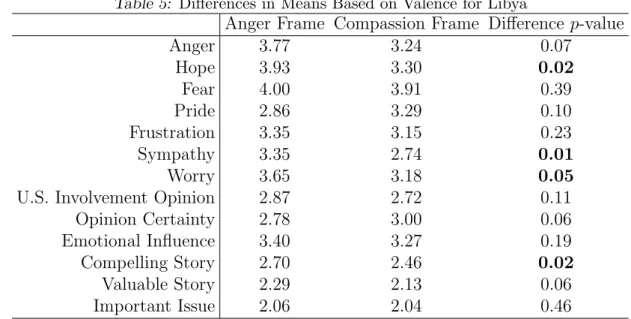
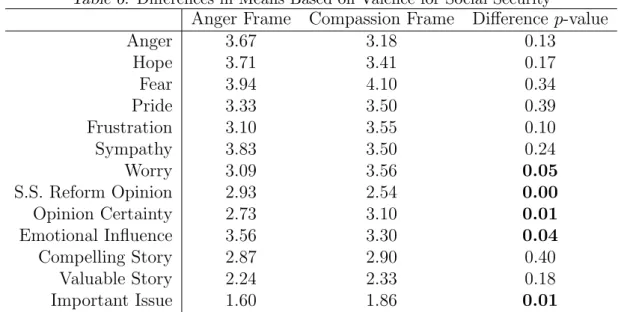
Finally, I am interested in whether respondents exposed to an anger frame were affected differently than those exposed to a compassion frame. I expect a positive emotion like compassion to generate more support for an issue and a negative emotion like anger to generate less support. Tables 5 and 6 show differences in the mean values of emotional intensity, opinions, perceived strength, and issue importance for the different frames. Again, the tables show very few differences. While those exposed to a Libya compassion frame feel higher levels of hope, sympathy, and worry, this does not translate to differing opinions. Those exposed to a Social Security compassion frame are more supportive of reforming Social Security, and respondents exposed to a Social Security anger frame consider the issue more important. However, these do not appear to be results of differences in emotions.
Table 5: Differences in Means Based on Valence for Libya
Anger Frame Compassion Frame Difference p-value
Anger 3.77 3.24 0.07
Hope 3.93 3.30 0.02
Fear 4.00 3.91 0.39
Pride 2.86 3.29 0.10
Frustration 3.35 3.15 0.23
Sympathy 3.35 2.74 0.01
Worry 3.65 3.18 0.05
U.S. Involvement Opinion 2.87 2.72 0.11
Opinion Certainty 2.78 3.00 0.06
Emotional Influence 3.40 3.27 0.19
Compelling Story 2.70 2.46 0.02
Valuable Story 2.29 2.13 0.06
Important Issue 2.06 2.04 0.46
Table 6: Differences in Means Based on Valence for Social Security
Anger Frame Compassion Frame Difference p-value
Anger 3.67 3.18 0.13
Hope 3.71 3.41 0.17
Fear 3.94 4.10 0.34
Pride 3.33 3.50 0.39
Frustration 3.10 3.55 0.10
Sympathy 3.83 3.50 0.24
Worry 3.09 3.56 0.05
S.S. Reform Opinion 2.93 2.54 0.00
Opinion Certainty 2.73 3.10 0.01
Emotional Influence 3.56 3.30 0.04
Compelling Story 2.87 2.90 0.40
Valuable Story 2.24 2.33 0.18
Important Issue 1.60 1.86 0.01
Smaller mean values indicate greater emotional intensity, more favorable opinions, more certainty, and greater emotional intensity, perceived story strength, and issue importance. Bold entires are significant atp=0.05 for a one-tailed test.
Discussion
What all of these results indicate is that the experimental treatments simply did not work as intended. Those in the high intensity emotion conditions do not report feeling a higher intensity of emotions. Increases in emotional intensity are not systematically related to opinions, perceived issue importance, or perceived strength of the frames for either issue. However, I do not take this as a rejection of my theoretical model. There are many potential reasons why the experiment did not uncover the expected results.
deployment, Muammar el-Qaddafi was killed by Libyan forces. This event likely influenced respondents’ views of the Libyan civil war. In addition, both issues are not highly salient for college students. Foreign policy and Social Security are issues that do not occupy a prominent place in a college student’s thoughts, pos-sibly making it difficult for respondents to feel invested in the issue.13 Future experiments should try to use more salient issues.
The news stories and the way in which the emotional manipulations were cre-ated may also be problematic. These articles used emotion words in an attempt to elicit stronger emotional reactions. The manipulation obviously did not work. As outlined above, many other factors may influence emotional reactions, including values, narrative, symbolism, and imagery. It is possible that the emotional words inserted into the high intensity frames were not adequate, or that other methods are needed to adequately manipulate the intensity of respondents’ emotional reac-tions. Future studies need to develop several potential manipulations and pretest them to ensure that the emotional manipulations work correctly. This experiment did not employ a pretest because of time constraints.
approximately 30-40 minute long survey, something most undergraduate students would likely lose interest in quickly. The fact that there were seven emotions that each had a group of five to nine emotional targets associated with them dra-matically increased the length of the experiment. Because the respondents were undergraduate students completing the survey as part of a course requirement, it is likely that, after a certain point, they stopped reading the articles carefully or answering the questions accurately.
The results also likely revealed nothing of note due to the low sample size, which is also related to the survey design. After respondents read an article, they were asked if they felt each of seven emotions. Only if they answered in the affirmative were they prompted to indicate how strongly they felt a particular emotion. Though each treatment condition had between 50 and 60 total respon-dents, this design choice greatly reduced the number of respondents for the main independent variable, which was especially a problem for the regression analyses. In most cases, fewer than 20 respondents reported feeling a particular emotion after reading a news article, meaning that every comparison and model that uses emotional intensity as a predictor has an extremely small number of observations off of which to make inferences. Oftentimes, including controls in a model added too many degrees of freedom, leaving too few pieces of information for the model to be estimated. In many cases, differences between groups or relationships in the correct direction do exist, but the small sample size creates high uncertainty in the estimates, making it difficult to draw valid inferences.
More engaging stories evoke stronger emotions, leading to a greater impact on at-titudes (Busselle and Bilandzic 2009; de Graaf et al. 2011; Green and Brock 2000). Although the frames developed for this experiment are not specifically narrative in style, they do attempt to elicit emotions. And while the frames are not partic-ularly effective, the fact that the emotionality they elicit is linked to finding the frames compelling indicates that emotional intensity plays an important role in how frames are viewed. Future studies should incorporate a more effective mea-sure of engagement to further explore the relationship between engagement with a frame and resulting emotions.
APPENDIX
Experimental Articles
Fig. 3: Libya Anger Low Intensity Frame
WHITE HOUSE DEFENDS CONTINUING U.S. ROLE IN LIBYA OPERATION
By Terrence Ryan June 15, 2011
OMAHA — The White House, responding to criticism in Congress over the air war in Libya, stated today that President Obama had the authority to continue the military campaign without Congressional approval because American involvement fell short of full-blown hostilities.
In a 38-page report sent to lawmakers describing and defending the NATO-led operation, the White House said the objectives were, protecting Libya’s civilian population while also loosening Col. Muammar el-Qaddafi’s grip on power.
In contending that the limited American role did not obligate the Administration to ask for authorization under the War Powers Resolution, the report stated that “U.S. operations do not involve sustained fighting or active exchanges of fire with hostile forces, nor do they involve U.S. ground troops.”
Essentially, the White House argues that the situation in Libya does not constitute a war, and therefore the War Powers Resolution should not apply to it.
The report came one day after the House speaker, John A. Boehner, Republican of Ohio, had sent a letter to Mr. Obama informing him that he appeared to be out of time under the War Powers Resolution, which says that presidents have to terminate a mission 60 or 90 days after notifying Congress that troops have been deployed into “hostilities,” unless lawmakers vote for the operation to continue.
The Libyan crisis began when its people took to the streets in February to seek reforms and stand up for their human rights. Qaddafi’s security forces responded with extreme violence. Rather than respond to the international community’s demand for an end to the violence, Qaddafi’s forces continued their assault against the Libyan people.
On March 17, the United Nations Security Council responded by calling for an immediate cease-fire and approving a no-fly zone over Libya. Joining with a coalition of allies, including NATO partners, the United States has aided in the protection of Libya’s civilian population.
Despite the humanitarian origins of the mission, over the last few months there has been increasing criticism toward the Obama administration by both Democrats who oppose the war and Republicans who cite Constitutional issues over the President’s failure to seek authorization from Congress for the operations. Both Democrats and Republicans have voiced concern that the President “has ignored Congress,” and ignored the essence of the War Powers Resolution—that Congress should be consulted before taking the country into war.
It is no surprise, then, that Republican Speaker Boehner has told President Obama that the House considers the situation a problem, and therefore might seek through resolutions to end or limit the United State’s involvement in Libya, or through the power of the purse to “defund” its participation.
Fig. 4: Libya Anger High Intensity Frame
WHITE HOUSE DEFENDS CONTINUING U.S. ROLE IN LIBYA OPERATION By Terrence Ryan
June 15, 2011
OMAHA — The White House, pushing hard against criticism in Congress over the deepening air war in Libya, claimed today that President Obama had the authority to continue the military campaign without Congressional approval because American involvement fell well short of full-blown hostilities.
In a 38-page report sent to lawmakers describing and defending the NATO-led operation, the White House said the key objectives were, foremost, protecting Libya’s civilian population while also loosening Col. Muammar el-Qaddafi’s brutal grip on power.
In declaring that the limited American role did not compel the Administration to receive authorization under the War Powers Resolution, the report asserted unequivocally that “U.S. operations do not involve sustained fighting or active exchanges of fire with hostile forces, nor do they involve U.S. ground troops.”
Essentially, the White House maintains that the situation in Libya does not constitute a war, and therefore the War Powers Resolution simply does not apply to it.
The report came one day after the House speaker, John A. Boehner, Republican of Ohio, had sent a letter to Mr. Obama warning him that he was out of time under the War Powers Resolution, which says that presidents must terminate a mission 60 or 90 days after notifying Congress that troops have been deployed into “hostilities,” unless lawmakers authorize the operation to continue.
The Libyan crisis began when its people took to the streets in February to seek democratic reforms and stand up for their human rights. Qaddafi’s security forces responded with extreme violence. Rather than respond to the international community’s demand for an end to the violence, Qaddafi’s forces continued their assault against the Libyan people.
On March 17, the United Nations Security Council responded by calling for an immediate cease-fire and approving a no-fly zone over Libya. Joining with a coalition of allies, including NATO partners, the United States has aided in the protection of Libya’s people.
Despite the humanitarian origins of the mission, over the last few months there has been increasing hostility toward the Obama administration by both Democrats who strongly oppose the war and Republicans who cite Constitutional issues over the President’s refusal to seek permission from Congress for the operations. Both Democrats and Republicans have angrily voiced alarm that the President “has ignored Congress,” and ignored the very essence of the War Powers Resolution—that Congress must be consulted before pulling the country into war.
It is no surprise, then, that Republican Speaker Boehner has repeatedly cautioned President Obama that the House judges the situation indefensible, and therefore could seek through resolutions to end or severely limit the United State’s involvement in Libya, or through the power of the purse to “defund” its participation.
Fig. 5: Libya Compassion Low Intensity Frame
THE U.N. APPROVES NO-FLY ZONE OVER LIBYA By Terrence Ryan
March 17, 2011
OMAHA — Today, the United Nations Security Council called for a cease-fire in Libya and approved the establishment of a no-fly zone over Libyan territory. “Expressing concern at the situation, violence, and civilian causalities,” the council approved the measure by a vote of 10 to 0, with five abstentions.
In broad language, the council authorized member nations to take “all necessary measures” short of “foreign occupation” to protect civilians.
The vote marked a turn in the world’s response to the situation in Libya after weeks of debate and reluctance by many to intervene, and it comes as rebel forces were said to be struggling in Benghazi. The costs of inaction could have been substantial; thousands of civilians might have been killed.
The Security Council’s action comes less than a month after it had passed Resolution 1970 reminding the Libyan authorities of their responsibility to protect their population and respect human rights and international humanitarian law. At that time, the
Security Council had also voted to impose sanctions on Libya’s leader, Muammar el-Qaddafi, and his inner circle of advisers, and called for an international war crimes investigation into the regime’s crackdown on Libyan citizens who had protested against the government.
The crisis began when the Libyan people took to the streets in February to seek reforms and stand up for their human rights. Qaddafi’s security forces responded with violence. Fighter jets and helicopter gunships attacked people who had no means to defend themselves. There were reports of government agents raiding homes and hospitals to round up or kill wounded protestors, and of killings, arrests, and torture as Qaddafi’s forces began attacks on cities that were standing up against his rule.
Rather than respond to the international community’s demand for an end to the violence, Qaddafi’s forces continued their campaign against the Libyan people. The people of Libya appealed to the world for help.
Fig. 6: Libya Compassion High Intensity Frame
THE U.N. APPROVES NO-FLY ZONE OVER LIBYA
By Terrence Ryan March 17, 2011
OMAHA — Today, the United Nations Security Council called for an immediate cease-fire in Libya and approved the establishment of a no-fly zone over Libyan territory.
“Expressing grave concern at the deteriorating situation, the escalation of violence, and the heavy civilian causalities,” the council approved the measure by a vote of 10 to 0, with five abstentions.
In broad language, the council authorized member nations to take “all necessary measures” short of “foreign occupation” to protect civilians under threat of attack.
The vote marked a dramatic turn in the world’s response to the Libyan crisis after weeks of debate and reluctance by many to intervene, and it comes as courageous rebel forces were said to be teetering on the brink of defeat in Benghazi. The costs of inaction could have been profound; thousands of civilians might have been slaughtered.
The Security Council’s decisive action comes less than a month after it had passed Resolution 1970 firmly reminding the Libyan authorities of their fundamental responsibility to protect their people and respect human rights and international humanitarian law. At that time, the Security Council had also voted unanimously to impose sanctions on Libya’s leader, Muammar el-Qaddafi, and his inner circle of advisers, and called for an international war crimes investigation into the regime’s bloody
crackdown on Libyan citizens who had spoken out against the murderous regime.
The crisis began when the Libyan people took to the streets in February to seek democratic reforms and stand up for their basic human rights. Qaddafi’s security forces responded with extreme violence. Fighter jets and helicopter gunships fired on people who had no means to defend themselves. There were reports of government agents storming homes and hospitals to kidnap or kill wounded protestors, and of random killings, arbitrary arrests, and torture as Qaddafi’s forces began a full-scale assault on cities that were standing up against his rule.
Rather than respond to the international community’s demand for an end to the violence, the government’s forces continued their brutal assault against the Libyan people. The people of Libya cried out to the world for help.
Fig. 7: Social Security Anger Low Intensity Frame
SOCIAL SECURITY TAKES CENTER STAGE IN DEFICIT TALKS
By Carl Landler July 6, 2011
OMAHA – President Obama is set to work for a deficit deal that will compel congressional Democrats to accept cuts to Social Security. Mr. Obama plans to announce his proposal at a meeting with House and Senate leaders tomorrow, where he will press policymakers to take action on addressing the federal budget deficit.
After a secret meeting with House Speaker John A. Boehner (Republican-OH) over the weekend, the president has raised his sights as Mr. Boehner has signaled a renewed willingness to bargain on revenues.
While Mr. Boehner has become open to the possibility of ending certain tax breaks and closing loopholes, Republicans continue to argue that any deficit plan contain no new tax increases. “We are not for any proposal that increases taxes,” said House Majority Leader Eric Cantor (Republican-VA).
Cuts to Social Security had previously been off the table in negotiations, and some Democrats have expressed alarm at the president's proposal. “Depending on what they decide to recommend, they may not have Democrats,” Senator Sheldon Whitehouse, a Rhode Island Democrat, said in an interview.
The negotiations between the president and the speaker have raised concern. Democrats are worried that they will be asked to accept a deal that is too heavily tilted toward Republican ideas and that produces too little new revenue relative to the amount of the cuts in programs like Social Security.
Senate Democrats have introduced their own plan, which leaves Social Security untouched while proposing cuts at the Pentagon, as well as $2 trillion in higher taxes, primarily on those earning more than $1 million per year.
Republicans have rejected that plan, saying a tax increase would be bad for an economy already hurt by a 9.2 percent unemployment rate. “We want to tackle deficit reduction in a way that doesn’t exacerbate unemployment,” said Senate Minority Leader Mitch
McConnell (Republican-KY).
Republicans also claim that the Democratic plan does too little to address the deficit and federal spending.
Fig. 8: Social Security Anger High Intensity Frame
SOCIAL SECURITY TAKES CENTER STAGE IN DEFICIT TALKS By Carl Landler
July 6, 2011
OMAHA – President Obama is set to argue for a far-reaching deficit deal that will force congressional Democrats to accept unpopular cuts to Social Security. Mr. Obama plans to announce his proposal at a meeting with House and Senate leaders tomorrow, where he will push policymakers to take action on controlling the growing federal budget deficit.
After a secret meeting with House Speaker John A. Boehner (Republican-OH) over the weekend, the president has dramatically raised his sights as Mr. Boehner has signaled a renewed willingness to bargain on revenues.
While Mr. Boehner has become open to the possibility of ending certain tax breaks and closing loopholes, Republicans continue to demand that any deficit plan must not contain new tax increases. “We are not for any proposal that increases taxes,” declared House Majority Leader Eric Cantor (R-VA).
Cuts to Social Security had previously been off the table in negotiations, and some
Democrats have voiced grave alarm at the president's surprising proposal. “Depending on what they decide to recommend, they may not have Democrats,” Senator Sheldon
Whitehouse, a Rhode Island Democrat, warned in an interview.
The intensifying negotiations between the president and the speaker have created anxiety. Democrats are fearful that they will be forced to accept an unfair deal that is far too heavily tilted toward Republican ideas and produces much too little new revenue relative to the magnitude of the cuts in programs like Social Security.
Senate Democrats have introduced their own opposing plan, which leaves Social Security completely untouched while proposing sharp cuts at the Pentagon, as well as more than $2 trillion in higher taxes, primarily on families earning more than $1 million per year.
Republicans have emphatically rejected that plan, saying that absolutely any tax increase would be devastating for a faltering economy already weighed down by a 9.2 percent unemployment rate. “We want to tackle deficit reduction in a way that doesn’t exacerbate unemployment,” pronounced Senate Minority Leader Mitch McConnell (Republican-KY).
Republicans also claim that the Democratic plan does too little to confront the ballooning deficit and out of control federal spending.
Fig. 9: Social Security Compassion Low Intensity Frame
CONGRESS CLOSE TO DEAL ON SOCIAL SECURITY REFORM By Carl Landler
June 28, 2011
OMAHA – Leaders in Congress are close to a deal to reform Social Security, after talks that have lasted months. With the president and leaders of both parties in Congress wanting to compromise, lawmakers are coming together on an agreement to address the future of Social Security.
The proposal being discussed would increase the cap on income subject to the Social Security tax from $107,000 to $250,000 while also increasing benefits to those affected. In addition, the plan would further reduce benefits to those who choose to retire before age 67, the current age required to receive full benefits.
Speaking at the Capitol, House Majority Leader Eric Cantor (Republican-VA) said the deal "ensures that seniors receive the benefits they have earned and that they will continue to do so for decades to come." Echoing those statements, Senate Majority Whip Richard Durbin (Democrat-IL) added, "We must pass this bill to protect Social Security for future generations and retain a financial safety net for their retirement."
Supporters of the plan describe it as a major bill that, if passed, would keep Social Security financially sound for decades to come while providing benefits to those in need. “Our seniors deserve security and peace of mind,” said Jennifer Marcom, spokesperson for the AARP. “They have been paying into this program their whole lives and the government has an obligation to repay them. This reform will uphold a commitment while safeguarding Social Security for today's children.”
According to the Congressional Budget Office, the Social Security Trust Fund will be depleted in 2039, at which point the program will no longer be able to pay out full benefits to retirees. Many claim that if this happens, the vulnerable will not receive the assistance they need.
Fig. 10: Social Security Compassion High Intensity Frame
CONGRESS CLOSE TO DEAL ON SOCIAL SECURITY REFORM
By Carl Landler June 28, 2011
OMAHA – Leaders in Congress are close to a deal to reform Social Security, after talks that have lasted months. With the president and leaders of both parties in Congress eager to compromise, lawmakers are coming together on an agreement to address the financial health of Social Security.
The proposal being discussed would increase the cap on income subject to the Social Security tax from $107,000 to $250,000 while also increasing much needed benefits to the elderly. In addition, the plan would further reduce benefits to those who choose to retire before age 67, the current age required to receive full benefits.
Speaking at the Capitol, House Majority Leader Eric Cantor (Republican-VA) said the deal "ensures that at-risk seniors receive the essential benefits they have rightfully earned and that they will continue to do so for decades to come." Echoing those
statements, Senate Majority Whip Richard Durbin (Democrat-IL) added, "We must pass this bill to save Social Security for future generations and safeguard a vital financial safety net for their retirement."
Supporters of the plan hail it as a landmark that, if passed, would keep Social Security financially sound for decades to come while providing crucial benefits to those in the most need. “Our hard-working seniors deserve security and peace of mind,” said Jennifer Marcom, spokesperson for the AARP. “They have been faithfully paying into this program their whole lives and the government has a moral obligation to repay them. This reform will uphold a worthy commitment while safeguarding Social Security for today's children.”
According to the Congressional Budget Office, the Social Security Trust Fund will be exhausted in 2039, at which point the program will no longer be able to pay out full benefits to needy retirees. Many fear that if this happens, the truly vulnerable will not receive the aid they desperately need.
Opinion Questions
Libya Anger
1. Do you favor or oppose Congress using the War Powers Resolution to require the President to seek authorization for U.S. military involvement in Libya?
2. Do you favor or oppose U.S. involvement in Libya?
Libya Compassion
1. Do you favor or oppose the United Nations’ establishment of a no-fly zone over Libya?
2. Do you favor or oppose U.S. involvement in Libya?
Social Security Anger
1. Do you favor or oppose the President’s plan to reduce the deficit, in part, by cutting Social Security?
2. Do you favor oppose the Republicans’ plan to reduce the deficit without any new tax increases?
Social Security Compassion
REFERENCES
Aaroe, Lene. 2011. “Investigating Frame Strength: The Case of Episodic and Thematic Frames.”Political Communication 28:207–226.
Atchley, Ruth Ann, Ryan Stringer, Eric Mathias, Stephen S. Ilardi and April Di-ane Minatrea. 2007. “The right hemisphere’s contribution to emotional word processing in currently depressed, remitted depressed, and never-depressed in-dividuals.”Journal of Neurolinguistics 20:145–160.
Barker, David C. 2005. “Values, Frames, and Persuasion in Presidential Nomina-tion Campaigns.”Political Behavior 27(4):375–394.
Barrett, Lisa Feldman, Kevin N. Ochsner and James J. Gross. 2006. On the auto-maticity of emotion. InSocial psyhcology and the unconscious: The automaticity of higher mental processes, ed. J. Bargh. New York: Psychology Press.
Berinsky, Adam and Donald Kinder. 2006. “Making Sense of Issues Through Media Frames: Understanding the Kosovo Crisis.” Journal of Politics 68(3):640–656.
Bodenhausen, G.V. 1993. Emotions, arousal, and stereotypic judgments: A heuris-tic model of affect and stereotyping. InAffect, Cognition, and Stereotyping: In-teractive Processes in Group Perception, ed. D. M. Mackie and D. L. Hamilton. San Diego, CA: Academic Press pp. 13–37.
Brewer, Paul R. 2001. “Value Words and Lizard Brains: Do Citizens Delibertae About Appeals To Their Core Values?” Political Psychology22(1):45–64.
Brewer, Paul R. 2002. “Framing, Value Words, and Citizens’ Explanations of Their Issue Opinions.” Political Communication 19:303–316.
Brewer, Paul R. 2003. “Values, Political Knowledge, and Public Opinion About Gay Rights: A Framing-Based Account.”Public Opinion Quarterly67:173–201.
Brewer, Paul R. and Kimberly Gross. 2005. “Values, Framing, and Citizens’ Thoughts about Policy Issues: Effects on Content and Quantity.”Political Psy-chology 26(6):929–948.
Cahill, Larry, Richard J. Haier, James Fallong, Michael T. Alkire, Cheuk Tang, David Keator, Joseph Su and James L. McGaugh. 1996. “Amygdala activity at encoding correlated with long-term, free recall of emotional information.” Neurobiology93:8016–8021.
Chong, Dennis. 1996. Creating Common Frames of Reference on Political Issues. InPolitical Persuasion and Attitude Change, ed. D. C. Mutz, P. M. Sniderman and R. A. Brody. Ann Arbor, MI: University of Michigan Press pp. 195–224.
Chong, Dennis and James N. Druckman. 2007a. “Framing Public Opinion in Competitive Democracies.” American Journal of Political Science 101(4):637– 655.
Chong, Dennis and James N. Druckman. 2007b. “Framing Theory.”Annual Review Political Science 10(1):103–126.
Chong, Dennis and James N. Druckman. 2007c. “A Theory of Framing and Opin-ion FormatOpin-ion in Competitive Elite Environments.”Journal of Communication 57:99–118.
Clore, G. L., R.S. Wyer, B. Dienes, K. Gasper, C. Gohm and L. Isbell. 2001. Affec-tive feelings as feedback: Some cogniAffec-tive consequences. InTheories of mood and cognition: A user’s handbook, ed. L. L. Martin and Gerald L. Clore. Mahwah, NJ: Erlbaum pp. 27–62.
Clore, Gerald L. and Andrew Ortony. 2000. Cognitive in emotion: Never, some-times, or always? In THe cognitive neuroscience of emotion, ed. L. Nadel and R. Lane. New York: Oxford University Press pp. 24–61.
Clore, Gerald L. and Andrew Ortony. 2008. Appraisal theories: How cogni-tion shapes affect into emocogni-tion. In Handbook of Emotions, ed. M. Lewis, J.M. Haviland-Jones and L.F. Barrett. 3rd ed. New York: Guilford Press pp. 628–642.
Clore, Gerald L. and Jeffrey R. Huntsinger. 2007. “How emotions inform judgment and regulate thought.” Trends in Cognitive Sciences11(9):393–399.
Clore, Gerald L. and Justin Storbeck. 2006. Affect as information about liking, ef-ficacy, and importance. InAffect in Social Thinking and Behavior, ed. J. Forgas. New York: Psychology Press pp. 123–142.
and Political Persuasion.”American Journal of Political Science 41(1):88–121.
Corson, Yves and Nadege Verrier. 2007. “Emotionas and False Memories: Valence or Arousal?” Psychological Science 18(3):208–211.
de Graaf, Anneke, Hans Hoeken, Jos Sanders and Johannes W. J. Beentjes. 2011. “Identification as a Mechanism of Narrative Persuasion.” Communication Re-search20(10):1–22.
Druckman, James. 2001a. “On the Limits of Framing Effects: Who Can Frame?” The Journal of Politics 63(4):1041–1066.
Druckman, James N. 2001b. “The Implications of Framing Effects for Citizen Competence.”Political Behavior 23(3):225–256.
Druckman, James N. 2004. “Political Preference Formation: Competition, Delib-eration, and the (Ir)relevance of Framing Effects.”American Journal of Political Science 98(4):671–686.
Druckman, James N. and Kjersten R. Nelson. 2003. “Framing and Deliberation: How Citizens’ Conversations Limit Elite Influence.”American Journal of Polit-ical Science47:729–745.
Druckman, James N. and Rose McDermott. 2008. “Emotion and the Framing of Risky Choice.” Political Behavior 30:297–321.
Dutton, D. and A. Aron. 1974. “Some evidence for heightened sexual attraction under conditions of high anxiety.”Journal of Personality and Social Psychology 30:510–517.
Edy, Jill A. and Patrick C. Meirick. 2007. “Wanted, Dead or Alive: Media Frames, Frame Adoption, and Support for the War in Afghanistan.” Journal of Com-munication 57(1):119–141.
Entman, Robert M. 1993. “Framing: Toward Clarification of a Fractured Paradigm.”Journal of Communication 43(4):51–58.
Green, Melanie C. and Timoty C. Brock. 2000. “The Role of Transportation in the Persuasiveness of Public Narratives.” Journal of Personality and Social Psychology79(5):701–721.
Gross, Kimberly. 2008. “Framing Persuasive Appeals: Episodic and The-matic Framing, Emotional Response, and Policy Opinion.”Political Psychology 29(2):169–192.
Gross, Kimberly and Lisa D’Ambrosio. 2004. “Framing Emotional Response.” Political Psychology25(1):1–29.
Haider-Markel, Donald P. and Mark R. Joslyn. 2001. “Gun Policy, Opinion, Tragedy, and Blame Attribution: The Conditional Influence of Issue Frames.” The Journal of Politics 63(2):520–543.
Han, S., J.S. Lerner and D. Keltner. 2007. “Feelings and consumer decision making: The appraisal-tendency framework.” Journal of Consumer Psychology 17:158– 168.
Hartman, Todd K. and Christopher R. Weber. 2009. “Who Said What? The Effects of Source Cues in Issue Frames.”Political Behavior 31:337–358.
Hastie, Reid and Nancy Pennington. 1995. The Big Picture: Is It a Story? In Knowledge and Memory: The Real Story, ed. R.S. Wyer and T.K. Srull. Hills-dale: Erlbaum pp. 133–38.
Heuer, F. and D. Reisberg. 1990. “Vivid memories of emotional events: The accuracy of remembered minutiae.”Memory and Cognition 18:496–506.
Iyengar, Shanto. 1991. “The Accessibility Bias in Politics: Television News and Public Opinion.”International Journal of Public Opinion Research 2(1):1–15.
Kim, Hyo J. and Glen T. Cameron. 2011. “Emotions Matter in Crisis: The Role of Anger and Sadness in the Publics’ Response to Crisis News Framing and Corporate Crisis Response.” Communication Research 20(10):1–30.
Kinder, Donald R. and Don Herzog. 1993. Democratic Discussion. InReconsidering the Democratic Public, ed. George E. Marcus and Russell L Hanson. University Park: Pennsylvania State University Press.
with Survey Questions: The Case of White Opinion on Affirmative Action for Blacks.” Social Cognition 8(1):73–103.
Kinder, Donald R. and Lynn M. Sanders. 1996. Divided By Color: Racial Politics and Democratic Ideals. Chicago: University of Chicago Press.
Kintsch, Walter. 1998. A Paradigm for Cognition. Cambridge: Cambridge Press.
Lakoff, George. 1996. Moral Politics. Chicago: University of Chicago Press.
Lakoff, George. 2006. Thinking Points. New York: Farrar, Straus, and Giroux.
Lakoff, George. 2008. The Political Mind. New York: Viking.
Lanctot, N. and U. Hess. 2007. “The Timing of Appraisals.” Emotion 7:207–212.
Lerner, Jennifer S. and Dacher Keltner. 2000. “Beyond valence: Toward a model of emotion-specific influences on judgment and choice.”Cognition and Emotion 14:144–150.
Lerner, Jennifer S. and Dacher Keltner. 2001. “Fear, anger, and risk.” Journal of Personality and Social Psychology81:146–159.
Marietta, Morgan. 2009. “The Absolutist Advantage: Sacred Rhetoric in Contem-porary Presidential Debate.”Political Communication 26(4):338–411.
Martin, L. L. 2001. Mood as input: A configural view of mood effects. InTheories of mood and cognition: A user’s guidebook, ed. L. L. Martin and G. L. Clore. Psychology Press pp. 135–157.
Matthews, A. 2006. Anxiety and the encoding of emotional information. In Mem-ory and Emotion: Interdisciplinary Perspectives, ed. B. Uttl, A. Singenthaler and N. Ohta. Malden, MA: Blackwell Publishing Ltd. pp. 37–58.
Miller, Joanne M. and Jon A. Krosnick. 2000. “News Media Impact on the Ingredi-ents of Presidential Evaluations: Politically Knowledgeable Citizens Are Guided by a Trusted Source.” American Journal of Political Science44(2):301–315.
Murphy, Sheila T., Lauren B. Frank, Meghan B. Moran and Paula Patnoe-Woodley. 2011. “Involved, Transported, or Emotional? Exploring the Deter-minants of Change in Knowledge, Attitudes, and Behavior in Entertainment-Education.”Journal of Communication 61:407–431.
Nabi, Robin. 1999. “A Cognitive-Functional Model for the Effects of Discrete Negative Emotions on Information Processing, Attitude Change, and Recall.” Communication Theory9(3):292–320.
Nabi, Robin. 2003. “Exploring the Framing Effects of Emotion: Do Discrete Emo-tions Differentially Influence Information Accessibility, Information Seeking, and Policy Preference?” Communication Research 30(2):224–247.
Nelson, Thomas E. and Donald R. Kinder. 1996. “Issue Frames and Group-Centrism in American Public Opinion.” The Journal of Politics 58(4):1055– 1078.
Nelson, Thomas E., Elaine Willey and Zoe M. Oxley. 1998. “Belief Content, Im-portance, and Accessibility in Issue Opinion.” Presented at the annual meeting of the American Political Science Association, Boston.
Nelson, Thomas E., Rosalee A. Clawson and Zoe M. Oxley. 1997. “Media Framing of a Civil Liberties Conflict and its Effect on Tolerance.” American Political Science Review91(3):567–583.
Nelson, Thomas E., Zoe M. Oxley and Rosalee A. Clawson. 1997. “Toward a Psychology of Framing Effects.” Political Behavior 19(3):221–246.
Ortony, A., G.L. Clore and A. Collins. 1988. The Cognitive Structure of Emotions. Cambridge, UK: Cambridge University Press.
Paulhus, Delroy L. and David T.K. Lim. 1994. “Arousal and evaluative extremity in social judgments: a dynamic complexity model.”European Journal of Social Psychology24:89–99.
Pennington, Nancy and Reid Hastie. 1986. “Evidence Evaluation in Complex Decision Making.”Journal of Personality and Social Psychology51(2):242–258.