Public Health
I
ntroductIonIn order to better address health disparities that disproportionately af-fect ethnic minorities, recruitment of these populations is needed in epidemiological research. There are multiple reported barriers to recruit-ment and retention of ethnic minori-ties in research studies,1-3 particularly
in longitudinal cohort studies4, 5and
clinical trials.6-8 Some of the barriers
are related to study research design9
and a lack of cultural and linguistic appropriate strategies and measures, particularly for minority partici-pants from low socioeconomic back-grounds.10,11 Among
Hispanics/Lati-nos, these types of barriers are marked and include other significant limita-tions such as low inclusion of bilin-gual and culturally competent trained staff12 who represent the same
heri-tage background as those recruited into the research.13 Research findings
have also identified barriers among participants related to the limited knowledge and/or understandings of research studies, mistrust of the re-search community, time constraints, and cost of travel to the study loca-tion.8, 9,14 Difficult procedures and
lengthy questionnaires also impede the recruitment and retention of eth-nic minority groups into research.15,16
The limited number of contem-porary studies conducted among Hispanics/Latinos provides marginal information to effectively design and implement research studies that in-clude culturally appropriate methods and strategies to recruit and retain Hispanics/Latinos. Previous litera-ture suggests staff characteristics (eg, culturally and linguistically compe-tent), attitudes and enthusiasm for the research study, along with person-alized attention can have a positive effect on recruitment and retention efforts among participants in
follow-i
nitiaL
c
ontact
and
e
xamination
v
isit
:
t
he
h
isPanic
c
ommunity
h
eaLth
s
tudy
/
s
tudy
of
L
atinos
(hchs/soL)
Ana C. Talavera, MPH1;Christina Buelna, MA1; Rebeca Espinoza Giacinto, MA, MPH1;
Sheila F. Castañeda, PhD1; Aida Giachello, PhD2; Madeline Crespo-Figueroa, BS3;
Johanne B. Hernández, RN, MBA1; Rosalinda Rodriguez, BS1;
Maria de los Angeles Abreu, MPA, CCPR4; Carlos M. Sanchez, MD5; Krista Perreira, PhD6 Objective: This study examined perceived
satisfaction among Hispanic/Latino individu-als who participated in a baseline examina-tion for the Hispanic Community Health Study/Study of Latinos (HCHS/SOL), a large cohort study of 16,415 adults living in four selected communities.
Method: An estimated 22% (n= 3,584) of participants completed a questionnaire re-garding satisfaction with staff attention, the overall experience during the study exami-nation, and the influence of the informed consent digital video disc (DVD).
Results: The majority of participants who completed the questionnaire expressed overall satisfaction with the study. Most participants reported that staff were friendly, courteous and respectful and study test pro-cedures were clearly explained. Participants who preferred to complete the interview in Spanish felt that the informed consent DVD positively influenced their ability to make an informed decision to enroll in the study. Participants who preferred to complete the interview in English tended to report that the baseline examination was longer than expected compared with participants who completed the interview in Spanish.
Conclusion: Results demonstrate that culturally and linguistically trained staff and the use of the study’s informed consent DVD were effective in explaining study procedures and positively influenced deci-sions to participate in the HCHS/SOL study. These results can inform recruitment and enrollment strategies for future participation of minority groups into longitudinal cohort studies. Ethn Dis. 2016;26(3):435-442; doi:10.18865/ed.26.3.435
Keywords: Recruitment; Retention; Hispan-ics/Latinos; Participant Satisfaction; Longitu-dinal Population-based Studies
1South Bay Latino Research Center, Gradu-ate School of Public Health, San Diego StGradu-ate University, San Diego, CA
2Feinberg School of Medicine, Department of Preventive Medicine, Northwestern University, IL
3Einstein College of Medicine, Bronx, NY 4Collaborative Studies Coordinating Center, University of North Carolina, Chapel Hill, NC
5Institute for Minority Health Research, University of Illinois at Chicago, IL
6Collaborative Studies Coordinating Center -Department of Public Policy, University of North Carolina, Chapel Hill, NC
up cohort studies and prevention research.13,17 In particular, successful
retention of study participants in lon-gitudinal studies should begin during the recruitment phase. Willingness to participate in this type of study can be assessed during the initial stages of the screening process by allow-ing ample time for potential partici-pants to consider participation in the research study.18 Hunt and White
(1998) stressed the importance of communicating the expectations of participation and necessary tasks in-volved to maximize retention efforts and ensure participant satisfaction.17
Inclusion of culturally and linguisti-cally aligned, well-trained and dedi-cated staff throughout the recruit-ment, data collection and follow-up phase is pivotal to retention and study acceptability.19 Particular importance
should be placed on hiring staff that best represents both the heritage and local language of the study partici-pants.20 Training of staff is essential
to maintain linguistic and cultural competency to effectively carry out related study activities and improve cultural appropriateness and overall participant satisfaction. Among His-panics/Latinos, traditional cultural values such personalismo, respeto, fa-milismo and gender norms are im-portant factors to consider through-out all aspects of the study.21,22
While findings in literature have identified important components described previously that may be predictive of study participation and retention,19 no research to date,
to our knowledge, has focused on evaluating the relative effectiveness of these strategies for recruiting and retaining Hispanic/Latino
partici-pants. Recruiting and retaining par-ticipants is especially challenging for prospective population-based studies which, in part, is due to the length involved in longitudinal cohort stud-ies. In order to increase involvement of minority populations in research studies it is essential to gain a bet-ter understanding of the debet-termi- determi-nants that influence participation. The aim of our study was to
ex-level of satisfaction regarding aspects of the baseline examination, which included recruitment experience, baseline examination, overall staff at-tention, and the field center environ-ment. The secondary aim of our study was to examine the extent to which the viewing of the informed consent DVD for the study influenced deci-sions among individuals to partici-pate in the study. Lastly, we assessed the perceived burden of the 7.5-hour baseline examination among par-ticipants in the HCHS/SOL study.
M
ethodsParticipants in HCHS/SOL in-cluded 16,415 adults aged 18 to 74 years living in Bronx, NY; Chicago, IL; Miami, FL; and San Diego, CA at time of recruitment. Eligibil-ity, study examination methods, design and sampling are described in more detail in previous publica-tions.23, 24 This study was approved
by the institutional review boards at the data coordinating center and at each field center where all par-ticipants gave written consent. Following completion of the base-line examination, a self-administered, optional participant feedback ques-tionnaire was provided to participants in the participants’ preferred language. The questionnaire was developed by the HCHS/SOL Retention Commit-tee, with national membership repre-sentation of field center investigators, research staff and sponsors. The pur-pose of the questionnaire was to: 1) improve study operations; 2) assess perceived satisfaction of the study visit; and 3) determine factors that
The aim of our study
was to examine
perceived satisfaction
among Hispanic/
Latino participants to
guide future research
practices and procedures
in longitudinal cohort
studies.
facilitate the retention of Hispanics/ Latinos in longitudinal studies. The questionnaire consisted of 16 closed-ended questions targeting aspects of the recruitment process, the baseline examination visit, the overall staff at-tention, and the field center environ-ment. The estimated average time to complete the questionnaire was about 2 minutes. Only a select num-ber of questions were analyzed. Three open ended questions asked: 1) how the examination visit could be more comfortable; 2) how the overall study experience could be improved; and 3) if respondent wanted to make addi-tional comments. We examined the frequencies of the questions and sum-marized the open-ended questions. Approximately 22% of the total HCHS/SOL participants completed the participant feedback question-naire. There were several reasons for the relatively low participation: 1) delay in the implementation of the feedback questionnaire; 2) the questionnaire was optional due to the length (7.5 hours) of the com-plete examination visit and desire to minimize burden; and, 3) other logistics such as participant’s flow at the end of the baseline examination visit. When time permitted, par-ticipants were asked to complete the feedback questionnaire at the end of the visit, or to return the form with other study-related assessments. An informational DVD was de-veloped by the HCHS/SOL team of investigators through a contract with a professional media consultant. The informed consent DVD was shown to individuals who agreed to partici-pate in the study upon arrival to the local field center for the study
exami-nation visit as part of the informed consent process. This DVD included 15-20 minutes of background in-formation illustrating the historical significance of the study, and depict-ing key players as spokespersons (ie, study participants, principal investi-gators, representatives of the funding sponsors, and key members of the re-search staff). The DVD also described the four study field centers and the locations where the study examina-tions were to take place, description of the study procedures, and the time commitment and importance of long-term participation to the success of the study. Trained bilingual and bi-cultural research staff, including those involved in the initial screening for el-igibility and enrollment, were trained to respond to participants’ questions.
Statistics
To analyze the closed-ended ques-tions and demographic information, SAS version 9.2 was used to incor-porate the complex sampling design and the sampling weights. All values were weighted to adjust for the un-equal selection of the sample and were calibrated to the 2010 Census characteristics by age, sex and His-panic background in each field cen-ter’s target population. Analyses also accounted for the cluster sampling and the stratification in sample selec-tion. Frequencies and standard errors are reported to summarize the charac-teristics of the participants that com-pleted the participant feedback ques-tionnaire. Some of the demographic characteristics reported included age, sex, language preference, income, etc. These characteristics were stratified by the interaction of sex and language
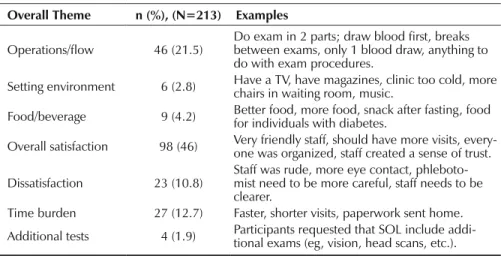
preference (Table 1). Frequencies of responses for closed-ended questions, stratified by the interaction between sex and language preference, were reported for participant responses. A series of Rao-Scott F adjusted Chi-square tests for independence were conducted to examine the relation-ship between sex, language prefer-ence, and the items in the Participant Feedback Questionnaire. Statistical significance was determined at an alpha level of .05 for all tests (Table 2). For the analysis of the open-ended responses, inductive content analytic methods were used to develop salient themes and patterns.25 A summary of
themes, frequencies, and examples for the question on improving partici-pant comfort are presented in Table 3.
r
esultsdemographic characteristics (eg, sex, age; data not shown). However, giv-en that field cgiv-enter and background groups were collinear (eg, more indi-viduals of Cuban heritage in Miami, more individuals of Mexican heritage in San Diego), and that there were discrepancies in completion by field centers, the Hispanic/Latino heritage background varied for those who completed the feedback questionnaire compared with those who did not. More participants from Cuban (35%) and Mexican (37%) heritage groups
completed the questionnaire com-pared with participants of Domini-can, Central AmeriDomini-can, Puerto RiDomini-can, South American heritage, or more than one/other heritage group (com-pletion rate ranged from 3% to 8%). Participants’ demographic data are presented in Table 1. To summa-rize, among females who preferred to complete the survey in Spanish, about 46% had greater than a high school de-gree and 65% who preferred to com-plete the questionnaire in English had greater than a high school education.
With regard to male participants who completed the questionnaire in Span-ish, about 42% had greater than a high school education and 56% of partici-pants who preferred to complete ques-tionnaires in Spanish had a high school degree or higher. The majority of the participants who completed the feed-back questionnaire were not US-born (80%), most were between aged 25 to 54 years (60%), and approximately 23% were between aged 55 to 74 years. Table 2 presents the results for selected questionnaire items. Across
Table 1. HCHS/SOL participant demographics
Language Preference by Sex Interaction
Female (2,204) Male (N=1,380)
All (N=3,584) (n=1,892)Spanish (n=312)English Spanish (1,093) English (n=287)
Age
18-24 15.40 (1.05) 9.02 (1.07) 35.76 (4.20) 13.53 (1.68) 29.44 (3.78) 25-34 19.18 (1.11) 16.77 (1.34) 25.27 (4.15) 17.58 (1.70) 28.38 (4.62) 35-44 22.48 (.99) 22.83 (1.17) 17.36 (2.84) 25.03 (1.92) 17.16 (3.08) 45-54 19.09 (.79) 21.47 (.96) 14.48 (4.74) 19.24 (1.18) 13.37 (2.13) 55-64 13.81 (.80) 16.55 (1.06) 5.44 (.96) 13.85 (1.02) 9.86 (4.46) 65-74 10.03 (.74) 13.36 (1.05) 1.68 (.73) 10.77 (1.43) 1.78 (1.20) Average years, M (SE) 42.34 (.44) 45.60 (.54) 33.00 (1.29) 43.22 (.70) 34.58 (1.33) Income
<$20,000 47.36 (1.90) 56.93 (1.87) 38.43 (5.08) 45.92 (2.38) 25.89 (3.81) $20,001- 50,000 40.63 (1.32) 36.84 (1.54) 46.95 (4.91) 42.33 (2.04) 43.77 (4.60) >$50,000 12.01 (1.70) 6.23 (1.16) 14.62 (2.60) 11.75 (1.81) 30.34 (5.29) Employment statusa
Retired 8.71 (.72) 10.68 (.97) 2.74 (.76) 9.32 (1.25) 4.08 (1.59) Not working 43.20 (1.23) 47.86 (1.50) 53.58 (4.44) 34.32 (2.15) 45.90(4.09) Employed 48.09 (1.17) 41.47 (1.42) 43.69 (4.47) 56.36 (2.15) 50.02 (4.01) Education
< High school 26.16 (1.18) 29.74 (1.45) 13.28 (2.60) 28.61 (2.06) 15.13 (2.97) High school grad 26.39 (1.02) 23.89 (1.29) 21.47 (2.88) 29.71 (1.82) 28.92 (3.34) >High school 47.45 (1.19) 46.38 (1.64) 65.24 (4.00) 41.68 (2.02) 55.95 (3.86) US-bornb
No 80.90 (1.44) 94.04 (.82) 38.45 (5.25) 90.88 (1.34) 33.66 (4.47) Yes 19.10 (1.44) 5.96 (.82) 61.55 (5.25) 9.11 (1.34) 66.34 (4.47) Immigrant Generation
1st Immigrant generation 79.24 (1.52) 92.33 (1.00) 36.96 (5.29) 90.05 (1.39) 29.45 (4.38) 2nd Immigrant generation 20.76 (1.52) 7.67 (1.00) 63.04 (5.29) 9.95 (1.39) 70.55 (4.38)
Data are % (SE) unless otherwise indicated.
a. Employment was derived using responses to several self-reported questions. The first category represents participants who were retired and not currently employed, the second category represents participants who were not retired and not currently employed, the third category represents participants who were either employed part-time (< 35 hours/week) or employed full-time (>35 hours/week).
both sexes and language, most par-ticipants (99%) liked their visit to the field center either somewhat or a lot compared with not at all or very little (1.39%). Almost all participants (99%) felt that the baseline exami-nation tests were explained clearly, rated staff as good in terms of respect, and friendliness and courtesy (99%). Regardless of sex, more Spanish-speaking participants (female=92%, male=90%) watched the informed consent DVD compared with English speakers (female=71%, male=81%).
However, more English-speaking fe-males found that the DVD about informed consent helped their under-standing of the study “a lot” (64%) compared with Spanish-speaking females (53%). Yet, more Spanish-speaking participants felt that the in-formed consent DVD influenced their decision to participate in the study “a lot” (female=50%, male=48%). Participants were asked to rate the length of the examination visit by choosing from three possible re-sponses (shorter than expected, what
was expected or longer than expected). Of those participants who preferred English, 24% of female participants and 25% of male participants felt that the baseline examination was longer than expected compared with both Spanish-speaking females (13%) and males (13%). However, regard-less of sex and language preference, 54% of the participants reported the length of the examination exactly as it was expected; while fewer male English-speakers reported that the visit was shorter than expected (21%).
Table 2. Participant satisfaction with exam visit experience: language preference by sex interactiona
Language Preference by Sex Interaction
Female Male
All Spanish English Spanish English
% (SE) % (SE) % (SE) P % (SE) % (SE) P
Enjoyed your visit to center
Not at all or very little 1.39 (.34) .79 (.27) .88 (.48) .0310 1.28 (.41) 4.24 (2.37) .0517 Somewhat or a lot 98.61 (.34) 99.21 (.27) 99.12 (.48) 98.72 (.41) 95.76 (2.37) Study visit tests were explained clearly
Yes 99.48 (.14) 99.53 (.16) 99.94 (.06) .0223 99.26 (.33) 99.66 (.25) .3375 Rate the respect you were shown by the staff
Good 99.04 (.29) 99.36 (.28) 98.72 (.69) .3061 99.54 (.21) 96.66 (2.03) .0024 Fair or poor .96 (.29) .64 (.28) 1.28 (.69) .46 (.21) 3.34 (2.03) Friendliness and courtesy of staff
Good 99.18 (.18) 99.01 (.29) 99.47 (.39) .4213 99.34 (.26) 99.14 (.66) .7618 Fair or poor .82 (.18) .99 (.29) .53 (.39) .66 (.26) .86 (.66)
Watched informed consent DVD
Yes 88.08 (1.06) 92.27 (.80) 71.29 (5.37) <.0001 89.76 (1.53) 80.55 (3.46) .0092 Informed consent DVD increased understandingb
Not at all 2.50 (.40) 1.59 (.40) 4.38 (1.97) .0066 2.98 (.68) 3.38 (1.54) .4903 Very little 4.90 (.60) 5.13 (.68) 3.04 (1.05) 4.18 (.82) 7.53 (2.94) Somewhat 40.21 (1.25) 40.73 (1.70) 28.82 (4.61) 42.00 (2.10) 39.50 (5.29) A lot 52.38 (1.31) 52.55 (1.79) 63.76 (4.60) 50.84 (2.18) 49.59 (4.50) Influence of informed consent DVD on participationb
Not at all 8.63 (1.17) 4.72 (.82) 22.93 (4.30) <.0001 5.68 (.84) 24.89 (5.79) <.0001 Very little 8.70 (.78) 7.05 (.97) 9.60 (2.32) 7.81 (.96) 17.57 (3.80) Somewhat 36.82 (1.30) 37.89 (1.70) 30.66 (4.86) 38.68 (2.03) 30.40 (5.30) A lot 45.85 (1.64) 50.34 (1.70) 36.81 (4.09) 47.83 (2.18) 27.14 (4.09) Expectation for length of time of examination
Shorter than expected 30.51 (1.28) 32.23 (1.68) 32.15 (5.41) .0027 31.30 (1.98) 20.80 (3.52) .0016 What you expected 54.31 (1.29) 55.24 (1.44) 43.13 (4.39) 56.01 (2.29) 54.09 (4.40) Longer than expected 15.17 (.92) 12.54 (.95) 24.72 (4.06) 12.69 (1.40) 25.11 (4.64)
Participant Feedback
Assessed through Open-ended
Questions
Of the 3,584 participants who completed the Participant Feedback Questionnaire, 229 (6%) provided suggestions for improving the HCHS/ SOL visit. Themes between and with-in participant responses to improve their study visit are summarized in Table 3. A total of two coders and percent agreement was used to cal-culate inter-coder agreement. Agree-ment between coders was 95%, which is considered an acceptable level of agreement.21 In cases where there was
disagreement, the coders discussed the themes and were able to reach an agreement. Of the total 213 responses coded, 16 responses were determined to be low frequency responses or did not fit the themes identified in this study. Low frequency suggestions for improving the HCHS/SOL visit included comments such as “Have someone take care of children,” “We should always try to improve.” The top three themes for improving the overall experience were categorized as: 1) overall satisfaction (46%); 2) operations/flow (22%); and 3) length of examination visit (13%). The com-ments concerning operations or study flow were primarily regarding the se-quence of the procedures involved as part of the baseline examination, and suggesting the completion of the visit in two parts. The length of the baseline examination visit generally pertained to suggestions from partici-pants such as having fewer questions in the questionnaires and shortening the time in the center or sending the paperwork prior to the visit. Feed-back provided by participants to
im-prove the study visit experience was largely reported for environmental aspects such as the room tempera-ture of the waiting room and provi-sions of hot beverages and snacks. Regarding the levels of satis-faction with the visit, the major-ity of the participants’ comments expressed satisfaction with different aspects of the study (eg, staff in-teraction [“Everyone was really (or very) professional”], overall experi-ence: [“It was a good experience”]). This is aligned with the quantitative analyses that suggests that partici-pants were satisfied with the study.
d
IscussIonResearch findings on the factors that may facilitate or hinder recruit-ment and retention of minorities in longitudinal cohort studies are lim-ited, particularly among diverse His-panic/Latino heritage groups. Even fewer studies have published specific strategies that examine participant sat-isfaction regarding study recruitment, retention and follow-up procedures,
which may be pivotal to inform par-ticipation strategies among minority populations such as Hispanic/Latino. Several challenges arose in the completion of the Participant Feed-back Questionnaire administered at the end of the study baseline exami-nation visit. The primary reasons for opting out of the questionnaire were related to time conflicts and time burden in addition to the average 7.5 hour baseline examination visit. Also, the voluntary nature of the feedback questionnaire administration method (eg, questionnaire not included as part of the minimum battery of ques-tionnaires) did not allow for stan-dardization in terms of implementing the survey across field centers. It is possible that there was some bias in the completion of the questionnaire, whereby some participants who were either very satisfied or dissatisfied were more willing to complete the questionnaire. The limited dispropor-tional sample size from two specific field centers led to the lack of repre-sentation across the Hispanic/Latino heritage groups restricting the gener-alizability to all Hispanics/Latinos in
Table 3. Participant suggestions for improving HCHS/SOL experience
Overall Theme n (%), (N=213) Examples
Operations/flow 46 (21.5) Do exam in 2 parts; draw blood first, breaks between exams, only 1 blood draw, anything to do with exam procedures.
Setting environment 6 (2.8) Have a TV, have magazines, clinic too cold, more chairs in waiting room, music.
Food/beverage 9 (4.2) Better food, more food, snack after fasting, food for individuals with diabetes.
Overall satisfaction 98 (46) Very friendly staff, should have more visits, every-one was organized, staff created a sense of trust.
Dissatisfaction 23 (10.8) Staff was rude, more eye contact, phleboto-mist need to be more careful, staff needs to be clearer.
the target population. Lastly, due to delays in its development, data collec-tion using the feedback quescollec-tionnaire was introduced almost half way into the study. This contributed to the small sample size of total Participant Feedback Questionnaires completed by participants. Additionally, because participants completed the question-naire at different times and environ-ments, it is possible that someone oth-er than the participant completed the
and retention efforts for inclusion of Hispanic/Latino heritage groups. The HCHS/SOL remains the largest and most comprehensive con-temporary epidemiological study conducted among Hispanic/Latino heritage groups and provides an ex-ceptional opportunity to assess par-ticipants’ satisfaction of the study at multiple levels. A unique attribute of HCHS/SOL is that most study re-cruitment and examination staff reside within the target study communities, are representative of the same Hispan-ic/Latino heritage group as those be-ing recruited, and have previous expe-rience in working with the Hispanic/ Latino population in similar studies. Results from our study are sig-nificant to develop and improve effective linguistic and culturally adapted recruitment and retention strategies among minority groups in research studies. Among Hispanics/ Latinos, the results of the HCHS/ SOL study suggest that participants were highly satisfied with their ex-amination visit experience. These findings may be due to the study’s awareness and emphasis of relevant cultural values (ie, respeto, familismo, personalismo) and cultural tailoring of each phase of the study and pro-cedures, which contributed to overall participant satisfaction. The use of bilingual/bicultural staff further sup-ported the cultural appropriateness of the study. HCHS/SOL staff treat-ment of and interactions with partici-pants fostered a sense of trust for the study which positively influenced the overall examination visit experience among participants. Moreover, by viewing the informed consent DVD, participants in the study increased
their understanding of the prevalent health issues affecting Hispanic/La-tino heritage groups and their valued contribution to science. These factors may have contributed to an average response rate of 86% for follow-up years 1 - 4. To determine how these factors influence future participation, it is important to continue evaluating satisfaction to predict retention rates. Based on this research we sug-gest a few strategies for improving the recruitment and retention of participants: 1) culturally tailor each phase of the study, including the use of bilingual and bicultural staff rep-resentative of the community being studied; 2) create an iterative process to gather feedback from participants throughout the study to maintain or improve satisfaction; 3) develop tools (eg, recruitment and consent DVDs) to help participants better understand the study purpose, importance, and procedures; 4) collaborate with stake-holders (eg, community representa-tives) to develop and refine the study materials (eg, consent form, recruit-ment). Our protocols, manuals, DVD tools have been made available to the general public on the study website: https://www2.cscc.unc.edu/hchs/. Using these strategies will help to im-prove the recruitment and retention of ethnic minorities in research studies.
AcknowledgMents
The HCHS/SOL was carried out as a collaborative study supported by contracts from the National Heart, Lung, and Blood Institute (NHLBI) to the University of North Carolina (N01-HC65233), University of Miami (N01-HC65234), Albert Einstein College of Medicine (N01-HC65235), Northwestern University (N01-HC65236), and San Diego State University (N01-HC65237).
Results from our study are
significant to develop and
improve effective linguistic
and culturally adapted
recruitment and retention
strategies among minority
groups in research studies.
Conflict of Interest
No conflicts of interest to report.
Author Contributions
Research concept and design: Talavera, Buelna, Espinoza Giacinto, Castañeda, Giachello, Hernández, Rodriguez, Sanchez, Perreira; Acquisition of data: Talavera, Buel-na, Castañeda, Crespo-Figueroa, Hernández, Rodriguez, de los Angeles Abreu, Sanchez, Perreira; Data analysis and interpretation: Talavera, Buelna, Espinoza Giacinto, Casta-ñeda, Perreira; Manuscript draft: Talavera, Buelna, Espinoza Giacinto, Castañeda, Giachello, Crespo-Figueroa, Hernández, Ro-driguez, de los Angeles Abreu, Sanchez, Per-reira; Statistical expertise: Buelna, Espinoza Giacinto, Castañeda, Perreira; Acquisition of funding: Perreira; Administrative: Talavera, Espinoza Giacinto, Castañeda, Giachello, Crespo-Figueroa, Hernández, Rodriguez, de los Angeles Abreu, Sanchez, Perreira; Supervision: Talavera, Giachello, Hernández, Rodriguez, Perreira
References
1. Giuliano AR, Mokuau N, Hughes C, et al; Ho RCS. Participation of minorities in cancer research: the influence of structural, cultural, and linguistic factors. Ann Epidemiol. 2000;10(8)(suppl):S22-S34. http://dx.doi. org/10.1016/S1047-2797(00)00195-2. PMID:11189089.
2. Shavers VL, Lynch CF, Burmeister LF. Racial differences in factors that influence the willingness to participate in medical research studies. Ann Epidemiol. 2002;12(4):248-256. http://dx.doi.org/10.1016/S1047-2797(01)00265-4. PMID:11988413. 3. Corbie-Smith G, Thomas SB, St George
DM. Distrust, race, and research. Arch Intern Med. 2002;162(21):2458-2463. http:// dx.doi.org/10.1001/archinte.162.21.2458. PMID:12437405.
4. Herring P, Montgomery S, Yancey AK, Wil-liams D, Fraser G. Understanding the chal-lenges in recruiting blacks to a longitudinal cohort study: the Adventist health study. Ethn Dis. 2004;14(3):423-430. PMID:15328945. 5. Evans MK, Lepkowski JM, Powe NR, LaVeist
T, Kuczmarski MF, Zonderman AB. Healthy aging in neighborhoods of diversity across the life span (HANDLS): overcoming barriers to implementing a longitudinal, epidemiologic, urban study of health, race, and socioeco-nomic status. Ethn Dis. 2010;20(3):267-275. PMID:20828101.
6. Charleswell CA. Commentary: clinician and researcher contributions to disparities in racial and ethnic minority participation in human subjects research. Ethn Dis.
2014;24(3):298-301. PMID:25065070.
7. Linden HM, Reisch LM, Hart A Jr, et al. Attitudes toward participation in breast cancer randomized clinical trials in the African American community: a focus group study. Cancer Nurs. 2007;30(4):261-269. http://dx.doi.org/10.1097/01. NCC.0000281732.02738.31. PMID:17666974.
8. Roberson NL. Clinical trial participation. Viewpoints from racial/ethnic groups.
Cancer. 1994;74(9)(suppl):2687-2691. http://dx.doi.org/10.1002/1097-0142(19941101)74:9+3.0.CO;2-B. PMID:7954287.
9. Booker CL, Harding S, Benzeval M. A systematic review of the effect of retention methods in population-based cohort studies.
BMC Public Health. 2011;11(1):249. http:// dx.doi.org/10.1186/1471-2458-11-249. PMID:21504610.
10. Añez L, Silva MA, Paris M Jr, Bedregal LE. Engaging Latinos through the integra-tion of cultural values and motivaintegra-tional interviewing principles. Prof Psychol Res Pr. 2008;39(2):153-159. http://dx.doi. org/10.1037/0735-7028.39.2.153. 11. Martin MA, Swider SM, Olinger T, et al.
Recruitment of Mexican American adults for an intensive diabetes intervention trial. Ethn Dis. 2011;21(1):7-12. PMID:21462723. 12. Andersen RM, Giachello AL, Aday LA. Access
of Hispanics to health care and cuts in ser-vices: a state-of-the-art overview. Public Health Rep. 1986;101(3):238-252. PMID:3086916. 13. Rosales MGP, Borrayo E. Strategies for
facilitating the recruitment of Latinas in cancer prevention research. Int Public Health J. 2012;4(3):47-64.
14. Nicholson LM, Schwirian PM, Klein EG, et al. Recruitment and retention strategies in longitudinal clinical studies with low-income populations. Contemp Clin Trials. 2011;32(3):353-362. http:// dx.doi.org/10.1016/j.cct.2011.01.007. PMID:21276876.
15. Paskett ED, Reeves KW, McLaughlin JM, et al. Recruitment of minority and under-served populations in the United States: the Centers for Population Health and Health Disparities experience. Contemp Clin Trials. 2008;29(6):847-861. http:// dx.doi.org/10.1016/j.cct.2008.07.006. PMID:18721901.
16. Keller CS, Gonzales A, Fleuriet KJ. Retention of minority participants in clinical research studies. West J Nurs Res. 2005;27(3):292-306. http://dx.doi. org/10.1177/0193945904270301. PMID:15781904.
17. Hunt JR, White E. Retaining and track-ing cohort study members. Epidemiol Rev. 1998;20(1):57-70. http://dx.doi. org/10.1093/oxfordjournals.epirev.a017972.
PMID:9762509.
18. Ejiogu N, Norbeck JH, Mason MA, Cromwell BC, Zonderman AB, Evans MK. Recruitment and retention strategies for minority or poor clinical research participants: lessons from the Healthy Aging in Neighbor-hoods of Diversity across the Life Span study.
Gerontologist. 2011;51(suppl 1):S33-S45. http://dx.doi.org/10.1093/geront/gnr027. PMID:21565817.
19. Bonevski B, Randell M, Paul C, et al. Reach-ing the hard-to-reach: a systematic review of strategies for improving health and medical research with socially disadvantaged groups.
BMC Med Res Methodol. 2014;14(1):42. http://dx.doi.org/10.1186/1471-2288-14-42. PMID:24669751.
20. Skaff M, Chesla CA, de los Santos Mycue V, Fisher L. Lessons in cultural compe-tence: adapting research methodology for Latino participants. J Community Psy-chol. 2002;30(3):305-323. http://dx.doi. org/10.1002/jcop.10007.
21. Haack L, Gerdes AC, Lawton K. E Conduct-ing research with Latino families: examina-tion of strategies to improve recruitment, retention, and satisfaction with an at-risk and underserved population. J Child Fam Stud. 2014;23(2):410-421. http://dx.doi. org/10.1007/s10826-012-9689-7. 22. Reidy MC, Orpinas P, Davis M.
Suc-cessful recruitment and retention of Latino study participants. Health Pro-mot Pract. 2012;13(6):779-787. http:// dx.doi.org/10.1177/1524839911405842. PMID:21540195.
23. Lavange LM, Kalsbeek WD, Sorlie PD, et al. Sample design and cohort selection in the Hispanic Community Health Study/Study of Latinos. Ann Epidemiol. 2010;20(8):642-649. http://dx.doi.org/10.1016/j.annepi-dem.2010.05.006. PMID:20609344. 24. Sorlie PD, Avilés-Santa LM,
Wassertheil-Smoller S, et al. Design and implementa-tion of the Hispanic Community Health Study/Study of Latinos. Ann Epide-miol. 2010;20(8):629-641. http://dx.doi. org/10.1016/j.annepidem.2010.03.015. PMID:20609343.