EU COMPETITION POLICY AND MARKET LIBERALIZATION; USING THE GAZPROM ANTITRUST CASE TO EXAMINE THE EU INFLUENCE ON RUSSIAN ENERGY POLICY
David Callahan Hager
A thesis submitted to the faculty of the University of North Carolina at Chapel Hill in partial fulfillment of the requirements for the degree of Master of Arts in the Department of Political Science, Concentration
European Governance.
Chapel Hill 2018
iii
ABSTRACTDavid Callahan Hager: EU Competition Policy and Market Liberalization; Using the Gazprom Antitrust
Case to Examine the EU Influence on Russian Energy Policy (Under the direction of Holger Moroff)
iv
TABLE OF CONTENTS
LIST OF TABLES……….v
LIST OF ABBREVIATIONS………...vi
CHAPTER 1: INTRODUCTION………..1
CHAPTER 2: THEORIES OF EUROPEAN INTEGRATION………4
Neofunctionalism………..5
Spillover………6
CHAPTER 3: EU-RUSSIA RELATIONS………8
CHAPTER 4: EU-RUSSIA NATURAL GAS RELATIONS……….10
CHAPTER 5: ENERGY POLICY………...12
EU Energy Policy………...12
Russian Energy Policy………13
Gazprom……….15
CHAPTER 6: EU ANTITRUST POLICY AND MARKET LIBERALIZATION………16
Gazprom Antitrust Case……….18
CHAPTER 7: ANALYSIS………..21
CHAPTER 8: CONCLUSION………....25
v
LIST OF TABLES
Table
vi
LIST OF ABBREVIATIONS
BCM Billion Cubic Meters
DG COMP European Commission Competition Directorate
ENTSO-E/G European Network of Transmission System Operators for Electricity
EU European Union
LNG Liquified Natural Gas
PCA Partnership and Cooperation Agreement
TFEU Treaty on the Functioning of the European Union
1
CHAPTER 1: INTRODUCTION
The European Union (EU) has made significant changes to its internal energy policy in recent years. The EU has introduced several new policies, strategies, and directives in order to decarbonize the economies of the soon-to-be EU-27 and provide a greater degree of collective energy security to its Member States. However, given the EU’s strong energy ties with Russia, European energy policy is large-ly connected to the supplarge-ly of energy from Russia. The influence that the Russian Federation exerts politi-cally and economipoliti-cally on the European Union is a highly debated topic and remains a primary concern for European policymakers. This concern is most evident in European and Eurasian energy markets. While the EU-Russia relationship is often examined from the perspective of Russian influence on the Eu-ropean project, this paper considers the inverse relationship. More specifically, this paper focuses on the sub-sector of natural gas to examine the influence that EU energy policy has on the domestic energy poli-cy of Russia.
2
While the mutual benefits of energy sales between the EU and Russia are clear, their respective energy policies have differed substantially. A key strategy of the EU has been to facilitate competition within its internal markets to increase the degree of collective energy security for its Member States. This strategy has been set in motion by market liberalization policies implemented at the EU level. At its core, this restructuring of the gas markets is designed to eliminate the possibility of a monopoly, offer market-based prices for customers, and limit the political and economic influence of external supplier countries in domestic European markets.
External influence on internal European markets is arguably most visible in the case of Russia. In the case of natural gas transmission from Russia to the EU, this external pressure on European competi-tion is identifiable with Gazprom, Russia’s state-owned energy company. This paper seeks to answer the following question: is EU energy policy influencing Russian energy policy? As a theoretical component to this research question, a neofunctionalist principle will be applied to this research question. I anticipate that the primary theoretical component of neofunctionalism, the concept of spillover, will demonstrate that the supranational energy policy of the EU is directly impacting the way the Russian government re-sponds to changing energy market dynamics, thus shaping its domestic energy policy. I will attempt to demonstrate this concept by examining competition, or antitrust, policy in European natural gas markets. Isolating the case of Gazprom, this paper will discuss how EU competition policy has directly affected the natural gas policy in Russia.
3
4
CHAPTER 2: THEORIES OF INTEGRATION
As the European project has developed and expanded, scholars and politicians have attempted to understand and conceptualize the integration that EU Member States have willingly accepted over the past several decades. The EU exhibits various traits of a federal state, an intergovernmental organization, and a confederation, among other political structures. This unique blend of political characteristics in Eu-rope prevents scholars from applying framework typically used to understand the development and struc-ture of nation states. Theories of European integration offer insight to the contexts, motives, and actors that drive nation states to strategically pool their sovereignty and delegate national competencies to a su-pranational polity and its institutions, such as the European Union. Furthermore, theories of integration in turn provide a better understanding of the European Union, its actions, and the effects its institutions have on its regional neighborhood and the international community. As certain policy areas have been collec-tively pooled, assigned, and entrusted to the European Union by Member States, these European compe-tencies thus make the EU a leading actor in the global arena. The EU holds exclusive competence in mat-ters pertaining to the customs union, monetary policy in the Eurozone, competition regulation in the in-ternal market, and commercial policy, among others. In addition, social policy, transportation, energy, consumer protection, and the environment are examples of policy areas where the EU holds “shared com-petence” with Member States (European Commission, 2018).
5
potential for a theoretical understanding of EU-Russia energy relations due to its distinguishing character-istic: spillover. The following section will provide a concise overview of both the theory and concept, and how it is expected to explain the relationship in question.
Neofunctionalism
Neofunctionalism remains a prominent theory of European integration, alongside the likes of Federalism, Liberal Intergovernmentalism, and Social Constructivism. Initially conceived by the work of Haas and Lindberg, Neofunctionalism has historically been used as a primary way to explain the devel-opment of the European Union and the integration of its Member States. Haas defined integration as fol-lows:
“The progress whereby political actors in several distinct national settings are persuaded to shift their loyalties, expectations and political activities toward a new centre, whose institutions possess or demand jurisdiction over the pre-existing national states. The end result of a process of political integration is a new political community, superimposed over the pre-existing
ones” (Niemann and Schmitter, 2009).
Neofunctionalism was accepted to be the leading theory of integration until the mid-1960s. However, its assumptions and framework have fallen subject to criticism in recent decades (Niemann and Schmitter, 2009). Neofunctionalism is concerned primarily with the delegation or pooling of sovereignty of EU Member States or candidate countries, and thus, the theory has not generally found application in the case of Russia. However, this paper seeks to examine the theory’s concept of spillover in greater detail, with the aim of determining the EU competition policies on Russian domestic energy policies. The central claim of this paper is that the EU is having a direct influence on the energy policy of Russia, which can be best explained using the idea of spillover. This paper holds wider applications to integration studies, as the research focuses on a particular sub-sector of energy policy and potentially offers a greater under-standing of sectoral-based integration of non-EU Member States.
6
Neofunctionalists prioritize the idea of the independent power and leverage of supranational institutions as drivers of integration. Distant from a functionalist approach, neofunctionalists place an importance on regional political interaction (Niemann and Schmitter, 2009). Three assumptions characterize the logic of the theory and are widely accepted by neofunctionalists: integration is a process that evolves over time; regional integration occurs as a result of multiple actors; and decisions are made by rational, self-interested actors capable of changing their individual preferences (Bergmann and Niemann, 2015). The second assumption remains distinctly relevant, as the theory asserts that integrative change can occur as result of state, supranational, and private entities, among others.
Spillover
The term “spillover” continues to be the principle that separates neofunctionalism from other in-tegration theories. At its core, spillover describes the notion that some sectors of the economy are so strongly interconnected that inevitable integration occurs in other sectors regardless of national borders (Niemann and Schmitter, 2009). This concept includes a natural spreading, or enlargement, effect that explains why nation states alter or delegate their policies to neighboring countries, with a regional under-standing applied to the case of contemporary Europe. The principle of spillover can be categorized by three classifications: functional, political, and cultivated spillover (Bergmann and Niemann, 2015). Func-tional spillover is the concept’s most pertinent form to the question at hand by asserting the economic, functional argument as the reason for integration.
“Integration would occur to the extent that (a) transnational activity and economic
interdependence proceeded, revealing the potential both to reap joint gains and to deal with the negative externalities created by transnational activity; (b) European elites (private actors, firms, and public officials) were led to seek regional—rather than national—solutions to shared problems; and (c) supranational organs of governance supplied rules (law, procedures for the ongoing production of rules and dispute resolution) that satisfied these needs” (Sandholtz and Sweet, 2012).
spillo-7
ver’s focus on supranational law works to support the principle idea of this thesis, as EU competition law applies to multinational companies operating within the borders of its Member States.
8
CHAPTER 3: EU-RUSSIA RELATIONS
Relations between the Russian Federation and the European Union illustrate both a geopolitical struggle and balance on numerous political and economic issues. Both the formation of a common market in Eurasia, the Ukrainian crisis, and ongoing economic sanctions continue to be the contemporary events that set the tone of EU-Russia relations. The EU and Russia are key partners on numerous issues of mutu-al benefit and have maintained strong historicmutu-al ties by working together on relevant regionmutu-al and interna-tional issues (EEAS, 2017). From a legal perspective, the EU-Russia relationship is largely characterized by the Partnership and Cooperation Agreement (PCA). The PCA was introduced in 1997 and has been re-approved by both parties on a yearly basis after it was initially slated to expire in 2007 (EEAS, 2017). The PCA designated framework for the Russian Federation and European Union to consult with each other on relevant issues and has been expanded through the addition of tangential sectoral agreements. While some of the consultations between the two PCA parties have halted following Russia’s annexation of Crimea, the EU and Russia have generally maintained open communication on issues relating to trade, education, technology, science, energy and environment, transportation, and the prevention of illegal activities (EEAS, 2017).
9
the political differences that are present between the EU and Russia, and thus how contrasting political structures and political agendas have resulted in EU-Russia cooperation in a certain few policy areas.
10
CHAPTER 4: EU-RUSSIA NATURAL GAS RELATIONS
As of 2000, the term “energy dialogue” has been used to describe EU-Russia energy relations (Godzimirski, 2014). This dialogue is largely shaped by the flow of energy from east to west, with the majority of energy flows consisting of natural gas. The energy policies and strategies of the two political entities are known to be starkly different. While the European Union imports significant amounts of natu-ral gas, dependency on the resource varies drastically among Member States. Legislation, directives, and targets at the supranational level influences the way Member States manage their natural resources and respective energy mixes, thus impacting the demand for natural gas within the EU.
Natural gas consumption in the European Union has declined in recent years. This decline in con-sumption can be attributed to existing decarbonization policies in place at the EU level. Despite the car-bon merits of natural gas in the goal of decarcar-bonizing Europe, the EU has instead focused on renewable energy development and energy efficiency programs (Pisca, 2016). Furthermore, competition with coal, the global financial crisis, and economic downturn have fostered the decline of natural gas consumption within the collective EU-28. Presently, no regional consensus has been reached on forecasted EU natural gas demand over the next decade. While the collective demand has decreased as of late, projections for future demand vary widely between organizations and research bodies. Many experts in the sector expect for EU natural gas demand to increase in the coming years as economic activity expands in the Union, while others anticipate declines as Member States limit their energy consumption through energy effi-ciency measures and increase the prevalence of renewable energy sources domestically. Overall, present demand outlooks for natural gas in Europe largely remain characterized by uncertainty (Pisca, 2016).
11
legislative process. Most EU Member States also lack access to the necessary natural resources needed within their internal borders, which has increased the importance of energy supplies on the EU political agenda and contributed to the overall complexity of the issues. Furthermore, the EU is known for its strong environmental and climate policies, which largely influences the direction of policy within the EU-28, as exhibited by the Energy Union (Godzimirski, 2014).
In comparison, Russia is a highly centralized federal state that has a strong leader capable of mak-ing swift changes in policy. The Russian State has regularly challenged western ideals and markets, of which the EU embodies (Godzimirski, 2014). The degree of centralization in Russia permits quick im-plementation or alteration of both domestic and foreign policy. Additionally, Russia has prioritized max-imizing profits from its energy exports, and maintaining its international position as a leading energy pro-ducer (Godzimirski, 2014). For years the Russian government has attempted to consolidate its market share in European gas markets and has influenced Gazprom to purchase additional downstream assets in Europe to strengthen the country’s market position (Boussena and Locatelli, 2011).
12
CHAPTER 5: ENERGY POLICY
In order to analyze the influence that the European Union is able, or unable, to project on the en-ergy policy of Russia, an understanding of enen-ergy policy is necessary. Regulating and managing a sector of such geopolitical importance is no easy challenge for any nation state or political entity. Energy policy is often highly interdependent with other policy areas, and comprehensively covers the development, dis-tribution, and consumption of energy resources. Energy policy includes legislation, programs, and rela-tions on energy efficiency, renewable energy, climate, energy security, electricity, and most relevant to this thesis, hydrocarbons. The natural gas sector is critical, as the resource serves as a primary electricity generation type, while other fossil fuels are used primarily for heating, the manufacturing of plastics, or the transportation sector.
EU Energy Policy
As part of the EU’s reaction to the Ukrainian Crisis, in February of 2015 the European Commis-sion released the Energy Union Package (Rutten, 2016). This set of documents formally detailed the EU’s energy and climate strategy and exists as the backbone of the European Union’s energy policy today. Fol-lowing the implementation of the Energy Union strategy, several guidelines and publications were intro-duced and elaborated on additional goals and considerations for Member States. Further proposals are intended to be unveiled in the future, as the rotation of the European Council Presidency is likely to shift the priorities and goals of the future Energy Union (Rutten, 2016). In its contemporary form, five key dimensions have formed the strategy of the Energy Union: security and trust; full integration of the inter-nal energy market; energy efficiency; climate action and decarbonization; research and competitiveness (EEAS, 2017).
13
the energy security rhetoric originating from the European Commission is specific to natural gas, as op-posed to the other components of security in the policy domain (Rutten, 2016). Among the multiple ob-jectives of the Energy Union, the Member States together strongly support the prioritization of the inter-nal market as well as the implementation of market instruments that facilitate the Union to function in its current design (Rutten, 2016). The consensus among Member States is that of support for a single internal market in the EU. Furthermore, Member States generally agree that the implementation of market instru-ments at the EU-level are highly relevant to the case later examined in this thesis: antitrust policy.
Of further relevance to the research question posed in this thesis, is the European Commission’s correspondence on the regulatory framework of the Energy Union. The Commission has issued its opin-ion on the need for improvements on the existing regulatory structure. The European Networks Transmis-sion System Operations for Electricity and Gas (ENTSO-E/G) is the current regulatory body responsible for natural gas transmission networks in Europe. As stated by the Commission in the Energy Union Pack-age,
“EU-wide regulation of the single market should be strengthened, through a significant rein-forcement of the powers and independence of the ACER to carry out regulatory functions at the European level in order to enable it to effectively oversee the development of the internal energy market and the related market rules as well as to deal with all cross-border issues necessary to create a seamless internal market” (European Commission, 2015).
Russian Energy Policy
14
From an institutional consideration, the Ministry of Energy of the Russian Federation is the pri-mary division of the Russian government responsible for all areas of energy policy. Energy policy is fur-ther influenced and executed by several ofur-ther government agencies, such as the Ministry of Finance and the Ministry of Natural Resources and Environment, which are responsible for the taxing of hydrocarbon exports and upstream regulation, respectively (OECD/IEA, 2014). In addition, the Presidential Commis-sion for Strategic Development of the Fuel and Energy Sector and Safe Environment is formed of repre-sentatives from various energy companies, relevant government ministers, and regulatory authorities (OECD/IEA, 2014). Numerous other regulatory bodies and committees are involved in various aspects of policy formation, and represent the interests of energy security, sustainability programs, and regional pro-grams and governments, among others (OECD/IEA, 2014).
Russian energy policy objectives are identified in the Energy Strategy to 2030 that was approved by the government in November of 2009. Russia’s long-term energy policy priorities are identified as fol-lows: energy security, energy efficiency of the economy, budget efficiency of the energy sector, and envi-ronmental safety of the energy sector (Ministry of Energy, 2010). Current legislation is designed to ex-pand the global role of Russia as an energy exporting country and to secure affordable, competitive ener-gy while increasing the sustainability of it national enerener-gy mix (OECD/IEA, 2014).
15
efficiency or renewable energy are substantial components of energy policy, the natural gas sector is high-ly dependent upon external relations with, demand in, and consumption of other states. Furthermore, a stated priority for Russian energy policy is the role of the country as a global exporter of energy, and its goal of maintaining or increasing its international market share is a political priority unique to Russia. Gazprom
16
CHAPTER 6: EU ANTITRUST POLICY AND MARKET LIBERALIZATION
Increased competition within energy markets has been a goal of European energy policy for two decades. The transformation of the European natural gas market has been influenced by a series of gas directives at the EU level, with legislation that prioritized market liberalization first introduced by the EU in the 1990s (European Commission, 2012). Article 9 of Regulation 1/2003 regulates the introduction of the competition policy in the EU (Stern and Yafimaya, 2017). Policy changes introduced in the sector were specifically designed to establish rules that permit and promote competition, and to restrict any un-competitive behaviors by energy companies. The transition towards a more liberal, single energy market aims to prohibit present and future monopolies from developing in the sector and to increase choices among consumers through equal market access for companies and sector diversification. These policies are applied universally to all energy companies, prospective or active, in the internal European market, regardless of the ‘incumbent’ status that companies like Gazprom have, de facto, obtained (Opolska, 2017). Antitrust policy has been implemented to facilitate, and to a great extent force, the unbundling of natural monopolies that have operated in the sector for decades. Additionally, the EU also introduced its “third country clause,” stating that if a third-party country is to maintain operations within the European gas market, it cannot exhibit any signs of threat to EU energy security (Boussena and Locatelli, 2011).
17
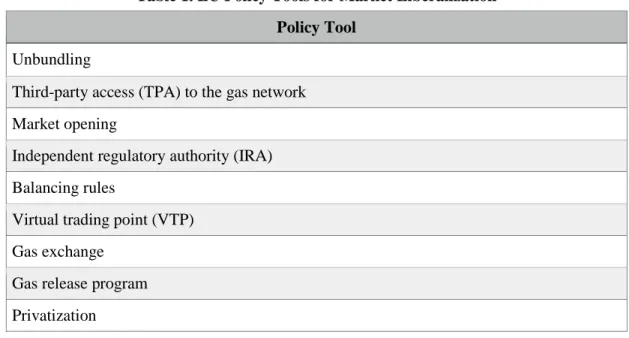
stated that the intended nature of competition policy in the natural gas and electricity sectors was to open internal markets to increased competition, gradually. Initially, companies and consumers exhibited con-cern for the slow development of markets, high prices, and limited market choices (European Commis-sion, 2012). The following table contains the policy tools that the EU adapted to liberalize natural gas markets as described in Opolska’s article.
Table 1. EU Policy Tools for Market Liberalization Policy Tool
Unbundling
Third-party access (TPA) to the gas network Market opening
Independent regulatory authority (IRA) Balancing rules
Virtual trading point (VTP) Gas exchange
Gas release program Privatization
18
middle-men in downstream markets and allow them to capitalize on profit margins and increased revenue. This policy focus on unbundling is designed to prevent further deployment of the business strategy and to effectively break-up control of energy assets across Europe. By separating downstream assets, competi-tion will be permitted in wholesale markets where it previously did not exist.
Another point of contention with the market liberalization policies in the European energy space is the use of TOP contracts. TOP contracts were the de facto foundation for energy policy in the EU for decades. Widespread TOP contracts were the norm in the sector prior to the implementation of the energy directives and the formation of a single Energy Union. TOP contracts are understood to facilitate risk-sharing between suppling and consuming parties in a transaction, rather than leaving sales and prices to market forces and mechanisms. Russian companies, and in particular Gazprom, see TOP contracts as a means to ensure continued gas sales to EU Member States (Boussena and Locatelli, 2011).
Gazprom Antitrust Case
19
Specific cases of violations in Bulgaria, Estonia, Latvia, Lithuania, and Poland on the basis of both territorial restrictions and unfair pricing were brought forward in the EU’s proceedings that devel-oped in 2015. Further instances of violation were provided in other Member States’ markets. This motion by DG COMP was met with strong reactions and disapproval by the Russian government. Unfair pricing claims by the EU were justified by Gazprom’s indexing of gas prices to baskets of oil products. Territorial restrictions claims were identified as Gazprom had included destination clauses and export bans in previ-ous agreements with some of the aforementioned Member States (Stern and Yafimaya, 2017).
The EU made clear its view that Gazprom’s operations and existing agreements in the EU were hindering market liquidity and serving as barriers to entry for other energy companies wishing to operate in the market (Boussena and Locatelli, 2011). The use of TOP contracts can be seen as the primary busi-ness tool of Gazprom, and the use of such contracts appear to directly contradict the EU’s antitrust policy. A key characteristic of TOP contracts between Russian exporters and European importers were the dura-tion of the agreements, which has been addressed as a problem by the EU. TOP contracts are also seen to violate EU competition policy due to price indexation formulas associated with existing agreements, as well as the inflexible quantities of gas that import countries must take from providers (Boussena and Locatelli, 2011). Furthermore, Gazprom’s widespread use of TOP contracts have served as way for the Russian government to force political discussions with import countries, and further politicize EU-Russia relations on the basis of gas transactions. As a result of EU antitrust action, Gazprom has gradually rene-gotiated the terms of its natural gas commitments in an attempt to avoid arbitration in EU markets (Fran-za, 2016).
“Today, one of the possible sources of friction between the EU and Gazprom (and probably other suppliers as well) is the possible re-examination of these long-term contracts or amendments to some of their clauses that are deemed incompatible with the flexibility needed for the operation of a single natural gas market” (Boussena and Locatelli, 2011).
20
21
CHAPTER 7: ANALYSIS
Antitrust concerns in European natural gas markets are most evident in the formal proceedings brought against Gazprom by the EU. The EU’s attempt at market restructuring to facilitate competition has implications both across the Union and across its external borders. But does the introduction of com-petition policy by the EU as part of its energy policy influence the energy policy of Russia? Does the case of Gazprom illustrate this influence by a resulting change in domestic policy in Russia? This section will address these questions and connections in further detail.
The Gazprom antitrust case is still active and has yet to be closed with a final penalty, or lack thereof, for the company’s clear violations of EU competition law. Gazprom has made preliminary changes to its existing agreements to address antitrust proceedings against its operations in the EU. These preliminary changes are important, as the EU is able to force compliance with its laws to external entities operating within its markets and is currently able to do so before the closing of its antitrust cases. Changes in agreements and operations by Gazprom are notable as they have inherently altered the way the compa-ny conducts its import and export negotiations with buyers. However, some eastern European Member States have voiced that Gazprom’s changes to existing gas contracts represent only a minimal change in the company’s behavior and aren’t sufficient action to rectify its alleged antitrust violations. Given the vast market share that Gazprom maintains in Europe, the fact that the Kremlin uses Gazprom as political leverage in negotiations, and the Russian state’s majority shareholdings in Gazprom, it’s plausible to ask what changes like these might mean for Russian energy policy.
ap-22
pear to be issue or region specific. Revisiting the notion of supranational governance as a condition of functional spillover, while EU law does apply universally to companies operating in the EU, the idea fails to explain the lack of change in Russian policy. Furthermore, any changes in Russian policy that have occurred since the implementation of an EU competition policy have not altered the way that the Kremlin approaches its hydrocarbon sales to the European Union. Changes in Gazprom’s operation model have not led to wider implications on Russian policy. Some TOP contracts with eastern European Member States have been dissolved or reevaluated but maintaining and increasing market share in natural gas markets continue be in the economic interest of Gazprom, and by extension, the Russian government.
The Russian government’s focus on economic interests is evident with the construction of Nord Stream and Nord Stream 2 pipelines in the Baltic Sea, even though the EU’s demand outlook for natural gas remains mixed. However, the domestic production of natural gas in Member States is declining, and the two Nord Stream projects are a way for Gazprom to preserve its economic interests and expand its operations in Europe. Although the Nord Stream AG is a consortium of five energy companies and Nord Stream 2 AG a consortium of six, Gazprom is the largest shareholder for both projects, with 51 percent and 50 percent ownership, respectively. This majority ownership underscores the economic power of Gazprom and the incentives present for the company to further its business in Europe.
fur-23
ther example of this close-knit relationship is visible as the Russian Prime Minister maintains the power to nominate heads of Russian state-owned companies. Considering economic motives, the EU continues to be Gazprom’s most profitable export market, over that of the domestic Russian market or markets in CIS countries (Boussena and Locatelli, 2011). With strong economic incentives for EU-Russia coopera-tion, preliminary compliance with EU law from Gazprom, and Gazprom officials holding an integral role in the policy-making process, future spillover in Russia is a distinct possibility.
Given the vast natural resources of Russia and the large volumes of hydrocarbons it exports to countries around the world, it’s easy to comprehend how Russia uses its state-owned energy companies as a political tool in the international community. Vladimir Putin has previously stated that Gazprom repre-sents a “powerful political and economic lever of influence over the rest of the world.” Russia’s usage of Gazprom as a political pawn can be seen in two distinct cases involving Ukraine. First, the actions of former Ukrainian President Yanukovych to reject an association agreement with the EU was met with lower gas prices to Ukraine from Gazprom. This decision, which led to civil unrest in Ukraine, illustrates the willingness of Gazprom to use its natural gas supplies as political leverage, with an offer of economic incentives to politicians that align policies to the goals of the Kremlin. Second, in the months following the ousting of Victor Yanukovych by the Ukrainian people, a western-aligned government was elected in Ukraine. Gazprom shortly thereafter announced an increase in price by 81 percent for natural gas supplied to Ukraine. It’s clear that for Russia, natural gas isn't just a commodity to be transported beyond its bor-ders. It’s a foreign policy tool.
24
serves as an excellent example of how the EU has minimized the Kremlin’s ability to use state-owned companies as a political chess piece. Gazprom’s willingness to align its existing agreements to European buyers with the policies of the Energy Union weakens its ability to impose the will of the Kremlin on im-port countries by offering them access to increased market options. This was a stated goal of EU competi-tion policy. These changes indicate the importance of Russian exports to Europe as a means to maintain Russia’s position as a leading energy exporter.
25
CHAPTER 8: CONCLUSION
The research discussed in this thesis did not result in any identifiable changes in Russian national energy policy following the implementation of EU liberalization policies in its internal energy market and the opening of the Gazprom antitrust case. Applying the concept of functional spillover to the case of Gazprom did not illustrate any degree of policy harmonization between the Russian Federation and the European Union. The case for spillover can be made for a potential harmonization of EU and Russian energy policies in the future due to the economic nature of the relationship and the private actors involved in agenda setting and policy-making process in Russia. Although the current relationship remains
stressed, the economic benefits associated with the flow of natural gas from east to west could result in a shift in Russian policy towards that of the EU.
26
27
REFERENCESBBC. (2015). Ukraine rejects Russia Gazprom gas price hike. BBC. Retrieved from http://www.bbc.com/news/business-26902522
Bergmann, J. & Niemann, A. (2015). Theories of european integration. In K. E. Jrgensens. K. Aarstad & E. Drieskens The SAGE Handbook of european Foreign Policy (Vol. 2, pp. 166-181). 55 City Road, London: SAGE Publications Ltd. doi: 10.4135/9781473915190.n11
Boussena, S. and Locatelli, C. (2011), Gas market developments and their effect on relations between Russia and the EU. OPEC Energy Review, 35: 27–46. doi:10.1111/j.1753-0237.2010.00181.x Boussena, S. and Locatelli, C. (2017) Gazprom and the complexity of the EU gas market: a strategy to
define, Post-Communist Economies, 29:4, 549-564, DOI:10.1080/14631377.2017.1349667 Cohen, J. (2015). Vladimir Putin’s most effective weapon is gas – but not the poison kind. Reuters.
Retrieved from http://blogs.reuters.com/great-debate/2015/07/28/why-vladimir-putins-gas-weapon-may-be-his-most-powerful-foreign-policy-tool/
European Commission. (2012). Antitrust: Commission opens proceedings against Gazprom. Retrieved March 1, 2017, from http://europa.eu/rapid/press-release_IP-12-937_en.htm?locale=enz European Commission. (2012). Competition. Retrieved from http://ec.europa.eu/competition/sectors/
energy/overview_en.html
European Commission. (2017). Antitrust: Commission invites comments on Gazprom commitments concerning Central and Eastern European gas markets. Retrieved March 1, 2017, from http://europa.eu/rapid/press-release_IP-17-555_en.htm
European Commission. (2018). FAQ on the EU competences and the European Commission powers. Retrieved from http://ec.europa.eu/citizens-initiative/public/competences/faq
European External Action Service. (2017). The European Union and the Russian Federation. Retrieved February 5, 2018, from https://eeas.europa.eu/delegations/russia/35939/european-union-and-russian-federation_en
European External Action Service. (2018). EU sanctions against Russia over Ukraine crisis. Retrieved from https://europa.eu/newsroom/highlights/special-coverage/eu-sanctions-against-russia-over-ukraine-crisis_en
Foy, H. (2018). Russia’s gas exports to Europe rise to record high. Financial Times. Retrieved from https://www.ft.com/content/7b86f4be-f08e-11e7-b220-857e26d1aca4
Franza, L. (2016). Outlook for Russian Pipeline Gas Imports into the EU to 2025. CIEP Perspectives on EU Gas Market Fundamentals. Clingendael International Energy Programme (CIEP). Retrieved from http://www.clingendaelenergy.com/inc/upload/files/CIEP_paper_2016_2B_Russia_web.pdf Gazprom Group. (2016). Gazprom in Figures 2011-2015 Factbook. Retrieved from http://www.gaz
28
Gazprom Group. (2018). About Gazprom. Retrieved February 5, 2018, from http://www.gaz prom.com/about/
Godzimirski, J. M. (2014). Energy in the neighbourhood: Russian and EU perspectives and policies. The Polish Quarterly of International Affairs, 23(4), 31-II. Retrieved from
http://libproxy.lib.unc.edu/login?url=https://search-proquestcom.lib.proxy.lib.unc.edu/docview/1758155537?accountid=14244
Ministry of Energy of the Russian Federation. (2010). Energy strategy of Russia for the period up to 2030. Retrieved from http://www.energystrategy.ru/projects/docs/ES-2030_(Eng).pdf Nord Stream 2 AG. (2016). Gazprom and ENGIE Modify Nord Stream 2 Shareholdings, Equalising
EU-Russian Ownership. Retrieved from https://www.nord-stream2.com/media-info/news- events/gazprom-and-engie-modify-nord-stream-2-shareholdings-equalizing-eu-russian-ownership-6/
Nord Stream AG. (2014). Secure Energy for Europe. Retrieved from https://www.nord-stream.com/me dia/documents/pdf/en/2014/04/secure-energy-for-europe-full-version_245_20140417.pdf OECD/IEA. (2014). Energy Policies of IEA Countries - The European Union 2014 Review. Retrieved
from https://www.iea.org/publications/freepublications/publication/EuropeanUnion_2014.pdf OECD/IEA. (2014). Russia 2014 - Energy Policies Beyond IEA Countries. Retrieved from
https://www.iea.org/publications/freepublications/publication/Russia_2014.pdf
Opolska, I. (2017). The efficacy of liberalization and privatization in introducing competition into European natural gas markets. Utilities Policy, 48.
https://doi.org/https://doi.org/10.1016/j.jup.2017.07.003
Pisca, I. (2016). Outlook for EU Gas Demand and Import Needs to 2025. CIEP Perspectives on EU Gas Market Fundamentals. Clingendael International Energy Programme (CIEP). Retrieved from http://www.clingendaelenergy.com/inc/upload/files/CIEP_paper_2016_2A_Demand_web.pdf Rutten, D. (2016). The Energy Union. Clingendael International Energy Programme (CIEP). Retrieved
from