DETERMINANTS OF INEQUALITY IN LATIN AMERICA AND EASTERN EUROPE
Bilyana Petrova
A dissertation submitted to the faculty at the University of North Carolina at Chapel Hill in partial fulfillment of the requirements for the degree of Doctor of Philosophy in
the Political Science in the School of Arts and Sciences
Chapel Hill 2018
ABSTRACT
Bilyana Petrova: Determinants of Inequality in Latin America and Eastern Europe (Under the direction of John D. Stephens)
How do structural transformations affect the income distribution in Latin America and Eastern Europe? This dissertation reveals that deindustrialization, the expansion of the service sector, and the growth of the commodity-producing sector have a meaningful impact on market, or pre-taxes-and-transfers, income inequality. This effect depends on each economy’s human capital endowments, on the type of primary goods that it specializes in, and on the ability of different commodities to contribute resources to governments’ coffers.
Chapter 2 focuses on the manufacturing and the service sectors. I argue that a higher proportion of the labor force employed in services is linked to higher market income inequality in both regions. The service sector is very diverse, with different productivity and skill levels, which means that income differentials tend to be higher among workers. In contrast, deindustrialization is likely to have a differential effect on inequality in the two regions. A larger industrial sector is correlated with lower market income inequality in Eastern Europe. This is because the region’s skill endowment is sufficiently high to keep the educational premium low. This is very different from Latin America, where the industrial sector is capital-intensive and qualified workers are scarce, driving the educational premium up. Consequently, a larger industrial sector in Latin America is associated with higher market income inequality.
on the income distribution as it drove many local producers who could not withstand competitive pressures out of the market. As a result, domestic producers of commodities transitioned to a capital-intensive method of production. Because of this, exports of primary goods from the region are also correlated with rising income inequality.
ACKNOWLEDGEMENTS
This dissertation benefited from the help, advice, and guidance of many mentors, colleagues, and friends. The project would not have been possible without the exceptional support of my advisers, John Stephen and Evelyne Huber. Their work awakened my interest in social policy and political economy while I was still in college, shaped my research agenda, and inspired multiple projects. Their mentorship greatly contributed to my intellectual growth and enriched my experience in graduate school. While their help was crucial at every stage of work on this dissertation - from choosing a topic, determining the scope of the project, learning the necessary methodological tools, and preparing for fieldwork to conducting interviews, clearing theoretical doubts, discussing findings, and planning a book manuscript - their role in my academic career extends much beyond the final manuscript. Apart from reading multiple drafts, encouraging me to think deeply about the complexity of the issues under examination, and providing invaluable insights, Evelyne and John introduced me to (the best aspects of) the profession, taught me to ask big questions, showed me how to approach research, and, most importantly, inspired me to be a conscientious member of the academic community. I am deeply thankful for their intellectual rigor, gentle yet firm criticism, willingness to engage with and support their students, generosity, patience, warmth, and belief in this project. I cannot express my gratitude for having had them as role models and mentors. Working with them was a true intellectual pleasure and a deep honor.
and hypothesis testing has guided me since my first semester. Apart from being an inspirational professor, Graeme was also a wonderful DGS, showing support, care, and respect when they were needed the most. I greatly appreciated his kindness, patience, and willingness to discuss different ideas and career choices, especially during my first years in graduate school. His guidance has meant a lot.
Cameron Ballard-Rosa joined my committee late but quickly became an invaluable member of it. He read multiple drafts, provided insightful feedback, discussed numerous methodological challenges, asked important theoretical questions, and helped me to better frame the argument. He was always willing to sit down and think with me about the dissertation, about future projects, and about my broader professional development. I am deeply thankful for his patience, kindness, generosity, wise advice, and brilliant feedback. Cameron truly set an example that I will strive to emulate.
I am profoundly grateful to Milada Vachudova for the wonderful feedback and the emotional support that she provided through my time in graduate school. Milada deeply cared about my emotional well-being and always put things into perspective. Her presence was crucial not only for the successful defense of this dissertation, but also for my broader growth as a person. She taught me important lessons about work-life balance, collegiality, and dedication that will always orient me. Her feedback to this and several other projects has greatly helped with their framing and successful execution. I am very thankful for her mentorship over the last six years.
I would also like to thank Thomas Oatley, who was instrumental in the early stages of work on this dissertation. My numerous conversations with him awakened my interest in structural transformations, opened my eyes to the role of global forces, helped me to settle on a topic, and propelled me to think carefully about causality. His brilliant leadership in the classroom taught me a lot about a variety of topics and greatly contributed to my intellectual growth. His mentorship later on stimulated me to ask big questions, to formulate more ambitious theories, and to pursue braver topics. I greatly appreciated his time, attention, critical feedback, and careful advice.
Tom Carsey, Santiago Olivella, Jim Stimson, Ashley Anderson, Cecilia Martinez-Gallardo, Jonathan Hartlyn, Layna Mosley, Jenny Pribble, and Alexandra Sznajder-Lee for very helpful advice and guidance throughout my time at UNC. Shannon Eubanks, Kim Bar-bour, Dana Sadek, Susan Heske, Chris Reynolds, and Alegro Godley greatly enriched my graduate school experience with their help and friendship.
Several individuals in Bulgaria, Chile, and Peru provided crucial help during my fieldwork. In Bulgaria, Iskra Baeva, Maria Benova, Tanya Chavdarova, and the team at the Institute for Economic Studies at the Bulgarian Academy of Sciences spent a lot of time talking to me about the transition and put me in touch with a number of important interviewees. In Peru, Eduardo Dargent not only spent hours discussing the complex political system in his country, but also introduced me to a rich network of contacts, all of whom were exceptionally kind and helpful. I am deeply thankful for Eduardo’s time and willingness to help – he made my field work in Lima so much easier and more pleasant. In Chile, Juan Pablo Luna, Javiera Arce, Pilar Giannini, and Gloria Jara helped me to learn more about Chile’s historical trajectory and put me in touch with a number of crucial interviewees. I deeply appreciate their help.
TABLE OF CONTENTS
1 INTRODUCTION . . . 1
2 ECONOMIC STRUCTURE AND MARKET INCOME INEQUAL-ITY IN LATIN AMERICA AND CENTRAL AND EASTERN EU-ROPE. . . 10
2.1 Introduction . . . 10
2.2 Existing knowledge . . . 15
2.3 Theoretical Framework . . . 19
2.4 Empirical Analysis . . . 23
2.5 Results . . . 28
2.6 Robustness Checks . . . 34
2.6.1 Industry in Latin America . . . 35
2.6.2 Prais Winsten Regressions with Country Fixed Effects . . . 36
2.6.3 Trade Specialization Models . . . 39
2.6.4 De-trended Models . . . 41
2.7 Discussion and Conclusion . . . 43
3 AGRICULTURE, NATURAL RESOURCES, AND MARKET IN-COME INEQUALITY IN CENTRAL AND EASTERN EUROPE . 46 3.1 Introduction . . . 46
3.2 Literature Review . . . 48
3.3 Theoretical Framework . . . 52
3.5 Results . . . 60
3.6 Who Benefits from the Primary Sector? . . . 66
3.6.1 Quintiles Income Shares . . . 66
3.6.2 Labor Income Shares . . . 70
3.7 Robustness Checks . . . 72
3.7.1 Temporal Trends . . . 72
3.7.2 Prais Winsten Regressions . . . 75
3.7.3 Alternative Specifications . . . 77
3.8 Discussion and Conclusion . . . 79
4 YOU REAP WHAT YOU SOW: COMMODITY PRODUCTION AND MARKET INCOME INEQUALITY IN LATIN AMERICA . . 82
4.1 Introduction . . . 82
4.2 Literature Review . . . 86
4.3 Theoretical Framework . . . 89
4.4 Empirical Analysis . . . 94
4.5 Results . . . 98
4.5.1 Larger sample . . . 98
4.5.2 Smaller sample . . . 102
4.6 Distributional Consequences: Income Quintile Shares . . . 105
4.7 Robustness Checks . . . 109
4.8 Conclusion . . . 121
5 CONCLUSION . . . 123
5.1 Median, Minimum, and Maximum Market Income Inequality Models . . 130
5.1.1 Jackknife Models . . . 133
APPENDIX 2 . . . 136
5.2 Top 20% and Bottom 20% Income Shares Models . . . 140
5.3 Prais Winsten Regressions with Country Dummies (Eastern Europe) . . 143
5.3.1 Imports Models . . . 145
5.3.2 Additional Notes . . . 149
APPENDIX 3 . . . 150
5.4 Summary Statistics . . . 150
5.5 Primary Exports as a Share of Total Exports (Latin America) . . . 160
LIST OF TABLES
2.1 Employment structure and market income inequality in Central and
East-ern Europe . . . 30
2.2 Employment structure and market income inequality in Latin America . 31 2.3 Employment structure and market income inequality in Eastern Europe and Latin America (Prais Winsten Regressions) . . . 38
2.4 Manufacturing specialization and market income inequality in Eastern Eu-rope and Latin America . . . 40
2.5 De-trended employment structure and market income inequality in Eastern Europe and Latin America . . . 42
3.1 Agricultural employment and market income inequality in Eastern Europe 62 3.2 Primary exports and market income inequality in Eastern Europe . . . . 63
3.3 The primary sector and the top / bottom quintile ratio in Eastern Europe 68 3.4 The primary sector and the total labor share in Eastern Europe . . . 71
3.5 De-trended Models (Eastern Europe) . . . 74
3.6 Prais Winsten Regressions (Eastern Europe) . . . 76
3.7 Additional Controls (Eastern Europe) . . . 78
4.1 The primary sector and market income inequality in Latin America . . . 101
4.2 The primary sector and market income inequality in continental Latin America . . . 104
4.3 The primary sector and top / bottom income share in Latin America . . 106
4.4 The primary sector and top / bottom income share in continental Latin America . . . 107
4.5 Detrended models: larger sample . . . 111
4.8 Prais Winsten regressions: smaller sample . . . 116
4.9 Trade specialization models: large sample . . . 119
4.10 Trade specialization models: smaller sample . . . 120
A1.1 Correlation Matrix (Eastern Europe) . . . 128
A1.2 Correlation Matrix (Latin America) . . . 129
A1.3 Median, minimum, and maximum market income inequality models (EE) 131 A1.4 Median, minimum, and maximum market income inequality models (LA) 132 A1.5 Jackknife Resampling Results . . . 134
A2.1 Summary Statistics . . . 136
A2.2 Correlation Matrix (Large Sample) . . . 139
A2.3 Primary exports and the top 20% income share in Eastern Europe . . . . 141
A2.4 Primary exports and the bottom 20% income share in Eastern Europe . . 142
A2.5 Employment structure and market income inequality (Prais Winsten re-gressions) . . . 144
A2.6 Commodity imports and market income inequality in Eastern Europe . . 146
A2.7 Agricultural imports and market income inequality in Eastern Europe (De-trended models) . . . 147
A2.8 Commodities imports and top 20% income share in Eastern Europe (Prais Winsten regressions) . . . 148
A3.1 Summary Statistics (Large Sample) . . . 150
A3.2 Summary Statistics (Reduced Sample) . . . 151
A3.3 Correlation Matrix (Large Sample) . . . 152
A3.4 Correlation Matrix (Reduced Sample) . . . 153
A3.5 Main analysis: large sample . . . 160
A3.7 Detrended models: large sample . . . 162
A3.8 Detrended models: small sample . . . 163
A3.9 Prais Winsten regressions: large sample . . . 164
LIST OF FIGURES
2.1 Market Income Inequality in Central and Eastern Europe (1990-2013) . . 26
2.2 Market Income Inequality in Latin America (1980-2013) . . . 27
2.3 Industrial Employment and Industrial Value Added in Latin America . . 36
2.4 Interaction between industrial employment and secondary education (Latin America) . . . 37
3.1 Market Income Inequality in Central and Eastern Europe (1990-2013) . . 58
4.1 Market Income Inequality in Latin America (1980-2013) . . . 96
A1.1 Industrial Employment and Industrial Value Added in Eastern Europe . 135 A3.1 Agricultural employment in Latin America . . . 154
A3.2 Crop and food production in Latin America . . . 155
A3.3 Primary exports in Latin America . . . 156
A3.4 Food exports in Latin America . . . 157
A3.5 Fuel exports in Latin America . . . 158
Chapter 1
INTRODUCTION
At the time of writing, Latin America is the world’s most unequal region. Its average pre-taxes-and-transfers income GINI coefficient exceeded 0.50 in 2015 (Darvas 2016). Its disposable income GINI was slightly lower at 0.47 (Darvas 2016, CEPAL 2017). Variation in living standards, work conditions, and access to education, health care, and social services remains substantial (World Bank 2014). A focus on wealth paints an even darker picture. In 2014, the richest 10% controlled 71% of Latin America’s wealth (CEPAL 2016). Between 2002 and 2015, the fortunes of the region’s billionaires increased by an average of 21% per year – six times faster than the growth of Latin America’s GDP (Oxfam 2016). Meanwhile, around 30.7% of the region’s population, or 168 million people, lived in poverty in 2016. Extreme indigence affected 10%, or 61 million citizens (CEPAL 2017). Consistent with the region’s historical trajectory, inequality remains “a distinctive, pervasive characteristic of [Latin America]” (Gasparini and Lustig 2011, Bourguinon and Morrison 2002).
Garay 2017). Diverse social policies undertaken by both left- and right-wing governments increased access to education, health care, and old-age pensions (Huber and Stephens 2012, Levitsky and Roberts 2011). As a result, income differentials declined, indigence decreased, the middle classes grew, and social protection expanded to cover previously excluded populations (Lustig 2015).
The experience of Central and Eastern Europe1 has been very different. Eastern Eu-rope has historically had low levels of economic inequality. The establishment of commu-nism in the 1940s brought about a variety of policies seeking to eliminate unemployment, suppress income differentials, and expand access to education, health care, and pensions (Haggard Kaufman 2008, Cerami and Vanhuysse 2009, Orenstein 2008).2 The socialist
status quo, however, eventually proved unsustainable in the long run. The transition to market capitalism after the collapse of the Berlin Wall noticeably raised the levels of poverty and inequality in the area (Milanovic 1998, Gerry and Mickiewicz 2008). In the course of a few years, economic uncertainty escalated, life expectancy declined pre-cipitously, indigence rose, living standards deteriorated, and the distribution of income approached or even exceeded the levels of dispersion typical of the advanced industrialized world (Orenstein 2008). Confronted with the imperative to balance budgets and build social protection programs capable of addressing the new socio-economic challenges cre-ated by the transition, these states redefined eligibility criteria, established new schemes, and increased reliance on the private sector for the provision of social services (Cerami and Vanhuysse 2009).
The late 1990s and the early 2000s witnessed economic stabilization. Years of uninter-rupted rapid growth decreased unemployment, reduced poverty and brought income gains across the income distribution. While the 2010 Sovereign Debt crisis affected the region and revealed its vulnerability to external shocks, Eastern European countries faced a less
1By Central and Eastern Europe I refer to the countries which formed part of the Communist Bloc between the 1940s and the late 1980s. My particular focus in this project is on the ten states which joined the European Union in the 2004 and the 2007 enlargement waves (Bulgaria, Czechia, Estonia, Hungary, Latvia, Lithuania, Poland, Romania, Slovakia, and Slovenia). Hereafter Eastern Europe.
painful recession than many members of the eurozone. Nevertheless, income inequality continued to rise throughout the region.3 Although this increase has slowed in pace, it
has proven resilient, suggesting that the region might have arrived at a new status quo following decades under a regime that artificially suppressed income differentials. And while Eastern European countries have sought to redress some of these imbalances though social policy, the success of this strategy has been put to the test as the welfare state retrenched to accommodate pressures to maintain fiscal discipline. As a result, income inequality is much higher in the region today than it used to be at the beginning of the transition.
What explains these diverging trends? Why has income inequality behaved differ-ently across Eastern Europe and Latin America? More broadly, what are the factors that affect the income distribution in the global periphery in an age of intensifying economic interdependence? Recent years have witnessed heightened academic interest in the causes of economic inequality around the world. This interest is justifiable given the repercus-sions that economic disparities have for a variety of other political and social phenomena. Existing scholarship links growing income differentials to violent conflict, democratic erosion, declining political participation, and higher political polarization (Solt 2011, 2012, and 2015, Boix 2003, Acemoglu and Robinson 2005). Inequality can also influence states’ prospects for democratization and democratic consolidation (Ansell and Samuels 2014, Houle 2009). It shapes governments’ willingness and ability to promise reparations (Greenstein unpublished) and redistribute income (Petrova unpublished). Recent studies also connect it to the intensifying backlash against globalization in the advanced indus-trialized world (Han 2016, Burgoon 2012). Given its variegated effects, income inequality is indeed a “defining challenge of our time” (Obama 2013).
Identifying its drivers therefore becomes crucial not only for addressing existing dis-parities but also for devising effective solutions to other social problems. A rich liter-ature examines changes to the income distribution in advanced capitalist democracies, highlighting the role of globalization, technological change, the prominence of left-wing
parties, the decline of unions, the retrenchment of the welfare state, and the growth of the financial sector (Huber and Stephens 2001, Huber, Huo and Stephens 2018, Brady et al. 2003). A smaller, but rapidly growing stream of research looks beyond the advanced industrialized world, focusing instead on less-developed countries. Apart from corrobo-rating the causal importance of the previously mentioned variables (Huber and Stephens 2012, Morgan and Kelly 2013, Levitsky and Roberts 2011, Lopez-Calva and Lustig 2010), this work has also illuminated the specific pressures unique to emergent economies (Appel and Orenstein 2015, Mahutga and Bandejl 2010).
market income distribution and its drivers can therefore shed light on other important political and socio-economic questions.
Second, market income inequality illuminates dynamics in net income inequality. The two measures are strongly linked. This is especially true outside of the advanced capitalist societies of Western Europe, North America, and the Antipodes. Welfare states remain underdeveloped or truncated in many less developed countries (Holland 2017, Haggard and Kaufman 2008). The coverage and generosity of social protection programs in these societies are frequently much lower than in the advanced industrialized world. Govern-ment redistribution, or the extent to which the state alleviates inequality, is notoriously low in Latin America, for example. While access has expanded in recent years, social protection systems are highly segmented, granting citizens unequal access to social ser-vices and often leaving out marginalized or disadvantaged groups (Holland unpublished, Pribble 2013, Huber and Stephens 2012). Although much more generous and inclusive, welfare states in Eastern Europe also face considerable challenges. Social spending as a proportion of GDP is much lower in post-communist states than it is in OECD countries (OECD. . . ). Furthermore, redistribution fluctuated enormously during the transition away from socialism when governments struggled to rebuild their economies. Therefore, understanding the causes of market income inequality is essential for understanding net economic inequality in these regions.
deepen-ing globalization and intensifydeepen-ing competitive pressures. Said pressures were particularly strong in the global periphery, which remains strongly dependent on foreign demand and capital for its internal development. This reliance therefore gives rise to specific incentives and constraints. Consequently, policy-makers had to navigate a complex envi-ronment characterized by limited autonomy, enhanced structural business power, and the emergence of new needs. Exploring how the structural transformation of the economy induced by the dismantling of internal protection and the policy courses political elites chose to pursue therefore has the potential to shed light on dynamics in the distribution of income.
This focus is relatively novel. Although existing work has analyzed multiple dimen-sions of the economic change that Latin America and Eastern Europe undergone during the 1990s and the 2000s, it has not explicitly linked these changes to income inequality. While a rich literature discusses deindustrialization, the expansion of the services sector, and specialization in the production of commodities, few studies have directly assessed the implications of these processes for the income distribution. This is especially true for the most recent literature. Furthermore, despite the proliferation of analyses that investigate the political constellations behind social policy reform (Niedzwiecki 2016, Niedzwiecki and Pribble 2017, Anria and Niedzwiecki 2016, Pribble 2013, Ponce de Leon unpublished, Huber and Stephens 2012, Dunn and Huber unpublished, Borges Sugiyama 2011, Fairfield 2016), little work focuses on economic and labor market policy, which also have important implications for income inequality, especially the pre-taxes-and-transfers income distribution.
considerable degree of policy continuity over time. In the absence of departures from the neoliberal policy status quo, economic transformations related to deindustrialization, the expansion of services, and the growth of the commodity-producing sector, shape income inequality. Simultaneously, these policies equilibria can generate “inequality traps” that might become increasingly difficult to overcome in the future (Kelly 2009 and 2018). A more detailed outline of the argument (and a roadmap to the three chapters) follows below.
against both regions show robust support for these expectations.
Chapters 3 and 4 complement this analysis of structural economic transformations by focusing on the primary sector. Chapter 3 examines dynamics in Eastern Europe. Following decades within the structures of the Council for Mutual Economic Assistance, post-communist governments dismantled barriers to trade and re-established commercial relations with the rest of the world. Combined with a process of technological renovation and restitution of previously expropriated land, this process entailed deep restructuring of their primary sector. I argue that the decline in the proportion of the labor force employed in agriculture exacerbated market income differentials in Eastern Europe. The sector had provided jobs for low-skill workers whose employment prospects were highly unfavorable in the years of the transition. The loss of these jobs as the sector modernized hurt low-income households particularly hard. The inflow of primary goods imports had a similar effect on the income distribution as it drove many local producers who could not withstand competitive pressures (and did not have equal access to the European Union’s enormous market) out of the market. As a result, domestic producers of commodities consolidated and transitioned to a different, more capital-intensive method of production. Because of this, exports of commodities from the region are also correlated with rising income inequality. Fixed effects and Prais Winsten models run against the ten countries in my sample confirm these expectations.
excluded from the analysis, however, the effect of the primary sector on market income inequality is weaker and less conclusive. Food exports in continental Latin America are associated with higher inequality while fuel exports and crop and food production lose statistical significance. These findings reveal the different importance, composition, and profile that the primary sector has across the region and suggest that commodity production absorbs more labor in Central America.
Chapter 2
ECONOMIC STRUCTURE AND MARKET INCOME INEQUALITY IN LATIN AMERICA AND CENTRAL AND EASTERN EUROPE
2.1 Introduction
On November 8th, 2016, Republican-backed businessman Donald Trump defeated Demo-cratic nominee Hilary Clinton and won the US presidential election. Trump had run a campaign centered on promising to bring high-paying manufacturing jobs back to Amer-ica. The decline of industry, he argued, had weakened the country, undermined its economic independence, deprived millions of American citizens of their livelihoods, and plunged communities into poverty and despair. Furthermore, Trump argued, the decrease in American industrial jobs had exacerbated income inequality (Trump 2016). As a re-sult, while the financial elite prospered, the former industrial bases in the heartland of the United States were slowly disappearing. According to Trump’s historical narrative, the collapse of manufacturing employment had decimated the middle classes and left America deeply polarized.
market-oriented reforms and the resulting weakening of trade unions have further exacer-bated this trend (Huber and Stephens 2001). These theoretical treatments thus identify the decline of industry and the transition to a service-oriented economy as being partly responsible for the rise of income inequality in the OECD area.
While these theories have received empirical support in work on the advanced indus-trialized world, they have been subjected to less scrutiny in the context of the global periphery. It is this periphery that Trump views as benefiting from the process of eco-nomic integration. Nevertheless, much remains unknown about the impact of ecoeco-nomic transformations on the income distribution outside of the OECD area. Although recent work has discussed the risk of premature deindustrialization in the emerging economies of Africa and East Asia (Wu 2016, Milanovic 2016, Rodrik 2015), it has paid less attention to other regions of the world that, rather than being currently enmeshed in these changes, have already undergone similar processes. Latin America and Central and Eastern Eu-rope have received particularly little consideration. This is puzzling, given the important role that structural change has played in shaping inequality dynamics there. The liter-ature’s lack of attention to the effects of deindustrialization on income inequality thus precludes a more complete understanding of the implications of economic restructuring.
Milanovic 2016) and invite further inquiry into the determinants of income dispersion around the world. They also raise questions about the extent to which current theoretical frameworks apply outside the OECD area.
I seek to answer this question by examining the relationship between structural change, as exemplified by deindustrialization and the growth of the service sector, and economic inequality in Latin America and Central and Eastern Europe. Although these regions are not usually compared in cross-regional work, their historical and economic cir-cumstances provide an excellent opportunity to tease out the causal mechanisms linking inequality to structural transformations. Throughout the twentieth century, both regions adopted interventionist development models that spurred industrialization. Following the severe economic crises that they faced in the 1980s and the 1990s, both of them con-fronted the imperative to restructure their economies and implement neoliberal policies. Although the speed and comprehensiveness of these reforms varied, they were similar in content and consequences, promoting the retreat of the state from economic affairs and fostering incorporation into the global economic system. In both cases, this integration brought about deindustrialization. Nevertheless, income inequality levels both between and within Latin America and Eastern Europe continue to exhibit noticeable variation. What explains the persistence of this variation despite the similar processes that coun-tries in these regions faced in the last twenty years? How do traditional theories about economic transformations apply to them?
In this paper, I argue that the transition to a service-based economy exacerbated market income inequality in both regions. This is partly because the service sector is more heterogeneous than the manufacturing sector, with remuneration rates varying much more widely across different occupations. Highly specialized, high value-added professions that demand high skills and levels of education coexist with low value-added jobs that do not require specific training or qualifications. As a result, wage dispersion is greater in services than in manufacturing. Thus, the expansion of this sector is associated with higher income inequality in both regions.
and Central and Eastern Europe. I posit that the industrial sector has had an equalizing effect in the post-communist area. Under communism, it absorbed a large proportion of the labor force. Its collapse after the fall of the Berlin Wall left millions of people jobless, which exacerbated income differentials. The decline of manufacturing in the region, however, was delayed by Western European producers that relocated there in search of lower costs and convenient locations. Manufacturing, therefore, continued to generate employment opportunities in the post-communist countries. Even though the sector became more capital-intensive with time, the educated labor force in Eastern Europe was able to handle this transition. Since differences in productivity in manufacturing are lower than in services, industry ameliorates the polarization of the employment structure. In contrast, industry in Latin America has traditionally been characterized as capital-and technology-intensive. After the collapse of import-substitution industrialization in the 1970s and the 1980s, local manufacturing ceased to absorb a large proportion of the labor force or to generate jobs for low-skill workers. In fact, mining, which relies on high-skill, highly specialized labor, constitutes a much larger part of industry in Latin America. In a context characterized by low educational attainment levels, its expansion has the potential to further raise the educational premium and thus drive up income in-equality. The types of restructuring that countries in Latin America and Eastern Europe experienced and the position that they occupy in the global system of production thus have important repercussions for national income distributions.
if scholars seeking to explain the trajectory of inequality do not have this first piece of the puzzle right, subsequent studies can misinterpret the effects of economic policymaking and misrepresent the repercussions of policy inertia on the income distribution.
Practically speaking, properly identifying the factors that shape this distribution is becoming increasingly important. In late 2013, former United States President Barack Obama described rising income inequality as the “defining challenge of our time” (Obama 2013). In her World Economic Forum address in Davos, Christine Lagarde, the managing director of the International Monetary Fund (IMF), characterized income differentials as corrosive to growth and social cohesion (2017). Existing scholarship links growing eco-nomic inequality to violent conflict, democratic erosion, intensifying nationalism, declin-ing political engagement and participation, and higher political polarization (Solt 2011, 2012, and 2015; Boix 2003; Acemoglu and Robinson 2005). Recent studies also connect it to the growing popularity of radical and anti-establishment political parties and the intensifying backlash against European and global integration in the OECD area (Han 2016; Burgoon 2012). Understanding the main causes of inequality is thus hugely impor-tant because policymakers will have difficulties formulating effective policies to combat it unless they understand the factors that drive income differentials.
research.
2.2 Existing knowledge
The literature on income inequality has focused on a variety of factors that influence the evolution of income dispersion. While some models highlight the impact of economic processes and international dynamics, others emphasize the importance of domestic in-stitutions and political actors. Existing scholarship on the less developed world draws on both traditions and acknowledges the importance of both sets of factors.
One of the earliest theories about inequality links changes in the distribution of income to transformations in economic structure (Kuznets 1955; Nielsen and Alderson 1995). In-dustrialization initially results in higher levels of income dispersion since the incipient manufacturing sector is more productive than traditional agriculture. As economies con-tinue to modernize and industry attracts a higher proportion of the labor force, however, sector dualism and inequality decrease. Because employees typically have similar produc-tivity levels and unions have historically fought for wage compression, wage dispersion tends to be lower in manufacturing. Logically, then, deindustrialization has been associ-ated with rising inequality (Milanovic 1999; Thewissen et al. 2013; Thewissen and Vliet 2014, Orenstein 2008; Bohle and Greskovits 2007 and 2012; Bogliaccini 2013; Kollmeyer 2013 and 2015). As employment becomes concentrated in more heterogeneous sectors, where productivity and remuneration vary considerably, the employment structure be-comes more polarized. This polarization is exacerbated by the destruction of high-wage employment opportunities for low-skilled workers, which industry has traditionally pro-vided (Rodrik 2011 and 2015). The transition to a service-based economy has thus contributed to income inequality by decreasing the weight of the more homogeneous manufacturing sector.
Stephens 2001) and in the less developed world (Orenstein 2008; Ivanova 2007; Huber and Solt 2004; Izyumov and Claxon 2008; Bogliaccini 2007). The removal of price con-trols and the resulting rise in utility prices hurt the poor while benefiting the rich, who gained ownership of many utility companies after the reforms (Haggard and Kaufman 2008; Kaufman and Nelson 2004). The sale of public enterprises also resulted in consid-erable unemployment and wage dispersion (Milanovic 1999; Milanovic and Ersado 2008; Ivaschenko 2002; Keane and Prasad 2002; Birdsall and Nellis 2002; Gerry and Mickiewitz 2008). The decline of the generally more egalitarian public sector thus had important implications for inequality.
Trade and financial liberalization, which neoliberalism actively promoted, have also sparked interest in the relationship between globalization and income inequality (OECD 1994; Autor et al. 2016, Kollmeyer 2009, 2013, and 2015; Bourguignon 2015; Thewis-sen 2014; Mahutga and Bandelj 2008). Recent decades have witnessed intensified capital and commercial flows and heightened competition in international markets (Garrett 1998; Mosley 2003; Rodrik 1990; Rudra 2002). The traditional Heckscher-Ohlin model1predicts that free trade would result in specialization favoring each country’s abundant factor of production (Krugman and Obstfield 2010). Opening up to foreign commerce supposedly raises the relative return of labor and benefits low-skill workers in less-developed countries (Kanbur 2015). This model, however, has received mixed empirical support (Meschi and Vivarelli 2007; Feenstra 2008; Goldberg and Pavcnik 2007). Indeed, research on Latin America and Central and Eastern Europe highlights that trade liberalization worsened the income distribution in these regions (Feenstra and Hanson 1996; Revenga and Mon-tenegro 1995; Bogliaccini 2013; Alarcon and McKinley 1995; Mitra and Yemtsov 2006). In many cases, this rise was due to increases in the educational premium (Wood 1995; Lustig 2010). Because specialization entails technology transfers and enhances the skill intensity of production, the wage gap between skilled and unskilled labor widened (Feen-stra and Hanson 1997; Kanbur 2015; Bourguignon 2015). Furthermore, competition with
low-income economies expands the supply of unskilled workers worldwide and threatens employment in higher-wage middle-income states (Kanbur 2015).
enable poorer citizens to mobilize and meaningfully affect policy-making may perpetuate pre-existing socio-economic hierarchies.
This is the point of departure of power resource theory (PRT), which highlights the organizational strength of political actors and views the fight over redistribution as a struggle between social actors with opposing interests (Huber and Stephens 2001; Hicks 1999). According to this analytical framework, where labor unions and left-wing parties are strong, the political agenda, either pre- or post-taxes-and-transfers, is more egalitarian (Hicks 2000; Huber and Stephens 2001; Bradley et al. 2003; Iversen and Soskice 2006). Apart from collaborating with unions, left-leaning parties also engage in market condi-tioning and expand social investment (Kelly 2004, 2009; Morgan and Kelly 2013). While PRT has found empirical support in Latin America, Western Europe, and the United States (OECD 2008 and 2011; Huber and Stephens 2012 and 2015; Esping-Andersen 1990; Volscho and Kelly 2012; Madrid et al. 2010; Levitsky and Roberts 2011; Segura-Ubierga 2007), it has been more controversial in Central and Eastern Europe, where the literature’s focus has frequently been on constraints and internal partisan dynamics (Tavits and Letki 2009).
2.3 Theoretical Framework
As previously noted, the crisis of the interventionist development models adopted in Latin America and Central and Eastern Europe in the mid-twentieth century brought about substantial economic reorganization. Facing skyrocketing inflation, considerable credit constraints, and deteriorating economic conditions, countries in the two regions had to dramatically restructure their economies. Throughout the 1980s and the 1990s, govern-ments across Latin America and Central and Eastern Europe liberalized trade, privatized previously state-owned enterprises, lifted price controls, eliminated subsidies, relaxed the regulatory framework, and allowed capital mobility (Williamson 1990). Although each state approached the reform process differently, they all adhered to the same guidelines and pursued similar policies.
The removal of state subsidies and trade barriers accelerated the decline of the man-ufacturing sector in both regions. Because local manman-ufacturing had enjoyed high state protection under communism and import-substitution industrialization, it had grown un-competitive and obsolete (O’Donnell 1973, Pop-Eleches 2009, Sznajder Lee 2016, Bohle and Greskovits 2012). Domestic enterprises lacked sufficient capital to invest in innova-tion, develop optimizing production methods, or purchase new technology. Once exposed to competition from more technologically advanced or lower wage countries, these enter-prises were unable to withstand international competition. As a result, domestic industry collapsed. In some cases, asset-stripping by predatory domestic elites contributed to this process (Ganev 2007). In Bulgaria, for example, groups related to the former communist party stifled domestic production by expropriating modern technology and domestic cap-ital, and by positioning themselves at the entrance and the exit of successful industrial enterprises to profit from their economic activity.
Consequently, they were either confined to unemployment or had to seek opportunities in other sectors. Services often provided such opportunities and absorbed the flow of labor that was leaving industry.
The expansion of the service sector is generally associated with an increase in market income inequality. Services are typically characterized by their heterogeneity. Some oc-cupations, such as ones in finance, information technology (IT), and telecommunications, demand high qualifications, technical expertise, and/or specific education. Others, such as the ones in retail or hotels and restaurants, do not require special training. Con-sequently, high-skill professions coexist with low-skill occupations. Productivity levels differ widely across these jobs and, as a result, wage dispersion tends to be high. Since highly specialized workers are more difficult to replace, they earn competitive salaries, enjoy relatively high job security, and receive generous benefits. In contrast, low-skill workers often lack job security, income stability, and access to benefits. The expansion of the service sector is therefore likely to result in the polarization of the employment struc-ture between high-paid highly specialized professionals and poorly remunerated service positions.
While institutional arrangements can mitigate this polarization, such institutions are less likely to emerge in the service sector. Most notably, labor unions, which have his-torically fought to increase wages, reduce income differentials, promote labor rights, and extend benefits to all workers in a given sector, rarely form in services. The significant diversity of this sector often means that workers have different interests and favor dif-ferent policies. Reforms that help some can hurt others. As a result, it is difficult for service sector workers to unite behind a common agenda and mobilize in representative sector-wide organizations. However, the absence of such unions prevents the pursuit of policies that can ameliorate income differentials.
the capital and other major urban centers, grow rapidly and offer diverse employment opportunities, others, such as smaller towns and rural communities, frequently stagnate. Consequently, wages exhibit high geographic variation. This variation is not so present in manufacturing, where unions generally harmonize pay levels, but services do not provide a mechanism for coping with regional differences. The service sector, then, contributes to income inequality through both its heterogeneity and its spatial dispersion. As a result, its expansion was associated with an increase in inequality in both Latin America and Central and Eastern Europe.
In contrast, I argue that dynamics within the industrial sector have had different repercussions on income distribution in the two regions. In the post-communist world, deindustrialization widened income differentials because it raised unemployment rates and reduced the employment opportunities available to low-skill workers. Industrial jobs typically offer higher pay even to low-skill workers because labor’s average productivity tends to be higher in manufacturing. Furthermore, productivity differences are lower in this sector, so pay levels tend to be more homogeneous. Labor unions, which often form in manufacturing, have also contributed to maintain this homogeneity. Industry has thus served as an equalizing force in Central and Eastern Europe.
Consequently, industry continues to provide employment opportunities in the region. These newly generated jobs vary in the skills that they demand. Some target low-skill workers, whose cheap labor can bring down production costs and grant a competitive advantage to otherwise expensive European producers. This is the case with the sewing factories in south-western Bulgaria. Others, like the jobs on assembly lines in the Czech Republic and Poland, as well as in the industrial parks in Bulgaria and Romania, require significant technical skills. Because the region generally boasts high levels of education, however, this division has not greatly exacerbated the educational premium. Manufac-turing thus continues to act as an equalizing force, and higher levels of employment in this sector are associated with lower levels of economic inequality.
In contrast, Latin America has experienced a different trend. Although the adoption of import substitution industrialization absorbed low-skill labor, once trade liberaliza-tion occurred, the manufacturing sector modernized and updated its producliberaliza-tion meth-ods. Many of the labor-intensive industries declined, forcing millions into joblessness. Simultaneously, the mining and resource extraction sector, which is highly dependent on modern technology and employs few workers in the production stages, expanded follow-ing the remarkable rise in commodity prices in the early 2000s. As a result, the Latin American industrial sector has become more capital-intensive in recent years. It seeks and employs educated and, on occasions, highly specialized, workers, which have histor-ically been relatively scarce in the region. Although this trend reversed in the 2000s and educational coverage rose significantly, access to education has traditionally been limited and the skill premium has been high in the area. Throughout the 1990s and the 2000s, then, industrial jobs were relatively few and significantly better paid than other sources of employment. Contrary to its effect in Central and Eastern Europe, the expansion of the manufacturing sector in Latin America should therefore be related to higher income inequality.
In sum,
• Hypothesis 1: The expansion of the service sector in Latin America and Central
• Hypothesis 2: A larger industrial sector is associated with lower market income inequality in Eastern Europe.
• Hypothesis 3: A larger industrial sector is associated with higher market income
inequality in Latin America.
In this sense, I argue that economic reorientation had important implications for the evolution of inequality in Latin America and Central and Eastern Europe. A country’s economic structure shapes the demand for labor, the return to skills and education, and the relative profitability of different sectors. This structure is thus likely to strongly affect the distribution of market income.
2.4 Empirical Analysis
To evaluate this argument, I employ a cross-sectional time-series analysis of 31 Latin American and Central and Eastern European countries. This geographical scope cov-ers Continental South America, Central America, Central Europe, and South-Eastern Europe. States in these regions have traditionally occupied a peripheral position in the global economic system (Bollen 1983; Dunn et al. 2000; Oatley et al. 2013; Snyder and Kick 1979). Their economic development has often been characterized as strongly dependent on international business and commodity cycles (Campello 2015; Cardoso and Faletto 1970; Frank 1969; Prebisch 1950), while their growth and macroeconomic stability have been tied to the performance of economically more advanced and influential neigh-bors (Bohle and Greskovits 2012, Campello 2014). Recognizing the different dynamics in these two regions, statistical models separate the 21 Latin American2 countries from the
10 Eastern European states.3
The analysis for all countries starts in the early 1990s. At that point, most of them
2Bolivia, Barbados, Bolivia, Brazil, Chile, Colombia, Costa Rica, the Dominican Republic, Ecuador, El Salvador, Guatemala, Honduras, Jamaica, Mexico, Nicaragua, Panama, Paraguay, Peru, Trinidad and Tobago, Uruguay, and Venezuela. Several small Central American states drop out of the analysis due to data availability issues.
had initiated the process of economic restructuring and integration into the global system of production. They had adopted and begun to implement neoliberal reforms, opening their economies to trade and capital flows. Because the first years of this process were exceptionally turbulent, domestic statistical offices often faced considerable challenges related to data collection. Consequently, missingness forces me to exclude some of these initial years from my analysis. Central and Eastern Europe, then, enter the models in 1994 and 1995, roughly five years after the collapse of Communism in the region. This period was unique and highly unusual in the region’s history in that it witnessed these countries’ attempts to create a private sector and completely rebuild their economies. Starting the analysis in 1995 thus helps to ensure that this exceptional period in the history of the region does not drive or bias my results.4 In the case of Latin America,
I exclude the 1980s and limit the statistical analysis to the 1990s and the 2000s. This is because the so-called Lost Decade witnessed a severe economic crisis that similarly transformed the economic and political trajectory of the continent. Furthermore, data for this period are characterized by substantial missingness, producing an interrupted time series. The endpoint for all countries is 2012.
The dependent variable, the pre-tax-and-transfer GINI coefficient, reflects the level of market inequality in a given year. A measure of statistical dispersion, the market GINI index captures the overall disparity characterizing the income distribution of a nation’s residents before redistribution. Although other measures of economic inequality provide information about the income shares of specific subsections of the population, the focus of this paper on structural transformations affecting the entire employment structure jus-tifies the use of an overall measure that reveals changes in the society-wide distribution of income. Furthermore, since my argument highlights the impact of sectoral economic processes, I choose to ignore the role of government intervention through transfers and taxes at this stage of the analysis. Data are available through the Standardized World Income Inequality Database (SWIID), which homogenizes and standardizes data from
various sources5 to enable cross-country comparability (Solt 2014). The SWIID is
cur-rently the most extensive dataset on inequality in terms of its geographical and temporal coverage, providing comparable observations for all of the countries in my sample6.
As illustrated by Figures 1 and 2, market inequality exhibits substantial variation over the period under examination. Market-generated income disparities are relatively low in the post-Communist world around 1990. This low starting point reflects the equalizing influence of the socialist economic model, which suppressed income differentials and arti-ficially homogenized remuneration levels across occupations of different productivity and skill levels. Obvious exceptions to this trend are Poland and Hungary, where economic reforms began in the late 1980s and which had attained a degree of market liberalization by the time Communism collapsed. Market inequality increased throughout the region over the course of the 1990s. In some cases, this rise was steep and concentrated during the first years of the transition, with income inequality stabilizing around the late 1990s or the mid-2000s. In others, it was more gradual and persistent, continuing throughout the first twenty-five years of the transition. The early 2010s witnessed considerable diver-sity in market inequality levels: while some Eastern European states, such as Bulgaria, Slovenia, and Romania, had succeeded in keeping differentials relatively low, others, such as the Baltic States, experienced much higher dispersion.
The Latin American context reveals similar variation. Starting levels of market income inequality in the region are diverse, but they tend to be substantially higher than in the post-Communist world, often exceeding 0.50. Inequality began rising during the 1980s and continued increasing throughout the 1990s in most of continental Latin America. Some Central American states, such as Guatemala, Nicaragua, and El Salvador, expe-rienced a decline during the early 1990s, but they faced a reversal of this trend around 1995. The mid-2000s, which witnessed the outset of the global commodity boom, bought
5Such as the Luxembourg Income Survey (LIS) and the World Institute for Development Economics Research at the United Nations University.
Figure 2.1: Market Income Inequality in Central and Eastern Europe (1990-2013)
about a substantial decrease in market inequality throughout the area. In some cases, this fall exceeded 0.10; in others, it was much more limited in size. The most recent data from the 2010s indicate a small increase in market inequality in a number of countries.
Figure 2.2: Market Income Inequality in Latin America (1980-2013)
Data come from the International Labor Organization’s Statistical Database, which offers the most complete coverage for the period between 1991 and 2012.7
A set of variables accounts for the effect of alternative explanations. Logged GDP per capita, inflation, GDP growth, employment levels as percent of the total labor force, and unemployment rates reflect changing economic conditions. Trade openness, foreign direct investment flows, and capital account liberalization capture the impact of globalization. Rural population measures the urban-rural divide. Natural resource rents reflect reliance on natural resources. Since the public sector might alleviate market income inequality by absorbing labor, suppressing income differentials, or influencing the supply and demand for goods and services, I add government final consumption. Because countries in both regions experienced substantial emigration, I include remittances as a share of GDP to
account for the additional income that citizens living abroad send home. I also control for the level of human capital in each economy. Lastly, consistent with existing scholarship on regime type and partisan ideology, I include V-Dem’s electoral democracy index and a control for left parties’ share in national legislatures. A dummy variable accounts for the period of rising commodity prices between 2003 and 2012.
Cross-sectional time-series analysis presents several substantial challenges that make the standard application of Ordinary Least Square (OLS) regression inappropriate (Hicks 1994). A fundamental assumption of OLS is that disturbances are independent from each other. In panel data, however, observations are linked in highly structured ways. Thus, pooled data produce temporally autoregressive and cross-sectionally correlated error terms, which result in biased and inconsistent parameter estimates (Hicks 1994; Huber, Huo, and Stephens 2017). To address this problem, I estimate fixed effects models with Driscoll-Kraay standard errors. Fixed effects models essentially absorb cross-sectional variation by introducing country dummies. They control for all time-invariant differences between cases, while simultaneously allowing unobserved country-characteristics to freely correlate with time-varying covariates (Bollen and Brand 2010). Fixed effects models thus focus on the temporal variation within panels. This makes them particularly appropriate for the study of the causes of change over time. Further-more, Driscoll-Kraay standard errors (DSKEs) correct for spatial dependence (Driscoll and Kraay 1998). An alternative to traditionally used panel corrected standard errors, DKSEs are heteroscedasticity-consistent and perform better when the number of panels exceeds the number of temporal observations (Hoechle 2007). My model specification and estimation technique are therefore conservative, ensuring that I am subjecting my argument to a particularly difficult test.
2.5 Results
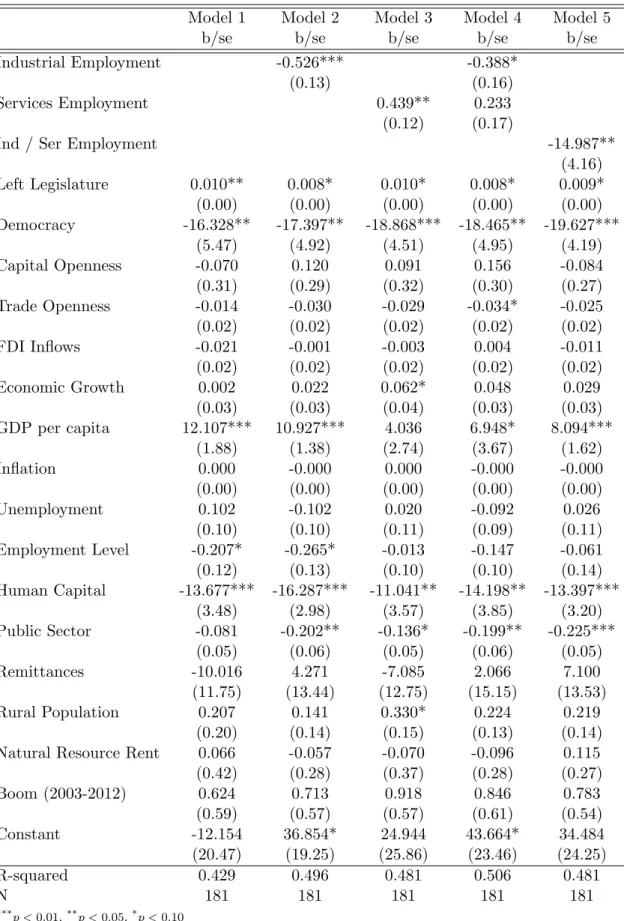
sample to Latin America. Models 1 and 6 run baseline specifications that exclude my main independent variables of interest. Models 2 and 7 add employment in industry. Models 3 and 8 focus on the service sector. Models 4 and 9 then include both employment share variables. Lastly, models 5 and 10 replace the main independent variables with the ratio of employment levels in industry and services, which captures changing dynamics within both of these sectors. The R2 values yielded by the regressions indicate that accounting for structural transformations improves model fit. In all of these cases, the addition of the employment structure variables increases the explanatory power of the models by 4 to 7 percentage points.
The measures of sectoral employment shares return statistically significant coefficients across all models. Their signs are consistent with the theoretical expectations developed above8. Holding the effect of all other variables constant, a larger industrial sector is
associated with lower market income GINI coefficient in Central and Eastern Europe. This result is consistent with the literature on deindustrialization in the post-communist world. The collapse of industry destroyed many jobs and deprived many low-skill workers of employment opportunities. Although some of these workers found jobs in services, this sector was not homogenous. Its expansion is related to higher income dispersion, ceteris paribus. This result confirms the polarization hypothesis, suggesting that Central and Eastern Europe underwent transformations that were similar to the ones that occurred in their Western European neighbors. The joint inclusion of both employment share vari-ables in the analysis does not substantially change this conclusion. The signs of the two coefficients remain the same. Service sector employment loses its statistical significance, but this might be because dynamics in industry are more important. The statistically significant ratio of both employment shares variables indicates that the transfer of more workers from the service to the industrial sector could alleviate market income inequality.
Table 2.1: Employment structure and market income inequality in Central and Eastern Europe
Model 1 Model 2 Model 3 Model 4 Model 5 b/se b/se b/se b/se b/se Industrial Employment -0.526*** -0.388*
(0.13) (0.16) Services Employment 0.439** 0.233
(0.12) (0.17)
Ind / Ser Employment -14.987**
(4.16) Left Legislature 0.010** 0.008* 0.010* 0.008* 0.009* (0.00) (0.00) (0.00) (0.00) (0.00) Democracy -16.328** -17.397** -18.868*** -18.465** -19.627***
(5.47) (4.92) (4.51) (4.95) (4.19) Capital Openness -0.070 0.120 0.091 0.156 -0.084 (0.31) (0.29) (0.32) (0.30) (0.27) Trade Openness -0.014 -0.030 -0.029 -0.034* -0.025 (0.02) (0.02) (0.02) (0.02) (0.02) FDI Inflows -0.021 -0.001 -0.003 0.004 -0.011 (0.02) (0.02) (0.02) (0.02) (0.02) Economic Growth 0.002 0.022 0.062* 0.048 0.029 (0.03) (0.03) (0.04) (0.03) (0.03) GDP per capita 12.107*** 10.927*** 4.036 6.948* 8.094***
(1.88) (1.38) (2.74) (3.67) (1.62) Inflation 0.000 -0.000 0.000 -0.000 -0.000 (0.00) (0.00) (0.00) (0.00) (0.00) Unemployment 0.102 -0.102 0.020 -0.092 0.026 (0.10) (0.10) (0.11) (0.09) (0.11) Employment Level -0.207* -0.265* -0.013 -0.147 -0.061 (0.12) (0.13) (0.10) (0.10) (0.14) Human Capital -13.677*** -16.287*** -11.041** -14.198** -13.397***
(3.48) (2.98) (3.57) (3.85) (3.20) Public Sector -0.081 -0.202** -0.136* -0.199** -0.225***
(0.05) (0.06) (0.05) (0.06) (0.05) Remittances -10.016 4.271 -7.085 2.066 7.100 (11.75) (13.44) (12.75) (15.15) (13.53) Rural Population 0.207 0.141 0.330* 0.224 0.219
(0.20) (0.14) (0.15) (0.13) (0.14) Natural Resource Rent 0.066 -0.057 -0.070 -0.096 0.115 (0.42) (0.28) (0.37) (0.28) (0.27) Boom (2003-2012) 0.624 0.713 0.918 0.846 0.783 (0.59) (0.57) (0.57) (0.61) (0.54) Constant -12.154 36.854* 24.944 43.664* 34.484 (20.47) (19.25) (25.86) (23.46) (24.25) R-squared 0.429 0.496 0.481 0.506 0.481
N 181 181 181 181 181
Table 2.2: Employment structure and market income inequality in Latin America
Model 6 Model 7 Model 8 Model 9 Model 10
b/se b/se b/se b/se b/se
Industrial Employment 0.171* 0.066 (0.06) (0.05) Services Employment 0.198*** 0.180***
(0.03) (0.03)
Ind / Ser Employment 3.654
(2.95) Left Legislature -2.478* -2.364* -1.864* -1.877* -2.453*
(0.93) (0.91) (0.74) (0.74) (0.94) Democracy 1.326 1.974 1.694 1.911 1.440
(1.39) (1.51) (1.26) (1.29) (1.43) Capital Openness 0.433* 0.432* 0.557** 0.545** 0.421* (0.21) (0.22) (0.18) (0.18) (0.21) Trade Openness -0.009 -0.008 -0.005 -0.005 -0.009 (0.01) (0.01) (0.01) (0.01) (0.01) FDI Inflows 0.256*** 0.243*** 0.223*** 0.221*** 0.253***
(0.06) (0.06) (0.05) (0.05) (0.06) Economic Growth -0.008 -0.019 0.000 -0.005 -0.012 (0.05) (0.05) (0.04) (0.04) (0.05) GDP per capita -6.359* -5.515** -7.255** -6.845** -5.971**
(2.30) (1.84) (2.35) (2.16) (2.10) Inflation 0.001* 0.001* 0.002* 0.002* 0.001* (0.00) (0.00) (0.00) (0.00) (0.00) Unemployment -0.035 0.000 -0.052 -0.037 -0.021 (0.07) (0.07) (0.06) (0.06) (0.07) Employment Level -0.068* -0.059 -0.004 -0.006 -0.071*
(0.04) (0.04) (0.04) (0.04) (0.04) Human Capital -1.617 -2.704 -2.627 -2.954 -1.942 (2.47) (2.77) (2.54) (2.64) (2.58) Public Sector 0.223** 0.286** 0.264** 0.284** 0.241**
(0.06) (0.08) (0.07) (0.08) (0.07) Remittances 3.942 4.650 2.854 3.230 5.082
(5.79) (6.36) (5.97) (6.18) (5.80) Rural Population -0.110 -0.135* -0.027 -0.045 -0.131*
(0.07) (0.05) (0.08) (0.08) (0.07) Natural Resource Rent 0.009 0.023 0.043 0.045 0.009
(0.05) (0.05) (0.04) (0.04) (0.05) Boom (2003-2012) -1.069 -0.986 -1.132* -1.094* -1.038 (0.64) (0.66) (0.58) (0.60) (0.66) Constant 116.940*** 106.697*** 107.689*** 104.583*** 113.258***
(20.37) (15.73) (21.46) (19.49) (18.38) R-squared 0.365 0.382 0.414 0.416 0.367
N 398 398 398 398 398
***p <0.01,**p <0.05,*p <0.10
increase as service sector employment levels rise. Nevertheless, a higher proportion of the labor force engaged in the industrial sector is not linked to lower inequality. The coefficient for industrial employment is positively signed, suggesting that the rise of in-dustry has the potential to exacerbate market income dispersion. As previously noted, this might be because industry in Latin America is not labor-intensive and nowadays de-mands high skills, which are relatively scarce in the region. Model 9 suggests that when both sectors are included, the expansion of services is more important. Finally, the ratio between industrial and service sector employment fails to reach statistical significance. This is logical given that both variables affect the market income distribution in the same direction. Changes in the distribution of workers between these two sectors are thus not likely to substantially alter the income distribution.
Several other findings are worth noting. Surprisingly, few of the economic controls are consistently statistically significant in the Central and Eastern European regressions. Higher GDP per capita is related to a higher GINI coefficient. This implies that as coun-tries get richer, their income distribution is likely to become more unequal. The region’s history during the transition confirms this result. Economic recovery and subsequent growth coincided with rising wage dispersion. A larger rural population has a similar effect. Many rural communities stagnated after 1989 as collectivized agriculture was re-formed. This could have led to a higher disparity between rural and urban centers. In contrast, a higher employment rate is related to lower income inequality. Similarly, higher levels of human capital are associated with a lower GINI index. An educated labor force generally implies more homogeneous productivity levels and a lower educational premium as a larger proportion of the population has access to education. This reduces the gap in remuneration between high and low-skill workers, suppressing income differentials.
variables in the regressions – democracy and partisan ideology – both return statistically significant coefficients. The consolidation of democracy in Central and Eastern Europe, as captured by V-Dem’s electoral democracy index, is associated with a more egalitarian income distribution. This might be partly explained by temporal forces since inequal-ity levels ceased their steep increase in the second half of the 1990s, when the political transition away from totalitarianism had concluded. Or it might be because, once estab-lished, democratic governments actively strove to ameliorate income differentials. This response, however, does not appear to have come from left-wing parties. The share of legislative seats occupied by leftist parties is actually positively correlated with the GINI coefficient. This result suggests that leftist parties oversaw rising inequality and could not condition markets to produce a more equitable distribution of income. My findings are therefore consistent with Tavits and Letki’s work, which shows that the Left in the region frequently adhered to macroeconomic orthodoxy and was forced to implement market-oriented reforms during the transition period (2002).
The political story is very different in Latin America. In this context, higher legislative control by left-wing parties is associated with lower market income inequality. This finding confirms the story developed by Huber and Stephens (2012) and Morgan and Kelly (2013), who argue that the Left in the region acted consistently with its historic commitment to greater equality not only by expanding social programs and redistributing income, but also by conditioning markets in a more equitable direction. This action appears to have counteracted the broader impact of the public sector. Indeed, government final consumption in Latin America exacerbates market income inequality. This might be because public sector employees in the region typically enjoy higher income, benefits and protection levels than other workers. The expansion of this sector therefore generates greater heterogeneity. Thus, the Latin American context strongly differs from the Eastern European one in political terms.
inequality. This might be partly because employment levels have stabilized over the last two decades. While the severe economic crises of the 1980s and the 1990s left millions jobless, the 2000s witnessed more people finding employment. Although in many cases these jobs were precarious and affected by business cycle dynamics, they did expand citi-zens’ income, ultimately mitigating income differentials. Furthermore, and unexpectedly, a larger rural sector results in lower market income inequality, suggesting that income differentials outside of urban centers are lower. Inflation, on the other hand, has tended to exacerbate inequality. In many cases this can be explained with the rise of utility prices, which have disproportionately hurt the poor while benefiting top earners, who gained ownership of utility companies in the 1980s and the 1990s.
Finally, of particular note are the coefficients attached to capital account openness and foreign direct investment in the region. Existing scholarship on Latin America has highlighted that foreign capital has historically flown to capital-intensive sectors (Huber et al. 2006, Huber and Stephens 2012). More recently, tourism and other services have also attracted substantial resources. Recent studies reveal that, although variation among countries remains notable, foreign direct investment is increasingly concentrated in high-technology sectors (CEPAL 2015). With regard to capital mobility, the literature has argued that it has the potential to increase income inequality. Thus, foreign capital is expected exacerbate income differentials. The coefficients for both capital account liberalization and foreign direct investment flows support this prediction.
2.6 Robustness Checks
series and re-estimated my models with the residuals.
2.6.1
Industry in Latin America
To further explore the impact of industry on the income distribution in Latin America, I plotted industrial employment against the value added by the industrial sector9. The
comparison between these two series enables us to examine the relative labor-intensiveness of industry. If the value added of the sector is much higher than the proportion of the labor force engaged in it, we have reasons to believe that industry absorbs less labor and is more capital-intensive. Figure 3 below shows these proportions for all Latin American countries in my analysis. As it becomes clear, industrial value added exceeds industrial employment in many of the countries in the region. Although in some Central American states - such as Belize, El Salvador, Panama, and Nicaragua - the difference between the two proportions is very small, in others, it is quite noticeable. This implies that industry is more capital-intensive in the latter group. For comparison purposes, the same figure including all states in Central and Eastern Europe is included in Appendix 1.
What are the implications of this for income inequality? To assess that question further, I reran model 7 including an interaction term between industrial employment and gross secondary school enrolment. The plot suggests that the inequality-exacerbating effect of industry decreases as proportion of students enrolled in secondary education institutions increases. The interaction term is not statistically significant over the entire range of the enrolment ratio, but, crucially, it reaches statistical significance in the middle ranges. This implies that raising enrollment further once a majority of students already attend high school does not have the same return. The dynamics illustrated by graph 4 thus lend some support to the idea that industry increases income differentials because the sector employs high-skill workers who are not abundant in Latin American countries.
Figure 2.3: Industrial Employment and Industrial Value Added in Latin America
2.6.2
Prais Winsten Regressions with Country Fixed Effects
Prais-Winsten regressions, which combine panel-corrected standard errors with ar1 cor-rections, are substantively designed to address the serial and spatial autocorrelation that characterize cross-sectional time-series data (Beck and Katz 2004 and 2011). This empir-ical strategy generally accounts for both temporal and cross-sectional variation. Simul-taneously, it effectively corrects for first order autoregressiveness by including a lagged dependent variable on the right hand side of the regression equation without suppressing the explanatory power of other covariates. It also assumes that disturbances are het-eroskedastic across panels. To minimize the likelihood of omitted variable bias, I follow Beck and Katz and add country dummies. My modeling technique is thus exceptionally conservative.
Figure 2.4: Interaction between industrial employment and secondary education (Latin America)