CRISIS PERCEPTIONS, FAN BEHAVIORS, AND EGOCENTRIC DISCUSSION NETWORKS: AN INVESTIGATION INTO THE
IMPERVIOUS NATURE OF NFL CRISES
Jennifer L. Harker
A dissertation submitted to the faculty of The University of North Carolina at Chapel Hill in partial fulfillment of the requirements for the degree of Doctor of Philosophy
in the School of Media and Journalism.
Chapel Hill 2018
Approved by:
Adam J. Saffer
Daniel Riffe
Lucinda Austin
Andrew Billings
ABSTRACT
JENNIFER L. HARKER: Crisis Perceptions, Fan Behaviors, and Egocentric Discussion Networks: An Investigation into the Impervious Nature of NFL Crises
(Under the direction of Adam J. Saffer, Ph.D.)
This dissertation uniquely measured stakeholders’ perceptions of crisis, and the affective
and behavioral outcomes of those perceptions. More specifically, sport identification, fan
behaviors, and egocentric discussion network analyses were all situated within the framework of
situational crisis communication theory to explore the ways in which individuals react to and
communicate perceptions concerning sport crises.
Stakeholders’ perceptions were divided into two categories, crisis perceptions and
reputational outcomes, and tested for associations with sport identification and the activation of
several fan behaviors. This dissertation captured stakeholders’ perceptions regarding four crises
involving the National Football League (NFL) among the three structural levels of the NFL
organization: the league as a whole entity, the team as an organization, and athlete as individual.
Each crisis, by level of attribution, was then explored in tandem with the sport-specific
measurements of sport identification and the activation of fan behaviors.
Sport identification was uniquely examined in this dissertation as a relational history with
sport entities and actors, and was tested as a predictive antecedent to stakeholders’ perceptions.
Sport identification was tested for its predictive power over stakeholders’ perceptions and for its
driving force behind the activation of fan behaviors. Several fan behaviors, including CORFing,
image management attempts in response to general sport outcomes and in response to sport
crises.
Findings indicate that sport identification is indeed a predictive element of stakeholders’
perceptions regarding sport crises, as well as an activating factor of fan behaviors in response to
both general sport outcomes and in response to sport crises. However, sport identification tracks
in an interesting new direction different than originally hypothesized within this research. As a
result, this dissertation extended current knowledge and furthers current theory, method, and
practice across the crisis communication, sport public relations, and the network perspective
bodies of literatures. Exciting new directions are paved by this dissertation for future sport crisis
communication research, including the application of fan behaviors as crisis outcomes and the
“
In pure identification there would be no strife. Likewise, there would be no strife in absolute separateness, since opponents can join battle only through a mediatory ground that makes their communication possible, thus providing the first condition necessary for their interchange of blows. But put identification and division ambiguously together, so that you cannot know for certain just where one ends and the other begins, and you have the characteristic invitation to rhetoric.”
DEDICATION
Every achievement related to the completion of this dissertation and doctoral degree is
directly because of my beautiful and loving family. This dissertation is dedicated to them.
To my loving, supportive hubby, this is our achievement. Thank you for doing the
laundry, cooking the meals, and wiping my tears away when things felt more difficult than I
could tackle. You are the greatest dad to our children. I am eternally grateful for you.
To my momma, thank you for your undying support through literally every year of my
entire life. I thank God for you every day and I am so grateful for your love and forgiveness.
Thank you for always being my biggest cheerleader.
Of course, my greatest life successes shall eternally be my three children: Jordan,
Brooklyn, and Haven. You each are my truest and purest blessings in life, and each of you fill
my heart to bursting. I do hope my time working toward this degree demonstrated to each of you
that you never have to be defined by your past, and you always have the power to redirect your
ACKNOWLEDGEMENTS
No successful moment occurs as a solo act. Our personal networks support us in every
imaginable way—some more poignant than others but all playing some relational role,
nonetheless. Here, I wish to acknowledge those in my own network who have meant the most
and helped me the most over these challenging years as I strived to grow as a scholar.
Dr. Adam Saffer, from my first semester in this doctoral program through the end of my
time in the School of Media and Journalism, you have dedicated an innumerable amount of hours
reviewing my work, editing, mentoring, and guiding me toward a future in academia. I have
appreciated your unwavering dedication to excellence in my work. You have crafted me into a
more diverse scholar than I ever imagined possible. Your support during the truly challenging
times of this program, your grace and forgiveness, and all the letters of recommendation for
fellowships and the job market will never be forgotten. Thank you for hanging in there with me
and I look forward to watching our professional network grow for many years to come.
To my wonderfully brilliant and esteemed committee, thank you for traveling this
journey with me. Your mentorship, guidance, advice, and brilliance have helped me
tremendously and your commitment to my success is both appreciated and coveted. Dr. Daniel
Riffe, there really are no words to truly convey how much working with you and learning from
you has meant to me. You have modeled the epitome of being an educator with your demand for
excellence yet constant show of patience. What I’ve appreciated most is your understanding
regarding the challenges of juggling a family while completing this degree and your continued
knew I was going to enjoy knowing you and learning from you. Your dedication and brilliance
are true assets to those of us lucky enough to work with you. Dr. Jonathan Jensen, thank you for
our lunch talks, especially the ones at Linda’s with Brussels sprouts. I’ve also appreciated the
time spent working and talking in your office, surrounded by inspiring sport marketing trinkets.
Sometimes, a big “no” leads to a whole series of even bigger yeses. My first year
submitting to AEJMC fell flat with three paper submission rejections. After regrouping, I looked
into other avenues for my work, and those avenues led me to conferences and exchanges with
Dr. Andrew Billings. Since, I have been connected to countless opportunities for success and
introduced to several amazing scholars who share my love for sport communication. Thank you,
Dr. Billings, for modeling the true reach of mentorship in academia. I promise to pay it forward.
The old adage that it takes a village is especially poignant when reaching this point in
one’s educational experiences. The first educator to truly make a difference in my life was my
journalism advisor, Mike Haynes. I owe my entire career to his earliest beliefs in my ability to
succeed. The coveted mentorship I continue to receive from Dr. Kristina Drumheller, and Dr.
Butler Cain’s unending “Just Do It” encouragement has helped me through this program in so
many remarkable ways, and I am forever grateful.
Here at Carolina, a million thanks go to Dr. Heidi Hennink-Kaminski for being a constant
source of mentorship and support. I thank you and Dr. Francesca Dillman Carpentier for giving
me this opportunity to attend my top choice doctoral program. Thank you, Francesca, for also
introducing me to the Ig Nobels, which will serve as a pinnacle career goal for me as well as a
perfect reminder to not take work so seriously all the time. Our 24/7 theory sessions will forever
remain my favorite pedagogical experience in all my years of higher education. I also benefitted
your humble view. You taught me so much in those one-hour mentorship sessions, including the
needed insight that this dissertation is the launchpad of my career and not solely the endpoint to
my earning this doctoral degree. I also wish to thank Dean Steve Matson whose unwavering
support of doctoral students has been admirable. His dedication to diversity at the graduate level
and his foresight to fund summer research has greatly enriched my time here. Dean Matson’s
tenure leading the UNC-CH Graduate School ends as my time here completes and I am grateful
to have coexisted at Carolina together.
And speaking of coexistence, to my cohort, I thank you for enlivening this experience.
My fondest memories from my time here will forever be every delightful moment spent with
Shao Chengyuan. Thank you for teaching my daughters and me so many beautiful new ways to
think about life, and enjoy tea! To Abigail Carroll, my neighbor, soul sister, and best friend
through all of this. Thank you for the summer trips to dance to Bob Weir singing, “Women are
Smarter” as we crammed for our comprehensive exams. Thank you for sharing your time for the
countless magical sessions of outdoor yoga and impromptu champagne cheers over our
milestone achievements. And thank you especially for sharing your life-breathing love for all
living things around you. You have been a true gift to my family and me.
And last but certainly not least; I must acknowledge the endless support I have received
from the numerous alumni of this program. They have cheered me on, co-authored with me,
shared materials with me, commiserated with me, advised me, comforted me, congratulated me,
and even hired me! To each and every one of you I am grateful. I feel honored to join the
Carolina blue bloodline and I am committed to paying it all forward to future Tar Heels whose
TABLE OF CONTENTS
CHAPTER 1: INTRODUCTION ... 1
Theory and Conceptual Needs ... 8
Purpose of this Dissertation ... 8
CHAPTER 2: LITERATURE REVIEW ... 12
Crisis Communication ... 17
Situational Crisis Communication Theory ... 19
Stakeholders’ Perceptions and Sport Identification ... 36
Identification and Involvement ... 38
Assessing Fan Behaviors as Affective and Behavioral Outcomes ... 46
Types of fan behaviors. ... 48
Network Perspective to Inform Situational Crisis Communication Theory ... 55
Applying Network Perspective to Situational Crisis Communication ... 58
Egocentric Network Analysis ... 67
Functional Specificity Hypothesis ... 70
Discussion Networks ... 72
Research Questions ... 78
CHAPTER 3: METHODS ... 86
Survey Instrument ... 91
Survey Procedures ... 91
Survey Sample ... 93
Survey Measures ... 95
Data Preparation for Analyses ... 126
Chapter Synopsis ... 128
CHAPTER 4: FINDINGS ... 129
Traditional Social Science Findings ... 130
Stakeholders’ Perceptions in Response to NFL Crises ... 130
Sport Identification ... 141
Fan Behaviors ... 160
Conclusion of Section 1: Traditional Social Science Findings ... 172
Section 2: Egocentric Discussion Network Results ... 173
Selection: Composition of the Discussion Networks ... 174
Activation: Relational Ties in the Sport-Related Discussion Networks ... 191
CHAPTER 5: DISCUSSION ... 219
Gaps in Current Literature Filled by this Research ... 220
Stakeholders’ Perceptions of Sport Crises ... 223
Crisis Attribution ... 223
Stakeholders’ Perceptions of NFL Crises ... 225
The Influential Relationship of Sport Identification ... 228
Sport Identification as an Influencer of Stakeholders’ Perceptions ... 228
Sport Identification and the Activation of Relational Ties ... 232
Network Influence and Sport Identification ... 233
Affective and Behavioral Outcomes of Sport Crises ... 236
Schadenfreude: A Joyful, Albeit Discordant, Crisis Response ... 237
Fan Behaviors in Networks: Psychological Measurements and Behavioral Actualities .... 240
Divergent Triggers: Sport Identification and Fan Behaviors ... 242
Sport Identification as a Discordant Communication Activator ... 245
Chapter Synopsis ... 250
CHAPTER 6: CONCLUSION ... 252
Implications for Situational Crisis Communication Theory ... 252
Implications for Sport-Related Public Relations Methods ... 255
Limitations ... 258
Future Research in Sport-Related Public Relations ... 259
Appendix A – Survey Codebook ... 262
Appendix B – Context Overview of Four NFL Crises Case Studies ... 294
Appendix C – Scale Creation for Stakeholders’ Perceptions and Sport Identification ... 295
Appendix D – Sport Interrelator ... 299
Appendix E – Structural Holes Measurement ... 302
Appendix F – Multilevel Model Regression Analyses ... 305
Appendix G – Alter Fan Levels by Relation, Role, and Discussion Network ... 309
LIST OF TABLES
Table 3.1. Research Questions, Method, and Analytical Procedure ... 87
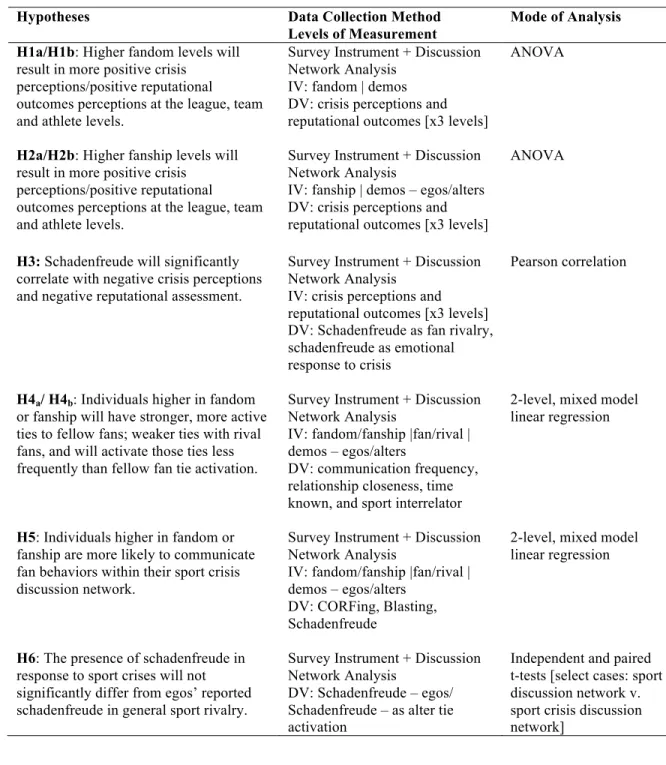
Table 3.2. Hypotheses Testing, Method, and Analytical Procedure ... 90
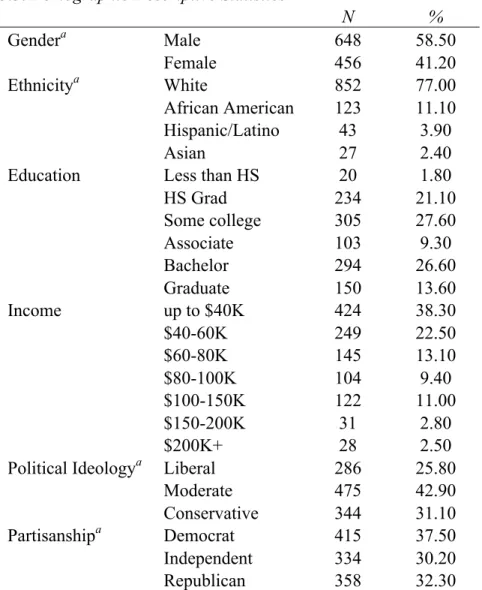
Table 3.3. Demographic Descriptive Statistics ... 94
Table 3.4. Four Crises Examined by SCCT’s Crisis Perception Factors ... 97
Table 3.5. Emotions in Response to Crisis Overall and Crisis Repercussions ... 106
Table 4.1. Crises, Crisis Attribution, and Amount of Blame ... 132
Table 4.2. Crisis Perceptions Descriptive Statistics and Scales ... 135
Table 4.3. Sport Identification Descriptive Statistics and Scales ... 144
Table 4.4. Associations of Fandom and Fanship with Stakeholders’ Perceptions ... 147
Table 4.5. League Level: Regression Analyses Fandom | Crisis Perceptions ... 151
Table 4.6. Team Level: Fandom | Crisis Perceptions ... 152
Table 4.7. Team Level: Fandom | Reputational Outcomes ... 153
Table 4.8. League Level: Fanship | Crisis Perceptions ... 154
Table 4.9. Team Level: Fanship | Crisis Perceptions ... 155
Table 4.10. Team Level: Fanship | Reputational Outcomes ... 156
Table 4.11. Split-High Variables of Fandom and Fanship ... 157
Table 4.12. Fan Behaviors Descriptive Statistics and Scales ... 160
Table 4.13. Fan Behaviors, Sport Identification, and Stakeholders’ Perceptions ... 163
Table 4.14. Emotional Responses to Crisis Repercussions ... 170
Table 4.15. Alter Demographics in Important Matters Discussion Network ... 175
Table 4.16. Relational Ties of Alters in Important Matters Discussion Network ... 176
Table 4.18. Relational Ties of Alters in Sport Discussion Network ... 177
Table 4.19. Demographics of Alters in Sport Crisis Discussion Networks ... 178
Table 4.20. Relational Ties of Alters in Sport Crisis Discussion Networks ... 179
Table 4.21. Homophily Measurements for the Egocentric Discussion Networks ... 181
Table 4.22. Fan Behavior Descriptive Statistics for Egos and Alters in Sport Discussion Network and Sport Crisis Discussion Network ... 187
Table 4.23. Sport Discussion Network Correlations of Perceived and Activated Fan Behaviors ... 188
Table 4.24. Schadenfreude Scale for Both Discussion Networks (alters only) ... 189
Table 4.25. Sport Crisis Discussion Network Correlations of Perceived and Activated Fan Behaviors ... 190
Table 4.26. Name Generators in Sport Discussion Network ... 193
Table 4.27. Name Generators in Sport Crisis Discussion Network ... 194
Table 4.28. Sport Discussion Network Tie Activation ... 195
Table 4.29. Sport Crisis Discussion Network Tie Activation ... 197
Table 4.30. Multilevel Modeling for Fan Behavior Activation in Sport Discussion Network ... 203
Table 4.31. Multilevel Modeling for Fan Behavior Activation in Sport Crisis Discussion Network ... 206
Table 4.32. Sport Crisis Discussion Network Stakeholders’ Perceptions, Sport Identification, and Fan Behavior Activation ... 210
Table 4.33. Regression Models for Network Influence for Crisis Perceptions: Sport Crisis Discussion Network ... 213
Table 4.34. Regression Models for Network Influence for Reputational Outcomes: Sport Crisis Discussion Network ... 216
Table 5.1. Multilevel Modeling for Sport Interrelator Activation in
Sport Discussion Network Compared to Sport Crisis Discussion Network ... 301
Table 5.2. Structural Holes Statistics for Communication Frequency in
All Three Egocentric Discussion Networks ... 303
LIST OF FIGURES
Figure 2.1. Situational Crisis Communication Theory: Layer 1 ... 21
Figure 2.2. Situational Crisis Communication Theory: Layer 2 ... 26
Figure 2.3. Situational Crisis Communication Theory: Layer 3 ... 34
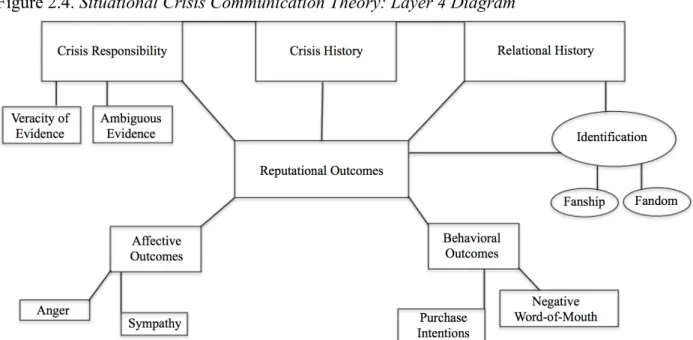
Figure 2.4. Situational Crisis Communication Theory: Layer 4 ... 37
Figure 2.5. Situational Crisis Communication Theory: Layer 5 ... 47
Figure 2.6. Situational Crisis Communication Theory: Layer 6 ... 57
Figure 6.1. The Situational Crisis Communication Theory Model in Sport Crises ... 253
This dissertation is funded in part by the Mass Communication & Society Division of the Association for Education in Journalism and Mass Communication (AEJMC), The University of
CHAPTER 1
INTRODUCTION
Public relations is better defined by what it does than what it is (Hopwood, Skinner, &
Kitchin, 2010; L’Etang, 2013). Public relations is the ongoing management of communication,
reputation, and relationship-building that furthers the interests of the entity being represented
(L’Etang, 2013). Public relations practitioners build relationships by communicating and
listening to the public in an effort to maintain a positive reputation. Reputation is a
perception-based construct (Walker, 2010), best explained by Hopwood et al., (2010) as, “everything you
do, everything you say and everything anyone else says or thinks about you” (p. 17). Reputations
are challenged during times of crises (Coombs & Holladay, 2002), which are sudden, unexpected
negatively perceived events (Coombs, 2007a). Researchers often begin by assessing the
wrongdoing that triggered a crisis and what the entities and actors experiencing the crisis said,
but more rarely study the public’s perceptions of the entities and the entities’ evolving
reputations (Avery, Lariscy, Kim, & Hocke, 2010; Ha & Boynton, 2014). This dissertation
begins by examining the public’s perception of entities and actors at the center of a crisis and
does so by applying a unique method to study the communication of those perceptions.
Traditionally, public relations scholars use one of two theoretical frameworks for
studying crisis. One is image repair theory (Benoit, 2015), a theoretical and rhetorical lens to
decipher the application of crisis remediation strategies. Retrospective case studies of individual
self-defense following a crisis. To truly understand crises and perceptions of crises, a more robust
framework is necessary. Image repair theory is limited by its one-way communication structure
and lacks inclusion and measurement of public perceptions. These limitations do not lead to a
complete assessment of reputation following crisis remediation.
Situational crisis communication theory offers a more comprehensive theoretical
framework that is empirically focused, practitioner-applied, and is situational in its crisis
communication typology (Coombs, 2014, 2007a, 2004, 1998, 1995; Coombs & Holladay, 2008,
2006, 2002, 1996). This theory matches common organizational crisis types with ten remediation
strategies that are prescribed to help correct the wrongdoing (Coombs, 1995). Broadly, this
theory encompasses an organizational crisis communication approach for crisis response. For
example, Cooley and Cooley (2011) examined the General Motors bankruptcy using situational
crisis communication theory and found the organization’s public relations practitioners applied
justification and excuse strategies most often when defending General Motors’ reputation during
that time period. The authors categorized the General Motors financial crisis as preventable,
which suggests a higher attribution of responsibility.
Beyond looking at the crisis types and the response strategies, situational crisis
communication theory draws from attribution theory (Heider, 1958; Weiner, 1985) to understand
the ways a public (or publics) attribute crisis responsibility in response to a perceived
wrongdoing (i.e. crisis event). With an interest toward remediating a crisis, the theory explains
how attribution of responsibility can be reduced and an organization can maintain its reputation.
Coombs (2007a) notes that adjusting information for both physical and emotional direction or
redirection is critical to crisis management and when conveyed appropriately helps to reduce
corrective action, in order for the remediation attempt to be successful (Coombs & Holladay,
2008). When the remediation attempt is not acceptable, crisis increases in severity because of
negative stakeholders’ perceptions (Coombs & Holladay, 2009).
A stakeholder is any person or group that holds some connected interest with the entity
enduring a crisis (Ulmer, 2001). Stakeholders can include other organizations, governmental
agencies, the media, and any individual connected or among the general public adjacent to the
organization, just to name a few examples (Ulmer, Seeger, & Sellnow, 2007). A centerpiece of
situational crisis communication theory provides guidance for the assessment of stakeholders’
perceptions of reputation. Coombs (2007a) explained that the ultimate outcome in a crisis is for
the organization’s reputation to remain intact. Recall that reputation is a perception-based
construct. It is here that this dissertation is situated.
Reputational assessment through stakeholders’ perceptions is a critical component of
crisis remediation and is an underutilized portion of situational crisis communication theory
(Coombs & Holladay, 2008, 2006). According to situational crisis communication theory, three
stakeholders’ perceptions can threaten an organization’s reputation in a crisis (Coombs, 2007a):
perceived responsibility (attribution, amount of blame, or amount of evidence), crisis history (is the crisis a one-time event or one in a crisis saga), and assessment of relational history. For example, the more a stakeholder believes an organization is responsible for the wrongdoing,
which can be multiplied by the wrongdoing occurring more than once (i.e. crisis history), the
lower the resultant reputational assessment (Coombs, 1995). However, generally speaking, a
prior positive reputation can serve as a buffer when a crisis occurs, thus reducing anger and
blame (Coombs, 2007a), but that is not always the case (Sohn & Lariscy, 2012) across all
factors might influence stakeholders’ perceptions and one understudied factor in the current
literature is a stakeholder’s prior relationship to an organization. This dissertation argues that
prior relationship to an organization or actors connected to the organization might play a key role
in the way perceptions of the organization and its response to crises are constructed.
Crisis perceptions are buffered by overall experiences and personal connectedness to the
entity experiencing the crisis (Coombs, 2007a). A buffer can be conceptualized as a “pre-existing
factor that could influence” the perceptions around a crisis (Koerber & Zabara, 2017, p. 194).
Buffers result in less serious crisis perceptions because of emotional or proximal perceived
connections (Koerber & Zabara, 2017). In other words, an individual interprets a crisis via a
kaleidoscope of perceptions and those perceptions shape attribution and reputational
measurement. The culmination of stakeholders’ perceptions of past experiences, reputational
assessment, and crisis attribution are as unique as the individual assessing the crisis. For
example, reaching back to Cooley and Cooley’s (2011) research on the General Motors financial
crisis, the bankruptcy might be perceived as a relief to some internal stakeholders because of the
protections bankruptcy can offer. Other external stakeholders, especially those General Motors
was indebted to, view the crisis much more negatively. For this reason, personal identification
with the entity should be measured because such perspective can play a key role in perception
(Coombs & Holladay, 2006).
Stakeholders’ perceptions, generally speaking, run along a continuum from negative to
positive. Positive perceptions of crisis events are not studied in the crisis communication
literature. In fact, for some it may seem counter to traditional crisis research. Yet, it is argued
here, that such exploration is important to consider especially when weighing Coombs’
attribute responsibility on an entity enduring a crisis. There are crises that could be perceived as
valuable or positive, depending upon a person’s individual perception or identity.
Identification occurs at the individual and group or social levels (Tajfel & Turner, 1979),
and can vary in intensity and duration. Identification can spur cognitive, emotional (or affective),
and behavioral outcomes (Brown, 2015; Moyer-Guse, 2015). Identification is one way this
dissertation will explore this understudied phenomenon in crisis communication. Coombs’
situational crisis communication theory nods to identification within the third of these
assessment factors of crisis perceptions: past reputation and relationship [i.e. relational history]
(Coombs, 2007a). Identification in relation to that factor has not yet been reviewed in depth in
crisis research, and the pairing of identification with sport and crisis perceptions has not yet been
examined.
This dissertation applies these concepts of crisis perceptions and identification to crisis
situations within the context of sport. Sport entities face similar crises as other types of
organizations but sport offers heightened perceptions because of identification (Kruse, 1981).
For example, research on connectedness to sport spans a continuum of identification levels from
the psychology of self to social identity (Kruse, 1977, 1981; Wann, Melnick, Russell, & Pease,
2001; Reysen & Branscombe, 2010). Put another way, a person who highly identifies her/himself
with sport is considered a sports fan (fanship), and those who highly identify with other sport
fans of say, a particular sport team, consider themselves to be among that family of fans
(fandom). By taking a multileveled approach, this dissertation research examines the individual
identification (fanship) and the social identification (fandom) considerations of sport
connectedness through identification—both team identification and social identification.
outcomes. In sport, specifically, those outcomes include an array of fan behaviors (Spinda,
2011).
As stated above, by beginning with an examination of fan and nonfan perceptions of
sport-related crises, the pairing with fan behaviors provides a nuanced view into how fans
convey their reactions to crisis scenarios. For example, this dissertation examines whether a
crisis involving a rival team makes a fan feel as joyful as when that rival team loses a game
(Billings, Qiao, Brown, & Devlin, 2017; Dalakas & Phillips Melancon, 2012; Havard, 2014).
Such exploration of fan behaviors allows for the examination of how crises are perceived and
whether and how those perceptions might mirror or differ in general sport-related outcomes and
subsequent behaviors. In other words, rival fans may blast each other, or “trash talk” following a
favorable or unfavorable game matchup (Cialdini & Richardson, 1980; Spinda, 2011). Such a
phenomenon brings up several empirical questions: Do fans enact similar behaviors during a
sport-related crisis involving a rival team? Moreover, are the same behaviors occurring amongst
fans of a team who experience a team-related crisis as has been researched among fans following
the loss of a game to a rival team? An assessment of similarities between these game-related fan
behaviors and sport-related crises behaviors might be similar. If so, results could inform
researchers and practitioners of sport crisis communication on the ways sport crises are
perceived similarly or differently from traditional organizational crises.
The proposed research study expands the application of situational crisis communication
theory both theoretically and conceptually, as well as methodologically. By adding a network
perspective, this study is situated to consider the ways communication is networked,
interconnected, and full of actions, thoughts, and behaviors (Monge & Contractor, 2003). This
in crisis recovery or furthers the reputational threat. Coombs suggested that word-of-mouth,
which occurs when stakeholders talk to others about an issue, is among the behavioral outcomes
of reputational assessment following a crisis. Analytically, the network perspective can capture
stakeholders’ word-of-mouth and assess the impact such discussions have on stakeholders’
perceptions and behaviors. In other words, people talk about sport with a wide variety of others
in their personal networks. By embracing this basic premise of the network perspective and the
topic of related crisis, this dissertation will identify those whom stakeholders discuss
sport-related crises, why they reach to those certain others for those conversations, and examine what
impact such discussion have on crisis perceptions.
This dissertation, therefore, proposes an egocentric network survey to investigate how
and with whom people discuss sport and sport-related crises. An egocentric network explores the
social network of an individual (Marsden, 1987). A discussion network measures the
communicative exchanges among an ego (the individual) and his/her respective alters (i.e. kin,
friends, acquaintances, or other fans). An egocentric discussion network in this study will
examine the precise ways in which stakeholders communicate with people in their personal
networks about sport. Previous ego network studies have studied individuals’ discussions about
“important matters” (Burt, 1984; Marsden, 1987) “health matters” (Bush, Walker, & Perry,
2017; Perkins, Subramanian, & Christakis, 2015; Perry & Pescosolido, 2010, 2015) and, most
recently, “political matters” (Bello & Rolfe, 2014; Cowan & Baldassarri, 2017; Eveland &
Kleinman, 2013; Klofstad, McClurg, & Rolfe, 2009). Never before has an egocentric network
Theory and Conceptual Needs
Taken together, the exploration of situational crisis communication theory, combined
with an egocentric discussion network approach, and the levels and activation of several
conceptual aspects specific to sport, will provide an in-depth nuanced view of stakeholders’
perceptions specific to sport crises. This dissertation fulfills many theoretical and conceptual
needs in the crisis communication literature.
Five areas have not yet been measured within sport crisis communication and will be
addressed in this dissertation. The first is the focus of stakeholders’ perceptions in the application
of situational crisis communication theory and the assessment of those perceptions specific to
sport. The second is identification with sport at the individual (fanship) and group (fandom)
levels and how that identification might impact crisis perceptions. The third is a unique
perspective to be explored involving a positively valenced view of crises. The fourth area
involves combining word-of-mouth and fan behaviors with sport-related crisis perceptions.
Finally, the fifth area of need this dissertation fills is the unique application of an egocentric
network analysis in sport and sport crisis communication. Together, these five areas fill gaps in
not only the sport and crisis literatures but in the network literature, too.
This dissertation therefore introduces an innovative new method and application of
situational crisis communication theory in sport crisis communication by expanding
understanding of the affective and behavioral components connected to stakeholders’ perceptions
specific to sport-related crises.
Purpose of this Dissertation
The connections under the theoretical umbrella of situational crisis communication
opportunity for exploration via a network perspective. In so doing, this dissertation connects the
psychological perceptions of stakeholders and examines how their behavioral outcomes might
differ when asked about sport in general and sport-related crises. This dissertation explores
whether individual and group identification shapes stakeholders’ perceptions and how fan
behaviors are communicated in specific real-life scenarios. The combination of these
sport-related concepts and crisis perceptions fills a gap in crisis communication, sport communication,
and fan behaviors bodies of literature. In so doing, this research serves to advance theory,
method, and practice in crisis communication and sport.
Theoretical contribution. This research extends crisis communication theory by teasing out key understudied and underutilized areas of situational crisis communication theory. The
connection of situational crisis communication theory with a network perspective will inform
best practices in real life sport-related crisis communication by providing a better understanding
of the unique perspectives of stakeholders who both shape and reshape the crisis storyline
through word-of-mouth. Pairing the components of theory with several conceptual frameworks
specific to sport will aid in a better understanding of theory application to broad subfields. This
research will identify stakeholders’ levels of individual and social identification through
measurement of sport fanship and fandom, and how that identification might act as a relational
history that influences stakeholders’ perceptions of sport crises.
Methods contribution. Crisis communication is most often examined retrospectively by quantitatively and qualitatively assessing case study examples of reparation strategies (Ha &
Riffe, 2015). This dissertation moves one step beyond the typology of a situational crisis and its
accompanying remediation strategies, and instead uniquely applies a network perspective.
network perspective to the body of literature. Furthermore, this egocentric network analysis will
be the first specifically focused on sport matters, and will uniquely build the subfield of
sport-related crisis communication as well.
Professional practice contribution. By understanding the nuanced perspectives of stakeholders, crisis remediation attempts can become more precisely targeted for improved
reputational assessment and subsequent crisis recovery outcomes. Interpersonal communication
exchanges involving fan behaviors will help discern the specific activation of crisis perceptions.
As a result, sport crisis practitioners can refocus remediation efforts in targeted ways for
differing stakeholder groups. Moreover, practitioners can also learn which interpersonal
communicative networks to use in an effort to enhance diffusion of positive word-of-mouth and
team or league ambassadorship. In other words, this research will inform the precise ways in
which practitioners can activate fan communication with stakeholders for increased remediation
outcomes.
In sum, this research examines fan and nonfan perceptions of sport-related crises, the
relationships and connections that inform those perceptions, and their resultant behavioral
outcomes, to further our collective understanding of crises in sport. A literature review
immediately follows this chapter to explain the connections among situational crisis
communication theory, identification, and each of the sport-related concepts. The literature
review shares an in-depth overview of the network perspective and introduces past research on
egocentric network analyses and discussion networks. Chapter two ends with the research
questions and hypotheses this innovative research will examine, specifically. Chapter three will
explain the method followed to conduct the egocentric discussion network analysis, and the other
will present the results of the egocentric discussion network analysis, and chapter five will offer
a full explanatory discussion of those findings. Chapter six will conclude by outlining
conclusions that can be drawn, and specific outcomes that can advance situational crisis
CHAPTER 2
LITERATURE REVIEW
The purpose of this dissertation is to examine how stakeholders’ perceptions of crisis are
shaped and communicated. A picturesque example of stakeholders’ perceptions of a crisis
situation in sport, driven by identification and demonstrative of fan behaviors, occurred on
February 5, 2017 when Roger Goodell, commissioner of the National Football League (NFL),
was so loudly booed at the Super Bowl. That culminating moment was quite the sensationalized
end cap to a tumultuous season littered with disagreement between Goodell and the beloved, for
some, New England Patriots and star quarterback, Tom Brady. Patriots’ fans were angry with
Goodell for suspending Brady for four games. Their thunderous boos drowned out the
microphones attempting to capture the historic moment of the Lombardi Trophy presentation.
Patriots’ fans were angry at Goodell’s attempts of disciplining their beloved star player for a
crisis that claimed the quarterback and team had been cheating during games by deflating
footballs. Rival fans alternatively found great joy in Brady’s four-game suspension, and the
Patriot’s fans experienced a considerable amount of blasting, or trash talking, because of the
crisis.
Sport offers a heightened environment for the study of crisis because stakeholders are
overt fans of sport entities, with high levels of identification. Moreover, stakeholders regularly
engage in conversations concerning sport, and negative fan-to-rival communication such as
1999; Havard, 2014; Spinda, 2011). Sport organizations experience similar crises as other
organizations, and sport organizations and actors have just as much need to protect or defend
reputations as any other entity (Kruse, 1981; L’Etang, 2013, 2006; L’Etang & Hopwood, 2008).
This dissertation utilizes crises experienced by the NFL to conceptualize sport-based crises and
to study the theoretical relationship among stakeholders’ perceptions, identification, fan
behaviors, and how people resultantly discuss sport-based crises in their social networks.
Contemporary crisis communication research originates from the one-way dissemination
of crisis remediation or self-defense efforts (Coombs & Holladay, 2013; Ware & Linkugel,
1973) from either an individual or an organization’s defensive posture (Avery et al., 2010;
Benoit, 2015; Coombs, 2004, 1995; Ware & Linkugel, 1973). For example, Ware and Linkugel
(1973) examined the rhetorical self-defense of Richard Nixon. They offered the commonly used
defensive communication strategies of denial, differentiation, transcendence and bolstering,
offered by politicians in response to crisis situations. Benoit (1995) later expanded the four
strategies into an expanded and prescriptive theoretical framework for image restoration.
Benoit’s image repair theory (IRT), as he later named it (2015), has been widely applied to
retrospectively assess the rhetorical strategies extended by an entity or actor to remediate crises.
In tandem to Benoit’s theoretical framework, situational crisis communication theory emerged
(Coombs, 1995; Coombs & Holladay, 2002). Situational crisis communication theory offered
prescriptive remediation strategies for organizations to apply to protect or repair reputations
during or immediately following a crisis. Such focus on organizations’ outward communication
only tells half the story, and overlooks the need for crisis communicators “to understand how
Not until 2004 did scholars begin to focus on stakeholders’ perceptions. Lee (2004)
conducted an experiment to assess perceptions of a plane crash scenario in Hong Kong and
revealed that stakeholders’ perceptions reached beyond the crisis type and severity of a crisis.
Lee instead reasoned that crisis responsibility, the organization’s prior reputation, and
stakeholders’ perceptions are driven by affective responses like sympathy. Until Lee’s work on
stakeholders’ perceptions, “crisis communication research reflected a strong sender orientation,”
(Coombs & Holladay, 2014, p. 40). Put another way, the research until then had only considered
what organizations communicated during or after a crisis.
Merely focusing on an organization’s outward communication is limiting. A power
structure exists that should be considered because when an organization communicates
outwardly, it does not allow for reciprocal dialogue (Leitch & Motion, 2010). Take for example,
the increased ability of an organization or a celebrity persona’s increased access to mediated
channels to amplify messages compared to other less powerful individual stakeholders (Kruse,
1977). In public relations, it is important to consider crises outside of that one-way
outward-focused communication, and integrate the public relations components of engagement and
dialogue that actually occur alongside crises (Coombs & Holladay, 2014; Heath, 2000; Kent &
Taylor, 2002; Leitch & Motion, 2010).
Frandsen and Johansen (2010) argue for an extension of what Heath (2000) best
describes as statement and counterstatement in public discourse. In crisis, this is especially
applicable because many voices enter the rhetorical arena when there has been a perceived
wrongdoing (Coombs & Holladay, 2014; Frandsen & Johansen, 2010). Furthermore,
stakeholders have become “increasingly vocal” in response to crises (Coombs, 2014, p. 13),
This dissertation therefore investigates crises from the stakeholder’s perception, and the
stakeholder’s resultant interpersonal crisis communication. Stakeholders’ perceptions and
reactions are ultimately what define the severity of a crisis, and stakeholders’ perceptions
influence whether the organization recovers from the crisis (Coombs & Holladay, 2013, 2008).
Whether a crisis assessment is approached from the view of the organization or from the
stakeholder’s perception, situational crisis communication theory serves as a comprehensive
roadmap for crisis research. The theory names specific assessment factors that are threats to the
organization’s reputation during and following a crisis. Prior research suggests that stakeholders
assess those factors when perceiving a crisis, how they feel about the entity and its actors, and
stakeholders assess the organization’s resultant reputation (Coombs, 2007a). Ultimately,
behaviors in relation to the entity and its actors and consideration of future interactions decide
whether crisis has been overcome, and not simply the remediation strategies that were conveyed
outwardly (Coombs, 2014, 2007a; Coombs & Holladay, 2014, 2008).
The first part of this chapter will define and explain crises. Situational crisis
communication theory is explained, especially focusing on the assessment factors that are
considered when determining crisis perceptions and reputational outcomes during or following
crises. As aforementioned, this dissertation argues that the assessment factor, relational history,
is understudied in crisis, especially in sport-related crisis, so this chapter also explains how that
factor relates to identification.
The second section of this chapter explores individual and group identification and how
identification relates to sport. An overview of measurement of sport identification is also
reputation and past relationship and is further discussed in relation to resultant behaviors, such as
word-of-mouth, which is evidenced in situational crisis communication theory.
This dissertation argues that resultant behavioral communication stems from the
combination of prior reputation and past relationship, coupled with identification. These matters
will be explored in the third section of this chapter. To explain, in sport specifically, an array of
fan behaviors have emerged during forty years of research, and the underlying motivator of these
fan behaviors is identification. Five fan behaviors are assessed for how each might be
communicatively exchanged with others. These fan behaviors will help examine how sport and
sport crisis are perceived and discussed among stakeholders.
The fifth section of this chapter explains the network perspective and how fan behaviors,
coupled with perceptions and identification, can all be connected and studied in tandem with
individuals’ discussions of sport and sport crises. In other words, this research explores how and
to whom crises are talked about. This sets a foundation to study the ways such discussion
networks might differ by stakeholders’ perception of a crisis or crisis response, their person
levels of identification, and the fan behaviors activated during discussions.
Collectively, these facets combine for a detailed and nuanced view of crisis perceptions.
Moreover, the five areas combine to help answer the main thesis of this dissertation: to examine
the theoretical relationship among stakeholders’ perceptions, identification, fan behaviors, and
how people resultantly discuss sport-related crises in their social networks. To begin the
theoretical examination, crisis is explored in a unique manner that leads with stakeholders’
perceptions of crisis and centers personal identification to explore the depth of prior reputation
Crisis Communication
Coombs (2014) conceptualizes crisis as “the perception of an unpredictable event that
threatens important expectancies of stakeholders,” (Coombs, 2014, p. 2). Crises can relate to
“health, safety, environmental, and economic issues, and can seriously impact an organization’s
performance” (p. 2), generate negative outcomes, and “disrupt or effect an entire organization or
have the potential to do so,” (p. 4). In a basic sense, crisis is also conceptualized as
“unpredictable but not unexpected,” (Coombs, 2014, p. 3). Coombs separates organizational
crisis from larger-scale natural disasters like hurricanes, for example, because disasters require a
much different response and are perceived in a very different ways from organizational crisis.
For example, disasters are commonly handled at the governmental level, with many responding
entities and focuses mostly on adjusting information for physical safety and psychological
coping (Coombs, 2014; Coombs & Holladay, 2008; Liu & Kim, 2011). The common thread
among any type of crisis, however, is the management of crisis through communication.
Crises are managed through crisis communication (Coombs, 2014). Recall that the
original development of crisis-related responses were rooted in rhetorical self-defense, generally
focused outwardly from the organization, entity, or actor experiencing the crisis. Crisis
communication has evolved to become a function of the practice of public relations because
crises are “a threat to relationship,” and any threat to relationship, “is a threat to the reputation,”
(Coombs, 2014, p. 35). Crisis communication, therefore, is the lifeblood of managing a crisis, according to Coombs (2014).
Nearly sixty percent of all crisis communication research focuses on case studies of
organizational response to crises (Avery et al., 2010; Ha & Boynton, 2014; Ha & Riffe, 2015).
communicate about crises. For example, research has assessed how the media react to crisis by
constructing news frames (An & Gower, 2009) or the ways media engage in adversarial
reporting in response to crisis (Harker, 2017). Social media use has been studied for information
seeking during crises (Austin, Liu, & Jin 2012; Liu, Austin, & Jin, 2011; Jin, Liu, & Austin,
2014), and social media use for communicating and coping with crisis (Brown & Billings, 2012)
have been studied. Still, the vast majority of crisis research remains on the organization’s
response and reputational outcomes.
Meta-analyses of crisis communication literature have found image repair theory (Benoit,
2015, 1995) and situational crisis communication theory (Coombs, 2014, 2007a, 1995) are the
two most often applied theoretical approaches to crisis communication research (Avery et al.,
2010; Ha & Boynton, 2014; Ha & Riffe, 2015; Kim, Avery, & Lariscy, 2009; Nekmat, Gower, &
Ye, 2014). The two theories have been replicated, tested, and scattered into subfields of study,
including sport, that have also tested and expanded remediation strategies and broadened
categorizations of crises.
Image repair theory (IRT) as aforementioned is rooted in rhetorical self-defense and
focuses on remediation strategies for repairing reputation following a crisis (Benoit, 2015, 1995;
Ware & Linkugel, 1973). IRT envelopes a variety of entities and actors that endure crises,
including organizations, countries, and celebrity personas. IRT also specifically includes
sport-related crises (Benoit, 2015; Benoit & Hanzcor, 1994). Research on sport crises that applies IRT
generally focuses on framing, rhetorical, and critical cultural analyses of case study situations
that analyze the offered rhetorical self-defense strategies by the entity or actor experiencing the
crisis. This type of research is difficult to quantify because of its subjective form (Kim, Avery, &
self defense in response to crisis and no other theoretical reach to the publics or stakeholders’
perceptions of the crisis, which renders it unusable for this dissertation’s focus.
A closely complimentary emerging conceptual framework in crisis communication is the
rhetorical arena (Frandsen & Johansen, 2010, 2005), and this framework closely relates to the
goals set forth in this dissertation. The rhetorical arena is an emerging conceptual response to the
overwhelming sender-oriented theoretical approach commonly applied to crisis communication.
Frandsen and Johansen (2010b) note that stakeholders interpret crisis within the rhetorical arena
in several ways, including: the assessment of personal stakes in group membership,
interpretations of a crisis, the strategic management of a crisis, and the discursive multiple voices
and genres related to particular crises. Still though, this is an emerging conceptual framework,
far from theoretical soundness but complimentary to the crisis conversation, nonetheless.
The following sections will offer an in-depth review of the most commonly applied
empirically-based crisis communication theory: situational crisis communication theory.
Situational crisis communication theory is the theoretical framework within which this
dissertation is based. The following sections explain situational crisis communication theory, the
differences between approach from the standpoint of an organization or the perception of a
stakeholder, and an overview of the affective and behavioral considerations the theory offers in
crisis assessment. The section wraps up with an overview of how crisis communication connects
to sport and to the NFL, specifically, and then explains how identification closely links to
stakeholders’ perceptions.
Situational Crisis Communication Theory
Situational crisis communication theory (SCCT) is an organization-focused, empirically
Holladay, 2009, 2008, 2006, 2002, 1996; Kim et. al., 2009). SCCT is based upon attribution
theory (Heider, 1958; Weiner, 1986) and encompasses an organizational communication
approach for crisis communication focused on types of crisis, and ten prescriptive remediation
strategies. SCCT extrapolates additional aspects of crises that reach wider and deeper than IRT’s
sole focus on remediation. For example, SCCT extends beyond crisis types and remediation
strategies to include reputational assessment and the affective and behavioral reactions of
stakeholders that occur in response to that reputational assessment (Coombs, 2007a, 1995;
Coombs & Holladay, 2008, 2006). This dissertation situates itself under this theoretical
framework. The paragraphs that follow detail the theory and how each component applies to this
dissertation.
As aforementioned, SCCT grew out of attribution theory. Coombs notes that when crises
occur individuals look to where the responsibility should be attributed (Coombs, 1995). This
sense making process seeks to answer why something occurred. Heider (1958), the original
author of attribution theory, introduced attribution theory around the same time that social
learning theory, cognitive dissonance, balance theory, and other cognitive consistency and social
psychology theories were being discussed (Weiner, 2008). Heider likened attribution theory to
the analogy of the cause for sand to be present on his desk. In other words, who or what could be
attributed responsibility for the sand dirtying up his desk.
Weiner’s (2006) research states attribution is shaped by locus, controllability, and
stability. Locus is split into internal or external locus of control (Coombs, 2007b). Controllability
is the entity or actor’s ability to alter the crisis-invoking behavior, and stability infers whether the
emotions, and behavior. Coombs notes that attribution is the linking variable between the types
of crises and the prescriptive remediation strategies applied to respond to those crises.
Crisis categorization and response. The crisis literature is saturated with retrospective examinations of various forms of crisis and the accompanying self-defense response offered by
the entity or actor experiencing the crisis (Coombs, 2014). Coombs’ earliest developments of
SCCT, titled “Choosing the Right Words,” focused on analyzing a crisis, deciphering attribution,
and then pairing prescriptive response strategies to certain crisis clusters and crisis types [see
Figure 2.1] (Coombs, 1995).
Figure 2.1. Situational Crisis Communication Theory: Layer 1 Diagram
Note: This simple figure depiction presents the underpinnings of traditional crisis communication case study research. Today’s SCCT model grew from these basic tenets.
Coombs developed three crisis clusters: the victim cluster, the accidental cluster, and the
preventable/intentional cluster. Differing types of crises are categorized under these clusters.
Each cluster progressively increases in reputational threat because of concurrent increases in
crisis attribution. To explain, the victim cluster holds the lowest levels of crisis attribution
because the entity or actor experiencing the crisis is perceived to be a victim of the crisis
situation, not the perpetrator. This cluster includes crises such as natural disasters, workplace
violence, rumors, or product tampering (Coombs, 2007a). Examples of the victim cluster can
include an industrial fire destroying property and rendering an organization unable to continue its
business practices (Ulmer, 2011), or when Tylenol experienced its cyanide product-tampering
The accidental cluster spurs increased attribution compared to the victim cluster but crisis
attribution remains relatively low in this cluster. The accidental cluster reflects accidents that
occur that could cause some form of harm to others, albeit accidentally. The accidental cluster
includes hefty challenges, technical-error accidents, and technical-error product harm (Coombs,
2007a).
The intentional/preventable cluster holds an increased level of crisis attribution because
this cluster includes crises such as human-error accidents, human-error product harm, and
managerial misdeeds (Coombs, 2007a). The crisis types under this cluster include varying
degrees of intentionality and are perceived as preventable. Organizational misdeeds like law or
regulation violations by management that knowingly put stakeholders at risk are commonly
included in this cluster (Coombs, 2004). The General Motors ignition switch crisis is an example
of this cluster. General Motors’ management knew about the faulty ignition switch for ten years
yet did not recall its vehicles to fix the problem. Some stakeholders who purchased the faulty
ignition switch GM vehicles died in vehicle malfunctioning accidents. The attribution of
responsibility was therefore high for this crisis.
Prescriptive remediation strategies. Whether a crisis is accidental or intentional, sport-related or otherwise, “Choosing the Right Words” is imperative to maintaining or repairing an
entity’s or actor’s reputation during and following a crisis (Coombs, 2014, 2007a, 1995). Crisis
communication responses are meant to accommodate stakeholders (Coombs, 2007b). In other
words, when a crisis occurs, the entity or actor responds with a remediation strategy and that
strategy is intended to be accommodating to some degree to help the message receivers cope
with the crisis. The remediation strategy, or self-defensive effort, is therefore intended to offer
way to communicate accommodation to stakeholders to remediate the crisis. Coombs links crisis
types to attribution to aid in deciphering the appropriate remediation responses (Coombs, 2007b,
2004, 1995; Coombs & Holladay, 2002).
Resultantly, SCCT provides a comprehensive list of ten remediation strategies that are
matched to the types of crises within the crisis clusters (Coombs, 2007a). The ten strategies are
classified as either primary or secondary strategies and include: denial, attack the accuser,
scapegoat, excuse, justification, compensation, and apology (primary); and reminder,
ingratiation, and victimage (secondary). Effective crisis response requires a precise strategy or
combination of strategies, and if the wrong strategy or combination of strategies is executed, the
whole approach can blow up into more of a crisis than the original crisis. Ultimately, the goal of
crisis remediation efforts includes the minimization of reputational damage, maintaining
purchasing intention, and “preventing negative word-of-mouth” (Coombs & Holladay, 2013, p.
40).
Types of crises in sport. The types of crises that involve sport organizations are often quite different than those occurring for other business organizations. The most often occurring
crises in sport involve transgressions that are internally ignited by actors within and throughout
the organization. For example, spoken or gestured slurs (including racial and homophobic slurs),
the use of performance enhancing drugs or being caught using prescription drugs or alcohol
illegally (i.e. driving under the influence), off-field assault and domestic assault, sexual assault,
and cheating or rule breaking are common transgressions related to sport (Schrotenboer, 2015).
Sport crises can include transgressions by organizations such as leagues and teams, as well as
individuals such as athletes, coaches, coordinators, owners, and other organizational senior
Scholarship on sport crises reflects these sources of transgressions and the rhetorical
self-defense applied to remediate sport-related crises. Wenner’s (2013) book, Fallen Sport Heroes, Media, and Celebrity Culture, for example was categorized into four main sections that depict
the foci commonly researched in sport-specific crises: framing and mediation of sport crisis,
athlete as celebrity, team sport celebrity, and sideline sport celebrity. Additional topical areas of
sport crisis communication includes organizational crisis (Benoit, 2015, 1995; Coombs, 2014,
1999; Fortunato, 2000, 2008), individual crisis (Benoit & Hanzcor, 1994; Brazeal, 2008),
audience perceptions (Brown & Billings, 2013), cross cultural considerations (L’Etang, 2006),
rhetoric, kategoria, apologia, and antapologia (Harker, 2017, Kruse, 1981; Stein, Barton &
Turman, 2013; Ware & Linkugel, 1973), new media (Brown & Billings, 2013; Sanderson, 2013;
Sanderson & Hambrick, 2012), and gender (Brown, Billings, Mastro, & Brown-Devlin, 2015).
All of these areas have been researched at least to some degree to investigate the crisis response
strategies that were offered for these various types of sport-related crises in an effort to build
prescriptive strategies specific for sport crises.
Noticeably, the transgressions common in sport differ considerably from those mentioned
in SCCT’s crisis clusters and types (e.g. technical error accidents or human error product harm).
But again, this dissertation reaches far beyond crisis typology (and response), to instead focuses
on stakeholders’ perceptions of wrongdoings. In order to understand stakeholders’ perceptions,
however, it is recommended that the whole crisis storyline is also understood (Coombs, 2007b),
and that stakeholders’ relationships with the entity or actor experiencing the crisis be considered
(Coombs, 2001). For these reasons, and in conjunction with that direction, this dissertation
Perception valence. Crises are generally discussed as negative events and negatively perceived events are most likely to motivate attribution (Coombs, 2007b). Moreover, the
“attribution process can have significant, negative ramifications” (Coombs, 2007b, p. 376), but
what is lacking in crisis literature, however, are examinations of positive perceptions related to
crisis. To explain, Weiner (2008, 2006, 1986) argued that attribution theory should be extended
to also include positively valenced attributions. In other words, attribution relates to both
negative and positive perspectives, Weiner argued, and both should be considered because we
attribute responsibility for negative outcomes but we take credit for positive outcomes.
Positive perceptions are not as widely discussed or studied in crisis, but sport crises might
necessitate such a broadened and inclusive view. To explain, when Roger Goodell extended the
corrective action strategy of suspending Tom Brady for four games in the Deflategate crisis, not
every NFL stakeholder attributed that as a negative ramification. Of course, Goodell being booed
at the Super Bowl evidenced the remediation strategy was perceived negatively by Patriots fans,
but fans of rival teams likely did not mind that the star quarterback was warming the bench while
his team played their favorite team. Point being, perceptions may differ concerning crisis
depending upon one’s view. In an effort to dig deeper into crisis perceptions, this dissertation
utilizes Coombs’ assessment factors—crisis responsibility, crisis history, and past reputation and
relationship [also known as relational history]—to describe how stakeholders’ perceptions
develop.
Crisis perceptions. Coombs (2014) once wrote, “it is the perceptions of a stakeholder that help to define an event as a crisis,” (p. 3). Coombs was suggesting that reputations are
challenged during times of crises (Coombs & Holladay, 2002) because stakeholders consider the
those perceptions. This dissertation positions the investigation into stakeholders’ perceptions
along the same continuum. In other words, stakeholders’ perceptions are divided into two main,
overarching categories of investigation: crisis perceptions and reputational outcomes. The
sections to come explain the components that make up these two main overarching categories.
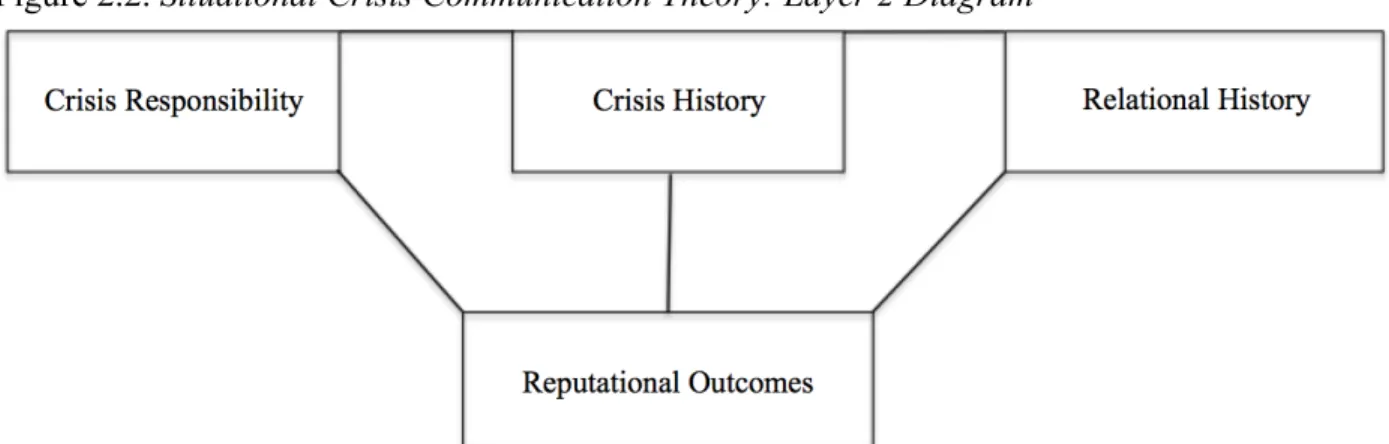
Note in Figure 2.2 that stakeholders’ perceptions of key aspects related to crises
ultimately result in reputation perception. Stakeholders therefore assess these overarching factors
related to crises that shape their ultimate perceptions of the organization’s reputation. Those
assessment factors include crisis responsibility, crisis history, and prior reputation or relationship
[i.e. relational history] (Coombs, 2007a, 1995; Coombs & Holladay, 2008). Crisis responsibility
includes several components such as amount of evidence, crisis history is measured by how
many times an organization has endured or initiated the crisis, and prior reputation and
relationship is rated by relational history or personal past experiences with the entity or actor
experiencing the crisis (Coombs, 2007a; Coombs & Holladay, 2008). Each factor is discussed in
more detail below, but first an example in sport crises is offered to better explain the process
depicted in Figure 2.2.
Figure 2.2. Situational Crisis Communication Theory: Layer 2 Diagram
The Ezekiel Elliot domestic assault crisis offers an example of how stakeholders move
through these perception assessments. Dallas Cowboys football player, Ezekiel Elliot, was
accused of domestic assault in 2016. Crisis responsibility is assessed by examining the evidence
presented that Elliot had assaulted his alleged victim. Criminal charges were brought against him
but he denied any guilt related to the charges. Crisis history was a complicating component in the
Elliot case because the season prior had brought on an onslaught of domestic assault cases
involving NFL players. Stakeholders needed to sift through perceptions about whether Elliot or
his victim were telling the truth, while also considering the history of prevalence of NFL players
who have engaged in domestic assault.
Elliot later engaged in other negatively perceived behaviors toward women, like being
caught on video pulling down a women’s shirt at a parade. As is likely in crises, stakeholders
assess relational history. This assessment factor is mutually dependent on the entity or actor
experiencing the crisis as well as the stakeholder sifting through perceptions in response to the
crisis. To better explain, Elliot’s behaviors that insinuate the charges against him are true will
result in stakeholders questioning his past reputation concerning such behavior. Moreover, past
relationship will vary among NFL fans. Elliot performed well for the Dallas Cowboys and that
team’s fans could perceive a beneficial relationship with Elliot that would be much stronger and
more positive than fans of other NFL teams.
Taken together, the assessment factors are key crisis perception antecedents to
reputational outcomes. The next several subsections explain these assessment factors in more
detail.
Crisis responsibility. Crisis responsibility can be defined as both an attribution of crisis