Master thesis Psychology, Social and Organisational Psychology Department of Psychology
Faculty of Social and Behavioural Sciences – Leiden University
Date: 11-06-2015
Student number: 0907464 Supervisor: Dr. E. J. Boezeman Second reader: Dr. G. Lelieveld
Willingness to volunteer
The role of urgency of the request for help,
self-perceived ability to help and diffusion of
responsibility.
1
Abstract
A 2 (urgency of request for help: high vs. low) × 2 (diffusion of responsibility: high vs.
low) between subjects experimental design was used to study predictors of organised helping
behaviour (volunteering). Students (N = 113), with and without volunteering experience, were
presented a scenario to test the influence of urgency of a request for help, self-efficacy and
diffusion of responsibility on willingness to volunteer. These predictors have been studied
before by Latané and Darley (1968, 1970; Darley & Latané, 1968) in the research field of
spontaneous helping behaviour. Urgency of the request for help and self-efficacy were
expected to positively influence willingness to volunteer and diffusion of responsibility was
expected to negatively influence willingness to volunteer. Correlation analysis and regression
analyses were performed. ANOVA’s were used to examine potential differences between the
participants in the low urgency group versus the high urgency group, and between participants
in the high diffusion of responsibility group versus low diffusion of responsibility group. To
examine potential interaction effects of moderation analyses involving a simple slope analysis
was performed. The PROCESS TOOL (Hayes, 2012) was used for the moderation analyses.
Results showed that the manipulations tested with ANOVA were successful, but the data did
not show support for the hypotheses. Theoretical and practical implications, and limitations
and avenues for further research, will be discussed.
2
1. Willingness to volunteer
Prosocial behaviour refers to being helpful to other people without necessarily getting
direct benefits for the self (Baron, Byrne, & Branscombe, 2007). Volunteerism is a form of
prosocial behaviour that requires a long-term commitment (Baron et al., 2007). There are
many different ways to volunteer, for instance: working as a volunteer for an organisation,
volunteering for a sports club or raising money for a non-profit organisation. The different
ways of volunteering share the feature that people do something without getting paid for it.
Despite of the absence of money, there are many reasons why people volunteer (Pearce,
1993), but there are still many organisations that have problems with recruiting volunteers.
What can organisations do to get more people to volunteer? The literature has a need for
research on volunteer recruitment (Boezeman & Ellemers, 2013).
Volunteer work is organised help. People plan to help other people for free and most of the
time this help is coordinated by an organisation. This help is recurrent, for example every
week or every month. Besides organised help, there is spontaneous help. This is the kind of
help that is not recurrent. People do this in the moment without the oversight of an
organisation, like helping someone who is ill or helping a victim of violence. Most of the
time, spontaneous help is about helping someone in an emergency (Baron et al., 2007).
According to Latané and Darley (1970) there are five elements that play a role in occurrence
of spontaneous helping behaviour: noticing that something unusual is happening, correctly
interpreting an event as an emergency, deciding that it is your responsibility to provide help,
deciding that you have the necessary knowledge and/or skills to help, and making the final
decision to provide help.
Baron et al. (2007) mentioned these five elements required to respond to an emergency
also apply to volunteering (organised help). The current study translates three of the five
3
behaviour as well, this could help organisations to improve the recruitment of volunteers. This
study contributes knowledge about why and how individuals decide to do volunteer work.
When organisations know how individuals decide to become a volunteer, then volunteer
recruitment might become easier for organisations. Research into these elements can also be
used to complement the scientific knowledge of volunteer management. Until now, there are
no studies that look into the applicability of the model of Latané and Darley (1970) to
willingness to volunteer for an organisation. The current research will study the effects of
correctly interpreting a request for help as urgent, diffusion of responsibility and being able to
help, on willingness to volunteer.
2. Spontaneous helping behaviour
Prosocial behaviour is being helpful to other people without necessarily getting direct
benefits for the self (Baron et al., 2007). This kind of behaviour is not always present in our
society. Epley and Dunning (2000) state that people believe they are more likely to engage in
prosocial behaviour than their peers. The results of their study showed that people believe
this, because they have overly charitable views of themselves. So even when people think that
they act prosocial, this is often overrated.
Prosocial behaviour can be divided into spontaneous helping behaviour and organised
helping behaviour. Spontaneous help is the type of help that people not plan and is, for
example, needed in emergencies. Latané and Darley (1968, 1970; Darley & Latané, 1968) did
a lot of research into why people do or do not act prosocial in emergencies. In one of their
studies they tried to explain why Kitty Genovese got killed in New York in 1964, without
being helped by one of the 38 eye witnesses. Not one of these witnesses used the telephone to
call the police (Latané & Darley, 1970). Explanations for these failures of human actions have
4
that these bystanders were not bad people. They suggested different reasons for why people
did not act prosocial during this night. A chain of explanations will be discussed in a five-step
process (see Figure 1) (Baron et al., 2007; Latané & Darley, 1970).
Figure 1. Five-step process in deciding whether to act prosocial or not.
Noticing the request for help. Before an individual can decide to intervene in an emergency, he or she must take several preliminary steps. The individual first must notice the
request for help (Latané & Darley, 1968). If the individual does not notice there is something
unusual going on, it is unlikely that help will occur. A study by Darley and Batson (1973),
with 40 students, examined the influence of several situational and personality variables on
helping behaviour in an emergency situation. The study showed that persons in a hurry are
more likely to keep going without stopping to help someone in need. Simply said, individuals
in a hurry do not notice a request for help.
Interpreting the situation as an emergency. After noticing the request for help, the individual must interpret the situation as an emergency (Latané & Darley, 1968). Latané and
Darley (1968) thought that the reactions of the people around the bystander would have a
strong influence on the bystander’s decision process. Their study supported the predictions. In
a room filling with smoke, subjects remained passive when surrounded by passive others, and
solitary bystanders were more likely to report the smoke than small groups of three naive
subjects. So, when participants were by themselves they were more likely to do something
(like reporting the smoke or leave the room), compared to participants who were sitting in the
waiting room with others. If you are waiting somewhere and you see something unusual, but
Noticing the situation
Perceiving the situation as an emergency
Assume responsibility
to help
Assessing ability to take
action
Deciding whether to act
5
the people around you act like nothing is wrong, you will probably doubt yourself and trust
the behaviour of the others.
Diffusion of responsibility. After noticing an event and perceiving it rightfully as an emergency, the individual must decide whether it is his or her responsibility to act (Latané &
Darley, 1968). When you are the only person around, it is pretty clear you are the one
responsible to do something. When there are more people it gets harder to decide who is
responsible. In some situations it is clear who, of all the present people, is responsible for
taking action. When there is a fire, and there is a fireman present, he is responsible. When
something happens in a classroom, the teacher is responsible to do something. It becomes
harder when there is nobody clearly in charge and individuals have to decide if they are
responsible or not. The more people there are, the harder it gets to decide if you are
responsible or not.
A study by Darley and Latané (1968) shows that when other people are also witnessing an
event, the likelihood that an individual will intervene in an emergency decreases. In their
experiment the participants heard a person having an epileptic seizure in another room. In the
first condition, the participants thought they were the only one who could hear this. In the
second condition, the participants thought they and four others could hear the epileptic person.
The participants who thought they were the only one who could hear the victim were much
more likely to intervene. The participants in this condition reacted in less than one-third of the
time required by participants who thought there were four other listeners. Latané and Darley
(1968) explain this as diffusion of responsibility. If an individual is alone while noticing an
emergency, the individual is solely responsible. The individual knows that if he or she does
not offer to help, the person in need will not get help at all (Latané & Darley, 1970). When
there are more people present, the responsibility to help is spread between the individuals and
6
still enough other individuals who could help (Latané & Darley, 1970). The responsibility is
spread, and this diffusion of responsibility makes the individual less likely to help.
Latané and Darley (1970) also discussed that individuals who did not help, because of
diffusion of responsibility, did not decide not to help, but were still in a state of indecision and
conflict concerning whether to do something or not. If an individual is driving on a busy
highway and sees someone’s car has a breakdown, the individual only has a few seconds to
decide before he or she is already too far away to decide to help. In the study of Latané and
Darley (1968) the participants who thought they heard another participant having an epileptic
seizure, were not able to leave the scene. Still, the conflict in their mind about what to do can
take so long that it is too late to do something. Some emergencies happen so fast that
bystanders do not have enough time to make up their mind. However, the murder of Kitty
Genovese took about 45 minutes, but the bystanders still did not do something to help. This
example shows how strong diffusion of responsibility can be.
Ability to take action. An individual notices a request for help, perceives it is an emergency and feels responsible to help. Still, the individual needs to be able to take action and help the
person in need. There are two kinds of interventions in emergency situations: direct
intervention, and reportorial intervention. In direct intervention, knowledge (for example
medical knowledge), strength, or certain skills are often needed. If someone is drowning, not
knowing how the swim, makes it very difficult to help. These certain skills or knowledge are
not that necessary for reportorial intervention (Darley & Latané, 1968). An example of
reportorial intervention is calling an ambulance or the police.
Help or not help? According to Latané and Darley (1970) an individual has to score positive on all these elements in order to decide whether or not to intervene in an emergency
situation. Scoring positive is no 100% guarantee that the individual will help, but the elements
7
3. From spontaneous helping behaviour to organised helping behaviour
Latané and Darley (1968; 1970; Darley & Latané; 1968) tried to explain why and how
people decide whether to intervene in an emergency situation. They came up with five
different explanations which can be put into a five-step process. According to Baron et al.
(2007), researchers propose that this process is also applicable to organised help, i.e. volunteer
work. Volunteer work is something that people do without getting paid for it. There are many
different ways to volunteer, for example: working in an organisation, doing something for
your sports club or other associations, or collect money for people in need. Despite of the
absence of a merit reward, there are many reasons why people volunteer. A few reasons are:
to serve other people, the social contact it brings, or to help achieve the objectives of a certain
organisation (Pearce, 1993). These examples are reasons why people volunteer, but they do
not explain how people decide whether to volunteer. This makes it interesting to study if the
explanations of Latané and Darley (1968, 1970; Darley & Latané, 1968) for spontaneous help
could also explain the decision making in organised help. It would be interesting to know if a
well-known and studied explanation of the bystander effect could be useful in volunteer
management as well. Besides the many reasons why people would like to volunteer, there are
still organisations that have problems with recruiting volunteers (Boezeman & Ellemers,
2008). Knowledge about the decision process of individuals to volunteer or not could help
recruiters in improving the recruitment process of volunteers. A clear decision process could
be useful for organisations in recruiting volunteers. If recruiters know how potential
volunteers make these decisions, they can try to change the recruitment tools with this
knowledge. The current study will try to answer the questions: Are the explanations of Latané
and Darley applicable to organised help? Do urgency of the request of help, diffusion of
8
4. Organised helping behaviour
The current study will test if three of the five elements described above can be applied to
volunteer work. After translating the elements to organised helping behaviour, these elements
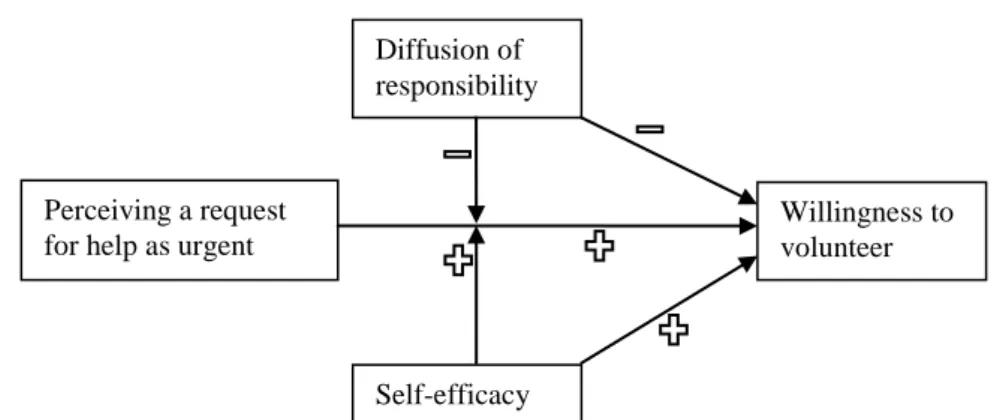
should influence the willingness to volunteer (see Figure 2). The current chapter will explain
how the elements could be translated to organised helping behaviour and hypotheses will be
proposed.
Figure 2. Expected effects of independent variables on the dependent variable.
Noticing the request for help. In order to become a volunteer, an individual first has to notice that there is a request for new volunteers from an organisation. Organisations can do
this in the form of vacancies in papers, magazines, on the internet and more. In the current
study, this element will not be tested. The current study is a lab study and the participants will
read the request for help in the scenario and will automatically notice the request. However,
future research could study how organisations can make potential volunteers aware of
vacancies for volunteers.
Perceiving the request for help as urgent. Reading the scenario guarantees that the participants will notice the request for help. However, it is not self-evident that the participant
will perceive this request for help as urgent. In case of an emergency, an individual can notice
the event, for example someone is lying on the ground, but it is still possible the individual
Willingness to volunteer
Self-efficacy Diffusion of responsibility
9
does not perceive the event as an emergency. Potential volunteers can read a vacancy for
volunteers, but still not perceive this request for help as urgent.
When this happens, the organisation will probably lose the individual’s attention. So, it is
important for the organisation to convey the request for help as urgent.
Bendapudi, Singh and Bendapudi (1996) proposed that the image of the charity, cause of
the need, and the portrayal of the beneficiary may determine whether prospective donors of
generic help even perceive that the need exists. Perceived positive familiarity, for example,
improves the charity’s image. The perception of need also appears to be greater when the
need of the beneficiary is caused by external uncontrollable factors. Portraying the beneficiary
in a needy way decreases the perception of need, because this will be perceived as
manipulation. These are only a few examples that influence the perception of need.
Latané and Darley (1970) explain how important it is to perceive a situation as an
emergency for making the decision to help. For organisations it is important that their request
for help is perceived as urgent. The examples above show what could influence this
perception of urgency. The current study will test if perceiving the request for help as urgent
will increase the willingness to volunteer. This results in the first hypothesis. Hypothesis 1:
Perceiving the request for help as urgent increases the willingness to volunteer of
non-volunteers.
Diffusion of responsibility. Assuming that diffusion of responsibility has an influence on the likelihood of spontaneous helping behaviour, diffusion of responsibility might also have
an influence on the willingness to volunteer. With more people present, the responsibility is
spread between individuals, known as diffusion of responsibility (Latané & Darley, 1970). An
individual might not feel responsible enough if there are many other potential volunteers. The
current study will test the influence of the second element of Latané and Darley (1970) on
10
the individual thinks there are no other potential volunteers and diffusion of responsibility will
occur when other potential volunteers are present, resulting in a decrease of willingness to
volunteer. Hypothesis 2: Diffusion of responsibility decreases the willingness to volunteer of
non-volunteers.
Believing in being able to volunteer. After noticing a request for help by an organisation and feeling responsible enough to do something, an individual needs to believe in having the
capacity to self-generate behaviours to obtain desired outcomes even when confronted with
barriers and obstacles (Almeida et al., 2008). If the individual does not thinks he or she is
capable of being a volunteer, the individual will probably not decide to become one. This
belief of being able to achieve a goal as a result of one’s own actions is known as self-efficacy
(Baron et al., 2007; Almeida et al., 2008).
Greenslade and White (2005) show in their study of 81 older volunteers from a non-profit
organisation in Australia that individuals who felt confident that volunteering would be easy,
were more likely to intent to volunteer. The fourth step of Latané and Darley (1970) is
assessing the ability to help. Is the individual able to offer help? Does the individual have the
right skills or knowledge to help? Are these questions also important for potential volunteers?
Is the individual able to become a volunteer, does the individual have the right knowledge or
skills? In the current study, it is proposed that feelings of self-efficacy will positively
influence the willingness to volunteer. This proposal results in the third hypothesis.
Hypothesis 3: Feelings of self-efficacy increase the willingness to volunteer of
non-volunteers.
Interaction effects. Besides the direct effect of diffusion of responsibility on the willingness to volunteer, there might be an interaction effect. The effect of perceiving the
request for help as urgent on the willingness to volunteer might be negatively influenced by
11
volunteers. The feeling of being responsible spreads toward these other potential volunteers.
If there are many potential volunteers the need for help decreases, because these potential
volunteers can answer this need. Latané and Darley (1968) explained how the presence of
others influences the perception of individuals, as mentioned before in chapter 2. Participants
of their study that were by themselves were more likely to do something in an unusual
situation, because they perceived the situation as an emergency, than participants surrounded
by others. Diffusion of responsibility occurs when surrounded by others as well. This
indicates that when diffusion of responsibility occurs, the direct effect of the urgency of the
request for help in willingness to volunteer will decrease. Hypothesis 4: Diffusion of
responsibility decreases the effect of the urgency of a request for help on the willingness to
volunteer of non-volunteers.
Besides the direct effect of self-efficacy on the willingness to volunteer, a moderation
effect is proposed. The effect of the urgency of the request for help on the willingness to
volunteer might be positively influenced by self-efficacy. If a potential volunteer believes that
he or she is able to help (having the right skills or knowledge), this can increase the influence
of urgency on the willingness to volunteer. Having the right skills or knowledge makes it
more likely to perceive an urgent request for help as actually urgent. The individual is more
likely to know what the consequences are if no help is offered. In prosocial behaviour,
whenever potential helpers are not completely sure about what is going on, they tend to hold
back and wait for further information (Baron et al., 2007). A high self-efficacy will increase
the chances that an individual knows what is going on. An individual that studied medicine is
more likely to perceive a request of help from someone that is having a stroke as urgent,
because the individual has the right knowledge to see that the individual is actually having a
stroke and the individual needs help immediately. The same applies to organised helping
12
something about the cause, the individual is more likely to know what the consequences are if
the beneficiary is not helped. This increases the effect of the urgency of the request for help
on the willingness to volunteer. This results in the final hypothesis. Hypothesis 5:
Self-efficacy increases the effect of the urgency of a request for help on the willingness to
volunteer of non-volunteers.
5. Method
Participants. Participants were 113 students (46 males, 67 females) with a mean age of 21 (SD = 2.30). 36.0% of the participants had no experience with participating in volunteer work, 12,4% were doing volunteer work at the moment and 50.4% had done volunteer work in the
past.
Design and procedure. A 2 (urgency of request for help: high vs. low) × 2 (diffusion of responsibility: high vs. low) between subjects experimental design was used. When the
participants entered the lab, they were seated in separate cubicles. After reading and signing
the informed consent form they were given the research materials on paper. The research
material was given randomly to the participants. The four different versions of the research
material determined the conditions the participants were in. The participants were asked to
take their time and read the scenario presented in the research material carefully and answer
all the questions. In every condition, the participants read about a fictional charity
organisation, named JONG. JONG is a volunteer organisation that is committed to help young
people, in Leiden and around, with a physical or sensory disability.
Urgency of the request for help. The distinction between the conditions was made by a difference in the way this information about JONG was given to the participant. One half of
the participants received a questionnaire where the request for help was presented as urgent
13
presented as not urgent (low urgency condition). In the high urgency conditions, the
information that the participant was given, indicated that help from extra volunteers was very
important and urgent. In the low urgency conditions, the help from extra volunteers was not
very urgent, but extra help was always welcome.
Diffusion of responsibility. The second manipulation was split up in high diffusion of responsibility versus low diffusion of responsibility. In the low diffusion of responsibility
conditions, the participant read a text that indicated that the participant is the one of the very
few people who could help and become a volunteer. In the high diffusion of responsibility
conditions, the participant read a text that indicates that there were, besides the participant,
other individuals who could help and become a volunteer. The responsibility will spread from
the participant to other potential volunteers, known as diffusion of responsibility.
When the participant finished reading the information about the organisation and filled in
the questionnaire, the participant was fully debriefed and paid €1,50 or 1 credit and thanked
for their participation.
Dependent variables. Most measures were adapted from existing measure scales and translated into Dutch. Some items were adjusted to volunteer work. All items used a
seven-point Likert scale ranging from 1 (strongly disagree) to 7 (strongly agree). The perceived
urgency for extra help (α = .93) was measured with an adapted version of the Group Need
Scale (Fisher & Ackerman, 1998). Five items were used, including “JONG has an urgent need
for additional volunteers to help young people”. Diffusion of responsibility (α = .74) was
measured with a scale specially designed for this research. Three items were used, including
‘I am one of the few who can help JONG with the guidance of young people with a physical
of sensory disability’. The willingness to volunteer (α = .89) was measured with a general
self-developed scale. Three items were used, including “If I was asked, I will most likely help
14
Perceived Behavioural Control scale (Taylor & Todd, 1995). Five items measured
self-efficacy, including “I am confident that I can help JONG with the guidance of young people
with a physical or sensory disability”.
6. Results
Manipulation checks. An ANOVA showed that the participants in the high urgency condition (M = 6.02, SD = 0.64) thought extra help was more urgent than the participants in the low urgency condition (M = 2.62, SD = 1.28) did, F(1, 110) = 315.44, p < .001, ² = .74.
Second, an ANOVA indicated that the participants in the low diffusion of responsibility
condition (M = 2.99, SD = 1.21) perceived a higher feeling of responsibility compared to the participants in the high diffusion of responsibility condition (M = 1.77, SD = 0.71), F(1, 111)
= 43.13, p < .001, ² = .28. These results show that the manipulations had worked as intended.
Participants experiences with volunteer work. The participants were not recruited on possible experiences with volunteer work in the past or present. After collecting the data it
turned out that 36,6 % of the participants had never done volunteer work, 12,5% was a
volunteer at the moment of the study and 50,9% of the participants had done some kind of
volunteer work in the past. An ANOVA was used to test if this difference in experiences with
volunteer work between the participants had an influence on the willingness to volunteer.
Already being a volunteer might have a negative influence on the willingness to volunteer and
being familiar with being a volunteer might have a positive influence on the willingness to
volunteer. However, the ANOVA showed there was no significant difference in willingness to
15
and the participants that have done volunteer work in the past (M = 3.63, SD = 1.24), F(2, 111) = .30, p = .74.
Factor analysis. A factor analysis was conducted on the 22 items with VARIMAX rotation. The Kaiser-Meyer-Olkin measure verified the sampling adequacy for the analysis,
KMO = .73. Barlett’s test was highly significant (p < .001), so the data is not randomly
factored. The analysis confirmed that the items that were used to measure the variables
clustered as intended (see Table 1). The criterion level used for the rotated factor loadings of
all items was .40 (values that appear in bold in Table 1). The factor solution suggested that
factor 1 represents willingness to volunteer (9 items), factor 2 represents urgency of the
request for help (5 items), factor 3 self-efficacy (5 items) and factor 4 diffusion of
responsibility (3 items). The four factors in combination explained 61.96% of the variance.
Correlation analysis. Correlations between the independent and dependent variables show no significant direct effects (see Table 2). There is, however, a significant correlation between
the manipulated urgency variable and measured urgency variable and the manipulated
diffusion of responsibility variable and measured diffusion of responsibility variable. There is
a positive relationship between the manipulated urgency and the measured urgency (r = .86, p
< .001). On average the higher a participant scored on the manipulated urgency variable, the
higher the participant scored on the measured urgency variable. There is also a positive
relationship between the manipulated diffusion of responsibility variable and the measured
diffusion of responsibility variable (r = .53, p < .001). On average the higher a participant scored on the manipulated diffusion of responsibility variable, the higher the participant
scored on the measured diffusion of responsibility variable. These results show that the
manipulation did work. Given the correlations there were probably no further effects to be
16
Table 1. Confirmatory factor analysis results of study variables.
Rotated Factor Loadings
Item Willingness Urgency of Self-efficacy Diffusion of
request responsibility
Zal ik zeer waarschijnlijk JONG en haar jongeren
met een beperking helpen. .85 Heb ik het voornemen om JONG met jongeren
met een beperking te helpen. .83 Heb ik niet het voornemen om JONG met
jongeren met een beperking te helpen. .75 Ik ben bereid om een jong iemand met een
lichamelijk of zintuigelijke beperking te helpen bij
het vinden van een geschikte woning. .74 Ik ben bereid om een jong iemand met een
lichamelijk of zintuigelijke beperking te helpen bij
het maken van zijn of haar studiekeuze. .66 Ik ben bereid om een jong iemand met een
lichamelijke of zintuigelijke beperking te begeleiden tijdens voorlichtingsdagen van een universiteit of hogeschool.
.63 Ik ben bereid om administratieve taken uit te
voeren voor JONG. .59 Ik ben bereid om posters en flyers te verspreiden
van JONG om zo de naamsbekendheid te
vergroten. .56
Ik ben bereid om een leuke activiteit te organiseren in Leiden voor jongeren met een
lichamelijk of zintuigelijke beperking. .56 JONG heeft urgent behoefte aan extra hulp om
jongeren met een beperking beter te kunnen
helpen. .94
JONG heeft urgent behoefte aan meer mensen op
vrijwillige basis om jongeren te helpen. .93 Met extra mensen op vrijwillige basis zou JONG
meer jongeren kunnen helpen. .89 Wanneer meer mensen zich vrijwillig zouden
inzetten voor JONG zou JONG effectiever kunnen
zijn in het helpen van jongeren met een beperking. .83 Het is noodzaak dat mensen JONG komen helpen
om de jongeren te helpen. .81 Als ik JONG zou helpen bij het begeleiden van
jongeren met een lichamelijke of zintuigelijke beperking dan heb ik daar zelf de volledige controle over.
.86 Als ik JONG zou helpen bij het begeleiden van
jongeren met een lichamelijke of zintuigelijke
beperking dan heb ik dat zelf helemaal in de hand. .78 Of ik JONG wel of niet zou helpen bij het
begeleiden van jongeren met een lichamelijke of zintuigelijke beperking zou volledig aan mijzelf zijn.
.69 Ik ben vol vertrouwen dat ik JONG kan helpen bij
het begeleiden van jongeren met een lichamelijke
of zintuigelijke beperking. .33 .64 Als ik het wil, dan is het niet moeilijk voor mij om
JONG te helpen bij het begeleiden van jongeren
met een lichamelijke of zintuigelijke beperking. .61 Naast mij zijn er ook veel anderen die JONG
kunnen helpen bij het begeleiden van jongeren
met een lichamelijke of zintuigelijke beperking. .89 Anderen kunnen JONG ook helpen bij het
begeleiden van jongeren met een lichamelijke of
zintuigelijke beperking. .83
Ik ben één van de weinigen die JONG kan helpen bij het begeleiden van jongeren met een
lichamelijke of zintuigelijke beperking. .31 .71
Eigenvalues 4.57 4.13 2.88 2.05
% of variance 20.78 18.75 13.10 9.33
Cumulative % 20.78 39.54 52.63 61.96
17
Table 2. Correlations between independent variables and dependent variables
Variable 1 2 3 4 5 6
1. Willingness to volunteer —
2. Measured urgency –.00 —
3. Measured diffusion of responsibility –.02 –.08 —
4. Self-efficacy .06 .03 .15 —
5. Manipulated urgency –.10 .86*** –.02 .02 —
6. Manipulated diffusion responsibility –.11 .03 .53*** .16 -.03 —
Note. * p < .001 (2-tailed), N = 113
Urgent request for help. The first hypothesis stated that perceiving the request for help as urgent positively influences the willingness to volunteer. The analysis did not support this
hypothesis. An ANOVA showed that there was no significant difference in the willingness to
volunteer between the participants in the low urgency group (M = 3.66, SD = 1.30) compared to the high urgency group (M = 3.38, SD = 1.36), F(1, 111) = 1.21, p = .28. A regression analysis showed that there was no significant effect of urgency (β = -.00, p = .97) on willingness to volunteer (R² = .00). Therefore, the urgency of a request for help has no influence on the willingness to volunteer.
Diffusion of responsibility. The second hypothesis proposed a negative influence of diffusion of responsibility on the willingness to volunteer. If diffusion of responsibility
occurs, an individual experiences low feelings of responsibility as a result of the knowledge
that there are many other potential volunteers. The analysis did not support the hypothesis. An
ANOVA showed that there was no significant difference in willingness to volunteer between
the participants in the high diffusion of responsibility group (M = 3.66, SD = 1.40) and the low diffusion of responsibility group (M = 3.38, SD = 1.25), F(1, 111) = 1.31, p = .25. A regression analysis showed that there was no significant effect of diffusion of responsibility (β
18
Self-efficacy. The third hypothesis was that feelings of self-efficacy would increase the willingness to volunteer. The analysis did not support the hypothesis. A regression analysis
showed that there was no significant effect of self-efficacy (β = .06, p = .50) on the willingness to volunteer (R² = .00). Therefore, feelings of self-efficacy have no direct influence on the willingness to volunteer. Beliefs of being able to volunteer did not influence
the willingness to volunteer in the current data.
Moderation diffusion of responsibility. The fourth hypothesis stated that there is an interaction effect of the urgency of the request for help and diffusion of responsibility on the
willingness to volunteer. The hypothesis proposed a decrease of the influence of urgency of
the request for help on the willingness to help as a result of diffusion of responsibility. To test
this hypothesis a simple slopes analysis was done, using the PROCESS tool (Hayes, 2012).
The analysis did not support the hypothesis. The analysis showed a non-significant effect of
urgency of the request for help (β = - .00, p = .98) on the willingness to volunteer (R² = .01).
The analysis also showed a non-significant effect of diffusion of responsibility (β = .03, p = .82) on the willingness to volunteer (R² = .01). Finally, the analysis showed a non-significant interaction effect of urgency of the request for help and diffusion of responsibility (β = .04, p
= .50) on willingness to volunteer (R² = .01). These results indicate that the relationship between urgency of the request for help and the willingness to volunteer is not moderated by
diffusion of responsibility.
Moderation self-efficacy. The fifth and last hypothesis stated that there is an interaction effect of the urgency of the request for help and self-efficacy on the willingness to volunteer.
High feelings of self-efficacy will increase the effect of urgency of the request for help on the
willingness to volunteer. The same simple slopes analysis was done to test this hypothesis.
The analysis did not support the hypothesis. The analysis showed a non-significant effect of
19
The analysis also showed a non-significant effect of feelings of self-efficacy (β = .09, p = .58) on the willingness to volunteer (R² = .01). Finally, the analysis showed a non-significant interaction effect of urgency of the request for help and self-efficacy (β = - .02, p = .82) on the willingness to volunteer (R² = .01). These results indicate that the relationship between urgency of the request for help and the willingness to volunteer is not moderated by feelings
of self-efficacy.
7. Discussion
Prosocial behaviour is being helpful to other people without necessarily getting direct
benefits for the self (Baron et al., 2007). Volunteerism is a form of prosocial behaviour that
requires a long-term commitment (Baron et al., 2007). Volunteer work is organised help.
People plan to help other people for free and most of the time this help is coordinated by an
organisation. This help is recurrent, for example every week or every month. Besides
organised help, there is spontaneous help. This is the kind of help that is not recurrent. People
do this in the moment without the oversight of an organisation, like helping someone who is
ill or helping a victim of violence. Most of the time, spontaneous help is about helping
someone in an emergency (Baron et al., 2007). Latané and Darley (1968; 1970; Darley &
Latané, 1968) studied what influences individuals to act prosocial and offer spontaneous help.
They found an influence of noticing the request of help, perceiving the request as urgent,
diffusion of responsibility and being able to help. The current study took three of these
influences and studied their influence on organised helping behaviour. It was expected that
being able to volunteer and the urgency of the request for help would positively influence the
willingness to volunteer and diffusion of responsibility would negatively influence
willingness to volunteer. The results showed the manipulations were successful, but the data
20
research, will be discussed before the discussion of possible explanations for the
non-significant hypotheses and the theoretical contributions.
Practical implications. If the data showed support for the hypotheses, the knowledge would be useful for the recruitment of new volunteers. The results would contribute to the
knowledge about the decision process of potential volunteers and could help organisations to
influence this process. According to the hypotheses (if they were confirmed), the recruiters
could focus on the way potential volunteers perceive the request for extra volunteers. The
message toward the potential volunteers would have to be urgent and the perceivers of the
message should think there are no other potential volunteers. Also, offering information or
training possibilities could improve the self-efficacy of the potential volunteers which would
improve the willingness to volunteer of the perceiver. However, the results could not confirm
the hypotheses. For now, recruiters should focus on other tools and theories that could
improve the recruitment of volunteers. Research shows most volunteers are primarily
recruited through friends, co-workers, and family of current volunteers and employees
(Pearce, 1993). Boezeman and Ellemers (2008) found across three studies that anticipated
respect as a volunteer offers means of what volunteer organisations can do in recruitment
efforts. They suggest that organisations could induce anticipated respect among potential
volunteers to attract them to the organisation. This is possible through the social network of
current volunteers and employees. So, recruiters should focus on theories like these instead of
the theory of the current study. Improvement of the current study and other future research
could contribute to the recruitment of volunteers too.
Limitations and future research. The dependent variable of the presented study was willingness to volunteer. This might be considered a limitation in that this measure does not
guarantees that the potential volunteer will actually become a volunteer. There is a difference
21
of Greenslade and White (2005) indicates that individuals intending to volunteer at an
above-average rate were more likely to engage in above-above-average participation in volunteerism.
A second limitation of the presented study is the lack of examination of a three-way
interaction. The results did not show a significant two-way interaction effect, but there might
be a significant effect of a three-way interaction of diffusion of responsibility, urgency of the
request for help and self-efficacy. However, this interaction effect is unlikely, because the
results did not show significant correlations between the variables.
Another limitation of the current study is the length of the questionnaire. It took the
participants pretty long to fill in the whole questionnaire and this could have harmed the
results (Saunders & Lewis, 2012).
A fourth limitation of the presented study is the specific group of participants that is used,
students. As mentioned in the results section, it did not matter that there was a difference in
volunteering experience between the participants, because this did not have an influence on
the willingness to volunteer. However, examining a homogeneous group of research
participants (all students) may limit the generalizability of the results. The results may only
specifically apply to highly educated and young potential volunteers. A recommendation for
future research would be testing the influences of urgency of the request of help, self-efficacy
and diffusion of responsibility on the willingness to volunteer in another group of participants.
Research shows that individuals of higher socioeconomic status are more likely to volunteer
(Pearce, 1993). The group of participants of the current study, students, do not have a lot of
money. This could be a reason why they were less willing to volunteer. They have to earn
money to live and study and cannot use their time to volunteer. However, the participants are
highly educated, something that increases the likeliness of volunteering, because these
individuals are more attractive for organisations and are often recruited from social networks
22
high socioeconomic status (Pearce, 1993). However, these explanations do not have an
influence on what the potential volunteer wants. It does not explain that higher educated
participants would be more likely to perform organised helping behaviour. Other studies show
relationships between volunteering and demographic characteristics. Volunteering among
teenagers increases until 18 years, then decreases and remains low during twenties. It remains
low until late twenties (Pearce, 1993). The group of participants of the current studies were
exactly in this period of age with a mean age of 21. Maybe the group of participant that is
used in the current study is not the right group for studying the willingness to volunteer. The
results could be different for a group of participants with a mean age of 40 or 50. Researches
show a peak in volunteering when individuals are in their forties and fifties (Pearce, 1993).
The current study might show different results when a group of participants in their forties
and fifties is used. The results of the current study did not show significant effects, so it is
possible that the tested elements do not influence willingness to volunteer among students and
this is certainly of interest to the recruitment efforts of volunteer organisations.
Another recommendation for future research could be a study with a manipulation of
self-efficacy. Self-efficacy was not manipulated in the present study. In future research, one group
could be trained a skill that is useful for the volunteer work or offer knowledge that is useful
and use a control group that is not trained or given extra knowledge. It would be interesting to
test if the first group scores higher on willingness to volunteer compared to the second
(control) group. It is important that the self-efficacy really has to be about skills or knowledge
and not about having enough time (or about other external factors).
The current study researched the applicability of theories from spontaneous helping
behaviour to organised helping behaviour, but future research could take theories that explain
what influences organised helping behaviour and study the influences of these effects on
23
likely to offer their help in an emergency? Does respect toward a bystander influence
spontaneous helping behaviour? Also, it would be interesting to study if volunteers are more
likely to offer spontaneous help compared to non-volunteers.
Possible explanations for the non-confirmed hypotheses. A positive influence of the urgency of the request for help by an organisation for extra volunteers on the willingness to
volunteer could not be confirmed by the results. The manipulation of the urgency of the
request was successful so the non-significant result is not a result of an error in the
manipulation of the experiment. It is possible that the urgency of the request for help does not
influence the decision process of potential volunteers. Fisher and Ackerman (1998) could not
prove a significant direct effect of urgency of the request for help on volunteer participation
either. An explanation could be that there is a different meaning of urgency in organised
helping behaviour compared to spontaneous helping behaviour. In spontaneous helping
behaviour it is more about minutes and in organised helping behaviour it is about days or
weeks. This also makes it easier for potential volunteers to delay their decision. When there is
an emergency, immediate action is needed and this prevents the individual confronted from
leisurely considering the possible courses of action open to him or her (Latané & Darley,
1970). It forces the individual to come to a decision before having time to consider the
alternatives. However, the short amount of time bystanders have when spontaneous help is
needed also has a bad influence on the decision making, because it causes a lot of stress
(Latané & Darley, 1970).
The expected interaction effect of urgency of the request for help and diffusion of
responsibility could also not be confirmed. The results indicate that the effect of urgency of
the request cannot be increased or decreased by diffusion of responsibility. The interaction
24
confirmed in the current data. This indicates that self-efficacy cannot increase or decrease the
urgency of the request for help.
A positive influence of self-efficacy of potential volunteers on the willingness to volunteer
could not be confirmed by the data either. Self-efficacy of the potential volunteer was not
manipulated, but it was measured. There might be an effect of self-efficacy on willingness to
volunteer if the self-efficacy is manipulated. The current study measured the self-efficacy of
the participants and checked for an effect of self-efficacy on willingness to volunteer. An
explanation for the non-significant effect could be that the potential volunteers were thinking
about having enough time to help instead of having the right knowledge or skills to help.
Participants with the right knowledge and skills could have scored low on self-efficacy,
because of their lack of time they thought they were not able to become a volunteer. In future
research there should be a clear distinction between having the time to become a volunteer
and having the right skills or knowledge to volunteer.
A negative effect of diffusion of responsibility on willingness to volunteer was expected.
An individual is more likely to offer spontaneous help if the individual is alone, because the
individual is solely responsible. If there are others present, the individual is not the only one
responsible anymore and feelings of responsibility are spread from the individual to the other
bystanders. It was expected that diffusion of responsibility would result in a lower willingness
to volunteer in the current study, because the participant would feel less responsible if there
are other potential volunteers as well. The data did not confirm this expectation. The
manipulation of diffusion of responsibility was successful. This means the non-significant
results are not a result of errors in the manipulation of the experiment. It is possible that
diffusion of responsibility does not have an influence on the decision making process of
potential volunteers. This indicates that feeling responsible or not to help does not have an
25
Theoretical contributions. Latané and Darley (1968; 1970; Darley & Latané; 1968) tried to explain why and how people decide whether to intervene in an emergency situation or not.
They came up with five factors and put these into a five-step process. According to Baron et
al. (2007), researchers propose that this process is also applicable to organised help, i.e.
volunteer work. The current study tried to apply three of the elements studied by Latané and
Darley (1968; 1970; Darley & Latané; 1968) to organised helping behaviour. The data
indicate that the expectations could not be confirmed. The knowledge that the elements did
not influence organised helping behaviour (in the current study) contributes to the scientific
field of volunteer management. Apparently, it is not easy to generalize theories from
spontaneous helping behaviour to organised helping behaviour. Maybe this is caused by the
difference in time. In spontaneous helping behaviour, individuals have to make a decision
really fast so heuristics and external factors might have a bigger influence compared to
organised helping behaviour. In organised helping behaviour, individuals can make an
informed choice. The consequences for both types of helping behaviour differ as well.
Spontaneous helping behaviour occurs often in emergencies and these emergencies could be
dangerous. Fear could result in deciding not to offer help (Baron et al., 2007). The
consequences of organised helping behaviour are long-term. In organised helping behaviour
the individual has to commit for a longer period of time instead of offering help ones. The
volunteer must commit time and effort for weeks, months, or longer. Time might have a
bigger influence on organised helping behaviour than the elements that were studied in the
current study. Does efficacy mean having the right skills and knowledge or is
self-efficacy about deciding on a course of action that is possible for you, as mentioned by Baron
26
The current study could not support the hypotheses, but it still contributes new information
to volunteer management. Mainly in the form of a new perspective on inapplicability of
27
8. References
Almeida, L., Kashdan, T. B., Coelho, R., Albino-Teixeira, A., & Soares-da-Silva, P. (2008).
Healthy subjects volunteering for Phase I studies: Influence of curiosity, exploratory
tendencies and perceived self-efficacy. International Journal of Clinical Pharmacology and Therapeutics, 46(3), 109-118.
Baron, R. A., Byrne, D., & Branscombe, N. R. (2007). Mastering Social Psychology. Pearson Education, Inc.
Bendapudi, N., Singh, S. N., & Bendapudi, V. (1996). Enhancing helping behavior: an
integrative framework for promotion planning. Journal of Marketing, 60(3), 33-49. doi:10.2307/1251840.
Boezeman, E. J., & Ellemers, N. (2008). Volunteer recruitment: the role of organizational
support and anticipated respect in non-volunteers’ attraction to charitable volunteer
organizations. Journal of Applied Psychology, 93(5), 1013-1026. doi:10.1037/0021- 9010.93.5.1013.
Boezeman, E. J., & Ellemers, N. (2013). Volunteer Recruitment. In: Yu, T., & Cable, D.
(Eds.) The Oxford Handbook of Recruitment. Oxford: Oxford University Press. 73-80 Darley, J. M., & Batson, C. D. (1973). “From Jerusalem to Jericho”: a study of situational and
dispositional variables in helping behavior. Journal of Personality and Social Psychology, 27(1), 100-108. doi:10.1037/h0034449.
Darley, J. M., & Latané, B. (1968). Bystander intervention in emergencies: diffusion of
responsibility. Journal of Personality and Social Psychology, 8(4), 377-383. doi:10.1037/h0025589.
Fisher, R. J., & Ackerman, D. (1998). The effects of recognition and group need on
28
Greenslade, J. H., & White, K. M. (2005). The prediction of above-average participation in
volunteerism: a test of the theory of planned behavior and the volunteers functions
inventory in older Australian adults. The Journal of Social Psychology, 145(2), 155- 172. doi:10.3200/SOCP.145.2.155-172.
Hayes, A. F. (2012). PROCESS: A versatile computational tool for observed variable
mediation, moderation, and conditional process modeling [White paper]. Retrieved from
http://www.afhayes.com/ public/process2012.pdf
Latané, B., & Darley, J. M. (1968). Group inhibition of bystanders intervention in
emergencies. Journal of Personality and Social Psychology, 10(3), 215-221. doi:10.1037/h0026570.
Latané, B., & Darley, J. M. (1970). The Unresponsive Bystander: Why Doesn’t He Help? New York: Appleton-Century-Crofts.
Pearce, J. L. (1993). Volunteers: The organizational behavior of unpaid workers. London: Routledge.
Saunders, M., & Lewis, P. (2012). Doing research in Business and Management: An Essential Guide to Planning Your Project. Essex: Pearson Education Limited.
Taylor, S., & Todd, P. (1995). An integrated model of waste management behavior: A test of