Investing Effectively
in Information and Communications
Technology in Schools,
2008-2013
The Report of the Minister’s Strategy Group
Investing Effectively in Information and Communications Technology in Schools, 2008-2013
Information and communications technology is now an integral part of our personal and working lives. The children of today have been born into this age of technology and they are generally very comfortable and capable users. The prevalence of ICT requires us to ensure that all citizens are capable of full participation in this digital world. At a European level, digital competence is one of the eight key competences adopted for lifelong learning. Undoubtedly, digital and interactive technologies can bring a new richness of resources to the classroom and to learning and teaching in general. Since the launch, ten years ago, of Schools IT 2000 – A Policy Framework for the New Millenium, considerable progress has been made in integrating ICT into learning and teaching in our schools. Evidence from Irish schools shows that where ICT is used innovatively and integrated into the curriculum, the learning experience can be more enriching, collaborative and personally gainful. ICT enables teachers to bring lessons to life in new ways, to motivate learners and to find new ways of reaching students with special educational needs.
I recognise the commitment of schools and the achievements of teachers in successfully using ICT in learning and teaching. The recent investment in school networks and the development of the schools broadband network is facilitating – and will continue to facilitate – greater access to digital resources for learning and teaching. The Government recognises the need for a new impetus to take greater advantage of the potential offered by the effective integration of ICT into learning and teaching. The allocation of €252m in the National Development Plan for the ICT in Schools Programme will support the next phase of ICT integration.
I appointed the Strategy Group to advise on the priorities for investment, having regard to the critical success factors for successful integration of ICT into learning and teaching. This Report highlights the need for an integrated approach addressing teacher professional development and school ICT infrastructure, including broadband provision, technical support and digital content. The report also identifies the decisive need for strong leadership and whole-school commitment if schools are to successfully integrate ICT in learning and teaching. We need to foster conditions and provide supports which will allow best practice in the use of ICT to flourish and spread.
I am delighted to introduce the Strategy Group’s Report, ‘Investing Effectively in Information and Communications Technology in Schools 2008–2013’, and would like to thank the members of the Strategy Group for their commitment and contribution. I am particularly pleased that the Group consulted with a wide range of interests and received so many submissions. The Group’s report sets out a significant agenda and I will be working with my Department and all relevant parties to progress the actions outlined.
Mary Hanafin, T.D.,
Minister for Education and Science
Foreword
Mr Jerome Morrissey, Chairperson of Strategy Group. Director, National Centre for Technology in Education
Dr Conor Galvin, School of Education and Lifelong Learning, UCD
The strategy group members
Mr Seamus Ryan, Principal, Dunshaughlin Community College
Dr Máirín Glenn, ICT Coordinator, Scoil Naisiúnta an Inbhir, Ballina
Dr Seán Baker, Chief Corporate Scientist, IONA Technologies PLC
Mr Frank Turpin, Education Manager, Intel Ireland Ltd
Ms Theresa Ryan, ICT Policy Unit, Department of Education and Science
Mr Tim O’Sullivan,
Department of Communications, Energy and Natural Resources
Mr Michael Hallissy, Director of Learning, Digital Hub Development Agency
Mr Matt Hume, Principal, St Joseph’s Boys National School, Terenure
ICT strategy group
Ms. Mary Hanafin, TDMinister for Education & Science Dear Minister,
On behalf of the ICT Strategy Group I am very pleased to submit our report ‘Investing Effectively in Information and Communications Technology in Schools 2008–2013’. In carrying out our task we consulted widely and were greatly encouraged by the demonstrably strong commitment of the education partners and of industry to the role of information and communications technology in learning and teaching. The many submissions received painted a comprehensive picture of stakeholders’ views, clearly identified their expectations and suggested priorities for ICT investment. Without explicitly referencing the recommendations that were made, I am confident that most of them find clear expression in the investment priorities identified by the Strategy Group and resonate in the vision we outline for ICT in education. We also reviewed international ICT policy and consulted with overseas colleagues on good practice models.
21st century Ireland is a rapidly changing country and ICT is increasingly at the heart of much that is integral to the social, educational, commercial and industrial life of its people. New demands and expectations are being placed on education at all levels. We believe that the planned use of ICT can uniquely contribute to meeting many of these challenges by endowing learning and teaching with a new richness of method and resource. The integrated use of ICT strengthens learning and increases the sense of relevance by making learning more reflective of students’ social and personal use of ICT. In its submission the Union of Secondary Students said:
“There should not be a dramatic transition between the use of technology at home and at school. We need to be stimulated and challenged in a modern learning environment.”
Our recommendations build on what has been achieved to date. The enthusiasm for and commitment of our teachers to ICT integration is manifest – there is now a need to provide them with the appropriate ICT facilities and supports to facilitate greater ICT integration in learning and teaching. Our vision for ICT goes beyond what the National Development Plan (NDP) funding can deliver but, if implemented, we believe that it will lead us to the ultimate goal of transforming our schools into 21st century e-learning environments. I wish to acknowledge the commitment, enthusiasm and insightful expertise shown by my colleagues on the Strategy Group throughout the development of this report. Finally, I wish to thank the secretariat support provided by the NCTE which was led by Anne White.
Jerome Morrissey Chairperson
Contents
Executive summary ... I
1. Envisioning the role of ICT in education ... 1
2. ICT in schools – the current context ... 5
2.1 Infrastructure and usage baselines ... 5
2.2 Teacher professional development ...6
2.3 Infrastructure, technology and innovation ... 7
3. The future ... 11
3.1 Creating leading-edge e-learning environments ...11
3.2 Investing effectively in ICT in education ...12
3.3 ICT investment goals 2008-2013 ...13
4. Objectives and priority recommendations for ICT investment .. 16
4.1 Continuing professional development ...17
4.2 Software and digital content for learning and
teaching ... 19
4.3 ICT equipment – additional and replacement ...20
4.4 Schools broadband and services ... 22
4.5 Technical support and maintenance ... 23
4.6 Implementation structures and supports ...24
4.7 Innovative practice and research ... 25
4.8 Desirable levels of ICT for schools ...26
4.9 Allocation of funding and overall budget ...26
– tables 1, 2 and 3 ...28
References ... 32
Selected bibliography ... 33
Appendices ... 34
Terms of reference ... 36
Strategy group membership ... 37
Methodology ... 38
Submissions ...39
Oral presentations... 40
Glossary ... 41
Investing Effectively in Information and Communications Technology in Schools, 2008-2013
Executive summary
1. Envisioning the role of ICT in education
Learning is changing. A pivotal force in bringing about this change is the use of information and communications technology (ICT) which provides richer, more immediate, world-relevant educational resources and opportunities. When used well, ICT enriches learning and enhances teaching. It invigorates classroom activities and is a powerful motivational tool thatencourages learners to progress in more personalised and self-directed ways.
Ireland has achieved rapid change and growth in the past decade, but to sustain this we must prepare the next generation for the knowledge society in which they will live.
The challenge we face is to ensure that the emphasis on ICT in schools shifts, in the immediate future, from technology provision to a focus on its deliberate use by the learner. Fostering personal creativity has always been a desirable educational value. The pursuit of creativity and inventiveness are now pivotal skills in a knowledge economy and the embedding of ICT in learning can greatly facilitate their development. Web 2.0 will facilitate greater interactivity and enable greater levels of user-generated content. It is crucial that young people acquire the ICT and related skills to support these new opportunities.
Achievements and challenges
Since 1998 the Government has implemented two programmes to incorporate ICT in learning and teaching in schools – Schools IT 2000 and Blueprint for the Future of ICT in Irish Education. A number of studies report on their impact and show that progress has been made on two fronts in particular. Firstly, teachers have demonstrated their willingness to incorporate ICT in their teaching by their high participation rates in ICT professional development programmes and, secondly, integration of ICT in learning and teaching has taken place in schools, albeit limited to a level commensurate with the level of ICT investment. However, the general conclusion of these studies is that, while all schools are equipped with some computers and have limited internet access, a lack of sufficient and sustained investment over recent years has resulted in inadequate and ageing ICT equipment in schools, no provision for technical support and inadequate levels of broadband internet.
If we are to successfully meet the challenge of providing our school-going children with the skills and capabilities they require for the future, we need to invest now in the process of transforming schools into e-learning environments. The following key investment goals must be met as necessary steps towards achieving this:
A. The provision of an appropriate ICT infrastructural configuration and technical services in each school
B. The support of leadership, ingenuity, creativity and vision for ICT integration in schools
C. Meeting teachers’ ICT professional development needs to support the development of school-wide ICT capacity
D. The provision of on-demand access to curriculum-relevant digital content and tools
E. The provision of robust and adequate levels of broadband internet to all schools.
I
Investing Effectively in Information and Communications Technology in Schools, 2008-2013
2. Summary recommendations
Investment priorities
Schools require new ICT equipment, adequate broadband, technical support services and pedagogical guidance. There is an immediate need to provide new equipment and technical support. The Strategy Group recommends that this requirement be met by frontloading investment in these areas in the first three years of the National Development Plan (NDP) period. While NDP investment will enable schools to update their existing ICT equipment and facilities and will provide ICT services and supports, it is insufficient of itself to provide the desirable level of ICT which will be required by schools over the next six years and beyond.
Achieving a desirable level of ICT usage in all schools depends on a number of critical and interconnected factors:
>> Teacher education and professional development to leverage the benefits of new learning technologies
>> The ready availability of appropriate digital content and content tools >> Sufficient computers and supporting ICT equipment in schools >> Adequate and robust broadband provision
>> Technical support and maintenance of a high standard >> Structures to implement and support the investment >> Support for effect-focussed, leading-edge ICT research.
Without adequate attention to each of these the entire project is at risk. We have, therefore, identified and outline here the key investment objectives that will support the project and the actions needed to attain these. Their significance is outlined and explained in Sections 2, 3 and 4 of this report. They are listed below in summary form.
Seven investment objectives and related recommendations
1. Continuing professional development
2. Software and digital content for learning and teaching
3. ICT equipment – additional and replacement
4. Schools broadband and services
5. Technical support and maintenance
6. Implementation structures and supports
7. Innovative practice and research
Investing Effectively in Information and Communications Technology in Schools, 2008-2013
Executive summary
3
2
1
Continuing professional development
Objective: To ensure that teachers gain the capabilities to make meaningful use of ICT in their work.
Recommendation: Put in place a national framework for ICT continuing teacher professional development (CPD) which:
>>
Provides in-service programmes on ICT integration in cooperation with the teacher education section of the Department of Education and Science (DES)>>
Integrates ICT in all in-service delivery and in all curriculum design and development>>
Empowers Ieadership in ICT integration in schools through enhanced supports toschool principals and ICT coordinating teachers as key champions of meaningful ICT usage in schools
>>
Provides pathways for accreditation and academic reward for teachers in the use of ICT>>
Ensures that ICT is fully integrated in pre-service education – for both primary andpost-primary teachers.
Software and digital content for learning and teaching
Objective: To ensure that there is an adequate supply of innovative, high quality and Irish curriculum-related digital teaching and learning material available to teachers and students at all levels.
Recommendation: Put in place a wide-ranging strategy for the specification, development and distribution of digital content for learning. This should:
>>
Enhance existing web portal facilities (Scoilnet) for distributing classroom-focussed digital content>>
Provide access to Irish curriculum-relevant digital content for all teachers and students>>
Support the sharing and creation of content by teachers and students>>
Facilitate strategic partnerships with Irish public bodies and agencies and other content holders for content-sharing and creation>>
Centralise licensing agreements and implement purchasing frameworks for software.ICT equipment – additional and replacement
Objective: To ensure that adequately specified, up-to-date teaching and learning technology is available in sufficient quantity in all schools.
Recommendation: Put in place national arrangements for the purchase and supply of school-ready equipment and a national plan for equipment renewal and countering obsolescence. This should:
>>
Provide a sufficient number of adequately-specified computers for all schools. All computers should be less than six years old>>
Utilise existing national purchasing frameworks for renewal and upgrade of school computers and put a new framework in place for the purchase of ICT devices/peripherals>>
Financially enable schools to purchase a range of digital devices and othermultimedia units that can be used to support learning for all students.
III
5
Technical support and maintenance
Objective: To ensure that all schools can provide, with a high degree of certainty, a functioning and dependable ICT infrastructure, and that they have access to appropriate technical support and maintenance to sustain this quality of service.
Recommendation: That the DES seek out sustainable solutions to the challenge of maintaining and supporting schools’ ICT infrastructure. This should include policy and action to:
>>
Put in place a national framework for technical support provision to facilitate country-wide services>>
Investigate the feasibility and practicality of building on the existing VEC-provided ICT services>>
Install technical support/proxy servers in the larger schools>>
Establish and resource a national technical support service desk.4
Schools broadband and services
Objective: To ensure that every school has access to an appropriately specified, cost-efficient broadband service that is delivered to all necessary learning areas within the school.
Recommendation: Develop the schools broadband network into a robust and truly high-speed nation-wide network that is equitably available to all schools, and provide all necessary ancillary infrastructure to assist schools to access and use this network. Secure wider Government funding and support for this necessary resource. This should:
>>
Provide affordable, high-speed connectivity to all schools via the schools broadband network>>
Make available a range of centrally-provided broadband services to schools including email, VLEs and web-hosting>>
Provide high-speed LAN connectivity to all areas within the school>>
Give schools the option to purchase additional bandwidth as their range of usage and requirements grows>>
Establish an expert advisory group to advise the National Centre for Technology in Education (NCTE) on broadband developments and their possible deployment in schools.Investing Effectively in Information and Communications Technology in Schools, 2008-2013 Executive summary
7
Innovative practice and research
Objective: Toensurethatourvisionfordigitaltechnologyineducationbecomes andremainsvibrant,relevantandattheforwardedgeinternationally. Recommendation: That the necessary role of effect-focussed, leading-edge ICT research is
recognised and supported. This will require:
>>
Funding research into models of best practice through innovative projects in schools and, where appropriate, in collaboration with third level institutions and the ICT industry>>
Providing for well-documented case studies of good e-learning practice and their dissemination>>
Developing the Digital Schools Initiative as a means of exploring and showcasing ICT innovation and generating lead models of school e-learning environments>>
Supporting the innovative use of ICT in schools by designing, delivering anddisseminating targeted research interventions, focussing mainly on the testing-out of novel practice and digital materials under closely monitored conditions.
V
6
Implementation structures and supports
Objective: Toensurethatthereisawell-informed,well-resourcedandresponsive authoritythatcanprogresstheinitiativeoftransformingschoolsinto e-learningenvironmentswiththeseriousnessofpurposeandthevision required.
Recommendation: That the essentially social and economic nature of this challenge is also recognised, and that the necessary inter-departmental arrangements are put in place to address the transformation agenda. This will require:
>>
A formally coordinated approach to ensure inter-agency cooperation in driving ICTand the e-learning agenda forward
>>
Establishing a consultative forum which includes legitimate stakeholders from the educational and entrepreneurial arenas of Irish life>>
Tasking an implementation agency to lead and deliver national ICT in education policy and to provide appropriate technological and pedagogical advice and guidance to schools. The NCTE is best placed to fit this role but requires formal establishment as an agency of the DES.Envisioning the
role of ICT in education
Investing Effectively in Information and Communications Technology in Schools, 2008-2013
1
Envisioning the role of ICT
in education
1
The integration of ICT in learning and teaching helps to create environments which enable all students to become confident and self-directed learners. When used well, ICT enriches learning and enhances teaching. It is a powerful motivational tool for students and it increases the scope and opportunities for learners with special educational needs.
Increasingly, young people are expert users of ICT and engage fluently and actively with the digital world in their everyday lives. They participate in online communities where they explore and share information and mediate their views and experiences within their peer groups. Essentially, they engage in informal learning across a continuum of digital activity in ingenious and impressive ways. We need to find ways of incorporating these new skills and experiences into the formal learning environment. Integrating ICT within a learner-centred environment will require new and greater levels of collaborative activity, both between teachers and between teachers and students. Emerging technologies for learning will, in a unique way, provide greater opportunities for more active and personalised learning.
Up to now the focus of ICT in Irish schools has, to a large extent, been concerned with the provision of technology and resources. While this will remain an important enabling aspect of the initiative, we will only begin to make real and meaningful progress when the main
focus shifts from the technology to its use by the learner. Appropriately integrated into what teachers do, ICT facilitates exploration, creativity and interdisciplinary work. Teachers must be provided with the necessary reasons, skills and technology toolkits to enable them to embed ICT in learning and teaching.
Formal education plays a central role in preparing people for social, personal and economic participation in society. Our growing knowledge economy requires an ICT-literate, creative and entrepreneurial workforce which confidently uses ICT for invention, problem-solving and knowledge creation. ICT enlivens learning in science, engineering and technology subjects which, in turn, can contribute to increased participation in these disciplines at third level. Creativity is, of course, an educational objective which should be valued for itself. Its nurture and expression can be facilitated in new ways through the incorporation of ICT. Creativity has always been a highly regarded attribute in society. Now it has been identified as a pivotal competence in the networked society and knowledge-based economy. A World Bank report on economic competitiveness (Sahlberg, 2006) says that many of the advanced education systems are focusing on “flexibility, creativity and problem solving through modern methods of teaching”. These include ICT integration and community networks. The report states that “teachers, who are catalysts of learning in the knowledge society, must be provided with incentives and encouraged to make their workplace and classrooms creative learning organisations where openness to new ideas and approaches can flourish”.
Emerging
technologies for
learning will, in
a unique way,
provide greater
opportunities
for more active
and personalised
learning
Investing Effectively in Information and Communications Technology in Schools, 2008-2013 Envisioning the role of ICT in education
Recent Forfás reports refer to the need to move young people’s learning approaches “from plateaus of knowing to continuous cycles of learning”. Effective integration of ICT in schools will enable learners to develop these skill sets. Web 2.0 will facilitate greater interactivity and user-generated content activities. It is crucial that young people acquire the ICT and related
skills to take full advantage of these new communication interfaces and opportunities. Bolstered by ICT, the art of teaching can more easily facilitate personalised learning experiences which develop independence, self-direction and life-long learning skills.
Ireland has experienced rapid social change and achieved enviable economic growth in the past decade but, to sustain these, it must prepare the next generation for the evolving knowledge society. Full participation in our knowledge society increasingly requires confidence and fluency in personal ICT usage. The very nature of learning is changing. Teaching must take account of the ICT-enabled styles and methods of learning that students have experienced outside the classroom. This is a major challenge but it is of great importance to the future of each individual student and to Irish society generally.
Expansive and strategic investment in ICT in education is an investment in all our futures and must now become a priority for Ireland.
02
Bolstered by ICT, the
art of teaching can
more easily facilitate
personalised
learning experiences
which develop
independence,
self-direction and
life-long learning skills
ICT in schools –
the current context
Investing Effectively in Information and Communications Technology in Schools, 2008-2013
2
This section of the report presents the context against which any consideration of future directions and strategies needs to be set. It draws from the presentations and submissions made to the Group as well as from our own expertise and the full variety of baseline data available to us. It points to some key realities that faced us in our attempts to advise on priorities for spending and future policy. These centre on desirable infrastructural baselines, the ICT capabilities of the teacher workforce and certain difficulties around generating and sustaining innovative ICT activity in our schools.
2.1 Infrastructure and usage baselines
Two government investment programmes for ICT in schools were implemented between 1998 and 2003 — Schools IT 2000 and Blueprint for the Future of ICT in Irish Education. These programmes focussed mainly on investment in computer hardware, on basic levels of teacher professional development and on innovative ICT practice in schools. A considerable body of research data has built up around these programmes. Much of this is small-scale, individualised and highly site-specific. Examples include the set of school profiles generated by Gleeson et al (2002) as part of an OECD project and publications related to the Schools Integration Project (SIP), such as those by Galvin and Mulkeen (2002), Galvin (2003) and Daly (2001), among others. Some policy commentary has also been published. This would include Conway (2005) and NPADC (2001). However, there is much less available by way of authoritative system-wide study. A series of four censuses were carried out by the NCTE between 1998 and 2005.
Two recent studies take up the challenge of providing a more comprehensive and informative picture of ICT infrastructure, its usage in Irish schools and of the perceptions and motivations of teachers regarding the integrated use of ICT in their classrooms. Some keynote findings from these studies are noted briefly for what they illustrate about our current schools’ ICT context:
NCTE Census (2005)
The NCTE 2005 Census on ICT Infrastructure in Schools found that only 22.8% of working computers in schools were less than two years old, 29.1% were between two and four years old, and a further 48.2% were over four years old. 48.2% of computers reported as working in 2005 are now over six years old. 83% of schools rated the purchase of new and replacement computers as a ‘high’ or ‘very high’ priority. Approximately 85.3% of schools listed technical support and maintenance as a ‘high’ or ‘very high’ priority and said that it should be a central component of the school ICT environment, with appropriate technical support being made available to maintain hardware and infrastructure. There is no centrally-provided technical support currently available to schools to maintain and service ageing technology. Over 84.3% of schools gave a ‘very high priority’ to faster internet access.
DES Inspectorate evaluation (2008)
The DES Inspectorate has recently completed a comprehensive evaluation on the impact of ICT on teaching and learning. It is the first report of its kind. Indicative findings at both primary and post-primary are that teachers are positively disposed to using ICT but
ICT in schools –
the current context
Investing Effectively in Information and Communications Technology in Schools, 2008-2013
ICT in schools – the current context
From an international perspective
The most recent EU report, Benchmarking Access and Use of ICT in European Schools (2006), has shown that 82% of Irish classroom teachers had used computers in class in the 12 months prior to the survey date. However, Ireland falls below the EU25 average in terms of use in ‘25-50% of lessons’ (8% vs. 20.2%) and in ‘more than 50% of lessons’ (7.5% vs. 16.5%). Clearly, although our teachers are using digital technologies in their lessons, the frequency in which they do so means that we sit at the lower end of the scale. In addition, 91% of Irish teachers acknowledge that there are significant learning benefits for pupils using computers in class and say that pupils are more motivated and attentive when computers and the internet figure as part of lessons.
The study also confirms that Irish teachers have positive attitudes about the different applications for ICT in teaching. They achieve figures around the EU25 average on attitudes that ICT should be used by pupils to do exercises and practice (79%), letting pupils retrieve information in a self-directed manner (79%) and for collaborative and productive work by pupils (82%).
However, Ireland ranks at the very bottom in Europe when it comes to teachers’ satisfaction with the ICT infrastructure: 85% of Irish teachers wish there was better support and maintenance for ICT in our schools. Schools do not have access to a basic level of equipment and technical support to enable ICT integration to take place. The absence of multi-annual funding makes it difficult for schools to plan for ICT development. Teachers do not have access to sufficient digital content and digital content tools relevant to Irish school curricula.
In brief: recent programmes for ICT in schools have been successful but this success has
been tempered by a limited level of investment. There are significant positives in relation to teacher attitude and legacy resources from past ICT initiatives. However, confidence in the quality of schools’ technology and a consequent favourable disposition towards ICT usage among teachers has been dented due to lack of follow-on programmes and consistent funding. Ireland should be at the leading edge of EU educational and technological
developments. While our situation is not unique, it needs to be reconciled with stated Government intentions in this regard.
2.2 Teacher professional development
Ireland is in a better situation where teachers’ skill bases are concerned, but there are issues to be addressed. Our investigations for this Report confirm that Ireland’s teachers are aware of the relevance of ICT in children’s lives – primarily because they themselves use technology to such an extent in their personal lives and recognise its increasingly central role in society. Equally, teachers recognise the role of ICT in learning and teaching and many thousands of teachers have attended professional development courses in a voluntary capacity as part of the Department’s programmes for ICT in schools previously mentioned. Others, at their own expense, have availed of taught programmes and courses where they live within reach of universities and colleges. But this approach is not sustainable in the longer term and will not ensure that all teachers receive the training and support necessary to more effectively and consistently embed technologies in their practice.
06
In recent years, ICT has been incorporated in the delivery of in-service programmes for teachers at primary and post-primary in a limited number of new and revised subject areas. The evidence is that, where curriculum support services have incorporated ICT into their programmes, it has subsequently led to greater ICT integration in the classroom. Examples of successful ICT incorporation are the in-service programmes for history, geography, junior cycle science and the technology subjects at post-primary.
However, in-service programmes at primary level have significantly lacked ICT integration to date. The National Council for Curriculum and Assessment (NCCA) review (2005) states that “the potential of ICT to support the aims and objectives of the Primary School Curriculum should be further exemplified for teachers, to support the development of children’s concepts and skills in all subjects”.
At the pre-service stage the approach to ICT integration varies in focus and priority. There are issues relating to resourcing and supporting initial ICT education between and among providers (IFUT, 2000). The lack of a clear vision and coordination for ICT in learning and teaching has, in many cases, resulted in ICT being seen as an add-on to a pre-service programme or as an optional tool or curriculum module rather than a core element of curriculum delivery. While these circumstances remain, progress will be much slower.
The training and supports currently available to ICT coordinating teachers in schools vary from school to school. This role, which is key to ICT take-up and integration, requires re-definition, expansion and enhanced support.
In relation to supporting teachers to integrate ICT in their classrooms, the NCCA’s ICT Framework “offers schools a structured approach to ICT in curriculum and assessment by identifying learning outcomes (knowledge, understanding, skills and attitudes) for ICT that students should attain by the end of compulsory education”. It provides teachers with a “cross-curricular scaffold for planning and teaching with ICT”.
In brief: there is need for an overall framework to bring together national schemes and
programmes of teacher ICT education. This holds for both the initial and in-career stages. The development of this framework should be informed by good practice nationally and internationally. Teacher education and development are central to the more successful national ICT interventions in other settings across the EU.
2.3 Infrastructure, technology and innovation
A lack of sustained investment in ICT infrastructure has resulted in Irish schools falling far behind their European peers (OECD, 2006). Several of the submissions and presentations received emphasised that teachers’ enthusiasm for ICT and their motivation to continue to actively engage in ICT activities have fallen. This has impacted at the level of innovative thinking and practice within schools. It has also made it more difficult to gauge the impact and outcome of interventions such as the schools broadband network.
A number of innovative elements characterised ICT deployment in our schools under the two previous government investment programmes for ICT in schools and the subsequent schools broadband initiative. These included funding and support for leading-edge work such as the
Investing Effectively in Information and Communications Technology in Schools, 2008-2013
ICT in schools – the current context
While technology
has become more
mobile, there is
a significant and
unexplored digital
divide between the
technology used
outside school and
that inside
08
partnership with RTÉ and others – such as the SciSpy and I Am An Artist resources.
It has been difficult to sustain the progress made by SIP and other pilot initiatives because the necessary funding, equipment and supports have not been available. The view of innovation that these projects fostered was a powerful one – that innovation is less concerned with inventing and more concerned with assembling or bringing together leading-edge ideas and technologies in ways that address issues raised in teaching and learning for the knowledge society.
Innovation, in this view, is about creativity based on developing familiarity with new ideas and new technologies. For teachers, this understanding of innovation can provide a way of responding to and redirecting change at the personal and school level. But it requires access to new and emerging technologies and the opportunity to explore their possibilities and potentials for education.
While technology has become more mobile, there is a significant and unexplored digital divide between the technology used outside school and that inside. Facilitated by cheaper computing devices and the use of Web 2.0 features, students are acquiring new interactive learning skills. The challenge for schools everywhere is to find appropriate and structured ways to incorporate these skills and students’ technologies into mainstream learning.
There are communities which do not have access to ICT in the home. This traditional digital divide still exists. The positive ICT supports of the Department should continue to be provided to schools in these communities.
In preparation for the Department’s broadband roll-out in 2005, grants were made available to all schools to install and upgrade their computer networking to facilitate the distribution
of broadband internet throughout the school. The subsequent provision of broadband to all schools was made possible by a unique partnership between the DES, the Telecommunications and Internet Federation (TIF) and the Department of Communications, Energy and Natural Resources (DCENR). This was seen by schools as a very positive development. However, it has become evident that the level of broadband-delivered internet is inadequate to meet the needs of schools, with insufficient bandwidth and high contention ratios making multi-user access impractical generally and impossible in some cases. While the issue of broadband quality and availability in schools is a consequence of the fragmented nature of the national broadband infrastructure, the lack of sufficient bandwidth in schools is a primary barrier to teachers and students using online digital resources in the daily life of the school.
In brief: there has been markedly successful ICT-related education change in many schools
as a result of Government ICT investment programmes. But this progress has not been system-wide and frequently lacked depth and resilience in the absence of recurrent development and financial support. There is a need to find ways to deal more effectively with ICT-facilitated change and the challenges it brings. There is also a need to foster innovative thinking and to invest in scaling up from pilot settings to more mainstream implementation.
The future
Investing Effectively in Information and Communications Technology in Schools, 2008-2013
3
The future
3
This section of the report provides recommendations in relation to how schools should plan for the process of transforming themselves into purposeful e-learning environments. Systematic planning will be needed to ensure maximum impact from the planned ICT strategy for schools. The Strategy Group has identified a number of critical factors for the development of e-learning cultures in schools. These are drawn from best practice internationally and from the experiences of Irish schools that have achieved Digital School status (www.digitalschools.ie) and other successful ICT implementation over the years.
3.1 Creating leading-edge e-learning environments
Our schools will need to be assisted in developing their e-learning plans prior to securing ICT-related funding. While it is not possible in this report to detail, in every respect, the decisive characteristics of successful ICT planning for schools, the Strategy Group would like to make the following series of observations which should, in the view of the Group, help to inform future policy in this area and guide the development of e-learning plans by schools.Leadership
Strong leadership and vision are pivotal to embedding ICT in schools. Every school, under the leadership of the principal and supported by the ICT coordinating teacher, must strive towards effective whole-school ICT coordination and this should filter down into concrete learning experiences for the students. School leaders must recognise ICT as a key enabling agent in assisting teaching and learning, integrating it as seamlessly as possible into the school day. School leaders must focus on their CPD needs, and those of their staff, and should make good use of the supports available to them through the NCTE and other sources. In addition, they should avail of any expertise available in their local communities and beyond to ensure that they have full community support for their ICT initiatives.
Whole-school vision
A whole-school shared vision recognises the capacity of ICT to motivate and inspire students and to build a cooperative and interactive learning environment in the school. It appreciates, and strives to include, emerging technologies that are relevant to 21st century learning, particularly those that can provide students with appropriate life-long learning skills. Schools should form a school ICT committee which will plan and guide ICT integration and work collaboratively across the school to develop a whole-school shared vision. The vision must acknowledge the potential to engage students through their own learning styles and experiences across a range of technology platforms. It should set out achievable targets, prioritising ICT as an interactive methodology rather than a standalone subject. Aspects of the whole-school shared vision will require long-term planning and collaboration and school leaders should regard the vision as an iterative, evolving element of school planning.
Investing Effectively in Information and Communications Technology in Schools, 2008-2013 The future
emerge, one that recognises and uses ICT as an integral part of school life. Schools must strive to draw upon students’ experience and use of ICT outside school as this forges powerful connections between ICT in the classroom, home and the wider world. School leaders should also exploit the potential of ICT to improve communication between home and school and to contribute to the development of school organisation and planning. A number of DES initiatives already allow schools to successfully use ICT for administrative purposes at post-primary level.
Curricular application
Integrating ICT in school life hinges largely on its successful curricular application. Schools must take a learner-centred, rather than a technology-centred, approach to ICT in order to create positive learning outcomes. Effective differentiation through ICT and its adaptive role for students with special educational needs must be recognised, developed and implemented. ICT should be used seamlessly within the curriculum at both primary and post-primary. Students must be encouraged to use technology in a multi-faceted way, to research and reinforce their subjects, to present their knowledge through multimedia presentations and digital video and, finally, to submit personal project work for official assessment as part of state examinations.
Realising ICT integration and e-learning
The successful integration of ICT in teaching and learning depends on a planned and coordinated approach, involving all staff and spearheaded by strong leadership at all levels. Schools must have access to the necessary supports and resources in order to fully implement their plan and vision for ICT at local level. They require assistance in the development of e-learning plans which will support and guide student-centred e-learning and which accommodate change and review.
Designing and building an e-learning culture in our schools which will lift and guide them towards becoming centres of 21st century education will require leadership, time, investment, and policy imbued with vision. This is not an easy task. The Strategy Group recommends that all those charged with the responsibility of delivering on the e-learning future of our education system consult widely, seeking advice and input from all of those with a legitimate stake in this future. The work of this Strategy Group should be the start of this process of creating not just a shared vision but a shared enthusiasm to actively transform our schools into 21st century e-learning environments.
3.2 Investing effectively in ICT in education
Ireland has achieved enviable economic performance and growth over the past decade. But, in order to prepare the next generation to contribute to continued economic success and to participate in the new knowledge-based society, substantive and strategic ICT investment in our schools is now urgently required.
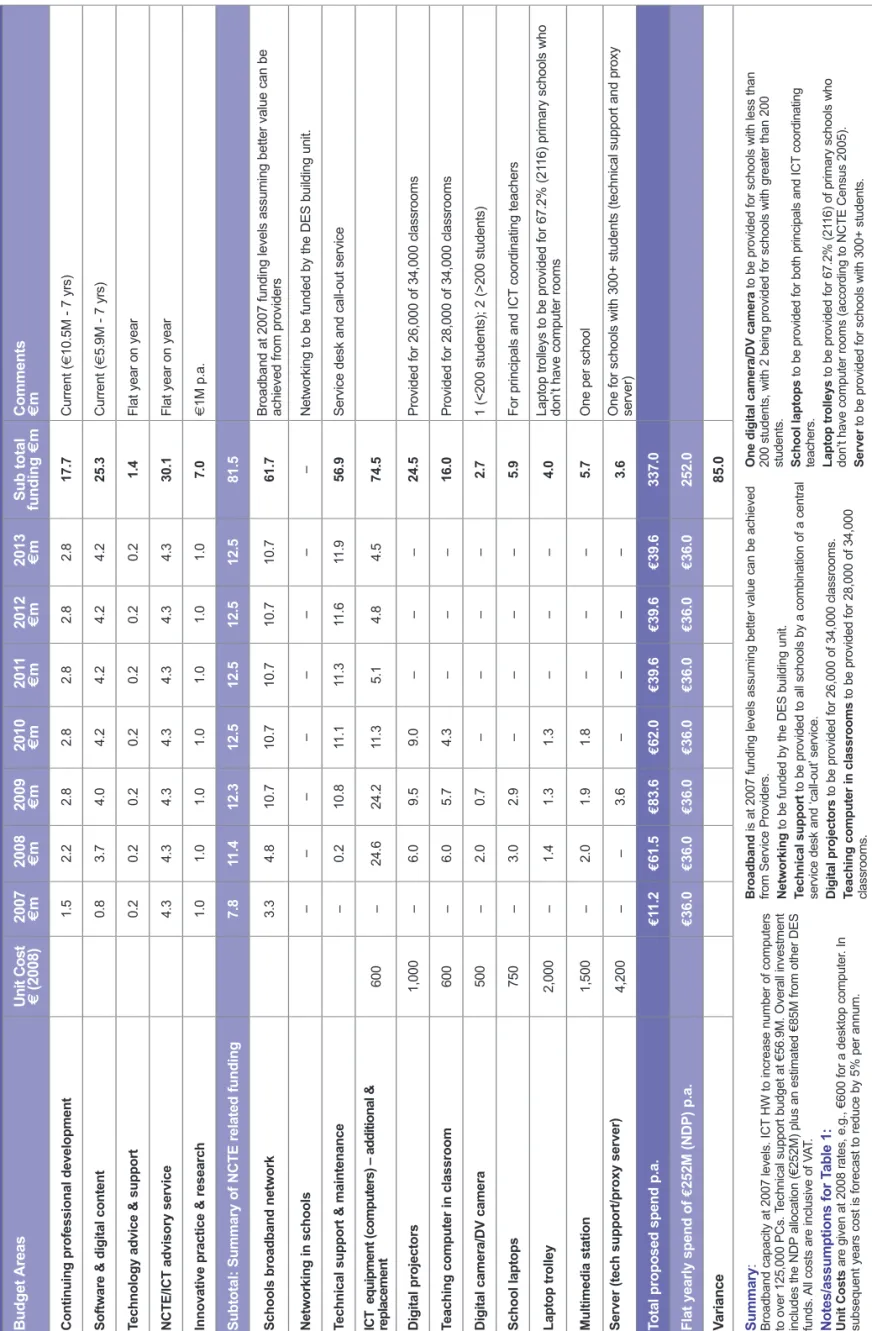
The allocation of €252 million in the NDP funding, augmented by the additional funds and supports that have been indicated to the Strategy Group by the DES, is a very welcome development. It will allow schools to re-engage with ICT and to make significant progress towards ICT integration and the use of digital technologies and tools.
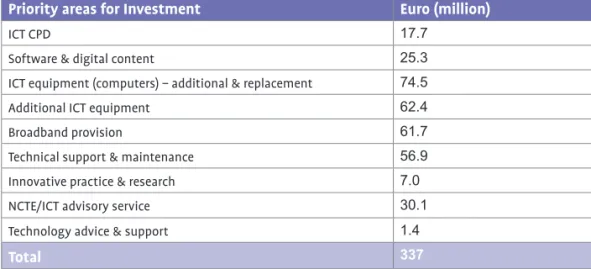
In addition to the NDP investment it is estimated that a further €85 million will be made available for ICT provision in schools by the DES Building Unit and other sources within the DES.
12
Together, these represent a potential spend of approximately €337 million. This is a substantial investment and will have a significant impact. However, given the numbers of schools and students and the existing levels of ICT, the Strategy Group regards it as inadequate to fund progress beyond an acceptable baseline of ICT provision. Further investment will be required to get our schools to an EU average level of ICT provision over the coming years.
Given our brief to advise on spending to maximise the impact of the funds indicated above, we offer the recommendations that follow.
These recommendations rest on a number of key assumptions:
Firstly, that strategic and timely delivery of these resources across all areas of ICT in schools is both necessary and possible. Many of the issues discussed in this report are interdependent and will require careful planning, review and further funding.
Secondly, that the DES ICT Policy Unit will be in a position to coordinate with the Department’s Building Unit to determine the levels and timings and to ensure that this additional ICT infrastructural development takes place in their schedule of building and development work.
Finally, the longer term objective is that Irish schools reach a point where ICT becomes a seamless component of the education experience and where ICT–fluent teachers feel supported and adequately resourced in its use.
This is a complex and multi-stakeholder challenge which can only be achieved if adequate arrangements are put in place at the outset to allow all partners in this challenge to input into both designing and driving the process forward.
3.3 ICT Investment goals 2008–2013
The underlying objective of ICT integration in schools is to facilitate and promote a learning environment that takes full advantage of technology in teaching and learning and encourages all students to become self-assured, self-directed learners – abilities which they will come to value throughout their lives. This requires investment in a well recognised set of key interconnected areas (see Figure 1) with the learner’s needs remaining central to all decisions.
Figure 1: Integrating ICT with learner-centred education
The Strategy Group believes that addressing any one area in isolation will reduce the impact and outcomes for the learner. And we are equally convinced that sustained and active pursuit of the following broad principles will assist greatly in achieving a powerful, learner-centric, e-learning culture in this country:
>>
Digitally enable all schools, through the provision of adequate and suitable infrastructure, ICT equipment and broadband internet services>>
Promote and support leadership, creativity and vision for ICT integration in schools>>
Meet teachers’ ICT professional development needs and support them in using ICT effectively in their teaching>>
Provide teachers and students with access to curriculum-relevant digital content and appropriate digital tools.Investing Effectively in Information and Communications Technology in Schools, 2008-2013 The future
advances and curriculum developments, will change in emphasis and orientation over the lifetime of the NDP and beyond.
Critical success factors
Certain critical success factors at system level are essential to achieving effective investment and in sustaining continued growth in the integration of ICT in schools. Foremost among these are:
>>
The provision of ICT infrastructure including broadband, technical support and school networking which is reliable, available where needed, easy to use and sustainable>>
Embedding of ICT from an early stage in the process of curriculum development and implementation>>
The provision of professional development in the integration of ICT in pedagogic practice to teachers at all levels in the system>>
Mechanisms to disseminate good practice models and to support effective and innovative practice between schools>>
Supporting strategic leadership at all levels, particularly within schools>>
Provision of sufficient interactive digital content and content creation tools to engage and support learners and to empower teachers in their changing roles.In brief: the ICT infrastructure in schools should provide a desirable level of access to ICT for teachers and students to use and share digital resources from any learning area in the school. Given that schools urgently require new equipment and technical support, the Strategy Group recommends that this need be met by frontloading investment in the first three years of the NDP period. In addition, there is a critical need in moving towards an embedded e-learning culture for cohesion and cooperation between the key educational partners and agencies. Inter-Departmental coordination will be required, principally in delivering adequate broadband to schools. Advice from relevant partners should be facilitated through appropriate consultation mechanisms.
D IG
ITA
L CONTENT AND SOFTW
ARE
PRO
FE SS
IO
NA L D
EVEL
OPMENT
BRO
AD BA
ND
HARDWARE
SUPPORT STRUCTURES
ADVICE & SU
PPO
RT
TECH
NICA
L SU
PPO
RT
LEARNER
14
Objectives and priority
recommendations for ICT
investment
Investing Effectively in Information and Communications Technology in Schools, 2008-2013
4
This section of the report identifies desirable objectives with accompanying points of discussion and outlines the recommendations arrived at in relation to seven key areas. The Strategy Group provides statements of priorities for investment with attached funding. This includes a suggested breakdown of the funding indicated as available over the lifetime of the initiative.
Objectives and priority
recommendations for ICT investment
4
4.1 Continuing professional development
Objective 1: To ensure that teachers gain the capabilities to make meaningful use of ICT in their work.
Discussion
Teacher professional development is central to successful ICT integration in schools. Recent initiatives in The Netherlands, Finland, Northern Ireland and other countries indicate that appropriate professional development and support for teachers, in tandem with teachers’ personal motivation, are key factors in progressing ICT integration. In Ireland, teachers’ participation in ICT-related professional development courses, voluntary since 1998, has been consistently high. The EU report Benchmarking Access and Use of ICT in European Schools (2006) confirms Irish teachers’ general willingness to embrace ICT. The next step involves harnessing this general amenability by providing teachers with the best possible professional development opportunities. Particular CPD and specific supports should be provided to principals and school ICT coordinating teachers as central champions of ICT integration in schools.
Recent reports on CPD and standards by both the DES Inspectorate and the NCCA confirm the need for interventions at different levels of the system using a range of approaches, system-led, school-based or cluster-based, with the teachers’ needs at the centre of each. The focus of ICT CPD is now firmly on the pedagogical use of ICT in learning and teaching. Teachers require professional development to embed the use of digital technologies within their subject areas. The implementation of the NCCA’s ICT framework for students and teachers will assist in the identification of curriculum-related ICT professional development.
Recommendations 4.1
1. The Department of Education and Science should draw up a framework for ICT CPD in which all support services include ICT integration as a key element of their professional development programmes for teachers. To date, ICT has not necessarily been a component of CPD and has often been regarded as an ancillary or post facto consideration. The framework should be drawn up in cooperation with the Teacher Education Section (TES) of the DES, the NCCA and the NCTE and should provide for ICT
Investing Effectively in Information and Communications Technology in Schools, 2008-2013
Objectives and priority recommendations for ICT investment
18
(SLSS), the School Development Planning Initiative (SDPI) and the School DevelopmentPlanning Support (SDPS). This should be budgeted for as part of TES provision.
2. ICT should be embedded, from the outset, in the design and delivery of all in-service programmes with time allocated to the pedagogical affordances of technology. The evidence from post-primary history and geography in-service, which adapted this approach to ICT, has already shown greatly increased integration of ICT by teachers in their classrooms.
3. Whole-school professional development initiatives on the integrated use of digital technologies should be an essential element of all school-based CPD. In-school CPD has a strong impact in improving staffs’ understanding of the role of ICT and how to plan for ICT usage in familiar teaching contexts. Such programmes encourage leadership, cooperation and ownership within the teaching staff and will relate to schools’ particular circumstances. Research in Europe indicated that staffs in schools, when provided with appropriately funded and well-supported CPD, make significant progress towards embedding ICT in learning and teaching.
4. Flexible and adaptable models of provision should be available to enable teachers to undertake professional development when and where it suits. Access should be facilitated for all teachers, whether based in rural or urban schools. Online delivery of ICT–based professional development should be expanded.
5. The development of communities of practice among teachers should be supported to encourage the sharing of methodologies and content in line with Web 2.0 developments and VLEs.
6. Off-site ICT professional development should continue to be provided, especially in Education Centres. Many teachers still avail of this out-of-school model of provision which allows for immersion in particular areas of interest such as digital media. It also provides a collaborative environment where peer-to-peer learning and sharing takes place.
7. At primary level the PCSP cuiditheoireacht service to schools is strategically important in supporting and progressing the integration of ICT in the primary curriculum. ICT integration advice and support must be part of their services to schools. The cuiditheoireacht service will require CPD to increase their understanding and ICT abilities in order to promote and support the use of ICT in the various curriculum areas.
8. Professional development programmes should be provided for principals to support their leadership role in integrating ICT in their schools. Empowering distributed leadership in ICT integration in schools through enhanced supports to school principals as the key champions of ICT integration should be at the heart of this action.
9. Specific professional development programmes and supports must be provided for school ICT coordinators. Teachers filling this role in schools are correctly of the view that relevant training and supports are required. The strategic role of ICT coordinators should be reviewed and enhanced by the school to ensure that it encompasses active promotion and peer-to-peer support on integrating ICT throughout their schools.
10. A collaborative approach to ICT course development and teaching resources should be continued with other agencies and, where appropriate, with industry. Current examples include collaborations with Intel, Discover Science and Engineering, Microsoft, IBM and Teachnet.
11. Pathways to accreditation should be clearly defined and agreed with third level providers to ensure that teachers undertaking CPD courses or modules in ICT can accumulate credits towards post graduate qualifications.
12. At pre-service level, newly qualified teachers must have a strong appreciation of the potential of ICT in the delivery of the curriculum and have had access to appropriate ICT facilities to become competent in using ICT. Facilities in some Colleges of Education and Education Departments have been expanded over the years. These colleges now require ICT production-focused digital media centres which will allow new teachers to acquire the practical skills of designing and producing digital resources and the methodologies to integrate them in their practice. It is necessary to address the ICT resource needs of these providers in relation to the education of the next generation of teachers.
It is essential that all those involved in teacher professional development maintain a dynamic approach to its design and delivery. As teachers’ knowledge, understanding and confidence increase in the use of ICT, professional development programmes must evolve to meet their changing needs. These recommendations underpin this reality.
4. 2 Software and digital content for learning and
teaching
Objective 2: To ensure that there is an adequate supply of innovative, high quality and Irish curriculum-related digital teaching and learning resources available to teachers and students at all levels.
Discussion
The learning process is built on a cyclical process whereby content in its many different forms is exchanged between the learner and the teacher. All schools require access to relevant, engaging and educative digital content and content creation tools. The roll-out of broadband provides a greater opportunity to deliver wide-ranging learning resources directly to teachers and students in all schools. Many of the submissions to the Strategy Group indicated that the lack of availability of relevant digital content is a concern for time-pressured teachers who want to integrate ICT but often find there is a limited supply available to them. Relevance to the Irish curriculum is the key yardstick. It is clear that a balance is required between providing offline digital content resources, online content and online content creation tools that allow teachers and students to create and share their own teaching and learning content. The use of online learning environments, VLEs and school websites provide opportunities to build and share content. As outlined in the NCTE’s Digital Content Strategy, the three most effective approaches used in establishing a content pool for schools are “procure, build and share”. The expertise of the teacher remains central to the development of digital content for Irish schools. Given the right supports and content creation tools, Irish teachers can contribute significantly to creating a first class content pool for the Irish curriculum.
Recommendations 4.2
1. Scoilnet (www.scoilnet.ie), the portal for Irish education, must be expanded to provide a dynamic and comprehensive library of Irish curriculum-related tagged content to ensure easy access to online curriculum resources. In addition, Scoilnet should provide access to online content creation tools, learning platforms,
Investing Effectively in Information and Communications Technology in Schools, 2008-2013
Objectives and priority recommendations for ICT investment
20
2. Develop digital content resources relating to, and supporting, the Irish curriculum, e.g., French.ie. Gaeilge, in particular, should be given special attention. It is important that teachers can easily access useful digital content in sufficient amounts.
3. Purchase digital content centrally and distribute it to all schools (e.g., Ordnance Survey Ireland maps) through the schools broadband network. Provide schools with a bank of encyclopaedic and reference materials as a necessary all-round resource for schools.
4. Facilitate the establishment of subject-specific online communities of practice, based on existing successful models. Online communities of practice increase teacher confidence and assist in building appropriate user-generated content for teaching and learning. Using VLEs and sharing content with other educational agencies and groups will boost the availability of relevant digital content in Ireland.
5. Develop strategic partnerships with those Irish public bodies and agencies that hold relevant cultural and historical content in order to transform this valuable indigenous content into useful learning resources. For example, the “Look at History” pilot project, which linked digital content in RTÉ’s archives with the Leaving Certificate history syllabus, has been a successful model of collaboration with purposeful content being made available for use in the classroom.
6. NCTE’s Software Central service should be developed as a support and advice centre for schools in relation to the use and purchase of software, digital content and digital tools.
7. Provide specific advice and support on software and digital content tools for special educational needs.
8. Promote the use of software/content tools in schools to encourage the local development and sharing of content by teachers and students. Advances in web technology will provide more opportunities for easier content development over the next six years.
9. Explore and promote, where appropriate, the use of open source software and its applicability in teaching and learning.
10. Build on existing software licensing agreements by putting purchasing frameworks in place for school-appropriate software and provide grants to schools to purchase digital content and software suitable to their needs.
4.3 ICT equipment – additional and replacement
Objective 3: To ensure that adequately specified, up-to-date teaching and learning technology is available in sufficient quantity in all schools in Ireland.
Discussion
It is axiomatic that the provision of computer hardware and other up-to-date teaching and learning technology is a priority area for investment. The ICT equipment currently available to teachers and students for use in the classroom is inadequate and much is outdated. It is not possible to create an e-learning culture and embed ICT in the curriculum without having appropriate and adequate information and communications technology tools available in schools.
A key lesson of previous initiatives is the need to sustain, on a long term basis, adequate infrastructure to maintain teacher and student use and motivation to utilise ICT. Within the rapidly changing world of technology, renewal and replacement of computers are on-going requirements. While the existing Northern Ireland centrally managed service (a total cost of ownership model) provides an effective solution for equipment replacement, upgrade and technical support, the cost of this service is approximately€74 million per year for 1200 schools. Such a solution is not an option due to cost coupled with the
length of time it would take to put such a provision in place. However, as outlined in this report, centralised services and purchasing frameworks can be used effectively to provide timely, efficient and cost-effective solutions.
Principals and teachers have called for a more centralised approach to procurement and pricing structures to ensure that they get the best value for money. Based on the level of funding available, the recommendations of the DES and on NCTE advice and support on the development of school e-learning strategies, schools can decide on the most appropriate technology options for their schools and make appropriate purchasing decisions using central purchasing frameworks.
In relation to ICT equipment in schools, the issue of standardisation is an important consideration and raises concerns about the subsequent provision of a uniform and effective system of technical support. The most effective technical support models in place today have standardised and uniform ICT equipment as a key strategic element. The more diverse the level and range of ICT equipment configurations in schools, the more complex and expensive the technical support solution will need to be to support it. A more centrally supported approach, where the specifications for new equipment are more standardised and are accompanied by suitable advice and guidance, will obviate many of these concerns.
Recommendations 4.3
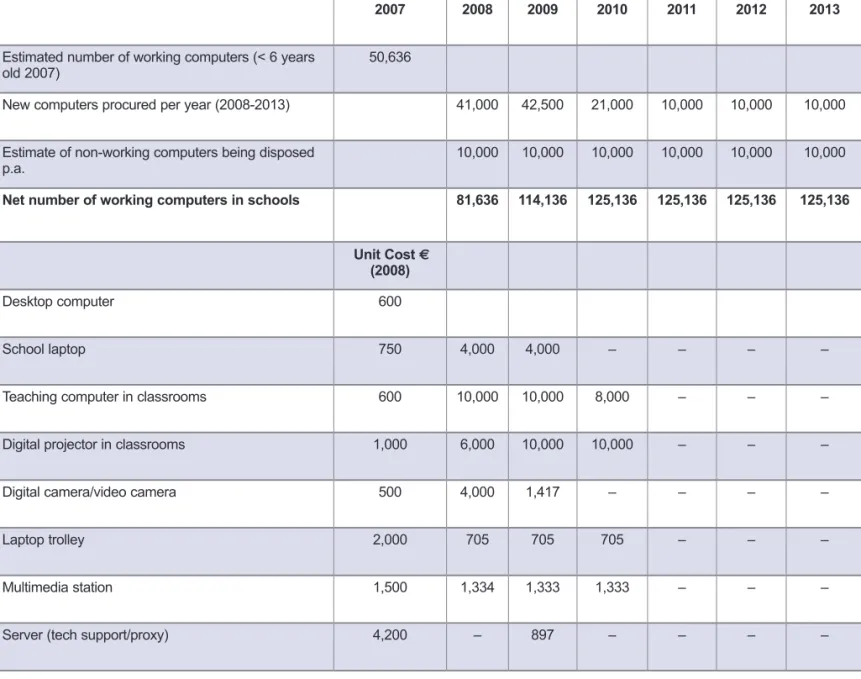
1. All schools must have access to a desirable baseline suite of ICT equipment and digital devices. The allocated funds should enable schools to upgrade their computer stock so that all computers are less than six years old by 2010. Schools with good ICT infrastructures already in place must also be facilitated in further improving their ICT environments.
2. A suitably pre-configured computer specification should be developed for schools, complete with appropriate systems software.
3. Schools should have ready access to advice on appropriate configurations for their school situation, for example, laptops or desktop computers in classrooms, data projectors and networked printers as well as advice on upgrading existing hardware. Depending on school size, a number of ICT configurations and specifications should be developed as guidelines/targets for schools.
4. Interactive Whiteboards (IWBs) offer opportunities for student participation and increased classroom interactivity. Effective investment in this technology is dependent on an existing positive ICT culture in schools, teachers who are experienced in using ICT in the classroom and on an existing desirable level of ICT access throughout the school. Given the current high costs of IWBs their deployment within schools will necessarily be limited.
5. The existing government purchase framework for PC/laptops and printers should be available for use by all schools. The Department/NCTE should develop and implement additional purchase frameworks for selected digital devices such as data projectors, digital cameras and the newer digital devices which will be available to schools in the future.