1 2
Dr. D. Muruganantham | V. Titus John Bosco
1Msc, MEd, MPHIL, PH.d, Research Guide, Associate Professor, Department Of Education, Prist To Be Deemed University,
Thanjavur.
2
Mphil Research Scholar, Department Of Education, Prist To Be Deemed University, Thanjavur.
INTRODUCTION:
Computers are scientific inventions of artificial intelligence. Now a day’s com-puters are used in every field. Comcom-puters are managing starting from launching the Rockets to operating sub-marines. Now we are using computers in educa-tional fields also. Schools and colleges are using computers for teaching and learning process. Computer is an electronic instrument. This stores the data by magnetic field. Computers give information when required. This can store a lot of information in a short time. Many teachers do not like using computers for their teaching. This is because the teachers are apprehensive that they may lose their job because of computers. But in reality computers can never replace the teachers. The teachers’ position in education is irreplaceable. Actually the com-puter helps the teachers and spares them from collecting and storing the informa-tion. But education through computers must be under the control of teachers Computer – assisted instruction improves instruction for students with disabili-ties because students receive immediate feedback and do not continue to practice the wrong skills. Many computer programs can move through instruction at the student’s pace and keep track of the student’s errors and progress. Computers capture the student’s attention because the programs are interactive and engage the student’s spirit of competitiveness to increase their scores. Also, CAI moves at the student’s pace and usually does not move ahead until they have mastered the skill. Programs provide differentiated lessons to challenge students who are at risk, average or gifted.
KEY WORDS: Computer – assisted instruction-CAI- students with disabilities, immediate feedback, electronic instrument
NEED FOR THE STUDY:
Teaching by traditional method is followed in schools. It is important to see the related pictures explanation in learning Matrices. Now day’s school pupils understand Mathematics through their memorization only. The learning will be effective only when this memorization becomes a visual experience. Observa-tion gives more understanding than hearing. Teachers are compelled to change their time honored methods of instructions so as to educate students on a wide spectrum of knowledge. The teacher is expected to rise to the occasion, develop gradual technology compliance, and make efforts to apply the principles of infor-mation technology in education particularly in instruction so that India can become “Knowledge Society”. So, the investigator decided that pupils are in need of visual teaching. Hence the need for the study is felt and carried out by investigator.
OPERATIONAL DEFINITIONS: EFFECTIVENESS:
th
Refers to the achievement in performance of X standard students after the learn-ing of CAI package prepared by the investigator.
CAI PACKAGE:
Refers to the educational medium in which instructional content on Matrices for Xth standard students and are delivered through a computer prepared in Microsoft Visual Basic 6.0 version for individualized learning. The package also is a compilation study material for the students which has the components viz., creating objectives, delivery of lesson through frames in simpler modes, pre tests, feedback and re – enforcement.
X STANDARD PUPILS:
TH
Refers to the pupils who have completed their IX standard and who are
study-TH
ing in X standard in the academic year 2018-2019 at the Matriculation schools.
MATHEMATICS:
Refers to one of the basic subjects taught at the Secondary level in schools.
MATRICES:
In mathematics, a matrix (plural matrices) is a rectangular array[1] of numbers, symbols, or expressions, arranged in rows and columns.[2][3] The individual
items in a matrix are called its elements or entries.
HISTORY OF MATRICES:
The history of matrices goes back to ancient times! But the term "matrix" was not applied to the concept until 1850."Matrix" is the Latin word for womb, and it retains that sense in English. It can also mean more generally any place in which something is formed or produced.The orgins of mathematical matrices lie with the study of systems of simultaneous linear equations. An important Chinese text from between 300 BC and AD 200, Nine Chapters of the Mathematical Art (Chiu Chang Suan Shu), gives the first known example of the use of matrix methods to solve simultaneous equations.In the treatise's seventh chapter, "Too much and not enough," the concept of a determinant first appears, nearly two millennia before its supposed invention by the Japanese mathematician Seki Kowa in 1683 or his German contemporary Gottfried Leibnitz (who is also credited with the invention of differential calculus, separately from but simultaneously with Isaac Newton).More uses of matrix-like arrangements of numbers appear in chapter eight, "Methods of rectangular arrays," in which a method is given for solving simultaneous equations using a counting board that is mathematically identical to the modern matrix method of solution outlined by Carl Friedrich Gauss (1777-1855), also known as Gaussian elimination.
TYPES OF MATRICES: Row Matrix:
A row matrix is formed by a single row.
Column Matrix:
A column matrix is formed by a single column.
Rectangular Matrix:
A rectangular matrix is formed by a different number of rows and columns, and its dimension is noted as: mxn.
Zero Matrix:
In a zero matrix, all the elements are zeros.
Upper Triangular Matrix:
In an upper triangular matrix, the elements located below the diagonal are zeros.
Lower Triangular Matrix:
In a lower triangular matrix, the elements above the diagonal are zeros.
Scalar Matrix:
A scalar matrix is a diagonal matrix in which the diagonal elements are equal.
EFFECTIVENESSOFCOMPUTERASSISTEDINSTRUCTION
th
(CAI)PACKAGEONLEARNINGMATRICSAMONGX
STANDARDSTUDENTSINTUTICORINEDUCATIONAL
DISTRICT
Identity Matrix:
An identity matrix is a diagonal matrix in which the diagonal elements are equal to 1.
Transpose Matrix:
Given matrix A, the transpose of matrix A is another matrix where the elements in the columns and rows have switched. In other words, the rows become the col-umns and the colcol-umns become the rows.
t t
(A ) = A
t t t
(A + B) = A + B
t t
(α ·A) = α · A
t t t
(A · B) = B · A
Regular Matrix:
A regular matrix is a square matrix that has an inverse.
Singular Matrix:
A singular matrix is a square matrix that has no inverse.
Idempotent Matrix: The matrix A is idempotent if:
2
A = A.
Involutive Matrix: The matrix A is involutive if:
2
A = I.
Symmetric Matrix:
A symmetric matrix is a square matrix that verifies:
t
A = A.
Antisymmetric Matrix:
An antisymmetric matrix is a square matrix that verifies:
t
A = −A.
Orthogonal Matrix:
A matrix is orthogonal if it verifies that:
t
A · A = I.
WHAT DOES CAI LOOK LIKE FOR MATHEMATICS?
In one computer game for children ages 5 through 12, a little green monster gob-bles numbers on a grid-like screen while avoiding evil monsters. The little green monster, controlled by the student, may be asked to gobble prime numbers, mul-tiples of 4, or factors of 32. If the little green monster eats the wrong number, it dis-appears. This type of game is a fun way for students to teach themselves basic skills, and it could be used as a reward. Mathematics computer programs demon-strate concepts, instruct, and remediate student errors and misunderstandings from preschool through college. Some programs are useful for teaching basic skills. The game in the box at the right helps students develop their basic skills in an entertaining way; it relies on the students' sense of competitiveness to improve their skills by improving their scores. Many entertaining computer mathematics games encourage students to learn while enjoying the experience. Other pro-grams are useful for instruction or remediation because they present problems that the student answers. If the answer is correct, the student is usually rewarded with a “Great Job!” or an animated response on the computer screen. If the answer is wrong, the computer demonstrates the correct way to solve the prob-lem. The example below demonstrates a typical mathematics computer lesson for demonstrating the concept of regrouping in addition.
Finally, programs are available that demonstrate mathematical concepts that are better explained through visual or manipulative resources. Examples of such online programs are the Math Forum @ Drexel at http://mathforum.org/arith-metic/arith.software.html and the Virtual Library of Interactive Manipulatives for Interactive Mathematics developed by Utah State University at http://matti.usu.edu/nlvm/nav/index.html.
CLASSIFICATION OF THE TECHNOLOGICAL – AIDS USED IN EDU-CATION:
Audio – visual aids in education, replaced by the new term 'Instructional Tech-nology' could be categorized into two broad categories i) Projected Aids and ii) Nun – projected Aids. They are similar to the modern categories of 'Hardwires' and 'Softwares'.
SOFTWARE TECHNOLOGY:
The software Technology uses the principles of Psychology for building in the learner a complex repertory of knowledge or modifying his behaviour. It origi-nated from the pioneering works of skinner and other behaviorists. The programmes which such a technology produces are often called 'software'.
Software approach is characterized by such psychological principles like, task analysis, writing precise learning objectives, selection of appropriate learning strategies, immediate reinforcement of responses and constant evaluation.
Newspapers, books, magazines, educational games, flash cards, charts, dia-grams, video lessons, Radio lessons, etc. form part of software, Infact tape recorded information, text of information provided by the computer, films and film-strips, all come under softwares as they involve psychological principles in their preparation.
HARDWARE TECHNOLOGY:
This is based on the application of engineering principles for developing electro-mechanical equipments for instructional purposes. All types of projectors, cas-sette players, tape recorders, Radio, Television, closed circuit Television (CCTV), Teaching Machines and computers are called educational hardwares. That is machines / equipments used for instruction tall under 'Hardware' and the instructional materials prepared for the hardwares constitute the 'software'. Hard-ware mechanize the process of teaching so that teachers would be able to deal with more students with less expenditure in educating them.
COMPUTER ASSISTED INSTRUCTION (CAI):
The most striking innovation in the field of educational technology is the use of computers. The main objective of computer assisted instruction (CAI) is to pro-vide the needed flexibility for individualizing the educational process. It meets the specific needs of the student in a way in which it is almost impossible to do so in a face- to – face student-teacher relationship. Computer-assisted instruction” (CAI) refers to instruction or remediation presented on a computer. Many educa-tional computer programs are available online and from computer stores and text-book companies. They enhance teacher instruction in several ways.
Computer programs are interactive and can illustrate a concept through attractive animation, sound, and demonstration. They allow students to progress at their own pace and work individually or problem solve in a group. Computers provide immediate feedback, letting students know whether their answer is correct. If the answer is not correct, the program shows students how to correctly answer the question. Computers offer a different type of activity and a change of pace from teacher-led or group instruction.
MEANING OF COMPUTER ASSISTED INSTRUCTION (CAI): A computer has the facilities to store information as well as retrieve it. The stored information is a particular computer language so that the computer understands and reacts. When the necessary procedures to process the information are given to it, interacts and manipulates the information and the answer is typed on a tele-typewriter. The different parts of the computer that are involved in this process are input equipment, memory store, processing unit, control unit and output equipment. The input equipment translates the information given to the com-puter the processing unit and output equipment. The input equipment translates the information, in terms of several operations such as adding, subtracting, mul-tiplying, etc., and also selects particular information that is needed, which in turn is translated back to an understandable form by the learner. This is the working of a computer in its most simple form.
TYPES OF COMPUTER ASSISTED INSTRUCTION (CAI):
There are a number of ways by which computers can be used for instruction. Computer assisted instruction (CAI) or computer aided learning (CAL) refers to situations in which a computer system is utilised in the learning process.
The first application involves utilization of the computer as a record keeper and
retriever. Teachers and administrators programme the computer for processing data of the students for instruction purposes such as printing report cards, storing and retrieving rest and examination results, pertinent details about students (age, sex, community, family background, etc) and scheduling students for classes in the case of streaming of students ability-wise or due to large strength of the col-lege or shift system. For the purpose of guidance and counseling, cumulative records, counsellor's records, file and details about vocational interest, aptitude, and information and psychological test results can be stored in the computer and retrieved as and when needed.
The second is to use the computer as a laboratory computing device, which is one
of the most frequently used educational application. A single terminal, teletype or electric typewriter is installed in the classroom with a direct access to an exter-nally placed computer. Students are encouraged to develop their own computer programmes relating to their regular classroom assignments. Talented and over-achieving students can be encouraged to develop their own software or help the peer group in preparing software to suit the different abilities of the learners. At the tertiary level, this will be a very stimulating experience.
The third form of CAI uses the computer as a tutor. One form of tutoring is to
pro-vide drill and practice to the student at a computer terminal. In this form, a plete lesson/ course is also presented in the computer to the student and the com-puter keeps track of his performance and can give a summary of his performance to the teacher whenever asked for. In drill and practice branching type of dial programme is also provided for those learners who are in need of such reme-dial teaching.
The fourth application is simulation which is effective when presented in CAI.
Through specific input, computers develop models of processes or structure. Simulated conditions are shown on the computer screen such as working of the circulatory system of the human body or the effect of interactions on the opera-tion of a system or other models from company management, biology, mathe-matics or ecosystem. Such simulations have tremendous potentials for instruc-tional purpose. Simulations are also planned as competitive games to motivate and increase the interest of the learners.
ADVANTAGES OF CAI:
In describing undergraduate computer-assisted learning in biology, chemistry and physics, Mc KENSIE (197) cites eight advantages and four criticisms of the method. The advantages of CAI are as follows:
Ÿ The immediate feedback is provided by interactive terminals and keeps stu-dents interacting and eager to keep trying.
Ÿ Weaker students are obliged to participate actively. They often remain pas-sive in lectures.
Ÿ The computer will wait patiently for an answer and will not express annoy-ance with wrong response.
VARIABLES OF THE STUDY: INDEPENDENT VARIABLES: Ÿ CAI package
DEPENDENT VARIABLE: Ÿ Gain performance
OBJECTIVES OF THE STUDY:
th
Ÿ To prepare a CAI package on Matrices for X standard pupils.
th
Ÿ To prepare an Achievement Test on Matrices for X standard pupils.
HYPOTHESES OF THE STUDY:
1. There is effectiveness in each and every individual after the Administration
th
of CAI package among X standard pupils in learning Matrices.
th
2. There is Mastery Level attainment by the X standard pupils in Learning Matrices through CAI package.
METHODOLOGY IN BRIEF:
The sample was collected using purposive sampling technique. The experimen-tal method was adopted for the investigation. It was a true - experimenexperimen-tal design. It consists of the experimental group and control group. The control group was exposed to the lecture method of teaching and the experimental group was taught
th
through CAI package. It has the samples of the X standard students. Pre-test before the treatment and Post-test after the treatment was conducted for both con-trol and experimental group.
SAMPLING TECHNIQUES:
A control group consists of 40 pupils and experimental group consists of 40 pupils studying in X standard were taken for the study. The pupils were selected from ST.FRANCIS XAVIER'S HR.SEC.SCHOOL in Tuticorin district.
TOOLS:
Ÿ CAI package prepared by investigator.
Ÿ Achievement test (MURGUTITAS TOOLS)
STATISTICAL TECHNIQUES USED:
The collected data was analyzed statistically by using the following techniques.
1. Mastery level calculated through gain Ratio.
2. Gain Ratio was calculated with the following formula:
Post test scores - Pre test scores
Gain Ratio = --- x 100 Maximum possible scores - Pre test scores
3.
M1 –Mean of the first sample
M2- Mean of the second sample
σ Standard deviation of the first sample1
-σ Standard deviation of the second sample2
-N The number of cases in the first sample1-
N The number of cases in the second sample
2-4. Correlation Coefficient
Where,
n = Number of pairs of scores
∑xy =Sum of the products of paired scores
∑x =Sum of x scores
∑y = Sum of y scores
2
∑x = Sum of squared x scores
2
∑y = Sum of squared y scores
SCOPE OF THE STUDY:
Through this study the investigator has the scope of reaching out to all State board and Matriculation Schools and all levels of pupils (gifted, average and slow learners). The topic selected for the present study is mainly meant to study the deep impression of Computer Assisted Instruction on IX standard pupils in Matrices. Therefore, it studies the interest, practice and understanding of Matri-ces by the pupils.
THE ADMINISTRATION OF THE TOOL: PRE – REQUISITE TEST:
The pre – requisite test was conducted to them to find out their previous knowl-edge in Matrices. After that Ten minutes time as given to recall. Finally they com-puted the answers.
PRE – TEST:
A pre-test was conducted to forty students with the constructed validated ques-tionnaire consisting of thirty items. Instruction was given to the Students.
APPLICATION OF METHOD:(CAI)
After the administration of the pre – test the learner in the experimental group was seated comfortably before the computer. Then the investigator introduced the object of Matrices. The students started learning. The learner took his own pace to learn the content. After gaining mastery in one frame, the learner was lead to the next teaching frame. In this manner all the 40 students learnt the material through CAI.
LECTURE METHOD:
After administration of the pre test, the teacher taught the lesson on Matrices through chalk and talk method to the students in the control group.
POST – TEST:
After the CAI and lecture method 5 minutes interval was given. After that the post – test was administered to them. The pre test and post test question papers were same. Time duration of 30 minutes was given to complete the test.
SCORING PROCEDURE:
The answer scripts for the conducted tests were collected and scored based on the scoring it was decided to give 1 mark as weight age for each correct answers. Thus a maximum of 50 marks could be given to a learner who responded all the 50 items correctly.
NULL HYPOTHESIS: 1
There is no effectiveness in each and every individual after the administration of CAI package among X standard pupils in learning Matrices.
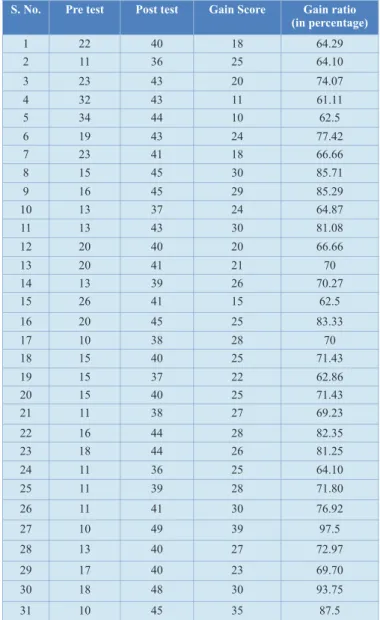
Table 1.1: Table showing the gain ratio of the individuals of X standard in learning Matrices through CAI package
From table No.1.1 it is inferred that there is effectiveness in each and every indi-vidual after the administration of CAI package among X standard pupils in learn-ing Matrices. Hence the null hypothesis, “There is no effectiveness in each and every individual after the administration of CAI package among X standard pupils in learning Matrices”, is rejected and the research hypothesis is accepted.
INTERPRETATION:
The CAI package prepared by the investigator on Matrices has proved to be effective in each and every individual. This could be because of the package has been designed very well and follows the principles of individualized instruction. It may be appealing to the senses and cognitive development of the pupils. The complexity of the subject (Maths) has been made simpler through the package which enhanced interest in learning in the pupils.
NULL HYPOTHESIS: 2
There is no Mastery Level attainment among X standard pupils in learning Matri-ces through CAI package.
Table 1.2: Table showing the Gain score of pupils based on their Mastery Level
The above table No.1.2 shows that there is over all gain performance after admin-istering the CAI package. The pupils have attained Mastery Level as follows:
Among the whole population 3 pupils have scored above 90.%. (i.e) Mastery Level I.
11 pupils have gained above 80.%. (i.e) Mastery Level II.
26 pupils have scored above 70.%. (i.e) Mastery Level III.
40 pupils have scored above 60.%. (i.e) Mastery Level IV.
All pupils participated in learning through CAI package material have achieved more than 60% of marks.
Hence the null hypothesis, “There is no Mastery Level attainment among X stan-dard pupils in learning Matrices through CAI package”, is rejected and the research hypothesis is accepted. It is evident that there is Mastery Level attain-ment by the samples in the CAI method of learning Matrices.
INTERPRETATION:
All the pupils participated in the learning of CAI package material have achieved more than 60% of marks. Their achievement is substantial. The achievement of the X standard pupil proves that the developed CAI package material is a valid one for them.
S. No. Pre test Post test Gain Score Gain ratio
(in percentage)
1 22 40 18 64.29
2 11 36 25 64.10
3 23 43 20 74.07
4 32 43 11 61.11
5 34 44 10 62.5
6 19 43 24 77.42
7 23 41 18 66.66
8 15 45 30 85.71
9 16 45 29 85.29
10 13 37 24 64.87
11 13 43 30 81.08
12 20 40 20 66.66
13 20 41 21 70
14 13 39 26 70.27
15 26 41 15 62.5
16 20 45 25 83.33
17 10 38 28 70
18 15 40 25 71.43
19 15 37 22 62.86
20 15 40 25 71.43
21 11 38 27 69.23
22 16 44 28 82.35
23 18 44 26 81.25
24 11 36 25 64.10
25 11 39 28 71.80
26 11 41 30 76.92
27 10 49 39 97.5
28 13 40 27 72.97
29 17 40 23 69.70
30 18 48 30 93.75
31 10 45 35 87.5
32 10 38 28 70
33 18 48 30 93.75
34 10 44 34 85
35 30 45 15 75
36 40 47 7 70
37 25 42 17 68
38 30 45 15 75
39 30 42 12 60
40 19 43 24 77.42
Figure 1: Figure showing the Gain Score of Pupils based on their Mastery Level
Mastery level C.F Percentage
MI (90-100) 3 7.5
MII (80-89) 11 27.5
MIII (70-79) 26 65
CONCLUSION:
A CAI package on Matrices was developed, subjected to individuals, groups and
th
tested on samples of 80 pupils from X standard. CAI is more effective than chalk and talk method of teaching. This is proved by gain score of control group and experimental group method in the study. Technology based education is the need of the time. Therefore, in order to develop the skills and knowledge of pupils every subsystems of the educational system have to enforce technology based learning. Hence it predicts that the CAI is more effective in learning Matrices. As a result of Experimental study the students form many good habits like initia-tive, self – dependence, self – reliance which can be elevating ladders in the life of the pupils. In the view of the researcher this experimental study was success-fully and contently undertaken. This study has become an eye – opener to the researcher to reach out to the areas untouched to teach Mathematics to the pupils effectively. It is the stern belief and hope that this CAI package will pave way for many more such efforts in the educational area.
REFERENCES:
1. Kothari C .R(2000), “Research Methodology”, Wishwa Prakashan pvt. Ltd, New Delhi.
2. Krishnamurthy .V (1990) “Rightway to teach Mathematics” Editor, The Hindu, May.
3. Kulbir Singh Sindhu (1982), “The teaching of Mathematics, Sterling Publishers (P) Ltd., New Delhi.
4. Kupuswami (1973) Aiyangar .M, “Teaching of Mathematics in new edition, The uni-versal Book and Stationary Co. Delhi.
5. Lokesh Koul (1997), “Methodology of educational Research”, Vikas publishing house pvt. Ltd, New Delhi.
6. Mangal . S .K (1995) “Teaching of Mathematics Prakash Brothers, Ludhiana.
7. Mujibul Hasan Siddiqui (2008)”, Educational Technology”, APH Publishing Corpora-tion, New Delhi.
8. Nagarajan. K (2003), “Research Methodology in Education”, Ram Publishers, Chennai.
9. Pannier Selvam (2007) “Research Methodology”, Prentice Hall of India pvt. Ltd, New Delhi-10 001.
10. Rai .B .C (1985), “Method of Teaching of Mathematics” Prakashan Kendra, Lucknow.
11. Romesh Verma, Suresh Sharma (1998, 2006), Modern Trends in Teaching Technol-ogy” Anmol publications pvt Ltd, New Delhi.
12. Sharma .R .A (2008), “Advanced Statistics in education and Psychology, VinajRakheja Publishers, Meerut.
13. Sharma .R .A (2008), “Essentials of Educational Technology Guidance and Manage-ment”, R .Lall Book Depot, Meerut (U.P).
14. Srivastava .C .BP (2002), “Science and Technology: Current Perspectives”, Kitab Mahal Agencies, Allahabad.
15. Vanaja (2004), “Educational Technology” Neel Kamal publication pvt Ltd, Hyderabad.
16. Venkataiah.N (2007), “Educaitonal Technology”, APH Publishing corporation, New Delhi.
JOURNALS:
17. Edutracks, “Importance of Mathematics in school Education”, Aug 2005, Vol.4, No.12, Pg.No:18.
18. Edutracks, April 2004, Vol.3, No.8, “Learning Science and Mathematics through Com-puters” Pg.No:31-34.
19. Edutracks, Feb 2004, Vol.3, No.6, “Teaching problem solving in Mathematics” Pg.No:12-14.
20. Edutracks, March 2001, Vol.10, N0.7, “Effectiveness of CAI” Pg.No:25-30.
21. Eraut Michael. A (1989), “The international Encyclopedia of Educational Technol-ogy”. Pergamon Press, Oxford.
22. Indian Education Abstracts, July 1988, Issue.5.
23. Journal of centre for pedagogical studies in Mathematics.
24. Lay. E. J (1992), “Encyclopedia of Modern Method of Teaching” (Vol.2), Anomal Pub-lishing, New Delhi.
WEBSITES:
25. http://www.dataanalysis.com
26. http://www.dictionary.reference.com
27. http://www.encyclopedia.com