M E T H O D O L O G Y
Open Access
Comparison of the effect of a CIDR-Select Synch
versus a long-term CIDR based AI protocol on
reproductive performance in multiparous dairy
cows in Swiss dairy farms
Jürn Rudolph
1, Rupert M Bruckmaier
2, Ramanathan Kasimanickam
3, Adrian Steiner
4, Marc Kirchhofer
4, Jürg Hüsler
5and Gaby Hirsbrunner
4*Abstract
Background:Synchronization programs have become standard in the dairy industry in many countries. In Switzerland, these programs are not routinely used for groups of cows, but predominantly as a therapy for individual problem cows. The objective of this study was to compare the effect of a CIDR-Select Synch and a 12-d CIDR protocol on the pregnancy rate in healthy, multiparous dairy cows in Swiss dairy farms.
Methods:Cows (N = 508) were randomly assigned to CIDR-Select Synch (N = 262) or 12-d CIDR (N = 246) protocols. Cows in the CIDR-Select Synch group received a CIDR and 2.5 ml of buserelin i.m. on d 0. On d 7, the CIDR insert was removed and 5 ml of dinoprost was administered i.m.. Cows in the 12-d CIDR group received the CIDR on d 0 and it was removed on d 12 (the routine CIDR protocol in Swiss dairies). On d 0 a milk sample for progesterone analysis was taken. Cows were inseminated upon observed estrus. Pregnancy was determined at or more than 35 days after artificial insemination. As a first step, the two groups were compared as to indication for treatment, breed, stud book, stall, pasture, and farmer’s business using chi square tests or Fisher’s exact test. Furthermore, groups were compared as to age, DIM, number of AI’s, number of cows per farm, and yearly milk yield per cow using nonparametric ANOVA. A multiple logistic model was used to relate the success of the protocols to all of the available factors; in particular treatment (CIDR-Select Synch/12-d CIDR), milk progesterone value, age, DIM, previous treatment of the uterus, previous gynecological treatment, and number of preceding inseminations.
Results:The pregnancy rate was higher in cows following the CIDR-Select Synch compared to the 12-d CIDR protocol (50.4% vs. 22.4%; P < 0.0001).
Conclusion:The CIDR-Select Synch protocol may be highly recommended for multiparous dairy cows. The reduced time span of the progesterone insert decreased the number of days open, improved the pregnancy rate compared to the 12-d CIDR protocol and the cows did not to have to be handled more often.
Background
The average size of a Swiss dairy farm herd is approxi-mately 18 cows [1], compared with herds in the USA, for example, which had an average size of 120 in 2006 [2]. Hence, the use of synchronization programs and fixed-time AI (artificial insemination) is not common.
Busato et al., (1995) retrospectively analyzed the health data of 3581 cows from 80 Swiss dairy farms and identi-fied endometritis (19.4%), silent heat (26.4%), non func-tional ovaries (7.6%) and cystic ovarian disease (5.5%) as the four main fertility disorders [3]. In Swiss dairy farms, the predominant therapy for cows with fertility disorders consists of a CIDR insert for 12 days without administering additional hormones (as described in the Eazy breed™ CIDR® B instruction leaflet), the cows being then inseminated upon observed estrus.
* Correspondence: [email protected] 4
Clinic for Ruminants, Vetsuisse Faculty, University of Berne, CH-3012 Berne, Switzerland
Full list of author information is available at the end of the article
Preparations of Gonadotropine Releasing Hormone (GnRH), human chorionic gonadotropin (hCG), Lutei-nizing Hormone (LH), and progesterone, either alone or in combination are frequently used to treat anestrus and/or COD [4-8]. Progesterone released from a CIDR insert inhibits the release of GnRH from the hypothala-mus and therefore causes GnRH to accumulate in the hypothalamus; removal of the CIDR insert after 12 d causes a large amount of GnRH to be released and this results in ovulation [9-11]. However, the oocyte quality in 12-d CIDR protocols is poor [12]. Different studies showed an acceptable pregnancy rate after the use of a 7-d CIDR protocol in combination with GnRH and/or prostaglandin F2a (CIDR-Select Synch) [13-15]. The objective of this study was to compare the effect of a CIDR-Select Synch and a 12-d CIDR protocol on the pregnancy rate in multiparous dairy cows in Swiss dairy farms. Based on a power analysis assuming a 10% increased pregnancy rate (from 35% to 45%) in the CIDR-Select Synch group, we needed a sample size of 380 cows per group to achieve 80% power for a two-sided hypothesis (a= 5%).
Methods
Animal selection criteria
Multiparous dairy cows at least 42 DIM (days in milk) of the breeds Holstein Friesian, Red Holstein, Brown Swiss and their crossbreds were included. The veterinar-ians performed a gynecological examination and cows diagnosed with anestrus, repeat breeders or cows diag-nosed as not pregnant after a pregnancy check were included, if the uterus and uterine discharge were nor-mal. Exclusion criteria were a preceding cesarean sec-tion, uterine torsion, uterine prolapse or birth-associated injuries of the genital tract. Also, cows with a history of lameness, acute mastitis or any systemic illness within 14 days prior to the CIDR insert were excluded. Any treatment within these 14 days resulted in exclusion. From CIDR removal to the point of insemination no therapy was allowed. Insemination had to be performed within 120 h after CIDR removal. Heifers and cows in first parity were excluded. Cows from farms using bulls were also excluded.
Treatment and insemination
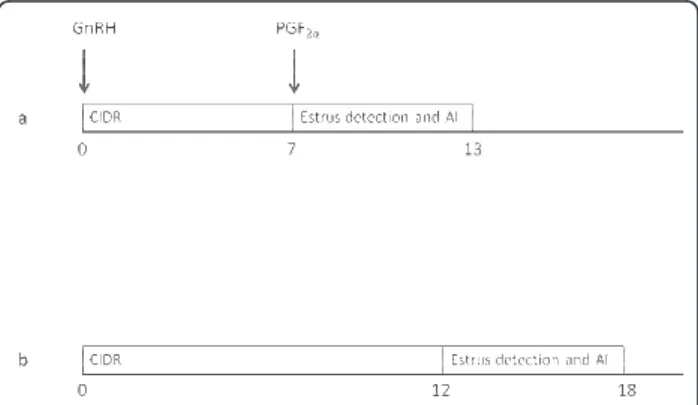
Cows were randomly assigned to CIDR-Select Synch (N = 262) or 12-d CIDR (N = 246) protocols based on the cows’odd or even ear-tag numbers, respectively. Cows in CIDR-Select Synch group received a CIDR insert (Eazi-breed™ CIDR® B containing 1.9 g progesterone, Pfizer Animal Health, Zurich, Switzerland) and 2.5 mL of buserelin i.m. (Receptal®4 μg/mL, Veterinaria AG, Zurich, Switzerland) on d 0. On d 7, the CIDR insert was removed and 5 mL of dinoprost i.m. (PGF2a;
Dinolytic®, 5 mg/mL, Pfizer Animal Health, Zurich, Switzerland) was administered. Cows in the 12-d CIDR group received a CIDR insert on d 0 and it was removed on d 12 (Figure 1). They were inseminated at observed estrus according to the AM-PM rule. The cows in both groups were observed for estrus three times daily for a minimum of 30 min. If no estrus was observed within 72 h after CIDR removal, each cow was examined by a veterinarian to exclude silent heat. Silent heat was defined by the presence of a mature follicle (≥ 13 mm in size), a regressing or no CL on one of the ovaries and a strong uterine tone. Cows found to be in silent heat were also inseminated. Cows were observed for estrus and inseminated up to 120 h from CIDR removal.
Milk progesterone test
A milk sample was collected from each cow on d 0 of treatment. About 5 mL was collected in a plastic tube containing 30 mg of sodium azide (Sigma-Aldrich, Bern, Switzerland) and was frozen until further analysis. The samples were centrifuged for 15 min at 1700 × g and the fat layer was removed. This step was repeated, and skimmed milk samples were further tested. The proges-terone concentrations were determined in skimmed milk by enzyme immunoassay as described by Meyer et al. (1986) [16]. The sensitivity of the test was 0.1 ng/mL. Intra- and inter-assay coefficients of variation were 8 and 12%, respectively. Cows with a progesterone level > 1 ng/mL were considered as having luteal activity. A progesterone level < 0.5 ng/mL was considered as
Figure 1Schematic representation of the 2 synchronization protocols. Cows in the CIDR-Select Synch group received a CIDR insert (CIDR; Eazi-Breed CIDR®cattle insert, Pfizer Animal Health, Zurich, Switzerland) and 10μg of buserelin i.m. (GnRH; Receptal®, Veterinaria AG, Zurich, Switzerland) on Day 0. On Day 7, the CIDR insert was removed and 25 mg of dinoprost i.m. (PGF2a; Dinolytic®;
representing no luteal activity and the values in between belonged to the third group (indistinct luteal activity).
Pregnancy determination and definition of pregnancy rate
Pregnancy was determined by rectal palpation and/or transrectal ultrasound at or later than 35 days after arti-ficial insemination. Pregnancy rates per group were determined by calculating the number of cows diag-nosed as pregnant following the AI (after the protocol) divided by the total number of cows in the correspond-ing group. Those cows diagnosed as pregnant that were inseminated more than 6 d after CIDR removal were retrospectively excluded from the analysis.
Statistical analysis
Data were analyzed with a statistical software program (SAS Version 9.12). The primary end point was ‘ preg-nancy after treatment’. As a first step, the baseline of the two groups were compared as to indication for treatment (non cyclic/negative pregnancy check/signs of estrus), breed (Brown Swiss, Holstein Friesian, Red Hol-stein and crossbreds), stud book (yes/no), type of stall (freestall/tiestall), pasture (yes/no), and farmer’s business (regular/sideline) using chi square tests or Fisher’s exact tests. The groups were also compared based on age, DIM, number of AI’s, number of cows per farm, and yearly milk yield per cow using nonparametric ANOVA. The second step was to use a multiple logistic model to relate the success of the protocols to all of the available factors; in particular treatment (CIDR-Select Synch/12-d CIDR), milk progesterone value (< 0.5/between 0.5 to 1/ > 1 ng/mL), age (< 3.5 yrs/between 3.5 to 5.5 yrs/> 5.5 yrs), DIM (> 100 d;≤ 100 d) previous treatment of the uterus (yes/no), previous gynecological treatment (yes/ no), and insemination (farmer’s observation/checked by veterinarian). We used a forward selection procedure. A test result was considered significant if the resulting p-value was < 0.05.
Results
Sixteen Swiss practices participated in this study. Multi-parous dairy cows (N = 552) were included from April 2009 to August 2010 following routine reproductive checks. The study was brought to an end because of the expiry date of the pharmaceuticals and as the time slot of data acquisition had elapsed. Forty-four cows were retrospectively excluded from the study due to the fol-lowing reasons: lost CIDR (n = 6), wrong group assign-ment (n = 10), developing lameness (n = 5), developing vaginitis (n = 6), developing mastitis (n = 5), mounted by bull (n = 5), culling (n = 7). The only significant effect (p < 0.0001) was observed for the CIDR-Select synch treatment (132 cows pregnant of 262) versus
CIDR 12-d (55 cows pregnant of 246) with 28% more cows becoming pregnant following the CIDR-Select Synch protocol [with 95% confidence interval (0.199, 0.358)] (Figure 2).
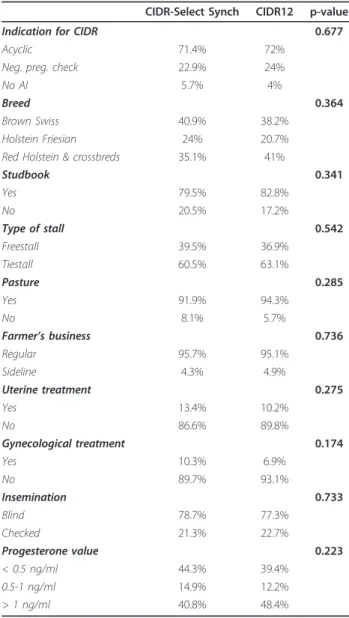
No significant differences (p > 0.1) were found between groups based on: indication for treatment, breed, stud book, type of stall, pasture, farmer’s busi-ness, age of the cows, DIM, number of AI’s before treat-ment, number of cows per farm, yearly milk yield per cow, milk progesterone value, previous treatment of the uterus, previous gynecological treatment, and character-istic of insemination (Tables 1 and 2). When the cows were grouped according to age, previous gynecological or uterine treatment, DIM, and milk amount, no signifi-cant difference was found as to the pregnancy outcome (tested for every variable, without splitting the groups CIDR-Select Synch and 12-d CIDR). There were 78.7% (196/249) of cows in CIDR-Select Synch and 77.3% (157/203) in 12-d CIDR group observed in estrus (P < 0.0001; estrus observed vs. silent heat in both groups). Using the multiple logistic model with the forward selection method, none of the factors exceeded the sig-nificant level except for the factor CIDR.
Discussion
In Swiss dairy farms, synchronization protocols are more often used to treat individual animals than to syn-chronize herds. Fertility treatments have to be econom-ical and practeconom-ical to implement and acceptable to farmers. The CIDR-Select Synch is a viable alternative to the 12-d CIDR protocol because the cows do not need to be handled more frequently. The costs of the additional drugs were expected to be compensated for by the reduction in days open (extending the voluntary
130 25. 6%
132 26. 0%
191 37. 6%
55 10. 8%
neg pos R e s u l t
7 12
CI DR
waiting period costs 10-20 Swiss francs/cow/day (perso-nal communication Berger & Lauener)). Our study revealed a pregnancy rate for the cows in the CIDR-Select Synch group of 50.4% versus 22.4% in the 12-d CIDR group. Chebel et al., (2010) demonstrated that the use of a CIDR insert for 7 days during a TAI protocol increased the proportion of functional CL in anestrus cows after AI and pregnancy/AI compared to protocols without CIDR [17]. Lamb et al. described a better preg-nancy rate in a Cosynch-CIDR protocol compared to Cosynch alone, but only in acyclic cows or cows with a low progesterone level when PGF was administered [18]. The use of exogenous progesterone over a longer period (as described in the Eazy breed™ CIDR® B instruction leaflet) might lead to the ovulatory follicles becoming persistent and to the ovulation of an excessively aged oocyte with a concurrent drop in the pregnancy rate [19]. As a consequence, Swiss practitioners using the 12-d CIDR protocol often skip the CIDR-provoked heat and inseminate cows in the consecutive estrus. The pro-duction of remaining large dominant follicles is inhib-ited by adding GnRH at the beginning of a CIDR protocol, the largest follicles being eliminated by ovula-tion or atresia [20]. GnRH induces a new follicular wave to emerge within 3-4 days after treatment [20]. Admin-istering GnRH at or after insemination, adminAdmin-istering hCG after insemination and supplementing progesterone after insemination have improved reproductive perfor-mance in normal, anoestrus and repeat breeder cows [21-25]. In the present study, no hormonal treatment was allowed around insemination. Perry & Perry (2009) demonstrated that treatment with GnRH at AI following the detection of standing estrus in cattle did not influ-ence conception rates [26].
Milk progesterone was used as a covariable in this study and it was measured at d 0 of treatment. The pregnancy rate was not significantly different among the 3 milk progesterone groups (low/intermediate/high) at the beginning of the protocols. Ryan and coworkers (1995) already described this fact in a study using three
different CIDR protocols [27]. Progesterone levels were, however, only measured at the beginning of our study.
Ryan et al. (1999) describe an increased estrus detec-tion rate and a decreased CIDR loss rate when the pro-gesterone insertion period was decreased from 12 to 8 days [28]. In both our groups, nearly 80% of cows were inseminated at observed estrus. The estrus detection rate might be better in small herds with moderate milk production as is mostly observed in Switzerland. Lucy described the difficulties of heat detection, identification and insemination in large herds and assumed poor estrus expression as being a major problem in dairy farms with high production levels [29]. Conception rates tended to be higher when AI occurred after detected estrus as compared with fixed-time AI. Pregnancy rates
Table 2 Baseline comparison of groups at cow level
CIDR-Select Synch CIDR12 p-value
Indication for CIDR 0.677
Acyclic 71.4% 72%
Neg. preg. check 22.9% 24%
No AI 5.7% 4%
Breed 0.364
Brown Swiss 40.9% 38.2%
Holstein Friesian 24% 20.7%
Red Holstein & crossbreds 35.1% 41%
Studbook 0.341
Yes 79.5% 82.8%
No 20.5% 17.2%
Type of stall 0.542
Freestall 39.5% 36.9%
Tiestall 60.5% 63.1%
Pasture 0.285
Yes 91.9% 94.3%
No 8.1% 5.7%
Farmer’s business 0.736
Regular 95.7% 95.1%
Sideline 4.3% 4.9%
Uterine treatment 0.275
Yes 13.4% 10.2%
No 86.6% 89.8%
Gynecological treatment 0.174
Yes 10.3% 6.9%
No 89.7% 93.1%
Insemination 0.733
Blind 78.7% 77.3%
Checked 21.3% 22.7%
Progesterone value 0.223
< 0.5 ng/ml 44.3% 39.4%
0.5-1 ng/ml 14.9% 12.2%
> 1 ng/ml 40.8% 48.4%
No significant differences were found between the two treatments for the parameters listed (percental distribution).
Table 1 Baseline comparison of groups at farm level
CIDR-Select Synch
CIDR12
p-value
Number of cows 262 246 0.224
Age of cows (years) 5 (4/7 5 (4/6.5) 0.627
DIM 98.5 (71/142) 100 (75/133) 0.709
Number of AI’s 0 (0/1) 0 (0/1) 0.942
Number of cows/farm 24 (18/32) 25 (19/35) 0.224
Yearly milk yield/cow (kg)
7500 (6800/8050) 7300 (6800/ 8300)
0.554
on the other hand, were higher after fixed-time AI when compared with insemination after detected estrus [30].
Conclusions
The CIDR-Select Synch protocol is a valuable and prac-tical alternative to the 12-d CIDR protocol. Reducing the time span of the progesterone insert also means fewer CIDR inserts lost and fewer days open. We were able to demonstrate that in small herds with intensive observation periods to detect estrus, the CIDR-Select Synch protocol produced a pregnancy rate of 50.4% in multiparous dairy cows. The milk progesterone value at the beginning of the protocol did not significantly influ-ence the outcome.
Abbreviations
CIDR: Controlled intravaginal drug release; AI: artificial insemination; COD: cystic ovarian disease; GnRH: Gonadotropine Releasing Hormone; hCG: human chorionic gonadotropin; LH: Luteinizing Hormone; PGF: prostaglandin F; DIM: days in milk; TAI: timed artificial insemination.
Acknowledgements
The authors thank the participating veterinarians and the dairy producers for their support and cooperation.
Author details
1Food Animal Practice Rudolph, CH-6284 Sulz, Switzerland.2Veterinary Physiology, Vetsuisse Faculty, University of Berne, CH-3012 Berne, Switzerland.3Department of Veterinary Clinical Sciences, Washington State University, Pullman, WA 99163, USA.4Clinic for Ruminants, Vetsuisse Faculty, University of Berne, CH-3012 Berne, Switzerland.5Institut of Mathematical Statistics and Actuarial Science, University of Berne, CH-3012 Berne, Switzerland.
Authors’contributions
This study represents the doctoral thesis of JR. JR had the basic idea of performing this study. RB helped with milk progesterone analysis. RK sensitized JR to synchronizing studies and revised the manuscript critically. AS and RK revised the manuscript critically and gave final approval of the version to be published. MK participated in the study design. JH performed the statistical design and analysis including calculating the sample size. GH made substantial contributions to the conception and the design of the study as well as the overall crosslinking. All authors read and approved the final manuscript.
Competing interests
The study was financially supported by Pfizer Animal Health, Zurich, Switzerland and Veterinaria AG, Zurich, Switzerland. Before the beginning of the study, publication of data was bound by contract whatever the results would prove.
Received: 22 June 2011 Accepted: 25 November 2011 Published: 25 November 2011
References
1. Agricultural report 2010.[http://www.blw.admin.ch/dokumentation/00018/ 00498/index.html?lang=en].
2. Changes in size and location US dairy farms.[http://www.ers.usda.gov/ publications/err47/err47b.pdf].
3. Busato A, Minder C, Küpfer U:Importance and seasonal pattern of fertility disorders in 80 Swiss dairy farms.Epidemiol sante anim1997,31-32:5. 4. Garverick HA:Ovarian follicular cysts in dairy cows.J Dairy Sci1997,
80:995-1004.
5. Osawa T, Nakao T, Kimura M, Kaneko K, Takagi H, Moriyoshi M, Kawata K:
Fertirelin and buserelin compared by LH release, milk progesterone and
subsequent reproductive performance in dairy cows treated for follicular cysts.Theriogenology1995,44:835-847.
6. Calder MD, Salfen BE, Bao B, Youngquist RS, Garverick HA:Administration of progesterone to cows with ovarian follicular cysts results in a reduction in mean LH and LH pulse frequency and initiates ovulatory follicular growth.J Anim Sci1999,77:3037-3042.
7. Tebble JE, O’Donnell MJ, Dobson H:Ultrasound diagnosis and treatment outcome of cystic ovaries in cattle.Vet Rec2001,148:411-413. 8. Chebel RC, Santos JE, Cerri RL, Rutigliano HM, Bruno RG:Reproduction in
dairy cows following progesterone insert presynchronization and resynchronization protocols.J Dairy Sci2006,89:4205-4219.
9. Odde KG:A review of synchronization of estrus in postpartum cattle.J Anim Sci1990,68:817-830.
10. Roche JF:Synchronization of estrous in heifers with implants of progesterone.J Reprod Fertil1974,41:337-344.
11. Lane EA, Austin EJ, Crowe MA:Estrous sychronisation in cattle-Current options following the EU regulation restricting use of oestrogenic compounds in food-producing animals: A review.Anim Reprod Sci2008,
109:1-16.
12. Adams GP, Jaiswal R, Singh J, Malhi P:Progress in understanding ovarian follicular dynamics in cattle.Theriogenology2008,69:72-80.
13. Crane MB, Bartolome J, Melendez P, de Vries A, Risco C, Archbald LF:
Comparison of synchronization of ovulation with timed insemination and exogenous progesterone as therapeutic strategies for ovarian cysts in lactating dairy cows.Theriogenology2006,65:1563-1574.
14. Thatcher WW, Moreira F, Pancarci SM, Bartolome JA, Santos JE:Strategies to optimize reproductive efficiency by regulation of ovarian function.
Domest Anim Endocrinol2002,23(1-2):243-254.
15. El-Zarkouny SZ, Cartmill JA, Hensley BA, Stevenson JS:Pregnancy in dairy cows after synchronized ovulation regimens with or without presynchronization and progesterone.J Dairy Sci2004,87:1024-1037. 16. Meyer HHD, Güven B, Karg H:Enzymimmuntest (EIA) auf Mikrotiterplatten
zur Progesteronbestimmung in Magermilchproben.Wien Tierärztl Mschr 1986,73:86-94.
17. Chebel RC, Al-Hassan MJ, Fricke PM, Santos JE, Lima JR, Martel CA, Stevenson JS, Garcia R, Ax RL:Supplementation of progesterone via controlled internal drug release inserts during ovulation synchronization protocols in lactating dairy cows.J Dairy Sci2010,93:922-931.
18. Lamb GC, Stevenson JS, Kesler DJ, Gaverick HA, Brown DR, Salfen BE:
Inclusion of an intravaginal progesterone insert plus GnRH and prostaglandin F2alpha for ovulation control in postpartum suckled beef cows.J Anim Sci2001,79:2253-2259.
19. Mihm M, Baguisi A, Boland MP, Roche JF:Association between the duration of dominance of the ovulatory follicle and pregnancy rate in beef heifers.J Reprod Fertil1994,102:123-130.
20. Twagiramungu H, Guilbault LA, Dufour JJ:Synchronization of follicular waves with a gonadotropin-releasing hormone agonist to increase the precision of estrus in cattle: a review.J Anim Sci1995,73:3141-3151. 21. Howard JM, Manzo R, Dalton JC, Frago F, Ahmadzadeh A:Conception
rates and serum progesterone concentration in dairy cattle administered gonadotrophin releasing hormone 5 days after artificial insemination.Anim Reprod Sci2006,95:224-233.
22. Stevenson JS, Portaluppi MA, Tenhouse DE, Lloyd A, Eborn DR, Kacuba S, DeJarnette JM:Interventions after artificial insemination: conception rates, pregnancy survival, and ovarian responses to gonadotropin-releasing hormone, human chorionic gonadotropin, and progesterone.J Dairy Sci2007,90:331-340.
23. Thuemmel AE, Gwazdauskas FC, Whittier WD, McGilliard ML:Effect of progesterone supplementation in repeat-breeder cattle on conception and plasma progesterone.Endocrinol Invest1992,15:393-396.
24. Son DS, Choe CY, Cho SR, Choi SH, Kim HJ, Hur TY, Jung YG, Kang HG, Kim IH:A CIDR-based timed embryo transfer protocol increases the pregnancy rate of lactating repeat breeder dairy cows.J Reprod Dev 2007,53:1313-1318.
25. Kim UH, Suh GH, Hur TY, Kang SJ, Kang HG, Park SB, Kim HS, Kim IH:
Comparison of two types of CIDR-based timed artificial insemination protocols for repeat breeder dairy cows.J Reprod Dev2007,53:639-645. 26. Perry GA, Perry BL:GnRH treatment at artificial insemination in beef
27. Ryan DP, Snijders S, Yaakub H, O’Farrell KJ:An evaluation of estrus synchronization programs in reproductive management of dairy herds.J Anim Sci1995,73:3687-3695.
28. Ryan DP, Galvin JA, O’Farrell KJ:Comparison of oestrous synchronization regimens for lactating dairy cows.Anim Reprod Sci1999,56:153-168. 29. Lucy MC:Reproductive loss in high-producing dairy cattle: Where will it
end?J Dai Sci2001,84:1277-1293.
30. Stevenson JS, Kobayashi Y, Thompson KE:Reproductive performance of dairy cows in various programmed breeding systems including OvSynch and combinations of Gonadotropin-Releasing Hormone and
Prostaglandin F.J Dai Sci1999,82:505-515.
doi:10.1186/1477-7827-9-151
Cite this article as:Rudolphet al.:Comparison of the effect of a
CIDR-Select Synch versus a long-term CIDR based AI protocol on reproductive performance in multiparous dairy cows in Swiss dairy farms.Reproductive Biology and Endocrinology20119:151.
Submit your next manuscript to BioMed Central and take full advantage of:
• Convenient online submission
• Thorough peer review
• No space constraints or color figure charges
• Immediate publication on acceptance
• Inclusion in PubMed, CAS, Scopus and Google Scholar
• Research which is freely available for redistribution