UDC 330.322.658
S. V. МYAMLIN
1, K. V. ZHYZHKO
2*1
Dep. «Cars and Car Facilities», Dnipropetrovsk National University of Railway Transport named after Academician V. Lazaryan, Lazaryan St., 2, Dnipropetrovsk, Ukraine, 49010, tel./fax +38 (0562) 47 18 66, e-mail [email protected], ORCID 0000-0002-7383-9304
2*
Dep. «Economics and Management», Dnipropetrovsk National University of Railway Transport named after Academician V. Lazaryan, Lazaryan St., 2, Dnipropetrovsk, Ukraine, 49010, tel./fax +38 (0562) 47 18 66, e-mail [email protected], ORCID 0000-0001-5103-5738
UPGRADING OF ECONOMIC SIMULATION METHODS
FOR INCREASING EFFICIENCY OF INVESTMENTS
Purpose. The main aim of research is improving the investments effectiveness during the development both specific industrial enterprises and economic sectors as whole. Methodology. Through the use of analysis and synthesis methods, as well as methods of mathematical and economic modeling, the authors managed to improve methodological approaches to assessment the performance of the investments effectiveness. Findings. Efficient mechanism for estimation rational level of the investments usage depending on major factors was created and tested. The approach allows defining rational correlation between basic components of investment process (revenue growth, investment volume and time of investment project implementation). Originality. Authors have developed the new economic and mathematical approach with aim of rational distribution of financial resources during the period of capital deficit. This approach is based on solving the problem of vector optimization with the use of set function. Application of proposed approach is up-to-date because of unstable economic situation in Ukraine. Practical value. Using economic and mathematical approach, one can define the rational options of investments during development both single enterprise and the overall branches of economics. The developed instrument of rational options determination in investments usage considerably simplifies process of making decision for perspective investor. It minimizes many options of investments up to several more promising investments that enable to ensure the maximum effect to their owners. Developed approach also can be used in forming process of principles of highly efficient national economy.
Keywords: rational investment; set function; vector optimization; revenue growth; investments volume; time of project implementation; highly efficient national economy
Introduction
One of the ways of increase the economy
effectiveness on the whole and individual
enterprise in particular is considered to be
investing, namely special purpose funding of
enterprises in certain sectors of the economy that
are usually associated with technical and
technological re-equipment of the enterprise or the
expansion of production capacity.
In this case, there is always a problem related to
the more efficient use of investment. The necessity
and importance of investments in the real sector of
the economy is explained that it facilitates the
acceleration of pace of development in the
productive sphere. But the assessment of
investments effectiveness is a complex of scientific
and applied issues. Its solution is connected with a
number of additional studies, including the
consideration
of
possible
options
for
the
implementation of investment procedures and the
maximum effect achievement. Therefore, the
current line of research is related to the
improvement of the theoretical foundations of
rational use of investment.
Recent research analysis
Shelobaev S. I., Monakhov A. V., Bosov A. A. and
others. At the same time a part of the work reveals
the general nature and features of simulation use in
applied problems of economics [3-5]. And another
part of the research is devoted to the use of
economic and mathematical methods and relevant
mathematical models [7-9, 11, 14-16]. It is also
important an opportunity to use the developments,
obtained by the authors during the analysis and
improvement of the main provisions of «high
national
economics».
This
is
discussed
increasingly by different reputable scientists in
recent years. [12-13]. At this there is a lack of
developments, which would give the possibility to
connect the main components of the investment
process and help to choose the best alternative use
of investments.
Purpose
Development of economic and mathematical
approach for determining the optimal ratio between
the components of the investment process -
investments volume, profit margins and the
implementation time of certain projects, the choice
of the most appropriate and effective option for
their use.
Methodology
The formation of economic and mathematical
approach is proposed to realize with the set
function usage that gives an opportunity for the
formulation and solution the problem of vector
optimization
regarding
the
assessment
of
investments objects effectiveness. In this case, the
objects will be considered as independent one, i. e.
projects financing on one of the objects does not
affect the results of financing and implementation
period for other objects.
Next we describe the
efficient
algorithm
for
object
of
rational
investments usage in independent objects or
independent lines of activities.
When forming the
mathematical description of the proposed approach
one should use basic mathematical expressions and
dependences [2, 10].
Findings
Then
the
algorithm
of
forming
the
mathematical part of the proposed economic and
mathematical
approach
was
described
consecutively.
The
n
objects is considered (factories,
workshops, farms, etc.) and for each object the list
of projects is indicated for its improvement
Q
i,
1,
i
n
is indicated.
The project
w
ij, which belongs to the list
Q
i, is
characterized with three indicators
с
ij
volume of
costs for project implementation
w
ij,
t
ijis the time
of project implementation
w
ij,
b
ij
revenue growth
after the project implementation.
Key assumptions:
1.
Economic
activities
of
objects
is
independent;
2.
Project
w
ijis implemented regardless of
other projects from the list
Q
i.Let’s introduce the list:
V V
1,
2,...
V
n
,
where
V
i
Q
i,
i
=
1
,
n
.
The list γ informs which projects will be
implemented on the relevant objects.
We will enter the list γ three relevant numbers:
1
( )
in
i w V
B
b w
total revenue growth on n
objects;
С
(γ) =
1( )
i
n
i w V
c w
the total investments
volume for the implementation γ.
Т
(γ) =
n i 1max
i V wmax
implementation time of
projects (program γ).
Let’s denote through
Г
many possible option
programs γ. It is obvious that
Г
is discrete set that
contains:
Qi n iП
Г
2
1
.
Various γ, where |
Q
i| is a number of projects on
i
-object.
We are considering vector optimization
problem:
( )
min
( )
В
С
(1)
Providing, that γ
Г
.
We enter the Lagrange function, which is equal
to:
L
B
C
,
where
0
, is Lagrange undetermined
multiplier. We are remarking, that
L
is multi-factor
function set, namely
1,
2,...
n
L
F V V
V
.
And the problem is considered with definition
such
V
*i,
i
=
1
,
n
, that when fixed
Lagrange
function would be minimal.
To solve this problem we use the necessary
condition (1).
i
n
L
i ij V w B i,
1
;
0
*
(2)
In ration (2) partial derivative is described with
respect to measure on sequence
B, which tends to
wij
.
In our case we obtain:
*0
ij i ij ij
B w V
L
B
C
.
From this we obtain, that set
V
*idepends on
and the result:
*:
ij,
1,
i ij i
ij
B
V
w
Q
i
n
C
(3)
Thus, if the lists of projects from
Q
iare ordered
by ratio (described by it):
1 1 ij ij ij ij
B
B
C
C
,
j
1,|Q | 1
i
,
We determine such
j
at given
, that
ij
ij
B
C
,
1 1 ij ijB
C
.
This value
j
will be a record
j
.
And then
*:
1,
;
1,
i ij
V
w
j
j
i
n
(4)
It let determine
( )
V
1*( ),
V
2*( ),...
V
n*( )
program ( )
and accordingly all components of
investment process:
,
,
,
B
C
T
,
sorting
0
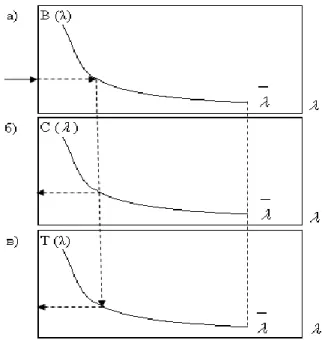
, we have an opportunity to construct
dependences accordingly, which are presented in
fig. 1 and fig. 2.
Fig. 1 shows an algorithm for solving the
problem (1)
for a given investments volumes and
obtaining a corresponding increase of revenue and
time of the program realization ( )
.
Findings and practical value
They all combined in to the vector of events
number accordingly workshops. The matrix C is a
matrix of project costs in each workshop, T is a
matrix of time expenditure on implementation of
each project; B is matrix of revenue growth in the
workshops in accordance with the implementation
of projects. Principal dependences between the
parameters of the investment process are presented
in fig. 1 and fig. 2. They allow estimating the
effectiveness of investments, depending on the
selected financing algorithm. Next we present a
fragment of a software implementation for the
example, which is considered:
,
, ,
, , ,
1
t=
3 [
[
w
]
,
,
,
,
]
,1 1
[ ] [ ] [ ] [ ]
1 3 7
,
, ,
, , ,
2
t=
2 [
[
w
,
]
,
,
,
,
]
,1 1
w
1 2,[ ] [ ] [ ] [ ]
4 9 12
,
, ,
, ,
,
3
t=
9
5
[
[
w
1 1,,
w
1 2,,
w
1 3,]
,
[ ] [ ] [ ] [ ]
,
,
,
]
9 18 15
,
, ,
,
,
,
4
t=
7
4
[
[
w
1 1,,
w
1 2,,
w
1 3,]
,
[
w
2 1,]
,
[ ] [ ] [ ]
,
,
]
13 25 19
,
, ,
,
,
,
5
t=
3
2
[
[
w
1 1,,
w
1 2,,
w
1 3,]
,
[
w
2 1,]
,
[ ] [ ] [
,
,
w
5 1,]
]
15 28 24
,
,
,
,
,
,
6
t=
10
7
[
[
w
1 1,,
w
1 2,,
w
1 3,]
,
[
w
2 1,,
w
2 2,]
,
[ ] [ ] [
,
,
w
5 1,]
]
22 38 26
,
, ,
,
,
,
7
t=
5
4
[
[
w
1 1,,
w
1 2,,
w
1 3,]
,
[
w
2 1,,
w
2 2,]
,
[
w
3 1,]
,
[ ] [
,
w
5 1,]
]
30 48 32
,
,
,
,
,
,
8
t=
20
17
[
[
w
1 1,,
w
1 2,,
w
1 3,]
,
[
w
2 1,,
w
2 2,]
,
[
w
3 1,]
,
[
w
4 1,]
,
[
w
5 1,]
]
47 68 33.7
Fig. 1. Determination algorithm for the volumeof revenues and realization time for a given volume of investments, where the dependence of
the total revenue growth (a), the total volume of investments (b) and the projects realization time
(c) on the change of Lagrange multiplier
Fig. 2. Determination algorithm for the necessary investments and realization time for a given volume of revenue growth, where a), b), c) are the
dependences of the total volume of revenue, volume of investments and realization time
,
,
,
,
,
,
9
t=
11
10
[
[
w
1 1,,
w
1 2,,
w
1 3,]
,
[
w
2 1,,
w
2 2,]
,
[
w
3 1,,
w
3 2,]
,
[
w
4 1,]
,
[
w
5 1,]
]
57 79 37.7
10
,
t=
, ,
1 [
[
w
1 1,,
w
1 2,,
w
1 3,]
,
[
w
2 1,,
w
2 2,]
,
[
w
3 1,,
w
3 2,,
w
3 3,]
,
[
w
4 1,]
,
[
w
5 1,,
w
5 2,]
]
,
68
,
90 44.2
,
11
t=
7
9
[
[
w
1 1,,
w
1 2,,
w
1 3,]
,
[
w
2 1,,
w
2 2,]
,
[
w
3 1,,
w
3 2,,
w
3 3,]
,
[
w
4 1,]
,
[
w
5 1,,
w
5 2,,
w
5 3,]
]
,
, ,
,
77 97 46.3
,
,
12
t=
11
15
,
,
,
[
[
w
1 1,,
w
1 2,,
w
1 3,]
,
[
w
2 1,,
w
2 2,]
,
[
w
3 1,,
w
3 2,,
w
3 3,]
,
[
w
4 1,]
,
[
w
5 1,,
w
5 2,,
w
5 3,,
w
5 4,]
]
,
92 108 47.8
,
,
13
t=
13
20
[
[
w
1 1,,
w
1 2,,
w
1 3,]
,
[
w
2 1,,
w
2 2,]
,
[
w
3 1,,
w
3 2,,
w
3 3,,
w
3 4,]
,
[
w
4 1,]
,
,
,
,
[
w
,
,
,
]
,5 1
w
5 2,w
5 3,w
5 4,] 112 121 50.8
,
,
,
14
t=
3
10
[
[
w
1 1,,
w
1 2,,
w
1 3,]
,
[
w
2 1,,
w
2 2,]
,
[
w
3 1,,
w
3 2,,
w
3 3,,
w
3 4,,
w
3 5,]
,
[
w
4 1,]
,
,
,
,
[
w
,
,
,
]
,5 1
w
5 2,w
5 3,w
5 4,] 162 136 53.3
,
,
,
:=
nn
14
14 options for possible investments usage were
obtained; from them the most appropriate one is
defined programmatically on the optimality
criterion. Thus, the main objective of the study to
improve the assessment method of investments
rational usage was achieved.
It is also possible to use the proposed algorithm
to determine correlation only two out of the three
main components of investment activity, for
example by type of two-parameter optimization
[1]. But the proposed economic and mathematical
approach enables to solve such problem by fixing
the numerical value of one out of the three
components and the variation of the two others. It
allows us to consider various options for the
investments usage and choose the most appropriate
one based on the condition in view.
Conclusions
Thus, an original economic and mathematical
approach to the assessment of the rational
investments usage in the form of formulating and
solving the problem of vector optimization of the
total investments ratio, the total volume of revenue
(income) and the implementation time of funded
projects was proposed. In order to conduct
theoretical studies on the rational use of
investments the authors have developed the
relevant computation program. The result is an
effective economic and mathematical apparatus for
analysis
implementation
of
investment
performance.
LIST OF REFERENCE LINKS
1. Босов, А. А. Векторная оптимизация по двум показателям / А. А. Босов, Г. Н. Кодола, Л. Н. Савченко // Вісн. Дніпропетр. нац. ун-ту залізн. трансп. ім. акад. Лазаряна. – Дніпропетровськ, 2007. – Вип. 17. – С. 134–138.
2. Ван дер Варден, Б. Л. Алгебра / Б. Л. Ван дер Варден. – Москва : Наука, 1976. – 648 с.
3.Вітлінський, В. В. Моделювання економіки : навч.-метод. посіб. для самост. вивч. дисц. / В. В. Вітлінський, Г. І. Великоіваненко. – Київ : КНЕУ, 2005. – 306 с.
4.Лугінін, О. Є. Економіко-математичне моделювання : навч. посіб. / О. Є. Лугінін, В. М. Фомішина. – Київ : Знання, 2011. – 342 с.
5. Макроекономічне моделювання та короткострокове прогнозування : за ред. І. В. Крючкової. – Харків : Форт, 2007 – 488 с.
6. Матросов, А. В. Maple 6. Решение задач высшей математики и механики / А. В. Матросов. – Санкт-Петербург : БХВ-Петербург, 2001. – 528 с.
8. Монахов, А. В. Математические методы анализа экономики / А. В. Монахов. – Санкт-Петербург : Пітер, 2002. – 101 с.
9. Мямлин, С. В. Теоретические основы оценки рационального использования инвестиций / С. В. Мямлин, К. В. Жижко, В. А. Федорова // Зб. наук. пр. Придніпров. держ. акад. буд-ва та арх-ри «Економічний простір». – Дніпропетровськ, 2012. – Вип. 61. – С. 212–219.
10. Ногин, В. Д. Принятие решений в многокритериальной среде: количественный подход / В. Д. Ногин. – Москва : ФИЗМАТЛИТ, 2002. – 144 с.
11. Пинегина, М. В. Математические методы и модели в экономике / М. В. Пинегина. – Москва : Экзамен, 2002. – 127 с.
12. Пшинько, А. Н. Влияние скорости обращения денежной массы на эффективность национальной экономики / А. Н. Пшинько, В. В. Мямлин, С. В. Мямлин // Вісн. Дніпропетр. нац. ун-ту залізн. трансп. ім. акад. В. Лазаряна. – Дніпропетровськ, 2012. – Вип. 42. – С. 292–299.
13. Пшинько, А. Н. К вопросу о научной обоснованности процентов по депозитам и кредитам
/ А. Н. Пшинько, В. В. Мямлин, С. В. Мямлин // Наука та прогрес транспорту. Вісн. Дніпропетр. нац. ун-ту залізн. трансп. – 2013. – № 1 (43). – С. 82–103.
14. Свідоцтво про реєстрацію авторського права на твір № 43911. Економіко-математичний підхід до оцінки раціонального використання інвестицій / С. В. Мямлін, К. В. Жижко ; зареєстр. 21.05.2012.
15.Шелобаев, С. И. Математические методы и модели в экономике, финансах, бизнесе : учеб. пособие для вузов / С. И. Шелобаев. – Москва : ЮНИТИ – ДАНА, 2000. – 367 с.
16. Шикін, Є. В. Математичні методи і моделі в управлінні : навч. посіб. / Є. В. Шикин, А. Г. Чхартішвілі. – Москва : Справа, 2000. – 439 с.
17. Aliyev, A. G. Economic-Mathematical Methods and Models under Uncertainty. – New Jersey : Apple Academic Press, 2013. – 302 p. doi : 10.1201/b16301.
18. Mikulás, L. Mathematical Optimization and Economic Analysis: Series: Springer Optimization and Its Applications / L. Mikulás. – New York : Springer, 2010. – Vol. 36. – 294 p. doi: 10.1007/978-0-387-89552-9.
С. В. МЯМЛІН
1, К. В. ЖИЖКО
2*1Каф. «Вагони та вагонне господарство», Дніпропетровський національний університет залізничного транспорту імені академіка В. Лазаряна, вул. Лазаряна, 2, Дніпропетровськ, Україна 49010, тел./факс +38 (0562) 47 18 66, ел. пошта [email protected], ORCID 0000-0002-7383-9304
2*Каф. «Економіка та менеджмент», Дніпропетровський національний університет залізничного транспорту імені академіка В. Лазаряна, вул. Лазаряна, 2, Дніпропетровськ, Україна 49010, тел./факс +38 (0562) 47 18 66, ел. пошта [email protected], ORCID 0000-0001-5103-5738
УДОСКОНАЛЕННЯ МЕТОДІВ ЕКОНОМІЧНОГО МОДЕЛЮВАННЯ
ДЛЯ
ПІДВИЩЕННЯ
ЕФЕКТИВНОСТІ
ВИКОРИСТАННЯ
ІНВЕСТИЦІЙ
Розроблений підхід також може бути використаний у процесі формування основ моделі високоефективної національної економіки.
Ключові слова: раціональне інвестування; функції множин; векторна оптимізація; приріст виручки; обсяг інвестицій; час реалізації проекту; високоефективна національна економіка
С. В. МЯМЛИН
1, К. В. ЖИЖКО
2*1Каф. «Вагоны и вагонное хозяйство», Днепропетровский национальный университет железнодорожного транспорта имени академика В. Лазаряна, ул. Лазаряна, 2, Днепропетровск, Украина, 49010, тел./факс +38 (0562) 47 18 66, эл. почта [email protected], ORCID 0000-0002-7383-9304
2*Каф. «Экономика и менеджмент», Днепропетровский национальный университет железнодорожного транспорта имени академика В. Лазаряна, ул. Лазаряна, 2, Днепропетровск, Украина, 49010, тел./факс +38 (0562) 47 18 66, эл. почта [email protected], ORCID 0000-0001-5103-5738
СОВЕРШЕНСТВОВАНИЕ
МЕТОДОВ
ЭКОНОМИЧЕСКОГО
МОДЕЛИРОВАНИЯ
ДЛЯ
ПОВЫШЕНИЯ
ЭФФЕКТИВНОСТИ
ИСПОЛЬЗОВАНИЯ ИНВЕСТИЦИЙ
Цель. Основной целью исследования, проведенного в данной работе, является повышение эффективности инвестиций при развитии, как конкретных предприятий промышленности, так и отраслей экономики в целом. Методика. С помощью использования методов анализа и синтеза, а также методов математико-экономического моделирования, авторам удалось усовершенствовать методические подходы к оценке показателей эффективности использования инвестиций. Результаты. В результате был создан и апробирован действенный механизм, который может применяться для оценки степени рациональности использования инвестиционных средств в зависимости от основных факторов. Это позволяет определить рациональное соотношение между основными составляющими инвестиционного процесса, а именно: приростом выручки, объемом инвестиций и временем реализации инвестиционного проекта. Научная новизна. С целью рационального распределения финансовых ресурсов в период дефицита капитала авторами разработан экономико-математический подход, в основу которого было положено решение задачи векторной оптимизации с использованием функции множеств. Применение данного подхода особенно актуально ввиду нестабильной экономической ситуации, в которой сегодня оказалась Украина. Практическая значимость. В результате использования разработанного авторами экономико-математического подхода можно определить рациональные варианты использования инвестиций при развитии, как отдельных предприятий, так и целых отраслей экономики. Разработанный инструмент определения рациональных вариантов использования инвестиций значительно упрощает процесс принятия решения для потенциального инвестора. Он позволяет сократить множество вариантов вложения инвестиционных средств до нескольких наиболее перспективных инвест-проектов, которые способны принести их владельцу максимальный эффект. Разработанный подход также может быть использован в процессе формировании основ модели высокоэффективной национальной экономики.
Ключевые слова: рациональное инвестирование; функции множеств; векторная оптимизация; прирост выручки; объем инвестиций; время реализации проекта; высокоэффективная национальная экономика.
REFERENCES
1.Bosov A.A., Kodola G.N., Savchenko L.N. Vektornaya optimizatsiya po dvum pokazatelyam [Vector optimization for two indicators]. Vіsnyk Dnіpropetrovskoho natsionalnoho universytetu zalіznychnoho transportu іmeni akademika V. Lazaryana [Bulletin of Dnipropetrovsk National University of Railway Transport named after Academician V. Lazaryan], 2007, issue 17, pp. 134-138.
2.Van der Varden B. L. Algebra [Algebra]. Moscow, Nauka Publ., 1976. 648 p.
3.Vitlinskyi V.V., Velykoivanenko H.I. Modeliuvannia ekonomiky [Modeling of economics]. Kyiv, KNEU Publ., 2005. 306 p.
5.Kriuchkova I.V. Makroekonomichne modeliuvannia ta korotkostrokove prohnozuvannia [Macroeconomic modeling and short–term forecasting]. Kharkiv, Fort Publ., 2007. 488 p.
6.Matrosov A.V. Maple 6. Resheniye zadach vysshey matematiki i mekhaniki [Maple 6. Solving the tasks of Higher Mathematics and Mechanics]. Sankt-Peterburg, BKhV-Peterburg Publ., 2001. 528 p.
7.Miksiuk S.F., Komkova V.M. Ekonomiko-matematychni metody i modeli [Economic and mathematic methods and models]. Mynsk, BHEU Publ., 2006. 220 p.
8.Monakhov A.V. Matematicheskiye metody analiza ekonomiki. Seriia «Korotkyi kurs» [Mathematical methods of economics analysis. Series «Short course»]. Sankt-Peterburhm, Piter Publ., 2002. – 101 p. 9.Myamlin S.V., Zhizhko K.V., Fedorova V.A. Teoreticheskiye osnovy otsenki ratsionalnogo ispolzovaniya
investitsiy [Theoretical bases of estimation of the rational use of investments]. Zbirnyk naukovykh prats Pridnіprovskoi derzhavnoi akademіi budіvnitstva ta arkhіtekturi «Ekonomіchnyi prostіr» [Proc. of Prydniprovsk State Academy of Construction and Architecture «Economic Space»], 2012, issue 61, pp. 212-219.
10. Nogin V.D. Prinyatiye resheniy v mnogokriterialnoy srede: kolichestvennyy podkhod [Decision-making in multi-criterion environment: a quantitative approach]. Moscow, FIZMATLIT Publ., 2002. 144 p.
11. Pinegina M.V. Matematicheskiye metody i modeli v ekonomike [Mathematic methods and models in economics]. Moscow, Ekzamen Publ., 2002. 127 p.
12. Pshinko A.N., Myamlin V.V., Myamlin S.V. Vliyaniye skorosti obrashcheniya denezhnoy massy na effektivnost natsionalnoy ekonomiki [Influence of the speed of money supply circulation on the efficiency of the national economics]. Vіsnyk Dnіpropetrovskoho natsionalnoho universytetu zalіznychnoho transportu іmeni akademika V. Lazaryana [Bulletin of Dnipropetrovsk National University of Railway Transport named after Academician V. Lazaryan], 2012, issue 42, pp. 292-299.
13. Pshinko A.N., Myamlin S.V. K voprosu o nauchnoy obosnovannosti protsentov po depozitam i kreditam [On the issue of the scientific validity of deposits and credits interests]. Nauka ta prohres transportu. Visnyk Dnipropetrovskoho natsionalnoho universytetu zaliznychnoho transportu − Science and Transport Progress. Bulletin of Dnipropetrovsk National University of Railway Transport, 2013, no. 1 (43), pp. 82-103.
14. Miamlin S.V., Zhyzhko K.V. Svidotstvo pro reiestratsiiu avtorskoho prava na tvir. Ekonomiko-matematychnyi pidkhid do otsinky ratsionalnoho vykorystannia investytsii [Certificate of copyright registration on the invention. Economic and mathematic approach to the estimation of rational use of investments], no. 43911, 2012.
15. Shelobayev S.I. Matematicheskiye metody i modeli v ekonomike, finansakh, biznese [Mathematic methods and models in economics, finance and business]. Moscow, YuNITI – DANA Publ., 2000. 367 p.
16. Shykyn Ye.V., Chkhartishvili A.H. Matematychni metody i modeli v upravlinni [Mathematic methods and models in management]. Moscow, Sprava Publ., 2000. 439 p.
17. Aliyev A.G. Economic-Mathematical Methods and Models under Uncertainty. New Jersey, Apple Academic Press Publ., 2013. 302 p. doi: 10.1201/b16301.
18. Mikulás Luptácik. Mathematical Optimization and Economic Analysis: Series: Springer Optimization and Its Applications. New York, Springer Publ., 2010, vol. 36. 294 p. doi: 10.1007/978-0-387-89552-9.