Address for correspondence
Dr. Nadia Ali Azfar, Associate Professor, Department of Dermatology, Unit 1 Allama Iqbal Medical College/ Jinnah Hospital, Lahore Email: [email protected]
Original Article
Exposure of dermatology postgraduate trainees to
different learning resources and procedural skills in
Pakistan
Introduction
Dermatology as a specialty has developed considerably over the last two decades.1The number of postgraduate trainees has greatly increased over the last few years. The recently increased interest in this specialty by the new residents is attributed to the greater diversity and opening of newer avenues of dermatosurgery, dermatopathology and aesthetic dermatology in
the recent years.2
Today there are an estimated 40 dermatology units recognized for training in FCPS, MCPS and MD dermatology all over Pakistan. Maintaining uniform standards in dermatology training is of utmost importance to produce properly trained specialists and consultants who can even accept cross-border challenges in dermatology.3
This present study was undertaken to observe the exposure of postgraduate students to various teaching and training methods in various teaching departments of the country and to come Nadia Ali Azfar, Lamees Mahmood Malik, Sana Aslam, Muhammad Jahangir, Tariq Rashid Department of Dermatology, Allama Iqbal Medical College/Jinnah Hospital, Lahore
Abstract Objective To determine the learning resources and procedures used for dermatology postgraduate training in Pakistan.
Methods Trainees from different centers accredited for dermatology postgraduate training in Pakistan were approached. A pre-designed proforma was filled by 100 dermatology trainees of FCPS, MCPS and MD programs.
Results Hundred percent trainees followed Rook’s Textbook of Dermatology as a major learning resource. The most commonly read journal was Journal of American Academy of Dermatology. Scientific conferences had been attended by less than 50% students. Most of the students were participating in clinical case discussions, while clinical slide sessions and histopathology sessions were not being attended by all. Most commonly learnt diagnostic procedure was fungal scraping (92%), least common was immunofluorescence (16%). Out of various therapeutic procedures, electrocautery was being performed by 100% students while dermal fillers and botox injections by none.
Conclusion There is a wide variation in exposure of dermatology residents to various learning resources and procedural skills across different teaching units of the country. The most lacking part of training highlighted in this study is the aesthetic or cosmetic aspects of dermatology.
Key words
up with suggestions regarding improvement and uniformity in this regard.
Methods
This cross-sectional survey was carried out in the year 2015. A predesigned proforma was filled by 100 dermatology trainees from different centers accredited for dermatology training all over Pakistan. Data were collected regarding reference books and journals, teaching clinical practices, as well as, diagnostic and procedural skills. The results were tabulated, percentages of responses were obtained and data was later analyzed by using SPSS version13.
Results
A total of hundred trainees filled and returned the proforma. The female to male ratio was 6:1. Sixty three respondents were fulfilling their requirement for FCPS, twenty six for MCPS while eleven were MD trainees.
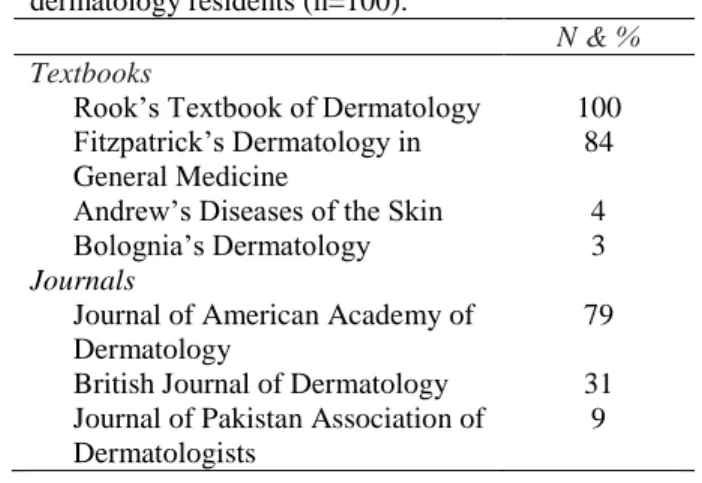
The most frequently consulted textbook was Rook’s Textbook of Dermatology (100%). The second commonly followed textbook was Fitzpatrick’s Dermatology in General Medicine (84%). Andrew‘s Diseases of the Skin and Bolognia’s Dermatology were followed by less than 5% students each (Table 1).
Regarding journals, 79% postgraduate students read the Journal of American Academy of Dermatology and 31% British Journal of Dermatology. Less than 10% consulted Journal of Pakistan Association of Dermatologists (Table 1).
Multimedia was being used in the department of 70% of trainees, while multi head teaching microscope for histopathology was available in the departments of 30% trainees.
Table 1 Textbooks / journals followed by dermatology residents (n=100).
N & % Textbooks
Rook’s Textbook of Dermatology 100 Fitzpatrick’s Dermatology in
General Medicine
84 Andrew’s Diseases of the Skin 4
Bolognia’s Dermatology 3
Journals
Journal of American Academy of Dermatology
79 British Journal of Dermatology 31 Journal of Pakistan Association of
Dermatologists
9
Table 2 Therapeutic / diagnostic procedures learnt by dermatology residents (n=100).
N & % Diagnostic procedures
Fungal scraping 92
Scrapping for scabies mite 89
Tzanck test 88
Skin biopsies 84
Dermatoscopy 42
Patch test 37
Immunofluorescence 16
Therapeutic procedures
Electrocautry 100
Cryotherapy 92
Intralesional injections 90
LASER 74
Chemical peeling 73
Intense pulsed light 56
Shave excision for moles 49
Iontophoresis 36
Phototherapy 35
National conferences had been attended by 32 students while International conferences by only 3 students. Only twenty-one residents had presented scientific papers in conferences, nineteen on national forum, while only two on international forums. Out of 100 students two had scientific publications.
Diagnostic procedures like fungal scraping were taught to 92% trainees, skin biopsies were being performed by 84%. Other commonly performed procedures were scraping for scabies mite 89%, Tzanck test 88%, and smear for Leishman-Donovan bodies 75%. Less common were dermatoscopy 42%, patch test for contact dermatitis 37% and immunofluorescence only 16% (Table 2).
Therapeutic procedures such as cryotherapy and electrocautery had been performed by 92% and 100% trainees, respectively. 90% students had learnt and given intralesional injections. Less commonly taught procedures were chemical peels for melasma 73%, shave excision for mole removal 49%, iontophoresis for hyperhidrosis 36%. Phototherapy was being performed by 35% trainees.
Fifty-six percent trainees had exposure in their departments to intense pulse light (IPL) and 74% to LASER for various skin problems (Table 2).
No trainee had the opportunity to gain skill in cosmetic procedures such as dermal fillers and botox injections in their departments. A small percentage of students (9%) had observed these cosmetic procedures in workshops and conferences but none had the opportunity of hands on training.
Discussion
The current study is an effort to observe the variations in learning resources and procedural skills used in postgraduate dermatology training in different teaching units of Pakistan. Although we have tried to include trainees from all over Pakistan, we are aware that it may not fully represent the situation of the whole country.
The results showed certain differences in the exposure of trainees to different teaching aids, availability of resources, research projects and
procedural expertise.
Our results showed the most commonly read book was Rook’s textbook of Dermatology. This was different from an American study4 and a Saudi Arabian study5 which showed that Fitzpatrick’s dermatology was the most common book followed. In our study the most commonly read journal was Journal of American Academy of Dermatology, this was in accordance with the study of Al Ghamdi.5 He also reported 100% residents participated in journal club, while in our study there was 80% participation.
21% trainees had presented a scientific paper in a national or international conference and 2% had a research publication to their credit. Although research projects are a mandatory part of certain postgraduate programs, scientific papers and presentations are deficient. The issue of research during residency training has been addressed in different specialties.6In a study by Wagneret al.7 it was noted that encouraging publication of student’s research project during training proved extremely beneficial.
Regarding teaching and therapeutic equipment availability, it was alarming to note that multimedia was not being used for presentations by 30% trainees. Today’s world demands that students who are the future teachers and trainers, should be well-versed with such teaching aids.
Histopathology was not being made a part of training in nearly 30% students, although it is a compulsory component of the FCPS exam. Only
16% candidates had exposure to
different frequency. In a survey by Lee et al.8 on residents in USA, most were receiving adequate training in procedures. For standardization of training all these procedures need to be taught on a regular basis in all our teaching departments.
The most lacking part of training programs highlighted in this study is the deficiency of training in the aesthetic or cosmetic aspects of dermatology. Only 4% trainees had ever observed a botox or filler injection in their department. Friemanet al.9 in a study carried out on Canadian residents, also reported least satisfaction of residents in cosmetic dermatology training. The small number of trained faculty in dermatological surgery contributes to this deficiency. With the advent of modern dermatology these aesthetic and cosmetic dermatology procedures are part of the dermatology curriculum, as also noted by Dogra.1 Candidates are expected to have a basic knowledge and moderate expertise in these procedures, as well.10For this, availability of modern equipment, structured academic sessions and hands on experience should be made a mandatory part of training.
It is quite evident that dermatology training is not uniform and there is an apparent interdepartmental variation in the teaching and training practices. This is not only a problem in our country, the aspect has been highlighted in various studies carried out at international level.8,9 The question is what can be done to overcome these variations to ensure a reasonably standardized level of training. Primarily, the standardization of recognized teaching units should be ensured by strict adherence to the guidelines laid down by CPSP. It is the first step towards standardization of training as a whole. It is important for supervisors to divide the time appropriately between teaching and clinical practice. In a survey by Buckley et al.11
physicians spending greater than 50% time seeing patients, have insufficient time for activities of research, teaching and mentoring.
Another recommendation is to start exchange programs for trainees as part of training to other well-equipped, well-staffed departments so they may learn the procedural skills and training components not available in their parent departments. They may overcome any deficiencies by interacting with other teachers in the specialty. Free workshops for trainees for hands-on training of procedural skills not routinely done in many departments should be arranged preferably by CPSP itself. This will not only help in standardization of training of these skills but also provide exposure of trainees to different teachers.
And in the end it is suggested that the supervisors should train themselves in the newer techniques and procedural skills especially those regarding the cosmetic and aesthetic aspects of dermatology but this should not take over clinical dermatology. So workshops/ training programs exclusively for supervisors should be arranged periodically and at least one faculty member from each teaching unit should attend them regularly.
This is the first survey of postgraduate dermatology teaching and training. More extensive studies are required which should include input from both trainees and trainers, that is, a bidirectional feedback, to evaluate dermatology post graduate programs and ensure a better quality of training in future.
References
2. Khunger N. Innovations and simulations in Dermatosurgery. J Cutan Aesthetic Surg. 2016;9:1-2
3. Chow S. Challenges in cross- border clinical dermatology training in Asia-The way
ahead. Available at:
www.dermquest.com/expert-opinions/ clinical/ updates /2014/ cross-border-training/.
4. Webb JM, Rye B, Fox L, Smith SD, Cash J. State of dermatology training: the residents’ perspective. J Am AcadDermatol. 1996;34:1067-71
5. Al Ghamdi KM. Current status of dermatology residency training in Saudi Arabia: trainees’ perspectives. East Mediterr Health J. 2008;14:1185-91.
6. Kanna B, Deng C, Ericson SN, Valerio JA, Dimitrov V, Soni A. The research rotation: competency-based structured and novel approach to research training of internal medicine residents. BMC Med Edu. 2006;6:52.
7. Wagner RF, Raimer SS, Kelly BC. Incorporating resident research into the dermatology residency program. www.ncbi.nlm.nih.gov
8. Lee EH, Nehal KS, Dusuza SW, Hale EK, Levine VJ. Procedural dermatology training during dermatology residency: A survey of third year dermatology residents. J Am Acad Dermatol. 2011;64:475-83.
9. Frieman A, Barzilai DA, Barakankin B, Natsheh A, Shear NH. National appraisal of dermatology residency training: a Canadian study. Arch Dermatol. 2005;141:1100-4. 10. Day I, Lin A. Quality assurance in
postgraduate medical education: implications for dermatology residency training programs. J Cutan Med Surg. 2012;16:5-10.