Knowledge of Formulaic Sequences as a Predictor of Language Proficiency
Vahid Rafieya 1,2*
1International College of Liberal Arts, Yamanashi Gakuin University, Kofu, Yamanashi, Japan 2Department of Comparative Study of Cultures, Tsuru University, Tsuru, Yamanashi, Japan Corresponding Author: Vahid Rafieyan, E-mail [email protected]
ABSTRACT
Formulaic sequences are assumed to play a vital role in foreign language learners’ speech fluency and language proficiency as they constitute a major part of foreign language learners’ linguistic repertoire. In this respect, the current study examined the relationship between knowledge of formulaic sequences and language proficiency to scrutinize the significance of knowledge of target language formulaic sequences in determining target language proficienc . The participants of the study were 45 Japanese learners of English as foreign language at three different levels of language proficiency: low-intermediate (18 participants), intermediate (12 participants), and high-intermediate (15 participants) at the Intensive English Program of International College of Liberal Arts, Yamanashi Gakuin University. The instrument used for data collection consisted of a 30-item oral-production discourse completion task to test language learners’ knowledge of formulaic sequences. The analysis of Spearman rank-order correlation coefficient (rho) revealed a strong positive relationship between language learners’ knowledge of target language formulaic sequences and their level of language proficienc . The pedagogical implications of the study suggested incorporation of target language formulaic sequences in every foreign language classroom instruction.
Key words: English as Foreign Language, Formulaic Sequences, Language Proficienc , Multiple-word Strings, Speech Fluency
INTRODUCTION
Formulaic sequences, a cover term for multiple-word strings that behave as single units such as collocations, idioms, proverbs, and lexical bundles (Boers et al., 2006; Alali & Schmitt, 2012; Grami & Alkazemi, 2016), constitute a major part of foreign language learners’ linguistic repertoire (Er-man & Warren, 2000; Foster, 2001; Schmitt & Carter, 2004). The analysis of the rate of formulaic sequences in the spo-ken and written discourse of English by Erman and Warren (2000) revealed that 58.6 percent of the spoken English dis-course and 52.3 percent of the written disdis-course was made up of formulaic sequences. The analysis of transcripts of un-planned English native speech by Foster (2001) also showed that 32.3 percent of unplanned English native speaker speech consists of formulaic language. The high rate of formulaic sequences in language indicates that they play a vital role in foreign language learners’ speech fluency and language pro-ficiency (Boers et al., 2006; Schmitt, 2010; Stengers et al., 2011; Peters & Pauwels, 2015). Therefore, “it is impossible to perform at a level acceptable to native users, in writing or in speech, without controlling an appropriate range of multi-word units” (Cowie, 1992: 10). However, appropriate use of target language formulaic sequences has been found to be a
Published by Australian International Academic Centre PTY.LTD.
Copyright (c) the author(s). This is an open access article under CC BY license (https://creativecommons.org/licenses/by/4.0/) http://dx.doi.org/10.7575/aiac.ijalel.v.7n.2p.64
particular challenge to foreign language learners, even at ad-vanced levels (Nesselhauf, 2003; Durrant & Schmitt, 2009; Laufer & Waldman, 2011; Levitzky-Aviad & Laufer, 2013).
The widespread discussions over the significance of knowledge of target language formulaic sequences in de-termining target language proficiency on one hand and lan-guage learners’ underuse of these multiple-word strings on the other hand encouraged a number of researchers to in-vestigate the relationship between knowledge of formulaic sequences and language proficienc . In one of these inves-tigations, Bardovi-Harlig et al. (2008) explored the produc-tion of convenproduc-tional expressions, a subgroup of formulaic sequences, by English as foreign language learners from different language-culture backgrounds at different levels of classes at the Intensive English Program of a university in the United States. The study consisted of 108 participants from four first languages of Arabic, Chinese, Japanese, and Korean. The data was collected through employment of a speech production task via a computer-delivered aural dis-course completion task including six aural scenarios: two of thanking, two of apology, and two of refusal scenarios. The comparison of multiple first languages showed that learners of various first languages often share production strategies. The comparison of different levels of language proficiency
ARTICLE INFO
Conflicts of interest: None Funding: None
Article history
Received: November14, 2017 Accepted: January 22, 2018 Published: March 01, 2018 Volume: 7 Issue: 2
also showed that language learners increase their use of conventional expressions at higher levels requiring both linguistic and sociopragmatic competence. The findings of the study indicated that knowledge of formulaic sequences, regardless of language-cultural background, plays a signifi-cant role in determining the proficiency level of learners of English as a foreign language.
Qi and Ding (2011) were another group of researchers who conducted a study to investigate whether there is any improvement in formulaic sequence use in terms of frequen-cy, accurafrequen-cy, and variation in monologues of Chinese stu-dents majoring in English. In their study, they compared the spoken corpora between students of years one and four. The corpus was derived from the Longitudinal Spoken English Corpus of Chinese Learners which contained transcriptions of audio recordings of Chinese university English majors’ monologues on different topics. The data were analyzed qualitatively and quantitatively. Qualitative analysis in-volved the examination of the use of a particular formulaic sequence or a particular type of formulaic sequences. It also involved the examination of erroneous formulaic sequences together with the concordance lines in which they occurred in attempt to tease out the sources of errors. The quantitative analyses measured the frequency, accuracy, and variation of formulaic sequences when investigating the use of formu-laic sequences in oral texts. The study revealed that there were no significant differences between the performance of students of year one and year four in formulaic sequence fre-quency and accuracy in their monologues, but there was sig-nificant improvement in formulaic sequence variation. The findings obtained by the study indicated that more proficient language learners possess a higher inventory of formulaic sequence knowledge.
In the same vein, Staples et al. (2013) conducted a study to determine whether the frequency, function, and fixe -ness of lexical bundles, a subgroup of formulaic sequences, used by English language learners in a controlled environ-ment vary across proficiency levels and to see how language learners’ use of lexical bundles compares with that generally found in academic writing. The study used data from a cor-pus composed of written responses to items on the TOEFL iBT. The corpus contained two written texts from 480 par-ticipants. The responses were scored on a five-point scale in half point increments. The corpus was further subdivided into three proficiency levels (low, medium, and high) based on a range of Education Testing Service (ETS) scores. Biber, Conrad, and Cortes’ (2004) taxonomy was used to identi-fy bundle functions. Following Biber (2009), the degree of fixedness for each of the four slots in the bundle was inves-tigated in relation to the other three. The results indicated that lower level language learners used more bundles over-all but also more bundles identical to those in the prompts. In contrast, the functional analysis revealed a similar use of stance and discourse organizing bundles across proficiency levels and very few referential bundles used by any of the groups. In addition, there were few differences in fixed versus variable slot bundles across proficiency levels. The fin -ings of the study, unlike those obtained by Bardovi-Harlig
et al. (2008) and Qi and Ding (2011), suggested a lack of correlation between knowledge of formulaic sequences and language proficienc .
In another attempt to examine the relationship be-tween knowledge of formulaic sequences and language proficienc , Serrano et al. (2015) investigated whether inten-sive exposure is more benefici l for lower-proficiency lan-guage learners, or whether a certain command of the target language is necessary before language learners can benefit from intensive exposure to the language. Participants of the study included 124 Spanish/Catalan learners of English as foreign language enrolled in two program types: intensive and regular. Both programs offered 110 hours of English in-struction distributed over four and a half weeks in the former and over 7 months in the latter program. The methodologi-cal approach, textbooks, and exams were the same for both programs, the only difference being time distribution. Three different proficiency levels of beginners, intermediate, and advanced were considered, as determined by their class level and on the basis of a range of independent proficiency mea-sures in terms of complexity, accuracy and fluenc . In order to examine language learners’ use of formulaic sequences, language learners’ target language performance was ana-lyzed in an oral narrative based on a series of pictures. Lan-guage learners were given around 30 seconds to become familiar with the pictures and when they were ready they narrated the story. The results of the study suggested that concentrating time distribution of target language hours of instruction fosters the acquisition of formulaic sequences but only under certain conditions. Also, it was concluded that in-tensity is not equally beneficial for the acquisition of formu-laic sequences at all proficiency levels. Advanced language learners did not seem to benefit from intensive instruction to the same extent as low-proficient language learners. The findings of the study, similar to the findings of the study by Staples et al. (2013), showed that knowledge of formulaic sequences is not a predictor of language proficienc .
sequences than higher proficiency language learners (Boers et al., 2006; Forsberg, 2010). To this end, the current study seeks to investigate the relationship between knowledge of formulaic sequences and language proficienc . Therefore, the research question to be addressed in the current study is:
Is there any relationship between knowledge of formula-ic sequences and language profformula-iciency
Accordingly, the null hypothesis is:
There is no relationship between knowledge of formulaic sequences and language proficienc .
METHODOLOGY Participants
Participants of the study were 45 Japanese learners of En-glish as foreign language at the Intensive EnEn-glish Program of International College of Liberal Arts, Yamanashi Gakuin University. Twenty-eight of the participants were males and the remaining 17 were females. Their ages ranged from 18 to 22, with a mean age of 19.2. The participants were at three different levels of language proficiency based on a TOEFL placement test: low-intermediate (18 participants), intermediate (12 participants), and high-intermediate (15 participants). None of the participants had the experience of living in an English speaking country over an extended pe-riod of time. However, they were taught by native English teachers and lived in the same dormitory with their interna-tional peers, enjoying an immersive English environment. Also, participants of all different levels of language profi-ciency were instructed based on the same teaching method and hours of instruction. Therefore, they were all equally ex-posed to English language and culture both inside and out-side classroom environment.
Instrument
To test language learners’ knowledge of target language formulaic sequences, an oral-production discourse comple-tion task developed by Bardovi-Harlig et al. (2015) was ad-opted. The test included two examples, two practice items, and 30 test items. The 30 items included 10 agreement, 10 disagreement, and 10 clarification (5 self-clarification and 5 other-clarification) scenarios. Each item started with a brief description of the topic and then for agreements and dis-agreements gave language learners a specific opinion. Lan-guage learners read the descriptions and their position. After language learners heard and read the setting and their posi-tion, they heard a classmate’s turn to which they responded. The narrator and the classmate alternated between a male and female voice so that language learners could easily dis-tinguish the classmate’s turn from the narrator’s turn.
Data Analysis
To assess language learners’ performance on the discourse completion task, the responses to the items on the discourse completion task were transcribed by the researcher. The re-sponses were then coded by two native English speakers. If
a student produced the targeted speech act appropriately, the response received 1 point. However, if the targeted speech act was not produced appropriately, it earned no points. There were 10 points possible for expressions that occurred in the context of agreements, 10 points possible for expres-sions that occurred in the context of disagreements, and 5 points for each of self- and other-clarifications. As there were overall 30 items on the discourse completion task, each language learner could get a score ranging from 0 to 30. The percentage of items receiving 1 point for a targeted expression were calculated for each student for agreements, disagreements, and self- and other-clarifications. Inter-rater reliability for speech act identification was 92 percent
To assess the relationship between language learners’ knowledge of formulaic sequences and their language pro-ficienc , Spearman rank-order correlation coefficient (rho), which is used to test for a rank order relationship between two quantitative variables when concerned that one or both variables is ordinal (rather than interval) and/or not normally distributed or when the sample size is small (Gravetter & Wallnau, 2013), was used. The value of Spearman rank-order correlation coefficient (rho) can range from -1.00 to +1.00. The positive and negative signs out the front indicate wheth-er thwheth-ere is a positive correlation (as one variable increases, the other variable increases as well) or a negative correlation (as one variable increases, the other variable decreases). The size of the value, regardless of the sign, provides an indica-tion of the strength of the relaindica-tionship. Values of closer to +1.00 or -1.00 are indicative of higher correlation between the two variables, whereas values of closer to 0.00 are indic-ative of a lower correlation (Pallant, 2013). Cohen (1988) suggests a set of guidelines to interpret the values between 0.00 and 1.00. The guidelines, which have been presented in Table 1, apply whether or not there is a positive or negative sign out the front of the correlation value.
The squared correlation (r2), called the coefficient of de-termination, was then used to measure the proportion of vari-ability in language proficiency that can be determined from its relationship with knowledge of formulaic sequences. Squared correlation would give a value ranging from 0.00 to 1.00. Cohen (1988) has also suggested a set of guidelines to interpret the values of squared correlation. The criterion for interpreting the value of squared correlation (r2), as proposed by Cohen (1988), has been presented in Table 2.
FINDINGS AND DISCUSSION Findings
high-intermediate level had the highest performance (mean score: 18.33). However, the mean performance of language learners at all proficiency levels in general was not remark-able (mean score: 13.51). This indicates that despite being at a moderately high level of proficienc , language learners do not possess a high command of target language formulaic sequences in general.
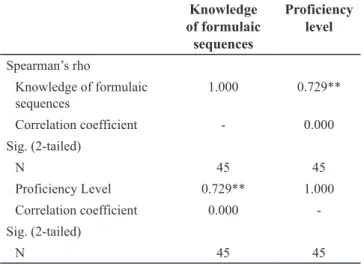
Table 4 presents the results of Spearman rank-order correlation coefficient (rho) analysis for language learners’ knowledge of formulaic sequences and their level of lan-guage proficienc . The first thing to consider in correlation analysis is the direction of the relationship between the vari-ables (knowledge of formulaic sequences and language
pro-ficiency). The data shows that there is a positive relationship between the two variables, that is, as knowledge of formula-ic sequences increases so too does the level of language pro-ficienc . The second thing to consider in correlation analysis is the size of the value of the correlation coefficient. This value will indicate the strength of the relationship between the two variables (knowledge of formulaic sequences and language proficiency). The value of correlation coefficient obtained in the analysis of Spearman rank-order correlation coefficient (rho) is 0.73 which according to the guidelines proposed by Cohen (1988) to interpret the values of correla-tion coefficient suggests quite a strong relacorrela-tionship between knowledge of formulaic sequences and language proficienc .
To get an idea of how much variance the two variables (knowledge of formulaic sequences and language proficie -cy) share, the coefficient of determination was calculated. This can be obtained by squaring the correlation value. The coefficient of determination for the obtained correlation analysis is r2 = (0.73)2 = 0.53 which according to the guide-lines proposed by Cohen (1988) to interpret the values of coefficient of determination suggests a very large correlation coefficient. To convert the value of coefficient of determi-nation to ‘percentage of variance’, it was multiplied by 100, that is, r2 = (0.73)2 × 100 = 53. This suggests that knowledge of target language formulaic sequences helps to explain 53 percent of the variance in language learners’ level of lan-guage proficienc . The performance of lanlan-guage learners at different language proficiency levels has been depicted in Figure 1.
Discussion
The study found that there is a strong positive relationship between language learners’ knowledge of target language formulaic sequences and their level of language proficienc . Language learners who possessed a higher level of language proficiency demonstrated a higher level of knowledge of target language formulaic sequences than language learners who possessed a lower level of language proficienc . There-fore, the null hypothesis of the study which states that ‘there is no relationship between knowledge of formulaic sequenc-es and language proficiency is rejected.
These findings can be explained through the fact that normal discourse, both written and spoken, contains large percentage of formulaic sequences, making up between one
Table 1. Strength of relationship
Correlation value Interpretation
0.10-0.29 Small correlation
0.30 – 0.49 Medium correlation
0.50 – 1.00 Large correlation
Table 2. Percentage of variance explained, r2
r2 value Interpretation
0.01 Small correlation
0.09 Medium correlation
0.25 Large correlation
Table 3. Knowledge of formulaic sequences at different proficiency levels
Levels Number of
participants Mean score Standard deviation
Low-intermediate 18 9.61 3.696
Intermediate 12 13.33 3.846
High-intermediate 15 18.33 3.177
All levels in general 45 13.51 5.133
Table 4. Relationship between language proficiency and knowledge of formulaic sequences
Knowledge of formulaic
sequences
Proficiency level
Spearman’s rho
Knowledge of formulaic
sequences 1.000 0.729**
Correlation coefficient - 0.000
Sig. (2-tailed)
N 45 45
Proficiency Level 0.729** 1.000
Correlation coefficient 0.000
-Sig. (2-tailed)
N 45 45
third and one half of discourse (Conklin & Schmitt, 2012). More exposure to target language input, through reading and listening materials, leads language learners to encoun-ter more target language formulaic sequences. Research (Raichle, 1998; McCrone, 1999) has shown that once the brain is familiar with a linguistic task, it is able to bypass the processing route that was used to learn it (Wray & Perkins, 2000). Consequently, the brain would make use of a rela-tively abundant resources by storing frequently occurring formulaic sequences which could then be easily retrieved and used without the need to compose them online through word selection and grammatical sequencing (Pawley & Sy-der, 1983). This helps language users who possess a high-er knowledge of target language formulaic sequences to be more proficient
Although language learners who had a higher knowledge of target language formulaic sequences were more proficient users of target language, they were not at native-like lev-el and did not show optimal performance on the test. This can be explained though Wray and Perkins’s (2000) mod-el. According to this model, unlike native speakers who are likely to have stored common word sequences holistically, that is, as single unanalyzed chunks which can be retrieved from memory as prefabricated units and as a result bypass the need to assemble the sequences word by word, adult language learners are less likely to have stored conventional word strings holistically. Accordingly, the most likely pro-cessing benefit that formulaic sequences confer on a lan-guage learner is that particular formulaic sequences may be encountered often enough that the associations between the component words become so strong that, on meeting or re-calling part of the string, the language learner will recall the rest (Boers & Lindstromberg, 2012).
The findings obtained in the current study are consistent with the findings obtained in the study conducted by Bardo-vi-Harlig et al. (2008) who found that knowledge of formu-laic sequences, regardless of language-cultural background, plays a significant role in determining the proficiency level of learners of English as a foreign language. The findings of the current study are also in line with the findings obtained in the study conducted by Qi and Ding (2011) who found that more proficient language learners possess a higher inventory of formulaic sequence knowledge. The findings obtained in the study, however, do not support the findings obtained in the studies conducted by Staples et al. (2013) and Serrano et al. (2015) who found a lack of correlation between knowl-edge of formulaic sequences and language proficienc .
CONCLUSION
The study investigated the relationship between knowledge of formulaic sequences and language proficienc , that is, whether a high level of knowledge of target language formu-laic sequences leads to a high level of target language profi-ciency or not. The findings of the study revealed that there is a strong positive relationship between knowledge of formu-laic sequences and language proficienc . Language learners at higher levels of target language proficiency demonstrated a better command of target language formulaic sequences
than language learners at lower levels of target language proficienc . Therefore, target language formulaic sequences are advised to be an indispensible part of foreign language instruction (Rafieyan, 2015; Rafieyan, 2016a; Rafieyan, 2016b).
REFERENCES
Alali, F. A., & Schmitt, N. (2012). Teaching Formulaic Se-quences: The Same as or Different from Teaching Sin-gle Words? TESOL Journal, 3(2), 153-180. https://doi. org/10.1002/tesj.13
Bardovi-Harlig, K., Rose, M., & Nickels, E. L. (2008). The Use of Conventional Expressions of Thanking, Apolo-gizing, and Refusing (Selected Proceedings of the 2007 Second Language Research Forum, ed. Melissa Bowles
et al., 113-130). Somerville, MA: Cascadilla Proceed-ings Project.
Bardovi-Harlig, K., Mossman, S., & Vellenga, H. E. (2015). The Effect of Instruction on Pragmatic Routines in Aca-demic Discussion. Language Teaching Research, 19(3), 324–350. https://doi.org/10.1177/1362168814541739 Biber, D. (2009). A Corpus-Driven Approach to Formulaic
Language in English: Multi-Word Patterns in Speech and Writing. International Journal of Corpus Linguistics, 14(3), 275–311. https://doi.org/10.1075/ijcl.14.3.08bib Biber, D., Conrad, S., & Cortes, V. (2004). If You Look
at.: Lexical Bundles in University Teaching and Text-books. Applied Linguistics, 25(3), 371–405. https://doi. org/10.1093/applin/25.3.371
Boers, F., Eyckmans, J., Kappel, J., Stengers, H., & De-mecheleer, M. (2006). Formulaic Sequences and Per-ceived Oral Proficiency: Putting a Lexical Approach to the Test. Language Teaching Research, 10(3), 245–261. https://doi.org/10.1191/1362168806lr195oa
Boers, F., & Lindstromberg, S. (2012). Experimental and In-tervention Studies on Formulaic Sequences in a Second Language. Annual Review of Applied Linguistics, 32, 83–110. https://doi.org/10.1017/S0267190512000050 Cohen, J. (1988). Statistical Power Analysis for the
Behavior-al Sciences. Hillsdale, NJ: Lawrence Erlbaum Associates. Conklin, K., & Schmitt, N. (2012). The Processing of For-mulaic Language. Annual Review of Applied Linguistics, 32, 45–61. https://doi.org/10.1017/S0267190512000074 Cowie, A. P. (1992). Multiword Lexical Units and Commu-nicative Language Teaching. In P. Arnaud, & H. Bejoint (Eds.), Vocabulary and Applied Linguistics (pp. 1-12). London: MacMillan. https://doi.org/10.1007/978-1-349-12396-4_1
Durrant, P., & Schmitt, N. (2009). To What Extent Do Na-tive and Non-NaNa-tive Writers Make Use of Collocations?
International Review of Applied Linguistics, 47(1), 157– 177. https://doi.org/10.1515/iral.2009.007
Erman, B., & Warren, B. (2000). The Idiom Principle and the Open Choice Principle. Text, 20(1), 29–62. https://doi. org/10.1515/text.1.2000.20.1.29
Foster, P. (2001). Rules and Routines: A Consideration of their Role in the Task-Based Language Production of Native and Non-Native Speakers. In M. Bygate, P. Skehan, & M. Swain (Eds.), Researching Pedagogical Tasks: Second Language Learning, Teaching and Test-ing (pp. 75–93). Harlow, UK: Longman.
Grami, G. M. A., & Alkazemi, B. Y. (2016). Improving ESL Writing Using an Online Formulaic Sequence Word-Combination Checker. Journal of Computer As-sisted Learning, 32(2),95–104. https://doi.org/10.1111/ jcal.12115
Gravetter, F. J., & Wallnau, L. B. (2013). Statistics for the
Behavioral Sciences. Belmont, C A: Wadsworth
Pub-lishing.
Laufer, B., & Waldman, T. (2011). Verb-Noun Collocations in Second Language Writing: A Corpus Analysis of Learners’ English. Language Learning, 61(2), 647–672. https://doi.org/10.1111/j.1467-9922.2010.00621.x Levitzky-Aviad, T., & Laufer, B. (2013). Lexical Properties
in the Writing of Foreign Language Learners over Eight Years of Study: Single Words and Collocations. In C. Bardel, C. Lindqvist, & B. Laufer (Eds.), L2 Vocabulary
Acquisition, Knowledge and Use (pp. 127-148). Eurosla
Monographs, Series 2. Creative Commons.
McCrone, J. (1999). States of mind. New Scientist, No. 2178 (20 March), 30-33.
Nesselhauf, N. (2003). The Use of Collocations by Ad-vanced Learners of English and Some Implications for Teaching. Applied Linguistics, 24(2), 223–42. https:// doi.org/10.1093/applin/24.2.223
Pallant, J. (2013). SPSS Survival Manual: A Step by Step
Guide to Data Analysis Using SPSS Program (5th ed.).
Australia: Allen & Unwin.
Pawley, A., & Syder, F. H. (1983). Two Puzzles for Linguis-tic Theory: Nativelike Selection and Nativelike Fluency. In J. C. Richards & R. W. Schmidt (Eds.), Language and
Communication (pp. 191–226). London: Longman.
Peters, E., & Pauwels, P. (2015). Learning Academic Formu-laic Sequences. Journal of English for Academic Purpos-es, 20, 28-39. https://doi.org/10.1016/j.jeap.2015.04.002 Qi, Y., & Ding, Y. (2011). Use of Formulaic Sequences in
Monologues of Chinese EFL Learners. System, 39(2), 164-174. https://doi.org/10.1016/j.system.2011.02.003 Rafieyan, V. (2015). Effect of National Cultural Distance
as Predictor of Pragmatic Competence on Writing
Pro-ficienc . Research on Humanities and Social Sciences, 5(18), 122-129.
Rafieyan, V. (2016a). Effect of Pragmatic Instruction ver-sus Educational Sojourn on Knowledge of Convention-al Expressions. International Journal of Learning and Development, 6(2), 1-12. http://dx.doi.org/10.5296/ijld. v6i2.9403
Rafieyan, V. (2016b). Effect of ‘Focus on Forms’ versus ‘Fo-cus on Forms’ Pragmatic Instruction on Development of Pragmatic Comprehension and Production. Journal of Education and Practice, 7(20), 41-48.
Raichle, M. E. (1998). The Neural Correlates of Conscious-ness: An Analysis of Cognitive Skill Learning. Philo-sophical Transactions of the Royal Society of London, Series B, 353, 1889-1901. https://doi.org/10.1098/ rstb.1998.0341
Schmitt, N. (2010). Researching Vocabulary: A Vocabulary
Research Manual. Basingstoke, UK: Palgrave
Macmil-lan. https://doi.org/10.1057/9780230293977
Schmitt, N., & Carter, R. (2004). Formulaic Sequences in Action: An Introduction. In N. Schmitt (Ed.), Formulaic
Sequences: Acquisition, Processing and Use (pp. 1–22).
Amsterdam: John Benjamins. https://doi.org/10.1075/ lllt.9
Serrano, R., Stengers, H., & Housen, A. (2015). Acquisi-tion of Formulaic Sequences in Intensive and Regular EFL Programmes. Language Teaching Research, 19(1), 89–106. https://doi.org/10.1177/1362168814541748 Staples, S., Egbert, J., Biber, D., & McClair , A. (2013).
For-mulaic Sequences and EAP Writing Development: Lex-ical Bundles in the TOEFL iBT Writing Section.
Jour-nal of English for Academic Purposes, 12(3), 214–225.
https://doi.org/10.1016/j.jeap.2013.05.002
Stengers, H., Boers, F., Housen, A., & Eyckmans, J. (2011). Formulaic Sequences and L2 Oral Proficiency: Does the Type of Target Language Influence the Association?
International Review of Applied Linguistics in Lan-guage Teaching (IRAL), 49(4), 321–343. https://doi. org/10.1515/iral.2011.017