C O M M E N T A R Y
Open Access
Design and initial implementation of the
WHO FP umbrella project- to strengthen
contraceptive services in the sub Saharan
Africa
Rita Kabra
1,3*, Moazzam Ali
2and James Kiarie
2Abstract
Background:Strengthening contraceptive services in sub Saharan Africa is critical to achieve the FP 2020 goal of enabling 120 million more women and girls to access and use contraceptives by 2020 and the Sustainable Development Goals (SDG) targets of universal access to sexual and reproductive health (SRH) services including family planning by 2030. Method:The World Health Organization (WHO) and partners have designed a multifaceted project to strengthen health systems to reduce the unmet need of contraceptive and family planning services in sub Saharan Africa. The plan leverages global, regional and national partnerships to facilitate and increase the use of evidence based WHO guidelines with a specific focus on postpartum family planning. The four key approaches undertaken are i) making WHO Guidelines adaptable & appropriate for country use ii) building capacity of WHO regional/country staff iii) providing technical support to countries and iv) strengthening partnerships for introduction and implementation of WHO guidelines. This paper describes the project design and elaborates the multifaceted approaches required in initial implementation to strengthen contraceptive services.
Conclusion:The initial results from this project reflect that simultaneous application these approaches may strengthen contraceptive services in Sub Saharan Africa and ensure sustainability of the efforts. The lessons learned may be used to scale up and expand services in other countries.
Keywords:WHO family planning guidelines, Contraception, Unmet need, Implementation, Adaptation, Partnerships, Health systems, Capacity building, Sub-Saharan Africa, Sustainability
Background
Unintended pregnancy resulting from the unmet need for family planning/contraception threatens the lives and well-being of women and girls and their families globally [1]. About 225 million women in low and middle-income countries have an unmet need for a modern method of family planning with the highest unmet need being in Sub-Saharan Africa [1–3]. Discounting the par-tial protection from lactational amenorrhea, unmet need
for family planning is particularly high among postpar-tum women [4] resulting in high levels of unintended pregnancies (estimated 73 million in 2012 [5]) especially in low and middle income countries.
Estimates by Guttmacher Institute indicate that, if all women who want to avoid a pregnancy used modern contraceptives and all pregnant women and their new-borns received care at the standards recommended by WHO the unintended pregnancies would drop by 70%, maternal deaths by 67%, and newborn deaths would de-cline by 77% (1) 1 as compared to the current situation. Post-partum family planning (PPFP) programs could ef-fectively contribute to achieving these results. Postpar-tum programs are premised on the assumption that demand for pregnancy prevention is significant following
* Correspondence:[email protected]
1Department of Reproductive Health and Research including UNDP/UNFPA/
UNICEF/WHO/World Bank Special Programme of Research, Development and Research Training in Human Reproduction, World Health Organisation, Avenue Appia 20, 1211 Geneva, Switzerland
322 chemin Henry Wissner, 1212, Grand Lancy, Geneva, Switzerland
Full list of author information is available at the end of the article
childbirth and that provision of services before discharge or at postnatal visits is a cost-effective solution and critical to achieving results. Studies show that where people feel they are receiving good-quality care, contraceptive use is higher, and that achieving higher standards of quality im-proves the effectiveness of sexual and reproductive health services and attracts people to use them [6].
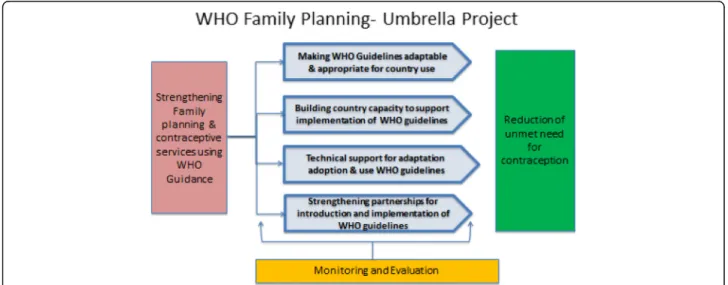
To address the low use of contraceptives particularly during the post-partum period and to ensure that deci-sions about family planning services are informed by the best evidence and field tested practices, World Health Organisation (WHO) has embarked on the “ FP-Um-brella project”. The project was designed and initiated in November 2015. The overarching goal of the project is to strengthen policy and health systems response to re-duce unmet need for contraceptives with special focus on PPFP. The four key approaches for implementation of this project are:
1. Making WHO Guidelines adaptable & appropriate for country use
2. Building capacity of WHO regional/country staff to support implementation of WHO guidelines 3. Providing technical support to countries for
adaptation, adoption and use of WHO guidelines 4. Strengthening partnerships for introduction and
implementation of WHO guidelines
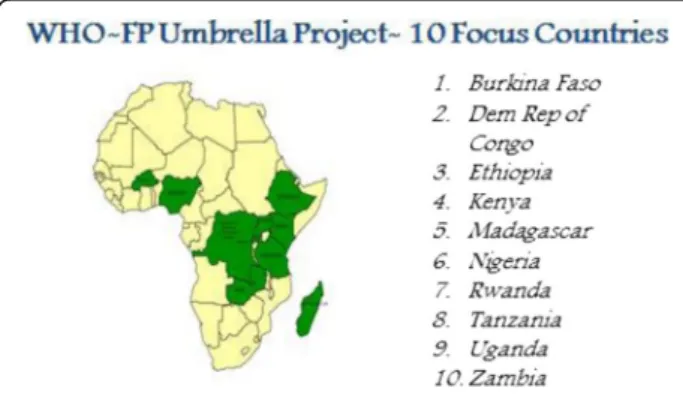
These approaches are interrelated and designed to ad-dress critical gaps in the health system to reduce unmet need for contraception. This paper provides the rationale for this approach and describes initial implementation activities in ten focus countries in Africa.1
These ten countries are selected based on the disease burden (un-met need in family planning), political willingness, and
commitment at national levels to FP 2020 Goals. Les-sons learnt from these countries can be used to scale up and expand practices in other countries Fig. 1.
Approach 1-Making WHO guidelines adaptable & appropriate for country use
WHO is the lead norms setting agency on health in the United Nations (UN) system. The department of Repro-ductive Health and Research (RHR) in WHO has devel-oped over 30 guidelines and tools for family planning managers and providers to promote evidence based FP services globally. These include the four cornerstones of family planning guidelines [7]: Medical Eligibility Cri-teria for contraceptive use (MEC); Selected Practice Rec-ommendations for contraceptive use (SPR) [8]; Decision making tool for Family planning Clients (DMT) [9] and Family planning: A Global Handbook for Providers [10].
Review of lessons learnt from previous guideline intro-duction activities in countries and discussions with key stakeholders (implementing partners, ministry of health, health care providers, trainers) revealed that the common challenges/barriers that limit the use of WHO FP guid-ance were lack of guidguid-ance for implementation [11] (clar-ity on what to use due to multiple guidelines, difficulties in interpreting some MEC categories, incorrect interpret-ation of recommendinterpret-ations), informinterpret-ation on what is needed to contextualise or adapt a guideline and lack of documentation of effective implementation approaches.
To respond to these challenges and requests by coun-tries to simplify and promote the use of the four corner-stones of family planning, emphasising quality and human rights principles, WHO RHR has developed sim-plified derivative tools to enhance implementation of evidence based recommendations in countries. These in-cludes the i) WHO Postpartum Family Planning (PPFP)
Compendium [12] that integrates core WHO guidance on safe provision of PPFP methods based on individuals’ needs and context, ii) A simple user friendly Check List [13] to prompt health workers to adhere and implement the principles of quality of care in contraceptive services and information from a human rights perspective and iii) A documentation guide [14] to support program managers and health care providers to identify the suc-cess and the impact of the programme and practices and document best practices during adaptation, implementa-tion and scaling up of programmes.
Pilot test results have suggested these new simplified tools and guidelines are user friendly, effective and easy to use. Studies from developing countries confirm that simplified tools that facilitate the application of know-ledge at the point of care and thereby simplify adherence to guidelines, can improve practitioner’s performance, and ultimately better patient care [15]. We look forward to countries using these tools to support implementation of WHO FP guidance in 2017.
Approach 2- Regional capacity building to support implementation of WHO guidance
Despite large-scale initiatives like the Strategic Partner-ship Programme (SPP) [16] by WHO and UNFPA, to support countries in developing knowledge, tools and national guidelines, the uptake in practice and in im-proving quality of services at the national level has been limited and not sustained. Limited resources (human and financial) at WHO country offices to support the family planning programmes including implementation of evidence based WHO FP guidelines have been cited as a key challenge for the limited impact.
Under this project, special efforts are directed to build capacity at the regional level with the expectation that this will be cascaded down to national and subnational level by local partners. In this context a regional consultation was organised in Harare, Zimbabwe in July 2016 which was attended by representatives of ministries of health, de-velopment partners, civil society, non-governmental orga-nisations, academia and WHO country staff from 18 African countries. Participants were oriented on the latest FP recommendations and guidelines. The teams jointly prepared action plans to adopt and implement the WHO guidance in their countries. In addition, three WHO inter-regional support teams based in Harare, Libreville and Ouagadougou, were identified to support country offices in their efforts to work with ministries of health in updat-ing FP norms and standards.
Considering that information and local expertise is most likely to influence policy makers [17], WHO initi-ated a program to strengthen technical capacity of the obstetricians and gynaecologists to support the ministry of health (MOH) in interpreting and advocating the use
of evidence based FP guidelines. In July 2016, WHO in collaboration with International Federation of Gynaecol-ogy and Obstetrics (FIGO) organized a Training of Trainers (ToT) workshop at Johannesburg, South Africa, to orient obstetrics and gynaecologists (approx. 20 par-ticipants) on the latest FP recommendations in accord-ance with the WHO’s MEC 5th edition on the safety and efficacy of contraception. A critical dimension of this training was to create capacity for organizational devel-opment so that the trainees can cascade training and facilitate and support ministries of health in adopting WHO evidence based guidelines into national programs. Following this, trainees from Nigeria and Rwanda con-ducted workshops in their countries to orient their peers on MEC Guidance.
Approach 3: Technical support for adaptation, adoption and use WHO guidelines
Countries develop national standards and practice guide-lines by adapting WHO guideguide-lines to local context. However, WHO guidelines are often not successfully im-plemented in countries because of weaknesses and lack of coordination in country expertise and stewardship often resulting in competing efforts, fewer synergies, and low sustainability [18]. To address this challenge, WHO offices in the focus countries received technical support and catalytic funds to support FP programmes in coun-tries. These funds leveraged additional resources from partners and ministries of health to strengthen the na-tional FP programmes by updating/developing nana-tional norms and guidelines, training health care providers on FP/PPFP or task sharing (based on country needs) Fig. 2. Early results show that the capacity building and the financial support provided to the country office acted as a catalyst to accelerate the development and implemen-tation of national FP guidelines and tools. During the year 2016, all 10 focus countries revised/updated their national Family planning guidelines, tools, based on the latest WHO FP guidelines. In Kenya, Rwanda, Tanzania, Uganda, and Zambia 2015 MEC wheel was adapted to
make a country specific wheel, while another 5 coun-tries- Democratic Republic of Congo, Burkina Faso, Ethiopia, Madagascar, and Nigeria adopted the generic wheel as country job aid. Development of national guidelines and tools is the first step towards implemen-tation of evidence based family planning service. WHO will continue to support implementation and monitor the use of these guidelines at national and subnational level and the impact that it may have on the life of women, children and adolescents globally.
Building WHO expertise also strengthened inter-country partnership. For example WHO Uganda inter-country office facilitated and provided technical support to Zambia for the development of country standards for Family planning. This has been a major step forward in the implementation of the programme. Next year we will continue to support WHO country office, work with local partners in rolling out the guidelines and training at subnational level
Approach 4: Strengthening partnerships for
introduction and implementationof WHO
guidelines
Partnerships can be effective vehicles for improving ser-vice delivery. Institutions within and outside public sec-tor are important to sustain leadership, enable resilience to shocks and further the achievement of national devel-opment goals [19]. This project is designed to mobilize and engage commitments of domestic partners and net-works like academia/trainers with disparate skills, strengths, disciplines not only to avoid confusion, dupli-cation and redundancy but also for coordination of ef-forts and sustainability.
In all the 10 focus countries the MoH has engaged with and is actively collaborating with a range of partners in-cluding academia, scientific, implementing partners, do-nors like FP 2020, Track 20, local IBP partners, UNFPA, WHO, Population Council and JHPIEGO to advocate and build consensus for implementation of evidence based FP guidance. Relevant partners participated in the workshops and based on their skills/comparative advantages they agreed to support national FP programmes and services. In this initial phase of implementation, it was noted that there were significant tangible and intangible benefits and initial estimates indicate that there was up to three times leverage on account of this targeted funding. Leveraging was in the form of local partner’s contributions both in cash and kind For example in Ethiopia, USAID collabo-rated with MoH in training health care providers on PPFP; in Nigeria and Zambia UNFPA supported printing of the national FP guidelines and job aids like MEC wheel. In Kenya, JHPIEGO sponsored a workshop for the adapta-tion of the MEC wheel. In Burkina Faso, Ouagadougou partnership supported training of health care workers. In
all 10 focus countries Implementing Best Practices (IBP) partners contributed to disseminate lessons learnt via the Knowledge gateway.
Early results (intermediate outcomes) show that al-though coordination with the different partners takes time and require alignment of different visions; it helps to build synergy, avoid duplication of efforts and has the potential to have a sustained response beyond the project life time in improving FP programmes and services thus delivering the vision of the SDGs and FP2020. Further achievements and impact of our work will be reported in the next manuscript on this project.
Monitoring the progress
Monitoring is an important means to hold stakeholders accountable for their commitments to the achievements of global and national goals. Lack of meaningful data and failure to use the available data on PPFP has been reported as one of the major drawbacks that prevents improving quality of family planning services in the postpartum period4.
A base line survey was conducted to collect data on the awareness, knowledge and use of WHO guidelines in the countries. Key indicators such as the number of countries that have updated their national guidelines based on WHO standards; number of personnel trained to support national programmes; documentation of best practices and lessons learned during adaptation will be collected to monitor the progress and evaluate the overall success of the project. Additional indicators such as, the unmet need for contraceptives, contraception demand satisfied policy amendments, evidence of increase government commit-ment (e.g. funding, resources) will be used to show im-pact. All efforts will be made to collect data from the existing health information management system. Data col-lected will be compared with base line, evaluated so that lessons learnt can be used for scaling up services. The re-sults will be share in a follow up manuscript.
Discussions
There is a paucity of rigorously evaluated processes to support countries in implementing WHO recommenda-tions. Results from a recent survey expressed high level of reliance of countries on WHO’s technical support, either through consultants or staff [20] . WHO country focal points are often called to lead the development of national FP norms and standards; they oversee multiple programmes and often may not have the updates on the latest evidence. Thus building a critical mass of experts at country level is essential to ensure sustainability of programmes as confirmed by other programmes too [21].Feedback from WHO country offices at the end of the year reflects improved confidence, engagement and enhanced skills in SRH following the capacity building approaches. The implementation of the project started in early 2016. Even though, at this stage we cannot claim on the impact of these approaches in reducing contra-ceptive services; however some lessons can be distilled from the intermediate outcomes. These include the following:
Leadership by Ministry of health is critical for owner-ship and sustainability- Ensuring MoH in the driving seat is an efficient strategy to ensure commitment, harmonization and effective implementation in the countries. In the ten focus countries, greater commit-ment of governcommit-ment and implecommit-menting partners to evi-dence based family planning policies was observed. Agreement to key milestones, roles & responsibilities, active monitoring (tracking calendar of event, telephone calls, newsletter, and monthly meetings), effective com-munication and accountability at all levels helps in exe-cuting the planned activities on time. Going forward we will continue to support MoH and strengthen local part-nerships particularly with USAID, UNFPA and FP2020.
Skilled professional at country level is mandatory for sustainability of efforts- A Regional focus to build a crit-ical mass of skilled professionals/program managers at regional/country level to support MoH to adopt and im-plement the WHO guidelines is important. Various models can be used to build regional capacity. We employed regional workshops to strengthen skills of WHO country office, ministries of health and imple-menting partners. Country teams came together to dis-cuss key challenges and made plans to improve the situation; country workshops led by national obstetrics and gynaecology society (FIGO-WHO Collaboration) leading to experts at country level to support ministries of health at national and subnational level; horizontal share of skills -country-country support for adaptation and development of national guidelines.
Role of Catalytic funding in galvanizing efforts- Finan-cial support to WHO country offices (as seed money) led to increase visibility and engagement of WHO offices
with partners and ministry of health. This resulted in ownership and accountability as well as leveraged add-itional resources and commitment from partners to sup-port contraceptive and FP services in countries.
Collaboration and coordination among implementing
partners is crucial for efficiency and effectiveness of ef-forts. Creating partnerships with all key stakeholders through consensus building led to ownership of the process and new and direct links for more effective im-plementation. Partners made significant commitment to the new guidelines and job aids developed in countries, agreed to use the tools developed for sub national imple-mentation which is an important change from the past and will enhance actual resources available by avoiding duplication of activities.
Limitations
At this early stage of project implementation, the out-comes (success factors) are mostly quantitative; number of national guidelines developed or capacity of regional experts developed in countries. It therefore is difficult to show results as outcome or impact at this stage. Based on the outcomes it is our expectation that the multiple approaches described above have the potential to strengthen country’s health systems and will contribute significantly to the identified targets of universal access to sexual and reproductive health.
Conclusion
In summary, this project presented a unique opportunity for WHO, ministries of health and partners to actively collaborate to reorient and strengthen national family planning programmes and services. The gains made in this short time (development of national guidelines and building experts at country level) can be stated as inter-mediate success factors. The lessons learned reflect that simultaneous application of these approaches has the potential to create stronger partnerships for SRHR be-yond the project life time and in delivering the vision of the SDGs and FP2020. The lessons learned may be used to scale up and expand contraceptive services in other countries.
Endnotes 1
Burkina Faso, Democratic Republic of Congo, Ethiopia, Kenya, Nigeria, Madagascar, Rwanda, Tanzania, Uganda, Zambia
Abbreviations
Nations Population Fund; USAID: United States Agency for International Development; WHO: World Health Organization
Acknowledgements
The authors are grateful to the WHO- FP Umbrella team for their support and contribution to the work under the project.
Funding
The project is funded by Bill and Melinda Gates Foundation. The funding sources did not play a role in the study design, analysis and interpretation of data, in the writing of the report, or in the decision to submit the article for publication. The conclusions and opinions expressed here are those of the authors and not necessarily those of the funder.
Availability of data and materials Not applicable.
Authors’contributions
The idea for this publication was conceived by RK. RK prepared the first draft with significant contribution from Mo A and JK. All authors reviewed the draft manuscript and approved the final manuscript for publication.
Competing interests
The funding sources did not play a role in the study design, analysis and interpretation of data, in the writing of the report, or in the decision to submit the article for publication. The conclusions and opinions expressed here are those of the authors and not necessarily those of the funder.
Consent for publication
All authors read and approved the final manuscript. This report contains the collective views of an international group of experts, and does not necessarily represent the decisions or the stated policy of the World Health Organization.
Ethical approval and consent to participate Not applicable.
Publisher’s Note
Springer Nature remains neutral with regard to jurisdictional claims in published maps and institutional affiliations.
Author details
1Department of Reproductive Health and Research including UNDP/UNFPA/
UNICEF/WHO/World Bank Special Programme of Research, Development and Research Training in Human Reproduction, World Health Organisation, Avenue Appia 20, 1211 Geneva, Switzerland.2Department of Reproductive
Health and Research, World Health Organisation, Geneva, Switzerland.322
chemin Henry Wissner, 1212, Grand Lancy, Geneva, Switzerland.
Received: 12 May 2017 Accepted: 31 May 2017
References
1. Singh S, Darroch JE, Ashford LS. Adding it up: the costs and benefits of investing in sexual and reproductive health 2014. New York: Guttmacher Institute; 2014. https://www.guttmacher.org/sites/default/files/report_pdf/ addingitup2014.pdf. Last accessed on 02.01.2017.
2. Ajong A.B, Njotang P.N., Yakum M.N., Essi M.J., Essiben F., Eko Eko F. et.al. 2016. Determinants of unmet need for family planning among women in urban Cameroon: a cross sectional survey in the Biyem–Assi health district, Yaounde. BMC Womens Health; 16(4): DOI: 10.1186/s12905-016-0283-9. https://www.ncbi.nlm.nih.gov/pmc/articles/PMC4949889/ Last accessed on 02.01.2017.
3. Nkosazana CDZ, Carlos L, Kaberuka D, Helen C. MDG report 2014: assessing progress in Africa toward the millennium development goals. Addis Ababa, Ethiopia: Economic Commission for Africa; 2014 http://www.afdb.org/ fileadmin/uploads/afdb/Documents/Publications/MDG_Report_2014_11_ 2014.pdf Last accessed on 02.01.2017.
4. Ross, John A. and William L. Winfrey. 2001. Contraceptive use, intention to use and unmet need during the extended postpartum period. Int Fam Plan Perspect 27(1): 20–27. https://www.guttmacher.org/journals/ipsrh/2001/03/
contraceptive-use-intention-use-and-unmet-need-during-extended-postpartum Last accessed on 02.01.2017.
5. Sedgh, Gilda and Rubina Hussain. 2014. Reasons for contraceptive non use among women having unmet need for contraception in developing countries. Studies in family planning 45(2): 151–169. http://onlinelibrary.wiley.Com/doi/10. 1111/j.1728-4465.2014.00382.X/full Last accessed on 02.01.2017.
6. Rama Raos, Lacuesta M, Costello M, et al The Link Between Quality of Care and Contraceptive Use. Int Fam Plan Perspect, 2003, 29(2):76-83. 7. Medical Eligibility Criteria for contraceptive use, 5th edition 2015 Last accessed
on 02.01.2017 http://www.who.int/reproductivehealth/publications/family_ planning/MEC-5/en/ Last accessed on 02.01.2017 MEC Wheel 2015 edition http://www.who.int/reproductivehealth/publications/family_planning/mec-wheel-5th/en/ Last accessed on 02.01.2017.
8. Selected Practice Recommendations for contraceptive use (SPR) http:// www.who.int/reproductivehealth/topics/family_planning/SPR-3/en/ Last accessed on 02.01.2017.
9. Decision making tool for Family planning Clients (DMT) http://www.who. int/reproductivehealth/publications/family_planning/9241593229index/en/ Last accessed on 02.01.2017.
10. Family Planning Global handbook for providers (2011 update) http://www. who.int/reproductivehealth/publications/family_planning/9780978856304/ en/ Last accessed on 02.01.2017.
11. Wang Z, SusanL Norris, and Lisa Bero Implementation plans included in World Health Organisation guidelines. Implementation Science 92016) 11:76 https://implementationscience.biomedcentral.com/articles/10.1186/s13012-016-0440-4 Last accessed on 02.01.2017.
12. WHO Post partum family planning Compendium www.srhr.org/ postpartumfp. Last accessed on 02.01.2017.
13. Quality of care in contraceptive information and services, based on human rights standards A check list for health providers http://www.who.int/ reproductivehealth/publications/qoc-contraceptive-services/en/ Last accessed on 02.01.2017.
14. A Guide to identifying and documenting best practices in family planning programmes http://www.who.int/reproductivehealth/publications/family_ planning/best-practices-fp-programs/en/ Last accessed on 02.01.2017. 15. Kawamoto K, Houlihan CA, Balas EA, Lobach DF: Improving clinical practice
using clinical decision support systems: a systematic review of trials to identify features critical to success. BMJ. 2005, 330 (7494): 765-10.1136/bmj. 38398.500764.8F. Last accessed on 02.01.2017.
16. WHO-UNFPA Strategic Partnership Program (SPP) Inter-country Implementation Review Workshop in Africa, 19–21 September 2006 http://www.who.int/ countries/eth/news/2006/19_10_2006/en/ Last accessed on 02.01.2017. 17. Ian Askew, Using operations research to introduce post abortive care
services in Burkina Faso and Senegal-turning research into practice: suggested actions from case studies of sexual and reproductive health research /UNDP. 2006 WHO/RHR06.9 http://apps.who.int/iris/bitstream/ 10665/43572/1/9241594837_eng.pdf Last accessed on 02.01.2017. 18. Wang Z, Susan L Norris, and Lisa Bero Implementation plans included in
World Health Organisation guidelines. Implement Sci 2016) 11:76 https:// implementationscience.biomedcentral.com/articles/10.1186/s13012-016-0440-4 Last accessed on 02.01.2017.
19. Keefer P. Collective action, political parties and pro-development public policy. Asian Dev Rev 2011;28:94-118 http://corruptionresearchnetwork.org/ acrn-news/articles/collective-action-political-parties-and-pro-development-public-policy Last accessed on 02.01.2017.
20. WHO ranked on technical support for countries http://www.who.int/hiv/ mediacentre/news/global-fund-nfm-ranking/en/ Last accessed on 02.01.2017. 21. Rita Kabra, Ornella Lincetto, Olive Sentumbwe-Mugisa, Luc de Bernis.