CISCO SYSTEMS PUBLICATION HISTORY 170 WEST TASMAN DR.
SAN JOSE, CA, 95134 REV B.13 MARCH 20, 2013 WWW.CISCO.COM
Cisco UCS C240 M3
High-Density
Rack Server (Small Form
Factor Disk Drive Model)
Chassis Front View . . . .4
Chassis Rear View . . . .5
BASE SERVER STANDARD CAPABILITIES and FEATURES . . . 6
CONFIGURING the SERVER . . . 9
STEP 1 VERIFY SERVER SKU . . . 10
STEP 2 SELECT CPU(s) . . . 11
STEP 3 SELECT MEMORY . . . 13
STEP 4 SELECT RAID CONFIGURATION . . . 18
STEP 5 SELECT HARD DISK DRIVES (HDDs) or SOLID STATE DRIVES (SSDs) . . . 24
STEP 6 SELECT PCIe OPTION CARD(s) . . . 26
STEP 7 ORDER OPTIONAL NETWORK CARD ACCESSORIES . . . 29
STEP 8 ORDER POWER SUPPLY . . . 32
STEP 9 SELECT AC POWER CORD(s) . . . 33
STEP 10 ORDER OPTIONAL REVERSIBLE CABLE MANAGEMENT ARM . . . 36
STEP 11 ORDER A TRUSTED PLATFORM MODULE (OPTIONAL) . . . 37
STEP 12 ORDER CISCO FLEXIBLE FLASH SD CARD MODULE (OPTIONAL) . . . 38
STEP 13 ORDER OPTIONAL USB 2.0 DRIVE . . . 39
STEP 14 SELECT OPERATING SYSTEM . . . 40
STEP 15 SELECT OPERATING SYSTEM MEDIA KIT . . . 42
STEP 16 SELECT OPTIONAL VALUE-ADDED SOFTWARE . . . 43
STEP 17 SELECT SERVICE and SUPPORT LEVEL . . . 44
OPTIONAL STEP - ORDER RACK(s) . . . 49
OPTIONAL STEP - ORDER PDU . . . 50
SUPPLEMENTAL MATERIAL . . . 51
CHASSIS . . . 51
CPUs and DIMMs . . . 52
Physical Layout . . . 52
Memory Population Rules . . . 54
Recommended Memory Configuration . . . 55
Supported DIMM Populations . . . 57
Low-Voltage DIMM Considerations . . . 58
RAID Summary . . . 59
RAID Option ROM (OPROM) Settings . . . 62
Upgrade and Servicing-Related Parts . . . 63
Drive Blanking Panels . . . 64
Adding an Additional CPU (with CPU heat sink) . . . 64
Motherboard Lithium Battery . . . 64
CPU Removal and Installation (“pick n place”) Tool Set . . . 64
Thermal Grease (with syringe applicator) for CPU to Heatsink Seal . . . 65
Air Baffle Replacement Kit . . . 65
CPU Heat Sink Cleaning Kit . . . 65
RACKS . . . 66
PDUs . . . 68
KVM CABLE . . . 69
Motherboard USB and SD Ports, and RAID Card Backup Locations . . . 70
TECHNICAL SPECIFICATIONS . . . 71
Dimensions and Weight . . . 71
OVERVIEW
The UCS C240 M3 rack server is designed for both performance and expandability over a wide range of storage-intensive infrastructure workloads from big data to collaboration.
Building on the success of the Cisco UCS C210 M2 rack server, the enterprise-class UCS C240 M3 server further extends the capabilities of Cisco’s Unified Computing System portfolio in a 2U form factor with the addition of the Intel® E5-2600 series processor family CPUs that deliver the best combination of
performance, flexibility and efficiency gains. In addition, the UCS C240 M3 server provides 24 DIMM slots, up to 24 drives and 4 x 1 GbE LOM ports to provide outstanding levels of internal memory and storage
expandability along with exceptional performance.
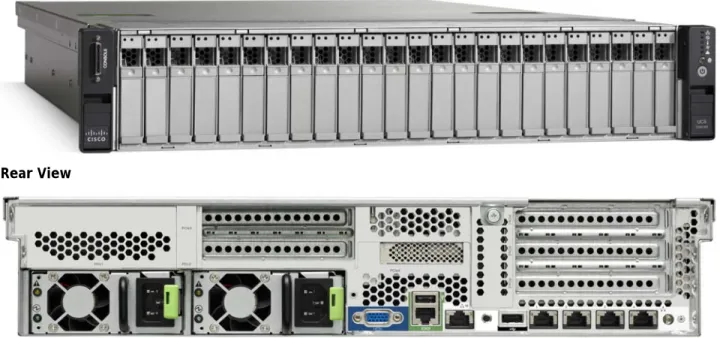
Figure 1 Cisco UCS C240 M3 High-Density SFF Rack Server Front View
DETAILED VIEWS
Chassis Front View
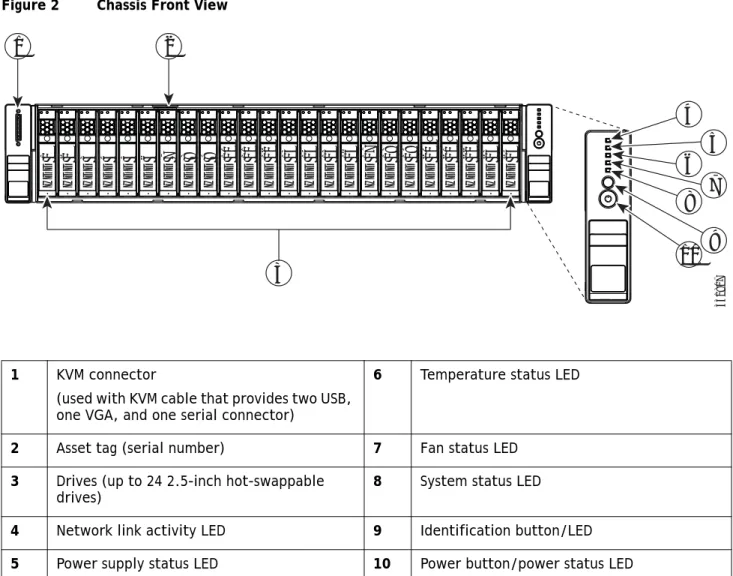
Figure 2 shows the Cisco UCS C240 M3 High-Density SFF Rack Server. Figure 2 Chassis Front View
For more information about the KVM cable connection, see KVM CABLE, page 71. 1 KVM connector
(used with KVM cable that provides two USB, one VGA, and one serial connector)
6 Temperature status LED
2 Asset tag (serial number) 7 Fan status LED
3 Drives (up to 24 2.5-inch hot-swappable
drives) 8 System status LED
4 Network link activity LED 9 Identification button/LED
5 Power supply status LED 10 Power button/power status LED
H DD 1 H DD 2 H DD 3 H DD 4 H DD 5 H DD 6 H DD 7 H DD 8 H DD 9 H DD 10 H DD 11 H DD 12 H DD 13 H DD 14 H DD 15 H DD 16 H DD 17 H DD 18 H DD 19 H DD 20 H DD 21 H DD 22 H DD 23 H DD 24 331807
4
5
6
7
8
10
9
3
2
1
Chassis Rear View
Figure 3 shows the external features of the rear panel. Figure 3 Chassis Rear View
1 Power supplies (up to two) 7 One RJ-45 10/100/1000 Ethernet dedicated
management port 2 Standard-profile PCIe slot on riser 2:
PCIe 5—full-height, 3/4-length, x16 lane width, x24 connector, GPU ready
8 USB 2.0 port
3 Low-profile PCIe slot on riser 2:
PCIe 4—half-height, 3/4-length, x8 lane width, x16 connector, no NCSI2 support
9 Quad 1-Gb Ethernet ports (LAN1, LAN2, LAN3, and LAN4)
4 VGA video connector 10 Standard-profile PCIe slots on riser 1(three):
PCIe 1—full-height, half-length, x8 lane width, x8 connector
PCIe 2—full-height, half-length, x16 lane width, x24 connector (supports Cisco Virtual Interface Card (VIC))
PCIe 3—full-height, half-length, x8 lane width, x16 connector
5 Serial connector (RJ-45) 11 Rear Identification button/LED
6 USB 2.0 port
-PSU1 PSU2
PCIe 1
PCIe 2
PCIe 3
PCIe 4
PCIe 5
4
5
6
7
8
9
10
11
2
3
331826
BASE SERVER STANDARD CAPABILITIES and FEATURES
Table 1 lists the capabilities and features of the base server. Details about how to configure the server for a particular feature or capability (for example, number of processors, disk drives, or amount of memory) are provided in CONFIGURING the SERVER, page 9.
Table 1 Capabilities and Features
Capability/Feature Description
Chassis Two rack unit (2RU) chassis
CPU One or two Intel® E5-2600 series processor family CPUs
Chipset Intel® C600 series chipset
Memory 24 slots for registered or unbuffered ECC DIMMs (RDIMMs or UDIMMs) or load-reduced DIMMs (LRDIMMs)
NIC Embedded quad-port Intel i350 PCIe-based Gigabit Ethernet controller, supporting the following:
■ Pre-Execution Boot (PXE boot) ■ iSCSI boot
Expansion slots Five PCIe slots (on two riser cards) ■ Riser 1 (PCIe slots 1, 2, and 3):
• One x16 PCIe Gen3 Slot, x24 extended connector, full-height, half-length
• Two x8 PCIe Gen3 Slots Full Height, x16 connector, half-length ■ Riser 2 (PCIe slots 4 and 5):
• One x16 PCIe Gen3 Slot, Full Height, (225W GPU Ready), x24 connector, three-quarter length
• One x8 PCIe Gen3 Slot, half-height, x16 connector, half-length Internal storage devices Drives are installed into front-panel drive bays that provide hot-pluggable
access.
■ Small Form Factor (SFF) drives. The server can hold up to:
• 24 2.5 inch (63.5 mm) SAS or SATA hard drives (HDDs) or solid state drives (SSDs) with the 24-drive backplane server configuration • 16 2.5 inch (63.5 mm) SAS or SATA HDDs or SSDs with the 16-drive
backplane server configuration
■ The server also contains one internal USB 2.0 port on the motherboard that you can use with a USB thumb drive for additional storage
Cisco Flexible Flash
drives The server supports one internal Cisco Flexible Flash drive (SD card). ■ The SD card is pre-loaded with four virtual drives. The four virtual
drives contain, respectively, the Cisco Server Configuration Utility, the Cisco Host Upgrade Utility, the Cisco C-Series server drivers set, and a blank virtual drive on which you can install an OS or a hypervisor.
Storage controller ■ Embedded RAID (3 Gbs)
• Embedded SATA-only RAID controller, supporting up to four SATA-only drives (RAID 0, 1, 10)
• ROM5 RAID upgrade, supporting up to eight SAS+SATA HDDs or SSDs (RAID 0, 1, 10).
• ROM55 RAID upgrade, supporting up to eight SAS+SATA HDDs or SSDs (RAID 0, 1, 5, 10).
Note that embedded RAID options can be supported only with the version of the C240 M3 SFF server that has been configured with a 16-drive backplane.
■ Mezzanine Cards (6 Gbs) - two versions
• Cisco UCSC RAID SAS 2008M-8i Mezzanine Card supports up to 8 SAS+SATA drives with the 16-drive backplane or 16 SAS+SATA drives with the 24-drive backplane (this card supports a maximum of 16 drives for a RAID volume). The card supports RAID 0, 1, 5, 10, and 50. This card has a product ID (PID) of UCSC-RAID-11-C240.
• Cisco UCSC RAID SAS 2008M-8i Mezzanine Card supports up to 8 SAS+SATA drives with the 16-drive backplane or 16 SAS+SATA drives with the 24-drive backplane (this card supports a maximum of 16 drives for a RAID volume). The card supports RAID 0, 1, and 10. This card has a product ID (PID) of UCSC-RAID-MZ-240.
Note that mezzanine cards are used as follows:
• A mezzanine card in a 16-drive backplane system can support up to 8 drives. The reason for this is that the 16-drive backplane does not support a SAS expander.
• A mezzanine card in a 24-drive backplane system can support up to 16 drives, due to a 16-drive limit for a RAID volume for this card. ■ Plug-in PCIe Cards (6 Gbs)
• LSI MegaRAID SAS 9266CV-8i 8-port plug-in PCIe RAID controller card with on-board 1 GB data cache and chassis-mounted (remote) supercap for data cache power backup, supporting RAID levels 0, 1, 5, 6, 10, 50, 60 and up to 24 internal SAS +SATA drives when
configured with 24-drive backplane1. When used with a 16-drive backplane version2 of the server, one controller can control up to 8 drives. Two controllers must be installed to control 16 drives. • LSI MegaRAID 9266-8i 8-port plug-in PCIe RAID controller card with
on-board 1 GB flash-backed write cache backup, supporting RAID levels 0, 1, 5, 6, 10, 50, 60 and up to 24 internal SAS+SATA drives when configured with 24-drive backplane1. When used with a 16-drive backplane version2 of the server, one controller can control up to 8 drives. Two controllers must be installed to control 16 drives. • LSI MegaRAID 9285CV-8e 8-port plug-in PCIe RAID controller card with
on-board 1 GB cache and chassis-mounted (remote) supercap for data cache power backup, supporting RAID levels 0, 1, 5, 6, 10, 50, 60. Supports 8 external SAS ports (up to 240 external drives). Capability/Feature Description
Video The Emulex Pilot 3 Integrated Baseboard Management Controller provides video:
■ Matrox G200e video controller
■ Integrated 2D graphics core with hardware acceleration
■ Supports all display resolutions up to 1920 x 1200 x 16 bpp resolution at 60 Hz
■ 24-bit color depth for all resolutions less than 1600x1200 ■ 256 MB video memory
Interfaces Rear panel
■ One RJ-45 10/100/1000 Ethernet management port, using Cisco Integrated Management Controller (CIMC) firmware
■ Four 1-Gb LOM ports
■ One RJ45 serial port connector ■ Two USB 2.0 port connectors ■ One DB15 VGA connector
■ Various PCIe card ports (dependent on which cards are installed) • Converged Network Adapter (CNA) ports
• Network Interface Card (NIC) ports • Host Bus Adapter (HBA) ports Front panel
■ One KVM console connector (supplies two USB 2.0, one VGA, and one serial connector)
Front Panel ■ A front panel controller provides status indications and control buttons Power subsystem One power supply is required (either 650 W or 1200 W). An additional power
supply may be ordered to provide 1+1 redundancy. The power supplies must match in a redundant power supply configuration.
Fans Chassis:
■ Six hot-swappable fans for front-to-rear cooling Power supply:
■ Each power supply is equipped with a fan. Integrated management
processor Cisco Integrated Management Controller (CIMC) firmware.Depending on your CIMC settings, the CIMC can be accessed through the 1-Gb Ethernet dedicated management port, the 1-Gb Ethernet LOM ports, or a Cisco 1225 virtual interface card (VIC).
Notes . . .
1. The 24-drive backplane contains a SAS expander, which allows a single PCIe RAID controller to support 24 drives.
2. The 16-drive backplane does not contain a SAS expander, and thus requires two PCIe RAID controllers to support 16 drives (8 HDDs per controller)
CONFIGURING the SERVER
Follow these steps to configure the Cisco UCS C240 M3 High-Density SFF Rack Server: ■ STEP 1 VERIFY SERVER SKU, page 10
■ STEP 2 SELECT CPU(s), page 11
■ STEP 3 SELECT MEMORY, page 13
■ STEP 4 SELECT RAID CONFIGURATION, page 18
■ STEP 5 SELECT HARD DISK DRIVES (HDDs) or SOLID STATE DRIVES (SSDs), page 24
■ STEP 6 SELECT PCIe OPTION CARD(s), page 26
■ STEP 7 ORDER OPTIONAL NETWORK CARD ACCESSORIES, page 29
■ STEP 8 ORDER GPU CARDS and ACCESSORIES (OPTIONAL), page 32
■ STEP 10 SELECT AC POWER CORD(s), page 35
■ STEP 11 ORDER OPTIONAL REVERSIBLE CABLE MANAGEMENT ARM, page 38
■ STEP 12 ORDER A TRUSTED PLATFORM MODULE (OPTIONAL), page 39
■ STEP 13 ORDER CISCO FLEXIBLE FLASH SD CARD MODULE (OPTIONAL), page 40
■ STEP 14 ORDER OPTIONAL USB 2.0 DRIVE, page 41
■ STEP 15 SELECT OPERATING SYSTEM, page 42
■ STEP 16 SELECT OPERATING SYSTEM MEDIA KIT, page 44
■ STEP 17 SELECT OPTIONAL VALUE-ADDED SOFTWARE, page 45
■ STEP 18 SELECT SERVICE and SUPPORT LEVEL, page 46
■ OPTIONAL STEP - ORDER RACK(s), page 51
STEP 1
VERIFY SERVER SKU
Select one server product ID (PID) from Table 2.
The Cisco C240 M3 server:
■ Includes one tool-less rail kit, adjustable from 26 inches (660 mm) to 36 inches (914 mm) ■ Includes either a 24- or 16-drive backplane.
■ Does not include power supply, CPU, memory, hard disk drives (HDDs), solid-state drives (SSDs), SD card, or plug-in PCIe cards.
Table 2 PID of the C240 M3 High-Density SFF Rack Base Server
Product ID (PID) Description
UCSC-C240-M3S2 UCS C240 M3 SFF, no CPU, memory, HDD, power supply, or PCIe, with rail kit, 16-drive backplane, and no SAS expander
UCSC-C240-M3S UCS C240 M3 SFF, no CPU, memory, HDD, power supply, or PCIe, with rail kit, 24-drive backplane, and SAS expander
NOTE: Embedded RAID can only be used with the 16-drive backplane version of the server.
Mezzanine cards can be used as follows:
■ A mezzanine card in a 16-drive backplane system supports up to 8 drives.
■ A mezzanine card in a 24-drive backplane system supports up to 16 drives.
NOTE: Use the steps on the following pages to configure the server with the components that you want to include.
STEP 2
SELECT CPU(s)
The standard CPU features are:■ Intel E5-2600 series processor family CPU ■ Intel® C600 series chipset
■ Cache size of 10, 15, or 20 MB Select CPUs
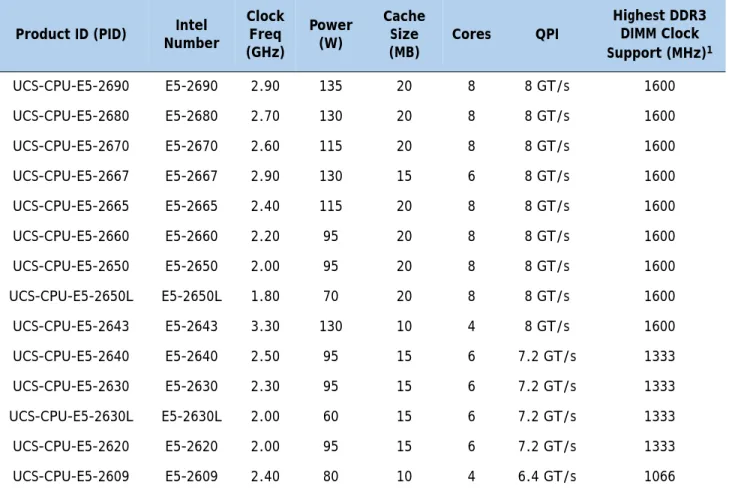
The available CPUs are listed in Table 3.
Table 3 Available Intel CPUs: E5-2600 Series Processor Family CPUs
Product ID (PID) NumberIntel
Clock Freq (GHz)
Power (W)
Cache Size (MB)
Cores QPI
Highest DDR3 DIMM Clock Support (MHz)1
Notes . . .
1. If higher or lower speed DIMMs are selected than what is shown in the table for a given CPU, the DIMMs will be clocked at the lowest common denominator of CPU clock and DIMM clock.
UCS-CPU-E5-2690 E5-2690 2.90 135 20 8 8 GT/s 1600
UCS-CPU-E5-2680 E5-2680 2.70 130 20 8 8 GT/s 1600
UCS-CPU-E5-2670 E5-2670 2.60 115 20 8 8 GT/s 1600
UCS-CPU-E5-2667 E5-2667 2.90 130 15 6 8 GT/s 1600
UCS-CPU-E5-2665 E5-2665 2.40 115 20 8 8 GT/s 1600
UCS-CPU-E5-2660 E5-2660 2.20 95 20 8 8 GT/s 1600
UCS-CPU-E5-2650 E5-2650 2.00 95 20 8 8 GT/s 1600
UCS-CPU-E5-2650L E5-2650L 1.80 70 20 8 8 GT/s 1600
UCS-CPU-E5-2643 E5-2643 3.30 130 10 4 8 GT/s 1600
UCS-CPU-E5-2640 E5-2640 2.50 95 15 6 7.2 GT/s 1333
UCS-CPU-E5-2630 E5-2630 2.30 95 15 6 7.2 GT/s 1333
UCS-CPU-E5-2630L E5-2630L 2.00 60 15 6 7.2 GT/s 1333
UCS-CPU-E5-2620 E5-2620 2.00 95 15 6 7.2 GT/s 1333
Approved Configurations
(1) 1-CPU configurations:
■ Select any one CPU listed in Table 3. (2) 2-CPU Configurations:
■ Select two identical CPUs from any one of the rows of Table 3 on page 11. Caveats
■ You can select either one processor or two identical processors.
■ For optimal performance, select DIMMs with the highest clock speed for a given processor (see Table 3 on page 11). If you select DIMMs whose speeds are lower or higher than that shown in the tables, suboptimal performance will result.
STEP 3
SELECT MEMORY
The standard memory features are:■ DIMMs
— Clock speed: 1333 or 1600 MHz — Ranks per DIMM: 1, 2, or 4
— Operational voltage: dual voltage capable (1.5 V or 1.35 V)
— Registered or unbuffered ECC DDR3 DIMMs (RDIMMs or UDIMMs) or load-reduced DIMMs (LRDIMMs)
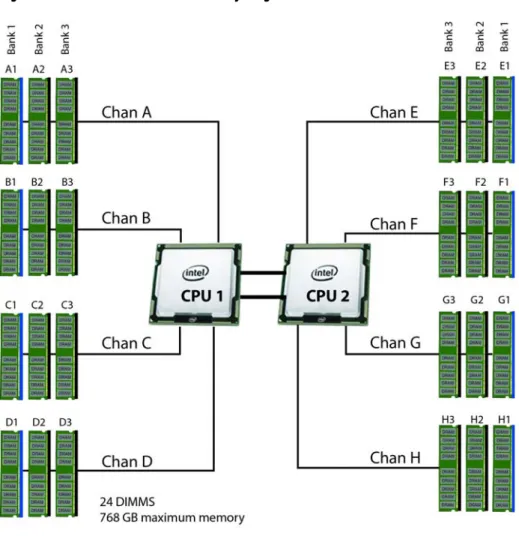
■ Memory is organized with four memory channels per CPU, with up to three DIMMs per channel, as shown in Figure 4.
Select DIMMs and Memory Mirroring
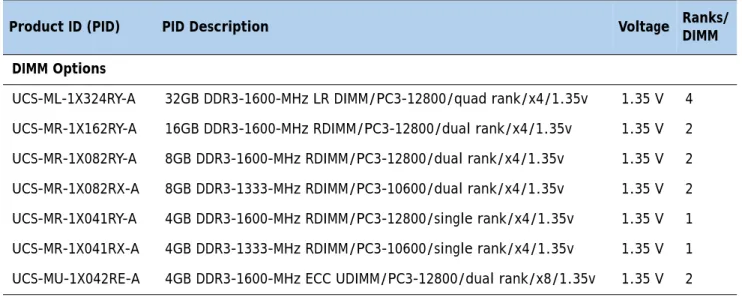
Select the memory configuration and whether or not you want the memory mirroring option. The available memory DIMMs and mirroring option are listed in Table 4.
Approved Configurations
(1) 1-CPU configuration without memory mirroring:
■ Select from 1 to 12 DIMMs. Refer to Memory Population Rules, page 56, for more detailed information.
(2) 1-CPU configuration with memory mirroring:
NOTE: When memory mirroring is enabled, the memory subsystem simultaneously writes identical data to two channels. If a memory read from one of the channels returns incorrect data due to an uncorrectable memory error, the system
automatically retrieves the data from the other channel. A transient or soft error in one channel does not affect the mirrored data, and operation continues unless there is a simultaneous error in exactly the same location on a DIMM and its mirrored DIMM. Memory mirroring reduces the amount of memory available to the operating system by 50% because only one of the two populated channels provides data.
Table 4 Available DDR3 DIMMs
Product ID (PID) PID Description Voltage Ranks/DIMM
DIMM Options
UCS-ML-1X324RY-A 32GB DDR3-1600-MHz LR DIMM/PC3-12800/quad rank/x4/1.35v 1.35 V 4 UCS-MR-1X162RY-A 16GB DDR3-1600-MHz RDIMM/PC3-12800/dual rank/x4/1.35v 1.35 V 2 UCS-MR-1X082RY-A 8GB DDR3-1600-MHz RDIMM/PC3-12800/dual rank/x4/1.35v 1.35 V 2 UCS-MR-1X082RX-A 8GB DDR3-1333-MHz RDIMM/PC3-10600/dual rank/x4/1.35v 1.35 V 2 UCS-MR-1X041RY-A 4GB DDR3-1600-MHz RDIMM/PC3-12800/single rank/x4/1.35v 1.35 V 1 UCS-MR-1X041RX-A 4GB DDR3-1333-MHz RDIMM/PC3-10600/single rank/x4/1.35v 1.35 V 1 UCS-MU-1X042RE-A 4GB DDR3-1600-MHz ECC UDIMM/PC3-12800/dual rank/x8/1.35v 1.35 V 2 Memory Mirroring Option
■ Select 2, 4, 6, 8, 10, or 12 identical DIMMs. The DIMMs will be placed by the factory as shown in the following table.
■ Select the memory mirroring option (N01-MMIRROR) as shown in Table 4 on page 14. (3) 2-CPU configuration without memory mirroring:
■ Select from 1 to 12 DIMMs per CPU. Refer to Memory Population Rules, page 56, for more detailed information.
Total Number
of DIMMs
CPU 1 DIMM Placement in Channels (for identical DIMMs)
Blue Slot (Slot 1)
Black Slot (Slot 2)
Black Slots (Slot 3)
2 (A1, B1) — —
4 (A1,B1); (C1,D1) — —
6 (A1,B1); (C1,D1) (A2,B2) —
8 (A1,B1); (C1,D1) (A2,B2); (C2,D2) —
101
Notes . . .
1. This configuration cannot be implemented with quad-rank DIMMs (the 32 GB DIMM). You can have only 1 or 2 DIMMs per channel when using quad-rank DIMMs.
(A1,B1); (C1,D1) (A2,B2); (C2,D2) (A3,B3)
(4) 2-CPU configuration with memory mirroring:
■ Select 2, 4, 6, 8, 10, or 12 identical DIMMs per CPU. The DIMMs will be placed by the factory as shown in the following table.
■ Select the memory mirroring option (N01-MMIRROR) as shown in Table 4 on page 14. Number
of DIMMs per CPU
CPU 1 DIMM Placement in Channels (for identical DIMMs)
CPU 2 DIMM Placement in Channels (for identical DIMMs)
Blue Slots Black Slots Black Slots Blue Slots Black Slots Black Slots
2 (A1, B1) (E1, F1)
4 (A1,B1);
(C1,D1)
— — (E1,F1);
(G1,H1)
— —
6 (A1,B1);
(C1,D1)
(A2,B2) — (E1,F1);
(G1,H1) (E2,F2) — 8 (A1,B1); (C1,D1) (A2,B2); (C2,D2) — (E1,F1); (G1,H1) (E2,F2); (G2,H2) — 101
Notes . . .
1. This configuration cannot be implemented with quad-rank DIMMs (the 32 GB DIMM). You can have only 1 or 2 DIMMs per channel when using quad-rank DIMMs.
(A1,B1); (C1,D1) (A2,B2); (C2,D2) (A3,B3) (E1,F1); (G1,H1) (E2,F2); (G2,H2) (E3,F3)
121 (A1,B1);
(C1,D1) (A2,B2); (C2,D2) (A3,B3); (C3,D3) (E1,F1); (G1,H1) (E2,F2); (G2,H2) (E3,F3); (G3,H3)
NOTE: System performance is optimized when the DIMM type and quantity are equal for both CPUs, and when all channels are filled equally across the CPUs in the server.
Caveats
■ For optimum performance, do not mix DIMMs with different frequencies. If you mix DIMM frequencies, the system defaults to the lower frequency.
■ Do not mix RDIMMs and LRDIMMs
■ DIMMs for CPU 1 and CPU 2 (when populated) must always be configured identically. ■ The server supports 1, 2, or 3 DIMMs per channel for single- or dual-rank RDIMMs. ■ The server supports 1 or 2 DIMMs per channel for quad-rank LRDIMMs.
■ The server supports registered DIMMs (RDIMMs) or load-reduced DIMMS (LRDIMMs), however, do not mix RDIMMs and LRDIMMs in a server.
■ When using mirroring, DIMMs must be installed in identical pairs across paired DDR3 buses. That is, mirrored pairs in channels A and B must be identical and pairs in channels C and D must be identical. However, the DIMMs used in channels A and B and in C and D can be different.
■ Non-ECC DIMMs are not supported.
■ Memory mirroring reduces the amount of available memory by 50% (quantity of DIMMs must be even for mirroring).
■ When single- and dual-rank DIMMs are populated for 2DPC, always populate the dual-rank DIMM in the blue DIMM slot first (blue slot) and the single-rank DIMM last in the black DIMM slots (only the 4GB DIMMs are single-rank).
■ By default, all DIMMs run at 1.35 V, which yields 1333-MHz memory speeds. To run the memory DIMMS at 1600 MHz, you need to go into the BIOS or set the policy with UCSM (service profile) to run in Performance Mode. This forces the DIMMs to operate at 1.5 V and yields 1600-MHz speeds, provided:
— The DIMMs are 1600-MHz devices and the DIMM type is RDIMM — The CPUs chosen support 1600-MHz operation
— There are less than 3 DIMMs per channel
■ With 3 DIMMs populated per channel, memory always runs at 1.5 V regardless if the BIOS setting is low-power mode (1.35 V) or performance mode (1.5 V).
For more information regarding memory, see CPUs and DIMMs, page 54.
NOTE: Memory speed is 1333 MHz for 3 DPC configurations when using 16 GB 1600-MHz RDIMMs and 8 GB 1600-MHz RDIMMs.
NOTE: 32 GB LRDIMMs run at a maximum speed of 1333 MHz for 1 DPC and 2 DPC even though their specified maximum speed is 1600 MHz.
STEP 4
SELECT RAID CONFIGURATION
The RAID controller choices are:
(1) Embedded RAID (on motherboard) (not supported in 24 HDD backplane systems)
(2) Mezzanine RAID controller cards (not supported in 1-CPU systems) (3) Plug-in PCIe RAID controller cards
Cisco can provide factory-configured RAID systems depending on the RAID controller chosen and the number of drives ordered. Factory-configured RAID options are listed with each RAID card description.
NOTE: For the 16-drive server option, if you do not select a mezzanine card, a plug-in PCIe RAID card, or one of the embedded RAID upgrade options, you will have an embedded SATA-only RAID controller that supports up to four SATA-only drives (RAID 0, 1, 10)
NOTE: The 24-drive version of the server does not support embedded RAID, which is normally installed on the motherboard and does not consume a PCIe slot. The only RAID support available for the 24-drive version is through a plug-in RAID controller PCIe card or a mezzanine card.
NOTE: When creating a RAID volume, follow these guidelines: ■ Use the same capacity for each drive in the volume ■ Use either all SAS drives or all SATA drives
■ Use either all HDDs or all SSDs
NOTE: The number of RAID groups (virtual drives) supported per controller is as follows:
■ Embedded RAID = 8
■ LSI MegaRAID 9266CV-8i RAID controller card = 64 ■ LSI MegaRAID SAS 9266-8i RAID controller card = 64 ■ LSI MegaRAID 9285CV-8e RAID controller card = 64 ■ Cisco UCSC RAID SAS 2008M-8i Mezzanine Card = 16
NOTE: The RAID configuration options listed in Table 7 on page 20 are not available if you choose embedded RAID (in this case, you must configure RAID yourself using separate software).
Select RAID Options
Select as follows (these choices are dependent on the number of CPUs installed and the backplane used (24-drive or 16-drive backplane)):
■ One embedded RAID upgrade option, or ■ One mezzanine RAID controller, or
■ One mezzanine RAID controller and one external RAID controller, or ■ One internal RAID controller, or
■ One internal RAID controller and one external RAID controller, or ■ Two internal RAID controller cards
NOTE: For all valid combinations of embedded RAID, mezzanine RAID, and internal/external RAID controller combinations, see RAID Summary, page 61.
Table 5 Available Embedded RAID Options Product ID (PID) PID Description
Embedded RAID Controllers (16-drive backplane server option only)
UCSC-RAID-ROM5 Onboard RAID, supporting up to 8 SAS +SATA drives. SAS and SATA drives can be mixed. This option supports RAID 0, 1, and 10, and operates at 3 Gb/s. Operating systems supported are Windows and Linux only (no VMware support).
UCSC-RAID-ROM55 Onboard RAID, supporting up to 8 SAS+SATA drives. SAS and SATA drives can be mixed. This option supports RAID 0, 1, 5, and 10 and operates at 3 Gb/s. Operating systems supported are Windows and Linux only (no VMware support).
Table 6 Available Mezzanine Card RAID Options Product ID (PID) PID Description
Mezzanine RAID Controllers (not supported in 1-CPU systems)
UCSC-RAID-11-C240 Cisco UCSC RAID SAS 2008M-8i Mezzanine Card (RAID 0, 1, 5, 10, and 50 supported), operating at 6 Gbs.
■ Supports up to 8 internal SAS+SATA drives with the 16-drive system or up to 16 SAS+SATA drives with the 24-drive system. SAS and SATA drives can be mixed.
■ Factory-configured RAID options available: RAID 0, 1, 5, and 10 (see the RAID PIDs section in this table)
UCSC-RAID-MZ-240 Cisco UCSC RAID SAS 2008M-8i Mezzanine Card (RAID 0, 1, 10 supported), operating at 6 Gbs.
■ Supports up to 8 internal SAS+SATA drives with the 16-drive system or up to 16 SAS+SATA drives with the 24-drive system. SAS and SATA drives can be mixed.
■ Factory-configured RAID options available: RAID 0, 1, and 10 (see the RAID PIDs section in this table)
Table 7 Available Plug-In PCIe Card RAID Options Product ID (PID) PID Description
RAID Controllers
Note that for 24-drive backplane systems, plug-in PCIe RAID controllers are installed by default in slot 3 for 1-CPU systems and slot 4 for 2-CPU systems, and for 16-drive backplane systems, the controllers are installed by default in slot 3 for 1-CPU systems and in slots 4 and 3 for 2-CPU systems. UCS-RAID-9266CV LSI MegaRAID SAS 9266CV-8i RAID controller card with data cache backup (RAID
0, 1, 5, 6, 10, 50, and 60), operating at 6 Gbs.
■ Supports up to 16 internal SAS+SATA drives with the 16-drive backplane system or 24 internal SAS+SATA drives with the 24-drive backplane system. SAS and SATA drives can be mixed.
■ Includes a 1 GB Transportable Memory Module (TMM) and a
chassis-mounted (remote) supercapacitor for data cache power backup ■ Factory-configured RAID options available: RAID 0, 1, 5, 6, and 10 (see the
RAID PIDs section in this table)
UCS-RAID-9266NB LSI MegaRAID SAS 9266-8i RAID controller card with no data cache backup (RAID 0, 1, 5, 6, 10, 50, and 60 supported), operating at 6 Gbs.
■ Supports up to 16 internal SAS+SATA drives with the 16-drive backplane system or 24 internal SAS+SATA drives with the 24-drive backplane system. SAS and SATA drives can be mixed.
■ Includes 1 GB of write cache
■ Factory-configured RAID options available: RAID 0, 1, 5, 6, and 10 (see the RAID PIDs section in this table)
Table 6 Available Mezzanine Card RAID Options (continued)
UCS-RAID-9285CV-E LSI MegaRAID SAS 9285CV-8e (RAID 0, 1, 5, 6, 10)
■ Supports eight external SAS ports (up to 240 external drives).
■ Includes an chassis-mount (remote) supercapacitor to power on-board 1 GB flash-backed write cache.
■ Factory-configured RAID options: RAID 0, 1, 5, 6, 10 (see the RAID Configuration section in this table)
Supercapacitor Option
UCS-RAID-CV-SC= LSI CacheVault Power Module for SAS 9266CV-8i. This is a spare supercapacitor. It is the exact same supercapacitor that ships with the 9266CV-8i and
9285CV-8e cards listed earlier in this table and can be used as a replacement or upgrade part.
RAID Configuration Options (not available for embedded RAID)
R2XX-SRAID0 Enable Single Disk Raid 0 Setting (for the following PIDs only): ■ UCS-RAID-9266-NB
■ UCS-RAID-9266CV ■ UCSC-RAID-11-C240 ■ UCSC-RAID-MZ-240
R2XX-RAID0 Factory preconfigured RAID striping option
Enable RAID 0 Setting. Requires a minimum of one hard drive. R2XX-RAID1 Factory preconfigured RAID mirroring option
Enable RAID 1 Setting. Requires exactly two drives with the same size, speed, capacity.
R2XX-RAID5 Factory preconfigured RAID option
Enable RAID 5 Setting. Requires a minimum of three drives of the same size, speed, capacity.
R2XX-RAID6 Factory preconfigured RAID option
Enable RAID 6 Setting. Requires a minimum of four drives of the same size, speed, capacity.
Table 7 Available Plug-In PCIe Card RAID Options (continued)
Product ID (PID) PID Description
NOTE: For SAS 9285CV-8e external drive enclosure support, see the compatibility list (enclosure section) at the following link:
http://tinyurl.com/b4etshk
Cisco is able to support customers with questions related to the SAS 9285CV-8e RAID card; however, customers should contact their storage vendor for technical support related to enclosure/JBOD.
Approved Configurations
(1) 1-CPU Configurations
For 24 HDD backplane systems, select an internal or external PCIe RAID controller or one of each from Table 7 on page 20. You may also select an appropriate optional RAID configuration listed in Table 7 on page 20. For 16 HDD backplane systems, you have the option to select an internal or external PCIe RAID controller or one of each from Table 7 on page 20 or an embedded RAID option from Table 5 on page 19.
(2) 2-CPU Configurations
For 24 HDD backplane systems, select a mezzanine RAID controller from Table 6 on page 19
along with an external PCIe RAID controller if desired, or an internal or external RAID controller or one of each from Table 7 on page 20. You may also select an appropriate optional RAID configuration listed in Table 7 on page 20. For 16 HDD backplane systems, you have the option to select an embedded RAID option from Table 5, one mezzanine RAID controller from Table 6 on page 19 along with an external RAID controller if desired, or an internal or external PCIe RAID controller or one of each from Table 7 on page 20. You may also select an appropriate optional RAID configuration listed in Table 7 on page 20.
R2XX-RAID10 Factory preconfigured RAID option
Enable RAID 10 Setting. Requires a even number of drives (minimum of four drives) of the same size, speed, capacity.
NOTE: Although RAID levels 50 and 60 are not orderable from the factory, they are supported for selected controllers as shown in Table 5
NOTE: In 1-CPU configurations, PCIe slot 3 is the default slot supported for an internal drive RAID controller. PCIe slots 1 or 2 can be used for one external drive RAID controller or for PCIe expansion cards. PCIe slots 4 and 5 are not supported for 1-CPU systems. You can change the default card slot for a RAID controller to a different slot by going into the BIOS and reconfiguring the option ROM (OPROM) settings.
NOTE: In 2-CPU 24 HDD backplane configurations, PCIe slot 4 is the default slot supported for an internal drive RAID controller. In 2-CPU 16 HDD backplane
configurations, PCIe slots 4 and 3 are the default slots supported for internal drive RAID controllers. The remaining slots can be used for one external drive RAID controller or PCIe expansion cards. You can change the default card slot for a RAID controller to a different slot by going into the BIOS and reconfiguring the option ROM (OPROM) settings.
Table 7 Available Plug-In PCIe Card RAID Options (continued)
(3) Available RAID Controller Combinations
Caveats
■ If you select an internal drive RAID controller, it is installed by default in PCIe slot 4 (half-height) or 3 (full-height); however, you can go into the BIOS and change the option ROM (OPROM) setting to enable a different slot for an internal drive RAID controller. Any remaining slot can then be used for an external drive RAID controller or for a PCIe expansion card.
■ Note that when just one CPU is populated, only a single Cisco 1225 Virtual Interface Card (VIC) card is supported and it must be installed in the full-height PCIe slot (slot 2) on riser 1. So take this into account when populating RAID controller cards. When two CPUs are populated, two VIC cards are supported (the Cisco VIC 1225). One can be installed in slot 2 of riser 1 and one in slot 5 of riser 2. The primary slot for a VIC card is slot 2. If you have only one of these cards, install it in slot 2.
■ For the plug-in PCIe RAID cards. you can choose an optional RAID configuration (RAID 0, 1, 5, 6, or 10), which is preconfigured at the factory. The RAID level you choose must be an available RAID choice for the controller selected. RAID levels 50 and 60 are supported, although they are not available as configuration options.
■ A system with 16-drive backplane supports up to 4 SATA-only drives if no ROM upgrade, mezzanine card, or plug-in PCIe card chosen
NOTE: For more important information regarding RAID combinations and support, see RAID Summary, page 61 and RAID Option ROM (OPROM) Settings, page 64.
NOTE: For more important information regarding RAID support, see RAID Summary, page 61 and RAID Option ROM (OPROM) Settings, page 64.
STEP 5
SELECT HARD DISK DRIVES (HDDs) or SOLID STATE DRIVES
(SSDs)
The standard disk drive features are: ■ 2.5-inch small form factor ■ Hot-pluggable
■ Sled-mounted Select Drives
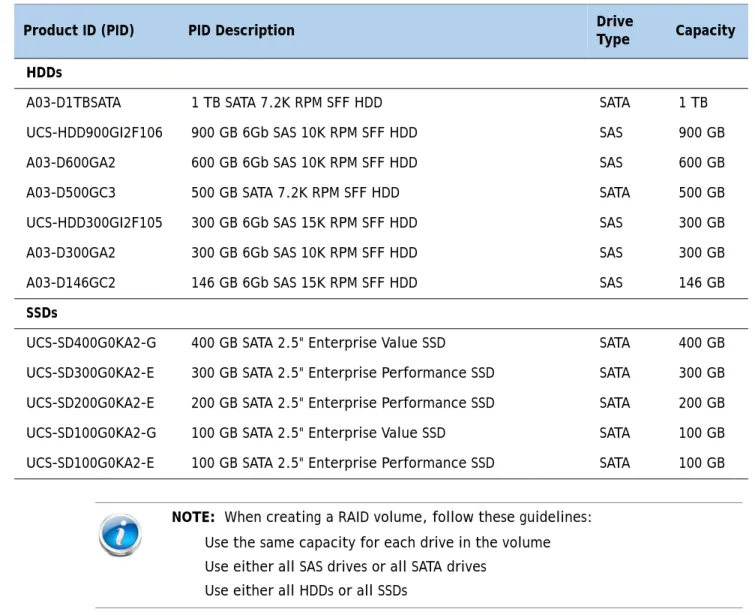
The available drives are listed in Table 8.
Table 8 Available Hot-Pluggable Sled-Mounted HDDs and SSDs
Product ID (PID) PID Description Drive Type Capacity
HDDs
A03-D1TBSATA 1 TB SATA 7.2K RPM SFF HDD SATA 1 TB
UCS-HDD900GI2F106 900 GB 6Gb SAS 10K RPM SFF HDD SAS 900 GB
A03-D600GA2 600 GB 6Gb SAS 10K RPM SFF HDD SAS 600 GB
A03-D500GC3 500 GB SATA 7.2K RPM SFF HDD SATA 500 GB
UCS-HDD300GI2F105 300 GB 6Gb SAS 15K RPM SFF HDD SAS 300 GB
A03-D300GA2 300 GB 6Gb SAS 10K RPM SFF HDD SAS 300 GB
A03-D146GC2 146 GB 6Gb SAS 15K RPM SFF HDD SAS 146 GB
SSDs
UCS-SD400G0KA2-G 400 GB SATA 2.5" Enterprise Value SSD SATA 400 GB
UCS-SD300G0KA2-E 300 GB SATA 2.5" Enterprise Performance SSD SATA 300 GB UCS-SD200G0KA2-E 200 GB SATA 2.5" Enterprise Performance SSD SATA 200 GB
UCS-SD100G0KA2-G 100 GB SATA 2.5" Enterprise Value SSD SATA 100 GB
UCS-SD100G0KA2-E 100 GB SATA 2.5" Enterprise Performance SSD SATA 100 GB NOTE: When creating a RAID volume, follow these guidelines:
■ Use the same capacity for each drive in the volume ■ Use either all SAS drives or all SATA drives
Approved Configurations
(1) Onboard RAID, Mezzanine Cards, and all Plug-In RAID Controllers ■ For systems with a 16-drive backplane:
— If you have not selected an onboard RAID upgrade option (ROM5 or ROM55), a mezzanine card, or a plug-in RAID controller for internal drives (LSI MegaRAID SAS 9266-8i or LSI MegaRAID SAS 9266CV-8i), you may select up to 4 SATA-only drives from Table 8.
— Select up to 8 drives for ROM5 or ROM55 embedded RAID upgrade or a mezzanine card.
— Select up to 16 drives for SAS 9266-8i or SAS 9266CV-8i controllers. Note that two identical RAID controllers are required to support 16 drives (each controller supports up to 8 drives).
■ For systems with a 24-drive backplane:
— Select up to 16 drives for mezzanine cards (only supported in 2-CPU systems). — Select up to 24 drives for SAS 9266-8i or SAS 9266CV-8i controllers. Only one
controller is required to support up to 24 drives. Caveats
STEP 6
SELECT PCIe OPTION CARD(s)
The standard PCie card offerings are:■ Converged Network Adapters (CNAs) ■ Network Interface Cards (NICs) ■ Host Bus Adapters (HBAs) Select PCIe Option Cards
The available PCIe option cards are listed in Table 9. Table 9 Available PCIe Option Cards
Product ID (PID) PID Description Card Height
Converged Network Adapters (CNAs)
UCSC-PCIE-BSFP Broadcom 57712 Dual Port 10Gb SFP+ w/TOE iSCSI Half
UCSC-PCIE-CSC-02 Cisco VIC 1225 Dual Port 10Gb SFP+ CNA Half
UCSC-PCIE-C10T-02 Cisco VIC 1225T Dual Port 10GBaseT CNA Half
UCSC-PCIE-ESFP Emulex OCe11102-FX dual-port 10 GbE FCoE CNA (Gen 3 CNA) Half
UCSC-PCIE-QSFP QLogic QLE8242-CU dual-port 10 GbE FCoE CNA Half
UCSC-PCIE-B3SFP Broadcom 57810 10Gb A-FEX SFP+ Half
Network Interface Cards (NICs)
N2XX-ABPCI01-M3 Broadcom 5709 Dual Port 1Gb w/TOE iSCSI for M3 Servers Half N2XX-ABPCI03-M3 Broadcom 5709 Quad Port 1Gb w/TOE iSCSI for M3 Servers Half
N2XX-AIPCI01 Intel X520 Dual Port 10Gb SFP+ Adapter Half
UCSC-PCIE-ITG Intel X540 Dual Port 10GBase-T Adapter Half
UCSC-PCIE-IRJ45 Intel i350 Quad Port 1Gb Adapter Half
UCSC-PCIE-BTG Broadcom 57712 Dual Port 10GBASE-T w/TOE iSCSI Half
Host Bus Adapters (HBAs)
N2XX-AEPCI03 Emulex LPe 11002 Dual Port 4Gb Fibre Channel HBA Half
N2XX-AEPCI05 Emulex LPe 12002 Dual Port 8Gb Fibre Channel HBA Half
N2XX-AQPCI03 QLogic QLE2462 Dual Port 4Gb Fibre Channel HBA Half
Approved Configurations
(1) No RAID controller plug-in card
■ If you did not choose a plug-in RAID controller (for example, you are using embedded RAID or a mezzanine RAID controller), you can select up to three PCie option cards listed in
Table 9 for a 1-CPU system or up to five for a 2-CPU system. (2) One RAID controller plug-in card
■ If you selected one plug-in PCIe RAID controller, you can select up to two of the optional PCIe cards listed in Table 9 for a 1-CPU system or up to four for a 2-CPU system.
(3) Two RAID controller plug-in cards
■ If you selected two plug-in PCIe RAID controllers (only supported in 16 HDD backplane 2-CPU systems), you can select three of the optional PCIe cards listed in Table 9.
Caveats
■ For 1-CPU systems:
— Only the three PCIe slots on PCIe riser 1 are available. The three slots are PCIe slots 1, 2, and 3 (see Figure 3 on page 5). These are the three slots on the right when looking at the rear of the server.
— Neither the PCIe riser 2 (with the two PCIe slots numbered PCIe 4 and PCIe 5, at the left when viewing the server from the rear) nor the mezzanine card are supported on 1-CPU systems.
— Only a single VIC card (the half-height Cisco VIC 1225 PCIe card) may be installed on a 1-CPU system, and it must be installed in slot 2 of riser 1. See Table 1 on page 6
for the slot descriptions. ■ For 2-CPU systems:
— Five PCIe slots are available, three on PCIe riser 1 (PCIe slots 1, 2, and 3) and two on PCIe riser 2 (PCIe slots 4 and 5).
— All of the slots are full-height except slot 4.
— All of the server PCIe adapter cards are half-height cards. Two VIC cards may be installed in 2-CPU systems, using slots 2 or 5. Note, however, that if the server is using UCSM, only slot 2 is supported for the VIC card. See Table 1 on page 6 for the slot descriptions.
■ All PCIe cards will fit in either slot (only slot 2 when the server uses UCSM). ■ Additional considerations for the Cisco VIC 1225:
— Supports 10G SFP+ optical and copper twinax connections.
— The server supports installation of up to two Cisco VIC 1225 cards and they are supported only in PCIe slots 2 and 5.
— To use the Cisco Card NIC mode, this card must be installed in PCIe slot 2. Slot 2 can operate while the server is in standby power mode.
— Requires that the server has CIMC firmware version 1.4(6) or later installed. There is a heartbeat LED on the top of the card that indicates when firmware is active. — To use this card for UCS integration (Cisco UCS Manager mode) with Cisco UCS Manager 2.1(0) or later, the minimum card-firmware and uboot image level is 2.1(0.306).
■ To help ensure that your operating system is compatible with the card you have selected, or to see additional cards that have been qualified to work with the UCS C240 M3 server, but are not sold on the Cisco pricelist, check the Hardware Compatibility List at this URL:
STEP 7
ORDER OPTIONAL NETWORK CARD ACCESSORIES
Copper twinax cables and SFP optical modules may be ordered to support the two-port network cards that are available with the server.
Choose Optional Twinax Cables
Table 10 lists the copper twinax cables available for the PCIe cards. You can choose cable lengths of 1, 3, 5, 7, or 10 meters. The two longer cables (7 and 10 meters) are active, which means that they contain active components within the SFP+ housing to improve signal quality.
Approved Configurations
(1) Choose Up to Two Twinax Cables for Each Network Card Ordered
■ You may choose one or two twinax cables for each network card ordered. The cables can be different lengths; however, you would normally order two cables of equal lengths to connect to the primary and redundant network switching equipment.
Caveats
The twinax cables listed in Table 10 can be ordered only for the following PCIe cards: — UCSC-PCIE-BSFP (Broadcom 57712)
— N2XX-AIPCI01 (Intel Dual Port Ethernet X520)
— UCSC-PCIE-CSC-02 (Cisco VIC 1225 Dual Port 10Gb SFP+ CNA) Table 10 Available Twinax Cables
Product ID (PID) PID Description
SFP-H10GB-CU1M 10GBASE-CU SFP+ Cable (1 M) SFP-H10GB-CU3M 10GBASE-CU SFP+ Cable (3 M) SFP-H10GB-CU5M 10GBASE-CU SFP+ Cable (5 M) SFP-H10GB-ACU7M 10GBASE-CU SFP+ Cable (7 M) SFP-H10GB-ACU10M 10GBASE-CU SFP+ Cable (10 M)
Choose Optional SFP Modules
Optical Cisco SFP+ modules are listed in Table 11.
Approved Configurations
(1) Choose Up to Two SFP+ Modules for Each Network Card Ordered
■ You may choose one or two SFP+ optical modules cables for each network card ordered. You would normally order two modules for connecting to the primary and redundant network switching equipment. With the SFP+ optical modules, you can use common fiber optic cables, widely available.
See Figure 5 on page 31 for typical SFP+ and twinax connections to the network cards. Caveats
The SFP-10G-SR optical module listed in Table 11 should be ordered only for the following PCIe cards, as they do not come by default with any optical modules:
— UCSC-PCIE-BSFP (Broadcom 57712) — N2XX-ABPCI02 (Broadcom 57711)
— UCSC-PCIE-CSC-02 (Cisco VIC 1225 Dual Port 10Gb SFP+ CNA)
The DS-SFP-FC8G-SW optical module listed in Table 11 should be ordered only for the following PCIe cards, as they do not come by default with any optical modules:
— N2XX-AEPCI05 (Emulex LPe 12002, 8Gb dual-port Fibre Channel HBA) Table 11 Available SFP Modules
Product ID (PID) PID Description
SFP-10G-SR 10GBASE-SR SFP+ Module
850 nm, multimode, SR, 3.3V, LC connector, with Digital Optical Monitoring DS-SFP-FC8G-SW 8 Gbit SFP+ Module
STEP 8
ORDER GPU CARDS and ACCESSORIES (OPTIONAL)
The GPU offerings are:
■ GPU kit
■ GPU PCIe cards
Select GPU Options
The available GPU PCIe options are listed in Table 12.
Approved Configurations (1) A GPU Kit
■ Select a GPU kit to prepare the C240 M3 chassis (-01 chassis version) for GPU capability.
(2) One or Two GPU PCIe Cards
■ You may choose one or two GPU cards, depending on if you have a -01 or -02 C240 M3 chassis
version.
Caveats
■ For a C240 M3 1-CPU chassis (-01 chassis version):
— Select a GPU kit (contains two new PCIe risers, power cables, and a mechanical
brace for the new risers).
— Select a single GPU.
— The GPU plugs into slot 2 only.
— Slot 1 is unavailable with a GPU plugged into slot 2 (the GPU card is double-wide).
— Note that if you plug a GPU into slot 2, you cannot select a VIC card because a VIC
Table 12 Available PCIe Option Cards
Product ID (PID) PID Description Card Size
GPU Kit
UCSC-GPUKIT1-C240 C240 GPU upgrade kit for NVIDIA GPU with two
PCIe risers, brace, and cables N/A
GPU PCIe Plug-In Cards
UCSC-GPU-VGXK1 NVIDIA GRID K1 Full-height, double wide
■ For a C240 M3 2-CPU chassis (-01 chassis version):
— Select a GPU kit (contains two new PCIe risers, power cables, and a mechanical
brace for the new risers).
— Select a single GPU.
— The GPU plugs into slot 2 or slot 5 only. Slot 5 is the preferred slot.
— With a GPU plugged into slot 5, you may plug a VIC card into slot 2.
— With a GPU plugged into slot 2, slot 1 in unavailable (the GPU card is double-wide),
and if you select a VIC card, it must be plugged into slot 5.
■ For a C240 M3 1-CPU chassis (-02 chassis version):
— Select a single GPU.
— The GPU plugs into slot 2 only.
— Slot 1 is unavailable with a GPU plugged into slot 2 (the GPU card is double-wide).
— Note that if you plug a GPU into slot 2, you cannot select a VIC card because a VIC
card can only be plugged into slot 2 in a 1-CPU system.
■ For a C240 M3 2-CPU chassis (-02 chassis version):
— Select one or two identical GPUs. You cannot mix the NVIDIA GRID K1 and K2 GPUs.
— If you select two GPUs, the server must have two 1200W power supplies.
— The GPUs plug into slot 2 and slot 5 only.
— If you select a single GPU, plug it into slot 5. A VIC card can then be plugged into
slot 2.
— If you select two GPUs, plug them into slots 2 and 5 only. If this configuration is
selected, you cannot select a VIC card.
— Slot 1 is unavailable with a GPU plugged into slot 2 (the GPU card is double-wide).
NOTE: Two power supplies are always required when adding a GPU card.
NOTE: To discover your chassis version (-01 or -02), look at the label on the top left side of the chassis. The label will be either 74-XXXX-01 or 74-XXXX-02.
NOTE: See Figure 6 on page 53 for the location of the 8-pin GPU power connector on the motherboard. Connect cable(s) as appropriate from this connector to the power connector on the GPU(s).
STEP 9
ORDER POWER SUPPLY
The C240 M3 server requires one power supply. A lightly loaded server may require one or two 650 W power supplies. A fully loaded server might need to be powered with two 1200 W power supplies (see Table 13). Use the power calculator at the following link to determine the needed power based on the options chosen (CPUs, drives, memory, and so on):
https://express.salire.com/Go/Cisco/Cisco-UCS-Power-Calculator.aspx
Table 13 Power Supply
Product ID (PID) PID Description
UCSC-PSU-650W 650 W power supply (CSCI platinum). UCSC-PSU2-1200 1200 W power supply (CSCI platinum).
STEP 10
SELECT AC POWER CORD(s)
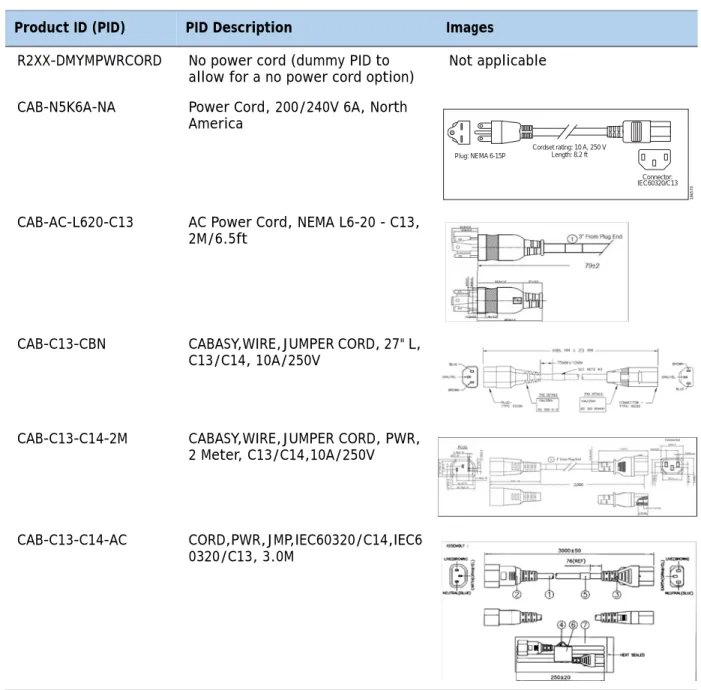
Using Table 14, select the appropriate AC power cords. You can select a minimum of no power cords and a maximum of two. If you select the option R2XX-DMYMPWRCORD, no power cord is shipped with the server.
Table 14 Available Power Cords
Product ID (PID) PID Description Images
R2XX-DMYMPWRCORD No power cord (dummy PID to
allow for a no power cord option) Not applicable CAB-N5K6A-NA Power Cord, 200/240V 6A, North
America
CAB-AC-L620-C13 AC Power Cord, NEMA L6-20 - C13, 2M/6.5ft
CAB-C13-CBN CABASY,WIRE,JUMPER CORD, 27" L, C13/C14, 10A/250V
CAB-C13-C14-2M CABASY,WIRE,JUMPER CORD, PWR, 2 Meter, C13/C14,10A/250V
CAB-C13-C14-AC CORD,PWR,JMP,IEC60320/C14,IEC6 0320/C13, 3.0M
Cordset rating: 10 A, 250 V Length: 8.2 ft
1
86570
Plug: NEMA 6-15P
Connector: IEC60320/C13
SFS-250V-10A-AR Power Cord, SFS, 250V, 10A, Argentina
CAB-9K10A-AU Power Cord, 250VAC 10A 3112 Plug, Australia
SFS-250V-10A-CN Power Cord, SFS, 250V, 10A, China
CAB-250V-10A-CN AC Power Cord - 250V, 10A - PRC
CAB-9K10A-EU Power Cord, 250VAC 10A CEE 7/7 Plug, EU
SFS-250V-10A-ID Power Cord, SFS, 250V, 10A, India
SFS-250V-10A-IS Power Cord, SFS, 250V, 10A, Israel Table 14 Available Power Cords
Product ID (PID) PID Description Images
186571
2500 mm
Cordset rating: 10 A, 250/500 V MAX Length: 8.2 ft Plug:
EL 219
(IRAM 2073) Connector: EL 701 (IEC60320/C13)
Plug:
Cordset rating: 10 A, 250 V/500 V MAX Length: 2500mm 186580 Connector: EL 701C (EN 60320/C15) EL 210
(BS 1363A) 13 AMP fuse
Cordset rating 10A, 250V
(2500 mm) Plug: EL 218 (CCEE GB2009) 186573 Connector: EL 701 (IEC60320/C13) Connector: VSCC15 Cordset rating: 10A/16 A, 250 V
Length: 8 ft 2 in. (2.5 m) Plug:
M2511
186576
OV
E
Cordset rating 16A, 250V (2500mm) Plug: EL 208 1 87490 Connector: EL 701
Cordset rating 10A, 250V/500V MAX
(2500 mm) Plug: EL 212 (SI-32) 186574 Connector: EL 701B (IEC60320/C13) EL-212 16A 250V
CAB-9K10A-IT Power Cord, 250VAC 10A CEI 23-16/VII Plug, Italy
CAB-9K10A-SW Power Cord, 250VAC 10A MP232 Plug, Switzerland
CAB-9K10A-UK Power Cord, 250VAC 10A BS1363 Plug (13 A fuse), UK
CAB-9K12A-NA Power Cord, 125VAC 13A NEMA 5-15 Plug, North America
CAB-JPN-3PIN Power Cord 3PIN, Japan Image not available
Table 14 Available Power Cords
Product ID (PID) PID Description Images
Plug: I/3G (CEI 23-16)
Connector C15M (EN60320/C15 ) Cordset rating: 10 A, 250 V
Length: 8 ft 2 in. (2.5 m)
186575
Plug: MP232-R
Cordset rating: 10 A, 250 V Length: 8 ft. 2 in (2.5 m)
186578
Connector: IEC 60320 C15
Plug:
Cordset rating: 10 A, 250 V/500 V MAX Length: 2500mm
186580
Connector:
EL 701C (EN 60320/C15) EL 210
STEP 11
ORDER OPTIONAL REVERSIBLE CABLE MANAGEMENT ARM
The reversible cable management arm mounts on either the right or left slide rails at the rear of the server and is used for cable management. Use Table 15 to order a cable management arm.
For more information about the cable management arm, see the Cisco UCS C240 M3 Installation and Service Guide at this URL:
http://www.cisco.com/en/US/docs/unified_computing/ucs/c/hw/C240/install/C240.pdf
Table 15 Cable Management Arm Product ID (PID) PID Description
UCSC-CMA2 Cable Management Arm for C240 rack servers
STEP 12
ORDER A TRUSTED PLATFORM MODULE (OPTIONAL)
Trusted Platform Module (TPM) is a computer chip (microcontroller) that can securely store artifacts used to authenticate the platform (server). These artifacts can include passwords, certificates, or encryption keys. A TPM can also be used to store platform measurements that help ensure that the platform remains trustworthy. Authentication (ensuring that the platform can prove that it is what it claims to be) and attestation (a process helping to prove that a platform is trustworthy and has not been breached) are necessary steps to ensure safer computing in all environments.
The TPM ordering information is listed in Table 16. Table 16 Trusted Platform Module
Product ID (PID) PID Description
STEP 13
ORDER CISCO FLEXIBLE FLASH SD CARD MODULE (OPTIONAL)
You can order one optional preloaded 16 GB Cisco Flexible Flash secure digital (SD) card. This SD card contains preloaded software for simplified server operation. The ordering information is listed in Table 17.See Figure 6 on page 53 for the location of the SD cards. There are two locations, SD1 and SD2. Table 17 Secure Digital (SD) Card (preloaded with software)
Product ID (PID) PID Description
UCSC-SD-16G-C240 16GB SD Card for C240 servers
NOTE: You can order an optional second blank SD card. The PID for the second SD (blank) card is shown in Table 18.
Table 18 Second Secure Digital (SD) Card (blank) Product ID (PID) PID Description
STEP 14
ORDER OPTIONAL USB 2.0 DRIVE
You can order one optional USB 2.0 drive. The USB drive ordering information is listed in
Table 19.
See Figure 6 on page 53 for the location of the USB connector. Table 19 USB 2.0 Drive
Product ID (PID) PID Description
STEP 15
SELECT OPERATING SYSTEM
Several operating systems are available from which to choose. Select one of the operating systems shown in Table 20.
Table 20 Operating Systems PID Description Product ID (PID)
SUSE Linux Enterprise Server
SLES-1A SLES/1yr subscription/svcs required/0 media SLES-3A SLES/3yr subscription/svcs required/0 media Red Hat Enterprise Linux
RHEL-2S-1G-1A RHEL/2 Socket/1 Guest/1Yr Svcs Required RHEL-2S-1G-3A RHEL/2 Socket/1 Guest/3Yr Svcs Required RHEL-2S-4G-1A RHEL/2 Socket/4 Guest/1Yr Svcs Required RHEL-2S-4G-3A RHEL/2 Socket/4 Guest/3Yr Svcs Required RHEL-2S-UG-1A RHEL/2 Socket/U Guest/1Yr Svcs Required RHEL-2S-UG-3A RHEL/2 Socket/U Guest/3Yr Svcs Required RHEL Add-Ons
RHEL-HA-2S-1A RHEL Option/High-Availability/2 Socket/1Yr Svcs Required RHEL-RS-2S-1A RHEL Option/Resilient w/Ha /2 Socket/1 Yr Svcs Required RHEL-SFS-2S-1A RHEL Option/Scalable File System/2 Socket/1 Yr Svcs Required RHEL-HA-2S-3A RHEL Option/High-Availability/2 Socket/3Yr Svcs Required RHEL-RS-2S-3A RHEL Option/Resilient Storage w/ HA /2 Socket/3 Yr Svcs Reqd RHEL-SFS-2S-3A RHEL Option/Scalable File System/2 Socket/3 Yr Svcs Required Windows Server
MSWS-08R2-STHV Windows Svr 2008 ST media R2 ST (1-4CPU, 5CAL) MSWS-08R2-ENHV Windows Svr 2008 EN media R2 EN (1-8CPU, 25CAL) MSWS-08R2-DCHV2S Windows Svr 2008 R2-2 CPU-Data Center
MSWS-08R2-DCHV4S Windows Svr 2008 R2-4 CPU-Data Center VMWare Server
VMW-VS5-STD-1A VMware vSphere 5 Standard for 1 Processor, 1 Year, Support Required VMW-VS5-STD-2A VMware vSphere 5 Standard for 1 Processor, 2 Year, Support Required
VMW-VS5-STD-3A VMware vSphere 5 Standard for 1 Processor, 3 Year, Support Required VMW-VS5-STD-4A VMware vSphere 5 Standard for 1 Processor, 4 Year, Support Required VMW-VS5-STD-5A VMware vSphere 5 Standard for 1 Processor, 5 Year, Support Required VMW-VS5-ENT-1A VMware vSphere 5 Enterprise for 1 Processor, 1 Year Support Required VMW-VS5-ENT-2A VMware vSphere 5 Enterprise for 1 CPU, 2 Yr Support Required VMW-VS5-ENT-3A VMware vSphere 5 Enterprise for 1 CPU, 3 Yr Support Required VMW-VS5-ENT-4A VMware vSphere 5 Enterprise for 1 Processor, 4 Year Support VMW-VS5-ENT-5A VMware vSphere 5 Enterprise for 1 CPU, 5 Yr Support Required
VMW-VS5-ENTP-1A VMware vSphere 5 Enterprise Plus for 1 Processor, 1 Year Support Required VMW-VS5-ENTP-2A VMware vSphere 5 Enterprise Plus for 1 CPU, 2 Yr Support Required VMW-VS5-ENTP-3A VMware vSphere 5 Enterprise Plus for 1 Processor, 3 Year Support Required VMW-VS5-ENTP-4A VMware vSphere 5 Enterprise Plus for 1 Processor, 4 Year Support Required VMW-VS5-ENTP-5A VMware vSphere 5 Enterprise Plus for 1 Processor, 5 Year Support Required Table 20 Operating Systems (continued)
STEP 16
SELECT OPERATING SYSTEM MEDIA KIT
Select the optional operating system media listed in Table 21. Table 21 OS MediaProduct ID (PID) PID Description
RHEL-6 RHEL 6 Recovery Media Only (Multilingual)
SLES-11 SLES 11 media only (multilingual)
MSWS-08R2-STHV-RM Windows Svr 2008 R2 ST (1-4CPU, 5CAL), Media MSWS-08R2-ENHV-RM Windows Svr 2008 R2 EN (1-8CPU, 25CAL), Media MSWS-08R2-DCHV-RM Windows Svr 2008 R2 DC (1-8CPU, 25CAL), Media
STEP 17
SELECT OPTIONAL VALUE-ADDED SOFTWARE
You can select from a variety of value-added software listed in Table 22. Table 22 Value Added SoftwareProduct ID (PID) PID Description
BMC-SE-4C BMC BladeLogic Standard Edition, 4 Cores, Support Required BMC-SE-6C BMC BladeLogic Standard Edition, 6 Cores, Support Required BMC-SE-8C BMC BladeLogic Standard Edition, 8 Cores, Support Required BMC-SE-10C BMC BladeLogic Standard Edition, 10 Cores, Support Required BMC-AE-4C BladeLogic Advanced Edition, 4 Cores, Support Required BMC-AE-6C BMC BladeLogic Advanced Edition, 6 Cores, Support Required BMC-AE-8C BMC BladeLogic Advanced Edition, 8 Cores, Support Required BMC-AE-10C BMC BladeLogic Advanced Edition, 10 Cores, Support Required BMC-002 BMC BladeLogic CM for Physical Cisco Servers
BMC-012 BMC BPPM Per Server
VMW-VC5-STD-1A VMware vCenter 5 Standard for 1 Processor, 1 Year, Support Required VMW-VC5-STD-2A VMware vCenter 5 Standard for 1 Processor, 2 Year, Support Required VMW-VC5-STD-3A VMware vCenter 5 Standard for 1 Processor, 3 Year, Support Required VMW-VC5-STD-4A VMware vCenter 5 Standard for 1 Processor, 4 Year, Support Required VMW-VC5-STD-5A VMware vCenter 5 Standard for 1 Processor, 5 Year, Support Required N1K-VLEM-UCS-1 Nexus 1000V License PAK for 1 Virtual Ethernet module
STEP 18
SELECT SERVICE and SUPPORT LEVEL
A variety of service options are available, as described in this section. Unified Computing Warranty, No Contract
If you have noncritical implementations and choose to have no service contract, the following coverage is supplied:
■ Three-year parts coverage.
■ Next business day (NBD) onsite parts replacement eight hours a day, five days a week. ■ 90-day software warranty on media.
■ Ongoing downloads of BIOS, drivers, and firmware updates.
■ UCSM updates for systems with Unified Computing System Manager. These updates include minor enhancements and bug fixes that are designed to maintain the compliance of UCSM with published specifications, release notes, and industry standards.
SMARTnet for UCS
For support of the entire Unified Computing System, Cisco offers the Cisco SMARTnet for UCS Service. This service provides expert software and hardware support to help sustain
performance and high availability of the unified computing environment. Access to Cisco Technical Assistance Center (TAC) is provided around the clock, from anywhere in the world. For UCS blade servers, there is Smart Call Home, which provides proactive, embedded diagnostics and real-time alerts. For systems that include Unified Computing System Manager, the support service includes downloads of UCSM upgrades. The Cisco SMARTnet for UCS Service includes flexible hardware replacement options, including replacement in as little as two hours. There is also access to Cisco's extensive online technical resources to help maintain optimal efficiency and uptime of the unified computing environment. You can choose a desired service listed in Table 23.
Table 23 Cisco SMARTnet for UCS Service Product ID (PID) On Site? Description
CON-PREM-C240M3SF Yes ONSITE 24X7X2 UCS C240 M3 Server - SFF CON-OSP-C240M3SF Yes ONSITE 24X7X4 UCS C240 M3 Server - SFF CON-OSE-C240M3SF Yes ONSITE 8X5X4 UCS C240 M3 Server - SFF CON-OS-C240M3SF Yes ONSITE 8X5XNBD UCS C240 M3 Server - SFF CON-S2P-C240M3SF No SMARTNET 24X7X2 UCS C240 M3 Server - SFF CON-SNTP-C240M3SF No SMARTNET 24X7X4 UCS C240 M3 Server - SFF CON-SNTE-C240M3SF No SMARTNET 8X5X4 UCS C240 M3 Server - SFF CON-SNT-C240M3SF No SMARTNET 8X5XNBD UCS C240 M3 Server - SFF
SMARTnet for UCS Hardware Only Service
For faster parts replacement than is provided with the standard Cisco Unified Computing System warranty, Cisco offers the Cisco SMARTnet for UCS Hardware Only Service. You can choose from two levels of advanced onsite parts replacement coverage in as little as four hours. SMARTnet for UCS Hardware Only Service provides remote access any time to Cisco support professionals who can determine if a return materials authorization (RMA) is required. You can choose a service listed in Table 24.
Unified Computing Partner Support Service
Cisco Partner Support Service (PSS) is a Cisco Collaborative Services service offering that is designed for partners to deliver their own branded support and managed services to enterprise customers. Cisco PSS provides partners with access to Cisco's support infrastructure and assets to help them:
■ Expand their service portfolios to support the most complex network environments ■ Lower delivery costs
■ Deliver services that increase customer loyalty
Partner Unified Computing Support Options enable eligible Cisco partners to develop and consistently deliver high-value technical support that capitalizes on Cisco intellectual assets. This helps partners to realize higher margins and expand their practice.
PSS is available to all Cisco PSS partners, but requires additional specializations and requirements. For additional information, see the following URL:
www.cisco.com/go/partnerucssupport
The two Partner Unified Computing Support Options include: ■ Partner Support Service for UCS
■ Partner Support Service for UCS Hardware Only Table 24 SMARTnet for UCS Hardware Only Service
Product ID (PID) Service Level GSP On Site? Description
CON-UCW7-C240M3SF UCW7 Yes UC PLUS 24X7X4OS UCS C240 M3 Server - SFF CON-UCW5-C240M3SF UCW5 Yes UC PLUS 8X5XNBDOS UCS C240 M3 Server - SFF
Partner Support Service for UCS provides hardware and software support, including triage support for third party software, backed by Cisco technical resources and level three support. See Table 25.
Partner Support Service for UCS Hardware Only provides customers with replacement parts in as little as two hours. See Table 26.
Unified Computing Combined Support Service
Combined Services makes it easier to purchase and manage required services under one contract. SMARTnet services for UCS help increase the availability of your vital data center infrastructure and realize the most value from your unified computing investment. The more benefits you realize from the Cisco Unified Computing System (Cisco UCS), the more important the technology becomes to your business. These services allow you to:
■ Optimize the uptime, performance, and efficiency of your UCS
■ Protect your vital business applications by rapidly identifying and addressing issues ■ Strengthen in-house expertise through knowledge transfer and mentoring
■ Improve operational efficiency by allowing UCS experts to augment your internal staff resources
■ Enhance business agility by diagnosing potential issues before they affect your operations Table 25 Partner Support Service for UCS
Product ID (PID)
Service Level GSP
On
Site? Description
CON-PSJ1-C240M3SF PSJ1 No UCS SUPP PSS 8X5XNBD UCS C240 M3 Server - SFF CON-PSJ2-C240M3SF PSJ2 No UCS SUPP PSS 8X5X4 UCS C240 M3 Server - SFF CON-PSJ3-C240M3SF PSJ3 No UCS SUPP PSS 24X7X4 UCS C240 M3 Server - SFF CON-PSJ4-C240M3SF PSJ4 No UCS SUPP PSS 24X7X2 UCS C240 M3 Server - SFF
Table 26 Partner Support Service for UCS (Hardware Only)
Product ID (PID)
Service Level GSP
On
Site? Description
CON-PSW2-C240M3SF PSW2 No UCS W PL PSS 8X5X4 UCS C240 M3 Server - SFF CON-PSW3-C240M3SF PSW3 No UCS W PL PSS 24X7X4 UCS C240 M3 Server - SFF CON-PSW4-C240M3SF PSW4 No UCS W PL PSS 24X7X2 UCS C240 M3 Server - SFF
You can choose a service listed in Table 27.
Unified Computing Drive Retention Service
With the Cisco Unified Computing Drive Retention (UCDR) Service, you can obtain a new disk drive in exchange for a faulty drive without returning the faulty drive. In exchange for a Cisco replacement drive, you provide a signed Certificate of Destruction (CoD) confirming that the drive has been removed from the system listed, is no longer in service, and has been destroyed. Sophisticated data recovery techniques have made classified, proprietary, and confidential information vulnerable, even on malfunctioning disk drives. The UCDR service enables you to retain your drives and ensures that the sensitive data on those drives is not compromised, which reduces the risk of any potential liabilities. This service also enables you to comply with regulatory, local, and federal requirements.
If your company has a need to control confidential, classified, sensitive, or proprietary data, you might want to consider one of the Drive Retention Services listed in Table 28.
Table 27 UCS Computing Combined Support Service
Product ID (PID)
Service Level GSP
On
Site? Description
CON-NCF2-
C240M3SFNCF2
No CMB SPT SVC 24X7X2 UCS C240 M3 Server - SFFCON-NCF2P-
C240M3SFNCF2P
Yes CMB SPT SVC 24X7X2OS UCS C240 M3 Server - SFFCON-NCF4P-
C240M3SFNCF4P
Yes CMB SPT SVC 24X7X4OS UCS C240 M3 Server - SFFCON-NCF4S-
C240M3SFNCF4S
Yes CMB SPT SVC 8X5X4OS UCS C240 M3 Server - SFFCON-NCFCS-
C240M3SFNCFCS
Yes CMB SPT SVC 8X5XNBDOS UCS C240 M3 Server - SFFCON-NCFE-
C240M3SFNCFE
No CMB SPT SVC 8X5X4 UCS C240 M3 Server - SFFCON-NCFP-
C240M3SFNCFP
NoCMB SPT SVC 24X7X4
UCS C240 M3 Server - SFFCON-NCFT-
C240M3SFNCFT
No CMB SPT SVC 8X5XNBD UCS C240 M3 Server - SFFNOTE: Cisco does not offer a certified drive destruction service as part of this service.
For more service and support information, see the following URL:
http://www.cisco.com/en/US/services/ps2961/ps10312/Unified_Computing_Services_Overview.pdf
For a complete listing of available services for Cisco Unified Computing System, see this URL:
http://www.cisco.com/en/US/products/ps10312/serv_group_home.html
Table 28 Drive Retention Service Options
Service Description Program NameService Level GSPService Service Level Product ID (PID) SMARTnet for UCS
Service with Drive
Retention UCS DR
UCSD7 24x7x4 Onsite CON-UCSD7-C240M3SF
UCSD7 8x5xNBD Onsite CON-UCSD5-C240M3SF
SMARTnet for UCS HW ONLY+Drive
Retention UCS HW+DR
UCWD7 24x7x4 Onsite CON-UCWD7-C240M3SF