- 1 -
2018
SYDNEY HIGH SCHOOL YEARLY EXAMINATIONASSESSMENT TASK 3
Preliminary Chemistry
Properties and Structure of Matter and Mole Concept
General Instructions • Reading time – 5 mins
• Working time – 2 hours
• Writing using blue or black pen
• NESA approved calculators are provided
Total marks:
75 Section I – 20 marks• Attempt Questions 1 - 20
• Allow about 25 minutes for this section
Section II – 55 marks
• Attempt Questions 21 - 31
• Allow about 1 hour 25 minutes for this section
Section I /20
Section II /55
Total Mark /75
Name: ... Class: ...
- 2 -
Section I
–Multiple Choice Questions.
20 Marks.Attempt Questions 1 – 20.
Use the Multiple Choice Answer Grid provided. Clearly mark one answer only per question. Allow about 35 minutes for this section.
--- 1. Choose a correct characteristic of a catalyst from the list given below.
(A) A catalyst doubles in a chemical reaction (B) A catalyst is consumed in a chemical reaction (C) A catalyst decreases the rate of reaction (D) A catalyst increases the rate of reaction
2. When reactions occur between molecules, the final rate of a chemical reaction is determined by which of the following factors?
(A) proportion of collisions in which the number of atoms is conserved (B) proportion of collisions in which the orientation is correct
(C) proportion of collisions in which the number of rearrangements is correct (D) proportion of collisions in which the number of molecules is conserved
3. When a piece of magnesium is placed into a blue Bunsen flame a bright white light is observed as the metal reacts with oxygen gas.
This reaction is:
(A) endothermic with a high activation energy. (B) endothermic with a low activation energy. (C) exothermic with a high activation energy. (D) exothermic with a low activation energy.
- 3 -
4. The following table shows the colour of universal indicator over a range of pH.
pH 1-4 5 6 7-8 9 10 11-14
Colour red orange yellow green blue mauve violet Four aqueous solutions were tested with the universal indicator. The results are shown below:
Solution Colour of Indicator
Milk Yellow
Soft soap Violet Lemon juice Pink Milk of magnesia mauve The solution that is very weakly acidic is
(A) Milk of magnesia (B) Lemon juice (C) Soft soap (D) Milk
5. Which of the alternatives below identifies the electron configuration of the cation and anion present in the compound aluminium chloride?
Cation Anion
(A) 1s2 2s2 2p6 3s2 3p5 1s2 2s2 2p6 3s2 3p1 (B) 1s2 2s2 2p6 3s2 3p1 1s2 2s2 2p6 3s2 3p5 (C) 1s2 2s2 2p6 3s2 3p6 1s2 2s2 2p6 (D) 1s2 2s2 2p6 1s2 2s2 2p6 3s2 3p6
6. A radioisotope (X) undergoes α-decay to produce radioisotope Y. Radioisotope Y undergoes β-decay to produce actinium-228. Which of the following identifies radioisotope X?
(A) uranium-238 (B) radium-226 (C) thorium-232 (D) palladium-231
- 4 -
7. Exothermic reactions
(A) Transfer energy to the surroundings
(B) Causes reaction and its surroundings to get colder (C) Take in energy from the surroundings
(D) Causes temperature decrease
8. The specific heat capacity of substances A and B are given in the table below.
substance specific heat capacity (Jg-1K-1)
A 2.121
B 1.433
From the data provided, if 100 kJ of heat energy was added to 1.0g samples of A and B, which of the following statements is true?
(A) The boiling point of substance A will increase more than that of B. (B) Substance B will become more reactive than substance A.
(C) The temperature of substance B will increase more than that of A. (D) The density of substance A will increase more than that of B.
9. A standard solution is defined as
(A) a solution of that has taken up all the dissolved substance (B) an unstable solution
(C) a solution that resists change in its hydrogen ion concentration (D) a solution of known and accurate concentration
- 5 -
10. When a person dives into the ocean, the pressure of gas in their lungs changes from 100kPa to 160kPa.
If their lungs initially held 6.0 L of gas, what volume of gas will be present in the lungs at the increased pressure?
(Assume the temperature of the gas in the lungs remains constant.) (A) 6.0 L
(B) 4.5 L (C) 3.8 L (D) 3.0 L
11. A chemistry student was provided with 250.0mL of 0.84M solution of barium hydroxide and asked to dilute the solution to form 100.0mL of 0.21M barium hydroxide.
Which of the following options concerning the procedure is correct?
Volume of 0.84M solution required to
make the diluted solution (mL)
Glassware required to make accurately known solution
(A) 25.0 measuring cylinder volumetric flask, (B) 75.0 measuring cylinder volumetric flask,
(C) 25.0 volumetric flask, pipette
(D) 75.0 volumetric flask, pipette
12. Limiting reagent in a chemical reaction is the one that (A) cannot react
(B) is completely used up
(C) causes the reaction to go faster (D) causes the reaction to go slower
13. While defining Charles’ law volume is directly proportional to what quantity? (A) Pressure
(B) Temperature (C) Moles
- 6 -
14. Which of the following is associated with decrease in entropy? (A) One particle decomposes into two
(B) The products formed is a gas
(C) The number of particles in the system decreases (D) The number of particles in the system increases
15. Given that ∆G = ∆H - T∆S, identify the correct statement below.
(A) A reaction will always be spontaneous if ∆H is negative and ∆S is negative. (B) A reaction will always be spontaneous if ∆H is negative and ∆S is positive. (C) A reaction will always be spontaneous if ∆H is positive and ∆S is negative. (D) A reaction will always be spontaneous if ∆H is positive and ∆S is positive.
16. Hydrogen bonding is an important intramolecular force between which of the following molecules?
(A) Methane (B) Hydrogen (C) Ammonia
(D) Hydrogen sulfide
17. A 2.00 kg sample of liquefied petroleum gas (LPG) contains 900.0 g of propane (C3H8) with the remainder being butane (C4H10).
What mass of this sample of LPG is due to carbon? (A) 1800 g
(B) 1648 g (C) 559 g (D) 473 g
- 7 -
18. Nitrogen and hydrogen react to produce ammonia according to the equation: 3H2(g) + N2(g) 2NH3(g) ∆H = -93 kJ/mol
Which of the following statements about this reaction is correct?
(A) Breaking the bonds in the reactants absorbs more energy than is released when the products are formed.
(B) Breaking the bonds in the reactants releases more energy than is absorbed when the products are formed.
(C) Breaking the bonds in the reactants releases less energy than is absorbed when the products are formed.
(D) Breaking the bonds in the reactants absorbs less energy than is released when the products are formed.
19. What is the enthalpy change for the reaction: H2O2(aq) H2(g) + O2(g)
given the following reactions and their associated enthalpy changes? 2H2O2(aq) 2H2O(l) + O2(g) ∆H= -200 kJ/mol 2H2O(l) 2H2(g) + O2(g) ∆H= +600 kJ/mol
(A) -400 kJ/mol (B) -200 kJ/mol (C) +200 kJ/mol (D) +400 kJ/mol
20. Concentrated sulfuric acid reacts with common sugar (C12H22O11) in the presence of oxygen to produce a residue of pure carbon as shown below.
2C12H22O11 (s) + 2H2SO4 (aq) + O2 (g) 22C(s) + 2CO2 (g) + 24H2O (l) + 2 SO2 (g) What mass of carbon could be produced from the reaction of 8.0g of sugar with excess sulfuric acid and oxygen?
(A) 6.2 g (B) 3.1 g (C) 1.4 g (D) 0.96 g
- 8 -
Section II –
55 Marks.
Instructions • Answer the questions in the spaces provided. These spaces provide guidance for the expected length of response.
• If you use extra space, clearly indicate which questions you are answering.
• Show all relevant working in questions involving calculations.
Question 21 (8 marks)
Phosphorus and nitrogen are in the same group of the periodic table. Both form chlorides.
Some data about their chlorides are shown in the table below.
Element Chloride Formula Boiling Point (o C)
Nitrogen NCl3 71
Phosphorus PCl3 76
PCl5 167
(i) The reaction to form liquid PCl3 involves heating solid phosphorus in the form of P4 with chlorine gas.
Write a balanced chemical equation for this reaction.
………... (ii) Complete the table below.
Formula Systematic name Electron dot diagram Molecular shape
PCl3
Marks
1
- 9 -
(iii) Account for the higher boiling point of PCl5 compared to PCl3.
………... ………... ………...
(iv) Provide an explanation, considering the electron configuration of N and P and the concept of valency, for why both nitrogen and
phosphorus can form NCl3 and PCl3, but only phosphorus is able to form PCl5.
………... ………... ………... ………... ………... ………... ………... ………...
1
3
Question 22 (3 marks)
Calculate the concentration of nitrate ions present in a 600.0 mL aqueous solution containing 18.50 g of dissolved aluminium nitrate.
………... ………... ………... ………... ………... ………...
3
- 10 -
Question 23 (3 marks)
Alex filled a spirit burner with methanol to heat 350 g of water in an aluminium can. He found that by burning 2.15 g of methanol, he could raise the temperature of water by 23.3 K. All mass measurements were made on the same balance. Using this data calculate the heat released by the methanol.
... ... ... ... ... ...
Question 24 (4 marks)
A chemist heats three substances, magnesium, copper (II) carbonate and ethane gas (one at a time) in a blue Bunsen flame.
All three substances react, two of them with oxygen in the air.
(a) Write a balanced chemical equation for each of the three reactions.
………... ………... ………... ………...
(b) Only the reaction of copper (II) carbonate is endothermic.
Use the appropriate chemical terminology to identify why the heat of the Bunsen flame is required for the other two reactions.
………... ………... ………...
3
3
- 11 -
Question 25 (4 marks)
The enthalpy change for the combustion of ammonia gas is shown below: 4NH3(g) + 7O2(g) → 4NO2(g) + 6H2O(g) ∆H= -1146 kJmol-1
Compound ∆Hf Ө kJmol-1
NO2(g) + 33.4
H2O(g) - 242
(a) Define the term standard enthalpy of formation. 1
………... ………... ………... (b) Use the data in the table to calculate the standard enthalpy of formation of ammonia.3 ………... ………... ………... ………...
Question 26 (4 marks)
The equation for the combustion of methane is:
CH4(g) + 2O2(g) CO2(g) + 2H2O(l) ∆Hc = -890 kJ/mol
The value of the entropy change for the combustion of methane is -242 JK-1mol-1. (a) Explain why a negative entropy change is consistent with the equation for the
combustion reaction.
………... ………... ………... ………... ………...
- 12 -
(b) Use the Gibbs free energy equation to determine whether the combustion of
methane will be spontaneous at 300 K. 2
………... ………... ………... ………...
Question 27 (7 marks)
A sample of carbon dioxide gas at a pressure of 300 kPa and a temperature of 50.00C occupies a volume of 40.0 L.
(a) Calculate the volume of this carbon dioxide at 298.15 K and 100 kPa.
………... ………... ………... ………...
(b) Calculate the number of moles of carbon dioxide in this sample.
3
2
………... ………... ………...
(c) Calculate the mass of this sample. 2
………... ………... ………...
- 13 -
Question 28 (4 marks)
Bond Energies at 298K
Bond ∆H (kJmol-1)
C-C 348
C=C 610
C-H 413
C-Cl 339
H-Cl 432
Cl-Cl 242
(a) Use the bond energies to estimate the enthalpy change for the following reaction. 3
………... ………... ………... ………...
(b) Explain why using bond energies is not an accurate method of calculating enthalpy changes. 1
………... ………... ………... ………...
- 14 -
Question 29 (5 marks)
Nitrogen gas can be prepared by passing ammonia gas over solid copper (II) oxide at high temperatures. The reaction also forms solid copper and water vapour.
In an experiment, 78.80 g of NH3 is placed in a container with 385.00 g of copper (II) oxide at high temperature.
What volume of nitrogen gas (collected at 25oC and 100kPa) will actually be formed if the process is only 80% efficient?
Show all working, including a relevant balanced chemical equation with your answer.
………... ………... ………... ………... ………... ………... ………... ………... ………... ………... ………... ………... ………... ………... ………... ………...
Marks
- 15 - Question 30 (8 marks)
Harry decided to set up two half-cells. One containing a solution of magnesium nitrate with a strip of magnesium metal as the electrode and the other containing copper (II) nitrate with a strip of copper metal as the electrode. Harry then connected the solutions in two beakers using a salt bridge soaked in potassium nitrate solution. The electrodes are connected to a galvanometer using electrical connecting wires.
(a) Draw a labelled diagram for Harry’s set up.
3
(b) Complete the following table for this galvanic cell.
3
Anode half equation Cathode half equation Overall cell equation
(c) Calculate the standard cell potential.
2
... ...
- 16 - Question 31 (5 marks)
Brian measured the speed of reaction of 0.5 g of Magnesium metal in 2.0 mol/L sulfuric acid. The volume of hydrogen gas evolved each minute was determined with no catalyst and copper as catalyst.
Time
(minutes) Volume of Hydrogen gas evolved (mL) (catalyst added) Volume of Hydrogen gas evolved (mL) (no catalyst)
0 0 0
2 20 7
4 35 12
6 42 17
8 43 22
10 43 25
12 43 28
14 43 30
16 43 34
18 43 38
20 43 42
(a) Plot a line graph to show the data given in the above table.
3
- 17 - (b) Write a conclusion for the above experiment.
2
... ... ... ... ...
- 18 -
Section II extra writing space.
If you use this space indicate clearly which question you are answering.
………. ………. ………. ………. ………. ………. ………. ………. ………. ………. ………. ………. ………. ………. ………. ………. ………. ………. ………. ………. ………. ……….
SBHS Y11 Chemistry Assessment Task 3 (Final Exam) 2018 - Marking Scheme. Marking Guidelines and Model Answers.
Section I Multiple Choice
1 2 3 4 5 6 7 8 9 10 11 12 13 14 15 16 17 18 19 20 D B C D D C A C D C C B B C B C B D C B
Section II
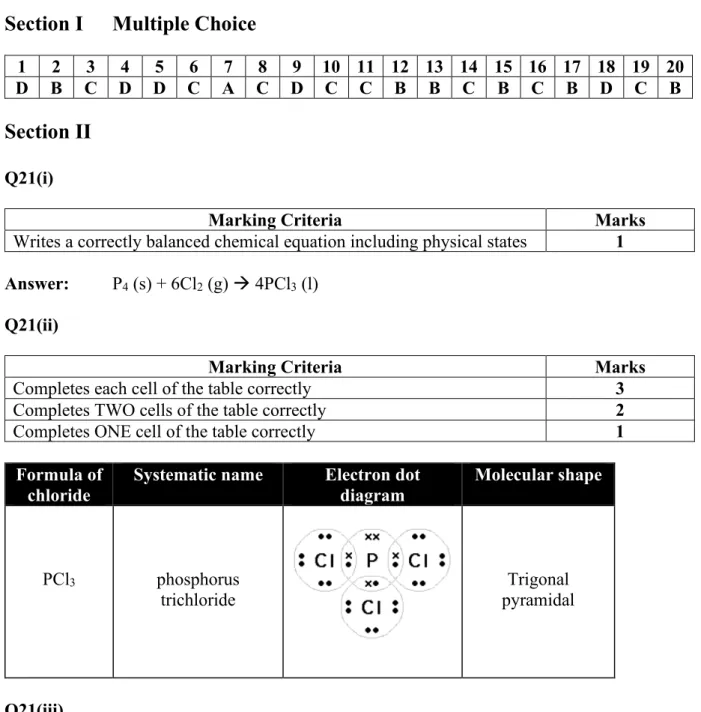
Q21(i)
Marking Criteria Marks
Writes a correctly balanced chemical equation including physical states 1 Answer: P4 (s) + 6Cl2 (g) 4PCl3 (l)
Q21(ii)
Marking Criteria Marks
Completes each cell of the table correctly 3
Completes TWO cells of the table correctly 2
Completes ONE cell of the table correctly 1
Formula of
chloride Systematic name Electron dot diagram Molecular shape
PCl3 phosphorus
trichloride pyramidal Trigonal
Q21(iii)
Marking Criteria Marks
Accounts for the higher boiling point of PCl5 compared to PCl3 in terms
of intermolecular forces 1
Sample Answer:
PCl5 has a higher molecular mass and higher number of electrons compared to PCl3, giving it stronger dispersion forces. This may be a reason for its higher boiling point.
Q21(iv)
Criteria Marks
• Gives the electron configuration of both N and P in terms of shells and subshells
• Explains why both N and P can form the trichloride compounds applying understanding of valency
• Explains why P can also form PCl5 but N cannot in terms of the maximum number of e- in the valence shell of each atom
3
Answer includes any TWO of the criteria above 2
Answer includes any ONE of the criteria above 1 Sample Answer:
Nitrogen has an electron configuration of 1s22s22p3 and thus has 5 valence electrons in the 2nd shell, which can hold a maxumim of 8. It can thus share 3 of its valence electrons with 1 from each Cl to form NCl3, but it cannot form NCl5 since this would require the 2nd shell to hold 10e-, which is not possible.
Phosphorus has the configuation 1s22s22p63s23p3 and also has a valency of 3, allowing it to form PCl3 but since the 3rd shell can hold 18e-, it can accomodate 5 e- from each Cl atom to form PCl5.
Q22
Marking Criteria Marks
Calculates the concentration of nitrate ions to the correct number of
significant figures. 3
Calculates the concentration of nitrate ions with one error 2
Shows one correct step in an attempt to calculate the concentration of
nitrate ions 1
Answer:
n (Al(NO3)3 ) = m/MM = 18.50 / 213.01 = 0.08685 mol Al(NO3)3 (s) Al3+ (aq) + 3NO3- (aq)
n (NO3-) = 3 x 0.08685 = 0.26055 mol
Q23
Marking Criteria Mark
Correctly calculates the value of heat released with correct units
corrected to 3 sig. figs. (ALL working shown) 3 Shows correct working out and correct answer with correct units, but
incorrect number of sig. figs. 2
Provides correct formula for calculation OR
Provides correct answer with correct units, but working out incorrect or incomplete
1
Answer: q = m C ΔT = 350 x 4.18 x 23.3 = 34088 J = 34100 J (3 s.f.) = 34.1 kJ (3 s.f.)
Q24 (a)
Marking Criteria Mark
Writes THREE correct, balanced chemical equations with correct
states 3
Writes THREE correct, balanced chemical equations with correct states with one error or omission
OR
Writes TWO correct, balanced chemical equations with correct states 2
Writes ONE correct, balanced chemical equations with correct states 1
Answers:
2 Mg (s) + O2 (g) 2 MgO (s) CuCO3 (s) CuO (s) + CO2 (g)
2 C2H6 (g) + 7 O2 (g) 4 CO2 (g) + 6 H2O (l)
Q24 (b)
Marking Criteria Marks
Identifies that the Bunsen provides activation energy to initiate reaction 1
Sample Answer:
Even though the burning of magnesium and the combustion of ethane are both exothermic reactions, the Bunsen burner provides the activation energy that is required to initiate the reaction.
Q25 (a)
Criteria Marks
Defines the term standard enthalpy of formation 1
Suggested answer:
The enthalpy change at a constant pressure when one mole of a compound is formed from its elements in their standard state (most stable form at 298 K and 100 kPa).
Q25 (b)
Criteria Marks
Uses Hess’s Law to correctly calculate the standard enthalpy of formation of
ammonia 3
Provides the main steps of the calculation 2
Provides some relevant steps 1
Suggested answer:
∆H = ∑∆HfӨ (products) - ∑∆HfӨ (reactants)
-1146 = (4 x 33.4 + 6 x -242) - ∆HfӨ (NH3) ∆HfӨ (NH3) = (4 x 33.4 + 6 x -242) + 1146
∆HfӨ (NH3) = (133.6 - 1452) + 1146
∆HfӨ (NH3) = -172.4 for 4 moles of ammonia
∆HfӨ (NH3) = - 43.1 kJmol-1
Q26 (a)
Marking Criteria Mark
• Relates a negative entropy change to a decrease in the
number of gas particles and explains why 2 • Relates a negative entropy change to a decrease in the
number of gas particles 1
The number of gas particles decreases moving from reactants to products so there is a decrease in disorder in the system. As a result the sign of S should be negative.
Q26 (b)
Marking Criteria Mark
• Correctly calculates ΔG and identifies that the reaction will
be spontaneous. 2
• Correctly identifies that the reaction will be spontaneous. 1
ΔG = ΔH – TΔS
= -890 – 300 x -0.242 = -817.4 kJmol-1
Because ΔG is negative, the reaction will be spontaneous at 300K.
Q27 (a)
Criteria Marks
• Correctly converts temperature units
• Correctly calculates the volume of carbon dioxide at 298.15 K and 100 kPa (significant figures not assessed)
• Includes appropriate unit
3
• Provides the main steps of the calculation 2
• Provides some relevant information 1
Answer:
T1= 50.0 + 273.15K = 323.15K P1V1/T1 = P2V2/T2
300*40.0 / 323.15 = 100*V2 /298.15 V2 = 298.15*300*40.0 / 100*323.15 = 110.71639 L
V2 = 111 L of CO2
PV = nRT n = PV/RT
= (300*40.0)/(8.314*323.15) = 4.4665 mol at 323.15K V = nRT/P
= (4.4665*8.314*298.15)/100
= 110.71639 L OR 110.7678 L (if only 323K used) = 111 L of CO2 at 298.15K
Q27 (b)
Criteria Marks
Correctly calculates the number of moles, stating ‘mol’ or ‘moles’ (significant
figures not assessed) 2
Provides the main steps of the calculation 1
NB: carry-on errors not penalised
Suggested answer
n = V/RTP (24.79)
= 110.716 L / 24.79 L.mol-1
= 4.4662 mol (4.46825 if only used 323K) = 4.47 moles
PV = nRT n = VP/RT
= 110.71639*100/(8.314*298.15) = 4.4665
Q27 (c)
Criteria Marks
• Correctly calculates mass and includes unit (shows all working) 2 • Provides the main steps of the calculation 1
NB: carry-on errors not penalised
Suggested answer:
MM (CO2) = 12.01 + 32 = 44.01g n = m / MM
m = n x MM
m = 4.466mol x 44.01g.mol-1
m = 196.57g (+/- 0.01g) OR 196.648 (+/- 0.01g) (if only 323K used at start) m = 197 g
Q28 (a)
Criteria Marks
• Provides correct number and type of all bonds broken and formed
• Uses bond energies to estimate the enthalpy change for the reaction 3 • Provides correct number and type of all bonds broken and formed
• Provides the main steps of the calculation 2 • Provides correct number and type of all bonds broken and formed 1
Answer:
Bonds broken Bonds formed
C - H 5x413
C - H 413 x6 C - Cl 339
C - C 348 C - C 348
Cl - Cl 242 H - Cl 432
Total 3065 kJ Total 3184 kJ
∆H = (sum of bond energies of bonds broken) - (sum of bond energies of bonds formed) ∆H = 3065 - 3184 = -116 kJ mol-1
Q28 (b)
Criteria Marks
Correctly explains why using bond energies is not an accurate method 1
Marker comment: don’t just “state”, explain.
Suggested answer:
- Enthalpy changes calculated using bond energies is not accurate, as they are simply an
average of similar bond dissociations. The energy of a particular bond varies according to the electrochemical environment surrounding the bond e.g. nearby electronegative atoms, nearby double bonds, molecule size etc.
OR
- Enthalpy changes calculated using bond energies is not accurate, as they are temperature and pressure dependent and assumes compounds are already in the gaseous state. Calculations are frequently based on assumed reactions of RTP conditions (298K at 100 kPa). This doesn’t accurately account for many non-standard conditions, affecting perceived enthalpy changes
Q29
Marking Criteria Marks
Writes a correctly balanced chemical equation AND
Calculates the correct volume of nitrogen formed (4 significant
figures ) 5
As above with one error or omission 4
Calculates the volume of nitrogen produced but working includes
two errors 3
Carries out any two correct steps in the calculation of the volume
of nitrogen produced 2
Writes a correctly balanced chemical equation OR
Completes one correct step in the calculation. 1
Answer:
3CuO + 2NH3 3Cu + 3H2O + N2
n(CuO) = m/MM = 385.00 / 79.55 = 4.8397 moles n(NH3) = m/MM = 78.8/ 17.034 = 4.626 moles LR: Cu: 4.8397 / 3 = 1.6132 NH3: 4.626/2= 2.313 Thus CuO is limiting reagent.
n(N2) = 4.8397/3 = 1.6132 mol (100% efficient)
Since process is only 80% efficient, V (N2) = 1.6132 x 0.80 = 1.2905 moles V= n x Vm = 1.2905 x 24.79 = 31.99L
Q30 (a)
Marking Criteria Mark
Provides a correct detailed and labelled diagram including correct connection of wires, galvanometer and salt bridge
AND
Identifies the Mg electrode is immersed in magnesium nitrate AND
Identifies the Cu electrode is immersed in copper nitrate
3
Any two of the above 2
Any one of the above 1
Sample answer:
Q30 (b)
Complete the following table for this galvanic cell. 3
Marking Criteria Mark
• Provides correct anode half equation AND
• Provides correct cathode half equation AND
• Provides correct overall equation
3
• Any two of the above 2
• Any one of the above 1
Sample answer
Anode half equation Mg(s) ⇌ Mg 2+ (aq) + 2e Cathode half equation Cu(s) ⇌ Cu 2+ (aq) + 2e
Overall cell equation Mg(s) + Cu 2+ (aq) ⟶ Mg 2+ (aq) + Cu(s)
MgNO3 CuNO3
Mg Cu
Salt bridge Galvanometer
Q30 (c)
Calculate the standard cell potential. (2 marks)
Marking Criteria Mark
• Provides correct answer AND
• Provides correct units
2
• Any one of the above 1
Answer:
E°cell = 0.34 + 2.36 = +2.70V
Q31 (a)
Marking Criteria Mark
Accurately plots data AND
Provides correct labels (with units) on axes AND
Lines drawn accurately (no dashed lines)
3
Any two of the above 2
Any one of the above 1
Sample answer
Q31 (b)
Marking Criteria Mark
• Speed of reaction is mentioned • AND
• Presence AND absence of catalyst is mentioned
2
• Any one of the above 1
Sample answer: