1
Entity Creation and Equity Considerations
§ Entity Formation
§ Founder Arrangements
§ Founder Employment Arrangements
§ Splitting the Pie
§ Founder Agreements
Legal Disclaimer
§ Not legal advice
§ K&L Gates and IPI are not your lawyers
§ There is no attorney-client privilege/don’t tell us
confidential information
§ Roadmaps are intended to assist in thinking
through issues in advance of obtaining legal assistance
§ Objective: Making you more effective consumers
3
§ C Corporation*
§ S Corporation*
§ Limited Liability Company*
§ Sole Proprietorship
§ Partnership
§ Limited Partnership
* Denotes most likely entity choice
Corporate Structure v. LLC Structure
Shareholders
Corporation Limited Liability
Company Members
Shareholder
Managed by Managers or Members Shareholder
5
Choice of Entity
There is no one answer for all companies “It depends…”
Limited Liability – Only Expose the Wager
§ Form of entity
§ Importance of formalities-“piercing the corporate
veil”
§ Contractual limitations
§ Insurance
§ Hidden liabilities
§ Unpaid wages and wage taxes
§ Pass-through entities with no cash to pay tax
7
Tax Considerations in Entity Choice
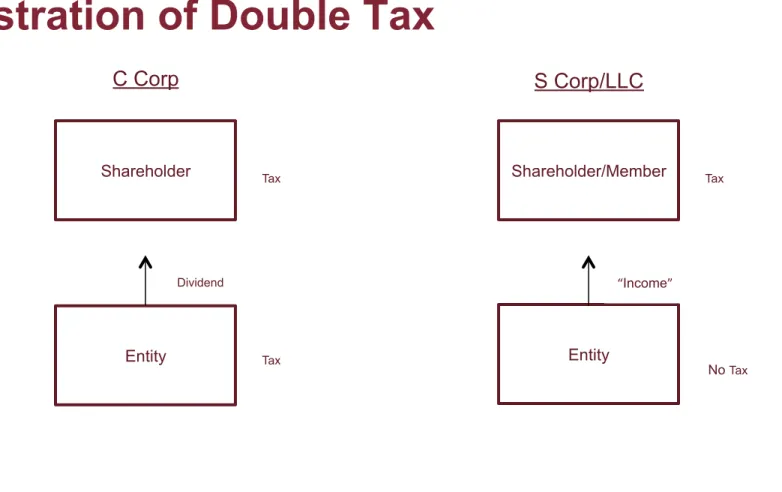
§ Double Taxation (C Corporation)
§ Corporate
§ Individual
§ Significance:
§ Material cash distributions/dividends
Illustration of Double Tax
Shareholder Entity Entity Shareholder/Member Tax C Corp Dividend Tax No Tax Tax S Corp/LLC “Income”9
Example of Double Tax
Income $100 $100
Corporate Tax $ 40 $ 0 After-Tax Entity Income $ 60 $100 Individual Tax $ 9 $ 40 Individual After-Tax Cash $ 51 $ 60
Assumed Tax Rates
40% corporate and individual tax 15% dividend rates
Other Tax Considerations in Entity Choice
§ Tax-Free Mergers (benefit for corporations)
§ Section 1202 – Qualified Small Business (benefit for
C Corporations)
§ 50% exclusion for qualified business stock
§ 5 year minimum holding period
§ Excluded businesses: professional service businesses; real
estate companies; financial services businesses § “Partner” implications (issue for limited liability
companies – benefit for corporations)
§ Self-employment taxes (2.9% of wages)
11
Limitations of S Corporations
§ Single class of stock (other than voting)
§ Limitation on number of shareholders – 100
§ Only individual and certain non-profit corporation
shareholders
§ Only citizens or residents of the United States
Other Considerations
§ Investor Favorable (C-Corporations)
§ IPO Favorable (C-Corporations)
§ Ease of use (e.g., option pools) (corporations)
13
Choice of Entity
C Corporation Limited Liability Company S Corporation
Sole Proprietorship/
Partnership Limited Partnership
Limited Liability Yes Yes Yes No Yes
Flexibility in Ownership Yes Yes No Yes Yes
Taxation
! Eliminates Double Taxation/ Flow-Through (losses, sale)
! Tax-Free mergers on sale
! Section 1202 tax favorable treatment No Yes Yes Yes No No Yes Yes No Yes No No Yes No No
Flexibility In Structure Yes Yes No Yes Yes
IPO Favorable Yes No No No No
VC Favorable Yes No No No No
Employer Eligible Yes No Yes No No
Ease of Use Yes No Yes Yes No
Bottom Line of Entity Choice
§ No simple answer
§ “Life-style company” or significant dividends/
distributions—consider S Corporation or LLC
§ Venture-capital oriented
§ Lean toward a C Corporation
15
Name of Entity
§ Check availability
§ Quick trademark search
State of Formation
Considerations
§ Flexibility § Taxation § Predictability § Cost § Attractive to capital § In general(a) “Fancy capital structure” or “Venture capital”-
17
Founders Clearance
§ Non-competition non-solicitation
§ Confidentiality Agreements
§ Fiduciary Duties
§ Intellectual property assignments
§ Agreements
Founder Employment/Consulting
Arrangements
§ Role of Founder going forward
§ Compensation
§ Intellectual Property Assignments—critical
§ Restrictive Covenants
§ Confidentiality – no limitation
§ Non-compete
§ Non-solicit (employees and customers)
19
Founder Equity Arrangements—Splitting the Pie
§ Lessons Learned
§ Keep in mind the inevitable dilution
§ Keep it simple
§ Align incentives
§ It is unusual for the right answer to be split it
evenly
§ Consider relative contributions (current and
anticipated)
§ Idea
§ Business Plan
§ Domain Expertise
§ Commitment and Risk
§ Responsibilities
§ Use Demmler’s Founders’ Pie Calculator
§ Evaluate related contributions
21
Demmler Founder Pie Chart – Example
(1) Inventor – leader in domain
(2) “Business guy” – business and industry knowledge (3) Technology – Inventor’s right-hand man
Demmler Founder Pie Chart (Example)
Idea 7 10 3 3 0
Business Plan 2 3 8 1 0
Domain Expertise 5 6 4 6 4
Commitment & Risk 7 0 7 0 0
23
Demmler Founder Pie Chart (Example)
Idea 70 21 21 0
Business Plan 6 16 2 0
Domain Expertise 30 20 30 20
Commitment & Risk 0 49 0 0
Responsibilities 0 36 0 0
Total Points 106 142 53 20 321
Founder Equity Arrangements
§ Vesting Arrangements
§ Amount of vested stock
§ Length of time of vesting
§ Buy-back arrangements
§ Decision-Making/Management
§ Who decides who decides?
§ Directors/Managers
§ Officers
§ Restrictions on Transfer
§ Absolute prohibition or Company consent
§ Rights of first refusal and modified rights of first refusal
25
Employment/Consulting Arrangements –
Similar to Founders
§ Term/severance
§ “At-will”
§ Intellectual Property Assignments—critical
§ Restrictive Covenants
§ Confidentiality – no limitation
§ Non-compete [Difficult to enforce with consultants]
§ Non-solicit (employees and customers)
Employee Equity
§ Types of Equity
§ Restricted equity (corporations; LLC’s)
§ Options
§ Qualified Options (corporations only)
§ Non-Qualified Options (corporations; LLC’s)
§ Profits Interests (LLC’s)
27
§ Restricted Stock
§ Taxed on receipt
§ Section 83(b) election
§ Stock Options—Non-qualified
§ No tax on receipt
§ Taxed on exercise at ordinary income rates
(fair market value less exercise price)
§ Taxed on sale (capital gain) (sale price less fair
market value at time of exercise)
§ Most likely outcome – exercise on sale; taxed
29
§ Stock Options – Illusive Qualified Options
§ No tax upon receipt
§ No tax upon exercise (subject to alternative
minimum tax on fair market value over exercise price)
§ Restrictions for Qualified Options (among
others)
§ Option price at fair market value
§ Must hold stock for at least 1 year after
exercise
§ Shareholder approval of plan
§ Employees Only
§ Non-transferable
§ Must be exercised with 90 days after
31
Profits Interests (LLC’s and Partnerships
Only)
§ Share in value in excess of value upon receipt
§ No tax upon issuance of profits interest
§ Treated as a member (e.g., share in distributions)
§ Potential capital gain treatment
Phantom Equity
§ Form of “Bonus Program”
§ Employee receives benefit of increase in value
33
Bottom Line
§ Restricted Stock is best if company has low value
§ Profits interests are attractive if entity is a limited
liability company
§ Non-qualified options are an attractive vehicle
§ Phantom equity is attractive if being used for a
broader audience
Other Terms
§ Vesting § Time-Based § Performance-Based § Repurchase Right § Vested § Non-vested35
Amount of Employee Equity
§ Amount necessary to attract and retain talent
§ A huge option pool may work against you
Roadmap
1. Consider choice of entity
2. Roles of Founders and Employment/Consulting
Arrangements with Founders
3. Apply Frank Demmler’s Founders’ Pie Calculator 4. Do a capitalization chart
§ Amount of Equity
§ Vesting Terms