A DV I S O RY
The Compliance
Journey
Balancing Risk and Controls
with Business Improvement
Contents
2
Introduction
4
Balancing Risk and Controls with Business
Improvement
6
Using Controls as a New Lens
10
Getting Started: Driving Value from Compliance
14
Conclusion
15
Appendix: Controls Definitions
16
Endnotes
Introduction
Compliance with government regulations, particularly
the Sarbanes-Oxley Act of 2002 (Sarbanes-Oxley), for
US or US-listed companies involves significant effort and
poses considerable challenges. At the same time, these
regulations require a level of introspection that can
reveal opportunities for business and risk management
improvements that go well beyond financial controls.
Consequently, many companies are seeking to leverage their compliance efforts to drive concurrent business improvements, which could include business process enhancements, risk mitigation, transformed controls, and increased business value. These improvements may not only help a business perform better, but also fundamentally reinforce the primary purpose of regulatory mandates (Sarbanes-Oxley or otherwise) – improved transparency in business management and bolstered investor/market confidence. In some cases, compliance with Sarbanes-Oxley has been perceived as burdensome and of limited business value – especially compliance with its section 404 requirements, that management document and assess internal control over financial reporting, report on the assessment, and subject the assessment to audit by the company’s independent auditor. Indeed, some companies have treated compliance with section 404 of Sarbanes-Oxley as a one-time project.1 Many Australian organisations will have complex control systems designed to ensure compliance with a range of relevant legislation – from financial reporting requirements to environmental or privacy demands. These controls will overlap and interact to achieve requirements.
In fact, achieving initial compliance is but the first important step in an ongoing process that must be sustained over time. If it is not treated as such,
organisations that meet compliance goals in one year may not necessarily do so in succeeding years. They may also have difficulties in complying with future legislative requirements. Moreover, viewing Sarbanes-Oxley and other regulatory requirements solely as costly legislative mandates may prevent organisations from looking beyond compliance to determine whether the organisation is controlling the 2 The Compliance Journey
Balancing Risk and Controls with Business Improvement 3
Going forward, organisations will need a dual focus: (1) sustaining an ongoing assessment process for Sarbanes-Oxley and/or other compliance and (2) balancing risk and controls while identifying and pursuing process improvement
opportunities to better the business.
The Journey Begins
This dual focus reflects the dual purpose of governance: to ensure compliance with laws and other constraints and to promote maximum performance. As with achieving compliance, good governance is a process or series of processes within an organisation rather than a state or structure.
Organisations exist to achieve objectives and risks and opportunities arise in relation to those objectives. To be successful, organisations (must) have controls in place to monitor and address these risks and opportunities. Control processes that do not address the risks of the organisation are unnecessary – a waste of organisational effort.
Now, having invested the time and resources necessary to document controls, organisations have more information about their controls in one place. By assembling this controls “portfolio,” leaders know what controls are performed and by whom – for perhaps the first time. They are beginning to understand how the nature of their controls affect, or are affected by, business performance – and, consequently, what changes may be needed to balance this portfolio as the business itself changes.
The efforts of compliance also provide considerable information about an
organisation’s business processes. The documentation and evaluation of controls is heavily guided by the nature of processes managed, their individual
significance, and the need to identify potential issues with internal control over financial reporting. With this information, organisations are beginning to
understand how their business processes work, how they interface, and how they can be made more effective and efficient. The insights about the business that can be derived from detailed analyses of company controls and business processes can lead to important business changes. An understanding of risks together with a catalogue of the controls in place can allow organisations to rationalise their overall control systems and guide their assurance processes. This paper is the first in a series of KPMG documents to examine this controls “transformation.” It sets the stage for this discussion by addressing some methods an organisation can use to begin transforming howthey control – so that controls are embedded within the business and compliance also supports business improvement. It also describes the benefits that can result from a focus that balances business improvement with risk and controls. Sustaining an ongoing process for regulatory compliance will be the topic of another document in this series.
By assembling a controls
“portfolio,” leaders know
what controls are
performed and by whom –
for perhaps the first time.
Balancing Risk and Controls
with Business Improvement
In many cases, organisations approach business
initiatives with a focus on improving performance and
creating value. These goals drive efforts to, for example,
automate processes, reengineer a supply chain, acquire
or divest, conduct joint ventures, or outsource.
Increasing levels of regulation, however, have prompted a greater focus on regulatory compliance and internal controls – efforts that to some have seemed separate and dissimilar from efforts to improve business performance and drive value. Concentrating on controls to the exclusion of purpose can divert energy from business improvement activities. However, considering controls in the context of proper risk management discipline (such as COSO ERM or AS/NZS 4360) can deliver significant benefit.
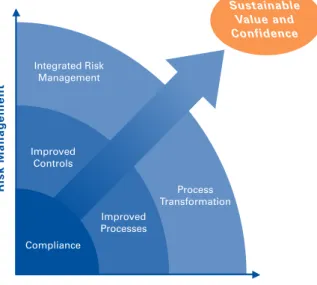
Structured risk management drives business value by achieving a balance between risk mitigation activity and business
improvement (see Figure 1). Sarbanes-Oxley, among other recent regulations, has put compliance on the leadership agenda. This mandate can be used to facilitate change and integrate a compliance/risk management focus into every aspect of the business.
Once initial compliance with key regulations is achieved, as depicted in Figure 1, organisations can build on that foundation to improve both their controls and their business processes – ultimately integrating risk management across the organisation and transforming processes. Information on the organisation’s controls portfolio provides leaders with a new lens through which they can evaluate their businesses, as they have used other lenses over time – such as Six Sigma, ISO 9000, or Total Quality Management. As a business lens, controls can become an important means of identifying new opportunities to manage risk, improve business performance, and add value, in both current and future initiatives. A strategic approach is essential to achieve sustained confidence and value.
4 The Compliance Journey
Business Performance R is k M a n a g e m e n t Sustainable Value and Confidence Improved Controls Integrated Risk Management Improved Processes Process Transformation Compliance
Figure 1: Achieving Improved Risk Management and Business Performance
Balancing Risk and Controls with Business Improvement 5
A Good Business Practice That Is Good for Business
To sustain control in a changing business environment, an organisation’s controls will not (and should not) remain static. As a business changes, so do its risks and, therefore, so must its controls.
Historically, many organisations have undertaken business initiatives – such as new information systems, process reengineering, mergers or acquisitions, or outsourcing – with a bias toward business improvement and value. When implementing an Enterprise Resource Planning (ERP) system, for example, internal controls were often addressed in a “siloed” fashion, late in the implementation process. Addressing controls as an after-thought sometimes resulted in ineffective or under-utilised automated controls, and retrofitting after implementation can be expensive and time-consuming. Experience shows that a large proportion of major implementations do not adequately address controls, resulting in challenges later.
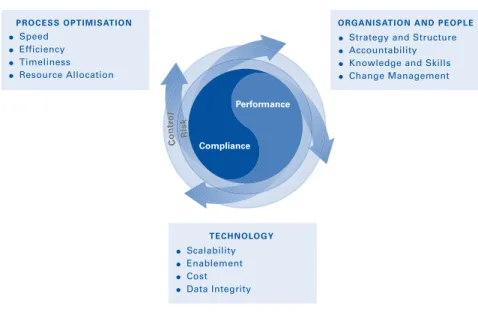
When planning significant business initiatives, organisations have always considered people, process, and technology. Increasingly, organisations are now explicitly considering risk and controls as a key dimension in planning change. Business initiatives need to be executed with a balance between risk and controls across the three
dimensions: process optimisation, organisation and people, and technology (seeFigure 2). Because of their
interdependencies, no single dimension can be the sole focus at any one time nor can performance be considered to the exclusion of compliance. Concerted effort is needed in the design phase of initiatives (not just during
implementation) to address all three dimensions. This integrated focus helps ensure that no single element is sacrificed for another; it is also good business practice. PROCESS OPTIMISATION ● Speed ● Efficiency ● Timeliness ● Resource Allocation TECHNOLOGY
ORGANISATION AND PEOPLE
● Scalability ● Enablement ● Cost ● Data Integrity
● Strategy and Structure ● Accountability ● Knowledge and Skills
● Change Management R is k C o n tr o l Compliance Performance
Figure 2: Balancing Risk and Controls with Business Improvement
Organisations do not have to sacrifice business improvement for effective compliance; indeed, an organisation that pursues both goals in an integrated fashion can achieve both.
Using Controls as a New Lens
Understanding how controls can be a lens to manage risk and identify opportunities for business improvement requires an understanding of the nature of controls.
In basic terms, a control is an activity that creates a context for action or validates information (for detailed definitions see Appendix: Controls Definitionson page 15). Controls are (or should be) embedded in processes – and the IT systems that enable them – to achieve organisational objectives and manage risk.
Controls are established to ensure, for example, that vendors are correctly paid, that inventory is safeguarded and managed, or that a sale was properly recorded. Large, complex organisations have literally thousands of controls, managed by potentially as many employees – a fact that underscores the importance of ensuring that the organisation has the right controls, at the right point in its processes.
6 The Compliance Journey
Controls are meaningless without a related objective. To
truly understand whether they have the right controls
over the right things, leaders should start with their
organisational objectives – financial reporting,
operations, and compliance. Then they can begin to
answer the questions: “Do our controls help us achieve
our objectives? Do we have the information we need to
determine if we will meet our objectives? Do our
controls enable the effective and efficient use of our
limited resources?”
Subsidiary 1 Subsidiary 2 Subsidiary 3 Subsidiary 4
Division 1 Division 2
Reporting Unit 1 Reporting Unit 2 Reporting Unit 3
Core Process 1 Core Process 3 Parent
Core Process 2
Division 3
Subprocess 1 Subprocess 2 Subprocess 3
Activity 1 Activity 3
Financial Data
Activity 2
Financial and Control Data
Board Communications External Reports Regulatory Reports Management Reports Other Communications FI N AN CI AL AN D PE R FO R MA N CE IN F OR M AT ION CO M PL IA NC E I NF OR M AT ION
INFORMATION CONVERGENCE INFORMATION CONVERGENCE
Figure 3: Information Flows and Controls Relevance
“Do our controls help us
achieve our objectives? Do
we have the information
we need to determine if
we will meet our
objectives? Do our controls
enable the effective and
efficient use of our limited
resources?”
When control information is not linked with the flow of
financial/performance information, how can leaders know the true impact on the organisation when things change?
Balancing Risk and Controls with Business Improvement 7
Understanding Information Flow and Controls Relevance
As depicted in Figure 3, the flows of information in a large organisation are multi-layered and complex. Financial and
performance information typically flows up, down, and across the entity and is used pervasively throughout.
For example, in a financial services organisation, Activity 2may encompass loan origination. When a loan is originated, the information generated may include such factors as interest rate (variable or fixed), the index to which variables are tied, payment frequency, maturity date, and information regarding the underlying collateral. That information would flow up to Subprocess 2, loan processing, where it would be consolidated with information on other loans and used for financial reporting.
The loan information would also flow across the organisation to, for example, the treasury department, where decisions on hedging interest rate risk would be made based on that information. As the information flows throughout the organisation, many rely on it for making business decisions.
Many companies have implemented reporting systems, such as financial consolidation software, to follow the flow of financial and performance
information and to allow for analysis thereof. In the process of developing controls documentation for financial reporting, information about performance has often been developed on a separate pathway.
Aligning the separate flows of business/financial information and controls information is critical to risk management and to managing the business. Financial/performance information is often disconnected from compliance information. When such is the case, and business changes take place, how can leaders expect that related controls will also be changed? Conversely, when control issues are identified, how can leaders know their true impact on the organisation – and related decision-making? When control information is not linked with the flow of financial/performance information, it becomes a “look back” and thereby loses much of its value.
Understanding the Controls Portfolio
Understanding the scope, magnitude, and impact of controls across the organisation requires a portfolio view. Using such an approach, an organisation can assess its controls from different demographic perspectives – such as by business units, applications, geographies, risk concentrations, or management objectives. Each of these demographic perspectives can be mapped in a similar fashion across four key control dimensions – automated versus manual and detective versus preventive (see Figure 4 on page 8).
This analysis is critical in assessing enterprise needs for controls evolution. An organisation should have a multi-faceted view of the quality and quantity of controls in the portfolio – a view of one demographic perspective will provide an incomplete picture. This multi-demographic view helps an organisation understand across the enterprise where the greatest challenges and opportunities lie.
Assessing control dimensions is useful. Manual controls depend on adequate resources and a consistent focus, and thus carry a greater risk of non-performance. When an urgent project arises, for example, staff normally
responsible for a control activity, such as matching invoices to purchase orders and receiving reports, may be pulled off to perform other activities – thereby leaving control needs unmet. In addition, manual controls tend to drive costs upward and reduce operating effectiveness as the organisation changes. On the other hand, automated controls can generally be relied upon to continue operating as programmed.
Moreover, some controls have a tendency to be “self-developing.” In this way, controls may become dispersed and duplicated, sometimes unnecessarily, throughout the organisation – one reason it can be time-consuming and complex to identify, document, test and remediate controls. Automated controls can help reduce costs, better manage risk, and provide more predictive business insights. Automated controls are often embedded within software programs – such as balancing control activities, predefined data listings, data reasonableness tests, and logic tests – to prevent or detect unauthorised transactions.
However, simply automating controls is no panacea – the over-arching goal is to help ensure that controls occur at the appropriate places in the process to be preventive, generate relevant information, and thereby enable appropriate action. Achieving this goal calls for an understanding of the process, the organisational objectives, the enabling technology, and the financial and performance
information that flows through the process – as well as what risks arise at what points in the process.
Structured analysis of the controls in place with reference to the risk profile of the organisation can help it identify duplicated or unnecessary controls. Analysis can also guide the organisation to those controls that will benefit from
automation. Effective control systems consider all means of implementation: process, technology and organisation.
8 The Compliance Journey
Preventive Detective
Automated
Manual
Division XXX – Control Portfolio
B u s in e s s U n it s A p p li c a ti o n s R is k C o rr e la ti o n s M a n a g e m e n t G e o g ra p h ic Evol ving Cont rols
Figure 4: Example Controls Portfolio Analysis
The portfolio approach can provide organisations with the opportunity to address controls from a variety of key perspectives.
Balancing Risk and Controls with Business Improvement 9
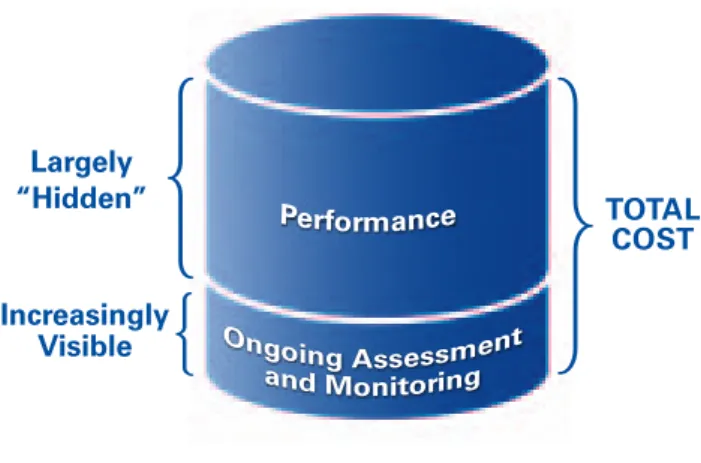
Control Performance + Ongoing Assessment of Control = Total Cost of Control
Of the potentially thousands of controls throughout an enterprise, much of their cost is related to their performance – that is, the design, execution, and administration of controls. In addition to incurring the performance cost of controls, organisations seeking to comply with Sarbanes-Oxley section 404 must now conduct an “ongoing
assessment” of controls. Other organisations with ongoing legislative compliance obligations will have a similar requirement. In addition to documenting internal controls supporting regulatory requirements, they must evaluate design and operational effectiveness, report on the assessment, and obtain a third-party audit of internal control. Together, control performance and ongoing assessment activities make up the total cost of control (see Figure 5).
The manual, labour-intensive nature of many controls in use today makes their performance and ongoing assessment a substantial cost and risk factor – potentially affecting the business’s performance and bottom-line results. For example, a large organisation may have more than 10,000 controls, 80 percent of which are manual and involve thousands of people in the organisation. The cost of performing manual controls, given the magnitude of controls and the number of people involved, can be staggering.
Linking Controls with Business Performance
Efforts to comply with external requirements such as Sarbanes-Oxley can help leaders understand the nature of their controls, processes, and systems; where they are located; and by whom they are performed – information that for most companies did not exist in one place before the Sarbanes-Oxley mandate. They also have an opportunity to create additional business insights by taking a controls portfolio view.
Armed with a vast array of information, organisations are beginning to understand how their controls are linked to business performance – and what changes may be needed to balance their controls portfolio as the business itself changes.
Otherwise, existing controls may become irrelevant and their cost unnecessary, and new risks may arise that are not addressed by appropriate controls.
The bottom line: for many companies, the Sarbanes-Oxley mandate has resulted in an opportunity for organisations to rethink the way they do business – where controls and business improvement are inextricably linked. The next section addresses how organisations can begin the process of driving value from compliance.
Figure 5: Understanding Total Cost of Control
The cost of performing manual controls, given the magnitude of controls and the number of people involved, can be staggering.
Getting Started: Driving Value
from Compliance
Having assembled a vast array of information about
processes, controls, and systems, organisations should
be better positioned to analyse their controls portfolio
and to use the results of that analysis to help them
reduce costs, enhance the quality of controls and
processes, and develop better business insights.
Many organisations are in the process of remediating gaps identified during initial compliance with Sarbanes-Oxley. These organisations may find that the process for beginning an analysis of the controls portfolio is compatible with their process for gap remediation. Remediation of key control gaps or compliance imperatives may be a primary priority; nevertheless, many opportunities for improving controls, processes, and systems may also be identified. If control activity focuses solely on legal compliance imperatives, opportunities for improvement may be overlooked.
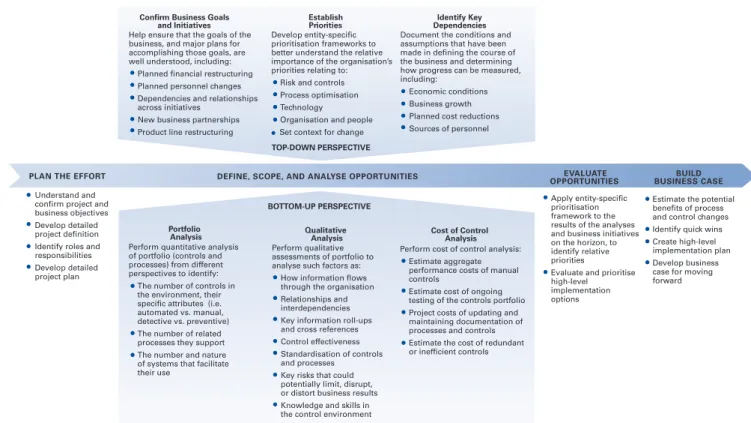
Driving value from compliance calls for a structured approach, such as summarised in Figure 6 on page 11 and described below.
Plan the Effort
As organisations change, they must include risk and controls as a key dimension in planning such change. Remediation of compliance gaps, new business initiatives, and other change events all present compliance imperatives as well as business improvement opportunities.
To get started, an organisation would plan the effort by developing an understanding of project drivers and objectives. Leaders may consider what business units, processes, systems, and controls, among other factors, may need to be included in the scope of the analysis. In so doing, the organisation can also identify key stakeholders who may need to be involved throughout the process.
Define, Scope, and Analyse Opportunities – Top-Down Perspective
Balancing risk and controls with business improvement begins with the identification of priorities and opportunities from a high-level or “top-down” perspective. This level of analysis is important to provide a scope and a context for the effort overall.
To effectively prioritise potential opportunities for improvement, leaders need to review and understand existing business goals and initiatives. Such goals and initiatives could include plans for financial restructuring, personnel changes, and new business partnerships as well as an evaluation of cross-initiative relationships 1 0 The Compliance Journey
If control activity focuses
solely on legal
compliance imperatives,
opportunities for
improvement may be
overlooked.
Balancing Risk and Controls with Business Improvement 1 1
This understanding also helps provide context for competing priorities and helps identify areas where risk and controls interact amongst initiatives.
Developing a top-down perspective also involves understanding an organisation’s relative priorities – considering risk appetite and controls across the dimensions of organisation and people, process optimisation, and technology. This process is the foundation for the development of an entity-specific prioritisation framework – including evaluation criteria, performance metrics, and business rules – that can be used to target areas for improvement, helping to ensure alignment with strategic priorities.
Another key aspect of the top-down analysis is to identify key dependencies that affect the business’s growth and development – such as economic conditions, growth opportunities, planned cost reduction, and sources of personnel. This analysis can help the organisation further evaluate where its best opportunities for business improvement may lie.
Figure 6: An Approach to Getting Started
Define, Scope, and Analyse Opportunities– Bottom-Up Perspective
The second level of analysis is conducted from a more detailed or “bottom-up” perspective. This analysis will differ from one organisation to the next, depending on each organisation’s objectives and relative priorities. For example, an
organisation seeking to reduce the total cost of control can assess detailed information in the controls portfolio from both quantitative and qualitative perspectives (including developing a better understanding of the cost of control), along with analyses relating to processes, technology, and the organisation. The list below provides examples of various aspects of such analyses.
1 2 The Compliance Journey
Risk and Controls
• Does the organisation have the right information to help it manage risk?
• How can the organisation align the various regulatory requirements with which it has to comply?
• Is there additional information that the organisation could be capturing concurrently to ensure that it is compliant with multiple regulations?
• How does the organisation ensure that new business changes (contraction, expansion, new ERP system, etc.) are appropriately captured and existing control documentation is updated accordingly?
Portfolio Analysis
Perform quantitative analysis of portfolio (controls and processes) from different perspectives to analyse such factors as:
• How many controls are present in the environment and what are the specific attributes, (i.e. automated vs. manual, detective vs. preventive)?
• How many processes do they support?
• What is the number and nature of systems that facilitate their use?
• What is their cost of control?
Process Optimisation
Perform process analysis to analyse such factors as: • How does information flow through the organisation, and
what information gaps exist?
• What are the costs and the cycle times of organisational processes?
• How can Sarbanes-Oxley information be leveraged to help identify process and control weaknesses, redundancies, and inefficiencies?
• To what extent are controls and processes standardised?
Technology
Perform analysis of information systems to analyse such factors as:
• How are business requirements aligned with technology
capabilities to help ensure that the organisation is taking advantage of technology enablement without redundancy?
• What service-level agreements are in place with outsourced vendors to help ensure that the organisation is receiving process and control information in a timely and consistent manner? • What automated control features are available in
current systems that may be under-utilised? • Where do multiple interfaces exist that may cause
inconsistent or inaccurate information?
Organisation and People
Perform analysis of organisational factors, such as: • Does the corporate structure facilitate the alignment
of end-to-end processes?
• Do process owners, outsource providers, and others understand their accountabilities for performance and risk management?
• What change management processes does the organisation have in place to ensure that any changes in processes or controls are embraced and followed by users?
• How does the organisation address cross-border and cross-process changes to the business?
Balancing Risk and Controls with Business Improvement 1 3
As a result of performing these analyses, an organisation can begin to identify opportunities to enhance risk management and improve processes, such as:
• Standardisation and simplification of processes, to reduce redundancy and improve quality.
• Improvement of information flows and the integrity of managed information – in some cases by moving the control portfolio from manual, detective controls to automated, preventive controls – thereby enhancing business decision-making.
• Enhancement of employee utilisation, as controls become more efficient and effective through appropriate use of technology, leading to reductions in the ongoing cost of compliance as well as the cost of performance (allowing for reallocation of resources).
Evaluate Opportunities and Build Business Case
The results of these analyses will help organisations to identify opportunities to better manage risk and improve business performance as well as reduce the ongoing cost of compliance over time. Applying an organisation specific
prioritisation framework to those opportunities helps identify priority initiatives for both immediate and future change. Potential benefits of process and control changes will factor into the decision process.
As a result of this effort to build on what the organisation learned during compliance initiatives, the organisation can create an implementation plan to address both short and long-term priorities, evaluate skill sets and resource availability, and make the business case for change.
Applying the organisation’s
entity-specific prioritisation
framework to those
opportunities helps
establish priority initiatives
for both immediate and
future change.
Conclusion
Compliance with Sarbanes-Oxley has driven many
organisations to assemble a vast array of information
about risks, controls, processes, and systems in one
place. Having made the investment in initial compliance,
leaders can leverage that effort in various ways.
A high-level as well as detailed analysis of their controls portfolio, for example, can help organisations identify areas in which they can enhance risk
management, reduce costs, and improve business processes. Thus they can embed controls (and the information about them) into systems and processes and, ultimately, balance a focus on risk and controls with efforts to improve performance.
For a typical organisation, the compliance journey – from a project-oriented state to a “new way of doing business”– will take many months or years. During each phase of the journey, the organisation will seek to balance controls improvements with improved business performance. Along the way, the question “How do we comply?” becomes “How can we use controls as a new lens to support the integrity and value of information in a changing organisation and dynamic marketplace?”
As the compliance journey continues, organisations can begin to move from a project approach to rethinking how they do business. Future documents in this series will address additional compliance topics, focusing on improved
transparency in business management and bolstered investor/market confidence 1 4 The Compliance Journey
TRADITIONAL CONTROLS • Static and project-oriented • Viewed in isolation
• Managed disparately
• Separated from the flow of business and financial information
• Owned by the compliance function(s)
• Supporting compliance
• Generating information of unknown or unmeasured usefulness
• Manual and detective
TRANSFORMED CONTROLS • Dynamic and action-oriented • Dependencies (controls/processes)
defined and captured
• Connected to the flow of business and financial information
• Process and data-centric
• Owned by the business and embedded in new processes • Supporting compliance and
information integrity
• Generating ongoing performance insights and business value • Automated and preventive (where
Appendix: Controls Definitions
Balancing Risk and Controls with Business Improvement 1 5
DEFINING INTERNAL CONTROL OVER FINANCIAL REPORTING – PCAOB AUDITING STANDARD NO. 2
The PCAOB defines internal control over financial reportingas a process designed by, or under the supervision of, the company’s principal executive and principal financial officers, or persons performing similar functions, and affected by the company’s board of directors, management, and other personnel, to provide reasonable assurance regarding the reliability of financial reporting and the preparation of financial statements for external purposes in accordance with generally accepted accounting principles.3
The Committee of Sponsoring Organisations of the Treadway Commission (COSO) and the Public Company Accounting Oversight Board (PCAOB), among others, provide specific, technical definitions of internal control.
DEFINING INTERNAL CONTROL – COSO
Internal control is broadly defined by COSO as a process, effected by an entity’s board of directors, management, and other personnel, designed to provide reasonable assurance regarding the achievement of objectives in the following categories:
• Effectiveness and efficiency of operations • Reliability of financial reporting
• Compliance with applicable laws and regulations
Internal control consists of five interrelated components. These are derived from the way management runs a business, and are integrated with the management process: Control Environment, Risk Assessment, Control Activities, Information and Communication, and Monitoring.2
End notes
1 Deborah Solomon and Cassel Bryan-Low, “Companies Complain About Cost of Corporate-Governance Rules,” The Wall Street Journal, February 10, 2004. 2 Committee of Sponsoring Organisations of the Treadway Commission,
Integrated Control Framework Executive Summary.
3 Public Company Accounting Oversight Board Auditing Standard No. 2, paragraph 7.
KPMG is the global network of professional services firms of KPMG International. Our member firms provide audit, tax and advisory services through industry-focused, talented professionals who deliver value for the benefit of their clients and communities. With nearly 100,000 people worldwide, KPMG member firms provide audit, tax and advisory services from 715 cities in 148 countries. In Australia, we operate nationally across 15 offices with nearly 300 partners and 4,000 people. Our local expertise, enhanced by the technical and industry knowledge of our global network, means we bring a deep understanding of our clients' business. It enables our professionals to deliver informed and timely advice.
Major KPMG Contributors
Steve Hill Larry Raff Stephen Burwell Eugene DeMark Colleen Drummond Gary Dushane Stephen Hasty Carole Law Mark Lindig Diane Nardin Michael Nolan John Rittenhouse Victor Rzeteljski Ted SenkoThe information contained herein is of a general nature and is not intended to address the circumstances of any particular individual or entity. Although we endeavour to provide accurate and timely information, there can be no guarantee that such information is accurate as of the date it is received or that it will continue to be accurate in the future. No one should act on such information without appropriate professional advice after a thorough examination of the particular situation.
Contacts
JoAnne Stephenson National Partner in Charge Risk Advisory Services +61 3 9288 5458
Cath Ingram Partner in Charge Internal Audit Services +61 2 6248 1209 [email protected]
Egidio Zarrella
Global and Asia Pacific Partner in Charge
Information Risk Management +61 2 9335 7590
James Allt-Graham Partner in Charge
Business Performance Services +61 2 9335 7084
John Somerville Partner in Charge
Financial Risk Management, Regulation & Compliance
+61 3 9288 5074
Mick Allworth Partner in Charge
Government Advisory Services + 61 2 6248 1201