European Cluster Observatory
Creative industries
Analysis of industry-specific
framework conditions relevant
for the development of
world-class clusters
The views expressed in this report, as well as the information included in it, do not necessarily reflect the
opinion or position of the European Commission and in no way commit the institution.
Extension of the European Cluster Observatory,
Promoting better policies to develop world-class clusters in Europe
Contract N° 71/PP/ENT/CIP/11/N04C031
Creative industries
Analysis of industry-specific framework conditions
relevant for the development of world-class clusters
Authors:
Kristina Dervojeda, Fabian Nagtegaal, Mark Lengton & Peyoush Datta, PwC Netherlands.
Contacts:
Kristina Dervojeda, PwC Netherlands, and Erica Monfardini, PwC Luxembourg.
Coordination:
Enterprise and Industry Directorate-General, Directorate D – “SMEs and
Entrepreneurship”, Unit D5 – “SMEs: Clusters & Emerging Industries”.
European Union, September 2013.
This work is part of a service contract for the
Enterprise and Industry Directorate-General
of the European Commission.
This report is financed under the Competitiveness and
Innovation Framework Programme (CIP) which aims to
Table of contents
Executive Summary 5
1. Objectives, scope and methodology 12
1.1. Rationale and objectives of the case study analysis 12
1.2. Definition and scope 13
1.3. Methodology 16
1.4. Structure of the report 19
2. Specifics of creative industries 20
2.1. Introduction 20
2.2. Key actors of the value chain 21
2.3. Key challenges of creative industries 23
2.4. Clusters in creative industries 23
3. Precursor stage: first interest in the emerging industry 25
3.1. Introduction 25
3.2. Presence of historical, cultural and artistic heritage 25
3.3. Critical mass of creative and entrepreneurial people in the region 27
3.4. Broad educational and research landscape 28
3.5. Presence of physical and social creative environment 29
4. Embryonic stage: entering a market environment 32
4.1. Introduction 32
4.2. Guarantee systems and other financial engineering mechanisms 32
4.3. Availability of seed and venture capital for creative companies 34
4.4. Critical mass of supply chain actors 35
4.5. Customer proximity 37
4.6. Policy measures supporting interdisciplinary cooperation 38
4.7. Policy measures supporting creative start-up companies 39
5. Nurture stage: demonstrating sustainable business potential 41
5.1. Introduction 41
5.2. Measures supporting creativity through education 41
5.3. Copyright system 42
5.4. Neighbouring rights 44
5.5. Policy measures promoting the mobility of artists and cultural practitioners 45
5.7. Strategy documents and roadmaps for the development of creative industries in the region 47
5.8. Dedicated cluster organisation 48
6. Growth stage: sustainable industrial growth 51
6.1. Introduction 51
6.2. Financial schemes supporting growth 52
6.3. Policy measures supporting flexible labour markets 53
7. Survey on industry specific framework conditions 55
7.1. Cross-regional comparison of general framework conditions 55
7.2. Industry specific framework conditions 57
8. Conclusions and policy recommendations 59
8.1. Key conclusions from case study analysis 59
8.2. Policy recommendations 60
Annex A: Questionnaire 66
Executive Summary
The current report represents a detailed case study description for creative industries prepared by PwC for Enterprise and Industry Directorate General of the European Commission within the “Extension of the European Cluster Observatory: Promoting better policies to develop world-class clusters in Europe” (contract nr 71/PP/ENT/CIP/11/N04C031).
Creative industries are becoming increasingly important components of modern post-industrial knowledge-based economies. They are thought to account for higher than average growth and job creation, they are also vehicles of cultural identity that play an important role in fostering cultural diversity. During the last decade, a number of governments around the world have recognised this fact and started to develop specific policies to promote these industries. This mainstreaming of the sector has led to a growing body of analysis, statistics and mapping exercises on the relationship between culture, creative industries and economic development to give officials in these countries the raw data they need to make policy. However, the sector is still poorly understood and many governments need to be convinced of its potential, while trying to accurately measure economic activity in the sector poses considerable obstacles1. It is therefore crucial to identify and analyse the framework conditions that are key to the competitiveness of creative industries in European regions.
The objective of the case study analysis is to demonstrate which framework conditions are favourable for the emergence of creative industries in regions, and specifically how policy makers can influence the development of this industry. The analysis aims to maximise policy relevance and produce practical policy recommendations on how to support the development of creative industries in Europe.
In order to obtain a realistic picture of the framework conditions relevant for the emergence and development of creative industries, the notion of industry’s dynamic nature was put in the centre of the analysis. This notion implies that the role and importance of the relevant framework conditions is likely to change with every new stage of the industry’s life cycle. To be effective, supporting measures thus need to be tailored to the various stages of the life cycle. The current analysis is built along the first four stages of the industry’s life cycle, i.e. stages relevant for emerging industries: (1) Precursor, (2) Embryonic; (3) Nurture; and (4) Growth. Key data sources include extensive desk-research, online questionnaire and validation interviews with industry experts (representatives of ten European hotspots in creative industries).
This case study is part of a number of reports prepared in the framework of the extension of the European Cluster Observatory. Two additional case studies also present results for the eco industries and for mobile services. The methodology for the case studies is described in more detail in a separate methodology report on the identification and benchmarking of ideal framework conditions. The definitions of emerging industries are detailed in the methodology report for the classification of the most active, significant and relevant new emerging industrial sectors. Emerging industries can be defined as the establishment of an entirely new industrial value chain, or the radical reconfiguration of an existing one, driven by a disruptive idea (or convergence of ideas), leading to turning these ideas/opportunities into new products/services with higher added value. The European Cluster Excellence Scoreboard Pilot Version measures regional strength in emerging industries and presents results in the fields of creative industries, eco industries and mobile services. The methodology applied by this scoreboard is described in more detail in a separate methodology report. Furthermore, a policy roadmap prepared by the European Forum for Clusters in Emerging Industries (EFCEI) introduces recommendations for actions for new linkages to promote the development of emerging industries through clusters in Europe. All reports – together with further maps by country, industry and indicators – can be found at http://www.clusterobservatory.eu/index.html#!view=aboutobservatory;url=/about-observatory /emerging-industries/ and http://www.emergingindustries.eu/.
1 UNESCO (2006) Understanding Creative Industries,
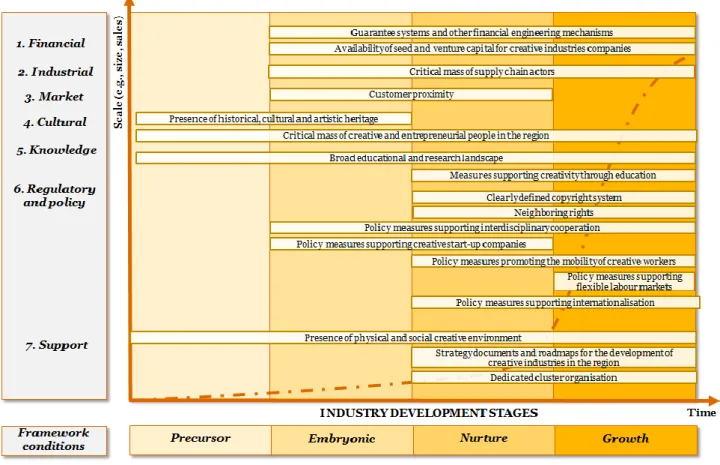
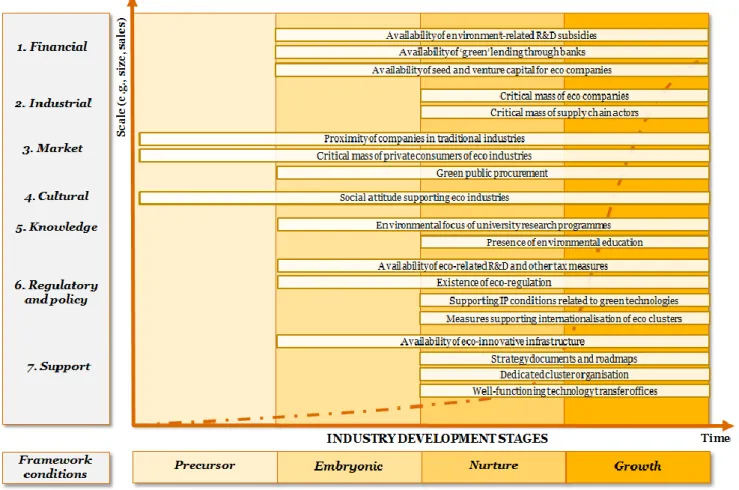
The analysis confirmed that the role and importance of the relevant framework conditions changes with new stages of the industry’s life cycle. However, all identified framework conditions prove to have a long-term impact and are relevant for more than one stage. Figure 0-1 presents the result of the mapping exercise of the analysed framework conditions for creative industries.
FIGURE 0-1: Mapping of identified framework conditions for creative industries
Key policy recommendations per industry development stage are as follows. Policy recommendations for Precursor stage
Policy makers can stimulate the development of creative industries at the Precursor stage in the following ways:
1) Presence of historical, cultural and artistic heritage:
a) Governments in most countries play an important role in the creative economy by their ownership and operation of public cultural institutions such as art galleries, museums and heritage sites. They are also often owners of significant tangible cultural heritage such as historic public buildings and collections of nationally significant artworks, artefacts, etc.
b) These cultural responsibilities of government should be seen as integral to the creative economy, especially because of the role of these institutions and activities in encouraging tourism, promoting social cohesion and fostering the beneficial aspects of cultural diversity;
c) Moreover historical, cultural and artistic heritage can be exploited to attract firms and individuals for building up a strong presence of creative industries through city marketing, tourism promotion, the organisation of festivals presenting cultural heritage assets that have shaped the identity of a city or a region;
d) Local culture and heritage also provides opportunities for further exploiting the full cultural and creative potential, by providing opportunities for scope and space for creative entrepreneurship to take place, e.g. by using creative lighthouses like infrastructure investments in museums to also foresee investments in entrepreneurship, e.g. integrated co-working spaces in new museums;
e) Policy makers may contribute to the exploitation of heritage related products and service in later stages of creative industry emergence.
2) Critical mass of creative and entrepreneurial people in the region:
a) Ensuring a better match between the supply of skills and the demands of the labour market is crucial in the medium and long run to boosting the sector's competitive potential.
b) Partnerships between art and design schools or universities and businesses can contribute to this aim. Incubator units, often established outside art schools but with their active cooperation, also have proved successful in closing the gap.
3) Broad educational and research landscape:
a) The spectrum of measures related to education is rather diverse. The measures related to education may include: (a) different awareness building measures: e.g. providing information on creative industries; (b) measures supporting creativity through education, e.g. targeted training in order to help people to value creative industries products and services; and (c) measures supporting the development of creativity in education: e.g. extra-curricular and vocational education and other youth related issues.
4) Presence of physical and social creative environment:
a) The physical and social creative environment might be influenced by policy makers in a variety of ways, depending on the stage of the industry emergence.
b) Regional and local policy makers might contribute to making available and developing space and buildings;
c) The development of the urban environment, making it more attractive, enlivening the atmosphere, developing the entire physical infrastructure, which includes activities aimed at: the development of public buildings, urban spaces, creative quarters and environments towards supporting creativity and bringing out inspiration;
d) Capital assets can be legislatively or institutionally protected from market forces, especially around property;
e) Affordable space for creative activity and enterprise is an enduring issue that need policy maker influence. Artists and other creative people are routinely priced out of areas that become popular due to the very creative activity that they helped generate.
Policy recommendations for Embryonic stage
Policy makers can stimulate the development of creative industries at the Embryonic stage by ensuring:
1) Guarantee systems and other financial engineering mechanisms:
a) Policy makers can use two main options to induce a change within creative industries regarding their emergence and access to financing option: direct access to capital through Public Investment Banks; and preferential credit;
b) Public Investment Banks should aim at giving SMEs better access to credit, supporting entrepreneurs at all stages of their project, helping enterprises to expand their market and their export activities; c) Policy makers might stimulate the use of crowd funding through educating creative entrepreneurs on
the use of crowd funding. Moreover regional policy makers can gather funds through crowd funding for financing creative projects that might not fit the local government budget or qualify for any other kind of financial support (e.g. a museum searching for funds to acquire new paintings).
2) Availability of seed and venture capital for creative companies:
a) Creative businesses are usually small, especially in the earliest phases, and considered quite high risk enterprises for the usual creditors and their standing with banks is not very high either;
b) Therefore this type of business often cannot use bank loans, at least in the early stages. To obtain additional capital, they have to go to the venture capital funds, which accept a higher level of risk. In many countries the venture capital funds are created by the public sector. In this case, if the company receives an investment from such a fund, there is usually a requirement for the inclusion of private investment;
c) Therefore policy makers might manage to instigate some venture capital schemes. As with start-up grants in smaller cities, venture capital funds may also be targeted at a broader range of enterprises including those in the creative sector, or may aim to facilitate cooperation between different sectors. An example of a venture capital fund aimed at the creative sector is the VC Fonds Kreativwirtschaft Berlin.
3) Critical mass of supply chain actors:
a) Building a critical mass of supply chain actors can help emerge creative industries within a region. However existing research indicates that value chains and spatial concentration of actors within creative industries differs per sub sector;
b) Following this pattern policy measures aimed at attracting supply chain actors can take into account spatial preferences of actors within sub sectors;
c) In attracting a critical mass in an embryonic stage of industry emergence, policy makers might lower the barriers for supply chain actors to locate their business within a region by creating an SME development policy that incorporates creative enterprises, based on a tailor made microenterprise development plan;
d) Policy makers can attract this mass by providing services and facilitate the establishment of SMEs, by speeding up the registration process, facilitating licenses, avoiding redundancies etc. This initiative could certainly be a catalytic tool for effective social inclusion measures, helping to bring the informal sector into existing organizational structures, such as professional associations;
e) Moreover value chains within creative industries are often diverse and complex without a strong organising entity. In the absence of such a strong organising entity (lead firm) public policy may have a role in mobilising and further integrating the supply chain of creative industries.
4) Customer proximity:
a) Policy makers influence on this framework condition extends to the policy domain of spatial planning and tourism;
b) Customer proximity also pertains to enhancing demand for creative industries through attracting customers on a permanent (attracting inhabitants) and temporarily basis (tourists and cultural visitors);
c) One type of measure in order to enhance demand for creative industries through customer proximity is by multi-targeted festivals. Supporting creative industries via multi-targeted festivals relates to various promotional activities—different events, including sector-based showcase festivals, broader city marketing activities, and others.
5) Policy measures supporting interdisciplinary cooperation:
a) Policy makers might recognize the importance of cooperation with creative industries, other businesses and the third sector through developing ways to participate in, or promote forms of interdisciplinary cooperation. These forms differ from location to location of course and reflect local traditions (political, economic, cultural) in the commitment of stakeholders to the development of the creative industries.
6) Policy measures supporting creative start-up companies:
a) As creative industries consist mainly of small and medium enterprises and even micro enterprises and freelancers, it has many similarities to other SMEs – they are affected by a specific set of entry and operational barriers like a lack of economy of scale, weak negotiating power, limited capital resources and limited human resources;
b) These measures entail a lot of different measures relating to general support measures for start-up companies and entrepreneurs. Examples of these measures include the following:
c) A regulatory environment which does not impose undue burdens on SMEs –to adjust the administrative regulations for small businesses in order to allow for ideas to bloom into businesses; d) Education and human resources management policies that foster an innovative and entrepreneurial
culture – to strengthen the links between arts, technology and business education;
e) Strengthening public-private partnerships and social dialogue – to involve more stakeholders in policy and city development; consistency with other national, regional and local policies – to cooperate and complement the policies provided on different administrational levels;
f) Consistency with other national, regional and local policies – to cooperate and complement the policies provided on different administrational levels.
g) Still they need partly tailor-made measures due to certain peculiarities of the people and companies in creative industries. Compared to other sectors part-time working, short-term contracts, freelancing and other flexible working forms are more common to creative industries.
Policy recommendations for Nurture stage
Policy makers can stimulate the development of creative industries at the Nurture stage by ensuring/supporting the presence of:
1) Measures supporting creativity through education:
a) Policy makers can influence creativity through educational activities over a broad spectrum covering young children up to adults. They can pursue the several options in order to do so:
b) promote the incorporation of creativity and innovation at all levels of education and training; c) support the professional development of teachers as mediators of creativity and innovation;
d) encourage the development of a learning culture where networks and partnerships between educational institutions and related bodies are forged with the corporate sector;
e) develop environments that favour creativity and innovation by promoting multi-level cooperation, intercultural dialogue and cultural production;
f) promote the development, exchange and dissemination of good practice on evidence-based education policies relating to creative and innovative skills;
g) promote creativity and innovation at all stages of lifelong learning through the EU programmes and instruments.
2) Copyright system:
a) Regional policy makers do not have much influence on the composition of intellectual property law. The concept of “copyright and related rights” is defined in national legislation;
b) However, enforceability of copyrights might be in the influence sphere of regional policy makers. Inadequate enforcement of copyright limits incentives to develop creative products, especially for small and medium-sized enterprises;
c) Other than enforcing copyright law on a regional level, policy makers might provide for adequate and up-to-date information on copyright laws in business support, education curricula and informal forms of protecting intellectual property, providing corresponding support.
3) Neighbouring rights:
a) Similar to copyrights, the influence of regional policy makers extends mainly to providing a system for enforcement and information providing facilities, reaching all actors in the value chain including customers.
4) Policy measures promoting the mobility of artists and cultural practitioners:
a) Mobility of artists and cultural practitioners can be influenced in a variety of ways. Policy makers might reduce the barriers for international mobility by liberalizing trade in services and goods within the creative industries and provide for free movement of natural persons. Although this policy measure is
in most of the cases out of the influence sphere of regional policy makers, these policy makers might be able to influence the international debate on liberalising labour markets for the mobility of artists and cultural practitioners;
b) Information services on mobility in the creative industries, i.e. an information system for cultural and creative workers providing information on mobility opportunities;
c) Programmes and schemes to support mobility such as Erasmus for Young Entrepreneurs programme. Mobility support schemes need to adapt to the new needs, trends and circumstances of artist mobility in Europe and learn from best practices. Flexibility is essential;
d) Installing and providing intermediary functions, i.e. organisations or agencies providing intermediary facilities for establishing mobility opportunities with other countries.
5) Policy measures supporting internationalisation:
a) Nurturing and growing world-class creative industries and exporting their works, products and services obviously entail developing links with other countries;
b) SMEs in particular require (financial) support to establish contacts and to have their activities promoted abroad. Industry–to–industry dialogue, scouting missions and market intelligence, and collective representation in international fairs are among the specific policy tools developed to support exports. A common support approach addressing groups of companies (clusters) offers more scope for impact;
c) Cooperation schemes offer both an opportunity for mutual learning and a network of contacts abroad. Facilitating artistic and other creative (e.g. gaming) exchanges with third countries is also important to stimulate cultural diversity and innovation.
6) Strategy documents and roadmaps for the development of creative industries in the region:
a) Strategy documents and roadmaps should target companies of all sizes in the region, not only SMEs, as well as universities and research institutes, i.e., there is a need for involvement of all actors of the value chain.
b) Objectives set in strategy documents and roadmaps need to be continuously monitored and periodically evaluated which implies appointing a responsible managing authority, monitoring committee, as well as carrying out interviews with beneficiaries, reporting by beneficiaries etc.
c) Interest in the actions set in strategy documents and roadmaps from the company side is crucial for their success. Higher interest is likely to be achieved if the documents are developed in close cooperation with the key stakeholders (by means of, for example, public consultations, workshop sessions, interviews etc.).
d) There is a constant need to adjust the strategic direction due to changes in the interests of the partners regarding general economic situation, international investment decisions (e.g., focus on Asia), changes in political focus etc., as well as difficulties in integrating interests of different stakeholder groups.
7) Dedicated cluster organisation:
a) Regional, national and EU authorities need to offer dedicated cluster policies that typically include grants for cluster management activities and specific collaboration projects.
b) The level of bureaucracy related to application and implementation of policies in the region needs to be minimised (i.e. complicated management procedures; long approval procedures for projects and excessive administrative workload need to be removed).
c) At the EU level, in close cooperation with national governments and regions, there is a need to support the efforts of cluster organisations to improve their performance and reach excellence (e.g., European Cluster Excellence Initiative and the organisation of further “train-the-trainers” activities for cluster managers).
Policy recommendations for Growth stage
Finally, besides the measures already mentioned above, the key measures to be taken by policy makers at the Growth stage include:
1) Financial schemes supporting growth:
a) A particular issue in relation to the execution of financial schemes supporting growth that has to be resolved at the regional level is how to create an organisational mechanism for supporting and financing the creative enterprises and creators – one possibility is to establish a special foundation; b) The fund can be financed by the establishment of a large capital fund for the use of the foundation and
which is boosted by the accumulated growth of the unused portion or alternatively which may involve annual funding from city budget. The next priority for the region will then be to secure the transfer of the region policy priorities into the foundation’s finance and administrative procedures;
c) In addition to the traditional financing support for cultural and creative institutions (covering the operating costs or financing the construction of cultural premises) various grant schemes for creators and creative companies and to support prime events and festivals in the region become relevant; d) Also added to the financing schemes may be support of creative aspects during the regeneration of city
districts and urban planning. In addition to the previous financing models, a region can support creative industries through offering tax benefits or lower rent conditions.
2) Policy measures supporting flexible labour markets:
a) Within creative industries, creative workers might still need partly tailor-made measures due to certain peculiarities of the people and companies in the creative sector, as opposed to general policy measures relating to supporting flexible labour markets;
b) Policy makers might influence the flexibility of labour at the forefront of the labour market during educational activities. Through these measures students that are likely to enter the creative industries are educated in such a manner that they are flexible and well informed about their options on the labour market;
c) Other than education and training facilities policy makers might support the emergence through policy measures in the area of awards and contests, start-up weekends, business support and tax and social security policies with most of the emphasis on the former.
Concluding remarks
1) While favourable policy measures cannot solve all the challenges on their own, their presence can significantly accelerate the development of creative industry clusters;
2) There is no generic ‘silver bullet’ across all creative industry clusters in terms of policy measures that have to be applied. What works in one region does not necessarily have to work in another one, as myriads of contextual factors (including historical, economic, demographic, cultural and other developments) determine the success of the applied policy measures;
3) The critical task is to ensure that policy interventions first support an effective process of identifying the action priorities and then provide the right tools to address whatever those priorities are;
4) Policy interventions supporting industry development should always be discussed with local companies, and designed in a way that captures the interest of those companies. Consequently, industry’s involvement in policy making is crucial from the very early stages, including the design stage of a policy intervention (joint objective setting), but also its monitoring and evaluation.
1.
Objectives, scope and
methodology
The current chapter summarises the objectives, scope and methodology of the case study analysis. The purpose of the chapter is to familiarise the reader with the applied approach and the rationale behind it. In the end of the chapter, we also elaborate on the structure of the current report.
1.1.
Rationale and objectives of the case study analysis
The current report represents a detailed case study description for creative industries prepared by PwC for Enterprise and Industry Directorate General of the European Commission within the “Extension of the European Cluster Observatory: Promoting better policies to develop world-class clusters in Europe” (contract nr 71/PP/ENT/CIP/11/N04C031).
Key objectives of the analysis
The analysis on industry specific framework conditions for the development of world-class clusters in creative industries implies the development of a suitable, feasible and robust methodology for the identification and analysis of these conditions that are considered to be conductive to the development of world-class clusters in emerging industries. The methodology then was applied to a selection of European regions in three emerging industries: creative, mobile services and eco industries. This exercise among others led to detailed case study descriptions demonstrating how emerging industries come to and evolves in regions, and specifically how policy makers can influence the development of these industries. The case study analysis therefore aims to maximise policy relevance and produce evidence-based policy recommendations on how to support the development of specific emerging industries in European regions.
Strategic importance of creative industries for Europe
The economic performance of the cultural and creative sectors is important for Europe: in the EU they account for 3.3% of GDP and employ 6.7 million people (3 % of total employment)2. Figures are also important if one considers the fashion3 and high-end industries, which rely on a strong cultural and creative input. They account for 3% of the EU GDP each and employ respectively 5 and 1 million people, with employment in the high-end industries expected to reach 2 million by 2020. Between 2008 and 2011, employment in the cultural and creative sectors proved more resilient than in the EU economy as a whole with growth rates varying however between subsectors. This tendency is all the more interesting because some sectors have a higher percentage of youth employment than the rest of the economy3.
Next to positive direct economic contributions, creative industries are catalysts for innovation. Being at the crossroads between arts, business and technology, cultural and creative sectors are in a strategic position to trigger spill-overs in other industries. They fuel content for ICT applications, creating a demand for sophisticated consumer electronics and telecommunication devices. Culture and creativity have also direct impacts on sectors such as tourism and are integrated at all stages of the value chain of other sectors such as fashion and high-end industries, where their importance as key underlying assets is increasing.
2 2010 European Competitiveness Report. Other sources have estimated it higher at 4.5% of GDP and 8.5 million people employed (TERA Consultants, 2010)
More generally, these sectors have an impact on innovation in other industries. As highlighted in the Innovation Union8, innovation is increasingly driven by non-technological factors such as creativity, design and new organisational processes or business models. It heavily relies on creative eco-systems in which the quality and diversity of partnerships across different sectors and types of actors is decisive. The most obvious example is the wider use of design in manufacturing industries, adding value to products, services, processes and market structures. Firms spending twice the average amount on creative inputs are 25% more likely to introduce product innovations9.
This catalytic potential can also constitute a fundamental resource for social innovation and responses to major societal challenges, such as climate change, sustainable development demographic changes or cultural diversity. For example, in partnership with the education and vocational training sector, the cultural and creative sectors can contribute to developing the blend of skills around creativity and entrepreneurship, critical thinking, risk taking and engagement, which is needed for EU's competitiveness in the knowledge society.
In addition creative industries contribute to local and regional development in the European Union. Creative-based development has relevance for regions in all stages of development – in the ‘convergence’ regions, where support for infrastructural development may continue to be needed, but also in both convergence and ‘competitiveness’ regions where the infrastructure and other local resources can be exploited to enhance the comparative advantages of the local economy and to stimulate creativity and enterprise. In many regions the creative sector is rapidly growing, outperforming other more established sectors in terms of growth in new businesses, turnover and employment; in many instances the absolute size of the sector now exceeds that of a range of traditional industries.
1.2.
Definition and scope
In this sub-section, we clarify the definition and scope of creative industries.
Employed definition of creative industries
Creative industries comprise activities related to the creation, production and/or distribution of creative goods and services as well as with the integration of creative elements into wider processes and other sectors. Creative industries are sometimes referred to as the cultural industries, but the two terms are neither synonymous nor interchangeable.
According to the United Nations Educational, Scientific and Cultural Organisation (UNESCO), “cultural industries refer to industries which combine the creation, production and commercialisation of creative contents which are intangible and cultural in nature. The contents are typically protected by copyright and can take the form of a good or a service. Cultural industries generally include printing, publishing and multimedia, audiovisual, phonographic and cinematographic productions as well as crafts and design.
The term creative industries encompasses a broader range of activities which include the cultural industries as well as all cultural or artistic production, whether live or produced as an individual unit. These industries are those in which the product or service contains a substantial element of artistic or creative endeavour and include activities such as architecture and advertising4.
The Priority Sector Report on Creative and Cultural Industries5 by the European Cluster Observatory argued for a common term for creative and cultural industries as it views both terms as conceptually linked, similar and to a certain level interchangeable. The final report6 of the ESS-net on Culture also has adopted a wider definition
4 Understanding Creative Industries: Cultural statistics for public-policy making, UNESCO, 2006
5 Power, D., 2011, Priority Sector Report: Creative and Cultural Industries, Europe Innova Paper No 16, The European Cluster Observatory, European Commission Directorate General Enterprise and Industry,
http://ec.europa.eu/enterprise/newsroom/cf/_getdocument.cfm?doc_id=7070
that includes, for instance, video games, although it maintains a perspective from the viewpoint of professions rather than industries.” Creative industries thus consist of activities drawing on “advertising, architecture, art, crafts, design, fashion, film, music, performing arts, publishing, R&D, software, toys and games, TV and radio, and video games”7.
Scope of creative industries
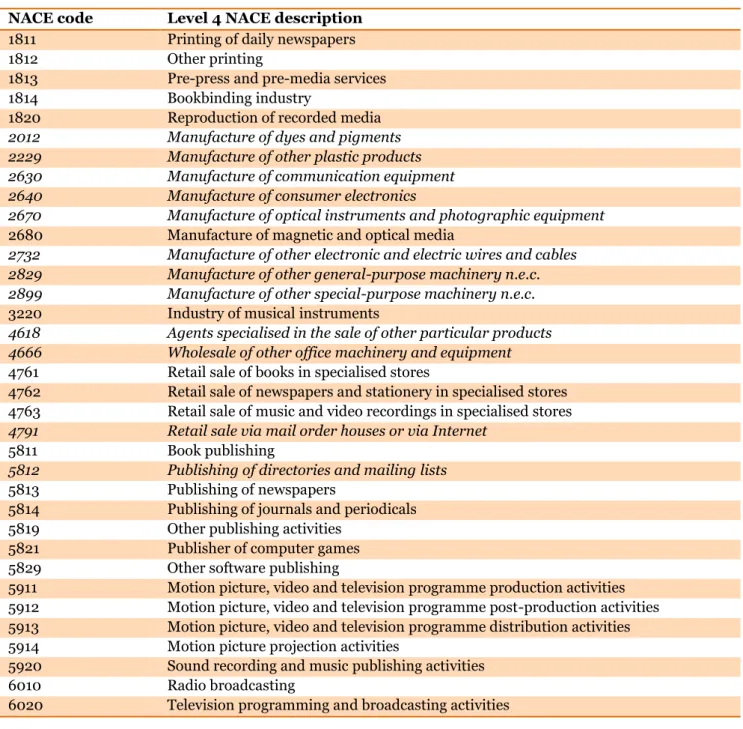
As included in the definition of creative industries, these industries comprise a broad array of sub-sectors. Below we present the scope of creative industries described in terms of NACE level 4 codes.
TABLE 1-1: Scoping of creative industries (based on the outputs of WP3; additional codes not included in the Priority Sector Report on Creative and Cultural Industries8 are highlighted in Italic)
NACE code Level 4 NACE description
1811 Printing of daily newspapers
1812 Other printing
1813 Pre-press and pre-media services
1814 Bookbinding industry
1820 Reproduction of recorded media
2012 Manufacture of dyes and pigments 2229 Manufacture of other plastic products 2630 Manufacture of communication equipment 2640 Manufacture of consumer electronics
2670 Manufacture of optical instruments and photographic equipment
2680 Manufacture of magnetic and optical media
2732 Manufacture of other electronic and electric wires and cables 2829 Manufacture of other general-purpose machinery n.e.c. 2899 Manufacture of other special-purpose machinery n.e.c.
3220 Industry of musical instruments
4618 Agents specialised in the sale of other particular products 4666 Wholesale of other office machinery and equipment
4761 Retail sale of books in specialised stores
4762 Retail sale of newspapers and stationery in specialised stores 4763 Retail sale of music and video recordings in specialised stores
4791 Retail sale via mail order houses or via Internet
5811 Book publishing
5812 Publishing of directories and mailing lists
5813 Publishing of newspapers
5814 Publishing of journals and periodicals 5819 Other publishing activities
5821 Publisher of computer games 5829 Other software publishing
5911 Motion picture, video and television programme production activities 5912 Motion picture, video and television programme post-production activities 5913 Motion picture, video and television programme distribution activities 5914 Motion picture projection activities
5920 Sound recording and music publishing activities
6010 Radio broadcasting
6020 Television programming and broadcasting activities
7 The Creative Economy: How People Make Money From Ideas, John Howkins, 2001
8 Power, D., 2011, Priority Sector Report: Creative and Cultural Industries, Europe Innova Paper No 16, The European Cluster Observatory, European Commission Directorate General Enterprise and Industry,
6110 Wired telecommunications activities 6120 Wireless telecommunications activities 6190 Other telecommunications activities
6201 Computer programming activities
6202 Computer consultancy activities
6209 Other information technology and computer service activities 6311 Data processing, hosting and related activities
6312 Web portals
6391 News agency activities
6910 Legal activities
7021 Public relations and communication activities
7022 Business and other management consultancy activities
7111 Architect's office
7112 Engineering activities and related technical consultancy
7311 Advertising agencies
7312 Media representation
7410 Specialised design activities 7420 Photographic activities
7430 Translation and interpretation activities 7722 Renting of video tapes and disks
7810 Activities of employment placement agencies 8230 Organisation of conventions and trade shows 8299 Other business support service activities n.e.c.
8552 Cultural education
8559 Other education n.e.c.
9001 Performing artists and producers of artistics and literary work 9002 Support activities to performing arts
9003 Artists, writers, journalists and others 9004 Theatre and concert hall companies etc.
9101 Libraries and archives
9102 Museums
9103 Institutions for the preservation of historical sites and buildings and similar visitor attractions
The NACE codes listed in Table 1-1 stem from both the Priority Sector Report on Creative and Cultural Industries and the definition of creative industries in the classification methodology of WP3 of this study. The additional codes identified for the creative industries relate to: the manufacturing of products and instruments used in the creative industries; the sale, distribution and promotion of creative goods (particularly online); information and communications technologies which play an increasingly important role in the creative sector; legal activities (e.g., related to Intellectual Property); and event management.
1.3.
Methodology
In the current sub-section, we highlight the key aspects of the methodology. For a detailed description of the methodology, the reader is advised to consult the Methodology Report of the analysis on industry specific framework condition for the development of world-class clusters in creative industries9.
Analytical framework
When studying emerging industries, their dynamic nature should not be ignored. The dynamic nature here refers to a continuous evolution of an industry and its periodical transitions from one stage to another. Therefore, in order to obtain a realistic picture of the framework conditions relevant for the emergence and development of the industries in question, the notion of their dynamic nature should be put in the centre of the analysis, since the role and importance of the relevant framework conditions is likely to change with every new stage of the industry’s life cycle. To be effective, supporting measures thus need to be tailored to the various stages of the life cycle. Furthermore, policies that aim to foster the development of clusters in emerging industries should differ from policies that aim to strengthen clusters in mature industries.
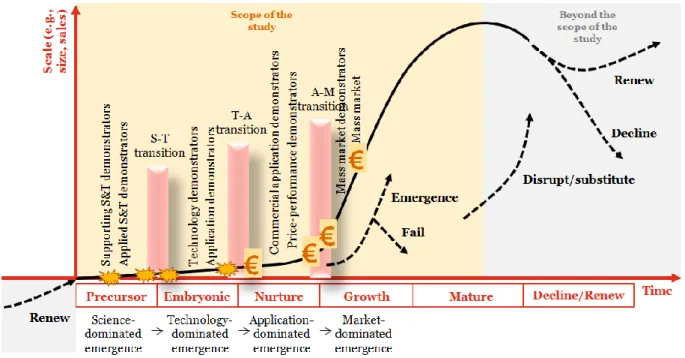
Figure 1-2 presents the employed analytical framework for characterising different stages of the development of emerging industries. The framework illustrates the growth/decline of an industry while it goes through the six main stages of its life cycle ((1) precursor, (2) embryonic; (3) nurture; (4) growth; (5) mature; and (6) decline/renewal), including three transition periods (Science -> Technology; Technology -> Application, and Application -> Market). The framework was adapted from Phaal et al. (2011) because of its comprehensive structure and high relevance to the scope of the current study. As can be seen from the Figure, sometimes an emerging industry’s first stage builds on the last stage of a mature industry.
FIGURE 1-2: Life cycle of regional industrial emergence
Source: adapted from Phaal R., O’Sullivan E., Routley M., Ford S., Probert D. (2011) A framework for mapping industrial emergence, Technological Forecasting and Social Change, Volume 78, Issue 2, February pp. 217-230 Below we elaborate on each of the stages and transition periods.
Stage 1 Precursor implies activities that support the development of a certain scientific phenomenon, business concept and/or underpinning service/technology platform in the region, which stimulate industrial interest and investment in particular market-directed feasibility studies.
Science - Technology Transition includes activities that support the demonstration of the feasibility of a scientific phenomenon, business concept and/or underpinning service/technology platform, helping the technology or service to be integrated into an application-oriented system.
Stage 2 Embryonic refers to activities that support the improvement of the reliability and performance of technology and services to a point where it can be demonstrated in a market environment.
Technology – Application Transition implies activities that help to demonstrate the commercial potential of technology and services in the region through revenue generation.
Stage 3 Nurture includes activities that help to improve the price and performance of applications to a point where sustainable business potential can be demonstrated.
Application – Market Transition refers to activities that help to develop a market with mass growth potential.
Stage 4 Growth implies activities that support marketing, commercial and business development leading to sustainable industrial growth in the region.
Stage 5 Mature includes activities that help to refine established applications, production processes and business models.
Stage 6 Renewal refers to activities that help to renew the industry through the development/adoption of new technologies that repeat the above phases.
For the analysis, the focus has been placed on the first stages and transition periods up to the Maturity stage (Stage 5), since the study aims to analyse the framework conditions helping to foster the development of exclusively emerging industries. Once the maturity stage has been reached, the industry per definition cannot be considered ‘emerging’ anymore, and becomes a mature one, which, in turn, is beyond the scope of the current study.
Key activities
Based on extensive desk-research and in-depth interviews with experts and industry representatives, the approach implies developing a pool of relevant industry-specific framework conditions, and assigning them to specific stages and transition periods of the regional industrial emergence.
The abovementioned activities were carried out in several steps:
(1) Step 1: developing a comprehensive overview of the relevant framework conditions from available sources (desk-research): this sub-task included an in-depth analysis of information on cluster framework conditions from existing sources such as EC publications (including ECO reports), business publications, academic articles and other relevant sources. This sub-task led to an extensive list of relevant industry-specific framework conditions.
(2) Step 2: compiling and structuring framework conditions:this sub-task implied the grouping of identified framework conditions into categories based on commonality patterns among those framework conditions thereby creating a nomological net of factors. The commonality patterns here refer to specific stages and transition periods of the life cycle. Furthermore, potential causal relationships between various groups of framework conditions were extracted from the desk-research analysis.
(3) Step 3: collecting evidence from a selection of European regions: this sub-task included additional desk-research on the regions in question complemented by an online questionnaire and in-depth interview rounds with the regional representatives of the industry in question. A complete overview of the content of the online questionnaire is provided in Annex A. For each region included in the analysis, a sample of key stakeholders was drawn, with a helicopter viewon the development of the industry in the region. The helicopter view in this case means understanding the overall picture of the industry’s development in the region rather than having a one-sided perspective. The included groups of stakeholders were: (1) cluster managers; (2) policy makers (regional/national); and (3) industry associations/chamber of commerce or similar. We aimed at developing a list of 5-10 stakeholders per hotspot and then to make a shortlist with 3 key stakeholders to be involved in an in-depth analysis.
(4) Consolidating the collected evidence and developing detailed case study descriptions:
the final step implied putting all the collected evidence together into one integrated case study description, and, based on thed key findings and conclusions, extracting practical policy recommendations.
Analysed framework conditions
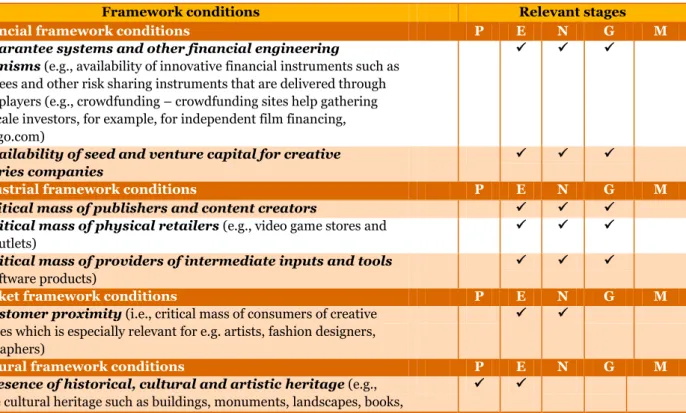
The framework conditions are listed below with the relevant stages:
TABLE 1-1: Consolidated overview of the identified framework conditions for creative industries (the acronyms in the table refer to the specific stages of the industry lifecycle: P = Precursor Stage; E = Embryonic Stage; N = Nurture Stage; G = Growth Stage; M = Maturity Stage).
Framework conditions Relevant stages
1. Financial framework conditions P E N G M
1.1. Guarantee systems and other financial engineering
mechanisms (e.g., availability of innovative financial instruments such as guarantees and other risk sharing instruments that are delivered through market players (e.g., crowdfunding – crowdfunding sites help gathering small-scale investors, for example, for independent film financing, indiegogo.com)
1.2.Availability of seed and venture capital for creative industries companies
2. Industrial framework conditions P E N G M
2.1. Critical mass of publishers and content creators
2.2. Critical mass of physical retailers (e.g., video game stores and rental outlets)
2.3. Critical mass of providers of intermediate inputs and tools
(e.g., software products)
3. Market framework conditions P E N G M
3.1. Customer proximity (i.e., critical mass of consumers of creative industries which is especially relevant for e.g. artists, fashion designers, photographers)
4. Cultural framework conditions P E N G M
4.1. Presence of historical, cultural and artistic heritage (e.g., tangible cultural heritage such as buildings, monuments, landscapes, books,
Framework conditions Relevant stages works of art, and artifacts; intangible cultural heritage such as folklore,
traditions, language, and knowledge; natural heritage including culturally-significant landscapes, and biodiversity)
4.2. Critical mass of creative and entrepreneurial people in the region (e.g., availability of people from different creative industries; availability of people from different complementary industries, e.g., telecom industries etc.)
5. Knowledge framework conditions P E N G M
5.1. Broad educational and research landscape focusing on both creative and technical disciplines (proximity of universities, research centres, schools)
5.2. Measures supporting creativity through education (e.g., targeted training; extra-curricular education; vocational education related to creative industries)
6. Regulatory and policy framework conditions P E N G M
6.1. Clearly defined copyright system that assigns an equivalent of property to new creative products
6.2. Neighboring rights that protect performers, recording producers and broadcasting organisations (the holders of neighbouring rights enjoy the exclusive right of reproduction, distribution and public communication of their performances/CDs/DVDs/broadcasts)
6.3. Policy measures supporting interdisciplinary cooperation
(e.g., measures promoting interdisciplinary cooperation between sectors of the creative industries; measures promoting interdisciplinary cooperation between creative industries and other industries)
6.4. Policy measures supporting creative start-up companies
6.5. Policy measures promoting the mobility of artists and cultural practitioners
6.6. Policy measures supporting flexible labour markets
6.7. Policy measures supporting internationalisation (e.g., funding creative cross-border events; industry-to-industry dialogue; scouting missions; market intelligence; collective representation in international fairs)
7. Support framework conditions P E N G M
7.1. Presence of physical and social creative environment (e.g., arts galleries, coffee shops, nightlife, work-live spaces at affordable prices)
7.2. Strategy documents and roadmaps for the development of creative industries in the region
7.3. Dedicated cluster organisation (cluster manager or similar) to coordinate the development of creative industries in the region
1.4.
Structure of the report
The structure of the report is organised following the dynamic model of industry’s development in the region.
Chapter 2 addresses the framework conditions relevant for the Precursor stage. Chapter 3 focuses on the framework conditions important at the Embryonic stage. Chapter 4 elaborates on the framework conditions relevant for the Nurture stage. Finally, Chapter 5 addresses the Growth stage. As shown in the Table 1-2, a framework condition is often relevant for more than one stage of industry’s development. In Chapters 3-6, we elaborate on framework conditions per stage, but to avoid repetition, if one framework condition is relevant for more than one stage, we specify it in the text where this framework condition first appears. In case there are considerable differences with other stages, we mention the same framework condition in the chapters dedicated to those other stages. In Chapter 7, we integrate the analyses of specific stages, draw the key conclusions and formulate policy recommendations. Annex A of the report contains the questions from the online questionnaire relevant for creative industries. Annex B provides an overview of the analysed regions and key data on creative industries-related clusters in those regions.
2.
Specifics of creative
industries
In this chapter, we elaborate on the specifics of creative industries, and particularly the key actors of the value chain, key challenges of the industry and the formation of clusters in creative industries.
2.1.
Introduction
Creative industries are becoming increasingly important components of modern post-industrial knowledge-based economies. They are thought to account for higher than average growth and job creation, they are also vehicles of cultural identity that play an important role in fostering cultural diversity. During the last decade, a number of governments around the world have recognised this fact and started to develop specific policies to promote these industries. This mainstreaming of the sector has led to a growing body of analysis, statistics and mapping exercises on the relationship between culture, creative industries and economic development to give officials in these countries the raw data they need to make policy. However, the sector is still poorly understood and many governments need to be convinced of its potential, while trying to accurately measure economic activity in the sector poses considerable obstacles10.
Creative industries comprise activities related to the creation, production and/or distribution of creative goods and services as well as with the integration of creative elements into wider processes and other sectors. Creative industries are sometimes referred to as the cultural industries, but the two terms are neither synonymous nor interchangeable. According to the United Nations Educational, Scientific and Cultural Organisation (UNESCO), “cultural industries refer to industries which combine the creation, production and commercialisation of creative contents which are intangible and cultural in nature. The contents are typically protected by copyright and can take the form of a good or a service. Cultural industries generally include printing, publishing and multimedia, audiovisual, phonographic and cinematographic productions as well as crafts and design. The term
creative industries encompasses a broader range of activities which include the cultural industries as well as all cultural or artistic production, whether live or produced as an individual unit. The creative industries are those in which the product or service contains a substantial element of artistic or creative endeavour and include activities such as architecture and advertising11. The Priority Sector Report on Creative and Cultural Industries12 by the European Cluster Observatory argued for a common term for creative and cultural industries as it views both terms as conceptually linked, similar and to a certain level interchangeable. The final report13 of the ESS-net on Culture also has adopted a wider definition that includes, for instance, video games, although it maintains a perspective from the viewpoint of professions rather than industries. ”Creative industries thus consist of activities drawing on “advertising, architecture, art, crafts, design, fashion, film, music, performing arts, publishing, R&D, software, toys and games, TV and radio, and video games”14.
10 UNESCO (2006) Understanding Creative Industries,
http://portal.unesco.org/culture/en/files/30297/11942616973cultural_stat_EN.pdf/cultural_stat_EN.pdf 11 Understanding Creative Industries: Cultural statistics for public-policy making, UNESCO, 2006
12 Power, D., 2011, Priority Sector Report: Creative and Cultural Industries, Europe Innova Paper No 16, The European Cluster Observatory, European Commission Directorate General Enterprise and Industry,
http://ec.europa.eu/enterprise/newsroom/cf/_getdocument.cfm?doc_id=7070 13 http://ec.europa.eu/culture/our-policy-development/eurostat-essnet-culture_en.htm
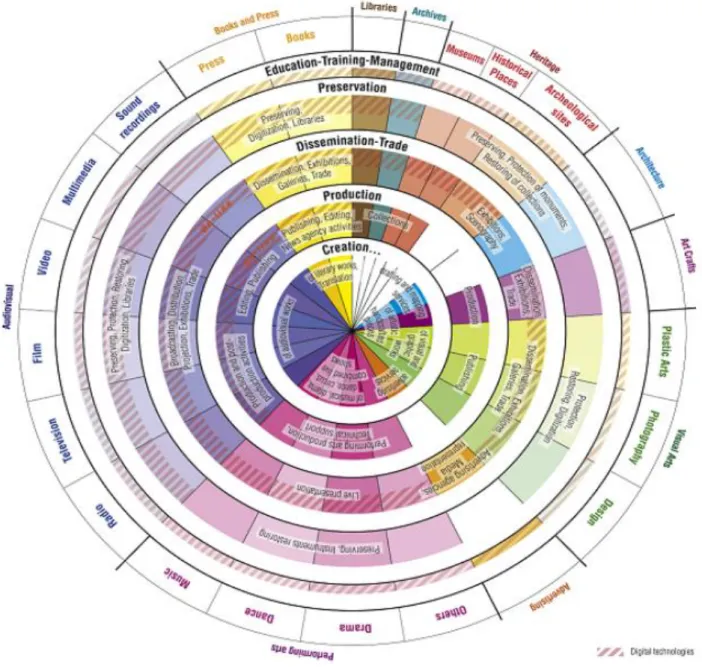
FIGURE 3-1: Framework for cultural activities
Source: ESSnet-Culture Final Report (2012)15
2.2.
Key actors of the value chain
In order to grasp the interplay of industry emergence, it is essential to distinguish between the different value chain actors. Abadie et al. (2008)16 identify the following groups of actors within the creative industries.
Publishers and content creators
Publishers and content creators need to finance the initial content creation and marketing, a requirement that places publishers in a central position in the industry. Processes of consolidation in the sector have reduced the
15 ESSnet-Culture Final Report (2012),
http://ec.europa.eu/culture/our-policy-development/documents/ess-net-report-oct2012.pdf
number of entry points into the market for content creators (e.g., independent authors, video game development and film studios etc.), creating a classic demand oligopoly situation. The dominant business model is based on publishers’ advancement of funding to content creators in exchange for the property rights over content (in some cases, it even includes future works). Once the advance is recouped from sales of the product, content creators start receiving royalties, usually a share of the revenue per unit of content sold.
Publishers and distributors
The nature of the interaction between publishers and distributors depends on the physical nature of the good being produced. Generally, the growing trend towards content digitisation and online distribution reduces the importance and power of distributors and wholesalers, who are in some cases being vertically integrated by publishers.
New players in the area of online distribution
Although the move towards digital distribution has not reduced the role of publishers who carry out essential funding and marketing functions (essential to increase a product’s visibility in a fiercely competitive environment), it creates new opportunities for actors with key capabilities and resources for online content aggregation, distribution and branding, such as Internet Service Providers and Internet Portals. In some cases, online distribution chains have been ‘captured’ by players who have been able to leverage their power in one step in order to attain dominance over the rest.
Retail
Physical retailers continue maintaining an important function in the distribution and promotion of creative content goods (e.g., by placing goods in visible displays in their stores). Consolidation of particular retail outlets areas (e.g., video game stores and rental outlets) has increased their bargaining power and made publishers reluctant to, for example, undercut them through online distribution of goods at prices which reflect the more cost-efficient nature of these channels.
Providers of intermediate inputs and tools
The growing complexity and costs of content creation brought forward by market and technological processes, and the fierce competition in creative content markets has increased content creators’ reliance on developers of creative and project management tools. The aim of such tools is to contain rising project costs and fulfil schedules. Access to these tools takes place in a form of user licensing, with contractual forms in some cases established using innovative revenue sharing models (e.g., tool providers who obtain royalties from the sales of the final output of a project).
Communities of customers
The move towards online distribution models facilitates the creation of closer communication channels between content owners and consumers, as well as the emergence of communities of consumers that in some cases engage in content production themselves. This area is undergoing an important degree of experimentation in terms of innovative business models and IPR arrangements. The dominant trend is based on the exchange of user-generated content for merchandise and non-monetary rewards such as prestige and visibility inside the consumer community, although other alternatives, such as the creation of markets for the exchange of such complementary assets have started emerging.
Nowadays it has become more important for firms in the creative industries to have different competences, i.e. to have creators, distributors and technological professionals (and not only different professionals with these skills but increasingly professionals that have all these different skills). This is one of the reasons why creative industries are an emerging industry because its subsectors are merging and being transformed as well because creative industries as a whole are merging with other industries such as tourism, fashion etc.
Below we elaborate on the framework conditions relevant for each of the steps of the industry life cycle. While the framework conditions are assigned to a particular stage here, they may and in many cases do apply also to other stages of the life cycle. In the text below, each framework condition is assigned to the stage that is of the highest relevance to this particular framework condition.
2.3.
Key challenges of creative industries
The main challenges that the EU creative industries have to face include the following17:
These industries are faced with a rapidly changing environment characterized in particular by new technologies (digital shift) and globalization, which bring with them new challenges and opportunities.18
In this changing context, access to finance remains a major difficulty: the banking sector does not have the necessary expertise to analyse business models in these sectors and does not adequately value their intangible assets. The financial and economic crisis only makes this situation more critical at the very time when investments are needed to adapt. 19
These sectors are also characterized by a high fragmentation along national and linguistic lines. While the resulting cultural diversity is a clear European asset, this leads to limited and sub-optimal transnational circulation of cultural and creative works and operators within and outside the EU, geographical imbalances and - subsequently - a limited choice for consumers.
Powerful dynamics take place at the borderlines between various sectors (for instance, through increased linkages between gaming, film and music) and with other industries (such as fashion, high-end or tourism). However, the sectors and policies are still often organised in sectoral silos, limiting the scope for synergies and the emergence of new solutions and businesses.
2.4.
Clusters in creative industries
As highlighted above in scoping industries, creative industries comprise a variety of subsectors. According to recent literature clustering and co-location tendencies differ per subsector20. Whilst there are different cluster and location tendencies for different sectors of the creative and cultural industries it is interesting to note that different stages in the creative industries value chain also exhibit different cluster tendencies.
Production and manufacturing activities are the most regionally concentrated, and consumer/end-user oriented activities the least regionally concentrated. Concentration measures clearly show that the most concentrated creative and cultural industries are those involved in specialised manufacture or publishing: games publishing, recorded media and film and television activities.
There is considerable evidence from other industries that specialised production benefits from, and is drawn to industry clusters; it seems this is also the case in creative and cultural industries. A similar pattern can be found for production related activities such as publishing of software and music, news agencies, and manufacture of musical instruments. High levels of concentration are apparent in institutions and organizations involved in cultural heritage and education as well as in libraries and archives.
17COM (2012) 537, “Promoting cultural and creative sectors for growth and jobs in the EU” 18 http://ec.europa.eu/culture/our-policy-development/cultural-and-creative-industries_en.htm 19 http://ec.europa.eu/culture/our-policy-development/cultural-and-creative-industries_en.htm
20 The European Cluster Observatory (2011) Priority sector report: Creative and Cultural Industries, Europa Innova Paper No 16
The least concentrated activities are those in the value chain that are nearest the consumer – such as bookshops, cinemas, and exhibition spaces – or are business services/inputs the creative and cultural industries may regularly need – such as printing, programming, photographic, or pre-press/pre-media services. Such activities do exhibit some cluster tendencies at a European level but locational concentration is likely more apparent within regions: e.g. at the level of shopping or theatre districts.
Employees in firms focused on advertising and in artistic and literary creation and interpretation are also less likely to be concentrated in dominant centres. This is likely due to the need to locally tailor advertising campaigns or artistic and literary products to local conditions: something that is most efficiently done in proximity to end user cultural contexts. Nonetheless as was shown earlier a degree of clustering on a European level can be found in these activities and several large urban areas are home to disproportionate concentrations of these activities.
There is also evidence to suggest that subsectors of the creative and cultural industries have a tendency to co-locate or cluster closely together. In other words subsectors of these industries are not equally drawn to each other: some subsectors are more likely to co-locate together than others.