50
ALLELOPATHIC POTENTIAL OF DILL ON GERMINATION AND GROWTH
PARAMETERS OF MAIZE SEEDLINGS
1BONEA DORINA
1University of Craiova, Faculty of Agronomy, Libertatii Str., no. 19, Dolj County, Romania;
Keywords: Dill, cogermination, Maize, seedling growth
ABSTRACT
The aim of the study was to examine allelopathic effect of dill (Anethum graveolens L.) on germination and growth parameters of maize (Zea mays L.). Cogermination of maize seeds with dill seeds and aqueous extracts of aboveground parts of dill in concentrations of 0; 2.5; 5 and 10% were evaluated in Petri dishes. Cogermination of dill seeds significantly decreased root length of maize. The extracts of dill at 2.5% concentration, significantly stimulated root and shoot lenght of maize, but with the concentration of the aqueous extract increased, the stimulating effects decreased, and even changed into inhibited. This study indicated that the dill plants have strong allelopathic potential on maize. Aqueous extracts of dill, in low concentration, can be used in organic farming as biostimulators for initial growth of maize.
INTRODUCTION
Anethum graveolens L., commonly known as dill, is a perennial herb plant belonging to family Umbelliferae (Apiaceae) originated from Mediterranean and West Asia (Rădulescu et al., 2010). Dill is one of the most useful essential oil bearing spices as well as medicinal herb (Chahal et al., 2017).
The aromatic and medicinal plants represent potential and neglected source of allelochemicals, and allelopathic effect depended on the plant species, concentration or whether the fresh or dry biomass was used (Ravlic et al., 2015).
The plants produce numerous secondary metabolites, named as allelochemicals, involved in biochemical defence mechanisms. Most of them have effective herbicidal and pesticidal effects, growth regulatory effects and medicinal values (Bonciu, 2012; Cotuna et al., 2016).
Phytochemical analysis of dill plant revealed the presence of alkaloids, terpenoids, flavonoides, saponins, glucosides, tannins (Dahiya and Purkayastha, 2012). In dill there are
hydroxycinnamic acid derivatives (caffeic acid, chlorogenic acid), rutin, quercetin (flavonoids from leaves and fruit), kemferol (flavonoids in fruit) (Orțan et al., 2009).
Allelopathic potential of medicinal and aromatic plants and their use as water extracts or essential oils has been increasingly explored (Đikić et al., 2005b). Maize (Zea mays L.) is one of the most important crops grown throughout the world. It is used as food, fodder and also utilized as a raw material in industries (Bonciu, 2015; 2017).
Adding chemical fertilizers to the maize crop plays a major part in the grain yield per hectare.
The use of herbicides is a compulsory measure for the effectiveness of many crops (Sălceanu and Olaru, 2016; 2017). While pesticides may be beneficial to the plants, they are not always as healthy for the rest of the environment (Bonciu, 2018).
51
reduce the application rates of synthetic fertilizers and pesticides by enhancing their efficacy (Van Oosten et al., 2017; Yakhin et al., 2017). Also, the inclusion of species with allelopathic activity in crop rotation systems, intercropping or for mulching may have benefits for crop management.
According to Maulood and Shireen (2012), increasing level of dill plant residue led to significant increase of nitrogen, protein percent, proline, phosphorus, Fe, K+, and Na+ content of the leaves in barley cultivars.
The aqueous extracts of Apiaceae species displayed their allelopathic effect on seeds germination and seedling growth of mustard and radish (Sipos et al., 2016). Valcheva et al. (2019) have found a positive impact on the seedling
growth of tomato upon the application of an extract of dill in low concentrations (0.1%). Xing (2009) noticed that the significant effect of dill weed extracted oil on tuber sprout number and weight of potatoes.
The allelopathic effects of this plant on maize have been less studied and especially the effect of cogermination. So far, we have not found such studies.
Therefore, in this paper was conducted a first study on both effects, respectively the effects of cogermination and the and the effects of dill aqueous extracts on the germination and the growth of maize seedlings.
MATERIAL AND METHODS
The experiments were conducted in 2019 in the Laboratory of Breeding plants at the Faculty of Agronomy in Craiova. Seeds of dill (Anethum graveolens L.) were purchased from Seed Company AGROSEL Cluj and seeds of maize (Olt hybrid) from NARDI Fundulea. All seeds were surface-sterilized with 1% NaOCl (4% NaOCl commercial bleach), for 20 min, then rinsed three times with distilled water (Siddiqui et al., 2009).
In the first experiment the effect of cogermination was investigated according to Đikić (2005a). In each treatment 30 seeds of maize and 30 seeds of dill were placed in Petri dishes on top of filter paper soaked in distilled water. Control treatments consisted of 30 seeds of a single species per dish. The Petri dishes were kept at room temperature (23 °C ± 2) for 7 days.
In the second experiment the effect of dill aqueous extracts was evaluated on filter paper in sterilized Petri dishes (9 cm in diameter). Aqueous extracts were prepared according to Norsworthy (2003) from fresh and dry aboveground biomass of plants. One hundred grams of biomass
was mixed with 1000 ml of distilled water and kept for 24 h at room temperature.
This mixture was filtered through filter paper and the obtained extracts were diluted with distilled water to obtain three final concentrations of 2.5%, 5% and 10%. Twenty seeds were placed in Petri dishes on top of filter paper. In each Petri dish was added 15 ml of aqueous extract, while distilled water was used in control. Petri dishes were kept at room temperature (23 °C ± 2) for 7 days. All treatments had three replications.
At the end of each experiment, seedling root length (cm) and shoot length were determined.
The final seed germination (G%) was calculated using the formula:
The data were subjected to standard analysis of variance (ANOVA) and means were compared at significant 5% level by Duncan’s multiple range test.
RESULTS AND DISCUSSIONS
52
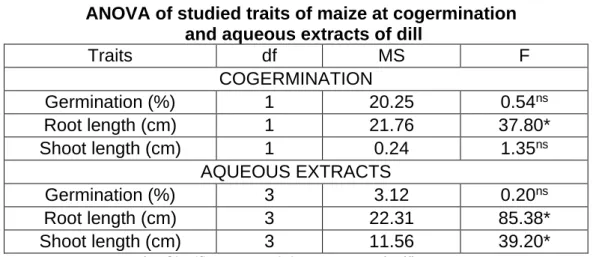
germination and shoot length, but had significant effect on root length of maize (Table 1 and 2). The root length of maize was significant reduced with dill seeds.
In other studies, seeds of dill showed considerable allelopathic effect on germination. Đikić (2005b) found that dill have inhibitory effect on germination of hoary cress but stimulatory effect on germination of quackgrass.
There are no previous experimental results presenting cogermination effect of dill on the
germination and growth in maize seedlings.
Similar results were reported by Bonea (2018), according to Sage seeds in cogermination with maize showed not significant effects on germination, but showed significant reduced on maize seedlings. On the contrary, cogermination of sweet marjoram has significantly stimulated the germination and growth of maize seedlings (Bonea and Urechean (2018).
Table 1
ANOVA of studied traits of maize at cogermination and aqueous extracts of dill
Traits df MS F
COGERMINATION
Germination (%) 1 20.25 0.54ns Root length (cm) 1 21.76 37.80* Shoot length (cm) 1 0.24 1.35ns
AQUEOUS EXTRACTS
Germination (%) 3 3.12 0.20ns Root length (cm) 3 22.31 85.38* Shoot length (cm) 3 11.56 39.20*
MS = mean square; * = Significant at p ≤0.05; ns = non-significant
Table 2
Effect of cogermination on germination and seedling growth of maize
Treatment Gi (%) Root length (cm) Shoot length (cm)
Control 93.67 12.33a 6.05
Cogermination (dill + maize)
95.67 6.88b 5.35
Different letters means significant differences at 5% probability level by Duncan’s test
Table 3
Effect of dill aqueous extracts on germination and seedling growth of maize
Treatment Gi (%) Root length (cm) Shoot length (cm) Control (0%) 95.00 12.34b 6.05c
2.5% 86.67 15.21a 10.89a
5% 91.67 12.94b 7.96b
10% 90.00 7.68c 5.14d
Different letters means significant differences at 5% probability level by Duncan’s test
The effects of different concentrations of dill aqueous extract on germination and seedling growth of maize are shown in Table 1 and 3.
The low concentration (2.5%) of dill aqueous extracts significantly (p≤0.05)
53
extracts began to inhibit the radicle elongation.
The effects on shoot length was similar with it on root length (Table 3), which was low concentrations (2.5% and 5%) stimulated the shoot length of maize and high concentration(10%) inhibited it.
The results showed that low concentrations (2.5%) of dill aqueous extract enhanced the seedling growth of maize, but with the concentration of the aqueous extract increased, the stimulating effects decreased, and even changed into inhibited.
Valcheva et al. (2019) showed that growth stimulation in roots of tomato was observed in 0.1% extract from dill, but and inhibitory effect in 0.3% and 1% extract.
Sipos et al. (2016) found that experimental variants: 2%, 5% and 10%
of dilutions from dill extract, showed significant stimulation on root and shoot length of mustard.
Our results were in agreement with the findings of Dhima et al. (2009) who reported that lower concentrations of allelochemicals generally have lesser or stimulatory effect on the plant growth, while negative effect increases with the increase in concentration.
Also, the data obtained correspond with the findings of Vlahova and Yoveva (2014), and Valcheva et al., (2019) who showed that the effect of the allelochemicals is manifested already during the seed germination, but it is more pronounced during the growth of primary seedlings of plants.
CONCLUSIONS
This study indicated that the dill plants had strong allelopathic potential on maize. Cogermination of dill seeds significantly decreased root length of maize. On the other hand, the aqueos extracts of dill had stimulating or inhibiting effect on maize seedling, depending on the concentration.
As a result, the stimulating potential of lower concentrations of dill aqueous extracts could be exploited to promote maize crop growth, but field studies should be achieved to complement the information obtained in the laboratory.
BIBLIOGRAPHY
Bonciu, E.,2012 - Agricultural biotechnologies, balance factor for the sustainable development of the
socio-economic system. Annals of the
University of Craiova, Series Biology, Horticulture, Food Produce Processing Technology, vol. XVII (LIII),1: 69-74.
Bonciu E., 2015 - Resources, elements of quality and prices for some
assortment of ecological
products. Annals of the University of
Craiova-Agriculture, Montanology,
Cadastre Series, vol. 45(1): 39-44.
Bonciu, E., 2017 - Food processing, a necessity for the modern world in the
context of food safety: a Review.
Annals of the University of Craiova –
Agriculture, Montanology, Cadastre
Series, Vol. 47(1): 391-398.
Bonciu, E., 2018 - Evaluation of cytotoxicity of the herbicide Galigan
240 EC to plants. Scientific Papers,
Series A. Agronomy, Vol. LXI(1)1: 175-178.
Bonea D., 2018. Allelopathic effect of
sage on germination and initial growth of maize. Annals of the University of Craiova-Agriculture, Montanology, Cadastre Series, vol 48: 54-60.
Bonea D., Urechean V., 2018. Effect of
sweet marjoram (Origanum majorana L.) cogermination and aqueous extracts on maize (Zea mays L.). “Agriculture for Life, Life for Agriculture” Conference Proceedings. 7(1):11-16
Cotuna, O., Paraschivu, M., Sarateanu,
V., Durau, C.D., Imbrea, I., 2016
54
growth of postharvage pathogens Penicillium expansum Link.and Botrytis cinerea Pers. Research Journal of Agricultural Science (ISSN 2066-1843) vol.48 (3), p.60-67.
Chahal, K., Monika, A.K., Bhardwaj, U.,
Kaur, R., 2017 - Chemistry and
biological activities of Anethum graveolens L.(dill) essential oil: A
review. J Pharmacogn
Phytochem 2017; 6(2): 295-306.
Dahiya, P., Purkayastha, S., 2012 -
Phytochemical analysis and antibacterial efficacy of dill seed oil against multi-drug resistant clinical isolates. Asian Journal of Pharmaceutical and Clinical Research, 5(2):62-64.
Đikic, M., 2005a - Allelopathic effect of
cogermination of aromatic and medicinal plants and weed seeds. Herbologia, 6(1): 15-24.
Đikić, M., 2005b - Allelopathic effect of
aromatic and medicinal plants on the seed germination of Galinsoga parviflora, Echinochloa crus-galli and Galium molugo. Herbologia 6(3): 51-57.
Dhima, K.V., Vasilakoglou, I.B., Gatsis,
ThD., Panou-Pholotheou, E.,
Eleftherohorinos, I.G., 2009 - Effects
of aromatic plants incorporated as green manure on weed and maize development. Field Crops Research, 110: 235-241.
Maulood P. M., Shireen, A.A., 2012 -
The allelopathic effect of Dill plant (Anethum graveolens L.) residues on the growth and chemical content of two types of Barley (Hordeum vulgare L.) cultivars. Raf. J. Sci. 23 (3): 1-12.
Norsworthy, J.K., 2003 - Allelopathic
Potential of Wild Radish (Raphanus raphanistrum). Weed Technology, 17: 307-313.
Orțan, A., Popescu, M.L., Gaiță, A.L.,
Dinu-Pîrvu, C., Câmpeanu, Gh., 2009
- Contribution to the pharmacognostical study on Anethum graveolens Dill. (Apiaceae). Romanian Biotechnological Letters, 14 (2), pp. 4342-4348.
Radulescu, V., Popescu, M.L., Ilies, D.,
2010 - Chemical composition of the volatile oil from different plant parts of Anethum graveolems L. (Umbelliferae) cultivated in Romania. Farmacia, 58(5):594-600.
Ravlić M., Baličević R., Nikolić M.,
Sarajlić A., 2015 - Assessment of
allelopathic potential of fennel, rue and sage on weed species hoary cress (Lepidium draba). Not Bot Horti Agrobo, 44(1):48-52.
Sălceanu C., Olaru A.L., 2016 -
Researches on weed control on strawberries. Annals of the University of Craiova - Agriculture, Montanology, Cadastre Series, Vol. XLVII: 271-275.
Sălceanu C., Olaru A.L., 2017 -
Researches concerning weed control on potato. Annals of the University of Craiova - Agriculture, Montanology, Cadastre Series, Vol. XLVII: 386-390.
Siddiqui, S., Bhardwaj, S., Khan, S.S.,
Meghvanshi, M.K., 2009 - Allelopathic
effect of different concentration of water extract of Prosopsis juliflora leaf on seed
germination and radicle length of wheat (Triticum aestivum Var-Lok-1). American-Eurasian Journal of Scientific Research, 4(2): 81-84.
Sipos M., Bandici Ghe., Chimpan C.,
2016 - The phytotoxicity of the aqueous extracts from fruits and seeds of some Apiaceae species. Analele Universităţii din Oradea, Fascicula Protecţia Mediului Vol. XXVII: 93-100.
Van Oosten, M.J., Pepe, O., De
Pascale, S., Silletti, S., Maggio, A.,
2017 - The role of biostimulants and bioeffectors as alleviators of abiotic stress in crop plants. Chem. Biol. Technol. Agric. 4:5.
Valcheva E., Popov , V., Marinov-Serafimov,P., Golubinova I., Nikolov
B., Velcheva I., Petrova S., 2019 - A
55
Vlahova V., Yoveva, Z.L., 2014 -
Research on allelopathic influence of selected flower species on pepper (Capsicum annuum L.). - In: The Modern Science and Scholar, pp. 129-134.
Xing, S., 2009 - The impact of dill weed,
spearmint and clove essential oils on sprout suppression in potato tubers.
M.Sc. Thesis. Saskatchewan University.
https://harvest.usask.ca/handle/10388/ etd-11302009-214226
Yakhin, O. I., Lubyanov, A. A., Yakhin,
I. A., and Brown, P.H., 2017 -