Hungarian Association of Agricultural Informatics
European Federation for Information Technology in Agriculture, Food and the Environment
Journal of Agricultural Informatics. 2015 Vol. 6, No. 4 journal.magisz.org
e-Government portal for providing integrated agrifood information based on Big
Data Analysis
Euijoo Yeo1, Sunggoo Yoo2, Yunhwa Koh3, Junghoon Moon4
I N F O
Received Accepted Available on-line Responsible Editor:
Keywords:
e-Government, big data analysis, agrifood information
A B S T R A C T
The e-government portal is a service that provides integrated agrifood information. Its purpose is to integrate vast amounts of agrifood data and to provide user-customized information on agrifood. Public agrifood data were collected from the Korean government, while private agrifood data were collected from Social Network Services and blogs. We analyzed the data and classified consumer purchasing behavior into five types. We then analyzed agrifood preference by type and weather conditions. Based on the results of these analyses, we developed recommendations for appropriate menus and agrifood and provided price information of recommended agrifood to consumers.
1. Introduction
“The age of Big Data has begun.” Recently, vast amounts of data have been generated from various sources, such as the Internet, cloud systems, and mobile devices (Dumbill 2013). Due to technological advances, the data can be gathered and analyzed through computers and algorithms. In this context, discussions on how to organize and use this enormous amount of data have continued in the academic world and in practical areas (Waller and Fawcett 2013).
In Korea, the Ministry of Agriculture, Food, and Rural Affairs (MAFRA) and government-affiliated organizations have accumulated vast amount of agrifood data. MAFRA, for example, has collected agrifood data related to agrifood businesses, and the National Agricultural Products Quality Management Service has collected agrifood certification data. Furthermore, various organizations, including firms and nonprofit organizations, have accumulated agrifood data. Even though the agrifood data is valuable for farmers, agribusinessmen, and consumers, these data have been scattered in many different databases and there has been no integration so that the data are not utilized effectively. In this light, MAFRA has identified the need to integrate the agrifood data, and thus the e-Government portal has been developed for this purpose.
The aim of this study is to introduce the recently developed e-Government portal in the area of agrifood in Korea and present the process of portal development. The services of the e-Government portal include 1) providing integrated agrifood data and 2) providing user-customized information on agrifood.
2. Methods
2.1. Data collection
Agrifood data for the e-Government portal were collected from government organizations, Korean households, and the private sector. Public agrifood data were collected from MAFRA and
1 Euijoo Yeo, Sunggoo Yoo, Yunhwa Koh,Junghoon Moon (corresponding author)
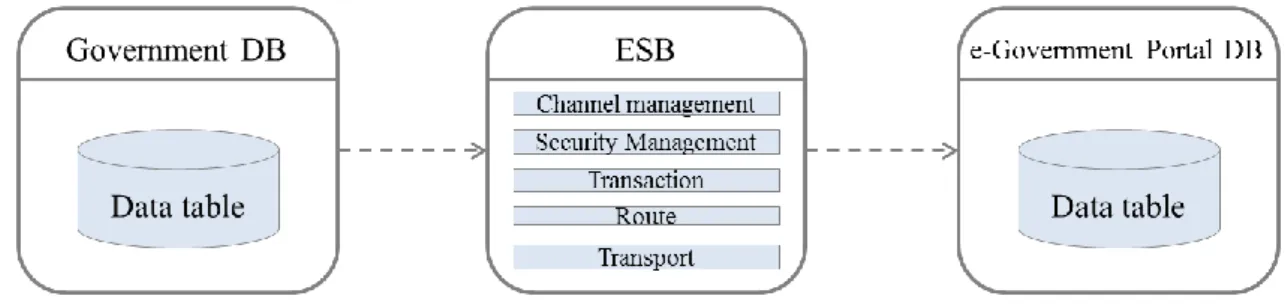
affiliated organizations through a database. The database of each organization was connected to the e-Government portal using the Enterprise Service Bus (ESB) software, which integrates a service-oriented architecture and provides new services (Schmidt et al. 2005). Currently, it is widely used by the Korean government. Through this process, the agrifood public data were collected automatically and saved in the e-Government portal database. Figure 1 illustrates the process of collecting the public agrifood data.
Figure 1. Process of collecting public agrifood data
Consumers’ purchasing agrifood data were collected from 640 Korean households. The data include the actual agrifood purchasing data and the data on consumers’ food-related lifestyles (FRLs). The actual purchasing data were obtained from Korean households’ food purchase receipts, which include information on the name of the product, the amount purchased, the date, and the price. The data of consumers’ FRLs were collected through surveys. The FRL is measured by five items: method of shopping, quality aspects of food, cooking method, consumption situation, and purchase motive (Grunert et al. 2011).
Private agrifood data were collected from blogs, online shopping malls, news articles, and Social Network Services (SNS) using the crawling technique. Raw agrifood data from private sectors were collected by crawling software. The crawling software, Talkro CIMS developed by Daum Soft, enables filtering of unnecessary data and effective collection of data on crucial key words of user interest. The collected agrifood data were saved in Hadoop, which is a system that saves vast amounts of data dispersively and effectively. Figure 2 illustrates the process of collecting the private agrifood data.
Figure 2. Process of collecting private agrifood data
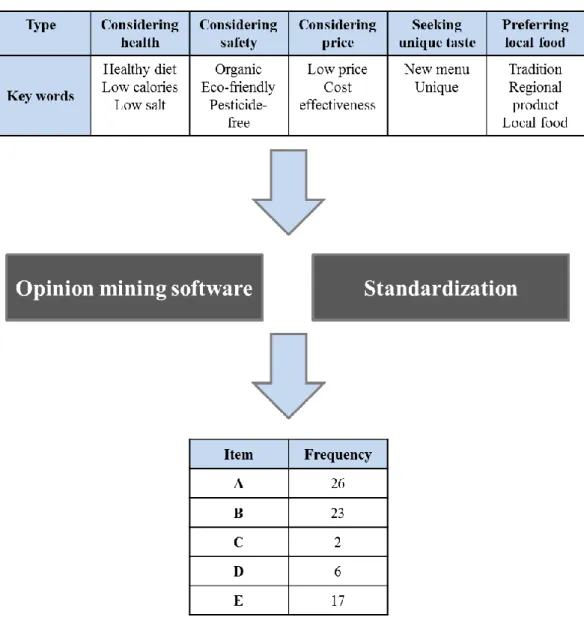
we input the key words for each type of purchasing behavior and found the related data. In a similar way, we investigated high-frequency items by each type. Figure 3 presents the process of analyzing preferences for agrifood.
Figure 3. Process of analyzing preferences for agrifood
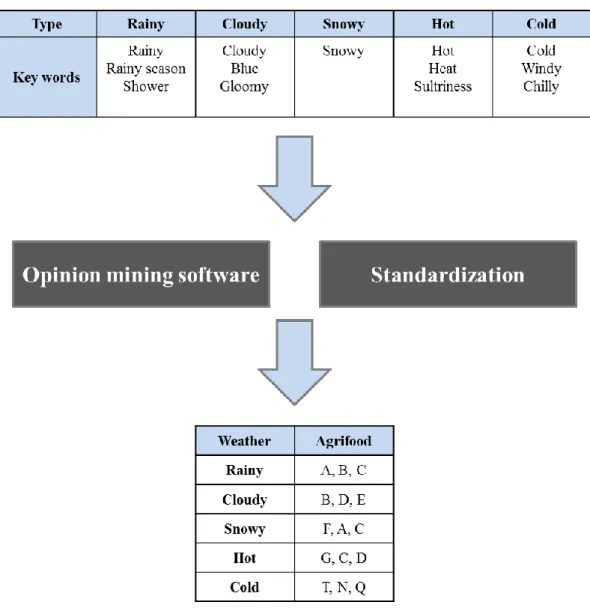
Figure 4. Process of analyzing preference for agrifood in regard to weather
3. e-Government Portal
3.1. Organizing the public agrifood information
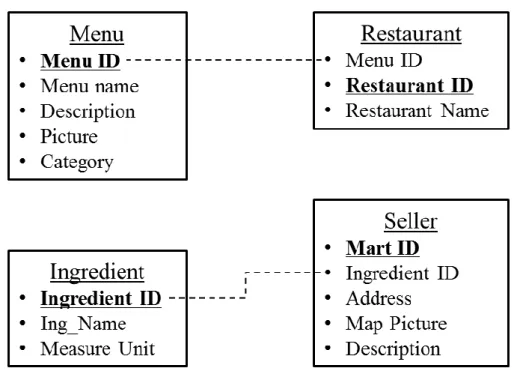
The e-Government portal provides recommendations on the appropriate agrifood for each type of consumer. Consumers can get information on a recommended menu and agrifood, restaurant, and market. Figure 5 illustrates an entity relationship diagram of a recommendation system.
Figure 5. Entity relationship diagram of the recommendation system
For more specificity, consumers can obtain information on their type of purchasing behavior through a brief survey. Based on the information, consumers can receive a recommendation of the appropriate agrifood by type. For example, consumers who are concerned with health can get a menu and agrifood recommendation along with detailed information for health. The recommended menu and agrifood have information on price change, seasonality, and preference for agrifood for particular weather conditions. Consumers can then know which agrifood is cheap and appropriate for the current weather.
In the case of a menu, the system provides information on ingredients and restaurants for a recommended menu. The restaurant information includes a list of the top 10 restaurants and frequency and content of mentions on SNS.
Figure 6. Recommendation system on the e-Government portal
Acknowledgements
This work was carried out with the Support of “Cooperative Research Program for Agriculture Science and Technology Development (Project No. PJ011390012015)” Rural Development Administration, Republic of Korea.
References
Dumbill, E 2013, 'Making sense of big data', Big Data, vol. 1, no. 1, pp. 1-2. doi: 10.1089/big.2012.1503
Grunert, KG, Perrea, T, Zhou, Y, Huang, G, Sørensen, BT and Krystallis, A 2011, 'Is food-related lifestyle (FRL) able to reveal food consumption patterns in non-Western cultural environments? Its adaptation and
application in urban China', Appetite, vol. 56, pp. 357-367. doi: 10.1016/j.appet.2010.12.020
Lee, JS and Lee, JC 2006, 'A case based music recommendation system using context-awareness', J. KIISS, vol
12, no. 3, pp. 111-126.
Phanich, M, Pholkul, P and Phimoltares, S 2010 'Food recommendation system using clustering analysis for
diabetic patients', IEEE.Int. Conf. Inf. Sci. and Appl, pp.1-8. doi: 10.1109/icisa.2010.5480416
Schmidt, M-T, Hutchison, B, Lambros, P and Phippen, R 2005, 'The enterprise service bus: making
service-oriented architecture real', IBM Systems Journal, vol. 44, no. 4, pp. 781-797. doi: 10.1147/sj.444.0781
Ueta, T, Iwakami, M and Ito, T 2011 'Implementation of a goal-oriented recipe recommendation system
providing nutrition information', IEEE Int. Conf. TAAI, pp. 183-188. doi: 10.1109/taai.2011.39
Waller, MA and Fawcett, SE 2013, 'Data science, predictive analytics, and big data: a revolution that will
transform supply chain design and management', Journal of Business Logistics, vol. 34, no. 2, pp. 77-84. doi: