APC Semantics for Petri Nets
Slavomír Šimoˇnák, Štefan Hudák and Štefan Koreˇcko Department of Computers and Informatics,
Technical University of Košice, Letná 9, 042 00 Košice, Slovak Republic
E-mail: [email protected], [email protected], [email protected]
Keywords:Petri nets semantics, process algebra, algebra of process components
Received:July 13, 2007
The paper deals with an algebraic semantics for Petri nets, based on a process algebra APC (Algebra of Process Components) by the authors. APC is tailored especially for describing processes in Petri nets. This is done by assigning special variables (called E-variables here) to every place of given Petri net, expressing processes initiated in those places. Algebraic semantics is then given as a parallel composition of all the variables, whose corresponding places hold token(s) within the initial marking. Resulting algebraic specification preserves operational behavior of the original net-based specification.
Povzetek: ˇClanek opisuje algebro semantike za Petri mreže.
1 Introduction
An assertion widely accepted in formal methods commu-nity states, that there will never be invented a single for-mal method, that will cover all aspects of the system in acceptable way [12]. The latter is mainly because of the complexity of the system and vast variety of its features (aspects) to be covered for the system to be modeled and designed. As a consequence of that situation, many formal description techniques (FDTs) exist and are used nowa-days. That reflects the fact that one featurefof the system is more readily expressed in FDT (say)F1, than it is the case forf inF2. To cope with that situation there have been attempts to integrate two or more formal methods. Main motivation for using FDT in design and analysis of computer-based systems lies in everyday growing depen-dence of human society on such the systems, particulary those applied in safety-critical domains (such as military weaponry, aircraft transport, medicine, etc.). The situation just described put strong requirements on new methods of the design, analysing and maintaining of such the systems. Time-critical issue of to be able to cope with malicious behaviour of the systems in limited time period, dictates strongly to deal with the problem in an automated way. The latter is impossible without using FDTs in proper combina-tion and integracombina-tion in the frame of computer-based design and analysis environments. Yet a formal way how to in-corporate conditions to guarantee the safety of system de-signed is an example of another problem which underlines the importance of expolitation of FDTs. Guided by the con-siderations mentioned an approach has been applied at the home institution of the authors to create an environment for the design and analysis of discrete systems based on inte-gration of three FDTs: Petri Nets (PN), process algebras and B-Method. That is why we have chosen the acronym mFDTE for it (multi FDT Environment). The choice of the
FDTs has been motivated by their abilities to cover in some mutually complementary ways a chosen set of system’s features. In this work we pay attention to two of the FDTs chosen: PN and process algebras. While on one side PN posses nice properties suited for system modelling (formal and graphical language) and analysis (invariants, reacha-bility), on the other side they suffer from a lack of formally sound and effective methods of their de/composition. The latter can be considered as an essential drawback as far as the modular system design is concerned. Process algebras (CCS, CSP, ACP)[1] on the other hand support composion-ality, by their definition, so PN and process algebras can be considered to meet the complementarity property in the above sense.
The paper is organized in the following way: Section 1 is introductory one, whole related works are briefly sum-marized in Section 2. In Section 3, basic notions and def-initions for the class of Petri nets used are given. Alge-bra of Process Components is defined in Section 4. Notion of term is presented as a mean for describing processes, axioms are given and operational semantics is assigned to process expressions (terms). Section 5 concentrates on the algebraic semantics construction for a Petri net given. A special variable is assigned to every place of the Petri net. Construction rules are defined for assigning a term to the variable which represents all the computations which can be initiated at the corresponding place. An example pro-vided in Section 6 demonstrates the approach introduced above. Section 7 concludes the paper and contains a sum-mary of the results and concepts presented.
2 Related work
[4, 5, 2, 6, 10, 11]. It will be mentioned further [3], where authors propose an approach to algebraic semantics for Hi-erarchical P/T nets. PTNA (Place/Transition Net Algebra) is defined there, based on process algebra ACP and an al-gebraic semantics for P/T nets is given such that a P/T net and its term representation have the same operational be-havior. The actions of the algebra presented correspond to the consumption and production of tokens by transitions. Results achieved are further extended to hierarchical P/T nets. In [11] relations among nets, terms and formulas are treated. Particularly relations are defined via properly de-fined semantics: net semantics of terms and process seman-tics of nets. The most influential works in the line we fol-low here are [5, 2]. In [5] relations between the process algebra, called there PBC (Petri Box Calculus) and a class of Place Transition Nets (safe P/T nets) are studied. Syntax and semantics of PBC terms are carefully selected to al-low to define a transformation yielding P/T nets preserving structural operational semantics of the source terms. The transformation allows composition of P/T nets. In work [2] authors treat the issue of partial-order algebras and their relations to P/T nets based on the theory of BPA and ACP.
Within our work we propose the general approach to characterising PN in form of E-(B-) terms. General (not only interleaving) semantics is given, and the results ob-tained in this respect are published in [9]. mFDT Environ-ment is under construction, based on FDT interfaces by the authors, which aims to integrate the three formal methods mentioned above.
3 Petri Nets
We assume the class of ordinary Petri nets [18] within this paper, and brief description of the basic notions follows [7].
Definition 1. The Petri net is a 4-tuple N = (P, T, pre, post), wherePis a finite set of places,Tis a fi-nite set of transitions(P∩T =∅), pre:P×T → {0,1}is the preset function and post:P×T → {0,1}is the postset function.
By the marking of PNN = (P, T, pre, post)we mean a totally defined functionm:P →IN, whereINis the set of natural numbers. We denote marked net with initial mark-ingm0asN0= (N, m0)orN0= (P, T, pre, post, m0).
Some useful notations can be defined:
•t={p|pre(p, t)6= 0}the set of preconditions oft
t•={p|post(p, t)6= 0}the set of postconditions oft p•={t|pre(p, t)6= 0}, •p={t|post(p, t)6= 0}
We say thatt is enabled inm(and denote itm →) if fort everyp∈ •t, m(p)≥pre(p, t). The effect of firingtinm
is the creation of a new markingm0 (m→t m0) andm0 is
defined in the following way:
m0(p) =m(p)−pre(p, t) +post(p, t), p∈P, t∈T
Denotation (N, m) →t (N, m0) is alternatively used
within the paper for expressing a step of computation (m →t m0) within the Petri netN. The set of reachable
markings for given Petri netN0 = (P, T, pre, post, m0) we define by
R(N0) ={m|m0→σ m}
where σ = t1, t2...tr stands for an admissible firing se-quence inN0. We also can define the language of Petri net
N0:
L(N0) ={σ∈T∗|m0→σ m}
4 APC - Algebra of Process
Components
Process algebra APC [8, 16] is inspired by the process al-gebra ACP [1]. ACP is modified in a way, that allows for comfortable description of PN processes in the alge-braic way. We use the same operators for the sequen-tial (·) and the alternative (+) composition respectively and corresponding axioms also hold in algebra APC (Table 1). ACP’s communication function (γ) and its extension -communication merge operator (|), are not present in APC. A composition function (π) and a special composition op-erator (|||) are introduced into the algebra APC instead. The impact of an introduction of the two operators will be treated later.
APC is defined as a couple(P,Σ), whereP(the domain) is represented by the set of constants, set of variables and set of all processes (terms) we are able to express. Σ(the signature) contains function (operator) symbols. It is sup-posed that, the set of variables contain arbitrary many of them (x,y, ...). Terms containing variable(s) are calledopen terms, otherwise terms areclosed.
4.1 Syntactical issues
From the syntactical point of view APC contains a num-ber of constantsa, b, c, ...(we use the setA={a, b, c, ...} for referring to them) a special constant δ(deadlock) and operators: +, ·, k (parallel composition), bb (left merge) and||| (process component composition). It also contains a (partial) commutative composition functionπ, denoting the merging of process components. Now we will define APC terms:
Definition 2. 1. variables are APC terms,
2. constants a ∈ A and a special constantδ are APC terms,
3. ifu, vare APC terms, thenu+v, u·v, ukv, ubbv, u|||vare APC terms,
All these terms are part of P - the domain of APC. P can further be subdivided into two parts PA and PC (P = PA∪PC). Terms belonging to the setPA defined by items 1, 2 and 3 of Definition 2 (i.e. those without the superscript notation) represent the set oftrue processes. Terms from the setPC(superscripted) represent the set of process components.
Only difference between the (true) process and process component is, that while the process is able to execute ac-tions, process component is introduced for synchronization purpose only. The latter is only able to join with its coun-terpart(s) (other process component(s) fitting for being syn-chronized to) in order to form a true process. The compo-sition functionπis defined as follows:
π:PC×...×PC→PA (1)
A connection between the composition functionπand the process component composition operator (|||) can be expressed as: x1|||...|||xn = π(x1, ..., xn) when
π(x1, ..., xn)is defined. Axioms of algebra APC can be found in Table 1. Within the tableu, v, z, x1, ..., xnstand for processes,a∈Aandδare constants.
u+v=v+u A1
u+u=u A2
(u+v) +z=u+ (v+z) A3
(u+v)·z=uz+vz A4
(u·v)·z=u·(v·z) A5
ukv=ubbv+vbbu+u|||v A6
(u+v)|||z=u|||z+v|||z A7
u|||(v+z) =u|||v+u|||z A8
aubbv=a(ukv) A9
(u+v)bbz=ubbz+vbbz A10
x1|||...|||xn=π(x1, ..., xn)if A11
π(x1, ..., xn)is defined
x1|||...|||xn=δotherwise
u+δ=u A12
δ·u=δ A13
Table 1: Axioms of APC
Theorem 1. In the case of the parallel composition of more than two processes the following equality (expansion theo-rem) can be proven:
x1k...kxn =
X
1≤i≤n
xibb(1≤j≤kn,j6=ixj)+ (2)
X
2≤k≤n
1≤i1<...<ikX ≤n
(xi1|||...|||xik)bb(
1≤j≤n,j6=i1,...,ik
k xj)
Proof 1. By induction onn, the number of processes. The case forn = 2is treated by the axiom A6, Table 1. The induction step is as follows:
(x1k...kxn+1) = (x1k...kxn)kxn+1
Denoting the RHS of original theorem asE, we can write:
(x1k...kxn)kxn+1=Ebbxn+1+xn+1bbE+E|||xn+1 (3)
Now we have three summands, each of them will be treated separately. Let’s start dealing with the first of them.
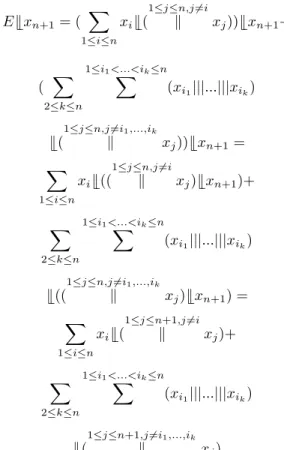
Ebbxn+1= (
X
1≤i≤n
xibb(1≤j≤kn,j6=ixj))bbxn+1+
( X
2≤k≤n
1≤i1<...<ikX ≤n
(xi1|||...|||xik)
bb(1≤j≤n,jk6=i1,...,ikxj))bbxn+1=
X
1≤i≤n
xibb((1≤j≤kn,j6=ixj)bbxn+1)+
X
2≤k≤n
1≤i1<...<iX k≤n
(xi1|||...|||xik)
bb((1≤j≤n,jk6=i1,...,ikxj)bbxn+1) =
X
1≤i≤n
xibb(
1≤j≤n+1,j6=i k xj)+
X
2≤k≤n
1≤i1<...<ikX ≤n
(xi1|||...|||xik)
bb(1≤j≤n+1k,j6=i1,...,ikxj)
The second summand of (3) can be expressed as follows:
xn+1bbE=xn+1bb(
1≤j≤n+1,j6=n+1
k xj)
The third one represents the process components composi-tion:
E|||xn+1= (
X
1≤i≤n
xibb(1≤j≤kn,j6=ixj))|||xn+1+
( X
2≤k≤n
1≤i1<...<ikX ≤n
(xi1|||...|||xik)
bb(1≤j≤n,jk6=i1,...,ikxj))|||xn+1=
X
1≤i≤n
(xi|||xn+1)bb(
1≤j≤n,j6=i k xj)+
( X
3≤k≤n+1
1≤i1<...<ikX≤n+1
(xi1|||...|||xik)
bb(
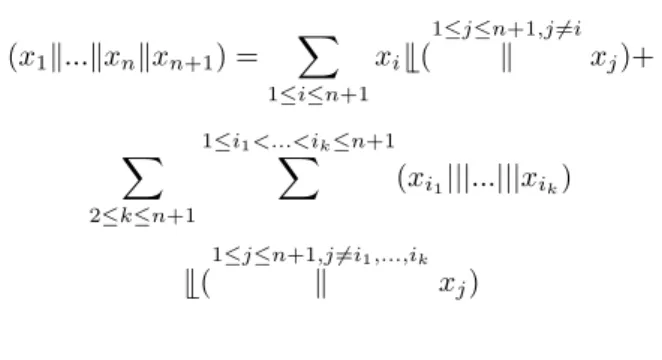
Summing up the three summands we have:
(x1k...kxnkxn+1) =
X
1≤i≤n+1
xibb(1≤j≤nk+1,j6=ixj)+
X
2≤k≤n+1
1≤i1<...<ikX≤n+1
(xi1|||...|||xik)
bb(1≤j≤n+1k,j6=i1,...,ikxj)
u t
4.2 Semantics issues
Constants a, b, c ∈ Aare called atomic actions, and are considered indivisible actions (events). The sequential composition operator (·) function can be explained as fol-lows:x·yis the process that first executesxand after finish-ing it, startsy. The alternative composition (+):x+yis the process that either executesxory(choice). The meaning of parallel composition (k) follows: considering the merge of two processesxky, we recognize three possibilities to proceed. Either we start with a first step of x(given by
xbby), or a first step fromy(ybbx) or we check a possibil-ity to compose processes by means of process components composition operator -x|||y. The result of this composi-tion of course is different fromδonly in a case, when the composition functionπis defined.
To assign an operational semantics to process expres-sions, we determine, which actions a process can perform. The fact, that process represented by the termtcan execute actionaand turn to the termsis denoted by: t −→a s(or alternativelyais enabled int). The symbol√stands for successful termination and thust−→a √denotes a fact that
tcan terminate by executinga. An inductive definition of action relations is given in the Table 2.
a−→a √
u+v−→a u0
v+u−→a u0
u−→a u0⇒ u·v−→a u0·v
ukv−→a u0kv
vku−→a vku0
ubbv−→a u0kv
u−→a u0,
π(u[1], ..., u[n]) =u⇒u[1]|||...|||u[n]−→a u0
a∈A, u∈PA, u[1], ..., u[n]∈Pc, u0, v∈P
Table 2: Transition relations for APC terms
5 APC semantics for Petri Nets
In this section the transformation description is given in detail [16]. We start with creating a special variable for
every place in the PN N to be transformed. We call these variables E-variableshere, and they will be bound to terms, representing possible computations started from given place in PN, later. So the value (term) assigned to a particular variable depends on the structure of the net in the vicinity of a place associated. So considering the placep, variableE(p)will be bound to a term representing all the computations within the netN, which are initiated inp.
Figure 1: Petri net fragments
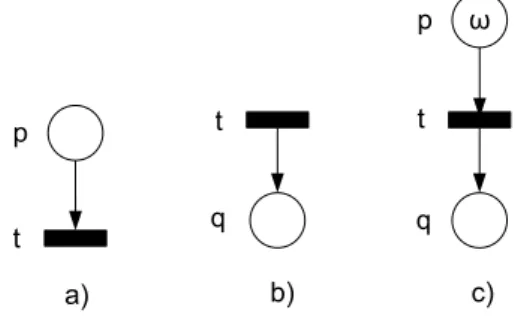
Basic situations are captured in Fig. 1. In the case a) a situation is depicted, where no arcs are connected to the place investigated.
This results to the assignment of a term representing no computations to the variable corresponding to such place, i.e. δ(deadlock). Case b) stands for an alternative compo-sition (choice). If a token is situated in placep, a choice is to be made, and only one of transitions t1, ..., tn can fire. Case c) represents general composition, where tokens must be present in all pre-places of transitiont. If some of these places does not contain a token, firing oftis not possible. After firing oft, however post-places of it are marked and thus processes initiated in those places are enabled.
General composition (case c) can be understood as a generalization of the three basic compositions - sequen-tial, parallel and synchronization (Fig. 2) - three of four basic composition mechanisms (with alternative composi-tion) used within the APC. Ifnis the number of pre-places andm, the number of post-places of a transitiont:
– n = 1∧m = 1we obtain sequential composition (case a) of Fig. 2),
– n= 1∧m >1we obtain parallel composition (case b) of Fig. 2),
– n >1∧m= 1we obtain synchronization (case c) of Fig. 2).
Now we can proceed by constructing terms representing possible computations for given places of PN N. These will be bound to a corresponding E-variables in a way given by the definition:
Figure 2: Basic compositions as a special cases of the gen-eral composition
– deadlock (Fig. 1a):E(p) =δ
– alternative composition (Fig. 1b):E(p) =
t1·E(q1) +t2·E(q2) +...+tn·E(qn)
– sequential composition (Fig. 2a):E(p) =
t·E(q)
– parallel composition (Fig. 2b):E(p) =
t·(E(q1)k...kE(qn))
– synchronization (Fig. 2c):E(p1) =
(t·E(q))[1], E(p
2) = (t·E(q))[2], ..., E(pn) = (t·
E(q))[n],
and the composition function is defined:
π((t · E(q))[1], ...,(t · E(q))[n]) = t · E(q) or
π(E(p1), ..., E(pn)) =t·E(q)
– general composition (Fig. 1c):E(p1) =
(t·(E(q1)k...kE(qm)))[1],
E(p2) = (t·(E(q1)k...kE(qm)))[2], ...,
E(pn) = (t·(E(q1)k...kE(qm)))[n],
and the composition function is defined in the follow-ing way:
π(E(p1), ..., E(pn)) =t·(E(q1)k...kE(qm))
– transition without post-place(s) (Fig. 3a):E(p) =t
– transition without pre-place(s) (Fig. 3b): a new place is added, such that firing properties of a transition given are preserved (Fig. 3c):E(p) =t·E(q).
In the case of the synchronization we can observe that, all variables composed are assigned to terms representing process components instead of true processes. These com-ponents, if all are present within the term representing the net computation, can merge together by means of composi-tion funccomposi-tionπ, and form the true process (able to execute actiontand then to behave likeE(q)).
Taking into account the case, when a transition without pre-places occurs within the net structure (Fig. 3b), the following solution is proposed: for every such transition
t, a new pre-place is added, such that the firing properties of transitiont are preserved (Fig. 3c). This is achieved by setting the initial marking of given place to ω, where
Figure 3: Transitions without input/output
∀n∈IN :ω±n=ω. In fact, this causes the transitiont
can be fired infinitely many times. Combining these basic principles, we are able to construct terms for more compli-cated net structures.
Definition 4. Let the PN N is given by N = (P, T, pre, post),m ∈ INk stands for its initial marking, andk=|P|. Then the APC semantics forN with marking
mis given by the formula:
A(N, m) =E(p1)(i1)k...kE(pk)(ik) (4)
Within the Definition 4, E(pi) stands for an APC-term defined according to PN structure in the vicinity of the place pi (Definition 3). The value ij is given by
ij = m(pj), so it represents the marking with respect to place pj,1 ≤ j ≤ k. E(pj)(i) is defined as a term
E(pj)k...kE(pj), and represents a multiple (i-times) paral-lel composition of a processE(pj). Note thatE(pj)(0) =
δ. Whenij=ωfor placepj, it means thatE(pj)can occur infinitely many times in resulting composition.
Theorem 2. For given PNN = (P, T, pre, post), APC-termp, representing an algebraic (APC) semantics for the netN, transitiont∈T andm, m0markings ofN,
follow-ing implication holds:
(N, m)→t(N, m0)⇒ A(N, m)→At (N, m0)
Proof 2. The proof is given by the induction on a structure of the net. Let us suppose, that a step in computation ofN
exists:(N, m)→t(N, m0), then
∀pi∈(•t) :m(pi)≥pre(pi, t)
∀pi∈P :m0(pi) =m(pi)−pre(pi, t) +post(pi, t) Algebraic semantics for Petri net N with marking m is given by:
A(N, m) =E(p1)(i1)k...kE(pk)(ik), k=|P| (5)
Transitiontfired inN within a step can be of two kinds:
1. |•t|= 1
According to the transition relations of APC (Table 2), a step can be made by executing the action of the true pro-cess or by merging the propro-cess components together with execution of an action associated. Let us explore the two cases:
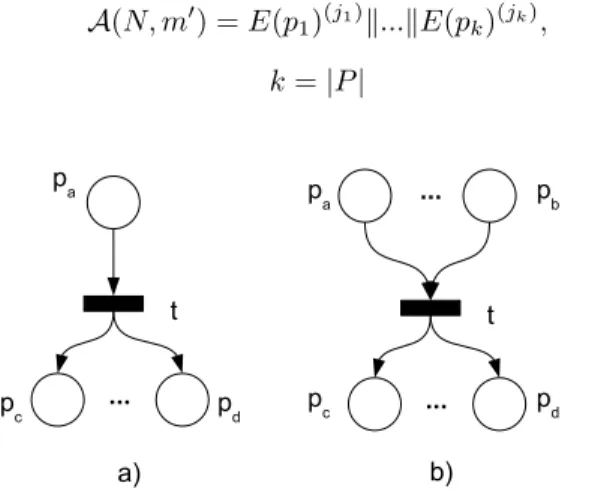
1. If|•t|= 1is the case, the situation is captured in the
Fig. 4, case a). Then within the Petri net N holds:
m(pa) ≥ pre(pa, t)(so the placepa contains a to-ken(s)) and also m0(p
i) = m(pi) + post(pi, t)−
pre(pi, t), pi ∈ P is a new marking after firing of the transition t. If E(pa) = t·(E(pc)k...kE(pd)) is corresponding APC semantics for process initiated in the place pa, then a step (action t) is enabled
E(pa)→tE(pc)k...kE(pd), since E(pa)is present in specificationA(N, m). Let valuesjl, l ∈ {1, ..., k} are given by:jl=il−pre(pl, t) +post(pl, t). When a step A(N, m)→At (N, m0) occurs, corresponding
APC semantics of the net(N, m0)is given by:
A(N, m0) =E(p
1)(j1)k...kE(pk)(jk), (6)
k=|P|
Figure 4: Two cases considered for a step in computation ofN
2. Here transition t firing in Petri net N occurs, for which|•t| ≥ 2holds. Situation is depicted in Fig. 4,
case b). Within the Petri netNthere holds:m(pa)≥
pre(pa, t), . . . , m(pb) ≥ pre(pb, t) (so the places
pa, . . . , pbcontain enough tokens) and thus transition
t can fire. From the definition of APC semantics for Petri netN (5) and Definition 3, we have that a step from(N, m)is represented by:
E(pa)(ia)k...kE(pb)(ib)→t (7)
E(pc)(jc)k...kE(pd)(jd)
The step is enabled inA(N, m)since valuesia, . . . , ib are given by number of tokens in correspond-ing places. Accordcorrespond-ing to the definition, variables
E(pa),...,E(pb)are bound to process components and composition function is defined:
π(E(pa), ..., E(pb)) =t·(E(pc)k...kE(pd)). The step (7) thus is enabled, and (6) holds, where: j1 =
i1+post(p1, t)−pre(p1, t),...,jk =ik+post(pk, t)−
pre(pk, t).
We can conclude, that if a step in Petri netNwith mark-ing m is enabled, so it is enabled also in corresponding algebraic representationA(N, m).
u t
We give a small example here, representing the configu-ration of Petri netN sometimes called confusion (Fig. 5) for the sake of clarity.
Figure 5: Confusion
First, APC-terms are assigned to variables created for every place of Petri netN.
E(p1) =t1·E(q1) + (t2·E(q2))[1],
E(p2) = (t2·E(q2))[2]
Next, the composition functionπis defined:
π((t2·E(q2))[1],(t2·E(q2))[2]) =t2·E(q2) (8)
Within the initial markingm0 of Petri netN, the only place holding a token is p1, so only the variable corre-sponding to this place will be included within the equation describing the algebraic semantics ofN.
A(N, m0) =E(p1) =t1·E(q1) + (t2·E(q2))[1]=
t1·E(q1) +δ=t1·E(q1)
In the configuration depicted, the only transition enabled ist1and it can fire. This is not the case of the transition
t2, because the placep2, the pre-place oft2is not marked. The same could be observed within the APC representation - only one process component ((t2·E(q2))[1]) is present within the equation (so the mappingπ cannot be used to produce a true process) and it thus cannot perform any ac-tion and is replaced by theδ.
6 An example
(depicted in Fig. 6) represents a synchronization problem for sharing one resource by two processes. System mod-eled consists of two processes (let the first process repre-sented by the placesp1, p2and transitionst1, t3, be named
A, and the second one (p3, p4, t2, t4) be namedB). The resource shared is represented by the placep0. The token at this place indicates the resource is free to be shared ei-ther by processAor processB. The placep2stands for the condition ’processAis using the resource’, firing transition
t1starts the resource usage and firingt3ends it. Similarly, for processB, firingt2starts and firingt4ends the usage respectively. A token occurrence in the placep3indicates the resource is used by the processB.
Figure 6: Petri net for resource sharing
We start with assigning APC-terms to variables created for every place of PNN, according to the structure of the net in the vicinity of the corresponding place.
E(p1) = (t1·E(p2))[1],E(p2) =t3(E(p0)kE(p1)),
E(p3) =t4(E(p0)kE(p4)),E(p4) = (t2·E(p3))[1],
E(p0) = (t1·E(p2))[2]+ (t2·E(p3))[2]
Composition functionπis defined in two cases:
π((t1·E(p2))[1],(t1·E(p2))[2]) =t1·E(p2) (9)
π((t2·E(p3))[1],(t2·E(p3))[2]) =t2·E(p3) (10) Since the initial marking of Petri netNis given asm0=
(1,1,0,0,1), only three places (p0,p1andp4) hold tokens, and only variables corresponding to these places will take place in equation describing the algebraic semantics of PN
N.
A(N, m0) =E(p0)kE(p1)kE(p4) (11) Since the term on the RHS of equation (11) represents parallel composition of three processes, we expand it ac-cording to (2):
=E(p0)bb(E(p1)kE(p4)) +E(p1)bb(E(p0)k
E(p4)) +E(p4)bb(E(p0)kE(p1))+
(E(p0)|||E(p1))bbE(p4) + (E(p0)|||E(p4))bbE(p1) +
(E(p1)|||E(p4))bbE(p0)+ (E(p0)|||E(p1)|||E(p4))
After substituting terms assigned (bound) to variables
E(p0),E(p1)andE(p4), we can write:
= [(t1·E(p2))[2]+ (t2·E(p3))[2]]bb((t1·E(p2))[1]k
(t2·E(p3))[1])+
(t1·E(p2))[1]bb[((t1·E(p2))[2]+ (t2·E(p3))[2]]k
(t2·E(p3))[1])+
(t2·E(p3))[1]bb[((t1·E(p2))[2]+ (t2·E(p3))[2]]k
(t1·E(p2))[1])+ ([(t1·E(p2))[2]+ (t2·E(p3))[2]]|||(t1·
E(p2))[1])bb(t2·E(p3))[1]+ ([(t1·E(p2))[2]+ (t2·
E(p3))[2]]|||(t2·E(p3))[1])bb(t1·E(p2))[1]+
((t1·E(p2))[1]|||(t2·E(p3))[1])bb[(t1·E(p2))[2]+ (t2·
E(p3))[2]]+ ([(t1·E(p2))[2]+ (t2·E(p3))[2]]|||(t1·
E(p2))[1]|||(t2·E(p3))[1])
Using the composition (π) definition (9, 10) and axioms associated (A11, A13), we have:
(t1·E(p2))bb(t2·E(p3))[1]+ (t2·E(p3))bb(t1·E(p2))[1]
Using the left merge operator axiom (A9) and substitut-ing forE(p2)andE(p3)we obtain:
=t1(E(p2)k(t2·E(p3))[1]) +t2(E(p3)k(t1·E(p2))[1])
=t1(t3(E(p0)kE(p1))k
(t2·E(p3))[1]) +t2(t4(E(p0)kE(p4))k(t1·E(p2))[1])
Considering all the cases for two processes composed by the parallel composition operator (k) and using the axiom A6:
=t1(t3(E(p0)kE(p1))bb(t2·E(p3))[1]+
(t2·E(p3))[1]bbt3(E(p0)kE(p1))+
t3(E(p0)kE(p1))|||(t2·E(p3))[1])+
t2(t4(E(p0)kE(p4))bb(t1·E(p2))[1]+
(t1·E(p2))[1]bbt4(E(p0)kE(p4))+
t4(E(p0)kE(p4))|||(t1·E(p2))[1])
=t1(t3(E(p0)kE(p1))bb(t2·E(p3))[1]+δ+δ)+
t2(t4(E(p0)kE(p4))bb(t1·E(p2))[1]+δ+δ)
=t1t3((E(p0)kE(p1))k(t2·E(p3))[1])+
t2t4((E(p0)kE(p4))k(t1·E(p2))[1])
Since E(p4) = (t2 · E(p3))[1] and E(p1) = (t1 ·
E(p2))[1], we can write:
=t1t3((E(p0)kE(p1))kE(p4))+
t2t4((E(p0)kE(p4))kE(p1))
=t1t3(E(p0)kE(p1)kE(p4))+
t2t4(E(p0)kE(p1)kE(p4))
Using axiom A4, the term becomes even simpler:
Here we can observe a parallel composition of the three variables, from which we started our derivation (E(p0) k
E(p1)kE(p4)). In terms of Petri nets, the initial marking was reached again. Prefix(t1t3+t2t4)represents the traces of processes. The sequential composition operator is often omitted, so we can state that the APC semantics is finally given by the following equation:
A(N, m0) = (t1t3+t2t4)ω
7 Conclusion
In this paper a general method was presented for construct-ing an algebraic semantics of Petri nets, based on Algebra of Process Components (APC) by the authors. The notion of process component is introduced in order to model syn-chronization, which, in case of Petri nets, is modeled in a natural way. A variable is created for every place of given net and a term is bound to this variable, which express the process initiated in the corresponding place. The descrip-tion of process representing computadescrip-tions of Petri net is given by the parallel composition of all the variables asso-ciated with places holding token(s) within the initial mark-ing. Traces of processes can be observed in addition to changes on the PN marking along the computation. Re-sulting algebraic specification can further be analyzed us-ing process algebra tools like CWB-NC, etc. A proof of identical operational behavior has also been provided.
The PETRI2APC tool, a practical implementation of method presented, is intended to be a part of multi FDT (mFDT) environment - an environment for designing and analysing of discrete systems based on three formal meth-ods with useful complementary properties. The methmeth-ods considered are Petri nets, Process algebra and B-Method. The mFDT environment is under development at DCI FEEI TU of Košice.
Acknowledgement
This work is supported in part by the VEGA 1/3140/06 and in part by the VEGA 1/4073/07 grant projects of Slovak Grant Agency.
References
[1] Baeten, J.C.M., Weijland, W.P.: Process Algebra, Cambridge University Press, ISBN 0 521 40043 0, pp.248, 1990.
[2] Baeten, J.C.M., Basten, T.: Partial-Order Process Algebra, in Handbook of Process Algebra, Elsevier Science, Amsterdam, The Netherlands, 2000, 78pp. [3] Basten, T., Voorhoeve, M.: An Algebraic
Seman-tics for Hierarchical P/T Nets, Computing Science Report, Eindhoven University of Technology, pp.32, 1995.
[4] Best, E.: Semantics of Sequential and Parallel Pro-grams, Prentice Hall Europe, ISBN 0-13-460643-4, pp.352, 1996.
[5] Best, E., Devillers,R., Koutny,M.: Petri Nets, Process Algebras and Concurrent Program-ming Languages , Lecture on Petri Nets II:Applications, LNCS , Advances in Petri Nets (W.Reisig,G.Rozenberg Eds.), Springer , Berlin 1998, ISBN 3-540-65306-6,pp.1-84.
[6] Desel, J., Juhás, G., Lorenz, R.: Process Seman-tics of Petri Nets over Partial Algebra, Proceedings of ICATPN 2000, 21-st International Conference on Application and Theory of Petri Nets, vol.1825 of LNCS, pp.146-165, Springer-Verlag, 2000.
[7] Hudák, Š.: Reachability Analysis of Systems Based on Petri Nets, Elfa s.r.o. Košice, ISBN 80-88964-07-5, pp.272, 1999.
[8] Hudák, Š., Šimoˇnák, S.: APC - Algebra of Process Components, Proceedings of EMES’03, Oradea, Fe-lix Spa, Romania, May 2003, pp. 57-63, ISSN 1223 - 2106.
[9] Hudák Š., Šimoˇnák S., Koreˇcko Š., N.Kovacs A.: Formal Specifications and de/compositional ap-proach to design and analysis of discrete systems, Computer Science and Technology Research Survey, Košice, Elfa, pp. 8-46, 2007.
[10] Mayr, R.: Combining Petri nets and PA-processes, in Theoretical Aspects of Computer Software (TACS’97), volume 1281 of Lecture Notes in Com-puter Science, pages 547–561, Sendai, Japan, 1997. Springer Verlag.
[11] Olderog, E.R.: Nets, Terms and Formulas, ISBN 0 521 40044 9, Cambridge University Press, 1991. [12] Paige, R.F.: Formal Method Integration via
Het-erogeneous Notations, PhD Dissertation, November 1997.
[13] PNML–Petri Net Markup Language,
URL: http://www.informatik.hu-berlin.de/ top/pnml/ [14] PNML Framework, URL:
http://www-src.lip6.fr/logiciels/mars/PNML/
[15] Šimoˇnák, S., Hudák, Š., Koreˇcko, Š.: ACP2PETRI: a tool for FDT integration support, Proceedings of 8th International Conference EMES’05, Oradea, Fe-lix Spa, Romania, 2005, pp. 122-127, ISSN 1223-2106.
[16] Šimoˇnák, S.: Formal methods integration based on Petri nets and process algebra transformations, PhD Dissertation, DCI FEEI TU Košice, 2003. (In Slo-vak)
[17] Starke, P.H.: Processes in Petri Nets, LNCS 117, Fundamentals of Computation Theory, ISBN 3-540-10854-8, Springer-Verlag, 1981.
[18] Petri Nets World (A Classification of PN),
URL: