Resource Management
in Message Passing Environments
Ivan Zoraja
1, Ursula Seitz
2, Arndt Bode
2, Petar Slapni
car
ˇ
11FESB, Department of Electronics and Computer Science University of Split, Croatia 2LRR-TUM, Institut f¨ur Informatik, Technische Universit¨at M¨unchen, Germany
This paper discusses the need for resource management support for parallel applications running on workstation clusters and communicating by message passing among tasks. Many resource management systems are only able to start a message passing runtime environment and parallel applications, but dynamic reconfiguration fails because of the missing cooperation between the resource manager and the runtime environment. In order to utilize computational resources in message passing environments efficiently, to control execution of parallel applications by rescheduling tasks at runtime, and to minimize their execution time, a resource management system has been developed and preliminary tests results have been carried out. Most of our efforts in this regard have been to design an efficient approach to load measurement and process scheduling and implement the resource management system in a manner such that it can easily be adapted to any message passing framework. Although our first version is based on the PVM system, we also intend to implement an MPI – based resource management system.
Keywords: resource management, load balancing, pro-cess migration, message passing, PVM, MPI, workstation clusters.
1. Introduction
Although hardware power incessantly increases, there are always applications which still re-quire a larger amount of computing capacity. Parallelization is a way to shorten the compu-tation time of long running and resource in-tense applications by dividing the underlying data region or decomposing the application’s functions and computing each of the resulting
smaller modules by a separate process on dif-ferent processors which, without having shared memory segments, perform communication by sending messages. Especially appropriate for parallelization are scientific computing appli-cations because they often exceed the resource availability of a single host and the underlying computational grid can easily be partitioned into smaller modules.
Owing to its very high aggregate performance, massively parallel systems (MPPs) have been built to run high performance parallel appli-cations, but, their widespread use has been prohibited by their high price and poor cost-performance ratio. Recently, networks of work-stations (NOWs) have been used as a unified concurrent computing resource and have evolved into a very effective and tenable environments for both high performance scientific computa-tion and commercial and business general based data processing. These computing environ-ments are typically based upon hardware con-sisting of a collection of heterogeneous worksta-tions interconnected by a high speed local area network and are able to achieve a supercom-puter’s performance at significantly less cost. The most common programming paradigms are those that provide a process or thread-based message exchange among tasks that reside in different address spaces.
The execution of a parallel application is inher-ently more complex than of a sequential one, because more than one host is involved in the computation and more than one thread of
con-*This work has been funded by the German Federal Department of Education, Science, Research and Technology
trol must be started and terminated. A message-passing environment primarily supports the mes-sage exchange between the processes, but be-yond that, it also performs some resource man-agement functionalities, e.g. the configuration of the runtime environment that controls the hosts and the running processes of a parallel application. However, the resource manage-ment functionality in current message-passing environment is rather poor and requires great support by the user.
In a NOW, a resource management system con-trols host pool and applications and tries to as-sign idle resources to an application waiting to be computed. Usually, a resource manage-ment system works in combination with a batch queuing component, i.e. the user specifies the resources needed for the execution, e.g. ma-chine architecture, and submits the application as a batch job to the resource management sys-tem where the job is queued until resources are available. The resource manager also decides on rescheduling or migration in case the system is overloaded or an interactive user has logged in. There are various resource management sys-tems available, e.g. CODINE 6] Condor 12], LSF 8] but most of these systems have been designed for sequential(uniprocessor) applica-tions and lack some funcapplica-tions that are important for parallel applications10].
In essence, there is no interaction between the resource management system and the message passing runtime system, which prevents both the resource management system of having full control over parallel applications and the paral-lel application of using resource management functionalities. The most suitable and gen-eral way to get resource management and mes-sage passing systems connected is to define a layer between them with interfaces that could be adapted to various resource management sys-tems and message passing environments. In this paper, we address the problems resulting from the design and implementation of the SEMPA Resource Manager which connects the CO-DINE system with the PVM system22, 1]and includes the CoCheck checkpointing facilities and process migration mechanisms20, 21]. The remaining article is structured as follows. Section 2 compares message passing systems and libraries such as PVM and MPI 3, 4, 7] and their suitability for a resource management
implementation. Since our first implementa-tion is based on PVM, some background ma-terial on PVM has been included. The aims and techniques of resource management sys-tems in a NOW are given in section 3. The SEMPA Resource Manager , an example for a resource management system that closely co-operates with the PVM message passing envi-ronment, is explained in section 4. Section 5 shows some performance measurements with the SEMPA Resource Manager . Discussion and an outlook on future work are presented in section 6; section 7 closes the article with a brief summary.
2. Message Passing Paradigms
According to the way processors communicate with one another, hardware architectures with multiple processors can be classified astightly -orloosely-coupled. In tightly-coupled systems, memory is accessible to all processors and com-munication is performed through shared data, while in loosely-coupled systems processes run in disjoint address spaces and communicate by sending explicit messages to one another. On the software side, many efforts have been un-dertaken to create a standard parallel process-ing environment, such as parallelizprocess-ing compil-ers, libraries, language extensions and tools to manage parallel resources and to identify pro-gram errors and performance bottlenecks. PVM and MPI have emerged to be widely used in the realm of message passing libraries mostly because they address portability, heterogene-ity, and scalability issues and both tend to be a standard for programming parallel distributed memory machines.
a network that can dynamically be reconfigured both in terms of machines and parallel tasks. These characteristics, coupled with the possi-bility of creating special tasks which can in-tercept PVM library calls, are the reason why our first implementation was PVM based, es-pecially since the MPI specification(MPI-1)at the time of our development did not support any dynamic host or process facilities.
2.1. Parallel Virtual Machine
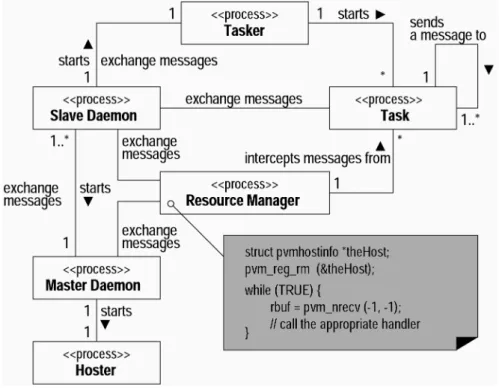
The PVM system presents a general library-based message passing interface to enable dis-tributed memory computing on parallel com-puters as well as on heterogeneous workstations and PC clusters. With thousands of users PVM has become the de facto standard and widely prevalent parallel programming paradigm. Start-ing tasks in parallel, message exchange among tasks as well as synchronization, virtual ma-chine management, process management and other miscellaneous functions are accomplished by the PVM library in conjunction with PVM daemons that run on each computing node and cooperate to emulate a parallel machine. With reference to Figure 1, where the structure of PVM is depicted by making use of the UML 2]class diagram, the first PVM daemon, called
master, is started manually and the others(
sla-ves)are started by the master on a user-defined host pool using remote login, remote shell pro-gram or therexecsystem call.
Parallelizing an application based on functional and data parallelism results in several cooperat-ing PVM tasks that can run in parallel, syn-chronize and send messages to one another. Tasks can be dynamically started and destroyed by calling thepvm spawn and pvm kill library
functions, respectively. The PVM library then forwards the requests to the daemon specified in the parameter list. If a special task called
tasker is not registered, new tasks are started and killed by the daemon calling the appropriate UNIX system calls. If the tasker runs, the dae-mon forwards the requests to the tasker which controls the execution of the tasks running on its host. The tasker is the direct parent of any process it controls and can be used to implement a distributed debugging system.
Interprocess communication in PVM is accom-plished with the pvm send and pvm recv calls
that support messages containing multiple data types, but require explicit encoding and decod-ing calls for buffer construction and extraction. Without setting the options that allow message exchange to use direct process to process stream
connection, i.e. TCP, data is transfered via dae-mons which operate on top of the UDP protocol. Messages are reliably delivered and buffered, so a task can use both blocking and nonblock-ing calls to receive messages. Each message is labeled with a user-supplied message tag and with a system-supplied context tag. The mes-sage tag and the sender identifier are used to discriminate among multiple messages arriving at the same time. The context tag discriminates among libraries which use PVM message pass-ing capabilities and are linked together in the same executable. PVM provides dynamic and static group operations, which are useful when more than one sender or receiver is involved in message exchange or collaborative computa-tion.
Any task can dynamically configure the virtual machine by callingpvm addhostsandpvm dele-tecalls to the library which forwards those
re-quests to the master daemon. In order to prevent system inconsistency the master daemon uses a two phase commit protocol to set up the new virtual machine, but since any task can recon-figure the virtual machine at any time, races are possible. As the tasker helps a daemon to manage the tasks, another special task, named hoster, can be registered by the master daemon to control the hosts’ configuration.
By default, the task and host scheduling in PVM is accomplished by a simple round robin algo-rithm. Beginning with version 3.3, PVM sup-ports a resource manager interface, which al-lows special tasks to be registered by the sys-tem and be responsible for the task and host placement decisions. If a resource manager
is registered, each library call that manipulates processes or hosts is intercepted by the PVM library and sent to the resource manager task using special messages. Typically, one resource manager is registered for an entire virtual ma-chine, but each daemon can have its own. The daemons without resource manager are handled by the resource manager associated with the master daemon. Any task can be registered with PVM as a tasker, a hoster or a resource manager by callingpvm reg tasker,pvm reg hosteror pvm reg rmlibrary call, respectively.
3. Resource Management and Load Balancing
Resource management and load balancing are very important techniques to efficiently utilize the resources in a NOW and to minimize the execution time of parallel applications. Taking scheduling decisions and controlling resources and applications in such a way that the load is evenly distributed are two major issues that must be taken into account with the design and implementation of resource management sys-tems. The mapping between hosts and appli-cation tasks is performed by a scheduling al-gorithm, which typically selects an application waiting in the batch queue, configures a runtime environment for the application, and starts it up. The scheduling algorithms require static infor-mation about hardware configuration and host’s performance data as well as dynamic informa-tion about the actual resource utilizainforma-tion and load distribution in the NOW. Besides the in-formation about the hosts, the scheduler also needs information about the applications’ re-source requirements. Usually, rere-source require-ments must be specified by the user and given in terms of such issues as the size of main memory, machine architecture, minimum and maximum number of nodes, and the host running the mas-ter process. There are a number of scheduling algorithms covering various management and mapping strategies, but a thorough treatment of these issues is out of the scope of this work. Aschedulerin a resource management system is not only responsible for the initial placement of applications but also for load balancing which requires a remapping of applications at runtime. Load balancing is crucial for message passing applications because the slowest process could determine the execution time of the whole par-allel application and, thus, defer the synchro-nization between the processes, thereby yield-ing poor performance. Therefore, cooperatyield-ing processes in a parallel application should be started on hosts with comparable performance and load so that synchronization delays can be minimized and the load situation remains in a balanced state.
the average length of the CPU run queue or the CPU utilization of the running processes. The load is measured periodically and load evalua-tion algorithms create a load map of the system by comparing the load values with each other or with predefined threshold values. Load bal-ancing is a complex optimization problem with a given cost function to equalize the load on the hosts. This optimization problem is NP-complete and has to be solved by using subop-timal or heuristic algorithms. A survey of load balancing algorithms is presented in19]. An unbalanced load distribution in a NOW re-quires load migration by, for instance, remap-ping processes to other machines. Important issues in process migration are the migration costs and the costs for the reconfiguration of the virtual machine, since both are quite ex-pensive and produce additional load. Process migration should be avoided, if the process fin-ishes soon, but predicting the remaining run-time of a process is a difficult problem 9]. A further reason for process migration is the inter-active use of target hosts. As a NOW usually is non-dedicated, interactive users expect to have priority over resource-intense applications that are primarily intended to use idle resources. If an interactive user starts working on a host exe-cuting parallel processes, the processes must be migrated to an idle host to ensure the interactive user a reasonable response time.
The most prevalent facility for the migration and the checkpointing of a single process is the Condor 12] single checkpointer that is avail-able for almost every hardware platform. Con-dor’s job is able to transparently vacate a work-station when the user attempts to use it. In this case, Condor will either transparently mi-grate the job to another idle workstation or just keep it in a queue until an idle worksta-tion has been found. Clearly, the computa-tion already performed should not be sacrificed and the job has to continue execution from the point where it was forced to vacate the ma-chine. Some hardware vendors provide their own checkpointing mechanisms for sequential processes, e.g. the user-transparent Checkpoint-Restart mechanism of SGI 23]. Process mi-gration in message passing parallel applications is more complex than in the sequential ones, mostly because parallel processes communi-cate with each other and process migration has
to deal with the communication routes. At the LRR-TUM the CoCheck 20, 21] system
Consistent Checkpoints) has been developed for process migration in message passing en-vironments while Coral25] migrate processes in software DSM(Distributed Shared Memory) environments.
Scheduling algorithms in existing resource man-agement systems are only able to perform the initial task-host placement for parallel applica-tions. Dynamic load balancing at runtime is not supported because of the missing control over parallel processes. Sequential applications are started and are fully controlled by the resource management system. Within parallel applica-tions, only the first process is started by the resource management system, while other pro-cesses are started by the application’s tasks or by the message passing runtime system and there-fore are unknown to the resource management system.
Full control over parallel processes is a crucial issue for resource management systems because without full control, they are not able to kill the whole application or to migrate processes. Fur-thermore, full control over parallel applications is required for writing periodic checkpoints in order to be able to continue the execution of an application after a failure, without restarting it form the very beginning. Finally, resource limitations can only be set and controlled if the resource management system knows of each process.
4. The SEMPA Resource Manager
SEMPA (Software Engineering Methods for
CODINE is a batch queuing and resource man-agement system that supports the execution of sequential and parallel applications in heteroge-neous NOWs. It is developed and distributed by GENIAS 6]. All the information about hosts and their utilization and jobs and their status is
managed by theqmasterprocess, which is CO-DINE’s central component. Using this informa-tion and the user defined resource requirements, the CODINE schedulerqschedddetermines the host pool where the job is to be computed. The CODINE execd running on every host in the
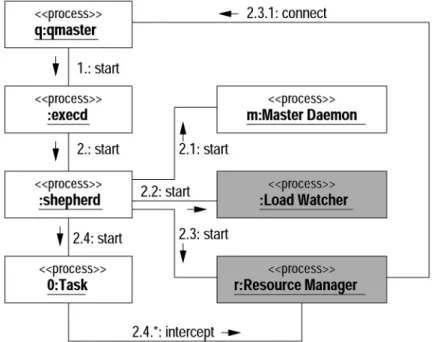
Fig. 2.The Structure of SEMPA Resource Manager on the Master Host.
NOW measures the load on the host periodi-cally and controls the execution of jobs on the host in cooperation withshepherdprocesses. With reference to Figures 2 and 3, where the structure of our resource management approach for both the master host and slave hosts is de-picted, we make use of the PVM resource man-ager interface to connect CODINE and PVM. We also integrate some additional functionality into our resource management scheme, e.g. load management including load evaluation and load migration capabilities15, 16].
The basis for load evaluation algorithms are load values that can be received from the CODINE
execdor an external load measurement compo-nent. However, we have implemented a load watching component, called load watcher, in order to faster react on the load changes in the virtual machine because obtaining the load val-ues measured by the CODINE execd via the CODINE qmaster takes more time and since we did not want to directly interact withexecd. The SEMPA Resource Manager makes use of CoCheck for process migration. CoCheck is a protocol that writes consistent yet transpar-ent checkpoints of a parallel application based on the message passing paradigm and uses the checkpointing facilities of Condor to write the state of a single process to a file or a socket. During process migration, the checkpoint state is transferred to the target host and restarted with the same state as it was before the migra-tion. Since the process selected to be migrated communicates with other processes, all affected processes must be stopped and all correspond-ing communication routes must be destroyed. However, after migration, these routes must be rebuilt and the processes affected by migration must be able to continue execution.
In Figures 2 and 3 we make use of UML ob-ject diagrams to depict the overall structure of the SEMPA Resource Manager as well as to show the interaction patterns between its com-ponents. The chronological sequence of ac-tions, performed to start the system up, is indi-cated by sequence numbers from 1 to 5. Before a PVM application(a group oftasks)is started, its runtime environment, according to the user requirements, must be configured. When the application is selected by the CODINE sched-uler, the runtime configuration is passed to the
PVMresource manager that builds up the run-time environment. The first process(0 : Task) of the parallel application is then started by the CODINE execd and controlled by a shep-herd process. Other application processes are spawned when a pvm task calls thepvm spawn
routine. This routine, in our scheme, is inter-cepted by the PVM resource manager which then selects the host on which to start the re-quested task.
The SEMPA Resource Manager has three op-tions for host selection. It can utilize the PVM default option, e.g. a simple round robin mech-anism without taking into account the current load distribution. Furthermore, the PVM re-source manager may consult CODINE to select the host considering the load distribution in the whole system controlled by CODINE. Finally, our resource manager is extended with a load evaluation component, which may select an ap-propriate host within the actual runtime environ-ment. If there is no appropriate host in the actual runtime environment, the PVM resource man-ager may requests a new host from CODINE. After a host has been selected, the PVMtasker
on the selected host creates the task(i : Task) in conjunction with the CODINE execd and a newshepherdprocess.
When the process terminates, theshepherd pro-cess passes information to the PVM tasker which forwards it to the PVM resource manager. Re-source statistics about the process are collected by theshepherd process and handed on to the
execdwhich periodically delivers it to the CO-DINEqmaster. PVM daemons are started with an application and terminate when the applica-tion finishes.
5. Measurements and Evaluation
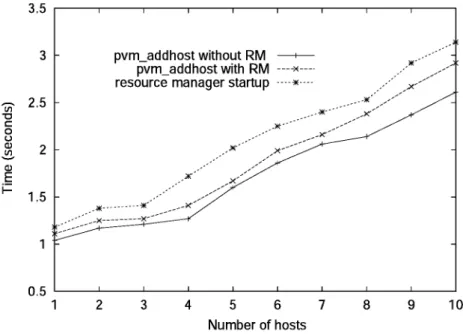
Fig. 4.Adding Hosts to the PVM Environment – Comparison.
The curve marked“pvm addhost without RM”
indicates the time needed to enhance the PVM virtual machine callingpvm addhostlibrary call from an application task, but, without the source management layer. The same test is re-peated, but this time with the resource manager layer between tasks and the PVM runtime sys-tem. The graphs show that the performance is only slightly diminished by the improved functionality and that the average overhead is about 10-30 %. For the curve marked“resource management startup”, the measurement is per-formed in the resource manager. However, this time the virtual machine is built by the resource manager at the startup and the time getting the virtual machine started, including RM initial-ization time is about 20 % bigger than the one when the virtual machine is dynamically en-hanced.
Table 1 shows the duration of the PVM
pvm spawn call in different scenarios; on the
local or remote machine with and without the PVM resource management layer. In this test, especially for the remote spawn the overhead is more than 100%. This is primarily caused by
the algorithm for the task-host matching used in the resource manager. It would be even more pronounced if the resource manager cooperated with the CODINE to get the best host in the whole system. Presently, our resource man-ager selects the best host from the host set re-ceived from CODINE at the startup, but this overhead in negligible in comparison with the benefit from starting a long-running task is on the appropriate machine.
The load situation in a NOW must be perma-nently controlled in order to have an insight into the resource utilization and to detect load imbalance. Our load measurement component runs at each host in the virtual machine and measures the load at regular time intervals(i.e. 5 seconds). The load on SGI machines is mea-sured in terms of the CPU utilization and takes about 170 µs. On SUN machines the load is measured as the average length of the CPU run queue(avenrun)and takes about 10 µs. Load measurement on SGI machines is obtained us-ing the/procfile system, while the one on SUN machines is based on the /dev/kmem file that
contains an image of the kernel virtual
mem-Spawn Time (ms) local host remote host
without the SEMPA Resource Manager 24 35
with the SEMPA Resource Manager 42 93
Time(µs) Measurement Evaluation Sending
SUN host 10 0.38 0.78
SGI host 170 0.21 0.61
Table 2.Management of Load Values.
ory of the computing node. As an example of load measurement, we show in Figure 2 a code snippet which obtains the average length of the running queue from the Solaris kernel. The ad-dress of these three long integers can be, using thenlistfunction, found in the/dev/ksymsfile
which contains kernel symbols and their actual addresses.
If the load situation changes or if an interac-tive user starts working, a PVM message is sent to the PVM resource manager, which migrates processes using CoCheck mechanisms based on Condor checkpoint files. The time needed to migrate a process depends on the process size, network bandwidth and latency and on the num-ber of communication routes the process has with another PVM tasks. The performance re-sults for process migration using CoCheck can be found in21]. Table 1 shows the time needed for the load measurement and evaluation as well as the time for sending the load value to the PVM resource manager. The time needed for the load evaluation and sending can is negligi-ble in comparison with the time needed for its measurement.
6. Discussion and Future Work
While the design and implementation of the SEMPA Resource Manager have proven to be successful in controlling and rescheduling par-allel processes, we intend to continue to enhance our project along several lines.
One of the first enhancements to be undertaken is the cooperation between the PVM resource manager and CODINE in allocating resources for a parallel application. Presently, the PVM resource manager only gets a host pool from CODINE at startup but the virtual machine can-not be extended automatically at runtime. The second issue is heterogeneous process migra-tion. Currently, CoCheck is only able to migrate processes to machines with the same processor and the same operating system version. Finally,
our implementation is PVM based mostly be-cause at the time of our implementation, the MPI standard(MPI-1)did not support any rou-tine for dynamic host or process manipulation which is crucial for our implementation scheme. The only way was to extend an existing MPI implementation by non-standard functions to support resource management what would cir-cumvent the standardization efforts of the MPI Forum. The improved standard MPI-2 offers some interfaces for user-defined extensions and primitives for dynamic process management4]. A further interesting function makes it possible to build up a connection between processes in different MPI applications. This function could be used to implement a daemon with the same functionality as the PVM resource manager. The SEMPA Resource Manager has many ad-vantages over other resource management sys-tems which in many cases do not have con-trol over parallel applications. For instance, the PSCHED standard proposal aims at standardiz-ing the interaction between the different compo-nents involved in the scheduling of parallel ap-plications5]. Interfaces are defined among a re-source manager, a message passing system and a scheduler to allow the cooperation of different systems and to make it easier to exchange com-ponents with standardized interfaces. PSCHED is just an interface standard, and, at the time of writing, an implementation is not available as yet.
The Prospero Resource Manager supports re-source allocation and scheduling in large net-works and multiprocessor systems 17]. The basic concept of the Prospero Resource ager is similar to the SEMPA Resource Man-ager : a job manMan-ager controls the resources of a parallel application and requests resources from a system manager on demand. A major draw-back of the Prospero Resource Manager is that a process migration component is missing. Approaches similar to the SEMPA Resource Manager are utilized by the Coral26, 24] pro-ject. Coral (Cooperative Onine Monitoring
ActionsLayer) is aimed at the design and im-plementation of online monitoring systems for applications based on the DSM programming paradigm. Coral only instruments parallel ac-tivities and constructs while the sequential ones are intended to be included by utilizing legacy sequential software. Coral is primarily focused on the interaction among parallel applications and DSM runtime systems, the transparent man-agement of DSM mechanism including process migration and consistent checkpointing, and the consistency of monitoring actions in a multiple-tool environment, but, in contrast to the SEMPA Resource Manager , does not deal with schedul-ing strategies.
7. Conclusion
Message passing environments support the par-allelization of applications and provide runtime environments for their execution. Resource management functionalities are especially re-quired in NOWs to configure the runtime en-vironment and schedule the applications to ap-propriate hosts. Load balancing is an extremely important issue for parallel applications to avoid waiting times potentially caused by synchro-nizations among parallel activities. However, there is no interface to make the information of a resource management system available to a message passing environment.
In this article, we discussed the problems arising from the missing cooperation between resource management systems and message passing en-vironments and presented the SEMPA Resource Manager to overcome these deficiencies. The performance measurements show that there is negligible overhead caused by the cooperation.
Up to now, there is only an implementation of the SEMPA Resource Manager for PVM be-cause the current (at the time of our develop-ment)MPI-1 standard lacks dynamic host and process management facilities and misses exter-nal interfaces. The MPI-2 standard provides the functionalities required for an interface to a re-source management system, however, only part of MPI-2 has already been implemented and is available as a message-passing environment.
References
1] A. BEGUELIN ANDJ. DONGARA ANDA. GEIST AND
R. MANCHEK ANDW. JIANG ANDV. S. SUNDERAM, PVM: A User’s Guide and Tutorial for Networked Parallel Computing, MIT Press, 1994.
2] G. BOOCH ANDJ. RUMBAUGH ANDI. JACOBSON,The Unified Modeling Language User Guide, Addison-Wesley, 1999.
3] The MPI Forum. MPI: A Message-Passing In-terface Standard, Version 1.1, Tehnical Report, University of Tennessee, Knoxville, TN, June 1995.http://www.mpi-forum.org/docs/ mpi-11.ps.Z
4] The MPI Forum. MPI-2: Extensions to the Message-Passing Interface, Tehnical Report, University of Tennessee, Knoxville, TN, July 1997.
5] D. G. FEITELSON AND L. RUDOLPH AND U.
SCHWIEGELSHOHN ANDK. C. SEVCIK ANDP. WONG, Theory and Practice in Parallel Job Schedul-ing, In IPPS’97 3rd Workshop on Job Schedul-ing Strategies for Parallel ProcessSchedul-ing, vol-ume 1291, of Lecture Notes in Computer Science, pages 1–34, Springer-Verlag, 1997. http://www.cs.huji.ac.il/ feit/
parsched.html
6] GENIAS Software GmbH, D-93073 Neutraubling,
Germany.CODINE Manual, Version 4.0.2, 1997.
7] W. Gropp and E. Lusk and N. Doss and A.
Skjel-lum,A High-Performance, Portable Implementation of the MPI Message Passing Interface Standard, Tehnical Report, Argonne National Lab, July 1996.
8] T. P. GREEN AND J. SNYDER, DQS, A Distributed Queuing System, Technical Report FSU-SCRI-92-115, Supercomputer Computations Research Insti-tute, Florida State University, 1992.
9] M. HARCHOL-BALTER ANDA. B. DOWNEY,
10] J. P. JONES, NAS Requirements Checklist for Job Queuing/Scheduling Software, Techni-cal Report NAS-96-003, NAS High Perfor-mance Processing Group, NASA Ames Re-search Center, Moffett Field, CA, April 1996. http://science.nas.nasa.gov/Pubs/
TechReports/NASreports/NAS-96-003.
11] P. LUKSCH ANDU. MAIER ANDS. RATHMAYER AND
M. WEIDMANN ANDF. UNGER, Software Engineer-ing Methods for Parallel Applications in Scien-tific Computing – Project SEMPA. IEEE Con-currency, pages 64–72, July-September 1997. http://wwwbode.informatik.tu-muenchen. de/archiv/artikel/ieee-concurrency/ sempa.ps.gz
12] M. LITZKOW ANDT. TANNENBAUM ANDJ. BASNEY ANDM. LIVNY,Checkpoint and Migration of UNIX Processes in the Condor Distributed Environment, Technical Report 1346, University of Wisconsin-Madison, Computer Sciences Department, 1997. http://www.cs.wisc.edu/condor/
publications.html
13] U. MAIER, Konzepte zur Ressourcenverwaltung f¨ur wissenschaftlich-technische Anwendungen in verteilten Rechensystemen, PhD Thesis, Technis-che Universit¨at M¨unTechnis-chen, 1999.
14] U. MAIER AND P. LUKSCH AND A. BODE,
Expe-riences with the SEMPA Resource Manager for Real World Scientific Computing in Networks of Workstations,Parallel and Distributed Computing Practices, 1999. to appear.
15] U. MAIER ANDG. STELLNER ANDI. ZORAJA, Batch
Queuing and Resource Management for PVM Applications in a Network of Workstations, in Mitteilungen – Gesellschaft f ur Informatik e.V., Parallel-Algorithmen und Rechnerstrukturen, vol-ume 16, pages 11–20, Gesellschaft f ur Infor-matik e.V., Parallel-Algorithmen, Rechenstruk-turen und Systemsoftware, December, 1997. http://wwwbode.informatik.tu-muenchen. de/archiv/artikel/pars97/maier.ps.gz 16] U. MAIER ANDG. STELLNER ANDI. ZORAJA,
Re-source Allocation, Scheduling and Load Bal-ancing based on the PVM Resource Man-ager, in Parallel Computing: Fundamen-tals, Applications and New Directions, volume 12, pages 711–718, Elsevier Publishers, 1998. http://wwwbode.informatik.tu-muenchen. de/archiv/artikel/parco97/maier.ps.gz 17] B. C. NEUMAN ANDS. RAO, The Prospero Resource
Manager: A Scalable Framework for Processor Allocation in Distributed Systems, Concurrency: Practice and Experience, 6(4):339–355, June 1994.
ftp://prospero.isi.edu/pub/papers/prm 18] J. PRUYNE AND M. LIVNY, Interfacing
Con-dor and PVM to harness the cycles of workstation clusters, Future Generations of Computer Systems, 12(1):67–85, May 1996.
http://www.cs.wisc.edu/condor/ publications.html
19] B. A. SHIRAZI ANDA. R. HURSON ANDK. M. KAVI,
Scheduling and Load Balancing in Parallel and Dis-tributed Systems, IEEE Computer Society Press, 1995.
20] G. STELLNER AND J. PRUYNE, Resource
Manage-ment and Checkpointing for PVM, InProceedings of EuroPVM’95, volume 5, pages 131–136, Herm `es, September 1995.
21] G. STELLNER. CoCheck: Checkpointing and
Pro-cess Migration for MPI. In Proceedings of the In-ternational Parallel Processing Symposium, pages 526–531, IEEE Computer Society Press, April 1996.
22] V. S. SUNDERAM, PVM: A Framework for Parallel
Distributed Computing,Concurrency: Practice and Experience, 2(4):315–339, December 1990.
23] BILL TUTHILL, IRIX Checkpoint and Restart
TM
Operation Guide, Silicon Graphics, Inc., 1996. http://techpubs.sgi.com/library/lib/ makepage.cgi?007-3236-001
24] I. ZORAJA AND A. BODE AND V. SUNDERAM, A
Framework for Process Migration in Software DSM Environments, Proceedings of the 8th Euromicro Workshop on Parallel and Distributed Processing, pages 158–165, IEEE Computer Society, January 2000.
25] I. ZORAJA, Online Monitoring in Software DSM Systems, PhD Thesis, Technische Universit at M unchen, submitted, March 2000.
26] I. ZORAJA ANDG. RACKL ANDT. LUDWIG. Towards
Monitoring in Parallel and Distributed Systems, in Proceedings of SoftCOM ’99, pages 133–141. FESB Split, October 1999.
Received:March, 1998 Revised:May, 2000 Accepted:February, 2001
Contact address: Ivan Zoraja FESB, Department of Electronics and Computer Science University of Split 21000 Split Croatia e-mail:fzoraja|[email protected] Ursula Seitz LRR-TUM Institut f ur Informatik Technische Universit at M unchen 80290 M unchen Germany
Petar Slapnicarˇ
FESB, Department of Electronics and Computer Science University of Split
21000 Split Croatia
DR. IVANZORAJAobtained his diploma degree in electronics from FESB in Split, his master degree in computer science from FER in Zagreb, both in Croatia, and his Ph.D degree(Dr. rer. nat)in computer science from the Technical University of Munich in Germany. His education includes several research stays in Germany(three years)and USA(two years). He is currently employed at FESB in Split in Croatia. His pri-mary research interests are parallel and distributed systems including distributed shared memory systems and distributed object computing.
DR. URSULASEITZobtained her diploma degree(Dipl. Inform)in 1994 and her Ph.D(Dr. rer. nat)in 1999 both from the Technical Univer-sity of Munich. The title of her PhD thesis is “Resource Management for Scientific Computing”. She is currently at Kratzer Automation AG, working on software development for pthe automation of industrial pro-cesses. Her major points of interest are parallel applications, distributed systems, and metacomputing.
PROF. DR. ARNDTBODEobtained his diploma degree(Dipl. Inform.) in 1972 and his Ph.D(Dr. rer.nat.)in 1975 both from the Technical Uni-versity of Karlsruhe, his Dr.-Ing. habil in 1985 from the UniUni-versity of Erlangen-N urnberg in Germany. He used to work for the Universities of Gie sen and Erlangen and is a full professor in computer science at the Technical University of Munich since 1987 and also a vice-president since 1999. His main research interests are computer architecture, mi-croprocessing, and parallel and distributed systems. He is the author and co-author of more than 175 publications including 10 books about the said topics.