A Readability Checker with Supervised Learning Using Deep Indicators
Tim vor der Brück, Sven Hartrumpf, Hermann Helbig Intelligent Information and Communication Systems (IICS) FernUniversität in Hagen, 58084 Hagen, Germany
E-mail: [email protected]
Keywords:readability, syntactic and semantic analysis, nearest neighbor
Received:May 11, 2008
Checking for readability or simplicity of texts is important for many institutional and individual users. Formulas for approximately measuring text readability have a long tradition. Usually, they exploit surface-oriented indicators like sentence length, word length, word frequency, etc. However, in many cases, this information is not adequate to realistically approximate the cognitive difficulties a person can have to understand a text. Therefore we use deep syntactic and semantic indicators in addition. The syntactic information is represented by a dependency tree, the semantic information by a semantic network. Both representations are automatically generated by a deep syntactico-semantic analysis. A global readability score is determined by applying a nearest neighbor algorithm on 3,000 ratings of 300 test persons. The evaluation showed that the deep syntactic and semantic indicators lead to promising results comparable to the best surface-based indicators. The combination of deep and shallow indicators leads to an improvement over shallow indicators alone. Finally, a graphical user interface was developed which highlights difficult passages, depending on the individual indicator values, and displays a global readability score.
Povzetek: Strojno uˇcenje z odvisnostnimi drevesi je uporabljeno za ugotavljanje berljivosti besedil.
1 Introduction
Readability checkers are used to highlight text passages that are difficult to read. They can help authors to write texts in an easy-to-read style. Furthermore they often dis-play a global readability score which is derived by a read-ability formula. Such a formula describes the readabil-ity of a text numerically. There exists a large amount of readability formulas (13). Most of them use only surface-oriented indicators like word frequency, word length, or sentence length. Such indicators have only indirect and limited access to judging real understandability. Therefore, we use deep syntactic and semantic indicators1in addition
to surface-oriented indicators. The semantic indicators op-erate mostly on a semantic network (SN); in contrast, the syntactic indicators mainly work on a dependency tree con-taining linguistic categories and surface text parts. The SNs and the dependency trees are derived by a deep syntactico-semantic analysis based on word-class functions.
Furthermore, we collected a whole range of readability criteria from almost all linguistic levels: morphology, lexi-con, syntax, semantics, and discourse2 (7). To make these
criteria operable, each criterion is underpinned by one or more readability indicators that have been investigated in the (psycho-)linguistic literature and can be automatically
1An indicator is calleddeepif it requires a deep syntactico-semantic
analysis.
2In this article, discourse criteria are subsumed under the heading
se-mantic because they form only a small group and rely directly on sese-mantic information.
determined by NLP tools (see (11) for details). Two typical readability indicators for the syntactic readability criterion of syntactic ambiguityare thecenter embedding depth of subclausesand thenumber of argument ambiguities (con-cerning their syntactic role3).
2 Related work
There are various methods to derive a numerical represen-tation of text readability. One of the most popular readabil-ity formulas is the so-called Flesch Reading Ease (4). The formula employs the average sentence length and the av-erage number of syllables for estimating readability. The sentence length is intended to roughly approximate sen-tence complexity, while the number of syllables approx-imates word frequency since usually long words are less used. Later on, this formula was adjusted to German (1). Despite of its age, the Flesch formula is still widely used.
Also, the revised Dale-Chall readability index (2) mainly depends on surface-oriented indicators. Actually, it is based on sentence length and the occurrences of words in a given list of words which are assumed to be difficult to read.
Recently, several more sophisticated approaches which use advanced NLP technology were developed. They de-termine for instance the embedding depth of clauses, the usage of active/passive voice or text cohesion (17; 9; 21).
3Such ambiguities can occur in German because of its relatively free
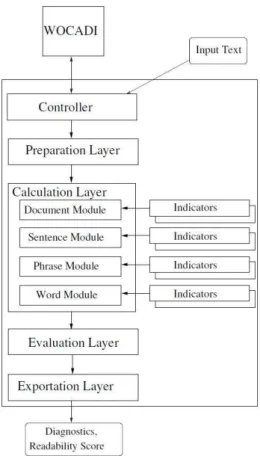
Figure 1: System architecture of the readability checker DeLite.
The methods of (3; 22) go a step beyond pure analysis and also create suggestions for possible improvements. Some approaches, e.g., (20), integrate their readability checkers into a graphical user interface, which is vital for practical usage.
As far as we know, all approaches for determining text readability are based on surface or syntactic structures but not on a deep semantic representation which represents the cognitive difficulties for text understanding more ade-quately. Readability formulas usually combine several so-called readability indicators like sentence or word length by a linear combination. Examples for non-linear approaches are the nearest neighbor approach of Heilman et al. (9) and the employment of support vector machines by Lars-son (15) to separate the vectors of indicator values for given texts into the three different readability classeseasy, medium, anddifficult. A drawback of the latter method is that this classification is rather rough.
3 System architecture
A text is processed in several steps (see Figure 1) by our readability checker DeLite (an association of Lite as in light/easy reading and De as in Deutsch/German; there is also a prototype EnLite for English). First, the Con-troller passes the text to a deep syntactico-semantic
analy-sis (WOCADI4parser, (6)), which is based on a word-class
functional analysis and is supported by a large semantically oriented lexicon (8). The parser output for each sentence is a morpho-lexical analysis, one or more (in case of ambi-guities) syntactic dependency trees, one or more SNs, and intrasentential and intersentential coreferences determined by a hybrid rule-statistical coreference resolution module. The resulting SNs follow the MultiNet formalism (multi-layered extended semantic network, (10), example in Fig-ure 2). On the basis of this analysis, the text is divided into sentences, phrases, and words in the Preparation Layer.
The individual indicator values are determined by the Calculation Layer. DeLite currently uses 48 morphologi-cal, leximorphologi-cal, syntactic, and semantic indicators; below we concentrate on some deep syntactic and semantic ones. Each indicator is attached to a certain processing mod-ule depending on the type of required information: words, phrases, sentences, or the entire document. Each module iterates over all objects of its associated type that exist in the text and triggers the calculation of the associated indi-cators. Examples for indicators operating on the word level are the indicatorsnumber of word charactersornumber of word readings. Semantic and syntactic indicators usually operate on the sentence level. As the result of this calcu-lation step an association from text segments to indicator values is established.
In the Evaluation Layer, the values of each indicator are averaged to the so-calledaggregatedindicator value. Note that there exists for each indicator only one aggregated in-dicator value per text. The readability score is then calcu-lated (see Sect. 4) by thek-nearest neighbor algorithm of the machine learning toolkit RapidMiner (18). In contrast to surface-oriented indicators, a deep indicator can usually only be determined for a given sentence (most deep indi-cators operate on sentences) if certain prerequisites are met (e.g., full parse or chunk parse is available). If this is not the case, the associated sentence is omitted for determining the aggregated indicator value. If an indicator could not be calculated for any sentence of the text at all, its value is set to some fixed constant.
Finally, all this information is marked up in XML and in a user-friendly HTML format and is returned to the calling process by the Exportation Layer.
4 Deriving a readability score using
the
k
-nearest neighbor algorithm
A nearest neighbor algorithm is a supervised learning method. Thus, before this method can be applied to new data, a training phase is required. In this phase, a vector of aggregated indicator values is determined by RapidMiner (see Sect. 4) for each text of our readability study compris-ing 3,000 ratcompris-ings from 300 users. The vector components are normalized and multiplied by weights representing the
importance of the individual indicators where the weights are automatically learned by an evolutionary algorithm. All vectors are stored together with the average user ratings for the associated texts. To derive a readability score for a previously unseen text, the vector of weighted and normal-ized aggregated indicator values is determined for this text first (see above). Afterwards, thekvectors of the training data with the smallest distance to the former vector are ex-tracted. The readability score is then given as a weighted sum of the user ratings associated with thosekvectors.
5 Syntactic indicators
5.1 Clause Center Embedding Depth
A sentence is difficult to read if the syntactic structure is very complex (5). One reason for a high complexity can be that the sentence contains deeply embedded subordinate clauses. The difficulty can be increased if the subordinate clause is embedded into the middle of a sentence since the reader has to memorize the superior clause until its contin-uation after the termination of the subordinate clause (12), for example: Er verließ das Haus, in dem die Frau, die er liebte, wohnte, sofort. (literal translation from German: He left the house where the woman he loved lived imme-diately.) In contrast to (21), two separate indicators are employed for the embedding depth: one measuring embed-ding depth in general and one focusing only on center em-bedding depth which allows it to compare both effects. In our experiments only center embedding depth was consid-erably correlated to the readability ratings from the partici-pants. Center embedding depth is calculated for each main verb in the following way. First, we determine the path from the root of the dependency tree to each main verb. Then, we count the occurrences of the dependency rela-tions for relative or other subordinated clauses on this path. However, they are only taken into account if the embedded clause is not located on the border of the superior clause.
5.2 Distance between Verb and Separable
Prefix
In German, so-called separable prefix verbs are split into two words in clauses with main clause word order, for ex-ampleeinladen(invite)⇒Er lädt . . . ein.(He invites . . . .). If the verb is far away from the verb prefix, it can be diffi-cult for readers to associate both parts.
5.3 Number of Words per Nominal Phrase
According to (19), long NPs degrade readability. Hence, some information from the long NP should better be placed in a subordinate clause or a new sentence. Therefore we count the average number of words contained in an NP where a larger number results in a worse readability score. Note that we only consider maximal NPs (i.e., NPs not con-tained in a larger NP); otherwise a large indicator value for
the long NP could be compensated by small indicator val-ues for the contained NPs which should be avoided.
6 Semantic indicators
6.1 SN Quality
An incomplete parse from WOCADI is mainly caused by syntactic or semantic defects of the sentence since the parser builds the syntactic structure as a dependency tree and the semantic representation as an SN in parallel. There-fore, the indicator SN quality is a mixed one: semantic and syntactic. Consider for instance the two sentencesDas Werk kam vor allem bei jungen Theatergängern an. Schul-busse reisten an, um es sich anzusehen.5 (The work was
very well accepted by young visitors of the theater. School buses arrived to watch it.) The second sentence, which is syntactically correct, is semantically incorrect and there-fore difficult to read. The semantic lexicon employed by the parser requires that the first argument (which plays the semantic role of the agent) ofansehen.1.16(to watch) is of
typehuman. Thus, this sentence is rejected by the parser as incorrect. In other cases the sentence might be accepted but considered as semantically improbable. This informa-tion, which is provided by the parser, is used by DeLite and turned out to be very valuable for estimating text readabil-ity.
Three parse result types are differentiated: complete parse (around 60% of the sentences; note that this means complete syntactic structureandsemantic representation at the same time), chunk parse (25%), failure (15%).7 These
three cases are mapped to different numerical values of the indicatorSN quality. Additionally, if a full parse or a chunk parse is available, the parser provides a numerical value specifying the likelihood that the sentence is semantically correct which is determined by several heuristics. This formation is incorporated into the quality score of this in-dicator too.8
6.2 Number of Propositions per Sentence
DeLite also looks at the number of propositions in a sen-tence. More specifically, all SN nodes are counted which have the ontological sortsi(tuation) (10, p. 412) or one of its subsorts. In a lot of cases, readability can be judged more accurately by the number of propositions than by sen-tence length or similar surface-oriented indicators. Con-sider for instance a sentence containing a long list of NPs: Mr. Miller, Dr. Peters, Mr. Schmitt, Prof. Kurt, . . . were
5from the newspaperSchleswig-Holstein am Sonntag, 2007 6Note that the readings of a lexeme are distinguished by numerical
suffixes.
7The absence of a complete parse is problematic only for a part of
the indicators, mainly deep syntactic and semantic ones. And even for some of these indicators, one can define fallback strategies to approximate indicator values by using partial results (chunks).
8Naturally, this indicator depends strongly on the applied parser. A
c2o SUBthis/der.4 CAUS ( ( R R R R R R R R R R R
c280io∨oa
SUBspeed/geschwindigkeit c292st SUBRval.0 ARG1 o o c9?decl.-sent.dn SUBSachieve/bewirken TEMPpast.0 ARG1 O O
ARG2 //
MODL ² ² c284da SUBSreduce/reduzieren TEMPpresent.0 AFF O O
AGT //
CSTR
²
²
INITmmmmmm66
m m m m m RSLT ( ( Q Q Q Q Q Q Q Q Q Q Q c246d SUBdriver/fahrer
can.0/können.0md SUBSc250asfear/angst
CSTR ² ² c291st SUBRval.0 ARG1 a a BBB BBB BBB BBB BBB BBB BBB BBBB
c255d∨io
PREDneighbor/nachbar
Figure 2: Simplified SN for the corpus sentenceDas könnte bewirken, dass der Fahrer aus Angst vor den Nachbarn die Geschwindigkeit reduziert.(This could achieve that the driver reduces the speed for fear of the neighbors.)
present. Although this sentence is quite long it is not diffi-cult to understand (14). In contrast, short sentences can be dense and contain many propositions, e.g., concisely ex-pressed by adjective or participle clauses.
6.3 Number of Connections between SN
Nodes/Discourse Entities
The average number of nodes which are connected to an SN node is determined. A large value often indicates a lot of semantic dependencies. For this indicator, the arcs leading to and leaving from an SN node are counted. Note that the evaluation showed that better results (stronger cor-relation and higher weight) are achieved if only SN nodes are regarded which are assigned the ontological sortobject (10, p. 409–411). These SN nodes roughly represent the discourse entities of a sentence.
6.4 Length of Causal and Concessive Chains
Argumentation is needed to make many texts readable. But if an author puts too many ideas in too few words, the pas-sage becomes hard to read. For example, the following sentence from a newspaper corpus has been automatically identified as pathologic because it contains three causal re-lations (CAUSandCSTRin Figure 2) chained together:Das
könnte bewirken, dass der Fahrer aus Angst vor den Nach-barn die Geschwindigkeit reduziert. (This could achieve that the driver reduces the speed for fear of the neighbors.). Again, length measurements on the surface will not help to detect the readability problem, which exists for at least some user groups. Splitting such a sentence into several ones is a way out of too dense argumentation.
7 Evaluation
To judge the viability of our approach, we conducted an online readability study with 500 texts, more than 300 par-ticipants, and around 3,000 human ratings for individual texts. The participants rated the text readability on a 7 point Likert scale (16).
Almost 70 % of the participants were between 20 and 40 years old; the number of participants over 60 was very small (3 %). The participants were mainly well-educated. 58 % of them owned a university or college degree. There is none who had no school graduation at all.
Our text corpus originated from the municipal domain and differs significantly from newspaper corpora, which are widely used in computational linguistics. It contains a lot of ordinances with legal terms and abbreviations, e.g., ˘g 65 Abs. 1 Satz 1 Nr. 2 i.V.m. ˘g 64 Abs. 1 Satz 2 LWG NRW (section 65.1.1 (2) in connection with section 64.1.2 LWG NRW). This corpus has been chosen because local admin-istrations in Germany have committed themselves to make their web sites accessible; one central aspect of accessibil-ity is simple language.
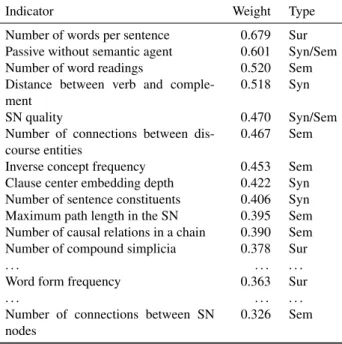
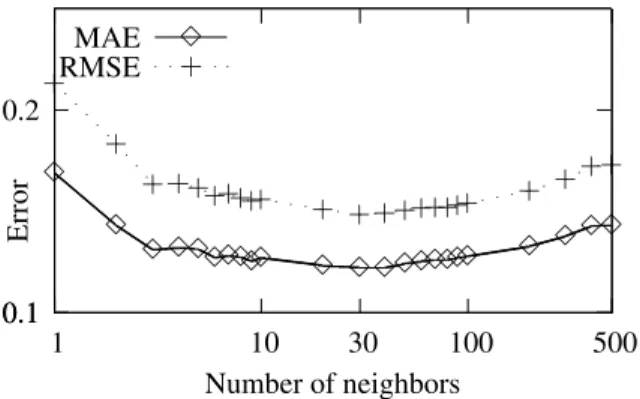
Figure 4 shows the mean absolute error (MAE) and the root mean square error (RMSE) of DeLite’s global read-ability score in contrast to the average user rating deter-mined by a 10 fold cross-validation over all 500 test doc-uments. The ordinate contains MAE and RMSE, the ab-scissa, on a logarithmic scale, the number of neighbors used. The lowest errors (MAE: 0.122, RMSE: 0.148) and highest correlation (0.528) were obtained with 30 nearest neighbors. The nearest neighbor algorithm determined the weights of each indicator using an evolutionary algorithm. The resulting indicator weights, in the case all indicators are used simultaneously, are given in Table 1.
Indicator Weight Type Number of words per sentence 0.679 Sur Passive without semantic agent 0.601 Syn/Sem Number of word readings 0.520 Sem Distance between verb and
comple-ment
0.518 Syn
SN quality 0.470 Syn/Sem
Number of connections between dis-course entities
0.467 Sem Inverse concept frequency 0.453 Sem Clause center embedding depth 0.422 Syn Number of sentence constituents 0.406 Syn Maximum path length in the SN 0.395 Sem Number of causal relations in a chain 0.390 Sem Number of compound simplicia 0.378 Sur
. . . .
Word form frequency 0.363 Sur
. . . .
Number of connections between SN nodes
0.326 Sem
Table 1: Indicators with largest weights in our readability function (Syn=syntactic, Sem=semantic, and Sur=surface indicator type).
Indicator Corr. Type
Number of words per sentence 0.430 Sur
SN quality 0.399 Syn/Sem
Inverse concept frequency 0.330 Sem
Word form frequency 0.262 Sur
Number of reference candidates for a pronoun
0.209 Sem Number of propositions per sentence 0.180 Sem Clause center embedding depth 0.157 Syn Passive without semantic agent 0.155 Syn/Sem
Number of SN nodes 0.148 Sem
Pronoun without antecedent 0.140 Sem Number of causal relations in a chain 0.139 Sem Distance between pronoun and
an-tecedent
0.138 Sem Maximum path length in the SN 0.132 Sem Number of connections between
dis-course entities
0.132 Sem
Table 2: Indicators most strongly correlated with user rat-ings (Syn=syntactic, Sem=semantic, and Sur=surface indi-cator type).
Figure 3: DeLite screenshot showing a sentence which con-tains a large distance between verb (lädt) and separable verb prefix (ein). English translation for the example sen-tence:Dr. Peters invites Mr. Müller and his wife for dinner on Thursday, Jan. 31, 2006 to his villa in Düsseldorf.
out to be quite comparable to surface-oriented indicators. Finally as a baseline, DeLite was compared to the read-ability index resulting from employing the nearest neighbor approach only on the indicators of the Flesch readability in-dex, i.e. average sentence length and number of syllables per word. The correlation of DeLite with the user ratings is 0.528, which clearly outperforms the Flesch indicators (0.432).
8 User interface
Besides a low-level server interface, DeLite provides a graphical user interface for comfortable usage. In Fig-ure 3, a screenshot of this interface is shown.9 The types
of readability problems found in the text are displayed on the right side. If the user clicks on such a type, the asso-ciated difficult-to-read text segments are highlighted. Ad-ditional support for the user is provided if he/she wants to have more information about the readability problem. By moving the mouse pointer over the highlighted text seg-ment, a fly-over help text with a more detailed description is displayed. Moreover, if the user clicks on the highlighted segment, additional text segments are marked in bold face. These additional segments are needed to fully describe and explain specific readability problems. Figure 3 shows the readability analysis of a verb which is too far away from its separable prefix (see Sect. 5.2). The prefixein-is high-lighted as problematic and additionally the main verblädt is marked in bold face for better understanding.
9Note that the classification of indicators is slightly different in the
0.2
0.1 0.1
500 100
30 10 1
Number of neighbors
Error
MAE
3 3
33333333 3 33333333 3 333 3
RMSE
+
+
++++++++ + ++++++++ + +++ +
Figure 4: Mean absolute error (MAE) and root mean square error (RMSE) between the DeLite readability score and the average user rating of a text depending on the number of neighbors.
9 Conclusion
An overview of some typical examples of deep syntactic and semantic readability indicators has been given. In our evaluation, it turned out that these indicators have weights and correlations comparable to the best surface-based indi-cators in accurately judging readability.
In the future, the parser employed in DeLite will be con-tinually improved. Currently, DeLite is only a diagnosis tool; we will investigate how DeLite can propose refor-mulations for improving readability. Finally, the automatic distinction between real ambiguities that exist for humans and spurious ambiguities that exist only for machines (e.g., NLP methods like PP attachment and interpretation) must be sharpened.
Deep syntactic and semantic indicators turned out to be quite valuable for assessing readability and are expected to be a vital part of future readability checkers.
Acknowledgments
We wish to thank our colleagues Christian Eichhorn, Ingo Glöckner, Johannes Leveling, and Rainer Osswald for their support for this work. The research reported here was in part funded by the EU project Benchmarking Tools and Methods for the Web (BenToWeb, FP6-004275).
References
[1] Amstad, T. (1978). Wie verständlich sind unsere Zeitungen? Ph.D. thesis, Universität Zürich, Zurich, Switzerland.
[2] Chall, J. and Dale, E. (1995). Readability Revisited: The New Dale-Chall Readability Formula. Brookline, Massachusetts: Brookline Books.
[3] Chandrasekar, R. and Srinivas, B. (1996). Automatic induction of rules for text simplification. Technical Report IRCS Report 96-30, University of Pennsylva-nia, Philadelphia, Pennsylvania.
[4] Flesch, R. (1948). A new readability yardstick. Jour-nal of Applied Psychology, 32:221–233.
[5] Groeben, N. (1982).Leserpsychologie: Textverständ-nis – Textverständlichkeit. Münster, Germany: As-chendorff.
[6] Hartrumpf, S. (2003).Hybrid Disambiguation in Nat-ural Language Analysis. Osnabrück, Germany: Der Andere Verlag.
[7] Hartrumpf, S.; Helbig, H.; Leveling, J.; and Osswald, R. (2006). An architecture for controlling simple lan-guage in web pages. eMinds: International Journal on Human-Computer Interaction, 1(2):93–112.
[8] Hartrumpf, S.; Helbig, H.; and Osswald, R. (2003). The semantically based computer lexicon HaGenLex – Structure and technological environment. Traite-ment automatique des langues, 44(2):81–105.
[9] Heilman, M. J.; Collins-Thompson, K.; Callan, J.; and Eskenazi, M. (2007). Combining lexical and grammatical features to improve readability measures for first and second language texts. In Proceed-ings of the Human Language Technology Conference. Rochester, New York.
[10] Helbig, H. (2006).Knowledge Representation and the Semantics of Natural Language. Berlin, Germany: Springer.
[11] Jenge, C.; Hartrumpf, S.; Helbig, H.; Nordbrock, G.; and Gappa, H. (2005). Description of syntactic-semantic phenomena which can be automatically con-trolled by NLP techniques if set as criteria by certain guidelines. EU-Deliverable 6.1, FernUniversität in Hagen.
[12] Kimball, J. (1973). Seven principles of surface struc-ture parsing in natural language.Cognition, 2:15–47.
[13] Klare, G. (1963). The Measurement of Readability. Ames, Iowa: Iowa State University Press.
[14] Langer, I.; von Thun, F. S.; and Tausch, R. (1981). Sich verständlich ausdrücken. München, Germany: Reinhardt.
[15] Larsson, P. (2006). Classification into Readability Levels. Master’s thesis, Department of Linguistics and Philology, University Uppsala, Uppsala, Sweden.
[17] McCarthy, P.; Lightman, E.; Dufty, D.; and McNa-mara, D. (2006). Using Coh-Metrix to assess distri-butions of cohesion and difficulty: An investigation of the structure of high-school textbooks. InProc. of the Annual Meeting of the Cognitive Science Society. Vancouver, Canada.
[18] Mierswa, I.; Wurst, M.; Klinkenberg, R.; Scholz, M.; and Euler, T. (2006). Yale: Rapid prototyping for complex data mining tasks. InProc. of KDD. Philadelphia, Pennsylvania.
[19] Miller, G. (1962). Some psychological studies of grammar.American Psychologist, 17:748–762.
[20] Rascu, E. (2006). A controlled language approach to text optimization in technical documentation. In Proc. of KONVENS 2006, pp. 107–114. Konstanz, Germany.
[21] Segler, T. M. (2007). Investigating the Selection of Example Sentences for Unknown Target Words in ICALL Reading Texts for L2 German. Ph.D. thesis, School of Informatics, University of Edinburgh, Ed-inburgh, UK.