International Journal of Research in Engineering & Applied Sciences Email:- [email protected], http://www.euroasiapub.org
An open access scholarly, online, peer-reviewed, interdisciplinary, monthly, and fully refereed journals
63
AN ANALYTICAL STUDY OF GENETIC VARIABILITY IN INDUCED MUTATIONS WITH THE HELP OF SUNFLOWER
Ragini Kumari1, Prof. Dr. Rita Kumari2
Department of Biotechnology
1,2Magadh University, Bodhgaya, (Bihar) INDIA
Abstract
The present examination was gone for clarifying data principally on the genetic variability for yield and yield segments through induced mutagenesis and to confine self rich mutants with high oil content. Pre-sown Sunflower Hybrid (H1) and open pollinated populace composite (C1) were treated with the mutagen EMS at 0.06 percentage. There was increment in mean head distance across, seed yield, mean structure content in the mutants of DSF 15B and increment in mean for plant tallness, stem width and head measurement if there should arise an occurrence of mutants of Sunflower Hybrid in M2 generation. Investigation of change uncovered the predominance of noteworthy contrasts among the genotypes for every one of the characters considered in M2 generation. Further studies should be focused on testing new mutant lines in hybrid combinations, as well as the determination of inheritance of mutant traits.
Key words: sunflower, inbred lines, induced mutations, agronomic traits
1. INTRODUCTION
Genetic variability among plants in population is a basic prerequisite for successful plant breeding. Natural genetic
variation e.g., hybridization and
spontaneous mutations have been used in plant breeding for a long time. Discovery that radiation can induce hereditary alterations in plant genome and thereby enhance the frequency of mutations
allowed breeders to use induced
mutagenesis to obtain more desirable mutations.
Prompted mutations have been effectively utilized as a part of sunflower breeding to increment hereditary inconstancy by changing plant qualities and profitability.
Many creators have utilized initiated mutations in sun-blossom breeding and numerous mutants with changed attributes were produced. [1] Have made mutants with shorter developing season, which had more slender frame and lower plant stature. Mutants with short stature and bigger head width were produced by [2] utilizing gamma beams. Other sunflower mutants were likewise gotten: the expansion of 1000 seed mass [3], expanded leaf range and diminished plant stature [4], expanded oil content [5], imperviousness to rust and cytoplasmic male sterility. It has delivered mutants impervious to sweeper assault, races show in Bulgaria, by treating
youthful incipient organisms with
International Journal of Research in Engineering & Applied Sciences Email:- [email protected], http://www.euroasiapub.org
An open access scholarly, online, peer-reviewed, interdisciplinary, monthly, and fully refereed journals
64
change of sunflower oil quality. Mutantshaving high centralization of palmitic [6] and [7] corrosive have been produced utilizing compound or physical mutagen medicines.
The principle destinations of this
exploration were to increment hereditary variety inside the gathering of sunflower ingrained lines from Institute of Field and Vegetable Crops, Novi Sad by mutagenesis [8]. The exploration was coordinated to advancement of mutants with transformed one or couple of agronomic qualities and afterward to examine efficiency and strength of these mutants in relative trial [9].
2. MATERIALS AND METHODS
Material
The base material used in this study consisted of two sunflower genotypes, one open pollinated popular variety Sunflower
Hybrid (H1) and another inbred pollinated
population composite (C1) which is the
female line of new hybrid DSH1. They were treated with chemical mutagen, ethyl-methane sulfonate (EMS) at optimum dose of 0.06% [10].
Method
M2 generation
The seeds from individual capitulum of each Mj plants were harvested separately that were planted during January 2010 in a plant to progeny row with wider spacing for better expression. M2 generation of EMS treated Sunflower Hybrid andC1 was raised
along with respective untreated check. The inter-row and intra-row spacing was 60 and 30 cm, respectively. Observations were recorded on plant height, stem diameter, head diameter, seed filling percentage, 100 seed weight, hull content, oil content and seed yield per plant on
individual plant basis [11].
Table 1 description of parents used
PARTICULARS SUNFLOWER HYBRID (H1) POLLINATED POPULATION
COMPOSITE (C1)
Duration (days) 14 12
Yield (kg/ha) - -
Rainfed 900
Irrigated 1000
International Journal of Research in Engineering & Applied Sciences Email:- [email protected], http://www.euroasiapub.org
An open access scholarly, online, peer-reviewed, interdisciplinary, monthly, and fully refereed journals
65
Ray Floret Light Yellow Light Yellow
Height (cm) 90 120
Seed Size & Seed Color Medium Black Medium Black
1000 Seed Weight (g) 44 50
3. RESULTS AND DISCUSSION
The results pertaining to M2 generations are presented below.
M2 Generation results
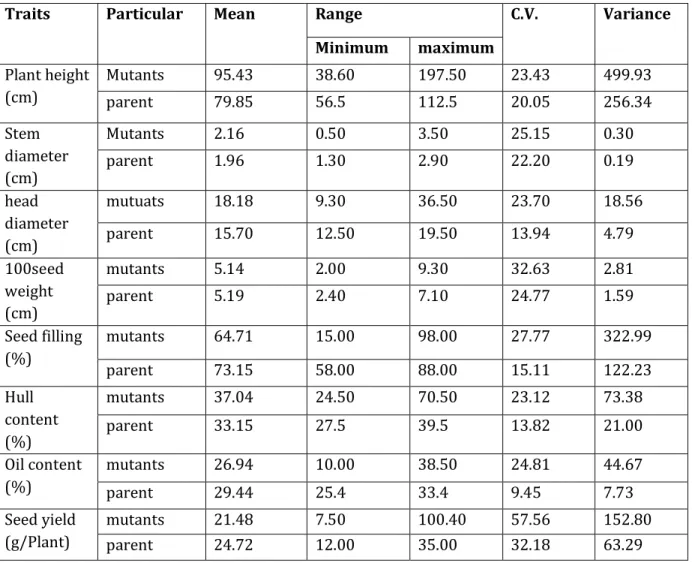
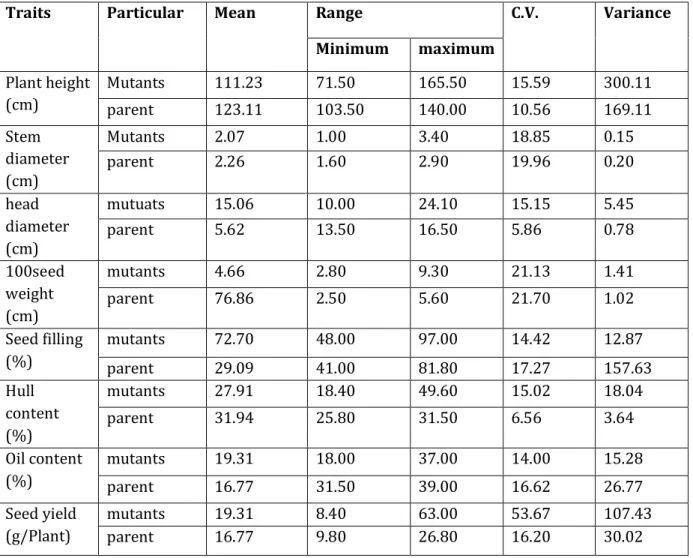
Statistical parameters computed for M2 generation of Sunflower Hybrid andC1 are
presented in Table 4 and 5 respectively.
Plant height (cm)
The mean values of plant height of mutant population (95.43) increased over theparent (79.85) in case of Sunflower Hybrid but in case of C1 mutants, decrease in mean plant
height (111.13) was observed as against parent (123.11). Range increased in both positive and negative directions in the mutants of both Sunflower Hybrid (38.60-197.50) as against the parent (56.5-112.5) and C1(71.5-165.50) as against the parent
(103.50-140.00).
Values of coefficient of variation increased in the mutants of both Sunflower Hybrid and DSF 15B. Coefficient of variation was highest in the mutants of Sunflower Hybrid (23.43) as compared to C1(15.59). Values of variance
were increased in the mutants of both
Sunflower Hybrid andC1 compared to their
respective parent. Mutants of Sunflower Hybrid recorded highest variance (499.93).
Stem diameter (cm)
The mean values of stem diameter of mutant population (2.16) increased over the parent (1.96) in case of Sunflower Hybrid but mutants of DSF 15B showed decrease in mean stem diameter (2.07) as against parent (2.26). Range increased in both positive and negative directions in the mutants of both Sunflower Hybrid andC1. But wider range was
observed in the mutants of Sunflower Hybrid (3.50-0.5).
Values of coefficient of variation increased in the mutants of Sunflower Hybrid where as decrease in coefficient of variation was observed in C1(18.85%) as against parent
(19.96%). Values of variance were increased in the Mutants of Sunflower Hybrid where as there was decrease in variance in the mutants of C1(0.15) as against parent (0.20).
Head diameter (cm)
International Journal of Research in Engineering & Applied Sciences Email:- [email protected], http://www.euroasiapub.org
An open access scholarly, online, peer-reviewed, interdisciplinary, monthly, and fully refereed journals
66
parents. Range was enlarged in both positiveand negative directions in the mutants of both Sunflower Hybrid (36.50-9.30) and C1
(24.10-10.00) compared to their respective parents.
Estimates of coefficient of variation was high for the mutants of both Sunflower Hybrid (23.70) as against the parent (13.94) and DSF 15B (15.15) as against the parent (5.86). Variance increased in both the mutants of Sunflower Hybrid (18.56) and DSF 15B (5.45) as against the parents (4.79) and (0.78) respectively.
Hundred seed weight (g)
The mean hundred seed weight of mutants of Sunflower Hybrid (5.14) decreased as against the parent (5.19). But of DSF 15B (5.62) increased as against the parent (4.66). Range increased in both positive and negative directions in the mutants of Sunflower Hybrid (2.00-9.30) as against the parent (2.40-7.10), whereas range in the mutants of DSF 15B (2.80-9.30) increased in positive direction as against the parent (2.50-5.60).
Estimates of coefficient of variation was high for the mutants of Sunflower Hybrid (32.63) as against the parent (24.33) while for the mutants of C1(21.13) was low as against the
parent (21.70). Variance increased in both the mutants of Sunflower Hybrid (2.81) and DSF 15B (1.41) as against the parents (1.59) and (1.02) respectively.
Self fertility (%)
The mean self fertility of mutants of Sunflower Hybrid (64.71) decreased as against the parent
(73.15), but of C1 (76.86) increased as against
the parent (72.7).
Range increased in both positive and negative directions in the mutants of Sunflower Hybrid andC1. But the extent of
increase was more in Sunflower Hybrid (15.00-98.00) as against the parent (58.00-88.00) compared to DSF 15B (48.00-97.00) as against the parent (41.0081.80).
Estimates of coefficient of variation was high for the mutants of Sunflower Hybrid (27.77) as against the parent (15.11) while for the mutants of C1(14.42), was low as against the
parent (17.27). Variance was high for the mutants of Sunflower Hybrid (322.99) as against the parent (122.23) while for the mutants of C1 (122.87), was low as against the
parent (157.63).
Hull content (%)
The mean hull content of mutants of Sunflower Hybrid (37.04) increased as against the parent (33.15), whereas mean hull content of mutants of C1 (28.27) decreased as against the parent
(29.09). Range increased in both positive and negative directions in the mutants of both Sunflower Hybrid (24.50-70.50) against the parent (27.50-39.50) and C1(18.40-49.60)
as against the parent (25.80-31.50).
International Journal of Research in Engineering & Applied Sciences Email:- [email protected], http://www.euroasiapub.org
An open access scholarly, online, peer-reviewed, interdisciplinary, monthly, and fully refereed journals
67
parent (21.00) as compared to the mutants ofC1(18.04) as against the parent (3.64).
Oil content (%)
The mean oil content decreased in the mutants of both Sunflower Hybrid (26.94) (parent 29.44) and C1(27.91) (parent 31.94). Range
increased in both positive and negative directions in the mutants of Sunflower Hybrid (10.00-38.50) against the parent (25.40-33.40), where as in the mutants of C1
increase in range (18.00-37.00) was in negative direction as against the parent (31.50-39.00).
Estimates of coefficient of variation were high for the mutants of Sunflower Hybrid (24.81) as against the parent (9.45), where as it decreased in the mutants of C1(14.00) as
against the parent (16.20). Variance increased for the mutants of Sunflower Hybrid (44.67) as against the parent (7.73) as compared to the mutants of C1(15.28)
decreased as against the parent (26.77).
Seed yield per plant (g)
The mean seed yield per plant of mutants of Sunflower Hybrid (21.48) decreased as against the parent (24.72), whereas mean seed yield per plant of mutants of C1(19.31)
increased as against the parent (16.77). Range increased in both positive and negative directions in the mutants of both Sunflower Hybrid (7.50-100.40) as against the parent (12.00-35.00) and C1 (8.40-63.50)
as against the parent (9.80-26.80). However, increase in the range in the mutants of Sunflower Hybrid was more compared to C1.
Estimates of coefficient of variation were high for the mutants of both Sunflower Hybrid (57.56) as against the parent (32.18) and
C1(53.67) as against the parent (16.20).
Variance was very high for the mutants of both Sunflower Hybrid (152.80) as against the parent (63.29) and C1(107.43) as against the
parent (30.02).
Frequency distribution of mutants for important traits in M2 generation
The frequency distribution among the mutants in comparison with parents is given for the mutants of Sunflower Hybrid andC1
respectively. X-axis represents traits which are divided into equal class intervals and Y-axis represents the genotype frequencies and range of traits.
International Journal of Research in Engineering & Applied Sciences Email:- [email protected], http://www.euroasiapub.org
An open access scholarly, online, peer-reviewed, interdisciplinary, monthly, and fully refereed journals
68
Table 2 Range mean variance and coefficient of variation for different traits of sunflower variety modern in 𝑴𝟐 generation
Traits Particular Mean Range C.V. Variance
Minimum maximum
Plant height (cm)
Mutants 95.43 38.60 197.50 23.43 499.93
parent 79.85 56.5 112.5 20.05 256.34
Stem diameter (cm)
Mutants 2.16 0.50 3.50 25.15 0.30
parent 1.96 1.30 2.90 22.20 0.19
head diameter (cm)
mutuats 18.18 9.30 36.50 23.70 18.56
parent 15.70 12.50 19.50 13.94 4.79
100seed weight (cm)
mutants 5.14 2.00 9.30 32.63 2.81
parent 5.19 2.40 7.10 24.77 1.59
Seed filling (%)
mutants 64.71 15.00 98.00 27.77 322.99
parent 73.15 58.00 88.00 15.11 122.23
Hull content (%)
mutants 37.04 24.50 70.50 23.12 73.38
parent 33.15 27.5 39.5 13.82 21.00
Oil content (%)
mutants 26.94 10.00 38.50 24.81 44.67
parent 29.44 25.4 33.4 9.45 7.73
Seed yield (g/Plant)
mutants 21.48 7.50 100.40 57.56 152.80
International Journal of Research in Engineering & Applied Sciences Email:- [email protected], http://www.euroasiapub.org
An open access scholarly, online, peer-reviewed, interdisciplinary, monthly, and fully refereed journals
69
Table 3Range mean variance and coefficient of variation for different traits of sunflower variety DSF-158 in 𝑴𝟐 generation
Traits Particular Mean Range C.V. Variance
Minimum maximum
Plant height (cm)
Mutants 111.23 71.50 165.50 15.59 300.11
parent 123.11 103.50 140.00 10.56 169.11
Stem diameter (cm)
Mutants 2.07 1.00 3.40 18.85 0.15
parent 2.26 1.60 2.90 19.96 0.20
head diameter (cm)
mutuats 15.06 10.00 24.10 15.15 5.45
parent 5.62 13.50 16.50 5.86 0.78
100seed weight (cm)
mutants 4.66 2.80 9.30 21.13 1.41
parent 76.86 2.50 5.60 21.70 1.02
Seed filling (%)
mutants 72.70 48.00 97.00 14.42 12.87
parent 29.09 41.00 81.80 17.27 157.63
Hull content (%)
mutants 27.91 18.40 49.60 15.02 18.04
parent 31.94 25.80 31.50 6.56 3.64
Oil content (%)
mutants 19.31 18.00 37.00 14.00 15.28
parent 16.77 31.50 39.00 16.62 26.77
Seed yield (g/Plant)
mutants 19.31 8.40 63.00 53.67 107.43
parent 16.77 9.80 26.80 16.20 30.02
Morphological Mutants in M2 generation
Some of the morphological mutants were observed in M2 generation namely, vegetative head type and dwarf mutant are shown in Plate 1. The mutants with respect to seed coat colour variation are shown in Plate 2.
International Journal of Research in Engineering & Applied Sciences Email:- [email protected], http://www.euroasiapub.org
An open access scholarly, online, peer-reviewed, interdisciplinary, monthly, and fully refereed journals
70
Table 4 Descriptions of Test Results
S. No. Test Parameters Observed Results (per 100 gm)
Test Method/Instrument Used
1.
Total Fat, gm 23.42 By Soxhlet Method
2.
Saturated Fat ,gm 7.59 AOAC 996.06/GC-FID
3.
Monounsaturated Fat ,gm 0.06 AOAC 996.06/GC-FID
4.
Polyunsaturated Fat ,gm 15.77 AOAC 996.06/GC-FID
Standard results show that polyunsaturated fats should be 23g/100g.But sunflower when tested with fatty acid it is found that sample 1 consists total fat (23.42), in this amount saturated fat were (7.59).
Monounsaturated fats were very less in amount (0.06), Polyunsaturated fats were (15.77). Polyunsaturated fats include omega-3 and omega-6 fats.
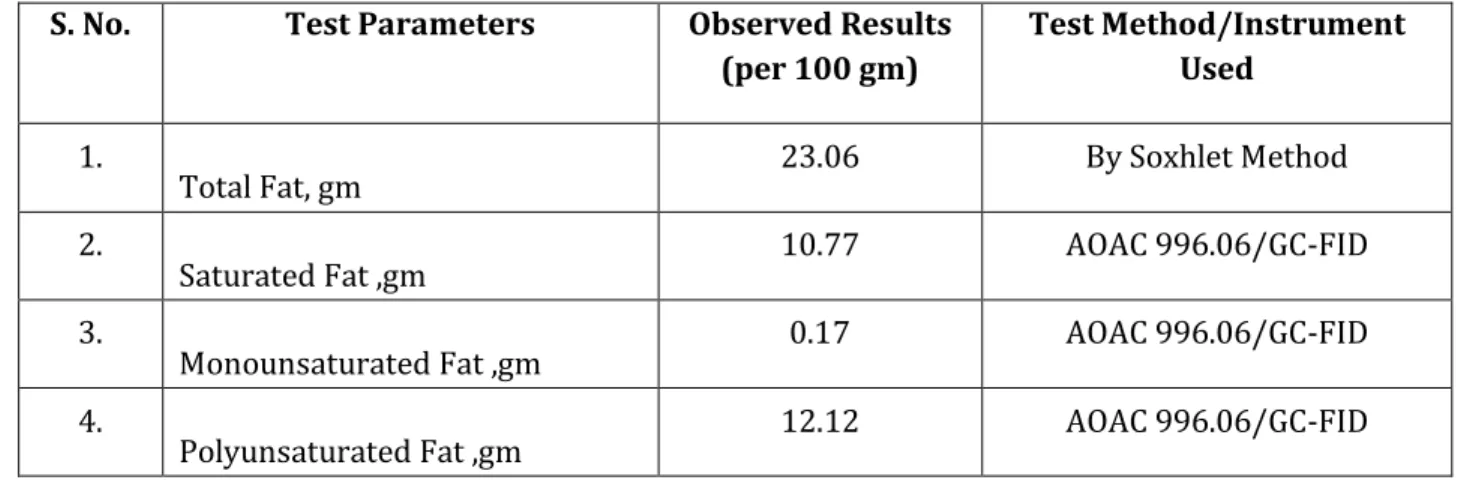
Table 5 Descriptions of Test Results
S. No. Test Parameters Observed Results (per 100 gm)
Test Method/Instrument Used
1.
Total Fat, gm 23.06 By Soxhlet Method
2.
Saturated Fat ,gm 10.77 AOAC 996.06/GC-FID
3.
Monounsaturated Fat ,gm 0.17 AOAC 996.06/GC-FID
4.
Polyunsaturated Fat ,gm 12.12 AOAC 996.06/GC-FID
Similarly, sunflower when tested with fatty acid it is found that sample 2 consists total fat (23.06), in this amount saturated fat
were (10.77). Monounsaturated fats were very less in amount (0.17), Polyunsaturated
International Journal of Research in Engineering & Applied Sciences Email:- [email protected], http://www.euroasiapub.org
An open access scholarly, online, peer-reviewed, interdisciplinary, monthly, and fully refereed journals
71
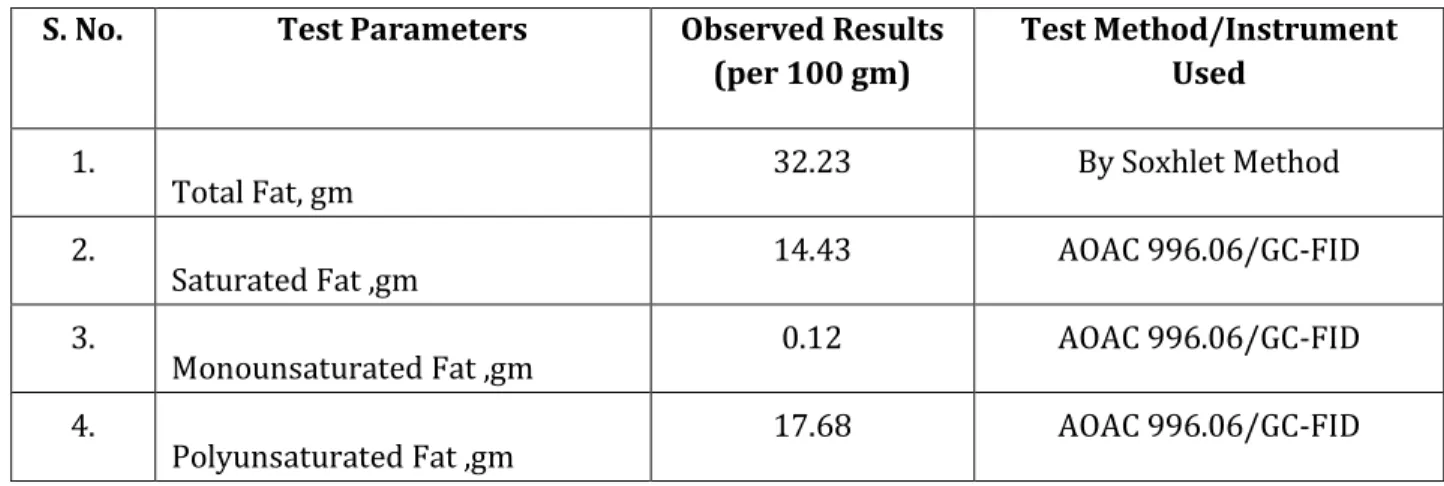
Table 6 Descriptions of Test Results
S. No. Test Parameters Observed Results (per 100 gm)
Test Method/Instrument Used
1.
Total Fat, gm 32.23 By Soxhlet Method
2.
Saturated Fat ,gm 14.43 AOAC 996.06/GC-FID
3.
Monounsaturated Fat ,gm 0.12 AOAC 996.06/GC-FID
4.
Polyunsaturated Fat ,gm 17.68 AOAC 996.06/GC-FID
Similarly when sample 3 was tested with fatty acid it is found that consists total fat (32.23), in this amount saturated fat were (14.43). Monounsaturated fats were very less in amount (0.12), Polyunsaturated fats were (17.68).
4. CONCLUSION
Actuated mutagenesis prompt hereditarily
acquired changeability of sunflower
ingrained lines, which is appropriate for use in breeding projects. Additionally studies ought to be centered on testing new mutant lines in half breed mixes, and in addition methods of legacy of mutant traits. Since created mutant lines vary in at least one trait, they can be utilized specifically in half breed generation rather than their unique lines. Tests with fatty acid it is found out that the sunflower consists fat, in that Polyunsaturated fats in huge amounts it is different sample-wise taken from different area.
5. ACKNOWLEDGMENT
It is my great pleasure to thank to the Staffs of Department of Biotechnology and my lab
mates of Magadh University, Bodhgaya
(Bihar). Also thanks to the Prof. Dr. Rita Kumari.
REFERENCES
1. Brunner, H., 1995. Radiation
induced mutations for plant
selection. Appl. RadiatIsot. 56 (6/ 7): 589-594.
2. Christov, M., 1995. Development of new sunflower forms by treating seeds with gamma rays. The First Balkan Symposium on Breeding and Cultivation of Wheat, Sunflower and Legume Crops, June 26-29, Albena, Bulgaria, 45-49.
International Journal of Research in Engineering & Applied Sciences Email:- [email protected], http://www.euroasiapub.org
An open access scholarly, online, peer-reviewed, interdisciplinary, monthly, and fully refereed journals
72
composition by induced mutationsin sunflower collection. Book of Abstracts. 19thEucarpia Conference,
Ljubljana, Slovenia, May 26-29, 75.
4. Encheva, J., Shindrova, P. and
Penchev, E., 2008. Developing mutant sunflower lines (Helian-thus
annuusL.) through induced
mutagenesis. Helia 31(48): 61-72.
5. Fernandez-Martinez, J.M. and
Dominguez-Gimenez, J., 1988.
Development of sunflower parental lines using EMS treatments. Proc.
12th International Sunflower
Conference, Novi Sad, Yugoslavia, Int. Sunflower Assoc., Paris, France, 415-418.
6. Girigaj, K., Bentur, M.G. and
Parameshwarappa, K.G., 2004.
Genetic amelioration for earliness and high test weight through induced chemical mutagenesis in restorer lines of sunflower. Proc.
16th International Sunflower
Conference, Fargo, ND USA, 2: 487-489.
7. Gvozdenović, S., Bado, S., Afza, R., Jocić, S. and Mba, C., 2009. Interval differences in response of sunflower
(Helianthus annuus L.) to different
mutagenic treatments. In: Induced Plant Mutations in the Genomics Era, Q.Y. Shu (ed.), Food and Agriculture Organization of the United Nations, Rome, and 358-360. 8. Ivanov, P., Petakov, V., Nikolova, V. and Petchev, E., 1988. Sunflower
breeding for high palmitic acid content in the oil. In : Proceedings of the 12th International Sunflower
Conference. Novi Sad, Yugoslavia. Int. Sunflower Assoc., Toowoomba, Australia. 463-465.
9. Jan, C.C. and Rutger, J.N., 1988. Mitomycin c- and streptomycin-induced male sterility in cultivated sunflower. Crop Sci. 28: 792-795. 10. Kalaydzhyan, A.A., Khlevnoy, L.V.,
Neshchadim, N.N., Golovin, V.P., Vartanyan, V.V., Burdun, A.M., 2007. Rossiyskiysolnechnyytsvetok.-Krasnodar: Sovet. Kuban'. pp.1-352. (In Russian)
11. Miller, J.F. and Vick, B.A., 1999. Inheritance of reduced stearic and palmitic acid content in sunflower seed oil. Crop Sci. 39: 364-367. 12. Nabipour, A., Yazdi-Samadi, B. and