International Journal of Research in Engineering & Applied Sciences
Email:- [email protected], http://www.euroasiapub.org
38
Identification of Moisture Content in Coal Sample by using Ultrasonic NDT
Ms.D.M.Kate1, Dr.N.K.Choudhari2, Dr (Mrs.) A.R.Chaudhari3
PriyadarshiniBhagwati College of Engineering, India
Abstract
- Coal is an extremely complex material and exhibits a wide range of physical and chemical properties. The rapidly expanding use of coal made it necessary to devise acceptable methods for coal analysis with the goal of correlating composition and properties with behavior. As a part of the multifaceted program of coal evaluation, new methods are continually being developed and the already accepted methods may need regular modification to increase the accuracy of the technique as well as the precision of the results. The use of ultrasonic testing for material characterization not only play a important role in quality assurance during in-manufacture inspection but also can serve as a powerful tool for life prediction technology during in-service inspection, residual life assessment and plant life extension . The measurement of ultrasonic parameters has been used for determining material properties for many years, but with the advent of modern signal processing techniques it is possible to extract significantly more information from ultrasonic signals. In this paper an attempt is made to characterize the Moisture content in Coal Sample by ultrasonic Non destructive techniques by measuring various NDT parameters of Coal Sample such as, ultrasonic velocity, attenuation, etc.Key words: Ultrasonic, Coal, NDT, Velocity, attenuation.
[I] INTRODUCTION
International Journal of Research in Engineering & Applied Sciences
Email:- [email protected], http://www.euroasiapub.org
38
[II]COAL PROPERTIES AND THEIR ANALYSIS
Coal is a black or brown rock that can be ignited and burned to produce energy in the form of heat. Coal's chemical makeup is a complex mix of elements that include sulfur, carbon, oxygen, hydrogen and nitrogen, as well as small
quantities of aluminum, zirconium and many other minerals. Coal is a special porous media that serves as a type of
unconventional gas reservoir.The utility of a particular coal for different purposes is based on different properties. These properties are chemical, physical, plastic, thermal and special properties. These properties are determined by a number of tests. Coal comes in four main types or ranks: lignite or brown coal, bituminous coal or black coal, anthracite and graphite. Each type of coal has a certain set of physical parameters which are mostly controlled by moisture, volatile content and carbon content. The importance of determining ‘Moisture’ in coal arises from the fact that all coals are mined in very wet conditions. Moisture decreases the heating value of coal, as it decreases the combustible matter of coal. Moisture in coal must be transported, handled and stored. Since it replaces combustible matter, it decreases the heat content per kg of coal. Typical range is 0.5 to 10% Moisture
[III] MATERIAL CHARACTERIZATION TECHNIQUES (NDT & DT)
The two major classification of material characterization technique are non-destructive testing (NDT) and destructive testing (DT). Under destructive technique of characterization the tested material or product cannot be used again. The destruction of test object usually makes this type of test more costly and tested material is normally of no use. Non-destructive testing technique is a specific procedure whereby the service ability of materials or components is not impaired by testing process. The various methods like visual testing, liquid penetrate testing, magnetic particle testing, eddy current testing, radiographic testing; ultrasonic testing, leak testing, thermographs and neutron radiography are the NDT technique of material characterization.
Among the various non-destructive testing and evaluation (NDT&E),ultrasonic signals plays an important role in material characterization. Ultrasonic properties provide important diagnostic for micro structural properties as well as deformation processes in a material, controlling material behavior based on the physical mechanism. It also helps us to predict future performance of the materials.
[IV]ULTRASONIC ATTENUATION MEASUREMENT
A typical ultrasonic testing system consists of a pulser /receiver, transducer, and display devices. High voltage electrical pulse is produced by the pulser/receiver which is an electronic device. The transducer, which can transform the mechanical energy into electrical energy and vice versa, generates high frequency ultrasonic energy. The sound energy propagates through the materials in the form of waves. Through transmission is preferred in coal because of its highly attenuative nature. Attenuation is the reduction in the energy of the wave as it passes through the medium.
International Journal of Research in Engineering & Applied Sciences
Email:- [email protected], http://www.euroasiapub.org
39
Figure(1):Experimental Set-up Attenuation MeasurementUltrasonic transducer is connected to the pulser via cable which converts electrical energy to ultrasonic wave that is propagated through a test sample. The receiving transducer is used to detect acoustic pulses that have propagated through test sample. The receiving transducer is connected to the Digital Storage Oscilloscope. A pair of MODSONIC transducer of 54 KHz has been used as a transmitting and receiving transducer. Attenuation coefficient α, is calculated in dB accordance to equation
α = (20 log (Vi/Vo) ) --- (1)
Where,
Vi is the input Voltage Vo is the output Voltage
[VII] Results and Discussions
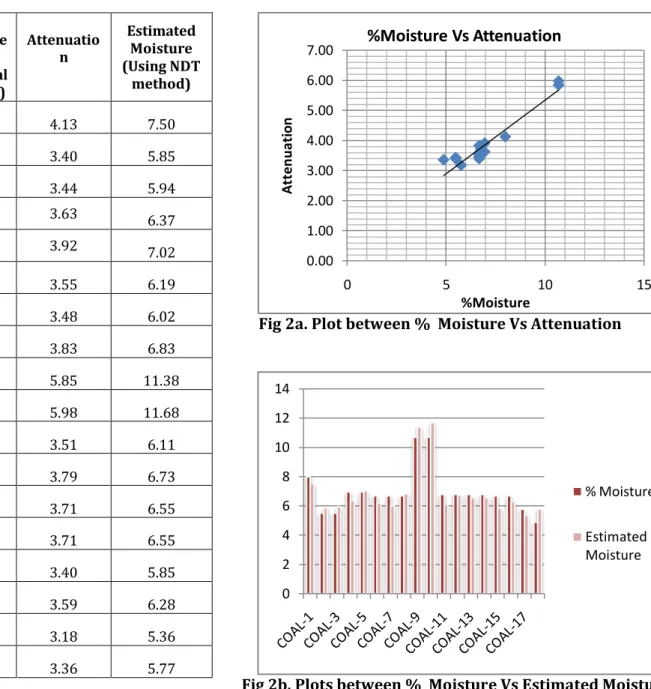
By using the electronic system developed during the research work various ultrasonic parameters are recorded. Table 1 shows the Moisture content present in a specific sample and for the same, sample value of Attenuation measured is mentioned. The Moisture content of various samples is obtained by using traditional chemical method (Proximate Analysis). To establish a correlation between Moisture content and Attenuation a graph is plotted by using the values as shown in table 1. Fig 2(a) shows the characteristics between Moisture content and Attenuation of coal sample
By using the data, an expression is developed as
%Moisture = (Attenuation – 0.809)/0.4428 ---(2)
By using eqn(2) we can obtained value of moisture content ,if we measure attenuation of ultrasonic signal. when
ultrasonic signal is allowed to pass through Coal ,its amplitude get reduced. Noting this amount of attenuation and by measuring moisture content classically by chemical method, we have prepared table .By using eqn (2),we have
calculated value of moisture content and it is observed that eqn(2) given almost same value .Graph plotted in fig
International Journal of Research in Engineering & Applied Sciences
Email:- [email protected], http://www.euroasiapub.org
40
Table 1:Measured and Estimated Values of Moisture
Fig 2a. Plot between % Moisture Vs Attenuation
Fig 2b. Plots between % Moisture Vs Estimated Moisture
0.00 1.00 2.00 3.00 4.00 5.00 6.00 7.00
0 5 10 15
A tt en u a ti o n %Moisture
%Moisture Vs Attenuation
0 2 4 6 8 10 12 14 % Moisture Estimated Moisture Name of sample % Moisture (Using Chemical Method) Attenuatio n Estimated Moisture (Using NDT method)
COAL-1 7.99 4.13 7.50
COAL-2 5.49 3.40 5.85
COAL-3 5.49 3.44 5.94
COAL-4 6.95 3.63 6.37
COAL-5 6.95 3.92 7.02
COAL-6 6.67 3.55 6.19
COAL-7 6.67 3.48 6.02
COAL-8 6.67 3.83 6.83
COAL-9 10.68 5.85 11.38
COAL-10 10.68 5.98 11.68
COAL-11 6.77 3.51 6.11
COAL-12 6.77 3.79 6.73
COAL-13 6.77 3.71 6.55
COAL-14 6.77 3.71 6.55
COAL-15 6.67 3.40 5.85
COAL-16 6.67 3.59 6.28
COAL-17 5.76 3.18 5.36
International Journal of Research in Engineering & Applied Sciences
Email:- [email protected], http://www.euroasiapub.org
41
[VIII]Conclusion:
From the above observations it is clear that electronic system based on ultrasonic signal processing technique can be fruitful technique for extracting information about various coal parameters and hence to specify the quality of the coal sample or coal on site. In this paper the author has focused about identification of Moisture content in given coal sample. Hence it is concluded that if we know attenuation of ultrasonic signal ,it is possible to obtain moisture content in a coal sample(by NDT) approach.
REFERENCES
[1]. P.P. Nanekar and B. K. Shah, ‘characterization of material properties by ultrasonics’,BARC Newsletter, Issue No. 249, Pg No. 25-38.
[2]. Dong Fei, David K. Hsu, and Mark Warchol, ‘Simultaneous Velocity, Thickness and Profile Imaging by Ultrasonic Scan’ Journal of Nondestructive Evaluation, Vol. 20, No. 3, September, (2001).
[3]S. Femmam, N.K.Sirdi and A Ouahabi, ‘ Perception and characterization of materials using signal processing techniques’ IEEE trans. on Insrumentation and measurements, Vol. 50,No. 5, October 2001, p.p. 1203-1211.
[4] M. B. Ali, S. Abdullah, M.Z. Nuawi, M.M. Padzi and K.A. Zakaria, ‘Experimental Analysis of an Instrumented Charpy Impact Using Signal Processing Approach’ , Advanced Materials Research Vols. 197-198 (2011), pp 1621-1625.
[5] P. Kalyanasundaram, Baldev Raj and T. Jayakumar, ‘Characterization of Microstructures in Metallic Materials using Static and Dynamic Acoustic Signal Processing Techniques’ Proc. Vth International Workshop, Advances in Signal Processing for Non Destructive Evaluation of Materials,(2005).
[6] Dharmendra Pandey and Shri Pandey, “Ultrasonics: A Technique of Material Characterization” (2010). Acoustic Waves, Don Dissanayake (Ed.), ISBN: 978-953-307-111-4, InTech,
[7]D.M.Kate, N.K.Choudhari, A.R.Choudhari “Evaluation Of Properties Of Coal Using Various Ndt Methods” International Journal Of Pure And Applied Research In Engineering & Technology , Vol 1(8): Ijpret,
Pp61-71(2013 )
[8] D.M.Kate, N.K.Choudhari, A.R.Choudhari “A Review On Non-Destructive Testing Methods To Study Properties Of Coal” International Journal of Electronics Communication and Computer Engineering,Vol 4, Issue (2) React-2013, Pp 62-65 (2013)