On Mobile Technology in Context:
Exploring Police Work
Daniele Pica and Carsten Sørensen
Department of Information Systems, London School of Economics and Political Science, London, UK
This article aims to propose elements for a theory of mobile technology use. Modern organizations heavily rely on mobile devices. Mobile technologies pervade most work and social organizations in various cultural and institutional expressions. This paper explores issues related to mobile device usage within work activities of two distinct roles in a police force in the UK to put forth a theory of mobile device usage across various work roles. It advances the idea that usage of mobile technologies is linked strongly to work conditions and that, in order to increase usage within organizations, we must employ a triangulated analysis to understand both the relation with the environment of work as well as the relation with information.
Keywords: mobile technology, virtual reality, work, po-lice work.
1. Introduction
As organizations are increasingly introducing personal mobile devices to support work, the need for understanding the dynamics between mobile devices, organizations and individuals’ work assumes a privileged position in informa-tion systems research. In fact, both academia and industry research efforts focus on maximiz-ing the interaction between individuals and mo-bile devices 29].
This is based on the idea that mobile devices will bring about fluid work organizations to sus-tain a post-modern era of efficient and ad-hoc services available ‘anytime, anywhere’ through the increased mobility and connectivity of pro-fessionals 16]. However, planning and
imple-menting a mobile enterprise strategy can be puz-zling. For mobile devices to be a success, these must meet various needs of the end-users 25].
Achieving this goal is not easy, in part because
of the novel state of mobile systems’ studies. In fact, as Johnson 13]states, the conventional
methods of human-computer interaction(HCI)
need to be reconsidered because they are not sufficient to address the changing contexts and interactions that mobile technology establishes. The use of mobile technologies signifies a stron-ger connection between the human and the tech-nical aspects, and also implies a stronger in-fluence of the context of interaction. It can indeed be argued that the mere separation be-tween the technology and the context of use is artificial, as we experience increasingly embod-ied interaction 10]. The aim of this paper is to
explorethe relationship between the context of work activities and mobile information usage. We aim to explore pertinent contextual factors determining particular modalities of usage of mobile technologies.
This paper offers an analysis and a discussion of the different practices of usage of mobile tech-nologies in organizations presenting as a partic-ular case the police. The police are one of the archetypical examples of organizations that rely on mobile technologies. Historically, technol-ogy has transformed police practices. From the introduction of the telegraph in the late 1800’s to the usage of two-way radios and computer-aided dispatching during the 1900’s 1; 30],
in-formation technologies have radically changed the organization of police work and, with it, the expectations of various police services 23].
versus passive environments and structured ver-sus unstructured work.
The structure of this paper is as follows. We start the paper by briefly looking at the method of re-search. Following, we present the case study. We then address the specific characteristics of mobile devices within the context of work orga-nizations, and develop a model for understand-ing the relationship between work activities and mobile devices. Finally, we present concluding remarks and future areas of research.
2. Method
In order to achieve the research aim, we build a qualitative case study. Inspired by new socio-technical theories 3; 4; 8; 27], we do not look at
technology as a self-contained entity, but rather as a highly contextualized tool which is affected by the social setting in which it is deployed and which in turn affects the social setting. Conse-quently, central to this research is the belief that technology is never an isolated body in a de-contextualized space, nor is it self-contained. Technology is significant, as much for its func-tional qualities as for the degree to which it is part of a persuasive narrative that binds the ob-ject and the viewer together in a shared system of beliefs. No technology exists for its own sake, alone, or alienated; rather, it is interwoven in the very historical fabric of the society it has been appropriated in.
Following these beliefs, the case study itself consisted of two intense days of observations
(2 half day observation of the actual work
per-formed by the police officers), interviews (3
in-depth interviews) and focus groups (2
two-hour focus groups with 4-6 people)with police
members from forensic science and community services. The methodology consisted of two complimentary interpretive research techniques that produced qualitative data:
Interviews aimed at understanding both the actual work practices together with the us-age of mobile technologies and the perceived needs of various police roles and,
Observations(where possible)of the actual
work and subsequent usage of mobile tech-nologies.
3. Two Police Work Roles
During the case study we concentrated on two differing and in some way contrasting roles within the police: the Scenes Of Crime Officer
(SOCO) and the Community Security Officer (CSO). Informed by socio-technical theories,
we did not look strictly at issues of design or ergonomics, but instead focused on issues of interaction in locus and the surrounding envi-ronment of work, what Suchman(1987)would
define as situated action. We concentrated on constructing a picture of the typical work activ-ities these two roles accomplish in their daily work. In particular, we aimed at documenting the officers’ information management activities and the relation of these activities to various mobile technologies.
3.1. SOCO’s Work
A Scenes Of Crime Officer (SOCO) collects,
documents, records and lends authority to foren-sic evidence at crime scenes. SOCOs generally hold postgraduate degrees in relevant subjects such as chemistry or forensic biology. Initially, in order to become a SOCO, a candidate will enrol in nine weeks intensive formal training in photography, pure forensics such as finding DNA and carpet fibres, fingerprints analysis, and assessment through the creation of scene of crimes scenarios.
during the day. They respond to new crime in-cidents logged in the Crime Information System
(CIS), either from the office, or when they are
on the move, from their laptop, or through mo-bile telephone calls. Generally, the CIS was not user friendly to access when on the move, since it tended to lock out the user, with a restart time of around 5 minutes, which in the daily rhythm of a SOCO was considered a substantial dis-ruption. As a result, laptops were only rarely used in the car. For security reasons and due to respect for the victims of crime, the laptop was not used within scenes of crime. Furthermore, once at the scene of crime, the SOCO needed to divert all their attention immediately towards obtaining a proper overview of the situation. Printouts from the CIS forms were typically used to begin the activity of surveying the crime scene. The primary aspect of SOCO work is gathering proof related to the crime. SO-COs also gather intelligence through aggregat-ing and processaggregat-ing information. The way in which a SOCO obtains information about the crime scene relies on the reports generated by the police officer filing the crime and on the con-versations with the victims of crime. The daily work of a SOCO generally consists of codifying observations, evidence and conjectures accord-ing to a complex classification structure that re-cently has been formalised and computerised in a bespoke application supporting SOCO work as well as the management of workflow pro-cesses related to the evidence collected. Aver-ages of five jobs are completed per day, and this includes a substantial number of mobile phone calls to coordinate as well as travel from site to site. After completing the jobs, a significant amount of time is spent documenting and stor-ing exhibits as well as writstor-ing up reports. The reporting is done on a paper-sheet at the crime scene. It takes about 10 minutes for each job to update the system and two hours total to fin-ish up the daily office work. This is generally done between 2 and 5pm, which represents a significant proportion of a working day.
In terms of the types of crime SOCOs attend, burglaries and theft account for around 85% of the cases and 10% are minor theft and vandal-ism. 5% are the major crimes such as murder. The success rate of a SOCO is constructed ac-cording to the number of arrests made as a result of the evidence collected. Obviously, as the sole
representative of the police force at the scene of crime, the SOCO will engage in the emotional support of the victim. This implies that SOCOs often will engage in Public Relations on behalf of the Department. A significant proportion of SOCO work is classified as “small crime” and will not be solved because of lack of evidence or because of low priority given the scarcity of resources. Summarising, SOCO’s work entails 3 major elements:
Proof gathering
Reassurance of victims Intelligence gathering
The SOCO information flow can be charac-terised as follows. The SOCO takes notes from CIS printouts. Often they will need more formation from the officer that has entered in-formation about the crime into the CIS as the level of detail, and the selection of information often will not match the need of the SOCO. Fol-lowing, they talk to the victim and make notes while they examine the crime scene and collect the physical evidence that will be sent back to the laboratory for examination. On their report sheet they document text, diagrams, sketches of shoe marks and pictures. The latter is seen as the richest kind of proof gathering.
3.2. CSO Work
The Community Security Officer (CSO) is a
highly localized police officer acting as a bridge between a local community and the police force. A CSO generally patrols the community on foot or by bicycle and has a personal relation with a significant proportion of the community. The CSO generally considered the car as alienating; it was seen as essential to be in the field and have extensive local mobility. The CSOs gen-erally perceived the job as a continuous involve-ment with the community, and they described their function as one of reducing the fear of crime in the community. Any formalized sys-tem could endanger the information, losing the local flavour. The way in which they entered information into the system was seen as crucial for the following investigations by other police roles. In a way, the information by being so localized was not suitable for sharing in a large-scale community. As one CSO put it, the in-formation was good for an insurance claim but not for community building — the main job of a CSO.
The CSO had extensive and continuous contact with many community institutions and, gener-ally, also volunteered at local schools. They built their own information gateways for the communities through e-mail and web pages. The information CSO looked at and shared within the organization were with: colleagues over a cup of coffee in the same office(in order
to share information about an area; LIO(Local
Intelligence Office – which, according to the CSO, were the most likely to get a positive ID on a criminal); Domestic violence team; dog team;
ID2 (Intelligence Surveillance Team in plain
clothes who used the information from CSO to survey people and make arrests); and the press
office which helped community awareness and potentially gave good publicity. In addition, the CSO had an extensive network outside of the organization, such as the local council, housing associations, schools and social services. Some of the members of the public had the mobile phone numbers of their local CSOs.
During the day the CSO would – either initially or towards the end – log into the CIS to check for incidents in her area, as well as make and receive phone calls on the mobile. A lot of coordination was conducted through and information passed over the mobile phone. Sometimes this infor-mation was ‘unofficial.’ The CSO also kept in
contact by e-mail with relevant members of the community, for example students at the Univer-sity and families in the community. One of the CSOs sent bulletin e-mails to targeted members of the community to keep them updated about recent events, and also received anonymous in-formation about drugs and fights.
As far as the structuring of the job was con-cerned, the CSO were self-tasking, and they generally decided what to do, depending on the perceived urgency of the situation. The CSO wanted to be seen in the field. When a CSO re-ported a crime, they usually did so through the phone or the police radio. The local information gained by the CSO was put into a local infor-mation system. However, some of it was only used personally and kept in a non-networked file. This meant that other officers did not have the benefit to access it. One of the concerns of CSOs was that through the increased computer-ization and formalcomputer-ization of information system their job would shift towards being mostly cler-ical as opposed to centred in the field.
As one CSO put it, he was ‘tasked by the pub-lic.’ For them, in fact, timeliness was criti-cal in solving problems. Differently from the SOCOS, the CSO would feel comfortable net-working their computer in the victims’ houses or sites. The CSO would like a tailored version of CIS that would filter out irrelevant informa-tion — for instance getting only local area CIS. It was claimed that this would save time and maybe enable a higher degree of out-of-office work. The CSO felt the need of having both laptops and PDAs. Given that most of the work was conducted in the streets of the community, such solutions were described as difficult to im-plement. In addition, it was noted that the con-fidence in the system was less than in the case of SOCO, because of the highly localized na-ture of the CSO’s job and the timeliness of the response.
3.3. Contrasting the Two Roles
evidence), the CSO deals with people. Most
importantly, the crime scene for the SOCO is one that has been already resolved by police of-ficers, while the CSO’s crime scene is emergent and uncertain. The objectives of the two roles also differ in significant ways. SOCOs have done their job when their work leads to an ar-rest; CSO, on the contrary, have done their job when the community is united and secure, and they generally seek to avoid conflict.
The difference in the context of work is illus-trated also by the different usage of mobile tech-nologies. The SOCO’s main tool is the laptop computer. The police radio is seldom used by SOCO, while it is the main tool at present time for the CSO. The mobile phone seems to be used equally by CSO and SOCO. However, while the CSO use the mobile phone for all kinds of communication – from keeping in touch with colleagues to keeping in touch with community members – SOCO mostly use the mobile phone to communicate with the victim prior to arrival.
The view of mobile devices by the two roles also differs. SOCO require an intense data com-munication throughout their visit at the crime scene, and are required by law to document ev-ery action they take. The CSO’s job is more abstract. It is about community building and does not require a continuous engagement with information. The CSO needs information in a quick way only when the environment demands it. The SOCO, on the contrary, is tasked by the information already contained in the sys-tem. SOCOs interviewed voiced the desire to be as much as possible in the field, be mobile, and go back to the station only to put recorded evidence into storage. Likewise, the CSO ex-pressed a desire to be more time in the street and access the CIS directly from the field.
In addition, time of engagement and disengage-ment from technology plays an important part when looking at mobile device usage(e.g. CSO
when responding to emergencies). If we
con-sider the information managed within the po-lice, then we can argue that whilst CSO could deploy mobile technologies in order to refine the information retrieved from the environment of work for the organization, the SOCO depend on that information to generate intelligence when feeding itback into the environment.
4. Understanding Mobile Devices
This section will discuss a particular analyti-cal lens for understanding and researching the phenomenon of interaction with mobile tech-nologies in geographically distributed work ar-rangements. The purpose of this framework is to conceptualize the phenomenon of interaction through and with mobile information and com-munication technologies, and as such contribute to alleviating the relative lack of theoretical ap-proaches to the study of mobile technologies
14].
The step we take in this section is to uncover the main characteristics of mobile devices as used in work activities. These are not to be re-garded as negative or positive aspects of current technologies, but rather as properties of mobile systems in action. Work can be generally di-vided into two distinct categories: structured – one which requires a high degree of routinized steps and a low degree of complexity – and un-structured – one which requires a high degree of improvisation 7]and has a high degree of
com-plexity 24]. Our contention is, therefore, that
the nature of work is the one that determines the successful or unsuccessful usage of mobile devices.
The main property of mobile devices, as that of communication technologies such as the tele-phone, is that of creating a virtual environment of interaction 18; 19; 20]. Thus, the mobile
phone or laptop, for instance, is a device that al-lows us to transport a spatially distant, or absent, reality containing people and objects and to in-teract with it 15]. Of interest to us is the absent
present, an oxymoron which draws attention to the way a sense of ‘belonging to a place’ can be altered and redefined by new technologies 11].
We can ‘belong’ to a communicative network rather than, or at the same time as, a physical space. In effect, the importance of physical en-vironment/situation diminishes. The emotional
elements that have vanished in relation to phys-ical location are moved to a social level; ‘that is the sense of identification, familiarity, stabil-ity and securstabil-ity 11]’ Many social theorists have
4.1. Virtuality, Mobile Technology and Work
In order to understand virtuality we must under-stand how it came about. With the advent of lit-eracy(and, later, of print and electronics)our
at-tention began to shift away from natural, face to face, communication 26]. We arrived at a point
ofmodularizationwhere only one or two of the human senses are predominant 18; 19; 20]. In a
sense, we become a big ear or a big eye, because the symbol system demands largely only one or at most two of our senses. And so, for instance, we learned to answer a phone call interrupting a ‘physical’ interaction with someone. This act illustrates how we are forced to divert attention from interpersonal physical communication to a virtual conversation.
The physical environment affects our usage of mobile equipment 6; 9; 28]. Various studies
point out that the physical environment can con-strain various work activities to the point where the use of mobile devices is impossible(e.g. the
case of CSO when walking in the street). In
addition, there are many social conventions that determine the ways in which we initiate inter-action 21](e.g. The SOCO not using the laptop
at the victim’s house). Thus, the real
environ-ment has the potential to restrict or to increase our interaction with the virtual. In fact, individ-ual orientations toward objects are continindivid-ually shifting and being transformed with respect to the ongoing interaction and activities 22]. The
mobile device, by allowing us to interact with virtual rituals, makes us act in different ways within our real environments.
The diminishment in natural communication has permitted the emptying of physical pres-ence in space 11]and thus a weakening of the
link between content and context in favor of a precise symbol system 17]. There is a stress
on individuality(for example the reading of a
book requires our complete visual attention and a non-oral environment); secondly, there is a
de-contextualizationof being. While primary oral-ity was context-bound, the initial virtualoral-ity, by separating the author from the text(in the case
of the book), creates an abstract and fixed space
26]. In order for information to be transmitted
across contexts we need a form of standardized codification 18]. The standardization itself is
separated from the context-embedded action of individuals. This is necessary for mobility. The
abstraction itself is needed for objects(etc.) to
be transferred across contexts. This tells us that technology cannot be locally constructed, that the specificity or flexibility of technology de-pends upon its ability to cross contexts 18]. In
addition,cross-contexuality, since it relies on an infrastructure, has a strongself-referential char-acter. This is evident when we look at the his-toricity of technological artifacts and how they inherit the functional and symbolic characteris-tic of older technologies 5]. In the end, mobile
devices, by virtue of being a system, force a user to a greater or lesser extent to conform to a set of guidelines and bring them across contexts. To sum up, the two main properties of mobile technologies are:
Mixture between virtual and real environ-ments
Higher de-contextualization of information because of a precise symbol system.
4.2. Work in Terms of Information and Environment
To sum up, firstly, there is a mixture between virtual and real environments; thus, it is im-portant to look at the work relation with the environment. This can be active or passive. An active relation can be characterized as one that requires constant attention to the physical space of interaction (e.g. CSO patrolling the street).
The physical space is the one dictating the line of action to be followed by the worker. Thus it is full of emergent details. Examples of such work can be the ones that involve either physical attention(e.g. a telephone engineer), visual
at-tention(e.g. a policemen walking across a high
crime area) or a mixture of both. The success
of mobile devices in active work environments is thus limited. We can argue that only voice-supported services can be adopted as in the case of CSO.
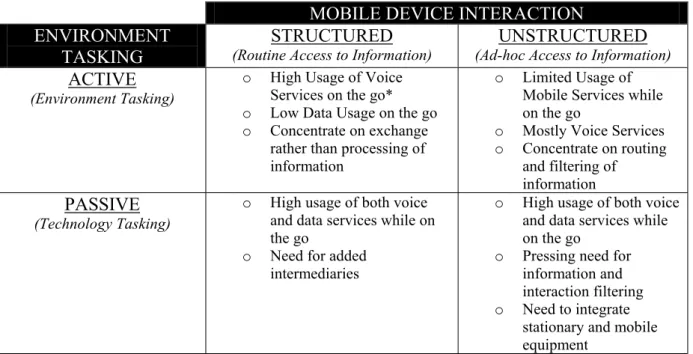
MOBILE DEVICE INTERACTION ENVIRONMENT
TASKING (Routine Access to Information) STRUCTURED (Ad-hoc Access to Information) UNSTRUCTURED ACTIVE
(Environment Tasking)
o High Usage of Voice Services on the go*
o Low Data Usage on the go
o Concentrate on exchange rather than processing of information
o Limited Usage of Mobile Services while on the go
o Mostly Voice Services
o Concentrate on routing and filtering of information
PASSIVE (Technology Tasking)
o High usage of both voice and data services while on the go
o Need for added intermediaries
o High usage of both voice and data services while on the go
o Pressing need for information and interaction filtering
o Need to integrate stationary and mobile equipment
* “On the go” refers to usage of mobile device while performing mobile work.
Table 1.Mobile Technology Use in Relation to Work Environments.
of SOCO. An unstructured task is the one that has to be supported by a dynamic access to formation through multiple channels. For in-stance, a directory assistance operator performs mostly structured information gathering, while a market analyst relies on multiple channels of information that are dynamically changing. Table 1 encapsulates the ideas developed. In the table we can locate the two roles analysed in the case study. The SOCOS would be located in the Passive/Structured cell. The success of
mobile applications in this cell is potentially high, because it is mostly related to data ac-cess. The CSO would be located in the Ac-tive/Unstructured cell. The adoption of mobile
applications in this cell is high. However, the supported applications should mostly be voice-enabled, because of the active environment of work.
The matrix shows that the more intense the re-lationship with the environment gets in terms of the emergent character of the situation, the more data services that require visual attention and particular physical postures lose value(e.g.
the CSO). What gains in importance in active
situations are voice services. In active situa-tions, coordinating activities are important. For instance, when the CSO notices a situation that requires police attention, she will call for help.
The best way to communicate in time critical sit-uations is by voice, being the more contextual-ized and immediate information modality 14].
In the case of SOCO, where the usage of data is high and thus the de-contextualization modality is high, there is a need for added intermediaries that will solve contextual problems that cannot be handled by the system. For instance, the short term improvement of SOCO work, as de-manded by SOCO themselves, would be to em-ploy an expert administrator that could assist in doing the administrative work of documenting the findings in the system and also help coor-dinate jobs between individual SOCOs. In the long term, there is a need for the introduction of mobile technology that will minimize the repli-cation of information and that, at the same time, does not get in the context of interaction. As an example, Tablet PCs were mentioned as a means for supporting the recording of informa-tion, with the additional requirement of a rug-gerised version since fingerprints primarily are lifted using aluminum powder, which is highly destructive to computer technology. Further-more, CSO demanded a good filtering of in-formation, in that they have very little time to react to it when engaged with an incident. If mobile devices are used for a support function
in the case of CSO, it permits a higher flexibil-ity in the daily organization. Thus, while the SOCO need more of a synchronization function which structures their work, the CSO need real time access to information and to communicate with different parts of the organization. The matrix can be seen as encapsulating also other kinds of work environments and is not meant only for understanding the interaction modali-ties in relation to the environment in a policing context.
5. Conclusion
In this paper, we have conducted a discussion of the relationship between work activities, the use of mobile devices and the work context. Mobile devices influence the way information is gath-ered, generated and used. This means that it is important to consider how data(we use data in
a loose sense to look at voice, images and text transmissions)flows, is accessed and interacts
with the environment of use. This discussion was introduced by a case study of two roles within the UK police force, Scenes of Crime Officers obtaining and recoding forensic evi-dence, and Community Security Officers pro-viding valuable policing to localized districts. The aim of the analysis has been to further ex-tend the theoretical discussion on mobile tech-nology use. The paper asks what the contex-tual factors affecting the usage of technology are. This becomes apparent when considering police work where some roles are tasked by the environment and others are not. Similarly, some police roles will critically rely on structured in-formation systems serving as a stable source of work process documentation and information. Other roles will need more ad-hoc access to a variety of information sources. Mobile devices are not an over-arching solution. There are sit-uations in which their usage is inappropriate or in which it can be ameliorated by changing the way in which they are used and thus the modality of interaction. This is to say that time does play an important part when looking at technology. The shrinking in the time it takes to configure resources questions the basis on which these decisions are made. To conclude, we propose a matrix that encapsulates a triangu-lar relation of workers with both mobile devices and the environment based upon the ideas of
active and passive environments and structured and unstructured work tasks. There are clearly other contextual factors that can influence mo-bile device usage(e.g. risk, time, infrastructural
arrangements etc.). However, in this paper we
confined ourselves to the most relevant ones to the policing context, as also suggested by the theory of virtuality. This paper marks an initial step in the investigation of the relationship be-tween mobile devices and the context of work, and we strongly believe that such analyses are necessary for further understanding the value of mobile technologies. In conclusion, the usabil-ity of mobile and wireless devices cannot be understood by considering the technical func-tions alone. The contextual factors relating to information usage modality and environmental engagement are important elements of analysis. Further research is needed to understand and test the contextual factors influencing the usage of mobile technologies.
6. Acknowledgements
First and foremost, we would like to extend our gratitude to all the police officers sharing their working lives with us. Thanks to David Allen who participated in the initial empirical study. Thanks to the two anonymous reviewers. Also thanks to Steve Sawyer and Urban Nuld´en who both provided important comments along the way. The end result is of course entirely our own responsibility.
References
1] AGAR, JON,Constant Touch: A Global History of
the Mobile Phone, Icon Books, Cambridge, 2003. 2] ANDERSON, B.,Imagined communities: Reflections
on the origin and spread of nationalism, Verso, London, 1983.
3] BERGER, PETERL.ANDTHOMASLUCKMANN, The
Social Construction of Reality, Anchor Books, Gar-den City, NY, 1966.
4] BIJKER, WIEBE E., Of Bicycles, Bakelites, and
Bulbs: Toward a Theory of Sociotechnical Change, MIT Press, 1997.
5] BOLTER, J.D.ANDR. GRUSIN, Remediation:
6] BROWN, BARRY ANDKENTONO’HARA, Place as a
practical concern of mobile workers,Environment and Planning, 2001.
7] CIBORRA, C.U., Notes on improvisation and time in
organizations,Accounting, Management and Infor-mation Technologies(1999), vol. 9, no. 2.
8] DAHLBOM, BO, The New Informatics,Scandinavian
Journal of Information Systems(1996), vol. 8, no.
2, pp. 29–47.
9] DIX, ALAN, TOM RODDEN, NIGEL DAVIES,
JONATHANTREVOR, ADRIAN FRIDAY, ANDKEVIN
PALFREYMAN, Exploiting Space and Location as a
Design Framework for Interactive Mobile Systems,
ACM Transactions on Computer-Human Interaction
(2000), vol. 7, no. 3, pp. 285–321.
10] DOURISH, PAUL,Where the action is: The
founda-tions of embodied interaction, MIT Press, 2001. 11] FORTUNATI, LEOPOLDINA,The Mobile Phone: New
Social Categories and Relations, University of Tri-este, 2000.
12] GRAHAM, G., The Internet: A Philosophical
En-quiry, Routledge, New York, 1999.
13] JOHNSON, P., Usability and Mobility: Interactions
on the move, inFirst Workshop on HCI for Mobile Devices, Glasgow, ACM, 1998.
14] KAKIHARA, MASAO, Emerging Work Practices of
ICT-Enabled Mobile Professionals, PhD Thesis The London School of Economics and Political Science, 2003.
15] KAKIHARA, MASAO ANDCARSTENSØRENSEN,
Mo-bility: An Extended Perspective, in35th Hawaii In-ternational Conference on System Sciences, Hawaii, USA, 2002.
16] KAKIHARA, MASAO ANDCARSTENSØRENSEN,
Mo-bile Urban Professionals in Tokyo: Tales of Lo-cational, Interactional and Operational Mobility, in
2nd Mobility Roundtable, Stockholm, 2003, ed. Bertil Thorngren.
17] KALLINIKOS, JANIS, The Age of Flexibility,
Academia Adapta, Sweeden, 2001.
18] KALLINIKOS, JANISRecalcitrant Technology.
Cross-contextual Systems and Context-embedded Action, in Department of Information Systems, London School of Economics, London, 2001.
19] KALLINIKOS, JANNIS,Technology and Society,
Ac-cedo, Munich, 1996.
20] KALLINIKOS, JANNIS, Virtuality and Virtual
Or-ganizations, Department of Information Systems, London School of Economics, 2002.
21] LJUNGSTRAND, PETER, Context Awareness in
Mo-bile Telephony, inProceedings of Wireless World Workshop, Digital World Research Centre, Guild-ford, 2000, United Kingdom.
22] LUFF, PAUL AND CHRISTIAN HEATH, Mobility in
Collaboration, inProceedings of ACM 1998 Con-ference on Computer Supported Cooperative Work, ACM Press, 1998, pp. 14–18.
23] MANNING, PETERK., Policing contingencies,
Uni-versity of Chicago Press, Chicago, 2003.
24] MATHIASSEN, LARS ANDJANSTAGE, The principle
of limited reduction in software design,Information Technology & People(1992), vol. 6, no. 2–3, pp.
171–185.
25] OLSHAVSKY, R., In telematics, no technology is a
panacea(2002),
http://www.cooper.com/newsletters/ 2002 08/no telematics panacea.htm
26] ONG, WALTERJ., Orality and Literacy: The
Tech-nologizing of the Word, Routledge, London, United Kingdom, 1988.
27] ORLIKOWSKI, W., The Duality of Technology:
Re-thinking the Concept of Technology in Organiza-tions, Organization Science(1992), vol. 3, no. 3,
pp. 398–427.
28] PERRY, MARK, KENTON O’HARA, AND ABIGAIL
SELLEN, Dealing with Mobility: Understanding
access anytime, anywhere, inTOCHI, 1999.
29] PICA, DANIELE ANDMASAOKAKIHARA, The
Dual-ity of MobilDual-ity: Understanding Fluid Organizations and Stable Interaction, inECIS 2003, Naples, Italy, 2003.
30] STANDAGE, TOM,The Vicorian Internet, Weidenfeld
& Nicholson, London, 1998.
Received:July, 2004
Revised:August, 2004
Accepted:September, 2004
Contact address:
Carsten Sørensen Department of Information Systems London School of Economics and Political Science Houghton Street London WC2A 2AE United Kingdom e-mail:[email protected]
CARSTENSØRENSENis a Senior Lecturer in Information Systems at The
London School of Economics and Political Science, United Kingdom. He holds a BSc. in mathematics, an MSc in computer science and a Ph.D. in information systems from Aalborg University, Denmark. His research investigates how ICT shapes and is shaped by working prac-tices, most recently mobile and wireless technologies. Core concerns in his research has been the management of social interaction in dis-tributed settings, in particular considering the increased mobilisation of interaction and the subsequent struggle for mobile individuals to engage in fluid interaction. Dr. Sørensen has through the past 14 years been affiliated with a number of Danish, Swedish and British institutions. In 2002 Dr. Sørensen initiated a research network in mobile interac-tion called mobility@lse(http://mobility.lse.ac.uk/), which
aims at drawing together academics and practitioners with an interest in studying the profound changes to society, individuals and technolo-gies in the mobile society of the 21st Century. He has since 1997
been Research Director of Laboratorium for Interaction Technology
(http://laboratorium.htu.se)at Trollh¨attan Uddevalla