Original Research Article
Stroboscopy: an evolving tool for voice analysis in vocal cord
pathologies
Sneha D. Rajput*, Mittal J. Poriya
INTRODUCTION
Benign vocal fold disease, such as vocal polyp, vocal nodule, intracordal cyst or Reinke’s edema is one of the most common causes which deteriorate the voice. Since 1854 when Manuel Garcia first observed the movement of his own vocal cords using a laryngeal mirror and sunlight as the light source, a number of techniques for
demonstrating laryngeal anatomy have evolved. Preoperative evaluation of these lesions initially by indirect laryngoscopy or direct rigid laryngoscopy, gave way to the use of transnasal flexible fibreoptic endoscopy in the eighties. The introduction of the video stroboscope into otorhinolaryngology practice has revolutionized the assessment of vocal cord pathology. With advent of commerciallly available stroboscopes, evaluation of these ABSTRACT
Background: Benign vocal fold disease, such as vocal polyp, vocal nodule, intracordal cyst or Reinke’s edema is one of the most common causes which deteriorate the voice. Since 1854 when Manuel Garcia first observed the movement of his own vocal cords using a laryngeal mirror and sunlight as the light source, a number of techniques for demonstrating laryngeal anatomy have evolved. Preoperative evaluation of these lesions initially by indirect laryngoscopy or direct rigid laryngoscopy, gave way to the use of transnasal flexible fibreoptic endoscopy in the eighties. The introduction of the video stroboscope into Otorhinolaryngology practice has revolutionized the assessment of vocal cord pathology.
Methods: The present study includes a 50 cases of subjects with complain of change of voice coming at department of E.N.T and Head and Neck surgery, at our hospital. A detailed history was taken following which a thorough examination of larynx using appropriate techniques were carried out. Further investigations were done as and when required.
Results: On stroboscopic examination patients were analyzed on four parameters like, symmetry, amplitude, periodicity and mucosal wave. Observations of periodicity and mucosal wave were significantly different in preoperative and post-operative analysis. Stroboscopic evaluation suggested that preoperatively 50% of the patient were having asymmetricity, decreased amplitude, aperiodicity and absent mucosal wave. On postoperative follow-up at 15 days and 2 months interval almost all the patients got all the parameters near normal.
Conclusions: It was observed that statistical significant difference in pre and postoperative findings of different parameters of voice evaluated using it. We can draw the probable conclusion that video stroboscope proved to be useful and reliable tool for evaluation of the patients with benign vocal cord pathologies as it reflects the change in the all the parameters of voice postoperatively most accurately and promptly.
Keywords: Stroboscopy, Glottal configuration, Mucosal wave, Phase difference Department of Otorhinolaryngology, S.C.L. Hospital, Ahmedabad, Gujarat, India
Received: 19 June 2017
Revised: 15 July 2017
Accepted: 18 July 2017
*Correspondence:
Dr. Sneha D. Rajput,
E-mail: [email protected]
Copyright: © the author(s), publisher and licensee Medip Academy. This is an open-access article distributed under the terms of the Creative Commons Attribution Non-Commercial License, which permits unrestricted non-commercial use, distribution, and reproduction in any medium, provided the original work is properly cited.
lesions and other laryngeal pathologies has become more comprehensive.1,2
Stroboscope was first employed by Oertel in 1878 to examine the larynx, used a pulsatile light generating device with a laryngeal mirror. This was the precursor of the modern stroboscope. Stroboscopy involves the use of high speed flashes of light at a frequency slightly lower or higher than the frequency of the patients vocal fold vibrations. The image thus obtained is an optical illusion of slow motion based on Talbots law i.e. the persistence of an image on the retina for 0.2 seconds after exposure. Stroboscopy can be performed with either a flexible laryngoscope or a rigid 70° or 90° angled telescope. Rigid stroboscopy provides brighter, clearer and more magnified images. With technological advances and video recording equipment; video stroboscopes are now being used more often to visualize the vocal folds and its vibratory function.3,4
Aims and objectives
Pre-operative and post-operative evaluation of patients of hoarseness of voice with stroboscope.
To understand unique indication, effectiveness and limitation for accurate assessment of larynx.
To understand pathology of various voice disorders, identifying subtle mucosal lesions and to study vibratory characteristics of vocal fold.
Anatomy of larynx
Larynx is a structure supported by cartilage framework, lined by mucosa and suspended from hyoid bone. It is a musculo-cartilaginous tubular structure.
Laryngeal cartilages
These are for structural support and controlling vocal fold position, length and tension. Following Table 1shows the paired and unpaired cartilages of larynx.
Table 1: Shows the paired and unpaired cartilages of larynx.
Unpaired Paired
Thyroid Arytenoids
Cricoids Cuneiform
Epiglottis Corniculate
Figure 1: Laryngeal muscles.
Extrinsic muscles are: suprahyoid- that are above the hyoid bone- elevators of larynx; infrahyoid- that are below the hyoid bone- depressors of larynx.
Physiology of larynx
Larynx has following important functions- respiration- swallowing- cough reflex- effort closure- phonation and resonation. Of these phonation is the latest adaptation while swallowing and respiration were the most primitive one. Coughing helps in expulsion of foreign bodies from airway. The false vocal cord act as exit valves to prevent egress of air from trachea till sufficient subglottic pressure has been generated, this phenomenon of adducted vocal cord is due to their unique shape and configuration and occurs independently of muscle tone and even in bilateral laryngeal palsies.5
Different methods of laryngeal evaluation
IDLE
Simplest method of examining larynx and vocal fold in outdoor basis settings is with the mirror.
Rigid endoscopy
Rigid endoscopy of larynx can be done by 70 or 90 angled laryngoscope.
Flexible larngoscopy
It is performed to gain a dynamic assessment of larynx during phonation and thus helpful in movement disorders of larynx and evaluation during phonation. It helps to evaluate nasal cavity, nasopharynx, eustachian tube, soft palate, tonsils, base of tongue, vallecula pyriform fossa, posteror pharyngeal wall.6
Video stroboscopy1,4,7
It is indicated when a detailed analysis of vocal fold vibration is desired in addition to indirect or flexible examination. Stroboscopic light can be attached to either rigid- 70 or 90 telescopic or flexible endoscopic examination.
Human vocal fold vibrate at the rate faster to be perceived by human eye. And therefore evaluation of vocal fold vibration requires special technology that slows down the vibration for assessment which forms the basis of stroboscopy principle.
Physics of strobe
The frequency is slightly less and several multiples slower than vocal fold vibration. The entire stroboscopic process is dependent on an adequately stable fundamental frequency, and the resulting sampled images form an averaged, down sampled estimate of the true underlying tissue motion. This is the ‘asynchronized’ mode of stroboscopy. In addition to this, the strobe can be set to a ‘synchronized’ mode wherein the strobe will flash at a frequency identical to the frequency of phonation. The synchronized mode records images from the same point in the vibratory cycle and the resulting recording shows the still image of the larynx captured from the same point in the vibratory cycle.
Indications of stroboscopy
When a detailed analysis of vocal fold vibration is desired in addition to other conventional modes of imaging. Usually in a patient with hoarseness and wherein other modes fail to show any frank abnormality. When vocal fold documentation is required pre and post treatment to evaluate the outcomes of various interventions.
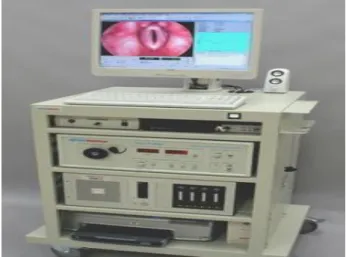
Videostroboscopy is also used during the surgical planning (Figure 2).
Figure 2: Video stroboscopy.
Parameters detected by stroboscopy8
Symmetry of vibration - it refers to movement of right and left vocal fold relative to one another. The right and left vocal folds normally vibrate as the mirror images of one another.
Periodicity of vibration- it is the relative length of the vibration cycle and should be stable from cycle to cycle.
Phase closure- it is the percentage of time vocal folds edged are open and/or closed during a single cycle of phonation.
Amplitude of vibration- it is the amount of lateral movement of vocal folds during vibration.10
Glottis configuration- it refers to the shape or contour of the glottis opening, at the point of maximal closure during the vibratory cycle.9
Mucosal wave- it is the movement of superficial tissues over the vocal fold as the air moves through the glottis. It can be seen as a travelling wave in the superficial tissues over the top of vocal surface from
medial to lateral. All these are subject to change with difference in the mechanical properties of vocal fold i.e. position, shape, mass, elasticity, stiffness, and tension and with mode, pitch and loudness of phonation.11
METHODS
The present study include a 50 cases of subjects with complain of change of voice coming at department of E.N.T and Head and Neck surgery, at our hospital. A detailed history was taken following which a thorough examination of larynx using appropriate techniques were carried out. Further investigations were done as and when required.
The data were collected for my study purpose after obtaining the written informed consent from the eligible patients. The study took place between August 2015 and October 2016. The patients who fulfilled the inclusion criteria were enrolled in the study. Proforma was filled for each patient and was subjected to Hopkins’s examination, video stroboscope preoperatively and postoperatively at 15 days and 2 months interval. They were informed about their rights to refuse or withdraw. Anonymity and confidentiality of the obtained information was assured.
Inclusion criteria
Inclusion criteria were age of patients: 15-70 years, either gender, complain of speech disorder, benign vocal fold lesion, vocal fold disorder.
Exclusion criteria
Exclusion criteria were neck or thyroid surgery, neurological voice disorder, cardio-pulmonary disease, pregnant and lactating mother, children below 15 year. They were subjected to IDLE, rigid endoscopy and stroboscopy.
Total 50 patients were included according to the inclusion criteria and the data were analyzed paired t-test was applied to calculate the level of significance in the results of preoperative data and that to with the results of the follow-up done at 2 weeks and 2 months.
RESULTS
Table 2 shows the age wise distribution of the patients in
male and female category. Maximum number of the patients fell in the age group of 46 to55 years of age. Table 3 shows the vocal abuse in relation to profession. This Table 4 shows the distribution of patients with different diagnosis. 50% of the patients were diagnosed of bilateral vocal cord nodule which is the highest percentage of patients and only 4-5% of patients were diagnosed of unilateral vocal cord.
Table 2: Shows the age wise distribution of the patients in male and female category.
Age 15-25 (%) 26-35 (%) 36-45 (%) 46-55 (%) 56-65 (%) Total (%)
Male 4 (8) 8 (16) 5 (10) 11 (22) 3 (6) 31 (62)
Female 4 (8) 4 (8) 3 (6) 5 (10) 3 (6) 19 (38)
Total 8 (16) 12 (24) 8 (16) 16 (32) 6 (12) 50 (100)
Table 3: Profession on vocal abuse.
Vocal abuse Non vocal abuse
Teacher
Other professions
Singer Vendor
Total 51% Total 49%
Table 4: Shows the distribution of patients with different diagnosis.
Initial diagnosis Number of cases (%)
Bilateral vocal cord nodule 26 (51)
Unilateral vocal cord nodule 6 (12)
Anterior commisure polyp 5 (10)
Unilateral vocal cord polyp 5 (10)
Anterior commisure cyst 4 (8)
Papilloma 4 (8)
Table 5: Shows the findings of stroboscope.
Stroboscopic parameter Preoperative Postoperative
P value After 2 weeks After 2 months
N=50 N=50 N=50
Symmetricity Symmetric 2 46 49 0.354
Asymmetric 48 4 1
Amplitude Decrease 46 0 0 0.016
Normal 4 50 50
Periodicity Periodic 21 0 0 <0.001
Aperioodic 29 50 50
Mucosal Wave Present 20 45 47 <0.001
Absent 30 5 3
Table 5 shows the findings of stroboscopy. On stroboscopic examination patients were analyzed on four parameters like, symmetry, amplitude, periodicity and mucosal wave. Observations of periodicity and mucosalwave were significantly different in preoperative and post-operative analysis.
DISCUSSION
In this study total 50 patients were included of either gender and with different vocal cord pathologies. They were subjected to stroboscopic examination pre-operatively and postpre-operatively.
In the present study 38% of the patients were female. Similar to our study there were 34% females in the study carried out by Baitha et al.12
Age wise analysis showed that 32% of the patient belonged to the age group of 46-55 years and only 12% of the patients were in the age group of 56-65 years. This may be related to the voice abuse due to profession. This finding was comparable to the study carried out by Printza et al, where in mean age was 55 years.13
Diagnostic analysis was carried out and it was found that the majority of the patients, 21% were suffering from nodule and only 4% of the patients were found to be suffering from papilloma. When this observation was compared with the other study carried out by Shin, Chang and Yang was observed that 20% of the patients had vocal cord nodule and 59% of the patients were diagnosed of vocal cord polyp.14 51% of the patients had bilateral vocal cord nodule which is suggestive of vocal abuse by those patients and this observation was similar to the study done by Fritzel.15
They observed that teachers, professors and vendors were having vocal cord nodule.
Stroboscopic evaluation suggested that preoperatively 50% of the patient were having asymmetricity, decreased amplitude, aperiodicity and absent mucosal wave. On postoperative follow-up at 15 days and 2 months interval almost all the patients got all the parameters near normal. There was statistical significant difference in the observations of periodicity and mucosal wave done pre-operatively and postpre-operatively at 15 days and 2 months interval. These observations were similar to the study carried out by Raghunandan et al.
CONCLUSION
The present study was carried out in 50 patients of either gender and with different vocal fold pathologies like 58% of patients were found to be suffering from vocal cord nodule and 42% of patients were habitual voice abuser. Most common age group with these pathologies was 46 to 55 years. All the patients were subjected to video-stroboscopy pre and postoperatively. It was observed that statistical significant difference in pre and postoperative findings of different parameters of voice evaluated using it. We can draw the probable conclusion that video stroboscope proved to be useful and reliable tool for evaluation of the patients with benign vocal cord pathologies as it reflects the change in the all the
parameters of voice postoperatively most accurately and promptly.
Funding: No funding sources Conflict of interest: None declared
Ethical approval: The study was approved by the Institutional Ethics Committee
REFERENCES
1. Clerf LH. Manuel Gravia’s contribution in to laryngology. Bull N Y Acad Med. 1956:32;603-11. 2. A short history of laryngoscopy. Anthony Jahn and
Andrew Blitzer. Log Phon Vocol. 1996;21:181-5. 3. Yoshida Y, Hirano M, Nakajima T. A videotape
recording system for videostroboscopy.1979;30:1-5. 4. American Speech Language Hearing association. Training guidelines for laryngeal videoendoscopy/stroboscopy, 1998.
5. Gleeson MJ, Clarke RC. Scott Brown’s otolaryngology. Head and Neck surgery, 7th edition. 2008: 2196-2205.
6. Laryngeal evaluation. Indirect laryngoscopy to high speed imaging. In: Kendall KA, Leonard RJ. Thieme; 2010.
7. Krausert CR, Olszewski AE, Taylor LN, McMurray JS, Dailey SH, Jiang JJ. Mucosal wave measurement and visualization technique. J Voice. 2011:25(4);395-405.
8. Kaszuba SM, Garrett CG. Strobovideolaryngoscopy and Laboratory voice evaluation. Otolaryngol Clin North Am. 2007;40(5):991-6.
9. Patrik JP, Felix IC. Consistency of preoperative and intraoperative diagnosis of benign vocal fold lesions. J Voice. 2003;17(3):425-33.
10. Raymond H, Colton P. Stroboscopic signs associated with benign vocal fold lesions. J Voice. 1995;9:315-25.
11. Sheth M, Michael J. Management of dysphonic patients by otolaryngologists. Otolaryngol Head Neck Surg. 2012;147(2):289-94.
12. Baitha S, Raizada RM, Singh AKK, M. Puttewar M, Chaturvedi VN. Clinical profile of hoarsness of voice. Indian J Otolaryngol Head Neck Surg. 2002;54(1):14–8.
13. Printza A, Triaridis S, Themelis C, Constantinidis J. Stroboscopy for benign laryngeal pathology in evidence based health care. Hippokratia. 2012;16(4):324-8.
14. Shin YS, Chang JW, Yang SM, Wu HW, Cho MH, Kim CH. Persistent Dysphonia after Laryngo-microsurgery for Benign Vocal Fold Disease. Clin Exp Otorhinolaryngol. 2013;6(3):166–70.
15. Fritzel B. Analysis of Longitudinal Phase Differences in Vocal-Fold Vibration Using Synchronous High-Speed Videoendoscopy and Electroglottography. J Voice. 2012;26(6):816–816.