The Existence of Insider Trading in Malaysia: An Event Study Approach
Abdul Hafiz Yusof*, Ahmad Fawwaz Mohd Nassaruddin, Sharazad Haris, Noor Hafizha Muhamad
Yusuf, and Wan Mohd Farid Wan Zakaria.
Faculty of Business Management, Universiti Teknologi Mara (UiTM), 02600 Arau, Perlis, Malaysia.
Abstract:
This paper focuses on the role of insider trading activity in Malaysia. It attempts to indicate the existence of the abnormal profit from this activity. Recently developed countries like United States and United Kingdom have reported that the activity can no longer gives abnormal profit for long period due to laws imposed in those countries, attention now turns to emerging market like Malaysia. By using event study analysis, 200 cases of insider trading activity reported between January 2008 and March 2009 were closely examine and the result shows that while abnormal return do exist, it is mostly not significant. This paper also looks at the individuals and institutional insider and their performances respectively.
Keywords: Insider trading; Event study; Abnormal returns
Introduction
The efficient-market hypothesis asserts that financial markets are "informationally efficient" in which prices on traded assets will reflect all known information, and instantly change to reflect new information. According to the weak form efficient market, it is impossible for investor to consistently outperform the market by using any information that the market already knows. When the market is said to be efficient, it indicates no individual can have higher expected trading profits than others because of monopolistic access to information. However this conclusion does not hold in the existence of insider trading.
Insider trading is an activity of trading corporation’s stock or any other securities by individuals with potential access to non-public information about the company. The study on insider trading can be categorized into two broad areas. The first category of this studies emphasis on insider trading regulations and their reaction to its enforcement. The second category on insider trading which also attracts reviewer is regarding the profit making from the activities.
In order to gain abnormal return, insider will have to repeatedly beat the market. In doing so, they will have to pay some attention to the enforcement of laws in that certain country and several hallmarks that could be important in their efforts to beat the market.
In recent years, it is found that insider in developed
market such as U.S, Japan and U.K cannot consistently outperform the market which means the activity of collecting abnormal profit is close to none. Shen (2007) claims this happens because investor in those countries react simultaneously to any relevant news and the efficiency of their insider trading regulations. The story is not similar in emerging market like Hong Kong and China as described by Huang (2004), Shen (2007) and Cheuk et.al (2006). Their studies found that the possibility of constantly outperforming the market is higher if the individual investors trace the trading patterns of institutional investor. Chung (2010) claims the trading activities by established institutional investor is likely to be influenced by insider trading. Shen (2007) attributes the high activity of illegal insider trading in China and Hong Kong with the less enforcement of insider trading regulations in both countries. Malaysia is also considered as emerging market. Thus, it is interesting to know whether insider can still gain abnormal return in Malaysia under the regulation and supervision of Capital Market and Service Act (CMSA) and Securities Commissions.
Literature Review
Efficient market hypothesis (EMH) is among the oldest theory in investment field. It was widely accepted up until the 1990s, when behavioral finance economists, who were a fringe element, became mainstream. The efficient-market hypothesis asserts that financial markets are "informationally efficient", or that prices on traded assets (e.g., stocks, bonds, or property) already reflect all known information, and instantly change to reflect new information. Therefore, according to the theory, it is impossible to consistently outperform the market by using any information that the market already knows.
The theory describes three forms of market efficiency; weak, semi-strong and strong form market. A strong-form market efficient assumes all available public and private information is fully reflected in a security's market price. The strong form, in terms of market participants, also assumes that no individual can have higher expected trading profits than others because of monopolistic access to information. Overwhelming evidence shows that market is not strong form efficient. This is due to insider trading activity done by individuals inside the organization itself who have enough information to decide whether to acquire/dispose their stocks in relative to the ‘private’ information they have and thus gaining abnormal return.
The studies on insider trading activity have attracted a lot of attention from scholars all over the world. While some researcher still question the possibility of using insider trading activity as guidelines in attaining abnormal profit, others tend to study the effectiveness and the enforcement of insider trading activity.
This study is interested in determining the existence of insider trading activity in Malaysia with the objective of investigating whether there is a chance for insider dealer to gain abnormal profit. The compilation and remarks on finding by previous researchers will next be documented in three sections. The first section will give some basic understanding on insider trading and person involved with it. Second section will give some insight on effect of regulation on insider trading. The discussion on Malaysian Securities Industry Act 1983 (SIA) and the Securities Industry (Central Depositories) Act 1991 (SICDA) will also be covered in this section. The third section of this literature will present the findings by previous scholars regarding the abnormal return and several insiders trading behavior. It is the main motive for this study to correlate the studies and findings from other country and prove whether the situation is identical in Malaysia.
Insider trading
Jaffe (1982) define insider trading as trading done by corporate officers, directors and large stockholder who possess special information about the company. The information they have will assist them in making decision that shall help them in achieving abnormal profit. To sum it all, insider trading is an activity of trading corporation’s stock or any other securities by individuals with potential access to non-public information about the company.
Many scholars argue about the correct definition of insider. A definition, however, emerges from activities that are prohibited under the insider-trading provisions and regulation. In recent years, most countries have amended their regulation in defining insider trading with special attention given to broaden the definition of insider.
Insiders in this study are defined by Securities Industry Act 1983 (SIA) as persons who have in their possession information that is not generally available. Basically, it includes persons with fiduciary duties such as CEOs or directors, a member of a director's family, a body corporate which is associated with that director, or a substantial shareholder. In addition, a person who communicates inside information to enable another person to use it for his advantage, the second-mentioned person, known as a "tippee", can also be considered as an insider.
The definition of insider is almost similar in other countries. In the United States and Germany, for mandatory reporting purposes, corporate insiders are defined as a company's officers, directors and any beneficial owners of more than ten percent of a class of the company's equity securities.
(2007) among others.
The classification also conforms to the list of identified insider trading groups as listed by Beams et.al (2003) with assist from Securities Exchange Commissions (SEC) website. The first group is corporate officers, directors, and employees who traded the corporation's securities after learning of significant, confidential corporate developments. The second group consists of friends, business associates, family members, and other "tippees" of such officers, directors, and employees, who traded the securities after receiving such information. The third group comprises of employees of law, banking, brokerage, and printing firms who are given such information to provide services to the corporation whose securities they traded. Government employees who learned of such information because of their employment by the government are categorized as fourth group while the last group is the other persons who misappropriated and took advantage of confidential information from their employers.
The next step after examining the definition of insider trading and insider is to decide the form of transaction to be selected in the study. Kara and Denning (1998) and Seyhun (1990) excludes any insider trading transaction if it includes any exercise of options, shares acquired from a compensation plan and private transactions. They only considered open market purchases and sales as their variable. Open-market sales and purchases occur more frequently for information reasons as proven by Seyhun. The same method as used by Kara and Denning (1998) and Seyhun (1990) will be employed in this study. Meanwhile, in terms of insider trading group selected as samples for study, this study will try to cover all five classes of group suggested by Beams et.al (2003) although it will depend a lot on the availability of the data.
Regulation on insider trading activity
Before we discuss about the regulation of insider trading, we must first understand the motives and rationale of insider trading activity. Beams et.al (2003) in their study suggests that guilt had the greatest effect on intent to trade based on insider information. Expected gain, cynicism, and perceptions of the fairness of laws were also significantly associated with the intent to trade based on insider information. Another finding on reasons for insider trading as found by Ma and Sun (1998) are as follows; first it is due to the portfolio diversification and liquidity adjustment. Firm managers often acquire stock through a plan or an exercise of options. They may later sell it to diversify their portfolios. Managers may also sell their stock due
to financial need. This is why insiders have normally made more sales than purchases of their firm's stock. The second reason is the corporate control. Managers purchase their firm's stock to increase their share of total stockholding and enhance their voting power in the firm. Another reason could be based on private information. This falls into two subcategories. First, insiders may purchase the firm's stock because they genuinely believe the stock is a good investment. Second, insiders may trade prior to announcements that will generate abnormal returns for themselves.
With such motives of insider, there is nothing can stop them but the boundary set by law and regulation. Regulation and laws of insider trading are made in order to prevent any manipulation of stock by insider. Rules for insider trading fall into two categories. The first one, namely called corporate insider rule is the rules that prohibit corporate insiders—officers, directors, and major beneficial shareholders—from certain kinds of trading activity in the securities of their own company. These forbid short sales by insiders and allow the company to recover any profits realized on purchase/sales cycles completed within a six-month period (short-swing profits). The second rules prohibit trading on material, inside (nonpublic) information. These forbid anyone, insider or not, from trading profitably on inside information. These can be termed the inside information rules.
McGee (2007) reckons the first country to have a law regarding insider trading are the United States followed by France. This is followed by other developed market like U.K., Australia, Japan, and Korea with help by United States’ law as model. This is followed suits by emerging markets like Malaysia, China and Hong Kong. McGee also shows the slow establishment of laws on insider trading. As of 1990, only thirty-four countries had laws restricting or prohibiting insider trading, and only nine of them had prosecuted anyone for insider trading. By 2000, the numbers increased. By that time, eighty-seven countries had passed insider trading laws and 38 had prosecuted at least one insider trading case.
Bhattacharya and Daouk (2002) provide additional information on passing ofinsider trading laws and years taken for person to be charged in violate the rules. The result seems to indicate that countries are not enforcing or perhaps do not strictly prosecuted the traders involve. Median for the developed countries is 1989 while the first reported case is in 1993. For emerging countries the median years on law creation is 1992 and only 5 years later the first case was brought to justice.
regulators to establish the law pertaining to insider trading. Among the answers that could appear as excuses are the effectiveness of the law itself and the perception on insider trading activity. Although it is widely accepted that insider trading is unethical, there are also several groups strongly disagree with the rules and restriction on insider trading.
There are at least three theories against the enforcement of a ban on insider trading. The first one, victimless crime was developed by Herzel and Katz (1987) which states that insider trading has no victim. This is because transactions carried out by the insider moves the stock price in the same direction as preferential information and consequently the counterpart of the insider also takes advantage of the insider’s transactions. The second theory is based on the concept that the only effective way to compensate managers is through the exploitation of preferential information. This is because of the fact that bonus and stock options are not flexible enough and financially viable for the company. This concept was brought forward by Manne in 1966. The latest theory against the regulation of the crime exploits the concept of market efficiency in its strong form, i.e. the stock price reflects all available information, preferential included. Hence, by carrying out his strategy, the insider pushes the stock price faster towards the value which better reflects the fundamentals of the company. A comprehensive study on pros and contras of insider trading is documented by Minenna (2003).
There are also numerous studies done with aim to establish the effect of regulation on insider trading. Arguably, the most studied is the Insider Trading Sanctions Act 1984 (ITSA). Eyssell and Reburn (1993) found evidence that ITSA can significantly reduce insider trading activity. In their study on seasoned equity, they found that there is significant reduction in abnormal selling prior to SEO announcement for the post-ITSA as compare to pre-ITSA era. Their finding is supported by Garfinkel (1997), Arshadi and Eyssell (1991) and Seyhun (1990). Masson and Madhavan (1991) also agree with the theory and claim current regulations tend to discourage insider trading activity. A study in New Zealand by Pinfold et.al (2007) shows that since the amendment made on Regulation of 1988, insider could not achieve abnormal profits anymore. The study on the same country by Gilbert and Tourani-Rad (2008) also found identical result.
Insider trading regulations are intended to keep insider from using non-public information to the disadvantage of others. Unfortunately, some studies found that the laws have been largely ineffective. Jaffe (1974) and Lin & Hoe (1990) are among scholars to prove this. Studies
in China by Cheng (2008) also prove that laws are not sufficient with most insider trading activities there are done by high-ranking government and party officials. Another study was done in Spain by Brio et.al (2003) suggesting the changes of law in Spain could not prevent insider trading; ironically Spain is one of the few countries where insider trading is still considered legal.
The different findings by previous scholars are explained by Eyssell and Reburn (1993) as a result of different test on various countries which have different laws. Another reason for the different findings is the degree of enforcement in different time and places. Khan and Lamba (2001) claim that insider trading still gains despite ITSA because insider do not suffer high penalty and will only have to pay penalty on the profit earned on their trades. They later suggest that regulation need to be enforced to the fullest extends.
In Malaysia, insider trading is governed by Capital Market and Service Act (CMSA). Section 188 (2) of the CMSA prohibits an insider in possession of certain information, as described in Section 183, Section 184 and Section 185 from acquiring, disposing or procuring, directly or indirectly, an acquisition or disposal of, or the entering into an agreement for or with a view to the acquisition or disposal of such securities. By virtue of Sections 190 and 191 of the CMSA, the prohibition of insider trading also extends to secrecy arrangements by corporations and partnerships.
Abnormal returns
Arguably the main objective for insider trading is to gain abnormal return. Abnormal return and its behavior have been documented in most of the study done previously. What actually creates this return? Givoly and Palmon (1982) observed and found that major part of insider trading return is likely due to price changes arising from the information revealed through the trades themselves.
The classic study by Finnerty (1976) was to be one of the first to discover the abnormal return. His study on insider trading and efficient market hypothesis concludes by summarizing that insiders are able to outperform the market. Insiders can and do identify profitable as well as unprofitable situations within their corporations. This finding tends to refute the strong-form of the efficient market hypothesis.
findings though are that investor can use insider as gauge to purchase/buy securities.
Ramirez and Yung (2000) focus their study on insider trading and investment bank reputation. They found that cumulative abnormal returns are positive after insiders of investment banking industry have purchased stocks of their own firm. The authors also suggest not to compile together studies of banking/financial industry firms with non banking/financial firms as biased will likely affect the result. Thus in this study, we will not be considering companies from the financial sector.
An important part of insider trading will be the timing. Lin and Howe (1990) found evidence demonstrating that insiders sell stock following periods of positive abnormal returns and buy after periods of negative abnormal returns. Further, the transactions of insiders have predictive content. Thus, insiders who have already decided to trade appear to be able to profit from using their information to time their transactions.
Heinkel and Kraus (1987) and Chakravarty and McConnell (1999) went further to study if there is any significant different between insider and non insider (outsider). Surprisingly, insider do not outperform outsider significantly which lead to their conclusion that effect of insider trading and non insider trading is no different.
Research Method
Data collection
This study used 200 cases of insider trading activities out of 4,782 cases (excluding any activities in MESDAQ market) recorded during the period of January 2008 until March 2009; 100 of which were taken from the cases of insiders’ selling activities and another 100 from insiders’ buying activities. The company data were taken from the Bursa Malaysia website (www.bursamalaysia.com) while the price movements were collected from DataStream.
This study used random sampling method. Companies from various sectors listed on the Main Board of Bursa Malaysia were considered for this analysis. Out of all the sectors, the finance sector was excluded from further analysis in order to minimize biases. The samples were then randomly selected after the names of the company have been alphabetically sorted. Another criterion used in selecting the sample is that only companies with more than 100,000 shares exchanges were considered for further analysis. This analysis focused on open-market purchases and sales by officers and directors with exclusion of options exercises,
private transactions, and all transactions by beneficial owners.
The 200 cases selected as samples were further divided into four groups; sales by individual insider, sales by institutional insider, purchase by individual insider and purchase by institutional insider. Appendix A summarizes the sample used in this study.
As explain by M.-Y. Cheuk et. al (2006), there are many possible motivations exist behind an insider transaction. The activity of insider’s disposal could be down to liquidity reasons and diversification of investment risk. Insiders also acquire shares as a result of exercising options. However, the general public and researchers tend to think that the more likely and intriguing reason behind insider transactions is private information. These groups of people are likely to react by purchasing or selling their ownership in response to the potentially good or bad news surrounding the company.
Methodology
This study employed the traditional event-study analysis. This event-study analysis was applied in this study in order to estimate the effect on stock returns towards any event that could give an impact on the company. This type of studies is most often used to test the existence and also the degree of insider trading.
The process of event study was instigated by determining the date upon which the market would have received the news. The date selected has to reflect when the public reasonably expected the news. This event date is vital for the next step, which is examining the return for the individual companies prior and posts the event date. Researchers noted and took interest in the price reaction before (t=-1, t=-2, etc), during event date (t=0) and after (t=+1, t=+2, etc) a specific event occurs.
Researchers then measured the abnormal return which is gauged by the difference between observed returns and ‘no-news” returns for each firm. The abnormal returns observed were then aggregated across companies and across time. Subsequently, these aggregated returns were statistically tested to determine the result.
There are several approaches of event study although only two were used in this study namely, market model and market adjusted return model.
Market model
market model to estimate abnormal returns associated to insider activities. These have been done previously by Finnerty (1976), Seyhun (1986 and 1998) and Damodaran & Liu (1993) among others. The single market model is
tm it r
r (1)
Where ri is the return on firm i, rm is the return on the market proxy, and ε is the Gaussian error term. α and β are parameters to be estimated. In this study, prior event date from day -75 to day -6 are used to estimates both α and β.
The returns are measured as
1 1 t t t it P D P
r (2)
Where Pt is the price at time t, Pt-1 is the price the day before, and Dt is the dividend payment, if any, on date t. The market return (rm) will also be compute in a similar manner
The abnormal return to firm j on day t, ARit, is then calculated from day-5 to day +20 for each day as follows:
R
R
ARit it (3)
With ARit is an abnormal return of security i during period t, Rit is rate of return on security i during period t and R is the average return on a market index during period t.
The average abnormal return (AAR) across firms for each day is:
t T t k t t ARtAAR (4)
where N is the number of firms with insider trading on day t.
The significance of the average abnormal return is tested by the statistic
t t t AAR N X AAR AAR stat t
t
(5)
The cumulative average abnormal return (CAAR) to the insider trading firms from day- D to day D is the sum of the average abnormal returns between day-D and day D. The formula is:
t T t k t t AARCAAR (6)
In order to assess the performance of stocks traded by insiders and the degree of market efficiency in the stock market, we examined the cumulative average abnormal returns (CAAR) associated with insider purchases and sales for various post-event periods. The CAARs of the transactions were then analyzed as a whole and any persistent abnormal returns found after the day on which the public is informed of any insider trading indicates that the market reacts to the dissemination of such information. Theoretically, if such abnormal returns exist, then it is likely that outsiders can actually earn abnormal profits by mimicking the trades of insiders.
Market adjusted return model
Another approach is the market-adjusted return. This method is easier than market model and actually has same similarities in calculating the variables. First is the step in defining an abnormal return for individual stock. Researchers typically assumed that the individual stock should experience returns equal to the aggregate stock market. This assumption meant that the market-adjustment process simply entailed subtracting the market return from the return for the individual securities to derive an abnormal return.
R R
ARit it (7)
Where ARit is an abnormal return of stock i on event
day t, Rit is rate of return on stock i on event day t and
R is the average return on a market index on event day t
Next, the average abnormal return (AARt) return for each time period t is calculated.
N i t t i t AR N AAR1
/
, (8)
Nt = The number of valid observations on event day t.
Next, cumulative abnormal returns (CAAR) on a specified event period t will be tested.
t T t k t t AARCAAR (9)
Test for individuals and institutions
This study examined the behavior of the individual and institutional on the event period. Two tests were used in this study, namely the parametric and non-parametric tests. The event window selected will be the same from the above event window (t=0 to t=3, t=0 to t=5,. t=0 to t=10,. t=0 to t=15,. t=0 to t=20). In this analysis, abnormal returns accrued to institutional are compared to those of individuals.
Analysis and Findings
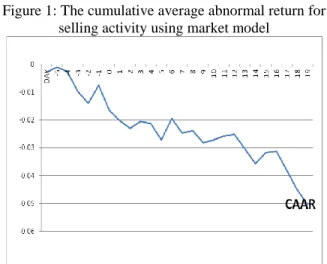
As shown by Figure 1, selling activities lead to constant drop in returns. The graph proves that by selling their stocks, insiders are able to predict future price performances and manage to avoid losses.
Figure 1: The cumulative average abnormal return for selling activity using market model
In the case of purchasing, the trends are bullish as CAAR increase over time after the event date. CAAR is always above than zero (0). This is represented by Figure 2 below.
Figure 2: The cumulative average abnormal return for purchasing activity using market model.
In addition, Table 1 shows the daily average abnormal return for the whole event windows ranging from t=-5 to t= 20. The table proves that AAR is always positive for insider purchase which indicates that insider has private information of the company. It also provides evidence that on every day, the abnormal return from purchasing is greater than abnormal return from selling.
Table 1: Average abnormal return for insider purchases and sales
DAY INSIDER
PURCHASE
INSIDER SALES
AAR T-STAT AAR T-STAT
-5 1.38% 0.981 -0.29% -0.641
-4 0.68% 0.485 0.18% 0.389
-3 2.06% 1.349 -0.15% -0.284 -2 1.30% 0.878 -0.71% -1.560 -1 1.35% 0.901 -0.44% -1.112
0 1.92% 1.294 0.65% 0.849
1 1.10% 0.774 -0.90% -1.875 2 1.30% 0.950 -0.38% -1.074 3 0.70% 0.478 -0.27% -0.712
4 1.39% 0.942 0.24% 0.398
5 1.29% 0.873 -0.07% -0.130 6 0.98% 0.602 -0.60% -0.913
7 2.52% 1.264 0.77% 0.563
8 0.92% 0.641 -0.52% -2.021
9 0.90% 0.730 0.08% 0.200
10 0.43% 0.346 -0.43% -0.891
11 1.66% 1.176 0.10% 0.324
12 0.80% 0.649 0.15% 0.271
13 1.24% 0.996 0.06% 0.123
14 0.86% 0.751 -0.53% -0.990 15 1.02% 0.832 -0.53% -0.978
16 1.42% 1.105 0.41% 0.857
17 1.41% 1.110 0.05% 0.144
18 0.65% 0.512 -0.68% -1.085 19 1.71% 1.345 -0.70% -1.296 20 0.53% 0.421 -0.00543 -1.198
The situation is totally different in discussing insider sales. Table 2 indicates that insider sales will have a negative CAAR. This could be related to an expected poor operating performance in the future. The CAAR for the insider sales is negative for each period after event date with four out of five is not significant at 5% significant level or 1.96. Only period from t=0 to t=20 is significant with CAAR of 3.67%. The performance also indicates that the insiders are doing the right things by selling their own stocks although they have to give up a bit part of their ownership. While investors who bought their shares will suffer losses, insider sales and those mimicking their activity are able to make profit, or at least avoid losses.
Similar to previous findings by Finnerty (1976) and Seyhun (1998), the result suggests that corporate insiders are making more profit from their purchasing activity rather than their selling activity. The result shows that in the aggregate, although insiders are able to earn abnormal profits from both buying and selling, the magnitude of short-run abnormal profits associated with insider purchase is considerably larger than that associated with insider selling.
Table 2: Cumulative daily abnormal returns for insider trading events
EVENT WINDOW
INSIDER PURCHASE
CAAR t-stat
INSIDER SALES
CAAR t-stat
T=0 to T=3 5.02% 0.890 -0.92% -1.324 T=0 to T=5 7.70% 0.903 -0.72% -0.730 T=0 to T=10 13.44% 0.903 -1.43% -1.1123 T=0 to T=15 19.03% 0.878 -2.21% -1.462 T=0 to T=20 24.75% 0.893 -3.67% -2.013
Result from market adjusted return analysis
The graph of CAAR for insider selling activity using market adjusted return is significantly different from the graph derived by market model. Figure 3 shows that the return moves in both ways.
Figure 3: The cumulative average abnormal return for selling activity using market adjusted return
For the insider purchase using market adjusted return, the graphs are almost similar to the one derived using market model. The different however occurs between day t=-5 until t=4 as CAAR recorded a negative return. After that, CAAR is always higher than zero. This is shown by Figure 4.
Figure 4: The cumulative average abnormal purchasing activity using market adjusted return.
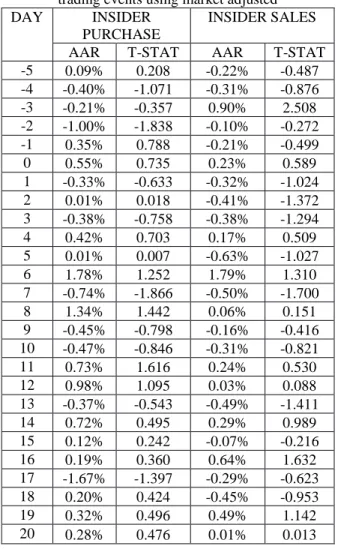
Table 3: Average daily abnormal returns for insider trading events using market adjusted
DAY INSIDER
PURCHASE
INSIDER SALES
AAR T-STAT AAR T-STAT
-5 0.09% 0.208 -0.22% -0.487 -4 -0.40% -1.071 -0.31% -0.876 -3 -0.21% -0.357 0.90% 2.508 -2 -1.00% -1.838 -0.10% -0.272 -1 0.35% 0.788 -0.21% -0.499
0 0.55% 0.735 0.23% 0.589
1 -0.33% -0.633 -0.32% -1.024 2 0.01% 0.018 -0.41% -1.372 3 -0.38% -0.758 -0.38% -1.294
4 0.42% 0.703 0.17% 0.509
5 0.01% 0.007 -0.63% -1.027
6 1.78% 1.252 1.79% 1.310
7 -0.74% -1.866 -0.50% -1.700
8 1.34% 1.442 0.06% 0.151
9 -0.45% -0.798 -0.16% -0.416 10 -0.47% -0.846 -0.31% -0.821
11 0.73% 1.616 0.24% 0.530
12 0.98% 1.095 0.03% 0.088
13 -0.37% -0.543 -0.49% -1.411
14 0.72% 0.495 0.29% 0.989
15 0.12% 0.242 -0.07% -0.216
16 0.19% 0.360 0.64% 1.632
17 -1.67% -1.397 -0.29% -0.623 18 0.20% 0.424 -0.45% -0.953
19 0.32% 0.496 0.49% 1.142
20 0.28% 0.476 0.01% 0.013
As shown in Figure 3 and Figure 4, by using market adjusted return, the AAR for selling activity are more volatile than AAR for purchasing activity during the period of the study. Table 4.4 shows that except for t=0 to t=3, all other insider purchase is positive. However only for window period of t=0 to t=15 that CAAR is significant at 5% level of significant. It again proves that besides insiders, outsiders also can take profit from the market by following the step of insiders.
For insider sales, while all the CAAR are negative which could indicate that insider are doing the right things to let go off their ownership, the t-stat proves that it is not significant. In fact, none of the event has a significant level of 5%.
Table 4: Cumulative daily abnormal returns for insider trading events using market adjusted
EVENT WINDOW
INSIDER PURCHASE
CAAR t-stat
INSIDER SALES
CAAR t-stat
T=0 to T=3 -0.15% -0.187 -0.97% -1.653 T=0 to T=5 0.28% 0.257 -1.40% -1.447 T=0 to T=10 1.75% 1.375 -0.51% -0.483 T=0 to T=15 3.94% 2.087 -0.47% -0.400 T=0 to T=20 3.26% 1.312 0.01% 0.009
Tests for individual and institutional insider
Parametric and non-parametric test for selling activity
Table 5 shows the means and t-statistic of institutional and individuals insider selling activity. Most of the activity are not significant except for institutional sales for event window of t=0 to t=5 with a mean 0f -1.61%. The institutional sales always have negative mean while individuals selling activity turns positive in the last three event windows tested. It means that for outsiders interested to avoid losses, they can learn from institutional activity.
Table 5: Mean test and t-test for individuals and institutional selling activity.
Event
window Types N Mean t-test
t=0 to t=3 Institutional 65 -1.07% -1.573
Individuals 34 -0.16% -0.179
t=0 to t=5 Institutional 65 -1.61% -2.174
Individuals 34 -0.64% -0.615
t=0 to t=10 Institutional 65 -1.17% -1.176
Individuals 34 1.17% 0.490
t=0 to t=15 Institutional 65 -1.80% -1.656
Individuals 34 0.25% 0.107
t=0 to t=20 Institutional 65 -2.55% -1.624
Individuals 34 2.26% 0.894
Table 6: Results for parametric and non-parametric test for sales activity Event day Types N Mean T-test of difference in
means
Mann Whitney test
t=0 to t=3 Institutional 65 -1.07% p=0.422 p=0.353
Individuals 34 -0.16%
t=0 to t=5 Institutional 65 -1.61% p=0.453 p=0.275
Individuals 34 -0.64%
t=0 to t=10 Institutional 65 -1.17% p=0.370 p=0.489
Individuals 34 1.17%
t=0 to t=25 Institutional 65 -1.80% p=0.425 p=0.279
Individuals 34 0.25%
t=0 to t=20 Institutional 65 -2.55% p=0.111 p=0.092
Individuals 34 2.26%
Parametric and non-parametric test for purchasing activity
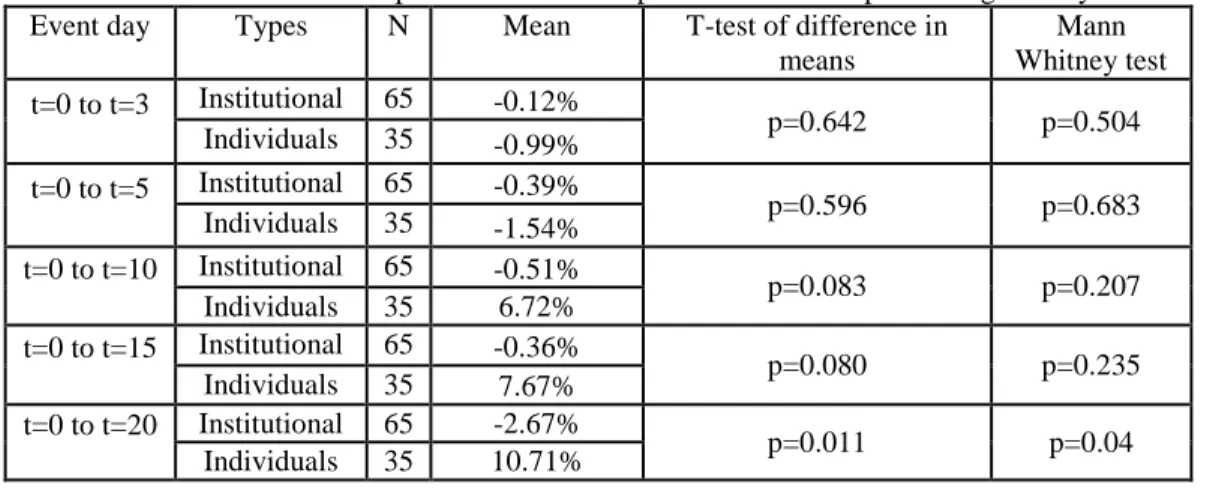
Table 7 shows that individual insiders have a positive mean in the last three event windows (t=0 to t=10, t=0 to t=15 and t=0 to t=20). Event t=0 to t=10 and t=0 to t=15 are significant at 10% significant while t=0 to t=20 is significant at 5% significant level. The purchases by the institutional insiders lead to negative returns but they are not significant. It indicates that unlike selling activity, outsiders interested with insider behavior should focus on individual rather than institutional insiders as they have private information to gain abnormal profit
Table 7: Mean and t-test for individuals and institutional purchasing activity
Event day Types N Mean t-test
t=0 to t=3 Institutional 65 -0.12% -0.147 Individuals 35 -0.99% -0.597
t=0 to t=5 Institutional 65 -0.39% -0.440 Individuals 35 -1.54% -0.788
t=0 to t=10 Institutional 65 -0.51% -0.456 Individuals 35 6.72% 1.717
t=0 to t=15 Institutional 65 -0.36% -0.302 Individuals 35 7.67% 1.785
t=0 to t=20 Institutional 65 -2.67% -1.330 Individuals 35 10.71% 2.320
Table 8 provides the result for t-test of difference in means and Mann Whitney test. The result suggests that purchases by individual insiders lead to price increases
and the difference is significant for event window 0 to 20.
Table 8: Results for parametric and non-parametric test for purchasing activity Event day Types N Mean T-test of difference in
means
Mann Whitney test
t=0 to t=3 Institutional 65 -0.12%
p=0.642 p=0.504
Individuals 35 -0.99%
t=0 to t=5 Institutional 65 -0.39%
p=0.596 p=0.683
Individuals 35 -1.54%
t=0 to t=10 Institutional 65 -0.51%
p=0.083 p=0.207
Individuals 35 6.72% t=0 to t=15 Institutional 65 -0.36%
p=0.080 p=0.235
Individuals 35 7.67% t=0 to t=20 Institutional 65 -2.67%
p=0.011 p=0.04
Individuals 35 10.71%
Conclusions
The possibility of consistently outperforming the market and collect abnormal profit is every investor dream but it is not practical according to efficient market theory. The activity of insider dealing is often
sensible.
From the result and findings, it can be concluded that while there is an insider trading activity in Malaysia that could give abnormal profit to investor, most of it is insignificant. It proves that the market is efficient enough to avoid any consistent abnormal profit activity. The study also implies that purchasing activity could give more reward than selling activities, a conclusion that is agreed by scholars like Finnerty (1976) and Cheuk et.al (2006) among others. This justifies the decision of mimicking the insider’s action although the result suggest only for purchasing activity. Furthermore there is evidence that individual insiders give more impact than institutional insider for purchases
The section headings are in boldface capital and lowercase letters. Use Times New Roman with fond 11. Second level headings are typed as italic as shown.
Acknowledgment
This research project would not have been possible without the support of many people. Special thanks to Dr. Kamarun Nisham Taufil Mohd who was abundantly helpful and offered invaluable assistance and guidance.
References
Arshadi, N., Thomas H. Eyssell (1991). Regulatory Deterrence and Registered Insider Trading: The Case of Tender Offers. Financial Management Vol. 20, No. 2 pp. 30-39.
Arshadi, N. (1998). Insider Trading Liability and Enforcement Strategy. Financial Management, Vol. 27, No. 2, Summer 1998, pages 70 – 84.
Beams, J. D., Brown, R. M. and Killough L. N. (2003). An Experiment Testing the Determinants of Non-Compliance with Insider Trading Laws. Journal of Business Ethics, 45, pp 309-323, 2003.
Bhattacharya, Daouk (2002). The World Price of Insider Trading. The Journal of Finance, Volume 57, Issue 1, pages 75–108.
Brio et.al (2003). Measuring the Impact of Corporate Investment Announcements on Share Prices: The Spanish Experience. Journal of Business Finance & Accounting, Volume 30, Issue 5-6, pages 715–747.
Cheuk, M.Y, Dennis K. Fan, Raymond W. So (2006). Insider trading in Hong Kong: Some stylized facts. Pacific-Basin Finance Journal, 14 (2006) 73– 90.
Chung (2010). Liquidity and market efficiency: A large sample study. Journal of Banking & Finance, 34, 2346–2357.
Cheng (2008). Insider trading in China: the case for the Chinese Securities Regulatory Commission. Journal of Financial Crime, Vol. 15 Iss: 2, pp.165 – 178.
Chakravarty, McConnell (1999). Does Insider Trading Really Move Stock Prices?. Journal of Financial and Quantitative Analysis, Volume 34, Issue 02, June 1999, pp 191-209.
Damodaran, Liu (1993). Insider trading as a signal of private information. Oxford Journals, Economics & Social Sciences, Review of Financial Studies, Volume 6, Issue 1, Pp. 79-119.
Eckbo, B.E., Smith, D.C., (1998). The conditional performance of insider trades. Journal of Finance, 53, 467–498.
Eyssell, Reburn (1993). The Effects of the Insider Trading Sanctions Act of 1984: The Case of Seasoned Equity Offerings. Journal of Financial Research, Volume 16 (1993), Issue 2, Pages: 161-70.
Fama, E., French, K., (1992). The cross-section of expected returns. Journal of Finance, 47, 427– 466.
Fama, E., French, K., (1995). Size and book-to-market factors in earnings and returns. Journal of Finance, 50, 131–155.
Finnerty, J., (1976). Insiders and market efficiency. Journal of Finance, 31, 1141– 1148.
Grinblatt, M., Keloharju, M.(2001). What makes investors trade?. Journal of Finance, 56, 589–616.
Gilbert, Tourani-Rad (2008). Insider Trading, Regulation, and the Components of the Bid-Ask Spread. Journal of Financial Research, Volume 31, Issue 3, pages 225–246.
Givoly, Palmon (1982). Timeliness of Annual Earnings Announcements: Some Empirical Evidence. The Accounting Review, Vol. 57, No. 3 (Jul., 1982), pp. 486-508.
Huang, H. (2004). The regulation of insider trading in China: a critical review and proposals for reform. Australian Journal of Corporate Law, Vol.17, pp 281-322.
Herzel, L., & Katz, L. (1987). Insider trading: who loses?. Lloyds Bank Review, July, 15–26.
Heinkel, Kraus (1987). The Effect of Insider Trading on Average Rates of Return. The Canadian Journal of Economics, Vol. 20, No. 3 (Aug., 1987), pp. 588-611.
Jaffe, J.F., (1974). Special information and insider trading. Journal of Business, 47, 410–428.
Jeng, L., Metrick, A., Zeckhauser, R., (2003). Estimating the returns to insider trading: a performance-evaluation perspective. Review of Economics and Statistics, 85, 453–471.
Juha-Pekka Kallunki, Henrik Nilsson and Jorgen Hellstrom (2009). Why do insiders trade? Evidence based on unique data on Swedish insiders. Journal of Accounting and Economics, volume 48, issue 1, October 2009, pages 37-53.
Khan, Lamba (2001). The Effectiveness of Legal Sanctions in Curtailing Insider Trading: Evidence from Exchange Listings. Quarterly Journal of Business and Economics, Vol. 40, No. 1 (Winter, 2001), pp. 3-15
Lakonishok, J., Lee, I., (2001). Are insider trades informative?. Review of Financial Studies, 14, 79–111.
Lin, J. and Howe, J., (1990). Insider trading in the OTC market. Journal of Finance, 45, 1273–1284.
Louis Cheng, Michael Firth, T.Y. Leung and Oliver Rui (2006). The effects of insider trading on liquidity. Pacific-Basin Finance Journal, 14 (2006) 467–483
Masson, Madhavan (1991). Insider Trading and the Value of the Firm. The Journal of Industrial Economics, Vol. 39, No. 4 (Jun., 1991), pp. 333-353
Ma, Sun (1998). Where Should the Line Be Drawn on Insider Trading Ethics?. Journal of Business Ethics, Volume 17, Issue 1, pp 67-75.
McGee, R.W. (2007). Two approaches to examining the ethics of insider trading. Available at SSRN:
http://ssrn.com
Manne (1996). The World Price of Insider Trading. The Journal of Finance, Volume 57, Issue 1, pages 75–108.
Minenna (2003). Insider trading, abnormal return and preferential information: Supervising through a probabilistic model. Journal of Banking & Finance, Volume 27, Issue 1, January 2003, Pages 59–86
Pope, P.F., Morris, R.C., Peel, D.A., (1990). Insider trading: some evidence on market efficiency and director’ share dealings in Great Britain. Journal of Business, Finance, and Accounting, 17, 359–380.
Pinfold, J.F., Tan, Y. And Zhang, J. (2007). The impact of changes to New Zealand Insider trading regulations on the profitability of insider trading. International Journal of Business Research, Vol.7, No. 1.
Rokiah Kadir, Suriyani Muhammad, (2012). Insider trading in Malaysia; towards an improve regulation. International Journal of Law and Management, Vol. 54, pp 78-86.
Rozeff, M., Zaman, M., (1988). Market efficiency and insider trading: new evidence. Journal of Business, 61,25–44
Ramirez, G.G., Yung, K., and Tin, J. (2000). Firm Reputation and Insider Trading: The Investment Banking Industry Quarterly. Journal of Business and Economics, Vol. 39, No. 3.
Shen (2007). Earnings Management and Corporate Governance in Asia's Emerging Markets. Corporate Governance: An International Review, Volume 15, Issue 5, pages 999–1021.
Seyhun (1990). Why Does Aggregate Insider Trading Predict Future Stock Returns?. Oxford Journals, Economics & Social Sciences , Quarterly Journal of Economics, Volume 107, Issue 4, Pp. 1303-1331.
Seyhun, N., (1988). The information content of aggregate insider trading. Journal of Business, 61, 1– 23.
Siti Faridah Abdul Jabbar, (2012). Insider dealing: fraud in Islam?. Journal of Financial Crime, Vol. 19 iss: 2 pp. 140 – 148.