Development of an ideal Thermo-Chemical method of EOR:
Case Study of a portion of Upper Assam Basin
Prasenjit Talukdar1
Assistant Professor,
Department of Petroleum Engineering,
Dibrugarh University, Dibrugarh-786004, Assam, India
Nitin Lahkar2
M. Tech. Student,
Department of Petroleum Technology,
Dibrugarh University, Dibrugarh-786004, Assam, India
ABSTRACT
The need for production by Enhanced Oil Recovery has increased drastically over the past two decades because of the constantly increasing need of Hydrocarbons and decline in the discovery of new oil and gas producing horizons. This paper deals with development of an ideal thermo chemical method of Enhanced Oil Recovery in the mature and depleting Naharkatiya Oilfield by experimental investigation of Reservoir rock and fluid samples and different phenomena occurring in the Petroleum Reservoir with TGA, XRD, SEM, PVT Analysis. In this paper the authors have designed a novel combination strategy taking into consideration all the techno-economic feasibilities and Reservoir Characteristics to develop the best method of EOR which can be employed by the Industry not only in Naharkatiya but also in analogous fields all over the world having the same Rock and fluid properties.
Keywords: EOR; Thermo-Chemical Method; Naharkatiya Oilfield; Mobility Ratio; Interfacial
Tension; Industrial Feasibility.
INTRODUCTION
methods are Chemical flooding, Miscible CO2 injection and Thermal EOR that mainly uses heat as source of additional oil recovery (Lake, 1989).
The Upper Assam Basin is a poly-historic basin which has produced hydrocarbons for more than a century. Since the first well was drilled in Digboi in 1889 extensive exploration and production has been carried out here over the past few years. (Dasgupta et al., 2013) Even now E & P Projects are constantly going on over the Upper Assam Basin. But due to production over 60 years most of the fields of this basin are in depleted stage and there is a decline in the number of new discoveries every year. On the other hand the socio-economy of the region is completely dependent on the production of hydrocarbons. Hence, there has been a paradigm shift to enhanced oil recovery methods for recovery of the massive residual oil trapped in the pore spaces of the reservoir rock. In this regard most of the researches till date have shown promising results in the aspect of either Chemical Flooding or Thermal Recovery methods. (Lazar et al., 2007) But unfortunately there is still a lacuna in the sphere of an ideal method of EOR which can be deployed in the fields of Upper Assam Basin due to lack of integrated approach and deployment of innovative thinking and latest technology. Perhaps due to this fact although a lot of research has been done on EOR but very less of these have been actually implemented in the oil fields of the basin. Therefore, the main objective here is to develop a method which is techno-economically very feasible for the industry.
Here object of study is the Barail and Tipam sandstone formations of Naharkatiya oil field from which a number of rock and fluid samples have been collected. Extensive experimental analysis have been conducted on these samples to understand their petrophysical and fluid properties and how the reservoir rock and fluids will react with the injected fluids may it be hot oil, hot water, steam, alkali, surfactant or a polymer.
The Tipam and Barail sands of Naharkatiya Oil Field have Medium Crude (API gravity between 22.3 ° API and 31.1° API) where conventional thermal methods are not required to increase the mobility of crude oil. So, focus has been given to devise a novel thermo-chemical method which meets all necessary criteria so that there is maximum recovery at minimum cost along with ensuring the long life of the oil field. This proposed method should be more efficient in increasing the ultimate recovery than the conventional chemical method also. Following are the general data collected from Oil India Limited regarding the Porosity, Permeability and Temperature range of Tipam and Barail sand of Naharkatiya oilfield:
INVESTIGATIONS
X- Ray Diffraction studies:
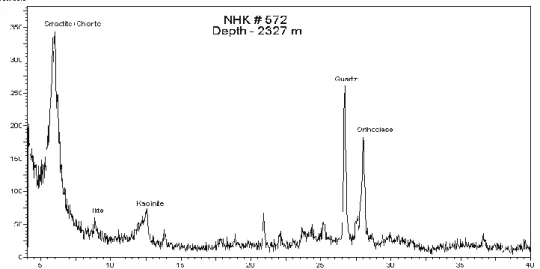
In this work, a study was conducted with the rock samples with the help of X-Ray Diffraction (XRD) photographs. From the study it has been found that the major clay minerals present in
Table-01: General Characterisitics of Naharkatiya Oilfield (Tipam and Barail formation)
Field Payzone Porosity (%)
Liquid Permeability (md)
Temperature Range (°C)
Naharkatiya Oil Field
Tipam 18-25 30-900 66-74
Barail 18-23 33-416 70-93
this oilfield were Smectite, Chlorite, Illite, and Kaolinite; of which Smectite is swelling clay and Illite, Kaolinite and Chlorite are non-swelling clay. Illite and Kaolinite are known as emigrational fines problem clay; and of the clay minerals, Smectite is the least stable and the most susceptible to hydration and diagenetic alteration. So, in the context of any flooding conducted with water as a medium (e.g. Chemical Flooding, hot Water Flooding, etc.) these clays may proof to be damaging to the reservoir. The EOR method is actually employed to decrease the residual oil saturation and in turn increase recovery. But, in the background it may be decreasing the productivity from the reservoirs by a decline in their porosity and permeability by the damaging clays present. So, to counter the damage, an ideal mud for this region must have saline inhibitive filtrate which should not swell the clay envelop around the pay zone particles and should not react with the formation fluid to form insoluble precipitate.
XRD images:
Fig. 01: X-Ray Diffraction (XRD) photograph of Core Sample (Depth: 2081 m) of Naharkatiya Oilfield
\
Fig. 03: X-Ray Diffraction (XRD) photograph of Core Sample (Depth: 2748 m) of Naharkatiya Oilfield
Scanning Electron Microscope studies:
In order to further ascertain the presence of the clays mentioned above we conducted a Scanning Electron Microscope survey of the same samples collected from this field. Again from the results of SEM survey, the presence of Illite, Kaolinite and Smectite was confirmed. Hence, while designing the EOR method we must have to keep in mind this nature of the formations.
SEM Results:
Fig. 05: SEM photograph of Core Sample (Depth: 2315.2 m) of Naharkatiya oilfield showing vermiform Kaolinite
Fig. 07 : SEM photograph of Core Sample (Depth: 2162.9 m) of Naharkatiya oilfield showing Smectite and Illite
Porosity and Permeability Analysis:
Porosity and Permeability results found from the analysis of the samples is given below:
Table-02 : Porosity-Permeability Results of Core Samples
Core Sample Description Depth (m) Liquid
Permeability(md) Porosity
NHK#572, Sample No.1 2081 365 26% NHK#15, Sample No.2 2161.5 470 28.71% NHK#15, Sample No.3 2162.9 500 31.45% NHK#470, Sample No.4 2315.2 305 25.75% NHK#572, Sample No.5 2327 301 26.66% NHK#572, Sample No.6 2748 90 28.94% NHK#559, Sample No.7 3051.7 415 23.89%
Analysis of Viscosity and its Change with Temperature:
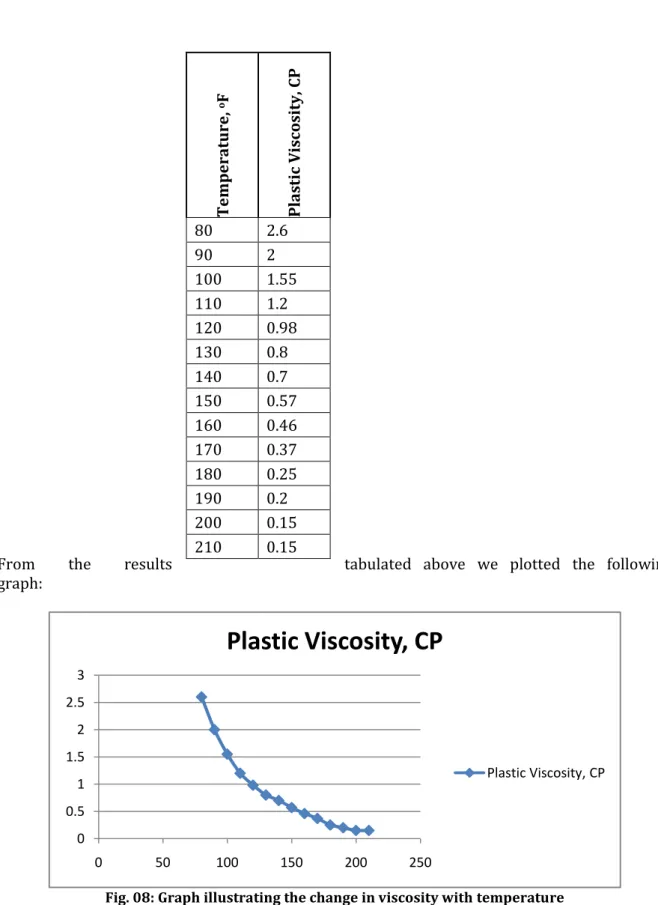
The study of the viscosity of crude samples collected from Naharkatiya oilfield and its changes with temperature was studied to get an idea of the temperature at which thermal EOR may be conducted and also to get a picture of the increase in mobility of the crude oil by decreasing its viscosity by introducing heat into the reservoir. Following were the results:
From the results tabulated above we plotted the following graph:
Fig. 08: Graph illustrating the change in viscosity with temperature
A fairly good result was obtained in view of the perfect temperature range to be maintained for the hot water or steam to be injected for the EOR process. From the graph (Fig. 8) we
0 0.5 1 1.5 2 2.5 3
0 50 100 150 200 250
Plastic Viscosity, CP
Plastic Viscosity, CP
Te
mp
era
tur
e,
oF
P
las
tic
V
isco
sit
y,
CP
is gradual, but it still continues to decrease. On the other hand as temperature increases above 93.34 °C, the rate of Viscosity decline is almost constant.
So, it is clear that increasing the temperature of reservoir above 93.34 °C has a rather slow effect on the Oil viscosity as compared to increasing the temperature below 93.34 °C.
From Table 01, we investigated the average reservoir temperature is around 80. Therefore, it would be beneficial in the sense of recovery efficiency, if we are able to maintain the reservoir temperature in the range of around 80-95°C.
Thermo-Gravimetric Analysis (TGA):
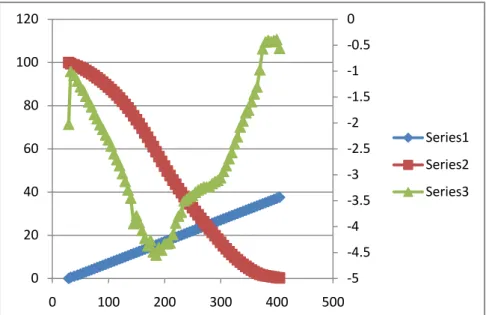
Further TGA was conducted on the crude samples to know the temperature range to be maintained at the reservoir so that the crude oil viscosity does reduce with temperature but does not go down beyond a certain level and reach a totally gaseous state and in the long run complicate the entire process by a gas breakthrough.
Fig. 09: TGA plot of Crude sample collected from Naharkatiya Oil Field
1) As we can see from the plot mass degradation (series 2) starts from a temperature as low as 38.779 °C. This is because crude contains a mixture of volatile substances and also substantial amount of water and moisture which vaporise out at low temperatures. 2) Actual and rapid degradation of mass of the Crude Sample occurs at about 124.833 °C
and continues till 349.855 °C
3) From temperature 369.793 °C the mass degradation decreases even when temperature increases and finally becomes constant at 404.812 °C.
4) After heating the sample for 37.5 minutes to a temperature of 404.812 °C, 99.80375% of the mass of the sample was vaporised leaving behind a mass % of 0.19265% of the sample.
Hence, from TGA Analysis we can conclude that if the reservoir temperature can be maintained below 124.833 °C then the rapid degradation of mass of the crude oil present in the reservoir can be eliminated.
KCl Experiments:
-5 -4.5 -4 -3.5 -3 -2.5 -2 -1.5 -1 -0.5 0
0 20 40 60 80 100 120
0 100 200 300 400 500
Series1
Series2
As per measuring manual instructions, ten (10) numbers of Smectite (Bentonite) samples [1500 ml Fresh Water + 10 mg/100ml (10%) Bentonite + KCl] were formulated by changing the composition of KCl as 0%, 1%, 2%, 3%, 4%, 5%, 6%, 7%, 8%, and 9%; keeping the other components constant.
After that, the effect of varying composition of KCl on Smectite (Bentonite) were investigated and the mud properties were tabulated for analysing them to select the best composition of KCl which can be added to the injected fluid.
Now, from the Table, it is quite clear that with increasing the composition of KCl from 0% to 5%, almost all rheological properties of the mud system inversely decreases. From 0% upto almost 3%, the decrease rate is high; but from 3% upto 5%, the decrease rate is very low. After 6% of KCl, the system becomes imbalanced and shows haphazard results. At 5% of KCl, all the rheological properties are at their minimum value i. e. this composition of KCl will not allow the build-up of the rheology of the system beyond their minimum values. So, the 5% KCl will inhibit the Smectite (Bentonite) efficiently. It will not allow the clay to swell and effect adversely in the reservoir. Thus, we can select the 5% of KCl as the optimum composition which will give best inhibition properties to the injected water.
Table-04 : Properties of ten (10) samples at different composition of KCl
Fresh Water: 1.5 liter, Clay (Bentonite): 10% and Temperature: 80 oF
KC
l %
Properties of the samples at different composition of KCl
Funn el V is cos ity , S ec ond A pp arent Vi sc os ity , CP Plas ti c V is cos ity , CP Yi eld P oi nt, lb / 100 ft 2 Gel 0 , lb / 100 ft 2 Gel 10 , lb / 100 ft 2 Sali ni ty , pp m T D S Spec ifi c G rav ity
0% 58 21.45 17.9 7.1 14 17 2050 1.008
1% 37 8.4 6.5 3.8 8 9 9280 1.18
2% 30 3.9 2.7 2.4 5 5 16600 1.35 3% 28 2.4 1.5 1.8 3 3 23500 1.51 4% 27 2.1 1.3 1.6 2 2 31700 1.65
5% 27 1.85 1.1 1.5 1 1 38300 1.79
6% 27 2.15 1.3 1.7 1 1 45600 1.89 7% 27 2.8 1.7 2.2 2 2 50500 1.99 8% 27 1.95 1.1 1.7 0 0 55600 2.09 9% 27 2.35 1.6 1.5 1 1 60400 2.2
Interfacial Tension Results:
DEVELOPMENT OF THE IDEAL EOR METHOD
A. Firstly to develop the ideal method of EOR we have to emphasize on following points
The crude of Naharkatiya Oil Field is not very heavy. It is medium Crude with API gravity around 25oAPI. So, conventional thermal methods like Steam Injection and In-situ combustion are not quite feasible here.
Generation of steam requires sophisticated equipment and it involves high cost.
Since density of steam is lower than that of water there is high probability that the steam will occupy the upper part of the reservoir leaving oil behind in the lower part decreasing the volumetric sweep efficiency.
Since, viscosity of steam is less than that of oil so there is a high chance of breakthrough of the steam through oil leading to poor efficiency.
High injection pressure is required to push the steam through injection well and into the reservoir since hydrostatic head is low for steam.
So, steam drive technology is not a techno-economically feasible option in this case.
B. Secondly, due to the techno-economical problems that are encountered in steam drive technology hot water injection will be the best thermal method that can be deployed here. From the viscosity versus temperature analysis we can investigate that the viscosity of the crude oil decreases upto around 95°C with increasing the temperature. After this there is a decrease in the rate of viscosity reduction. So, this is in agreement with the hot water injection method because water gets converted to steam only above 100°C. Also, it is appreciable to mention that the average reservoir temperature is already around 80°C; thus, once the water reaches the reservoir there will not be much heat loss inside it. Again hydrostatic head of water is much higher than that of steam so injection pressure required will be much lower. As compared to steam, hot water has lesser chances of breakthrough so displacement efficiency will be higher. Finally from economic aspect also if we see most of the wells in Naharkatiya are already on water flooding and hence heating that water before injection is both technically and economically feasible considering all reservoir parameters and crude oil properties. So, we will use hot water flooding in this case.
Moreover, the Mobility Ratio for the displacement process is expressed as M= Kw x µ0 / K0 x µw = (Kw/ K0) x (µ0/ µw).
This ratio can be made favourable by either increasing the viscosity of water (µw) or decreasing the viscosity of oil (µ0). Here we have attempted to make the Mobility ratio favourable by decreasing the viscosity of crude oil by increasing the temperature (The effect of decrease in viscosity with increase in temperature is more profound in oil as compared to that of water). We have to maintain the temperature and chemical profile of the injected fluid such that the mobility ratio remains favourable (i.e. less than 1) throughout the EOR process.
Hot water will naturally be beneficial than normal cold water flooding as it will decrease oil viscosity and in turn make the mobility ratio more favourable along with very less capital investment.
C. Again, from the TGA results of the crude we see that the actual and rapid degradation of mass of the crude sample occurs at about 124.833 °C and continues till 349.855 °C. Hence, this point also stresses the importance of hot water circulation and also it is evident that steam drive may not be the best option here.
solution can be used to prevent clay swelling and hence minimize damage to the reservoir. Now, we also know that high pH (around 10.5) causes the kaolinites to develop sufficiently high potentials to cause them to detach from the surface, migrate and be in the pore constrictions. (K. K. et al., 1993). Hence, some more research has to be carried out in near future regarding the feasibility of the Tipam and Barail Payzone from the point of view of feasibility for Alkali Flooding.
E. As per our experiment, the Interfacial Tension between the crude oil of Naharkatiya oilfield and tap water was found as 17.2 mN/metre. So, to increase the mobility of this crude, we have to decrease the Interfacial Tension below this value. It is clearly mentioned in previous literature that the IFT can be decreased below this level using Black Liquor, whose main constituent is Na-lignosulfonate along with Co-surfactant. Black Liquor is an effluent produced from Nagaon Paper Mill, Jagiroad, Assam, which can be easily used in the Naharkatiya oilfield. The biggest advantage of lignosulfonate over other market-available sulfonate is that they are at least four times cheaper and are available in huge quantities as by-product from the paper industries. This approach is also competent for sustainable development of environment. (Hazarika et al. 2014)
F. Investigating the complete study and economic feasibility from industrial point of view it is seen that instead of the traditional method of either Thermal EOR or Chemical EOR we can go for a hybrid method of EOR involving the injection of solution consisting of:
1. Hot water (to maintain the reservoir temperature around of around 80-95 °C and in turn decreases the viscosity of oil to increase its mobility and also keeping into mind the results of different experiments and economic feasibilities mentioned above)
2. Black Liquor (Surfactant) whose prime component is Na- lignosulfonate (to reduce the IFT value below 17.2 mN/m)
3. 5% KCl (to prevent the swelling characteristics of Smectite clay presemt in the formation)
Implementation of this method by the oil industries in the Tipam and Barail formations of Naharkatiya oilfield can definitely increase ultimate oil recovery by extraction of the residual oil and without causing any damage to the reservoir.
CONCLUSION
We were successfully able to develop an ideal thermo chemical method of EOR by conducting a case study of a portion of Upper Assam Basin. This method will not only help in improving recovery from different parts of Upper Assam Basin but also from analogous reservoirs around the world having same Reservoir Rock and Fluid properties similar to Tiapm and Barail Formations of Naharkatiya Oil Field.
ACKNOWLEDGEMENT
2) I. Lazar, I. G. Petrisor and T. F. Yen (2007), Microbial enhanced oil recovery, Petroleum Science and Technology, 25: 11, 1353-1366
3) Jimoh Ismaila Adetunji (2012), Microbial Enhanced Oil Recovery, Ph.D. Thesis, Department of Chemistry, Biotechnology and Environment Section of Chemical Engineering, C I Chem Research Group, Aalborg University Esbjerg
4) K. Hazarika and S. B. Gogoi (2014), Int J Appl Sci Biotechnol, Vol 2(4): 432-436
5) K. K. Mohan, R. N. Vaidyab, M. G. Reed and H. S. Fogler (1993), Water sensitivity of sandstones containing swelling and non-swelling clays. Colloids and Surfaces A: Physicochemical and Engineering Aspects, 73 (1993) 231-254, Elsevier Science Publishers B.V., Amsterdam
6) Kanailal Mandal and Rahul Dasgupta (2013), Upper Assam Basin and its basinal depositional history, 10th Biennial International Conference & Exposition, Kochi, 2013, P 292
7) L. Stephen Melzer (2012), Carbon Dioxide Enhanced Oil Recovery (CO2 EOR): Factors Involved in Adding Carbon Capture, Utilization and Storage (CCUS) to Enhanced Oil Recovery
8) L.W Lake (1989), Enhanced Oil Recovery, Prentice Hall, Englewood Cliffs New Jersey 9) R. Cosse. (1993) Basics of reservoir engineering. Oil and gas field development techniques.
Technip, Paris, 1993.
10) R.S Bryant, A.K Stepp, K.M Bertus, T. E. Burchfield, and M. Dennis (1993) Microbial enhanced waterflooding field pilots. Dev. Pet. Sci. 39:289-306