A Framework for Collecting and
De
fi
ning Requirements for Data
Warehousing Projects
Nenad Jukic and John Nicholas
School of Business Administration, Loyola University Chicago, Illinois, USA
In this paper we address the issue of failure of data warehousing projects due to inadequate requirements collection and definition process. We describe a frame-work that can help accomplish the objective of developing a business-driven, actionable set of requirements. The framework consists of a series of steps to facilitate collec-tion and definicollec-tion of requirements in data warehousing projects.
The paper also addresses the difficult yet common issue of end-users’ limited availability during the requirements collection process and proposes an approach that can serve to alleviate this problem.
Keywords: data warehouse, SDLC, requirements
collec-tion and definicollec-tion
1. Introduction
Data warehousing has become a standard prac-tice for most large companies worldwide [8]. The focus of this paper is on the data warehouse requirements collection and definition process. This process has been examined by a number of publications, e.g., [8,11,12], usually as one step in the larger data warehouse system de-velopment process. In this paper we focus on the data warehouse requirements collection and definition process itself and provide a detailed prescriptive framework.
Usual approaches to requirements gathering are classified as data-driven and requirements-dri-ven [6,14]. The data-driven (also known as supply-driven)approach focuses on the analy-sis of the underlying operational data sources as a basis for establishing the scope and function-ality of a future data warehouse. The method
starts with analysis of the data sources with the designer selecting which portions of the data available from the corporate databases are rele-vant to decision makers.
The requirements-driven(also called demand-driven) method starts by determining the in-formation requirements of the users. Poten-tial problems of matching the requirements to the available data sources are faceda posteriori
[14,15].
Contrasting the methods, the data-driven re-quirements method simplifies designing the ETL, but gives a subordinate role to user re-quirements; the requirements-driven approach gives priority to user requirements, but requires more effort in designing the ETL[6].
2. Data Warehouse Requirements Collection and Definition Process within the SDLC
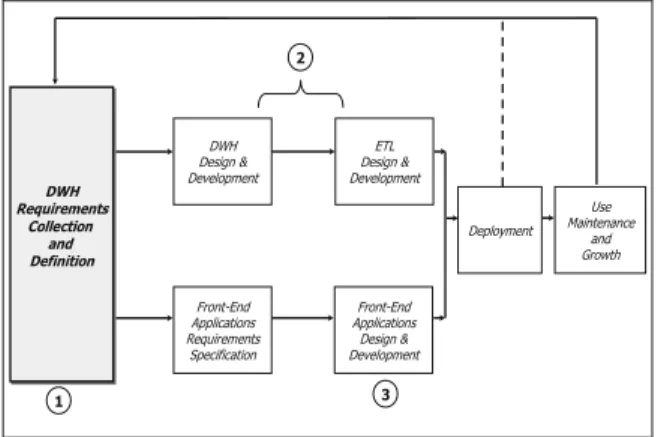
Like most information system development pro-cesses, data warehousing projects typically fol-low some form of a System Development Life Cycle (SDLC). SDLC is the overall process of developing information systems through a multi-step process that includes planning, anal-ysis, design, and implementation[5]. One pop-ular data warehouse-focused variation of the SDLC is the Data Warehousing Lifecycle [11]
illustrated in Figure 1. Certain steps of the SDLC (such as product selection, project ini-tiation, etc.) are omitted from the figure for brevity. The steps depicted are common to any data warehousing project; they include: data warehouse requirements collection and defini-tion, data warehouse modeling and design, ETL design and development, front-end application specifications(requirements collection and def-inition), front-end design and development, de-ployment, and use/maintenance/growth.
Front-End Applications
Design & Development
Deployment Use Maintenance
and Growth ETL
Design & Development
DWH Requirements
Collection and Definition
DWH Requirements
Collection and Definition
DWH Design & Development
Front-End Applications Requirements Specification
1
2
3
Figure 1.Abbreviated data warehouse system
development lifecycle.
As Figure 1 illustrates, the actual design and de-velopment of the data warehouse, ETL infras-tructure, and front-end applications all follow the collection and definition of the data ware-house requirements. The dashed line in Figure 1 represents the options of alpha(within the de-velopment team)and beta(outside the develop-ment team)test releases prior to the deployment of the actual working-system. These releases are designed to provide for testing and feed-back collection that can result in modifications of the requirements and changes in the system before the actual deployment takes place.
As highlighted in Figure 1, the focus of our paper is on the data warehouse requirements collection stage (marked by number 1). We will however also discuss the effects of the data warehouse requirements collection stage on the data warehouse and ETL design and de-velopment process(number 2)and on the front-end application design and development process
(number 3).
3. Steps of the Data Warehouse Requirements Collection and Definition Process
Figure 2 illustrates our framework for the chrono-logically ordered steps that should be taken dur-ing a typical data warehousdur-ing requirements collection and definition stage. In particular, it illustrates the data warehousing requirements collection and definition stage where the box la-beled “DWH Requirements” represents its out-come. Arrows in Figure 2 represent steps that take place within the data warehouse require-ments collection and definition phase (Figure 1, number 1). In Figure 2, the solid arrows indicate the process of requirements collection
and the dashed arrows indicate the process of
considering the implicationsof the collected
re-quirements.
Before we describe the framework in detail, we emphasize itsiterativenature, i.e. the four steps
(arrows 1.1, 1.2, 1.3, 1.4)will repeat more than once before the actual quality set of require-ments is composed.
DWH DETAILS Sources
ETL DWH Model
END- USER BUSINESS ANALYTICAL
NEEDS DWH
REQUIREMENTS
Requirement Collection Requirement Consideration
LEGEND
1.1
1.4
1.2 1.3
Figure 2.Data warehouse requirements collection and
As illustrated by arrow 1.1 in Figure 2, the first step in the requirements collection process is to establish(in the first iteration at a high-level and in subsequent iterations at levels of increasing detail) the end-user business analytical needs that the future data warehouse should satisfy. In other words, we should determine how the data warehouse will be used by the analysts and other users. In its first iteration, this step provides a set of initial high-level requirements containing the themes, opportunities, topics, guiding prin-ciples, and vision for the data warehouse. These needs should be prioritized, e.g., into categories such as “must have,” “want,” and “wish to have,” to allow flexibility later on in the development process to better enable the system to meet cost or technical limitations.
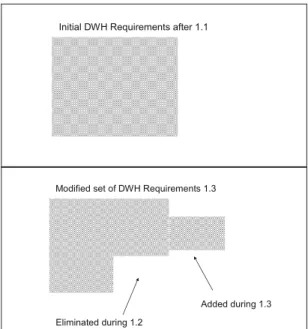
The next step, indicated by the arrow 1.2, is to consider what implications the initial set of re-quirements will have on details of the future data warehouse. Available operational data sources are recognized, and the initial details of the data warehouse data model and the ETL process are identified. As illustrated by the Figure 3, dur-ing this process certain parts of the initial set of requirements may be eliminated due to spe-cific reasons that emerge while considering the details of the data warehouse. For example, cer-tain initial analytical needs stated in the initial set of requirements produced by step 1.1 may not be supported by any available operational
Initial DWH Requirements after 1.1
Modified set of DWH Requirements 1.3
Eliminated during 1.2
Added during 1.3
Figure 3.Modifying the requirements – example.
or external sources. Figure 3 also indicates the possibility of new requirements being added to the initial set of requirements after considering the data warehouse details. For example, new possibilities for analysis(not identified during the step 1.1) may emerge while studying the operational(and other possible)sources. Step 1.3 in Figure 2 indicates the creation of the modified set of requirements from the initial set of requirement(step 1.1) after considering the data warehouse details.
Step 1.4 in Figure 2 represents a sensitive and vital step in the requirement collection phase. During this step the set of requirements that has been modified from the DHW details perspec-tive is now consideredagainfrom the end-user business analytical needs perspective. This step is necessary for two critical reasons. One rea-son is to ensure that whatever was added during step 1.3 has analytical and/or reporting uses and adds value to future front-end applications. The other reason is that consideration of the require-ments in step 1.4 will lead into another iteration of step 1.1.
In the second and subsequent iterations of step 1.1, the end-user business analytical needs will move from high-level ideas and themes to low-level details about particular uses.
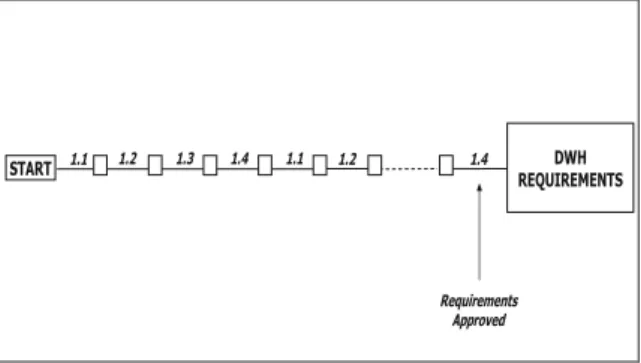
As mentioned above, it is important to note the iterative nature of the process and that the cy-cle of steps 1.1, 1.2, 1.3, and 1.4 will repeat multiple times. Also important to note is that the final iteration of the entire process should end with step 1.4 in order to ensure that the set of requirements to be used for actual im-plementation is considered and approved from the end-user business analytical needs point of view. This is illustrated by Figure 4 showing the sequence of steps in the data warehouse require-ment collection and definition process based on the framework presented in Figure 2.
The cycle of steps 1.1, 1.2, 1.3, and 1.4 is repeated multiple times to address high-level business needs and the needs of individual and groups of users (through iterations of 1.1 and 1.4, addressing requirements referred to as
busi-ness requirements and user requirements,
The process illustrated by Figure 3 describes
onlythe requirements collection and definition phase (Figure 1, number 1). The implementa-tion of the various portions of the actual data warehousing system(Figure 1, numbers 2 and
3) follows this stage. The one type of
devel-opment that can occur during the requirements collection and definition phase is creation of simple demo-prototypes (e.g. using such sim-ple tools as MS Access) with sample data for requirements verification, communication and clarification during the 1.1-1.4 cycle. Note that this is not the same process as the step indicated by the dashed line in Figure 2. The difference is that the former is a quick and simple demo-type development done during the requirements col-lection and definition stage, whereas the latter is a part of the actual working system creation, an examination of a version of the actual sys-tem. In addition to simple demo-prototypes, other verification, communication, and clarifi-cation methods potentially used during the re-quirements collection and definition cycle in-clude creation and examination of written doc-uments, ER models, dimensional models( star-schemas), and so on.
1.2 1.4
1.1
1.1 1.2 1.3 1.4
Requirements Approved
START REQUIREMENTSDWH
Figure 4.Example sequence of steps in a data
warehouse requirements collection and definition process.
4. User Involvement
Step 1.4 and follow-up step 1.1 are often neither intuitive nor simple, and therefore, as numer-ous industry examples demonstrate, are easily neglected or completely omitted. The conse-quences of this omission are usually dire. Al-though the definition of high-level business re-quirements often begins with high-level man-agers and other stakeholders, essential to the
success of the process is the involvement of the actual end-users of the data warehouse.
Identifying the right users and involving them in the requirements collection and definition pro-cess can be problematic. Sometimes the users can be listed by name, although often it is better to start with a list of constituencies or categories of users[4]. The list can be populated by brain-storming, but actually attaching names to the list to get the right people can be difficult. One way to get the names is tobroadcastthe project dur-ing the requirements collection and definition stage, i.e. to[4]:
Post an announcement on the company newslet-ter, on bulletin boards, on email, or whatever way the organization uses to broadcast infor-mation. The announcement tells what is going on, and solicits contributions.
However, including the users in the process is not necessarily easy, nor is it a panacea for re-moving problems from requirements collection and definition. End-user involvement can di-minish too soon(e.g. after the first iteration of step 1.1), and selecting the right blend of end users can be a challenge, e.g.: [1]
The most vocal users are usually the ones to show up in the requirements-gathering work-shop. This is known as the process of “squeaky wheel end-user selection”. Another problem is when the most technical subset of users is se-lected to participate in business drivers.
Even if we are able to ensure participation of a perfect combination of users for the entire dura-tion of the requirement collecdura-tion and definidura-tion process, stated input from the end-users alone cannot be the sole determinant of the require-ments. That input has to be carefully assessed and managed. The following quote from [12]
illustrates this point:
In other words, end-user provided input has to be thoughtfully extracted and then converted into system requirements by data warehouse team members(DWH team)whose focus is on the functionality of the system. Through care-ful iterative interaction with the intended clients of the data warehouse using demo-prototypes, sample data, sample data models, etc, a qual-ity set of on-target system requirements will emerge.
One of the difficult obstacles in this process is the amount of available access to the end-users by the DWH team during the data warehouse requirements collection and definition phase. Often, due to reasons such as organizational problems in the company, political and power-struggle issues, low level business-end sponsor-ship for the data warehousing project, logistical problems of meeting with geographically dis-persed stakeholders, etc., access to critical end-users is limited and in some cases not possible at all. It is easy in those cases for DWH de-velopment team members to simply shrug their shoulders and, after getting their initial high-level (and usually vague) marching orders in the first(and, in that case, only)iteration of 1.1, perform the entire data warehouse requirements collection and definition phase by the series of
DWH team-internaliterations of steps 1.2-1.3.
That, however, is usually a recipe for failure. The result is often a competently designed data warehousing system that is technically correct, but neither fulfills the existing needs of the end-users nor clearly indicates to end-users its capability to create and satisfy new and useful analytical requests. Consequently, the system fails due to the lack of use.
One way for the DWH team to deal with the difficult, but not uncommon, issue of insuffi-cient available access to the end-users during the data warehouse requirements collection and definition phase is to divide the requirements collection and definition team into two groups with separate roles. One role, which we call the
DWH analytical requirements role, would be in
charge of steps 1.1(usually not the first iteration of it, which is often a group effort between the leaders of the DWH team and business spon-sors, but the subsequent ones) and 1.4. The other role, which we call theDWH details role, would be in charge of steps 1.2 and 1.3.
The task of the DWH analytical requirements role is to be the gatekeeper of the requirements, to keep theend usageof the data warehouse in the forefront. The mandate of this role is to em-ploy all means available to deduce, as much as possible, requirements that are most likely to re-sult in creation of an attractive and intuitive sys-tem for future end-users. The team in charge of the DWH analytical requirements role can rely on several means to deduce user requirements that, in addition to interviews, include[3][5]:
• Review of available records.
• Review of past interviews
• Focus groups
• Questionnaires surveys to all or a sample of users
• Comments about existing data warehouses
• Observation to see what users really do, what they use, what they need.
At the end of the data warehouse requirements collection and definition phase, the team in charge of the DWH analytical requirements role should be responsible for final approval and ve-rification to the requirements.
While this approach of dividing roles cannot guarantee the success of the data warehouse re-quirements collection and definition phase(and, subsequently, to the entire data warehousing project) when the company environment lim-its access to end-users, it can reduce the risk of complete project failure.
On the other hand, the “shrug-the-shoulders ap-proach” will almost certainly guarantee failure. We call such an approachthe ETL driven data
warehousing project. It occurs when, due to the
of any data warehousing project, but data inte-gration and ETL alone should not become(even initially)a self-contained and self-serving pro-cess. It must be directed at fulfilling the busi-ness needs of end user needs.
Although user requirements customarily address user functional needs, i.e., so-called functional
requirements, they must also address
non-functi-onal requirements such as usability, maintain-ability, expandmaintain-ability, etc. Though these obvi-ously directly affect the users, oftentimes users fail to state them explicitly. User requirements should also address constraints imposed on the data warehousing project (e.g., policies, time, cost) as well as on the data warehousing sys-tem (e.g., interface with procedures or other systems) [13]. Accounting for all these re-quirements expands the list of participants in the requirements collection and definition stage to stakeholders beyond the obvious “users.” As the requirements collection and definition process moves iteratively through steps 1.1-1.4, the requirements should be listed on a master user requirements document [2]. This list will expand in breadth and level of detail and become the definitive document to which the DWH team refers as it moves through later phases of the DWH project. It is also the document to which everyone refers at the end of the project, to as-sess the success of the deployed DWH system. Before the project moves beyond the require-ments collection and definition stage, senior managers responsible for approving or funding the DWH project should review and endorse the user requirements document; there is little point in proceeding with a group of requirements that satisfy the end-users, but exceed or conflict with the goals or objectives of management[2]. Although the user requirements document is substantially completed at the end of requiments collection and definition stage, some re-quirements will likely be modified or added af-ter the stage has been completed.
Beyond the scope of this paper, but crucial to project success, is a formal procedure the DWH team follows to review and approve suggested changes or additions to the requirements. This procedure, called “change control” in project management, is essential to delimiting “scope creep” and keeping the project on target[13].
5. Implementation Steps Following the Data Warehouse Requirements Collection and Definition Process
The output of the data warehouse requirements collection and definition process shown in Fig-ure 2 is a set of data warehouse requirements. These requirements are used to implement the details of a data warehouse. The process of design and implementation of the data model for the data warehouse and of the associated ETL infrastructure connecting the data ware-house with the operational and other sources
follows the 1.1-1.4 iterative cycle of
require-ment collection and definition.
Once the details of the data warehouse(i.e. im-plemented DWH Model and ETL)are created, front-end applications that will retrieve infor-mation from the data warehouse can be imple-mented. Each front-end application has its own set of requirements. Collecting and defining front-end applications requirements(illustrated in Figure 1 by the box “Front-end applications requirements specification”)is the process that determines the navigation style, intended look and feel, and the analytical needs that each par-ticular application will address.
Front-end application requirements can be as-sembled prior to the implementation of the ac-tual data warehouse, but the implementation
of the actual front-end applications (such as OLAP/BI queries and reports)can occur only
afteran actual data warehouse is in place. Any
front-end application can do only what the data warehouse permits. That is why it is crucial during the data warehouse requirements collec-tion and definicollec-tion phase to consider end-user analytical needs: these become the basis for developing front-end applications.
In summary, the framework in Figure 2, prop-erly applied, ensures that the end-user business analytical needs are considered early enough in the project so that the subsequently developed data warehouse provides a fitting foundation for the development of front-end applications.
6. Conclusions
the requirements collection and definition pro-cess for data warehouses. The goal of a typical operational information system application is to facilitate (and sometimes improve or even change) an existing business process. Though a business process can be highly complex, it is essentially describable. Consequently, the re-quirements for such a system can be accurately defined. The failure of such an operational in-formation system due to improper or inadequate requirements collection and definition can often be summarized as “the system is not doing what it is supposed to do”. In contrast, the failure of a data warehousing system can often be summa-rized as “there was never an agreement about what the system was supposed to do in the first place, and whatever was decided was certainly not it”.
The exact mission and purpose of a data ware-house is rarely(if ever)clear at the onset, which creates a challenge for the data warehouse re-quirement collection and definition process. In this paper we illustrated and addressed the is-sues and problems that hinder the data ware-house requirements collection and definition process.
We introduce a new framework for developing business driven, actionable set of DWH require-ments that minimize the probability of DWH project failure. The introduced framework ac-knowledges and fills the clearly described gap in current practices in a logical manner based on the established best project management prac-tices.
The framework presented in this paper ( Fig-ure 2) contains steps that are similar to those taken during most data warehouse requirements collection and definition efforts. However, our framework differs in that it prescribes how to ef-fectively structure and chronologically use the required steps and, subsequently, obtain a qual-ity set of requirements. The framework deter-mines business and end-user needs and defines a set of data warehouse requirements that satis-fies those needs and conforms to technical lim-itations of the data sources
References
[1] J. DYCHE, e-Data, Turning Data into Information
with Data Warehousing. Addison-Wesley, 2000.
[2] R. FAULCONBRIDGE, J. RYAN, Managing Complex
Technical Projects. Artech House, Boston, 2003.
[3] K. FORSBERG, H. MOOZ,Visualizing Project
Man-agement. John Wiley, New York, 1996, pp. 110–111.
[4] S. R. GARDNER, Building the Data Warehouse.
Communications of the ACM, 4, 9, (September
1998), pp. 52–60.
[5] D. GAUSE, G. WEINBERG,Exploring Requirements:
Quality Before Design. Dorset House, New York,
1989.
[6] P. GIORGINI, S. RIZZI, M. GARZATTI, Goal-oriented
requirements analysis for data warehouse design.
Proceedings, 8th ACM International Workshop on
Data Warehousing and OLAP, (2005). Also in
GRAnD: Goal-oriented approach to requirement analysis in data warehouses.Decision Support Sys-tems, 45(2008), pp. 4–21.
[7] P. GRAY, Manager’s Guide to Making Decisions
about Information Systems. Wiley, 2006.
[8] W. INMON,Building the Data Warehouse. 3rd
Edi-tion, Wiley, 2002.
[9] N. JUKIC, Data Modeling Strategies and Alternatives
for Data Warehousing Projects.Communications of
the ACM, 49, 4,(2006), pp. 83–88.
[10] N. JUKIC, M. VELASCO, Data Warehousing Require-ments Collection and Definition – nalysis of a
Fail-ure.International Journal of Business Intelligence
Research, forthcoming.
[11] R. KIMBALL, L. REEVES, M. ROSS, W. THORNTH -WAITE,The Data Warehouse Lifecycle Toolkit.
Wi-ley, 1998.
[12] J. MUNDY, W. THORNTHWAITE, R. KIMBALL, The
Microsoft Data Warehouse Toolkit, Wiley, 2006.
[13] J. NICHOLAS, H. STEYN, Project Management
for Business, Engineering and Technology.
Butterworth-Heinemann, Amsterdam, 2008. [14] N. PRAKASH, A. GOSAIN, Requirements driven data
warehouse development. In CAiSE Short Paper
Proceedings,(2003).
[15] J. SCHIEFER, B. LIST, R. BRUCKNER, A Holistic
Approach for Managing Requirements of Data Warehouse Systems. Proceedings, 8th Americas
Conference on Information Systems,(2002),
pp. 77–87.
[16] R. STACKOWIAK, When Bad Data Warehouses
Hap-pen to Good People. The Journal of Data
Ware-housing, 2(2) (1997), pp. 33–36.
Received:June, 2010
Accepted:November, 2010
Contact addresses:
Nenad Jukic Information Systems and Operations Management Department School of Business Administration Loyola University Chicago 1 E Pearson Chicago, IL 60137 USA e-mail:[email protected]
John Nicholas Information Systems and Operations Management Department School of Business Administration Loyola University Chicago 1 E Pearson Chicago, IL 60137 USA e-mail:[email protected]
NENADJUKICPhD, is a professor of information systems and the Direc-tor of Graduate Certificate Program in Data Warehousing and Business Intelligence in the School of Business Administration at Loyola Univer-sity Chicago. Dr. Jukic conducts active research in various information technology related areas, including data warehousing/business intelli-gence, database management, e-business, IT strategy, and data mining. His work was published in a number of management information sys-tems and computer science academic journals, conference publications, and books. In addition to his academic work, his engagements include providing expertise to a range of data management, data warehousing, and business intelligence projects for U.S. military and government agencies, as well as for corporations that vary from startups to Fortune 500 companies.