Bridging the Knowledge Gap
between Transactional Databases
and Data Warehouses
Nenad Jukic
1and Boris Jukic
21Loyola University Chicago, Illinois, USA 2Clarkson University, Potsdam, New York, USA
Data warehouse is widely recognized in the industry as the principal decision support system architecture and an integral part of the corporate information system. How-ever, the majority of academic institutions in the US and world-wide have been slow in developing curriculums that reflect this reality. This paper examines the issues that have contributed to the lag in the coverage of data warehousing topics at universities.
Keywords: ICT education, transactional databases, data warehouses, educational resources
1. Introduction
Even though data warehouse is widely recog-nized in the industry as the principal decision support system architecture and an integral part of the corporate information system, the major-ity of academic institutions in the US and world-wide have been slow in developing curriculum components that are consistent with this devel-opment. In this paper we examine the issues that have contributed to the lag in the coverage of data warehousing topics at universities. Since the advent of data warehousing in the 1990’s, industry seminars, vendor specific tu-torials, and on-the-job training have been al-most the exclusive means of education for the majority of people involved in corporate data warehousing projects. In many cases, the lack of formal academic education related to data warehousing has left these information systems professionals without a clear and meaningful understanding of the overall purpose of the data warehousing process and its various stages.
This has been one of the contributing factors to the extraordinary failure rates of data warehous-ing projects, which are by some estimates higher than 50%[6][9]. Our goal is to bring the atten-tion of the informaatten-tion systems academic com-munity to this issue, by examining of the data warehouse academic-education challenges. This paper is organized as follows. Section 2 gives an overview of data warehousing and related issues. Section 3 describes contempo-rary challenges and approaches related to data warehousing teaching and learning. Section 4 points to the existing data warehousing related resources that are available to academic insitu-tions. The paper is concluded with Section 5 that offers a brief summary.
2. Background – Data Warehousing
176 Bridging the Knowledge Gap between Transactional Databases and Data Warehouses
operations. A data warehouse is created within an organization as a separate database (using its own DBMS)whose primary purpose is data analysis for the support of management’s de-cision making processes [10]. The data stored in the data warehouse captures many different aspects of the business process such as produc-tion, supply-chain management, sales, and mar-keting. This data reflects strategically important information such as customer behavior patterns, sales trends, outcomes of marketing strategies, and other characteristics. Therefore, this data is of vital importance to the success of the business whose state it captures. That is the reason why companies choose to engage in the relatively ex-pensive and lengthy undertaking of creating and maintaining the data warehouse, often contain-ing multiple terabytes of data. A recent study
[7], reports typical cost of $3 million for creat-ing a 1 terabyte data warehouse, with a typical implementation time of 2 years.
Often, the same fact can have both operational and analytical purposes, and subsequently can be stored in both an transactional database and the data warehouse. For example, data describ-ing that product A was bought by customer B in store C can be stored in a transactional data store for business-process support purposes such as financial transaction record keeping or inven-tory monitoring. That same fact can also be stored in a data warehouse where, combined with vast numbers of similar facts accumulated over a time period, it is used to analyze impor-tant trends, such as sales patterns or customer behavior.
Why should the same fact be stored in two sep-arate places? There are two main reasons that necessitate the creation of a data warehouse as a separate analytical data store. The first reason is the performance of queries in different contexts. Operational queries are mostly short and fast, while analytical queries are complex and con-sume a significant amount of time. The perfor-mance of operational queries can be severely di-minished if they have to compete with analytical queries for computing resources. The second reason lies in the fact that, even if performance is not an issue, it is often impossible to structure a database which can be used in a straightfor-ward manner for both operational and analyt-ical purposes. Therefore, a data warehouse is created as a separate data store, designed for
accommodating analytical queries. A typical data warehouse periodically retrieves selected analytically-useful data from the transactional data sources. The process and the infrastructure that facilitate the retrieval of the data from the transactional databases into the data warehouses is known as ETL, which stands for Extraction, Transformation and Load. Figure 1 illustrates a layout of a typical data warehouse.
Figure 1.Data warehouse – a separate analytical repository.
A data mart is a data store based on the same principles as a data warehouse, but with a more limited scope. Whereas a data warehouse com-bines data from transactional databases across an entire enterprise, a data mart is smaller and focuses on a particular department or subject. Typical data warehousing project follows some form of a System Development Life Cycle
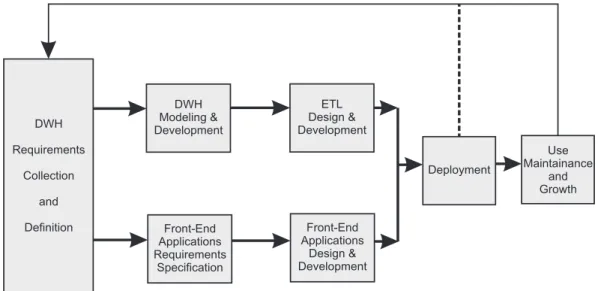
(SDLC). SDLC is the overall process of de-veloping information systems through a multi-step process including multi-steps such as planning, analysis, design and implementation [4]. One popular data warehouse-focused variation of the SDLC is the Data Warehousing Lifecycle[13]. The steps depicted in Figure 2 are common to any data-warehousing project: data warehouse requirement collection and definition – data warehouse modeling – ETL design and devel-opment – front-end specifications (i.e. front-end requirement collection and definition) – front-end design and development – deployment – use/maintenance/growth.
The data warehouse requirement stage involves agreeing on and defining the desired capabili-ties and functionalicapabili-ties of the future data ware-house. The final list of requirements must take into account the availability of information in the transactional data sources.
Figure 2.Abbreviated data warehouse system development lifecycle.
for creating a target data warehouse model and then using DBMS to implement the model by developing the structure of the actual target data warehouse.
The ETL design and development stage creates infrastructure and procedures for the tasks of re-trieving analytically useful data from the trans-actional sources, transforming such data so that it conforms to the structure of the target data warehouse model, ensuring the quality of the transformed data, and loading the transformed and quality assured data into the target data warehouse. In most real-world data warehous-ing projects, the ETL stage is the most time and resource intensive. However, it is important to note that the ETL process as the process of mov-ing data from the transactional sources into the data warehouse target, if properly undertaken, is predetermined by the results of the require-ments collection and data warehouse modeling stages which specify the sources and the target. Front-end applications requirements, design, and development stages specify the details of the data warehouse interfaces that are used to present the capabilities and functionalities of the data warehouse that are determined in the initial re-quirement collection and definition stage of the project to the end-users. Simply put, the role of the front-end applications stages is to provide user-friendly ways of utilizing those capabili-ties and functionalicapabili-ties.
The deployment of the data warehouse involves activating the data warehousing system
com-posed of its target data warehouse, ETL infras-tructure, and the front-end applications. The dashed line in Figure 2 indicates the options of alpha (within the development team)and beta
(outside the development team) test releases, prior to the deployment of the actual working-system. These releases are designed to provide for testing and feedback collection, which can result in a modification of the requirements and changes in the system before the actual produc-tion deployment takes place. Once the actual production release has taken place, the use of the data warehouse by the analytical commu-nity of the organization can commence.
If the deployed corporate data warehouse has been used in a way that increases the efficien-cies of the company’s processes and opens new business opportunities, the first version of a data warehouse is often followed by the initiative to expand the scope of the project. The subsequent iterations of the data warehouse will have to go through the same stages of the project as the ini-tial version, as is illustrated by the recursive line connecting the left-most and right-most squares in Figure 2.
infor-178 Bridging the Knowledge Gap between Transactional Databases and Data Warehouses
mation retrieval. Enterprise-widerefers to the fact that a data warehouse provides a company-wide view of the information it contains. In-tegrated refers to the fact the data warehouse integrates data from a number of separate in-dependent transactional data sources within the company, and, in many cases, external sources as well. Structured repositoryrefers to the fact that a data warehouse is a structured data reposi-tory hosted by a DBMS like any other database.
Historical refers to the fact that a data ware-house typically contains multiple years worth of data, as opposed to the much shorter time-horizon for data in most traditional transactional databases. Time-variantrefers to the fact that a data warehouse contains slices of data depicting corporate conditions across different time peri-ods within its time horizon. Subject-oriented
refers to the fundamental difference in the pur-pose of a traditional transactional database sys-tem and a data warehouse. A typical transac-tional database system is developed in order to support a specific day-to-day business opera-tion (e.g. company order-entry database). A data warehouse is developed to analyze a spe-cific business subject area (e.g. sales, profit). The data in the data warehouse is organized around major subject areas of an enterprise, and is therefore useful for an enterprise-wide under-standing of those subjects[13].
Following this brief overview of basic data warehousing concepts, the next section exam-ines the coverage of data warehousing topics in the academic settings.
3. Academic Data Warehouse Challenges and Issues
Practically every contemporary information sys-tems program at universities in the US and worldwide features one or more database man-agement related course. Within the last few decades such courses have become one of the fundamental parts of the management informa-tion systems curriculum. There is a plethora of mature database management textbooks, such as [5][8][15], with firm agreement on the top-ics that form the foundation of a contempo-rary database management course. Those com-mon topics are centered on the skills and meth-ods that facilitate the main database lifecy-cle activities. These activities are conceptual
database modeling (which includes collecting the requirements and creating an architectural blueprint for a database), database implemen-tation (using DBMS to create actual transac-tional databases, based on the conceptual de-sign)database utilization(using DBMS to pop-ulate and update databases, as well as to re-trieve data from the databases) and database administration (security, concurrency control, user rights administration etc). In contempo-rary database textbooks these processes are typ-ically discussed and demonstrated in the context of transactional (a.k.a. operational) databases supporting day-to-day business processes. Most contemporary database textbooks include an overview of data warehousing topics, where much of the terminology and fundamental con-cepts are mentioned, defined, and, in some cases, described by small, typically stand-alone examples. However, in contrast to the detailed and systematic coverage of the topics related to the development and utilization of transac-tional database systems (such as conceptual data base modeling, normalization, SQL), the amount of hands-on development material and other associated resources is negligible. There-fore, contemporary database textbooks mostly fail to illustrate the details and mission of the data warehousing projects in a comprehensive, integrated and meaningful fashion. Similar abridged summary-style coverage of data ware-housing topics and materials can be found in books dealing with encompassing and/or par-allel topics such as decision support systems, business intelligence, data mining or data visu-alization[14][16].
In addition to the shortage of comprehensive ready-to-use teaching content, the issue of data warehouse technology complexity and cost has also contributed to the lag in coverage of data warehousing topics at universities. A typical data-warehousing project utilizes a host of soft-ware solutions including data modeling tools, ETL tools, OLAP tools, DBMS(in many cases specialized data warehousing DBMS). Many of the professional tools in these categories are ex-pensive, complex to install and maintain, and re-quire significant hardware resources. This fact often serves as a discouraging factor forcing ed-ucators into token coverage of data warehousing topics.
In order to provide a strong argument about the unsatisfactory state of academic data warehouse coverage, an analysis was performed on the course descriptions of 103 representative under-graduate information systems programs in the US. We considered schools that can reasonably be viewed as either mainstream or trendsetting institutions when it comes to the information systems curriculum and implementation. The undergraduate programs we analyzed either ap-pear in the Business Week top 50 undergraduate programs ranking or the top 100 ranking by the US News and World report(or both, of course)
and have an undergraduate program in infor-mation system. The remainder of the sample consists of the schools whose graduate informa-tion systems programs were ranked, and have an undergraduate program in information systems. Results of our analysis reveal that the students in standard database management classes acquire a great deal of knowledge and skills that prepare them for developing, using and managing trans-actional database systems. On the other hand, most programs are typically less focused and consistent when it comes to the teaching of the skills that are necessary for the design and use of decision-supporting data warehouses. The typical course sequence in an undergraduate in-formation systems program includes one or two database design and management courses fol-lowed by, or taken concurrently with, a deci-sion support systems course. In few instances there is a whole decision support track, with two, three or even more courses offered. The purpose and content of the data design and man-agement courses is relatively uniform, expos-ing students to the fundamentals of relational database design, ER modeling, and
normaliza-tion as well as writing of SQL queries of varying degrees of complexity. The content of the deci-sion support courses varies widely across insti-tutions, often reflecting individual institution’s understanding of which of the many different decision support activities and processes merits emphasis. In most surveyed institutions, data warehousing is not covered in either database or decision support courses. In only 34% of sur-veyed institutions there is some mention of data warehousing within any of the course descrip-tions in their entire information systems-related curriculum. Moreover, less than half of those institutions(15% overall)have courses that of-fer any meaningful coverage of data warehouse design and modeling. It is reasonable to assume that in the broader academic environment, be-yond this sample of highly ranked schools, these numbers are even lower.
This situation reflects a problematic disconnec-tion between the industry and academia. The current job market for IS majors requires com-petence in both transactional database systems and data warehouses, while academic programs for the most part focus strictly on the former. This is not to say that other decision support pro-cesses and activities should be de-emphasized at the expense of extending the curriculum to cover data warehousing issues, but rather that the schools seem not to be aware of the paramount importance of data warehousing in all the deci-sion support activities within large(and increas-ingly in small to medium)enterprises.
The lack of appropriate amount of attention and focus on data warehousing in most academic programs and curriculums is strongly related to the unavailability of appropriate educational re-sources. In the next section we will describe some of the available free resources that can enable educators to deal with the issues and challenges described above.
4. Free Academic Resources
180 Bridging the Knowledge Gap between Transactional Databases and Data Warehouses
we provide a short overview of the two data modeling techniques for modeling large-scale, enterprise-wide data warehouses [11]: dimen-sional modeling and ER modeling.
Dimensional modeling[13]groups data attributes into two types of tables: facts and dimensions. A fact table contains one or more measures
(usually numerical) of a subject that is being modeled for analysis. Dimension tables con-tain various descriptive attributes(usually tex-tual)that are related to the subject depicted by the fact table. The data model that is produced by the dimensional modeling method is known as a star-schema[2], or a star-schema extension such as snowflake or constellation. The intent of the dimensional model is to represent rele-vant questions whose answers enable appropri-ate decision-making in a specific business area
[3]. Dimensional data warehousing modeling method, championed by Kimball[13], views a data warehouse as a collection of dimension-ally modeled data marts. Another option for modeling data warehouses, first proposed by Inmon [10], envisions a data warehouse as an integrated database modeled by using the tradi-tional database modeling technique(ER model-ing). After such a data warehouse is created, it then serves as a source of data for dimensionally modeled data marts.
One tool, named FatFreeERD, is a standard ER modeling tool, an alternative to commer-cial data modeling tools such as CA ERwin Data Modeler. Unlike commercial tools, Fat-FreeERD is completely free of charge for aca-demic institutions and requires no licensing or tool-specific training. The other tool, named FatFreeStar, is a dimensional modeling tool for creating star schemas, complete with fact and dimension tables. Like FatFreeERD, Fat-FreeStar is also completely free of charge for academic institutions and requires no licensing or tool-specific training. The diagrams created by these tools can be easily embedded into a variety of documents of different formats, such as MS Word or MS PowerPoint. In addition to FatFreeERD and FatFreeStar tools, we have created a number of data warehouse modeling-assignments, and we have made them avail-able to the wider academic community. These tools and case-assignments are available for free download and use by any academic institution at the Teradata University Network (TUN)
web-site www.teradatauniversitynetwork.com. Ter-adata University Network is a no-catch free educational portal that uses a zero cost-zero installation-zero maintenance model to provide tools, data-sets, and other materials for teaching and learning about database management, data warehousing, decision support, and other con-temporary data management and analysis top-ics.
In addition to the resources we just described, other free data warehouse education-related con-tent offered on TUN includes data warehousing DBMS software, OLAP software, large indus-try data-sets, articles, case studies, tests, exer-cises, lectures, syllabi, lesson plans, tutorials, demos, and podcasts. Detailed descriptions of the TUN resources can be found in [12]. The DBMS and OLAP software is hosted by TUN and is used via the internet.
5. Summary and Conclusion
The focus of this paper was on examining the is-sues that encumber the pervasive, effective, and meaningful inclusion of data warehousing topic into information systems curriculums world-wide and describing resources that can help dealing with these issues.
Many of the professional data warehousing soft-ware tools are expensive, complex to install and maintain, and require significant hardware re-sources, which hinders widespread meaningful data warehouse education in academic settings. With the resources we described here, the cost, maintenance, installation, hardware, and sup-port personnel factors are eliminated from the data warehouse teaching equation, enabling any faculty member with internet access to provide a meaningful data warehouse learning experience to their students.
References
[1] S. ADELMAN, L. T. MOSS,Data Warehouse Project Management, Addison-Wesley, 2000.
[2] A. CHAUDHURI U. DAYAL, An Overview of Data
[3] T. CHENOWETH, D. SCHUFF, AND R. ST. LOUIS,
Method for developing dimensional data darts.
Communications of the ACM, 46, 12, 93–98, 2003.
[4] A. DENNIS, B. WIXOM ANDR. ROTH,System Anal-ysis & Design, 3rd Edition, John Wiley and Sons, 2006.
[5] R. ELMASRI AND S. NAVATHE, Fundamentals of Database Systems, Addison Wesley, Boston, MA, 2007.
[6] M. N. FROLICK, K. LINDSEY, Critical Factors for Data Warehouse Failure.Business Intelligence Jour-nal, 8, 1, Winter 2003.
[7] P. GRAY, Manager’s Guide to Making Decisions about Information Systems, Wiley, 2006.
[8] J. HOFFER, M. PRESCOTT, AND H. TOPI, Modern Database Management. Prentice Hall, Upper Sad-dle River, NJ. 2008.
[9] M. I. HWANG, H. XU, The Effect of Implementa-tion Factors on Data Warehousing Success: An Exploratory Study. Journal of Information, Infor-mation Technology, and Organizations, 2, pp. 1–14, 2007.
[10] W. INMON,Building the Data Warehouse, 4th
Edi-tion, Wiley, 2005.
[11] N. JUKIC, Data Modeling Strategies and Alternatives
for Data Warehousing Projects.Communications of the ACM, 49, 4, pp. 83–88, 2006.
[12] N. JUKIC AND P. GRAY, Using Real Data to In-vigorate Student Learning. INROADS – the ACM SIGCSE Bulletin, Vol. 40, No. 2, 2008, pp. 6–10.
[13] R. KIMBALL, M. ROSS, W. THORNTHWAITE, J.
MUNDY, B. BECKER,The Data Warehouse Lifecycle Toolkit. Wiley, 2007.
[14] G. M. MARAKAS,Modern Data Warehousing, Min-ing, and Visualization – Core Concepts. Prentice Hall, 2003.
[15] P. ROB ANDC. CORONEL, Database Systems: De-sign, Implementation and Management. Cengage Learning, Florence, KY, 2008.
[16] E. TURBAN, R. SHARDA, J. E. ARONSON, D. KING, Business Intelligence – A Managerial Apporach. Prentice Hall, 2008.
Received: June, 2009
Accepted: April, 2010
Contact addresses:
Nenad Jukic Loyola University Chicago 1 E Pearson, Chicago IL 60611, USA e-mail:[email protected] Boris Jukic Clarkson University 372 Bertrand H. Snell Hall PO Box 5790, Potsdam NY 13699-5790, USA e-mail:[email protected]
NENADJUKIC, Associate Professor of Information Systems and the Director of Data Warehousing and Business Intelligence Graduate Pro-gram at Loyola University Chicago(US)first attended and presented a paper at ITI in 1998, when it was held in Pula. Since then Nenad has attended seven more ITI conferences. He has been a vice chair for the Business Intelligence, Databases and Information Systems track at ITI for more than five years. Nenad has brought a number of distinguished speakers to ITI over the years and continues to be involved with the organization of the conference.