VOLUME 15 ISSUE 4 (2017), Page 57 – 68
SUSTAINABLE FOOD WASTE MANAGEMENT IN HOTELS: CASE STUDY LANGKAWI UNESCO GLOBAL GEOPARK
Saraswathy Kasavan1, Ahmad Fariz Mohamed2, & Sharina Abdul Halim3
1,2,3 Institute for the Environment and Development
UNIVERSITI KEBANGSAAN MALAYSIA
Abstract
The hotel sector is one of the key players in developing tourism industry in the islands, and contributing towards islands economy, employment opportunities and the overall development. However, food waste generated by hotels has significantly impacted the environment, social well-being and tourism economy. Sustainable food waste management practices are vital among the business operations of the hotel sector to reduce food waste and operational costs through efficient use of food resources. The aim of this paper is to examine current practice of hotel operators towards sustainable food waste management from purchasing of food resources to food wastes disposal. The data was gathered using structured and self-administered questionnaires, which involved 42 hoteliers from the island of Langkawi UNESCO Global Geopark. From the main findings, it was found that there was a lack of emphasis from the hotels on their policy related to wastage of food and unsustainable food consumption pattern by their guests. This reflects on the lack of practices towards sustainable food waste management by the hotel sector. Therefore, planning for sustainable food waste management on island hotels is essential to ensure the protection of environmental resources and to reduce the problem regarding limited capacity landfills on the islands
Keyword: Food waste, geopark, hotel, island, practice, sustainable food waste management
Date Received: 7th July 2017
INTRODUCTION
The tourism sector is a booming industry in almost every country globally. Apart from the export of various commodities internationally, most of the countries are now prioritizing tourism as one of the main sources of income through foreign exchange (Kasimu, Zaiton & Hassan, 2012). The Statistics of Tourism Malaysia 2016 indicated that the tourism sector is the third largest revenue contributor at RM82.1 billion for Malaysia economy (Tourism Malaysia, 2017). Environmental resources and unique nature of islands have become attractive tourism products and have contributed largely to the development of the Malaysian tourism industry. A majority of the islands are blessed with environmental resources; such as warm climate, crystal beaches, geological features and clean air (Mensah & Blankson, 2014).
The hotel sector is one of the key players in developing the tourism industry in the islands that contributes to local economy as well as providing employment opportunities. However, the lack of proper management among the business operations of the hotel sector may lead to damages on the islands’ environment, and then lose out on tourism and economic activities (Bohdanowicz, 2005; Mensah & Blankson, 2014).
Being one of the largest food consumers, hotels generate a large amount of food waste every day (Agamuthu Pariatamby & Nagendran Periaiah, 2007; Papargyropoulou et al., 2016; Sandaruwani & Gnanapala, 2016). WRAP (2011) found that almost 50% of food waste produced from total solid waste was generated by the hotel industry. This clearly shows that there is a serious sustainability issue regarding food waste from the hotel sector. Moreover, islands are highly vulnerable and sensitive towards any environmental changes and impacts, particularly from any unsustainable practices of food waste. Therefore, sustainable food waste management on island hotels is essential to ensure the protection of environmental resources and reduce the problem regarding limited capacity landfills on the islands. Additionally, hotel operators should also pursue practices of sustainable food waste management because resources for foodstuff also take a larger portion of the hotel’s operation cost.
Previous studies have indicated that hoteliers are mainly focusing on sustainable practices for water, electricity, and recyclable solid waste, such as bottles, can, paper, and plastics (Kasim, 2009; Kasimu, Zaiton, & Hassan, 2012; Molina et al., 2009; Pirani & Arafat, 2015). Meanwhile, documentation on hoteliers’ practices towards sustainable food waste management have not been specifically given great attention by previous researchers and hence, the need for this study, particularly for Langkawi Island.
management for the hotel sector on islands and most of the wasteful processes could be identified. This can evidently guide the waste minimisation strategy by informing where the focus should be and which recommendations could have a greater impact in reducing food waste.
RESEARCH APPROACH Study Area
Langkawi Island is situated at the Andaman Sea within 30 km off the mainland coast of the north-western corner of Peninsular. Langkawi is also one of the districts in the state of Kedah, Malaysia and is blessed with unique geological features, biodiversity, cultural heritage, and environmental resources. The declaration of Langkawi as a duty-free island in 1987 is considered a major evolution of economies from the agriculture and fisheries sector to the service sector and has become the turning point for rapid tourism development for this island (Sharina Abdul Halim et al., 2011). In 2007, Langkawi became the first UNESCO Global Geopark in the Southeast Asia and the 52nd memberin the world
(Ong et al., 2010). Langkawi took the centre stage to be one of international tourism destinations by hosting world class events such as Langkawi International Maritime and Aerospace Exhibition (LIMA), Royal Langkawi International Regatta, Ironmen Langkawi International Triathlon, and Le Tour De Langkawi (Azizan Marzuki et al., 2016). Thus, this leads Langkawi to become a popular destination for domestic and international tourists. Tourist arrivals in Langkawi has increased from 2.4 million in 2010 to 3.6 million in 2016 (LADA, 2017).
Several new hotels have emerged in order to cope with the developing tourism industry in Langkawi. However, Agamuthu Pariatamby & Nagendran Periaiah. (2007) found that Langkawi has one of the highest food waste generation among the tourist islands in Malaysia and in great need for a systematic effort to reduce waste generation. Furthermore, tourists in Langkawi generated waste per capita more than double as compared to the local residents (Shamshiry et al., 2011). Similarly, Wang et al. (2017) found that, generally, food waste per capita per meal for tourists is higher than local residents.
With a status of UNESCO Global Geopark, Langkawi needs to apply the practices of sustainable food waste management not only at the household level but also for the hotel sector. Therefore, hoteliers should apply the practices of sustainable food waste management to maintain balance between environmental conservation and tourism development.
Method
current hoteliers’ practices and participation towards sustainable food waste management. The study focuses on selected hotels that provide accommodation together with food and beverage services. The list of hotels on the island of different categories, ranging from 1 star to 5 star hotels, was collected from various website resources such as the Malaysian Association of Hotels (MAH), Langkawi Municipal Council and travel agencies (Agoda and Trivago). All together 56 hotels were identified and all were selected as sample in this study.
A few completed copies of the questionnaire were collected through online surveys, while most of the other questionnaires were personally collected by the researchers. In total, 42 questionnaire forms were received from the total population of 56 hotels.
Normally, hotel food management operations and personnel vary between hotels, depending on the star category of the hotels. Hence, for this research, several different respondents holding different positions were chosen such as chef, steward, operation manager, general manager, and F&B manager. The questionnaire was a self-constructed close-ended questionnaire using the 5 Likert scale to measure current level of hotels’ participation in food waste management. The statistical methods used in this study were mainly descriptive statistics of min and standard deviation. To assess the level of practices towards sustainable food waste management, the interpretation of mean score by Ahmad (2002) was adapted (Table 1).
Table 1 Interpretation of the trend level of mean score
Score Interpretation
3.68-5.00 High
2.34-3.67 Moderate
1.00-2.33 Low
Source: Ahmad, 2002
RESULTS AND DISCUSSIONS
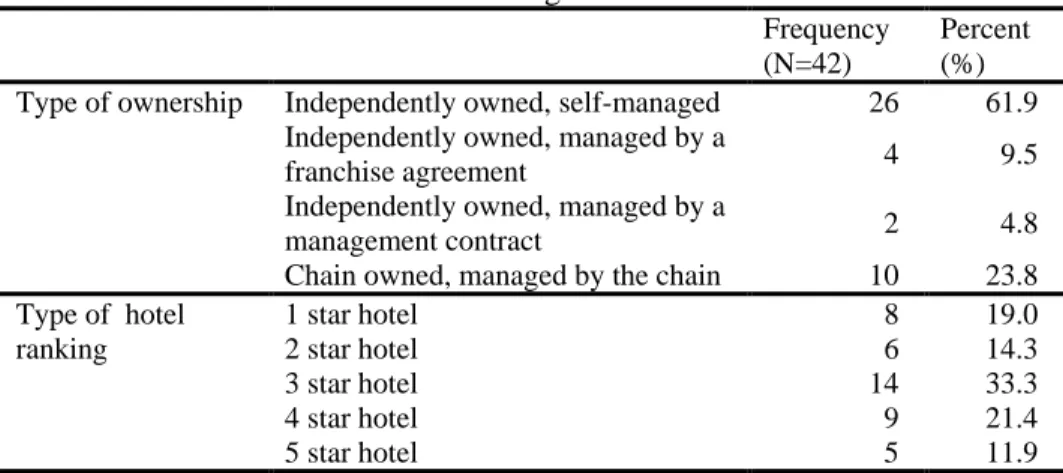
Table 2 Profiling of the hotels
Frequency (N=42)
Percent (%) Type of ownership Independently owned, self-managed 26 61.9
Independently owned, managed by a
franchise agreement 4 9.5
Independently owned, managed by a
management contract 2 4.8
Chain owned, managed by the chain 10 23.8
Type of hotel ranking
1 star hotel 8 19.0
2 star hotel 6 14.3
3 star hotel 14 33.3
4 star hotel 9 21.4
5 star hotel 5 11.9
Hotel Participation in Sustainable Food Waste Management
Table 3 Practices towards sustainable food waste management
Construct items Min SD Interpretation
Purchasing
1. Only buy the food ingredient according to needs.
4.55 .091 High
2. Check the food ingredient when
purchasing to ensure that food is not broken or packaging is not damaged.
4.60 .084 High
3. Check the food ingredient’s expiry date when purchasing.
4.60 .084 High
4. Check what food ingredient is already in storage before purchasing.
4.48 .119 High
5. Reduce purchasing of food items that are much discarded.
4.36 .156 High
Storage
6. Make sure those fresh food ingredients are stored at the appropriate temperatures.
4.74 .069 High
7. Store the food ingredient in order during purchase – “first-in, first-out”.
4.40 .137 High
8. Label food ingredients that show the
products’ expiry dates before being stored. 4.40 .132 High
9. Label food ingredients that show the storage instructions before storage.
4.31 .134 High
10. Ensure the food ingredient storage area is safe (avoid spills, broken and damaged products).
4.60 .091 High
Food preparation
11. Make extra food in case it is needed only. 4.36 .136 High
12. Reduce using food ingredients that are easily damaged for preparing food.
4.02 .162 High
13. Consider guests’ demands when preparing
food.
4.07 .150 High
14. Use the leftover quality food for the preparation of other meals.
2.88 .184 Moderate
15. Prepare a variety of sizes of portion meals. 3.95 .144 High
Serving food
16. Waiter will give a clear explanation about the cooking method to the guests while taking food orders.
4.26 .128 High
17. Waiter will give a clear explanation about the food ingredients used to the guests while taking food orders.
4.21 .125 High
18. Waiter will give a clear explanation about the size portion of food served to the guests while taking food orders.
4.19 .137 High
19. Provide training for waiters to perform clear communication about menu order to the chef.
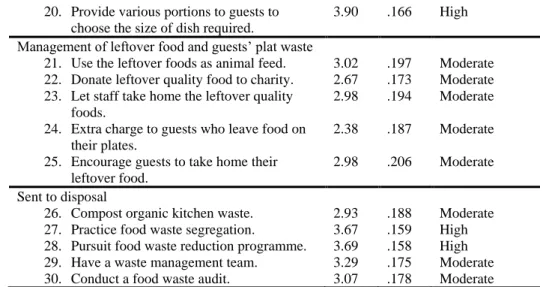
20. Provide various portions to guests to choose the size of dish required.
3.90 .166 High
Management of leftover food and guests’ plat waste
21. Use the leftover foods as animal feed. 3.02 .197 Moderate
22. Donate leftover quality food to charity. 2.67 .173 Moderate
23. Let staff take home the leftover quality foods.
2.98 .194 Moderate
24. Extra charge to guests who leave food on their plates.
2.38 .187 Moderate
25. Encourage guests to take home their leftover food.
2.98 .206 Moderate
Sent to disposal
26. Compost organic kitchen waste. 2.93 .188 Moderate
27. Practice food waste segregation. 3.67 .159 High
28. Pursuit food waste reduction programme. 3.69 .158 High
29. Have a waste management team. 3.29 .175 Moderate
30. Conduct a food waste audit. 3.07 .178 Moderate
Hotels cater food and beverage services not only to house guests, but also to the outsiders. Hence, hoteliers need to have a systematic process on storage to avoid the spoilage of food. Table 3 shows that most of the hoteliers pursue first in first out (FIFO); labelling food ingredients that show the product expiry dates, and storage instructions in order to avoid damaged raw food ingredients in the storage. These practices also control the stock of raw food ingredients effectively with the right rotation (Halloran et al., 2014). In addition, stored fresh food ingredients at the appropriate temperatures will also prevent food waste. Table 3 shows that the interpretation score for all the items for the process of storage is high, which is above mean 4.31.
fresh and harmless for the guests, but generates a certain amount of buffet leftover waste.
Based on Table 3, an interpretation of mean for all items for the process of serving food is high, which is above mean 3.90. The results also indicate that communication is a very important part in pursuing a systematic process for serving food. For example, clear communication between the waiters and guests regarding food ingredients that are used in the menu, cooking method, and serving portion size of the menu can be avoided in the event of a wrong menu order. In addition, communication between waiters and chefs regarding food menu ordering and number of guest orders is also required. Those clear communications will be helpful to avoid preparing excess quantities of food and preparation food waste. Furthermore, providing various portions of dishes (such as big, medium or small) for guests to choose the size of dishes helps to reduce plate waste. The findings of this study are supported by Kallbekken and Saelen (2013) who found that hoteliers are able to reduce food waste by 19.5% by reducing portion of dishes using smaller size of plate.
The mean interpretation of all items for the process of management of leftover food and guests’ plate waste is moderate, which is below mean 3.02. The results indicate that the strict policy of hotels influences the process management of leftover food and guests’ plate waste. In order to follow the hotel’s policy, hoteliers (especially big hoteliers) do not allow staff to take anything from their hotels even though there is leftover food or guests’ plate waste. Moreover, hoteliers also do not encourage their guests to take away excess plate food ('a la carte') for safety and hygienic purposes. In addition, tasteless food (error in the recipe) or food that does not meet their expectations also increases guests’ plate waste. Sometimes, hoteliers prepare extra quantity of food to avoid last minute cooking for guests who arrive without any booking or reservation. However, such practice results to creating higher leftover food waste. Besides that, this study found that guests’ food consumption pattern also influences the practices towards sustainable food waste management and this is beyond the control of hoteliers. Guests expect to have a variety of food on their tables, especially during buffet. The hotel, consequently, offers a variety of foods to meet the guests’ satisfaction. But unsustainable guests’ food consumption pattern leads to generating a lot of plate waste. According to Food Wise Hong Kong (2013), plate waste could be reduced by education or raising awareness among guests through an effective communication program. On the other hand, studies done by Jeffery et al. (1994) and, Kuo and Shih (2016) found that overall average plate waste could be reduced significantly by using coercion approach (include penalty) compared to education approach. Thus the best might be to use both approaches to increase guests’ awareness.
landfills. The practice of compost shows it is still moderate (Table 3). The finding in this study on compost concurs to findings by Sullivan and Smith (2014) that explain capital and labour intensive in tropical settings, supportive management, and a market for the compost influenced compost practices. Composting practices are attractive options for island hotels to reduce the costs of managing food waste and are good source for landscaping purposes. According to the Environment Protection Agency (2010), composting system at hotels has a capacity to reduce 44% of waste costs. In addition, the separation of waste is the starting point for disposal of food waste in a sustainable way. The results indicate that 95% of the hotels have not implemented a waste audit or established a special team for waste management needs as shown in items 29 and 30 (Table 3).
There are several possible explanations for this overall result. First, the main finding to emerge from this study is that, the lack of concern in hotel policy for food wastage, in which influences the practices towards sustainable food waste management. The results of this study indicate that most of the big hoteliers (4 star and 5 star hotels) have strict hotel policy and food safety standards, which emphasise on safety and standard hygiene purposes but lack of concern about food waste reduction. While most of smaller hoteliers (1 star to 3 star hotels) were more flexible with various situations and were more concern in reducing leftovers food waste. The second major finding from this study is that the unsustainable guests’ food consumption pattern also influences sustainable food waste management practices for all type of hotels. As found by Stuart (2009), culture, personal choice and socio-demographic characteristics have been associated with increased food wastage. For hotel sector, guests arrivals from different cultures, background and personal taste, will determine the consumption of different types of food, which will affect food waste generation. Thus, hoteliers should take possible actions in convincing and encouraging their customers towards plate waste reduction.
CONCLUSION AND RECOMMENDATIONS
Hoteliers have difficulty to achieve zero food waste in their hotels because it is a common characteristics for the hospitality sector (Sandaruwani & Gnanapala, 2016). However, sustainable food waste management among the business operations of the hotel sector can reduce maximum food waste from purchasing until disposal. This sustainable practice will lead to the efficient use of resources relating to foodstuff and helps to reduce operational cost. Apart from the internal management, hoteliers need good cooperation with stakeholders such as customers, other hoteliers, suppliers, NGOs, government and communities, which are important to achieve sustainable food waste management in the hotel sector (Thi, Kumar, & Lin, 2015).
recommendations provide the platform for developing guidelines and strategies to improve food waste management practice in the hotel sectors.
Hoteliers should provide fresh and quality food to meet guests’ expectations and satisfaction. At the same time, hoteliers should encourage their guests to reduce plate waste. For example, effective communication helps to raise guests’ awareness on reducing food waste or preventing over-ordering of food. Other than that, notice boards, written messages or instructions are used to remind customers to reduce plate waste.
Hoteliers should establish a specific internal audit team and audit food waste generation by measuring the present food waste levels and identify the key sources of food waste generation. Such practices give useful information for hoteliers to implement effective strategies to reduce food waste before food waste is sent to landfills for disposal.
Hoteliers should provide training to staff on sustainable food waste management from purchasing to disposal in order to instil and educate staff with food waste reduction culture.
Hoteliers should develop a food waste management policy with clear objectives, procedures, and goals towards reduction of food waste, and at the same time, maintaining the safety and standard hygiene purposes. In other words, hotel policy for food waste reduction should target the circumstances and actions that lead to food wastage and to facilitate the culture of reduce waste in the hotel operation.
Competitors (other hoteliers) should cooperate to reduce food waste. For example, a win-win situation could be formed if all hoteliers (all competitors) together make a practice of extra charging the customers who leave food on their plates. These practices would help to reduce plate waste, prevent over-ordering, and at the same time, cut down operational costs.
The government and non-governmental organisations (NGOs) should promote reduce waste awareness by promoting more programmes and campaigns continuously to all types of hoteliers, guests and also to the local communities.
The government and non-governmental organisations (NGOs) should encourage green practice (including sustainable food waste management) by giving out awards and helping to promote those hotel names internationally.
Ministry of Tourism and Culture Malaysia should also consider the criteria regarding sustainable food waste management as a requirement aspect for the star rating of hotels in Malaysia.
REFERENCES
Agamuthu Pariatamby, & Nagendran Periaiah (2007). Waste management challenges in sustainable development of islands. Retrieved from http://www.iswa.org/uploads/tx_iswaknowledgebase/Pariatamby.pdf
Ahmad, J. (2002). Pemupukan budaya penyelidikan di kalangan guru di sekolah: Satu Penilaian. Bangi: Universiti Kebangsaan Malaysia.
Azizan Marzuki, Shardy Abdullah, Mastura Jaafar, Diana Mohamad, M. M. I. (2016). Kajian daya tampung sosial dan ekonomi bagi pelancongan di Pulau Langkawi. Tanjong Malim: Penerbit Universiti Pendidikan Sultan Idris.
Bohdanowicz, P. (2005). European hoteliers’ environmental attitudes: Greening the business. The Cornell Hotel and Restaurant Administration Quarterly, 46(2), 188–204.
Environment Protection Agency. (201). Case studies of organisations managing food
waste properly. Retrieved from
http://www.envirocentre.ie/includes/images/Case-Studies-of-Organisations-Managing-Food-Waste-Properly.pdf
Halloran, A., Clement, J., Kornum, N., Bucatariu, C., & Magid, J. (2014). Addressing food waste reduction in Denmark. Food Policy, 49, 294–301.
Jeffery, R. W., French, S. A., Raether, C., & Baxter, J. E. (1994). An environmental intervention to increase fruit and salad purchases in a cafeteria. Preventive Medicine, 23(6), 788–792.
Kallbekken, S., & Sælen, H. (2013). “Nudging” hotel guests to reduce food waste as a win–win environmental measure. Economics Letters, 119(3), 325–327.
Kasim, A. (2009). Managerial attitudes towards environmental management among small and medium hotels in Kuala Lumpur. Journal of Sustainable Tourism. http://doi.org/10.1080/09669580902928468
Kasimu, A. B., Zaiton, S., & Hassan, H. (2012). Hotels involvement in sustainable tourism practices in Klang Valley, Malaysia. International Journal of Economics and Management, 6(1), 21–34.
Kuo, C., & Shih, Y. (2016). Gender differences in the effects of education and coercion on reducing buffet plate waste. Journal of Foodservice Business Research, 8020(May), 1–13.
Langkawi Development Authority [LADA] (2017). Laporan Tahunan Lembaga Pembangunan Langkawi.
Mensah, I., & Blankson, E. J. (2014). Commitment to environmental management in hotels in Accra. International Journal of Hospitality & Tourism Administration, 15(2), 150–171.
Ministry of Tourism and Culture Malaysia. (2013). Minimum requirements for star rating of hotel 1.
Mourad, M. (2016). Recycling, recovering and preventing “food waste”: Competing solutions for food systems sustainability in the United States and France. Journal of Cleaner Production, 126, 461–477.
Ong, P. L., Nurhafizah Yusoff, & Sharina Abdul Halim. (2010). Menjejak semangat ’Kawi’: Langkawi sebagai geopark. Akademika, 80, 55–68.
Papargyropoulou, E., Wright, N., Lozano, R., Steinberger, J., Padfield, R., & Ujang, Z. (2016). Conceptual framework for the study of food waste generation and prevention in the hospitality sector. Waste Management, 49, 326–336.
Pirani, S. I., & Arafat, H. A. (2015). Reduction of Food Waste Generation in the
Hospitality Industry. Journal of Cleaner Production.
http://doi.org/10.1016/j.jclepro.2015.07.146
Sandaruwani, J. A. R. C., & Gnanapala, W. K. A. C. (2016). Food wastage and its impacts on sustainable business operations: a study on Sri Lankan tourist hotels. Procedia Food Science, 6(2015), 133–135.
Shamshiry, E., Nadi, B., Mokhtar, M., Komoo, I., Saadiah Hashim, H., & Yahaya, N. (2011). Integrated models for solid waste management in tourism regions: Langkawi Island, Malaysia. Journal of Environmental and Public Health, 2011, 1–5.
Sharina Abdul Halim, Ong, P. L., Nurhafizah Yussof, & Lim, C. S. (2011). Participation towards heritage conservation: Case of fishing community in Langkawi Geopark. Planning Malaysia, (1), 185–196.
Stuart, T. (2009). Waste: uncovering the global food scandal. New York: W.W. Norton & Company.
Sullivan, K., & Smith, J. (2014). Recycling for small island tourism developments : Food waste composting at Sandals Emerald Bay, Exuma, Bahamas. Resources, Conservation & Recycling, 92, 25–37.
Tan, K.C., Lyman, S. B., & Wisner, J. D. (2002). Supply chain management: a strategic perspective. International Journal of Operation & Production Management, 22(6), 614–631.
Thi, N. B. D., Kumar, G., & Lin, C.-Y. (2015). An overview of food waste management in developing countries: Current status and future perspective. Journal of Environmental Management, 157, 220–229.
Tourism Malaysia. (2017). Malaysia tourism statistics in brief.
Wang, L. en, Liu, G., Liu, X., Liu, Y., Gao, J., Zhou, B., … Cheng, S. (2017). The weight of unfinished plate: A survey based characterization of restaurant food waste in Chinese cities. Waste Management, 66, 3–12.
Food Wise Hong Kong (2013). Food waste reduction good practice guide for hotel sector.