Edinburgh Research Explorer
Multimodal, label-free nonlinear optical imaging for applications
in biology and biomedical science
Citation for published version:
Mouras, R, Bagnaninchi, P, Downes, A & Elfick, A 2013, 'Multimodal, label-free nonlinear optical imaging for
applications in biology and biomedical science: Multimodal, label-free nonlinear optical imaging', Journal of
Raman Spectroscopy, vol. 44, no. 10, pp. 1373-1378. https://doi.org/10.1002/jrs.4305
Digital Object Identifier (DOI):
10.1002/jrs.4305
Link:
Link to publication record in Edinburgh Research Explorer
Published In:
Journal of Raman Spectroscopy
General rights
Copyright for the publications made accessible via the Edinburgh Research Explorer is retained by the author(s)
and / or other copyright owners and it is a condition of accessing these publications that users recognise and
abide by the legal requirements associated with these rights.
Take down policy
The University of Edinburgh has made every reasonable effort to ensure that Edinburgh Research Explorer
content complies with UK legislation. If you believe that the public display of this file breaches copyright please
contact [email protected] providing details, and we will remove access to the work immediately and
investigate your claim.
Multimodal, label-free nonlinear optical
imaging for applications in biology and
biomedical science
†
R. Mouras,
a* P. Bagnaninchi,
bA. Downes
aand A. El
fi
ck
aWe have developed a multimodal optical platform for label-free imaging on the basis of nonlinear optical microscopy (NLO) for applications in biology and biomedical science. Three application areas have been chosen as examples: regenerative medicine, drug delivery monitoring and cancer diagnosis. Obtained data showed the potential of NLO microscopy for the following: (1) investigating the stem cell differentiation states prior their use in regenerative medicine and tissue repair, (2) tracking drug molecules in living cells and (3) detecting cancer by imaging biopsiesex vivo. The results of this study illustrate the potential to translate NLO microscopy fromex vivotoin vivoapplications. Copyright © 2013 John Wiley & Sons, Ltd.
Supporting information may be found in the online version of this article.
Keywords:multimodal microscopy; multiphoton microscopy; CARS microscopy; label-free imaging; drug delivery monitoring; cancer diagnosis; stem cells
Introduction
For decades, microscopy has been a key tool in the investiga-tion of biological processes, imaging of cellular structures and
the localisation of molecules within cells. The identification of
different molecular species on the microscopic scale is still a considerable challenge in many areas of biology. Fluorescence microscopy is a key research tool in biomedical science, enabling cells and tissues to be imaged in three dimensions
and localise specific molecules of interest. However, this
tech-nique, as powerful as it is, has a number of significant
limita-tions, which cause significant barriers: (1) photobleaching of
fluorophores, which makes continuous observation of
biochem-ical processes difficult; (2) cells have to be genetically modified
to express fluorescence, or exogenous fluorescent labels are
added, both of which may cause perturbation of the system of interest and are time-consuming; and (3) experiments are often
performed onfixed samples preventing the study of dynamic
processes. There is a real need to develop non-invasive tech-niques dedicated to real-time imaging.
Spontaneous Raman microscopy is a non-invasive technique,
which probes a molecule’s intrinsic vibrational modes[1].
Detecting the vibrational signatures of molecules circumvents
the need forfluorescent or other extrinsic tags and permits the
visualisation of the distribution of specific molecules (chemically
selective imaging) with high sensitivity.
Recently, Raman microscopy has been used to image living cells, by adapting a different approach by illuminating a line and collecting a set of spectra from all points along this line, in
parallel, rather than taking a Raman spectrum at each pixel.[2,3]
Unfortunately, despite the efforts performed to develop Raman microscopy, low signal levels limit this technique; hence, either a large number of molecules or long acquisition times are
required, presenting significant limitations to the development
of real-time studies.
Over the past decade, new microscopy approaches using coherent Raman scattering as a contrast mechanism have been emerged as powerful techniques to address these limitations. Coherent anti-Stokes
Raman scattering (CARS) microscopy[4–10]is an established resonant
Ra-man technique, where the molecular vibrations are driven coherently through stimulated excitation by pulsed lasers. The CARS signal is
greatly amplified, around five orders of magnitude over traditional
Raman spectroscopy, offering new possibilities for high sensitive
detec-tion in living cells and tissue, with high chemical specificity and inherent
three-dimensional (3-D) optical sectioning capability.[11–13]
In addition, complementary nonlinear optical (NLO) techniques,
such as two-photon excitation fluorescence (TPEF), and second
harmonic generation (SHG) have been widely used for biological
specimens imaging[14–17]. TPEF exploits the autofluorescence of
biological samples or added tags, and SHG makes use of the noncentrosymmetric properties to image structural proteins such
as collagen[15]and myosin[18]. In combination with CARS, these
mo-dalities provide a wealth of chemical and biological information, which can help to resolve the most persistent biological questions. These techniques have the potential to revolutionise biomedical imaging offering the new insights into the biochemistry and
path-ways at the subcellular level[19,20].
* Correspondence to: Rabah Mouras, Institute for Materials and Processes, School of Engineering, The University of Edinburgh, Edinburgh, EH9 3JL, UK E-mail: [email protected]
† This article is from the ECONOS part of the joint special issue on the European Conference on Nonlinear Optical Spectroscopy (ECONOS 2012) with Guest Editors Johannes Kiefer and Peter Radi and the II Italian Conference of the National Group of Raman Spectros-copy and Non-Linear Effects (GISR 2012) with Guest Editor Maria Grazia Giorgini.
a Institute for Materials and Processes, School of Engineering, The University of Edinburgh, Edinburgh, EH9 3JL, UK
b MRC-Centre for Regenerative Medicine, The University of Edinburgh, Edinburgh, EH16 4SB, UK
Received: 18 March 2013 Accepted: 20 March 2013 Published online in Wiley Online Library: 11 June 2013 (wileyonlinelibrary.com) DOI 10.1002/jrs.4305
In this paper, we investigate the use of NLO in biomedical science as a label-free technique for real-time monitoring of che-motherapeutic drug action in living cells, for breast cancer tissue imaging and to monitor and quantify stem cell (SC) differentiation into the osteoblast (bone) and adipocyte (fat) lineages.
Experimental
Multimodal microscope
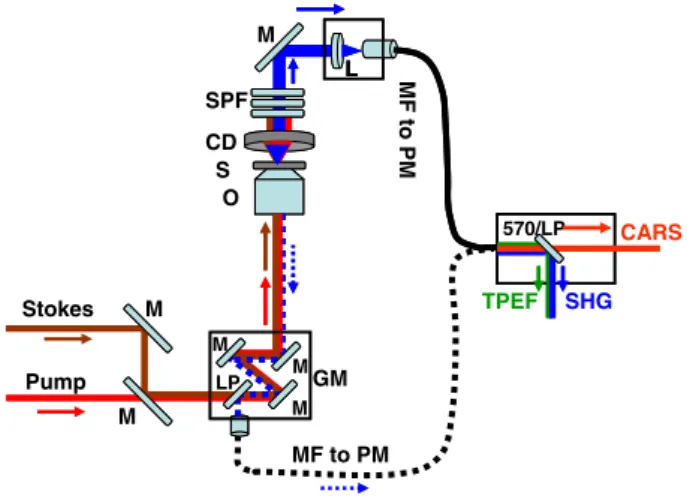
The experimental setup (Fig. 1) used in this study is described
elsewhere.[21]Briefly, the pump (532 nm, 5 ps) was used to pump an
optical parametric oscillator (Levante Emerald), and the Stokes
(1064 nm, 6 ps) beams were generated by a mode-locked Nd: YVO4
laser source (PicoTrain, High-Q laser). The Stokes and the output signal of the optical parametric oscillator were collinearly combined and
focused on the sample using a 60oil immersion objective (Plan
Apo VC, NIKON) with 1.4 numerical aperture and directed into a confocal laser-scanning microscope. A laser-scanning confocal
inverted optical microscope (Nikon BV‘C1’, Amsterdam, Netherlands)
is used to acquire images. The configuration of the system enables
both backward (epi-) and forward detection schemes. An appropriate
set of dichroic mirrors, short-pass and band-pass filters (Chroma,
Rockingham, USA) are used to selectively transmit the desired NLO
signals. Photomultiplier tubes (R3896 Hamamatsu) are used to acquire
CARS, TPEF and SHG images simultaneously using a three-channel
detection scheme. For the imaging of living cells andin situ
observa-tion of anticancer drug delivery, glass bottom dishes were used. All
the imaging experiments were carried out at 22C for tissue samples
or 37C for living cells. The temperature was controlled by means of a
heating stage. The laser power at sample was 12 and 8 mW for the
pump and Stokes beams, respectively. All images were 512512
pixels, acquired by Nikon EZ-C1 3.4 software and processed using
ImageJ. The lateral and depth resolution with a 60 oil immersion
objective was measured to be 0.25 and 1.1mm, respectively.[11]
Cell culture and tissue sections preparation
Cancer cells
Human rectal carcinoma H630 (chemosensitive) and their derived subclones resistant (chemoresistant) cells H630-RT cell lines were
generously provided from the group of Prof. M. Frame group (Edinburgh Cancer Research UK Centre, ECRC) and cultured according to standard mammalian tissue culture protocols and sterile technique. The cell lines were cultured in RPMI 1640
me-dium supplemented with 10% foetal calf serum, 100 Units ml 1
penicillin and 100mg ml 1 streptomycin. Cell lines were
incu-bated at 37C in a humidified 5% CO2-containing atmosphere.
The chemoresistant cell lines H630-RT were generated in vitro
by continuous exposure of the parent line to 5-Fluouracil (5FU). Over time, continuous exposure of 5FU-sensitive cells (H630) to
5FU caused the cells to become resilient to this treatment[22].
Finally, the chemoresistant cells were maintained in normal
culture medium containing 10mM of 5FU.
Stem cells
Human adipose-derived SCs (ADSCs) (Invitrogen) were expanded to passage three in a low serum medium (complete RS MesenPRO,
Invitrogen) with 2 mML-glutamine supplement according to the
supplier protocol. ADSCs were induced after 93 h towards either osteoblast or adipocyte lineages with, respectively, an osteogenesis or an adipogenesis differentiation medium (Invitrogen). In two weeks post-induction, end point staining was performed to assess
that ADSCs were induced towards osteoblasts using Alizarin red
stainingand towards adipocytes using oil-red-oil (data not shown). All cell lines were cultured in glass bottom Petri dishes
(Fluorodish Cell Culture Dish – 35 mm, World Precision
Instru-ments) in a humidified incubator at 37C and 5% CO2.
Tissue sections for microscopy
All tissue samples used in this study were donated anonymously
by patients from the Edinburgh Royal Infirmary. Tissue sections
were cut from paraffin-embedded blocks to a thickness of
10mm using a microtome. Sections were mounted either on glass
slides (SuperFrost Plus) that had been coated with an adhesion agent or on borosilicate cover slips for NLO microscopy measure-ments. Haematoxylin and eosin (H&E) staining was conducted for conventional histopathological observation. Finally, the tissue
section was dewaxed using Histoclear deparaffinisation reagent.
Results
CARS microscopy of live cells
The CARS microscopy is a powerful technique for minimally inva-sive live cell imaging without the need of any labelling, using only endogenous chemical contrast. However, the CARS images thus obtained are composed of contributions from both the resonant and the nonresonant (NR) signals, which limit the utility of CARS. To overcome this drawback, many techniques such as
heterodyne CARS[23], frequency modulated CARS[24], Polarised
CARS[25]and so on, were developed to suppress the NR signal.
Because the NR signal arises from the electronic structure of the molecule of interest and does not carry any chemically selec-tive information, it can be visualised by tuning the excitation frequency away from that of the desired molecular vibration. Thus, a background-free image can be obtained by subtracting the NR image from the resonant image without altering the chemical infor-mation or distorting the image. Figure 2 depicts CARS images of wild-type breast cancer cells (MCF7-WT) obtained by tuning the
Raman shift to the CH2stretch vibration in lipids on resonance at
2840 cm 1, off resonance at 3050 cm 1and the difference image
(on-off). The obtained image is background-free, and the contrast M
M Stokes
Pump LP GM
M
SPF
O S CD
MF to PM
MF to PM L M M M CARS SHG TPEF 570/LP L
Figure 1. Schematic diagram of the multimodal microscope setup. M, mirror; LP, long pass dichroic mirror; GM, galvano mirrors; O, objective; S, sample; CD, condenser; SPF, short-passfilters set; L, focusing lens; MF, multimodefibre, PM; photomultiplier.
R. Mouraset al.
wileyonlinelibrary.com/journal/jrs Copyright © 2013 John Wiley & Sons, Ltd. J. Raman Spectrosc.2013,44, 1373–1378
is increased by a factor of ~3 as shown on the line profiles plotted in Fig. 2(d, e). All CARS images were acquired following this protocol. One can see that the nuclei are well resolved because of the chem-ical contrast between the cytoplasm, which contains huge amount of lipids, and the nuclei, which are mainly composed of DNA. This is of great interest for biologist as they always use staining by Hoechst
in living cells or DAPI onfixed cells to visualise the nuclei.
Monitoring chemotherapeutic drugs using CARS and TPEF
The multimodality of our system allows us to acquire multiple im-ages simultaneously. Hence, we can use CARS to image the cells,
whereas TPEF can be used for the colocalisation of the drug mol-ecules. In our study, we used doxorubicin (Dox) as a test
mole-cule. This drug is autofluorescent, and it is known to intercalate
into the DNA to retard replication, pushing the cells to undergo
apoptosis[26](programmed cell death). Thus, we used TPEF to
in-vestigate the intracellular distribution of Dox in chemosensitive cells and in their chemoresistant variants. The cells were
incu-bated with 10mM of Dox for 20 min and then transferred onto
the multimodal microscope for imaging. First, we took CARS
and TPEF images at t= 20 min (Fig. 3). To monitor the drug
uptake in real time, we kept the cells under observation for 100 min, and TPEF images of Dox were taken every 5 min
Intensity / Cts.Pix
el
-1
Intensity / Cts.pix
el
-1
Figure 2. CARS images of wild-type breast cancer (MCF7-WT) live cells obtained at different frequencies. (a) On resonance wavenumber of CH2stretch
vi-bration at 2840 cm 1, (b) off resonance wavenumber at 3050 cm 1and (c) the difference on-off. Image size (130130mm) and the acquisition time was 21 s
per image. Signal-to-noise ratio is greatly enhanced as shown on the intensity profiles from (d) on resonance CARS image and (c) the difference on-off image.
Figure 3. (150150mm) multimodal image showing the accumulation of doxorubicin in H630 chemosensitive cells att= 20 min (upper panel) and at
t= 120 min (lower panel) post-incubation with 10mM of Dox. (Left): CARS images of H630 obtained at CH2stretch vibration wavenumber (2840 cm 1)
showing the morphology of the cells at the beginning and the end of the treatment, (centre): TPEF of Dox acquired using a band-passfilter at 580 nm and (right): overlay of CARS and TPEF images showing the localisation of Dox molecules within the cells. Images were taken at 3mm inside the cells and with an accumulation time of 21 s per image.
(20 images in total). The data obtained are presented as a movie in Fig. 4(b) (supporting information). After 2 h, we took both CARS and TPEF images and compared them with images taken at the beginning of the process. Figure 3 shows CARS/TPEF images of
chemosensitive cells at thet= 20 min and t= 120 min. We can
see clearly the accumulation of Dox in the cytoplasm and mainly in the nuclei. The accumulation of a high concentration of Dox in the nuclei implies the absence of any resistant mechanisms against Dox. We also found that Dox molecules reach the nuclei in less than 30 min, and the effect of drugs can be noticeable in a few hours. After 2 h of incubation with Dox, the chemosensitive cells show the early signs of their reaction to the drugs by shrink-ing and start to undergo apoptosis (Fig. 4(a)). These results show
the efficacy of Dox on the chemosensitive cells.
However, in the resistant subclones, drug molecules appear to be located mainly in the cytoplasm in the nuclei periphery, and take up to 24 h to reach the nuclei and accumulate in high concentrations. This is due to the multidrug resistance developed by these cells, which are continuously cultured with
10mM of 5FU (Fig. 5). Previous studies have shown that the
pres-ence P-glycoprotein on the plasma membrane is responsible of the development of multidrug resistance mechanisms and the
influx of the drugs outside the cells[27,28].
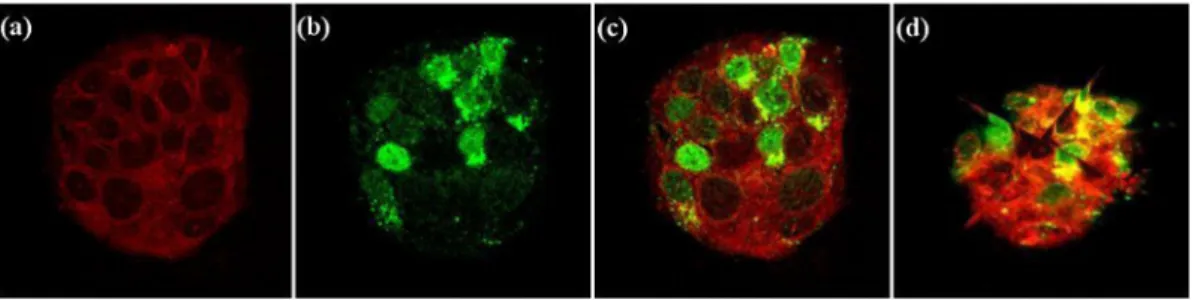
The 3-D sectioning capability permits visualising the distribution of Dox within the cells. Figure 5(d) highlights the 3-D distribution of Dox in H630-RT cells. The image consists of Z-stack of ten images
taken at 1mm steps. The visualisation of the 3-D distribution of
drug molecules shows that drugs are preferentially localised in
the cytoplasm and completely absent in the nuclei. These observa-tions demonstrated that Dox is differently distributed in the chemosensitive H630 and in their chemoresistant variants H630-RT.
Multimodal microscopy as a diagnostic tool for cancer: toward clinical application
The utilisation offluorophores is not always possible because of
their toxicity; hence, the focus of this research is to demonstrate
alternative imaging modalities.[29–32] Systems that can use
en-dogenous markers within the body are preferable, for example, redox measurements, SHG signals from collagen, TPEF from
autofluorescent elastin, and then CARS for examining specific
lipid or protein structures.
Figure 6 depicts a multimodal image of breast ductal
carci-noma embedded in paraffin compared with its H&E staining
and transmitted light. Note that all lipids were removed
chemi-cally with the paraffin during the dewaxing process. The
multi-modal image is rich in information that cannot be obtained from transmitted light or H&E staining. The CARS image at the
CH3vibration wavenumber (2950 cm 1) shows aggregations of
cells lying within extracellular matrix.
The multimodal image illustrates the localisation of these
pro-tein structures within the fibrous–collagen network and elastin
imaged by SHG and TPEF, respectively. The shape of these fea-tures indicates that these regions are solid tumours. These obser-vations concur with those that may be drawn from the H&E
stained sections, confirming the utility of NLO in this application.
Furthermore, Fig. 6 illustrates additional advantages of multi-modal imaging when compared with H&E staining. The high levels of SHG signal generated are associated with a highly ordered tissue; disorganised structures produce lower signal. This
suggests that the observed fibrous tissue is predominantly
constituted from collagen type I, as it has the crystalline and noncentrosymmetric properties required for generating high SHG
signal[33]. This organised structure of collagen is in a good
agree-ment with previous investigations showing the reorganisation of
collagenfibres to facilitate the local invasion of tumour cells.[34]
Likewise, 3-D information regarding the content, distribution and structure of collagen is easily accessible by adopting a multimodal
approach. This valuable information is beneficial to understanding
of the pathologic changes that occur in breast cancer and cannot be readily obtained using classical histolopathology techniques.
The results obtained demonstrate the usefulness of multimodality
for understanding the distribution of the elastin–collagen network of
the extracellular matrix in addition to the localisation of tumours, as
(a) (b)
Figure 4. (a) comparison of CARS images att= 20 min (Red) andt= 120 min (Blue) showing the morphology change of the cells because of the shrinkage of the cells under Dox effect. (b) Monitoring of Dox trafficking for 100 min. The movie (supporting information) is made of a total of 20 TPEF images taken every 5 min. Image size (150150mm) and accumulation time was 21 s per image. This figure is available in colour online at wileyonlinelibrary.com/journal/jrs
Figure 5. (130130mm) multimodal image showing the accumulation of doxorubicin in H630-RT chemoresistant cells after 24 h post-incubation with 10mM of Dox. (a) CARS images of H630 obtained at CH2stretch vibration wavenumber (2840 cm 1) showing the morphology of the cells, (b) TPEF
of Dox acquired using a band-passfilter at 580 nm, (c) overlay CARS/TPEF showing the localisation of Dox molecules in the nuclei and in the cytoplasm and (d) 3-D distribution of Dox inside the cells. Images were taken at 3mm inside the cells and with an acquisition of 21 s per image.
R. Mouraset al.
wileyonlinelibrary.com/journal/jrs Copyright © 2013 John Wiley & Sons, Ltd. J. Raman Spectrosc.2013,44, 1373–1378
well as their size and shape. These data show the ability of multi-modal microscopy to be translated into clinical applications.
Multimodal microscopy applications in regenerative medicine: monitoring stem cells differentiation to different lineages
Adult SCs are likely candidates for cell therapy and for the study ofin vitrodisease models. In both cases, label-free assessment of the differentiated state of SCs is desirable either to prevent any harmful effects that could be caused by unwanted lineage or to facilitate time course studies of cell differentiation. We investigated NLO to monitor the differentiation of ADSCs into adipocytes and osteoblast lineages by using only inherent sources of contrast. The induction of ADSCs towards two different cell lineages was monitored in a non-invasive manner by using CARS, TPEF and SHG simultaneously at different time points.
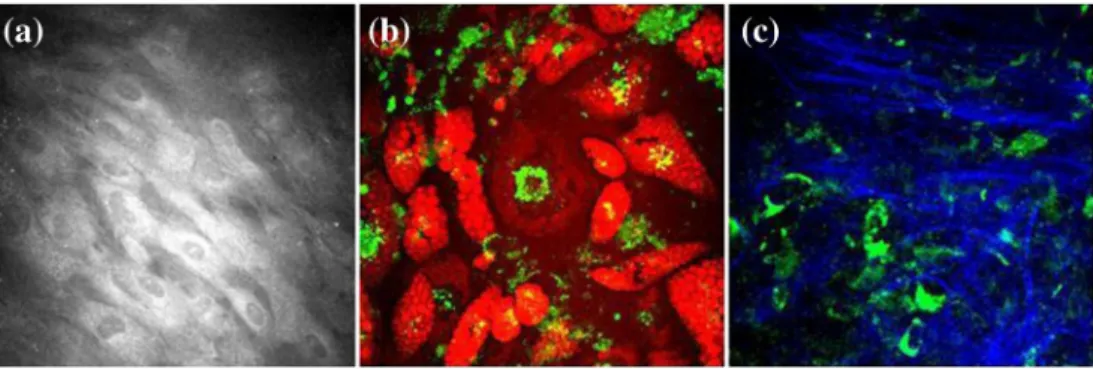
Figure 7 displays multimodal images of ADSCs induced towards adipogenesis and osteogenesis after 14 days post-induction, com-pared with the negative control (noninduced cells).
Changes in cell morphology, together with the appearance of
functional markers such as lipid droplet accumulation, andfibrous
collagen matrix deposition for, respectively, adipo-induced and
osteo-induced cells were observed. In addition, autofluorescent
features appeared near the nuclei and in the endoplasmic reticu-lum. The spectral peak of TPEF of these features was found between 580 nm and 610 nm. Previous studies showed that these
wavelengths correspond to thefluorescence offlavoproteins and
lipofuscin.[35,36]The increase of the number of these features as well
as their fluorescence signal during the differentiation process at
different stages revealed that changes in cell metabolism were occurring throughout ADSC differentiation towards osteoblasts and adipocytes. These results show the potential of multimodal microscopy as an enabling technology to investigate SC
differenti-ation, which is minimally invasive and is label-free.[37]CARS can be
used to characterise the morphology of the cells undergoing differ-entiation, TPEF to monitor the metabolic activity by imaging the
autofluorescence of flavoproteins, and SHG to investigate the
fibrous collagen deposition. It is clear that the acquiring multiple
image modes yield an enriched dataset with the ability to distinguish change in cell phenotype. It is probable that image processing, together with automated scanning, could enable the
screening of SC-basedin vitromodels.
Conclusion
We have shown the potential of multimodal NLO microscopy for applications in biomedical science. By using only endogenous markers, we have been able to do the following: (1) monitor ADSCs differentiation towards two discrete lineages: adipogenesis and osteogenesis, (2) follow anticancer drugs in WT cells and their chemoresistant type subclones and (3) image tumours in breast tissue biopsies and observe their localisation within the extracellu-lar matrix. The data obtained show that multimodal, multiphoton
microscopy holds significant promise for the real-time imaging of
drugs, cancer diagnosis and the non-invasive assessment of the
Figure 6. (Left): (10075mm) multimodal image of breast ductal carcinoma embedded in paraffin compared with its H&E staining (middle) and trans-mitted light (right). All lipids were removed chemically with the paraffin. CARS image obtained at CH3vibration wavenumber (2840 cm
1
) in proteins (red) highlighting the solid tumours lying in a connective tissue composed offibrous collagen and elastin probed with SHG (blue) and TPEF (green), respectively. The time acquisition was 21 s per image. Thisfigure is available in colour online at wileyonlinelibrary.com/journal/jrs
Figure 7. (212212mm) multimodal images of ADSC cells induced towards adipocytes and osteoblasts at day 14 post-induction showing changes in cell morphology and the appearance of functional markers such as lipid droplets (for adipocytes),fibrous collagen (osteopblasts) and FPs and lipofuscin. (a) CARS image of ADSCs control sample before induction obtained by probing the lipid stretch vibration wavenumber at 2840 cm 1. (b) Overlay of
CARS image (Red) of ADSC cells induced towards adipocytes obtained by probing the lipid stretch vibration wavenumber at 2840 cm 1(red) showing the formation of lipid droplets around the nuclei, and TPEF (Green) of FPs and lipofuscin indicating the metabolic activity of the cells undergoing dif-ferentiation towards adipocyte. (c) Overlay of SHG of depositedfibrous collagen (blue) and TPEF of FPs and lipofuscin (green) in ADSCs induced towards osteoblasts. The acquisition time was 21 s for all images. Thisfigure is available in colour online at wileyonlinelibrary.com/journal/jrs
differentiation state of SCs prior to their use for cell therapy in regenerative medicine and tissue repair. Additionally, it opens the doors to biologists to observe multiple complex physiological and biochemical processes in real-time and in a cellular background
that more closely reflects their natural environment, helping to
address persistent biological questions without the need to use labels or perturbing approaches.
Supporting information
Supporting information may be found in the online version of this article.
References
[1] J. De Gelder, K. De Gussem, P. Vandenabeele, L. Moens,J. Raman Spectrosc.2007,38, 1133.
[2] K. Hamada, K. Fujita, N. I. Smith, M. Kobayashi, Y. Inouye, S. Kawata,
Proc. SPIE2007,6443, 64430Z.
[3] Y. Harada, T. Ota, D. Ping, Y. Yamaoka, K. Hamada, K. Fujita, T. Takamatsu,
Proc. SPIE2008,6853, 685308.
[4] M. D. Duncan, J. Reintjes, T. J. Manuccia,Opt. Lett.1982,7, 350. [5] B. G. Saar, C. W. Freudiger, J. Reichman, C. M. Stanley, G. R. Holtom,
X. S. Xie,Science2010,330, 1368.
[6] A. Volkmer, J. X. Cheng, X. S. Xie,Phys. Rev. Lett.2001,87, 023901. [7] C. Heinrich, S. Bernet, M. Ritsch-Marte,Appl. Phys. Lett.2004,84, 816. [8] J. Moger, B. D. Johnston, C. R. Tyler,Opt. Express2008,16, 3408. [9] C. Krafft, A. A. Ramoji, C. Bielecki, N. Vogler, T. Meyer, D. Akimov,
P. Rösch, M. Schmitt, B. Dietzek, I. Petersen, A. Stallmach, J. Popp,
J. Biophoton.2009,2, 303–312.
[10] C. Y. Lin, J. L. Suhalim, C. L. Nien, M. D. Miljković, M. Diem, J. V. Jester, E. O. Potma,J. Biomed. Opt.2011,16, 021104.
[11] R. Mouras, G. Rischitor, A. Downes, D. Salter, A. Elfick, J. Raman Spectrosc.2010,41, 848.
[12] A. Zumbusch, G. Holtom, X. S. Xie,Phys. Rev. Lett.1999,82, 4142. [13] A. Kachynski, A. Kuzmin, P. Prasad, I. Smalyukh,Opt. Express2008,16,
10617.
[14] W. Denk, J. H. Strickler, W. W. Webb,Science1990,248, 73. [15] P. J. Campagnola, L. M. Loew,Nat. Biotech.2003,21, 1356. [16] J. Mansfield, J. Yu, D. Attenburrow, J. Moger, U. Tirlapur, J. Urban,
Z. Cui, P. Winlove,J. Anat.2009,215, 682.
[17] T. E. Matthews, J. W. Wilson, S. Degan, M. J. Simpson, J. Y. Jin, J. Y. Zhang, W. S. Warren,Biomed. Opt. Expr.2011,2, 1576. [18] V. Nucciottia, C. Stringarib, L. Sacconib, F. Vanzib, L. Fusia, M. Linaria,
G. Piazzesia, V. Lombardia, F. S. Pavone,PNAS2010,107, 7763. [19] A. Downes, R. Mouras, P. Bagnaninchi, A. Elfick,J. Raman Spectrosc.
2011,42, 1864.
[20] C. L. Evans, X. S. Xie,Annu. Rev. Anal. Chem.2008,1, 883. [21] A. Downes, R. Mouras, A. Elfick,J. Raman. Spectrosc.2009,40, 757. [22] L. Murray, The role of E-cadherin in colon cancer drug resistance,
PhD thesis, http://theses.gla.ac.uk/1943/, University of Glasgow,2010. [23] F. Lu, W. Zheng, Z. Huanga,App. Phys. Lett.2008,92, 123901. [24] F. Ganikhanov, C. L. Evans, G. G. Saar, X. S. Xie,Optics Lett.2006,31,
1872.
[25] J. X. Cheng, L. D. Book, X. S. Xie,Opt. Lett.2001,26, 1341. [26] F. A. Fornari, J. K. Randolph, J. C. Yalowich, M. K. Ritke, D. A. Gewirtz,
Mol. Pharmacol.1994,45, 649.
[27] N. Baldini, K. Scotlandi, M. Serra, S. Toshiharu, N. Zini, A. Ognibene, S. Santi, R. Ferracini, N. M. Maraldi,Eur. J. Cell Biol.1995,68, 226. [28] G. Wurzer, Z. Herceg, J. Wesierska-Gadek,Cancer Res.2000,60, 4238. [29] R. Mouras, A. Downes, G. Rischitor, M. Mari, A. Elfick,Proc. SPIE2010,
7569, 756933.
[30] H.W. Wang, L. L. Thuc, J. X. Cheng,Opt. Comm.2008,281,1813. [31] H. Chen, H. Wang, M. N. Slipchenko, Y. Jung, Y. Shi, J. Zhu,
K. K. Buhman, J.-X. Cheng,Opt. Express2009,17, 1282.
[32] R. S. Lim, A. Kratzer, N. P. Barry, S. Miyazaki-Anzai, M. Miyazaki, W. W. Mantulin, M. Levi, E. O. Potma, B. J. Tromberg, J. Lip. Res. 2010,51, 1729.
[33] T. Hompland, A. Erikson, M. Lindgren, T. Lindmo, C. de Lange Davies,
J. Biomed. Opt.2008,13, 054050.
[34] P. P. Provenzano, K. W. Eliceiri, J. M. Campbell, D. R. Inman, J. G. White, P. J. Keely,BMC Med.2006,4, 38.
[35] W. L. Rice, D. L. Kaplan, I. Georgakoudi,PLoS One2010,5, e10075. [36] W. L. Rice, D. L. Kaplan, I. Georgakoudi,J. Biomed. Opt.2007,12,
060504.
[37] R. Mouras, P. Bagnaninchi, A. Downes, A. Elfick,J. Biomed. Opt.2012,
17(11), 116011.
R. Mouraset al.
wileyonlinelibrary.com/journal/jrs Copyright © 2013 John Wiley & Sons, Ltd. J. Raman Spectrosc.2013,44, 1373–1378