Validating and Applying a Novel Method of Assessing Trauma Burden in a
Resource Poor Setting
By
Javeria S. Qureshi
A Master’s Paper submitted to the faculty of
the University of North Carolina at Chapel Hill
In partial fulfillment of the requirements for
the degree of Master of Public Health in
the Public Health Leadership Program.
Chapel Hill
2012
_____________________________/
Advisor signature/printed name
Second Reader Signature/printed name
_________16 July 2012______
ABSTRACT
Introduction:
Trauma, particularly Road Traffic Injury (RTI), is a leading cause of global death. African RTI mortality is among the highest in the world, at 28.3 deaths per 100 000 population. However, this burden of injury may be underestimated for the African region as only 7% of cause of death information is obtained from population based vital registration systems. The Verbal Autopsy (VA) method has been extensively used to assess maternal and child deaths in resource poor settings by analyzing the deceased's symptoms and circumstances as reported by family members. Here we present the validation and application of a VA tool to assess trauma burden in Lilongwe, Malawi, an urban sub Saharan African setting.
Methods:
A modified World Health Organization (WHO) VA tool was administered at the Kamuzu Central Hospital (KCH) morgue in Lilongwe, Malawi to family members of inpatient deceased. Two physicians assigned cause of death as ‘trauma’ or ‘non-trauma’ as well as a simplified ICD-10 code based on the Verbal Autopsy questionnaire. These assignments were compared to the ‘gold standard’ of physician review of hospital records using a kappa statistic. The validated tool was then applied to deceased from the community who were “brought in dead” (BID) to the morgue.
Results:
The VA method had near perfect agreement with the hospital record in determining “trauma” versus “non-trauma” while there was moderate agreement when comparing types of death e.g cardiovascular disease versus infectious disease. When applied to the BID population, it showed a significantly higher percentage of RTI deaths in BID versus in-hospital deceased while the total trauma burden was similar in BID versus in-hospital deaths.
Conclusion:
TABLE OF CONTENTS
Background………... 4
Methods………. 6
Results………..10
Discussion………... 14
References………... 18
Background
Injuries are recognized as a leading cause of global death and disability, with road traffic injuries (RTIs) being the greatest contributor [1]. Injuries due to road traffic crashes are estimated to be the second leading cause of lost disability-adjusted life years (DALYs) in developing countries by 2020 [2]. Injuries disproportionately affect adult males aged 15-59 years, thus impairing the most productive members of society in the developing world, who support not only economic growth but whose families’ health depends on them [3]. In 2004, RTIs were 2.2% of all deaths and ranked ninth in worldwide causes of death [4]. Mortality due to RTI in Africa is among the highest in the world, at 28.3 deaths per 100 000 population while North America (Canada and U.S.) have a rate of 14.6 deaths per 100 000 population and Europe has the lowest mortality due to RTI at 11.0 deaths per 100 000 population [5]. However, this burden of injury may be grossly underestimated for the African region as only seven percent of cause of death information was obtained from population based vital registration systems [4].
Malawi, like many nations in sub-Saharan Africa, does not have a vital registration system. Information on injury or trauma mortality has previously been estimated based on police reports and hospital-based trauma registries [6]. This is an immense public health problem as any intervention to reduce trauma and/or injury burden does not have accurate data on the scope of the problem. Therefore, it is unclear to policy makers which interventions would be most effective to reduce the burden of injury and trauma. The first step in addressing the lack of data on the burden of injury in Malawi has been the establishment of hospital based trauma registries.
Dead (BID; also know as Dead on Arrival), it is well documented that most deaths in low- and middle-income countries go unrecorded and vital registration data, if recorded are often missing, incomplete or inaccurate [8]. Knowledge about the distribution of causes of death in a population is essential for public health planning, resource allocation and measuring the impact of interventions. Medically certified cause of death data are available for less than one third of over 58 million deaths occurring worldwide annually [4]. We recognized that in Malawi, similar to many other LMIC, rapid improvement of poorly
performing vital registration system to accurately estimate the burden of trauma is not realistic. Although attaining quality vital registration data remains our long-term goal, alternative methods of ascertaining and estimating trauma burden at the population level must be used in the interim.
Verbal autopsy (VA) is an indirect method of ascertaining biomedical causes of death from information on symptoms, signs and circumstances preceding death, obtained from the deceased’s caretakers. During the 1980s and early 1990s, it had been widely used as a method of ascertaining causes of death in children in places where the majority of deaths occur without medical supervision [3, 9-13]. However, due to the predominant use of estimates and modeling to provide cause of death information for LMIC, particularly in sub-Saharan Africa, there was a growing interest in the use of VA in the context of disease surveillance and vital registration systems, particularly for causes of death in adults [8]. We decided to use verbal autopsy of adult deaths presenting to the KCH mortuary to augment the findings of the KCH trauma registry, and ultimately develop a better measurement of the burden of trauma in Lilongwe, Malawi. We hypothesized that the burden of trauma related deaths in the community exceeds inpatient trauma deaths due to the absence of pre-hospital care or resuscitation. Those traumas arriving to the hospital have already exceeded the “golden hour” so they are most likely to survive, whereas the
Materials and Methods
Study area and population
Malawi is a landlocked nation in the southeast region of sub Saharan Africa with a population of 16 million on a land area of 90, 080 square kilometres, making it one of the most densely populated nations in sub Saharan Africa [14]. This study was conducted at Kamuzu Central Hospital (KCH), a 600-bed tertiary care centre situated in Lilongwe, the capital city of Malawi with a catchment population in 5 million people in the central region. There is a 4-bed intensive care unit (ICU), a 4-bed surgical high dependency unit (SHDU), and three surgical, one orthopedic adult ward and three pediatric surgical wards. There is no pre-hospital care system in Malawi and minimal basic life support measures are available prior to hospital arrival.
The KCH mortuary is located on the main hospital grounds. It is staffed by a director as well as three to four assistants who embalm and prepare bodies for burial. All inpatient deaths are brought to the mortuary by hospital staff while community deaths or brought-in-dead patients are brought to the
mortuary by family members, bystanders or police, and kept at the mortuary until families collect the bodies for burial. Many Malawians prefer to be buried in their home village, even if urban dwellers, therefore the main element determining the time to body collection is the ability of the family to pay for transport to the home village.
Interview Process
while the closed questions dealt with specific symptoms and conditions. Interviewers administered the questionnaire to those who had witnessed the deaths and/or took care of the deceased at the time of body collection from the KCH mortuary.
All interviewers had both completed secondary school education and were fluent in the local language, Chichewa. They had no medical training to eliminate the possibility of attribution bias. They were trained in how to approach grieving respondents and request interviews. A supervisor coordinated the interviewer activities, oversaw data collection process and checked questionnaires for completeness, as well as randomly witnessing about 5% of interviews to assure quality control. In most cases, data was collected within one week of death. Those respondents who were too despondent to respond immediately were offered a telephone interview at a later date.
Validation of UNC/KCH Verbal Autopsy Questionnaire
We used physician certified verbal autopsy (PCVA) to assign cause of death based on the
UNC/KCH Verbal Autopsy questionnaire. Historically, the gold standard for cause of death assignment in a vital registration system is physician or hospital assigned cause of death (HCOD). In order to validate PCVA, we compared how it performed against HCOD for the same patient subset.
Physician certification of VA questionnaires
Hospital cause of death (HCOD): the “gold standard”
The inhospital cause of death at KCH was recorded by a physician member of the VA study team. This physician reviewed the charts of all in-hospital deaths and cause of death assigned by hospital
personnel. Hospital diagnosis was based on standard guidelines (full medical history) and reflected the best judgment of the physician, substantiated by relevant radiological or laboratory investigations. In cases where cause of death was not clearly stated by the provider, the VA study physician reviewed patient’s presentation, history, exam and all available laboratory and imaging data. The final diagnosis
was coded based on the VA list of causes of death by the WHO, which the WHO has correlated with ICD-10 diagnoses (REF). The physician collecting HCOD data was separate from the physicians assigning PCVA and was blinded to those assignments.
Assessment of Brought In Dead Trauma Burden
We estimated that the burden of trauma in inpatient deaths was about ten percent based on review of which wards patients were coming from in the mortuary register. Using this as a reference point, power analysis indicated that we would require over 400 interviews of inpatient deaths to validate the
UNC/KCH VA questionnaire to assess trauma burden. These interviews were conducted between 12 April 2010 and 20 December 2010. Following validation, we conducted interviews of only brought in dead to the KCH mortuary from 12 March 2011 to 12 June 2011, a three month period. The validated PCVA method was used to assess trauma burden in the brought in dead cohort.
Ethical approval
Data management and statistical Analysis
HCOD was used as the gold standard for validating PCVA based on the primary cause of death. Cause-specific mortality fractions (CSMF) were used to measure agreement at population level and case-by-case agreement between the methods was measured by Cohen’s kappa [15].
Mortality fractions
Cause-specific mortality fractions (CSMF) were determined as the proportion of all deaths that were attributed to a specific cause across the HCOD and the PCVA.
Cohen’s Kappa statistic
We used Cohen’s kappa statistic to measure the level of agreement between the PCVA and the
HCOD (the gold standard) for the underlying causes of death.
The kappa measure of agreement is stated as:
= P(A) – P(E) 1 - P(E)
Where P(A) is the proportion of times the raters agreed, and P(E) is the proportion of times the raters were expected to agree by chance alone. Complete agreement corresponds to a kappa of 1, complete disagreement corresponds to a kappa value of 0. A negative value of kappa would mean negative agreement. We used the following kappa scale to rate the strength of agreement as described previously [16]: a < 0.21 is considered poor, a between 0.21 and 0.40 fair, a between 0.41 and 0.60 moderate, a between 0.61 and 0.80 good, and a > 0.80 very good.
Results
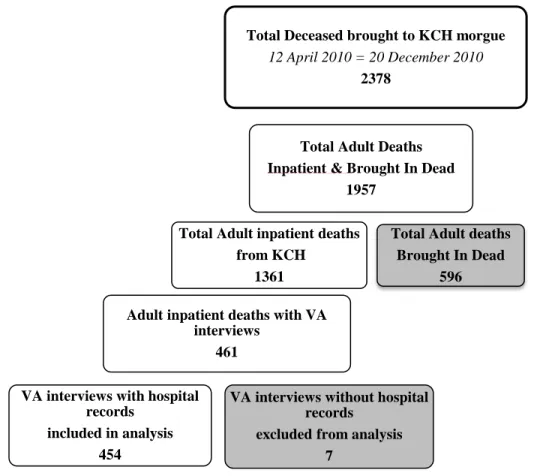
From April to December 2010, 2378 bodies were brought to the KCH morgue. Of these 1957 were adult deaths, and 1361 were inpatient adult deaths. Four hundred sixty-one deceased family or caregivers acquiesced to interviews and of these, 454 had hospital records and were included in the analysis (Figure 1). The mean age at death for the inpatient population was 43 years ± 18 years), and 43% were male and 57% were female. On the basis of Physician Coded Verbal Autopsy (PCVA), 423 (93%) cases were coded with a cause of death and 31 (7%) cases were coded as indeterminate.
Figure 1: Patient Selection for validation of UNC/KCH Verbal Autopsy (VA) questionnaire
The majority of deaths were attributed to five categories by both HCOD and PCVA; these were Infectious disease, Cardiovascular disease, Injury, Cancer and Gastrointestinal disease. The mortality
Total Deceased brought to KCH morgue 12 April 2010 = 20 December 2010
2378
Total Adult Deaths Inpatient & Brought In Dead
1957
Total Adult inpatient deaths from KCH
1361
Total Adult deaths Brought In Dead
596
Adult inpatient deaths with VA interviews
461
VA interviews without hospital records
excluded from analysis 7
VA interviews with hospital records
fractions obtained from PCVA were compared to those cited by HCOD (Figure 2). The PCVA mortality fractions were within one percent of the gold standard HCOD for four of the five categories and within two percent for the fifth category (gastrointestinal disease). Both PCVA and HCOD designated infectious disease as the highest cause of death with PCVA attributing 238 deaths (52.5%) to infectious disease and HCOD attributing 236 deaths (52.1%). With regards to injury, PCVA attributed 46 (10.2%) deaths to injury, while HCOD designated 47 (10.4%) deaths to injury. (Figure 2)
Figure 2: Cause specific mortality fractions for 454 adult inpatient deaths
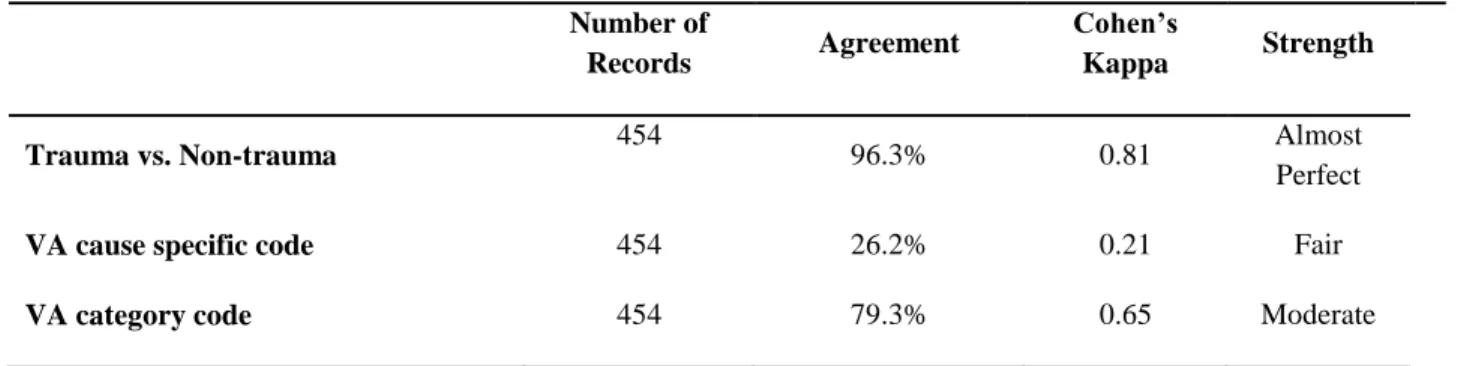
The Cohen’s Kappa () for trauma versus non-trauma designation between PCVA and HCOD
had near perfect agreement, = 0.81 (Standard Error 0.05) and 96.3% agreement (Table 1). However, for
cause specific code (for example, HIV versus Tuberculosis), the = 0.21 (Standard Error 0.01) with
26.2% agreement which is considered fair while for disease categories (for example, infectious disease versus cardiovascular disease), the = 0.65 (Standard Error 0.04) with 79.3% agreement which is considered moderate agreement.
0 10 20 30 40 50 60
Between 12 March 2011 and 12 June 2011, VA interviews were conducted for those “brought in dead”
(BID) to the KCH mortuary, i.e. people who had died outside of the hospital. A total of 962 bodies were brought to the mortuary during this period (both adult and child deaths). Of these, 715 (74%) were adult deaths and 174 (24%) of the adult deaths were BID, and were brought to the mortuary. Seventy-three percent (127 families) of the 174 BID were interviewed. (Figure 3)
Figure 3: Flowchart for interviews of only Brought In Dead
Total Adult & Child deaths brought to KCH morgue
12 March 2011 = 12 June 2011
962
Total Adult Deaths Inpatient & Brought In Dead
715
Total Adult BID 174
KCH Inpatient Adult deaths 541
Adult BID with VA interviews 127
Table 1: Cohen’s Kappa for PCVA vs. HCOD
Number of
Records Agreement
Cohen’s
Kappa Strength
Trauma vs. Non-trauma 454 96.3% 0.81 Almost
Perfect
VA cause specific code 454 26.2% 0.21 Fair
The top five categories of mortality were the same for both the inpatient population studied in the validation phase and the BID population. (Figure 4) According to Physician Coded Verbal Autopsy (PCVA), infectious diseases remained the highest cause of mortality in BID patients followed by injury, gastrointestinal disease, cancer and cardiovascular disease. However, injury constituted a higher
percentage of deaths in the BID population than in the inpatient population. (Table 2)
Figure 4: Category specific mortality fractions BID versus Inpatient
Based on Physician Coded Verbal Autopsy (PCVA), 13.4% of the BID died due to injury while only 10.4% of the inpatient population died due to injury. In addition, of the 47 patients who died due to injury in the inpatient population, only 14 (3.1% of the total deaths) were due to road traffic injuries (RTIs) or their complications. Whereas of the 17 patients who died due to injury or trauma in the BID population, 14 (11% of the total) died due to road traffic injuries, almost three times what was found in the inpatient population.
0 10 20 30 40 50 60
Table 2: Burden of Traumatic Injury in Brought-In-Dead Patients
Discussion
Many previous studies have validated the verbal autopsy methodology for mortality estimation in adults [13, 17-19], however we believe this is the first study using this method specifically to assess trauma-related adult mortality. Our study shows that Physician Certified Verbal Autopsy (PCVA) method can accurately quantify the burden of non-hospital trauma deaths in resource poor settings and provides an adjunct to hospital based trauma registries to quantify the burden of trauma in LMIC.
From a public health standpoint, assessing mortality burden due to a certain disease category versus a specific cause of death is most important. The Physician Certified Verbal Autopsy (PCVA) method reported category specific mortality within 2% of Hospital Certified Cause of Death (HCOD) for the top five categories of mortality. Therefore PCVA had broad agreement with HCOD at the population level, providing useful information towards healthcare allocation of resources.
With regards to trauma burden, PCVA had near perfect agreement with HCOD and only varied substantially with regards to specific cause of non-traumatic deaths. This is understandable as the majority of deaths in the validation phase were due to infectious diseases and our hospital setting many patients present with HIV and other co-infections, therefore it is difficult to ascertain the exact cause of death. For our purposes, PCVA provided an accurate assessment of trauma burden based on the validation phase.
Total Deaths Trauma RTIs
Inpatient 453 47 (10.4 %) 14 (3.1%)
Upon assessing trauma burden in the brought-in-dead (BID) population, PCVA revealed that the burden of injury death in the BID population was similar to that in the inpatient population of the
validation phase, but the type of injuries were significantly different. The BID population had three times the number of deaths due to road traffic injuries (RTIs) than the inpatient population. This intuitively makes sense as those who died on the road would not be brought to the hospital. But it also shows that hospital based trauma registries significantly underestimate the burden of RTIs and this highlights the importance of improved pre-hospital trauma care as a strategy to reduce RTI mortality in addition to improving in-hospital trauma care.
This can be daunting in an environment such as Malawi, with a well-documented dearth of health care workers [20]. However, one alternative is basic trauma care training to members of the public, who would be the most-likely first responders at a traffic crash. While there is not any definitive data to show that this is effective, there are positive findings from studies conducted in Uganda and Sierra Leone [21, 22].
Limitations
Using verbal autopsy in a resource poor setting presents some key obstacles. First, the language and cultural context are different so that the interviewer has to translate the caregiver’s viewpoint to answer the specific questions of the questionnaire. In addition, the basis of verbal autopsy validation uses hospital cause of death as the “gold standard.” However at KCH, like many other public hospitals in
sub-Saharan Africa, health care workers are overwhelmed and on multiple instances minimal diagnostic methods were used to justify the cause of death assigned in the patient chart. For example, adults with fever during the rainy season were often written to have died of “malaria” without any documentation of a
should be qualified as the “best possible” or “most reasonable” cause of death in a resource limited setting.
Future Directions
Historically, physician review of the verbal autopsy questionnaire (PCVA) is used to assign cause of death. This process is time consuming, particularly in a setting with a dearth of health care providers. More recently, probabilistic modeling has been put forward as a viable methodology to infer cause of death from a pattern of symptoms. We plan on using InterVA, one probabilistic modeling method that has previously been validated [23, 24], to assess whether this is a better method than PCVA to assess trauma burden as it is less time consuming..
In addition to the RTI data, we expect data from the VA mortuary registry will give a better idea of the burden of untreated surgical disease in the community. These findings can help determine the most effective surgical diseases to address in the community. At this time it is unclear what role malignancies, burn injuries or even congenital malformations have in community deaths. The initial survey of
community based all cause mortality from the VA study will determine future directions of study.
Leadership Recommendations
patients and prevent some patients from dying en route to the hospital.
Second, I would share the information on RTI deaths with the KCH administration and Road Traffic Council (RTC) of Malawi. The RTC collects information on all road-related deaths using police reports. The information collected on BID patients should be compared to RTC information to determine how many road traffic deaths occurred in Lilongwe during the study period. In addition, the verbal autopsy team should continue working at the KCH mortuary for one year. Subsequently the road traffic death information for Lilongwe district should be compared to another similar districts such as Blantyre. If Lilongwe district is able to provide more detailed road traffic death information than other districts then a case can be made to the Ministry of Health to place verbal autopsy teams at each of the other central hospitals (Mzuzu, Zomba, and Queen Elizabeth Central Hospital in Blantyre) to improve cause of death information on all deaths but particularly road traffic deaths. This integration of information would be coordinated by a group of clinicians, researchers and policymakers whose focus would be to reduce trauma burden in Malawi, as well as improve trauma care. This group would also raise public awareness about the burden of trauma and encourage the basic life support training of laymen.
Conclusion
References
1. Peden M: Global collaboration on road traffic injury prevention. Int J Inj Contr Saf Promot 2005, 12(2):85-91.
2. Murray CJ, Lopez AD: Alternative projections of mortality and disability by cause 1990-2020: Global Burden of Disease Study. Lancet 1997, 349(9064):1498-1504.
3. Phillips M, Feachem RG, Murray CJ, Over M, Kjellstrom T: Adult health: a legitimate concern for developing countries. Am J Public Health 1993, 83(11):1527-1530.
4. Mathers CDB, T.; Ma Fat, D.: Global and regional causes of death. British Medical Bulletin 2009, 92:7 - 32.
5. Ameratunga S, Hijar M, Norton R: Road-traffic injuries: confronting disparities to address a global-health problem. The Lancet 2006, 367(9521):1533-1540.
6. Samuel JC, Sankhulani E, Qureshi JS, Baloyi P, Thupi C, Lee CN, Miller WC, Cairns BA, Charles AG: Under-reporting of road traffic mortality in developing countries: application of a capture-recapture statistical model to refine mortality estimates. PloS One 2012, 7(2):e31091.
7. Samuel JC, Akinkuotu A, Villaveces A, Charles AG, Lee CN, Hoffman IF, Miller WC, Baloyi P, Hoffman M, Brown LB et al: Epidemiology of injuries at a tertiary care center in Malawi. World J Surg 2009, 33(9):1836-1841.
8. Setel PW, Macfarlane SB, Szreter S, Mikkelson L, Jha P, Stout S, AbouZahr C, Monitoring of Vital Events (MoVE) writing group: Who Counts? A scandal of invisibility: making everyone count by counting everyone. Lancet 2007, 370:1569-1577.
9. Kumar VD, N.: Lay reporting and verbal autopsy in assessment of infant mortality. Indian J Pediatr 1986, 53(6):672 - 674.
10. Datta NM, M.; Kumar, V.: Validation of causes of infant death in the community by verbal autopsy. Indian J Pediatr 1988, 55(4):599 - 604.
11. Bang ATB, R.A.: Diagnosis of causes of childhood deaths in developing countries by verbal autopsy: suggested criteria. The SEARCH Team. Bulletin of the World Health Organization 1992, 70(4):499 - 507.
12. Martinez HR, H.; Tome, P. Guiscafre, H.; Gutierrez, G.: The verbal autopsy: a tool for the study of mortality in children. Bol Med Hosp Infant Mex 1993, 50(1):57 - 63.
13. Chandramohan D, Maude GH, Rodrigues LC, Hayes RJ: Verbal autopsies for adult deaths: issues in their development and validation. International journal of Epidemiology 1994, 23(2):213-222.
14. Organization WH: WHO Country Cooperation Strategy 2008-2013 Malawi. In., Second edn; 2009.
15. Cohen J: A coefficient of agreement for nominal scales. Educational and Psychological Measurement 1960, 20:37-46.
16. Roberts CMR: A matrix of kappa-type coefficients to assess the reliability of nominal scales. Stat Med 1998, 17(4):471-488.
17. Lulu KB, Y.: The use of simplified verbal autopsy in identifying causes of adult death in a predominantly rural population in Ethiopia. BMC Public Health 2005, 3(5):58.
18. Kumar RT, J.S.; Rao, B.T.; Singh, M.M.; Bhatia, S.P.: Validity of verbal autopsy in determining causes of adult deaths. Indian Journal of Public Health 2006, 50(2):90 - 94. 19. Kahn KT, S.M.; Garenne, M.; Gear, J.S.: Validation and application of verbal autopsies in a
rural area of South Africa. Tropical Medicine & international health 2000, 5(11):824 -831. 20. Initiative JL: Human Resources for Health: Overcoming the Crisis. In.: Harvard University;
2004.
prehospital trauma care program for lay first-responders in Kampala, Uganda. PloS One 2009, 4(9):e6955.
22. Leow JJ, Brundage SI, Kushner AL, Kamara TB, Hanciles E, Muana A, Kamara MM, Daoh KS, Kingham TP: Mass casualty incident training in a resource-limited environment. The British journal of surgery 2012, 99(3):356-361.
23. Byass PH, D.L.; Minh, H.V.: A probabilistic approach to interpreting verbal autopsies: methodology and preliminary validation in Vietnam. Scandinavian Journal of Public Health Supplement 2003, 62:32 - 37.
24. Oti SO, Kyobutungi C: Verbal autopsy interpretation: a comparative analysis of the InterVA model versus physician review in determining causes of death in the Nairobi DSS.