Sharif University of Technology
Scientia IranicaTransactions A: Civil Engineering http://scientiairanica.sharif.edu
Optimal domain decomposition using the global
sensitivity analysis-based metaheuristic algorithm
A. Kaveh
a;and V.R. Mahdavi
ba. Centre of Excellence for Fundamental Studies in Structural Engineering, Iran University of Science and Technology, Narmak, Tehran, P.O. Box 16846-13114, Iran.
b. School of Civil Engineering, Iran University of Science and Technology, Narmak, Tehran, P.O. Box 16846-13114, Iran. Received 6 October 2016; accepted 30 May 2017
KEYWORDS Optimal domain decomposition; Global Sensitivity Analysis-Based (GSAB);
k-median method; Finite-element meshes.
Abstract. In this paper, an ecient approach is presented for nding optimal domain decomposition in conjunction with k-median method. Using the clique graph, the connectivity properties of nite-element meshes are represented. In order to divide the nodes of the graph or the meshes of the nite-element model into k subdomains, k-median approach is employed. For optimal subdomaining, a recently developed metaheuristic algorithm, called Global Sensitivity Analysis-Based (GSAB), is utilized. The performance of the proposed method is investigated through three nite-element models to minimize the cost of the k-median problem. A comparison of the numerical results obtained using the proposed method with those obtained by standard Colliding Bodies Optimization (CBO) and Particle Swarm Optimization (PSO) algorithms indicates that the proposed technique is capable of obtaining more promising solutions using less computational eorts.
© 2018 Sharif University of Technology. All rights reserved.
1. Introduction
Parallel processing has been widely applied to large-scale problems, such as the analysis of hydraulic sys-tems, electrical networks, and nite-element meshes. The aim of a parallel algorithm is to decompose the given domain of system into subdomains and analyse each subdomain by a processor. The dependency between substructures is resolved after completing the study of individual substructures.
Some algorithms were developed for optimal do-main decomposition of nite-element models [1-6], and some review papers on this topic are also available [7,8]. Finding the medians of a graph is an NP-hard combina-torial optimization problem, and the exact solution to
*. Corresponding author. Tel.: +98 21 44202710; Fax: +98 21 77240398
E-mail address: [email protected] (A. Kaveh) doi: 10.24200/sci.2017.4508
the problem is complex and highly time consuming for graphs with a large number of nodes. Such algorithms can be found in the works of [9-12]. Therefore, many approximate algorithms are developed for nding the medians of a graph. The simplest approach to dealing with domain decomposition is referred to as the k-median method [7]. In this method, a graph is associ-ated with the topological property of the nite-element models. Then, the optimal medians in the graph are selected, such that the sum of the distances of nodes to medians becomes optimum. Recently, methods have been developed using metaheuristics, such as Genetic algorithms [13,14], bionomic approaches [15], ant colony [16,17], particle swarm optimization, and colliding bodies optimization [18], for obtaining solu-tions to the k-median problem.
As a newly developed metaheuristic algorithm, the Global Sensitivity Analysis-Based (GSAB) algo-rithm is introduced for the design of structural prob-lems [19]. In this method, the search space of the op-timization is determined using the sensitivity indicator
of variables. Unlike many metaheuristic algorithms, in which all the variables are simultaneously changed in the optimization process, in this approach, the sensitive variables of the solution iteratively change more rapidly than the less sensitive ones in the search space. This algorithm utilizes simple formulation and requires no parameter tuning.
In this paper, an algorithm based on the k-median concept is presented for optimal domain decomposi-tion of nite-element meshes with continuous variables using the GSAB algorithm. Computer programs are developed to perform this optimization, and three numerical examples with dierent domain shapes are presented to demonstrate the eciency of the proposed method.
2. Mathematical formulation of the median problem
The aim of the k-median problem is to cut a node set, N, into k-node Nk 2 N, such that the sum of
the distances of nodes to the median nodes becomes minimum. The problem of k-median can be stated as optimizing a function which decomposes domain G into k subdomains, G1; G2; ; Gk, where k is the number
of subdomains [20]. The objective function, which must be minimized, is formulated as follows:
0(Nk) =
X
j2N
vjd(Nk; j); (1)
where 0(Nk) is called out-transmission of nodes Nk;
Nk is the median node number; vj is the weight of the
node j; and d(Nk; j) is dened as follows:
d(Nk; j) = min[d(i0; j)] : (i0 2 Nk): (2)
Let i0 be the node of Nk which corresponds to the
minimum value of Eq. (1), and then node j is allocated to i0. A shortest-route tree is rooted in each node for
obtaining the shortest distance between nodes [5]. In order to nd the nodal numbers of the medians of a graph, the coordinates of the medians are consid-ered as the variables of the optimization process. Then, the nearest nodes from this coordinate are selected as the medians of the graph. Otherwise, if nodal numbers are considered as optimization variables, due to the high number of meshes in nite-element models, the search space becomes very large; secondly, discrete variables should be used in the optimization process. Therefore, in this work, the proposed optimization algorithm is considered to use the continuous variables.
3. A global sensitivity analysis-based algorithm
This section introduces a Global Sensitivity Analysis-Based (GSAB) optimization algorithm, which is a
single solution search method. The proposed algorithm is named as \Global Sensitivity Analysis (GSA)" be-cause of determining the Sensitivity Indicator (SI) of decision variables for guiding the search boundaries of the algorithm.
The samples/populations of GSAB algorithm are used for two purposes: estimating the SI of decision variables and nding the single-solution of the algo-rithm. Since these samples are not updated iteratively, the proposed GSBA is studied within the single-solution metaheuristic category. The feasibility space of samples in the GSAB algorithm is updated for searching the optimal solution over several iterations. In each iteration, the feasibility space is updated using two values consisting of the sensitivity indicators and the global best sample. It is assumed that the problem is a minimization problem in RD. The notations used
are as follows:
St The sample matrix in the tth iteration,
St= [Xt
iji = 1; 2; ; N];
Xt
i The position of sample vector i in
the tth iteration, Xt
i = fxtijjj =
1; 2; ; Dg;
Xmin The minimum allowable values vector
of variables, Xmin = fxminjjj =
1; 2; ; Dg;
Xmax The maximum allowable values vector
of variables, Xmax = fxmaxjjj =
1; 2; ; Dg;
f(Xi) The tness of vector i;
UBt The upper search boundary vector
of variables in the tth iteration, UBt= fubt
jjj = 1; 2; ; Dg;
LBt The lower search boundary vector
of variables in the tth iteration, LBt= flbt
jjj = 1; 2; ; Dg;
BWt The bandwidth of search space
of variables in the tth iteration, BWt= fbwt
jjj = 1; 2; ; Dg;
SFt The scale factor of bandwidth of
search space in the tth iteration, SFt= fsft
jjj = 1; 2; ; Dg;
Sbest The global best sample (i.e., with lower tness), Sbest = fsbestjjj =
1; 2; ; Dg;
R A random vector within [0,1]. 3.1. Methodology
The following steps outline the main procedure to implement the GSAB.
Step 1. Initialization: The initial positions of samples are determined with random initialization in
the search space: X0
i =Xmin+R(Xmax Xmin); i=1; 2; ; N; (3)
where X0
i determines the initial value vector of the
ith sample, and N is the number of samples;
Step 2. Calculation of the sensitivity indices of variables: In this step, the outputs (the objective function of the optimization problem) are calculated rst. The sensitivity analysis is conducted next for the generated samples, and the Sensitivity Indicators (SIs) of variables are calculated.
The most well-known methods for calculat-ing the variance-based sensitivity indicators are the Monte Carlo simulations; however, these do not make full use of each output model evaluation. In order to calculate the variance-based sensitivity indicators from the given data, the scatter plot partitioning method can be utilized [21]. For this method, a single set of samples suces to estimate all the sensitivity indicators. For estimating the variance-based sensitivity indices, suppose that there are N points/samples fX1; ; XNg and N model output
samples fy1; ; yNg obtained using model y =
g(X). The variance of Y can be calculated by sample variance V (y). For the sample bounds of Xi as
[b1; b2], let it be decomposed into s successive, equal-probability and non-overlapping subintervals Ak =
[ak 1; ak), with k = 1; ; s, b1 = a0 < a1 <
< ak < < as = b2, and Pr(Ak) = 1=s.
Decompose the output samples fy1; ; yMg into s
subsets according to the decomposition of Xi, where:
Bk = fyjjxji 2 Akg; k = 1; ; s:
The conditional variance V (Y jxi 2 Ak) can then be
evaluated by the following:
V (Y jxi 2 Ak) = V (Bk): (4)
The expected conditional variance, Exi(V (Y jxi)),
can now be evaluated approximately using the fol-lowing relationship:
Exi(V (Y jxi))
1 s
s
X
k=1
V (Bk): (5)
Ultimately, the sensitivity indicator of the ith vari-able, SIi, is calculated as follows:
SIi=V (Y ) EV (Y )Xi(V (Y jXi)=1 EXi(V (Y jXV (Y ) i):
(6) In sensitivity analysis, SIi varies between 0 and
1. The lower value of SIi corresponds to the less
inuential Xi; the higher value of SIi corresponds to
the much inuential Xi; for SIi= 0, Xi will have no
inuence on Y ;
Step 3. Denition of the search boundaries: In the GSAB algorithm, the search boundaries are moved around to the global best sample (which is updated and memorized in each iteration), Sbest, to push the samples into the feasible search space. The search boundaries are also decreased based on the values of sensitivity variables, which are evaluated in the previous step. Hence, the upper and lower boundaries of the search space of variables in the t+1th iteration can be computed by the following:
UBt+1= Sbest + BWt SFt Xmax;
LBt+1= Sbest BWt SFt X
min; (7)
where BWt and SFt are the bandwidth and scale
factor of boundaries in the tth iteration, respectively. Eq. (7) ensures that the current search space is moved around Sbest with bandwidth BWtin the
D-dimensional space. Vector BWtcan be calculated as
follows:
BWt= max(Sbest LBt; UBt Sbest): (8)
For the algorithm to converge to a near-optimal solu-tion, further exploitation (strong locality) is required to move the current solution towards the optimal one. In the proposed GSAB algorithm, this is achieved by using a scale factor, SF. For this purpose, once SI values of variables are calculated, the most sensitive variable, i.e., variable with high SI value, is identied for reducing the bandwidth; then, SF is calculated as follows:
SFj=
(
1 sij if sij = max(SI)
1 Otherwise
8j = 1; ; D: (9) This equation shows that the bandwidth of the most sensitive variable decreases, while other bandwidths are constant in the tth iteration;
Step 4. Replacement of the current samples: In this step, the samples must be ensured to be inside the new search boundaries. For this purpose, the samples that exceed the boundaries are regenerated randomly in the new search boundaries as follows:
Xt+1 i = 8 > > > < > > > : Xt
i; LBt+1 Xit UBt+1;
LBt+1+R(UBT+1
LBt+1) Otherwise; (10)
where i = 1; 2; ; N, and t represents the iteration index.
Figure 1. Flowchart of the GSAB.
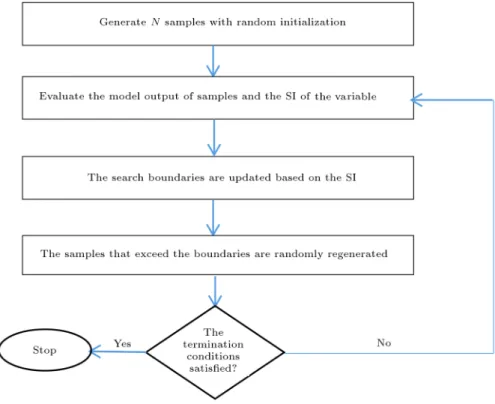
repeated from Step 2 until a termination criterion, such as maximum iteration number or no improve-ment of the best sample, is satised. In the GSAB algorithm, if the maximum bandwidth of the search space, max(W ), becomes smaller than 0.000001, the optimization process will be terminated. This is because the GSAB cannot change the search space of the agents. For the sake of clarity, the owchart of the optimization procedure using the proposed GSAB is shown in Figure 1.
4. Examples
In this section, three numerical examples are studied. The topological properties of the nite-element models are transferred to the connectivity properties of graphs by the clique graphs [4]. A clique graph G of a FE mesh has its nodes in a one-to-one correspondence with the elements of the considered FE mesh, and two nodes of G are connected by an edge if the corresponding elements have at least one common node. In all of these examples, the weights of all the edges and the demands of all nodes are taken as unity, and the four-node rectangular meshes are considered for the FEMs. In order to compare available metaheuristic al-gorithms, all of the examples are also solved using the Particle Swarm Optimization (PSO) and Colliding Bodies Optimization (CBO) [18]. In these examples, the number of agents is set to 20 individuals. Compar-isons are made through the cost of k-median problem
and the number of function evaluations as well as the convergence curves.
4.1. Example 1
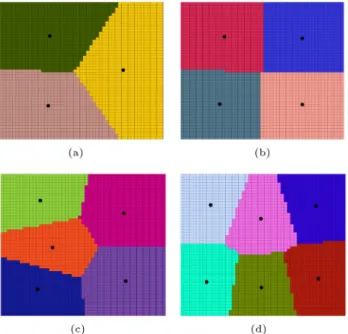
A rectangular FEM for a plate, shown in Figure 2, is considered as the rst example. The numbers of medians in this example are set to k = f3; 4; 5; and 6g. As can be seen in Figure 2, the number of meshes is 2601(51 51). The performance of the algorithms is tested on this model, and the results are depicted in Table 1. Figure 3 shows the optimal subdomains of FE meshes with dierent colors for dierent values of k. The evolution processes of the best tness value obtained by three algorithms for k = 6 are also shown in Figure 4.
4.2. Example 2
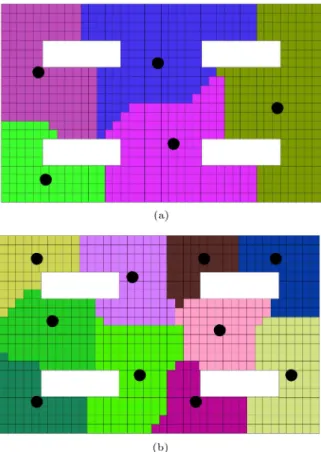
The FEM of a rectangular plate with four openings consisting of 760 meshes, as shown in Figure 5, is considered. The number of medians considered in this example is set as k = f5 and 10g. The performance of the proposed algorithm is tested on this model, and the results are depicted in Table 1. Figure 6 shows the optimal subdomains obtained using the GSAB algorithm for dierent values of k, and Figure 7 illustrates the convergence curves of the best results obtained for this example.
4.3. Example 3
In the last example, a circular plate with 2400 elements having one opening is considered (Figure 8). The
Table 1. The optimal cost and CPU time obtained using the CBO and PSO algorithms for the examples. The number
of medians
Algorithm
PSO CBO Proposed method
Cost
Number of function evaluations
Cost
Number of function evaluations
Cost
Number of function evaluations Example 1
k = 3 28122 4000 28097 4000 28099 1494
k = 4 22186 4000 22113 4000 22113 2235
k = 5 20589 4000 20505 4000 20507 3746
k = 6 19219 4000 18924 4000 18927 2537
Example 2 k = 5 3809 6000 3787 6000 3798 1765
k = 10 2876 6000 2589 6000 2563 3954
Example 3 k = 5 21745 8000 21508 8000 21400 3288
k = 10 15742 8000 15071 8000 14759 4172
Figure 2. (a) A 2601 rectangular FEM for a rectangular plate. (b) The associated clique graph.
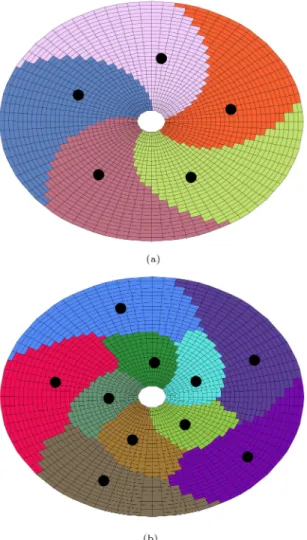
number of medians considered in this example is k = f5 and 10g. Similar to the previous examples, the performance of all the algorithms is tested on this model, and the results are depicted in Table 1. Figure 9 shows also the optimal subdomains obtained using the GSAB algorithm for dierent values of k, and Figure 10
Figure 3. A FEM divided into k subdomains using the GSAB algorithm: (a) k = 3, (b) k = 4, (c) k = 5, and (d) k = 6.
Figure 4. The convergence curves for k = 6 using three algorithms.
Figure 5. A plate FE mesh with 760 elements.
Figure 6. An FE mesh divided into k subdomains using the GSAB algorithm: (a) k = 5 and (b) k = 10.
illustrates the convergence curves of the best result obtained for this example.
4.4. Discussions
As can be seen in Figures 3, 6, and 9, the problem of nding the median of the considered FEMs is achieved using the proposed method. The optimal subdomains contain approximately equal numbers of meshes to balance the computational load between processors and, also, have good aspect ratios.
Table 1 shows the comparison of the results obtained using the GSAB algorithm and those of the
Figure 7. The convergence curves for k = 10 using three algorithms.
Figure 8. The FEM of a circular plate with one opening.
CBO and PSO algorithms for all the examples. It can be seen in this table that the best costs obtained by the presented algorithm are better than those of the PSO and CBO algorithms, except for some cases with few number of function evaluations.
According to Figures 4, 7, and 10, although CBO and PSO are considerably faster in the early opti-mization iterations, GSAB converges to a signicantly better decomposition without being trapped in local optima.
5. Concluding remarks
This paper proposed an optimal subdomain decompo-sition method for nite-element meshes based on the Global Sensitivity Analysis-Based (GSAB) algorithm and k-median method. In this method, the search space of the optimization was determined using the sensitivity indicator of variables, and the sensitive variables of solution were iteratively changed more rapidly than the less sensitive ones in the search space. In order to nd the optimal subdomains, a clique graph was used to transform the connectivity properties of FE meshes into those of graphs. Then, the medians of the graph were selected based on optimization algorithm with the continuous variables.
Figure 9. An FEM divided into k subdomains using the GSAB algorithm: (a) k = 5 and (b) k = 10.
Figure 10. The convergence curves for k = 10 using three algorithms.
The validity and eciency of the proposed method were illustrated using three test problems. The proposed algorithm solutions were compared with the best-known standard particle swarm optimization and colliding bodies optimization algorithms. The outcome was that the GSAB algorithm clearly outperformed the PSO and CBO algorithms with the few number of function evaluations.
References
1. Farhat, C. \A simple and ecient automatic FE mesh
domain decomposer", Comput. Struct., 28, pp. 579-602 (1988).
2. Farhat, C. and Lesoinne, M. \Automatic partitioning
of unstructured meshes for the parallel solution of problems in computational mechanics", Int. J. Numer Methods Eng., 36, pp. 745-764 (1993).
3. Khan, A.I, and Topping, B.H.V. \Sub-domain
gener-ation for parallel nite element analysis", Proc. Civil Comp., B.H.V. Topping, Ed., Edinburgh, UK (1993).
4. Kaveh, A., Optimal Structural Analysis, John Wiley
(Research Studies Press), 2nd Edn., Chichester, UK (2006).
5. Kaveh, A., Computational Structural Analysis and
Finite Element Methods, Springer Press, Switzerland (2014).
6. Kaveh, A. and Roosta, G.R. \Domain decomposition
for nite element analysis", Communs Numer Methods Eng., 13, pp. 61-71 (1997).
7. Kaveh, A. and Shojaee, S. \Optimal domain
decom-position via p-median methodology using ACO and hybrid ACGA", Finite Elem Anal Des., 44, pp. 505-512 (2008).
8. Kaveh, A. and Shara, P. \Ant colony optimization for
nding medians of weighted graphs", Int. J. Computer-Aided Eng. Softw., 25, pp. 102-120 (2008).
9. Christodes, N. and Beasley, J.E. \A tree search
algorithm for the p-median problem", Europ J Oper Res., 10, pp. 196-204 (1982).
10. Kariv, O. and Hakimi, S.L. \An algorithmic approach
to network location problems", SIAM J. Appl. Math., 37, pp. 539-560 (1979).
11. Osman, I. and Christodes, N. \Capacitated clustering
problems by hybrid simulated annealing and tabu search", Int. Trans. Oper. Res., 1(3), pp. 317-336 (1994).
12. Charikar, M., Guha, S., Tardos, E., and Shmoys, D.B.
\A constant-factor approximation algorithm for the k-median problem", Proceedings of the 31st Annual ACM Symposium on Theory of Computing, pp. 1-10 (1999).
13. Osman, A., Erhan, E., and Zvi, D. \An ecient genetic
algorithm for the p-median problem", Ann. Oper. Res., 122, pp. 21-42 (2003).
14. Castro, V.E. and Vela Zquez, R.T. \Hybrid genetic
algorithm for solving the p-median problem", Lecture Notes in Computer Science, paper presented at Se-lected papers from the Second Asia-Pacic Conference on Simulated Evolution and Learning on Simulated Evolution and Learning, 1585, pp. 19-25 (1998).
15. Maniezzo, V., Mingozzi, A., and Baldacci, R. \A
bio-nomic approach to the capacitated p-median problem", J. Heurist., 4, pp. 263-280 (1998).
16. McKendal, A.R. and Shang, J. \Hybrid ant systems for
the dynamic facility layout problem", Comput. Oper. Res., 33, pp. 790-803 (2006).
17. Levanova, T.V. and Loresh, M. \Algorithms of ant system and simulated annealing for the p-median problem", Auto Remote Control., 65, pp. 431-438 (2004).
18. Kaveh, A. and Mahdavi, V.R. \Optimal domain
de-composition using colliding bodies optimization and k-median method", Finite Elem. Anal. Des., 98, pp. 41-49 (2015).
19. Kaveh, A. and Mahdavi, V.R. \Optimal design of truss
structures using a new optimization algorithm based on global sensitivity analysis", Struct. Eng. Mech., Techno Press, 60(6), pp. 1093-1117 (2016).
20. Jackson, L.E., Rouskas, G.N. and Stallmann, F.M.
\The directional p-median problem; denitions, com-plexity, and algorithms", Europ. J. Oper. Res., 179, pp. 1097-1108 (2007).
21. Zhai, Q., Yang, J. and Zhao, Y. \Space-partition
method for the variance-based sensitivity analysis", Optimal Partition Scheme and Comparative Study, Reliab Eng Syst Safety, 131, pp. 66-82 (2014).
Biographies
Ali Kaveh was born in 1948 in Tabriz, Iran. After graduating from the Department of Civil Engineering
at the University of Tabriz in 1969, he continued his studies on Structures at Imperial College of Science and Technology at London University and received his MSc, DIC, and PhD degrees in 1970 and 1974, respectively. He then joined the Iran University of Science and Technology. Professor Kaveh is the author of 595 papers published in international journals and 145 papers presented at national and international conferences. He has authored 23 books in Persian and 10 books in English published by Wiley, Re-search Studies Press, American Mechanical Society, and Springer.
Vahid Reza Mahdavi was born in 1988 in Zarand, Kerman, Iran. He graduated from Shahid Bahonar University of Kerman with BS degree in Civil Engineer-ing. He obtained his MS and PhD degrees in Earth-quake Engineering at Civil Engineering Department of Iran University of Science and Technology. He is now a postdoctoral researcher at Civil Engineering Depart-ment of Iran University of Science and Technology. His current research interests include meta-heuristic opti-mization algorithms and their applications in structural engineering.