R. Christopher Doty. Influences of Anticipated Citation Counts and Author-Fees on the Attitudes of Tenure-Track Science Faculty toward Open Access Journals. A Master’s Paper for the M.S. in I.S. degree. April, 2010. 59 pages. Advisor: Phillip Edwards
Numerous studies have reported that articles published in open access journals garner more citations than articles published in subscription-based journals, although this claim has recently come under intense scrutiny. What the debate about quantitative trends in citation patterns is missing is the opinion of the authors who publish articles in open access and subscription-based journals. In particular, are authors concerned with the anticipated post-publication metrics (citations, pageviews, or downloads) for their articles when choosing publication venues? For authors who have not submitted a manuscript to an open access journal, what percentage increase in post-publication metrics would be necessary to persuade them to do so? This study seeks to address these questions via semi-structured interviews with tenure-track faculty members in the Departments of Biology and Chemistry at the University of North Carolina at Chapel Hill. It is hoped that this study will help inform the outreach efforts of open access advocates and campus administrators.
Headings:
Bibliographical Citations Open Access Publishing Scholarly Communication
ACCESS JOURNALS
by
R. Christopher Doty
A Master’s paper submitted to the faculty of the School of Information and Library Science of the University of North Carolina at Chapel Hill
in partial fulfillment of the requirements for the degree of Master of Science in
Information Science.
Chapel Hill, North Carolina April 2010
Approved by
TABLE OF CONTENTS
Introduction...3
Literature Review...5
Methodology ...16
Results...18
Discussion ...27
Conclusion ...43
Works Cited ...47
Appendices...50
Appendix A. Initial Recruitment Email ...50
Appendix B. Follow-Up Recruitment Email ...51
Appendix C. Informed Consent Form ...53
LIST OF TABLES
INTRODUCTION
The much-documented explosion in serials pricing has been called by many a crisis in scholarly communication (Kyrillidou & Young, 2005). At the very least it is a serious problem for academic libraries around the world. Concerned faculty, librarians, and university administrators have responded to this situation in a number of different ways, as detailed by Guédon (2001). It has become increasingly clear that there is no single remedy to the serials pricing crisis—a multipronged approach is necessary. This is exemplified in the open access (OA) movement by the “gold” and “green” roads to OA (Harnad et al., 2004; Harnad et al., 2008). The gold road is defined as publishing in an OA journal. The green road is defined as publishing in a non-OA journal but self-archiving in an OA repository. The most recent development is a hybrid publishing model in which an author publishes in a non-OA journal but has the opportunity to make the article instantly and freely available online for a fee, generally between $500 and $2500 (Schroter, Tite, and Kassem, 2006; Shieber, 2009). If an author chooses not to pay the fee, the article remains available only to subscribers of the journal.
computer science articles that could be located online had a citation advantage of 336% (median 158%) compared to offline articles. In an attempt to control for selection bias, Lawrence restricted his analysis to the top 20 publication venues by average citation rate. The citation rate for online articles was determined to be 286% (median 284%). This study begat numerous other studies looking for an OA citation effect in different
disciplines and publication venues. There has been a significant amount of pushback in the last few years on the widely-held belief that an OA citation effect exists. Proponents of the OA citation effect argument have continued to respond with additional research studies (Wagner, 2010). The literature surrounding this topic is inconclusive, however, and the debate is unlikely to end soon. What is missing from the debate is the opinion of the authors who publish articles in OA and non-OA journals: the idea that authors care a great deal about the number of citations their articles receive is an assumption underlying all of the OA citation effect studies published to date. It is not an unreasonable
assumption, but it is one that has not been verified. This study seeks to answer the following research questions:
RQ1: What influence would any “OA citation effect” have on the decision-making of tenure-track science faculty concerning where to submit a manuscript for publication?
RQ2A: What other factors in determining where to submit a manuscript compete with the OA citation effect?
RQ2B: What other factors related to where to submit a manuscript take precedence?
RQ2C: How much of a citation increase or other relevant outcome would be required for the OA citation effect to take precedence?
RQ4: What is the general attitude among tenure-track science faculty concerning citations and open access?
LITERATURE REVIEW
The OA citation effect is complicated and unlikely to be resolved to everyone’s satisfaction anytime soon. The following literature review attempts to explain where these complications lie and to point out which research articles better control for these complications. First, the literature review addresses author perceptions of OA publishing and the author-pays model. It then examines in detail the literature pertaining to the OA citation effect.
Author perceptions of OA publishing
attitudes of OA publishing differ by geographical region and discipline. The second conclusion was that OA publishing is still a minority activity. They found that only 10% of authors reported publishing in an OA journal. They also found a similar geographic component to OA authorship as the first conclusion, namely that authors in Africa, Asia, Eastern Europe, and South America were more likely to publish in an OA journal than authors from Australia, the US, and Western Europe. A more recent study focused solely on the biological sciences, however, did not find this same geographic bias (Frandsen, 2009). Non-Westerners were not over-represented in OA publications covering the biological sciences nor do they cite OA publications more than their Western colleagues. Frandsen’s result is not terribly surprising in light of the findings by Nicholas et al. (2005) that of authors in the West, it is the scientists who are the most knowledgeable of OA publishing. The third set of conclusions dealt with attitudes towards OA publishing. The most notable was the association by authors in the West of OA with ephemeral publishing, poor archiving, and no career advantage. There was also a great deal of confusion by Western authors as to who funds OA publications.
Slightly more recent work on author perceptions of OA and the author-pay model was conducted by researchers employed at the BMJ, which is published by “BMJ
OA citation effect
Kurtz et al. (2005) proposed three non-exclusive explanations for the OA citation effect described in the literature: [1] the OA postulate, [2] the early access (EA) postulate, and [3] the self-selection bias (SB) postulate. The OA postulate states that articles with unrestricted access allow authors to read them more easily and, hence, cite them more frequently. The EA postulate states that articles deposited in a pre-print server (or posted on the web prior to publication) are seen earlier than articles that are not available prior to publication and, as a result, have more time to accumulate citations. The SB postulate states that authors preferentially deposit in pre-print servers (or post on the web) their most important and, hence, most citable articles. With these postulates in mind, Craig et al. (2007) critically reviewed the OA citation effect literature. They criticized the vast majority of prior work for proclaiming the superiority of the OA postulate despite
showing only correlation and not causation. In particular, the methods used in these early studies were heavily criticized for a lack of randomization in article selection, which would control for selection bias and “the skewness of science” (Seglen, 1992), and failure to use fixed windows of time for citation counting—the EA postulate.
The earliest paper singled out by Craig et al. (2007) for being “concerned with systematically deconstructing the elements of the open access citation effect, which they recognize as being a complex, multi-dimensional phenomenon” (p. 244) was the
This result implied that something other than the OA and EA postulates was affecting citations. The authors proposed that this was evidence of the SB postulate. Kurtz et al. were very careful to state that their results could not be generalized beyond astronomy, which has a very high barrier to entry (data is very hard to get).
A similar study was performed by Davis & Fromerth (2007) for the field of mathematics. They found that “articles deposited in the arXiv receive more citations and fewer
downloads at the publishers website than non-deposited articles” (p. 209). Davis & Fromerth failed to find support for either the OA or EA postulate and found only inferential support for the SB postulate—“ a higher percentage of highly-cited articles (receiving more than 5 citations) are found in the arXiv, in spite of being significantly younger than non-deposited articles” (p. 213). The authors did not believe their results to be particularly generalizable because of the long citation half-life of articles in
mathematics.
Eysenbach (2006) received special mention by Craig et al. (2007) for
available for the first six months of its “life.” Potentially confounding variables that were controlled in logistic and linear multiple regression models included number of authors, authors’ lifetime publication count and impact, submission track, country of
corresponding author, funding organization, and discipline. Citations were gathered at three time points: 0-6 months after publication, 4-10 months after publication, and 10-16 months after publication. At each time point the mean number of citations to OA articles was greater than that for non-OA articles, and the number of uncited articles was smaller at each time point for OA articles. Upon controlling for potential confounding variables, it was discovered that OA articles compared to non-OA articles were twice as likely to be cited 4-10 months after publication and almost three times as likely to be cited 10-16 months after publication. It was also shown that there is an advantage to publishing as an OA article on the journal’s web site compared to self-archiving. These results led the author to conclude that there is “a clear relationship between the level of openness and the citation levels” (Eysenbach, 2006, p. 0695). Craig et al. (2007) disagree with this conclusion and point out that Eysenbach did not explore the idea of selection bias in the authors’ initial decision to participate in the author-pay model. Craig et al. also felt that the sample size was too small to explore differences between the different disciplines that publish in PNAS.
of citations per paper vs. months after publication for both ArXiv and non-ArXiv papers (Fig. 3, p. 2050). Translating the curve of the ArXiv papers forward six months—the average length of time a pre-print resided in ArXiv before publication—resulted in the ArXiv and non-ArXiv curves being almost indistinguishable—a clear indication of the EA postulate. Moed also found that prominent authors were over-represented in the condensed matter section of ArXiv, and that papers with a higher proportion of prominent authors were more likely to be cited. Moed interpreted this as a “quality bias” (p. 2051), which is another way of looking at the SB postulate. Moed concluded that when
controlling for the EA and SB postulates, there is no evidence of the OA postulate. He did note, however, that depositing articles in ArXiv “accelerates citation” (p. 2054). Moed was also careful to state that his results were applicable only to a sample of six journals within the discipline of condensed matter physics.
citation practices and the level of OA were found to be subject dependent, making it difficult to both generalize results across subjects and explain the cause of the OA citation effect. Numerous confounding factors (e.g., number of authors, location of authors, journal impact factor) were tested for correlation, but the authors were unable to find strong or conclusive support for correlation (let alone causation) between them and the observed OA citation effect. Norris et al. conclude that “although the reasons why there is a citation advantage for OA articles still has not been satisfactorily explained, it is clear that the advantage exists and occurs regularly across a range of subject areas” (p. 1970). They do not believe that a quality (or self-selection) bias can be the lone
explanation because half of the articles studied were OA. However, they noted earlier in the discussion that in all subjects OA articles had more self-citations than TA articles— an observation that can be explained by the SB postulate. Also, the methodology used by the authors makes it nearly impossible for them to address the EA postulate.
status of 247 (out of 1619, 15%) articles published in 11 different journals.
Randomization controlled for the SB postulate, and control of journal publication dates combined with identifying self-archived copies of articles allowed for control of the EA postulate. The effect of numerous confounding variables was also investigated. In general, Davis et al. found strong evidence suggesting that “open access increases the readership of articles but has no effect on the number of citations in the first year after publication” (p. 4). An important conclusion the authors draw is that “measuring success by only counting citations may miss the broader impact of the free dissemination of scientific results.” (p. 5).
A criticism of the study by Davis et al. (2008) is that the journals offered by the APS for participation in the randomized controlled trial were of low impact, and, hence, “it should not be surprising that the cheapest journals post an indiscernible open-access effect” (Evans, 2009, p. 267).
39% of OA articles) was excluded from the analysis. The citation advantage for PNAS alone was found to be 23%, a confirmation of sorts of Eysenbach (2006).
In gradually moving toward change in scholarly communication it is necessary to foster as broad an understanding of “openness” as possible—freely sharing not just publications but data, presentations, chemical compounds, experimental equipment, etc. Piwowar, Day, and Fridsma (2007) attempted to determine whether or not the sharing of research data leads to higher citation rates. 85 articles reporting on cancer microarray clinical trials were selected for this study. The articles were identified via a previously published systematic review. Microarray data was freely accessible for 41 of the 85 clinical trials (48%). The 48% of clinical trials that shared their data received 85% of the aggregate citations. In order to eliminate any bias introduced by extremely high-profile articles, the study was repeated for only the most recent clinical trials published in lower-profile publications. This subset included 70 of the original 85 trials. While only 39% made their data freely available, they received 68% of the aggregate citations. Within the subset of data-sharing clinical trials, linear regression relationships between additional covariates and citation counts were examined. The additional covariates included trial size, presence of a clinical endpoint, type of microarray platform, inclusion in various public databases, release of raw data, mention of supplementary information, and
use the terminology of Kurtz et al. (2005), Piwowar et al. determined that any citation effect resulting from the sharing of data could be attributed to the SB postulate.
The idea of a citation effect for data sharing is intriguing because sharing individual data sets is notoriously problematic in the sciences (Savage & Vickers, 2009). The reason usually given is that the researcher does not have time to aggregate all of the relevant data, clean it up, annotate it, and send it to the researcher making the request. If
researchers were more aware that data sharing could increase the exposure of their work, they might take steps during the actual data gathering to ensure that it was in a suitable state for sharing. This work is very much in its infancy, however, and appears to exhibit similar selection and quality biases as has been shown for OA articles.
Summary
While author perceptions of the general concepts of OA publishing may be improving, there is still a significant amount of confusion surrounding the details, particularly in regard to the author-pays model. Publishing in OA venues is still limited to a small minority of authors. Not surprisingly, journal reputation is still reported as the most important factor when it comes to deciding where to submit articles. There is still a lot of work that needs to be done in this area.
controversial is the observation that OA articles receive a higher number of unique visitors and more full-text and pdf downloads (Davis et al., 2008).
Questions remain as to precisely what motivates authors to participate in the OA publishing model. When they talk about “faster dissemination of results to a wider audience” and “more equitable access” (Schroter et al., 2005) are they speaking theoretically, or do they expect a return on their investment in the form of increased citation counts, downloads, or pageviews? How much of an increase are they expecting? And for authors who currently have no interest in publishing in an OA journal, how large an increase would it take to convince them to do so? Are the answers to these questions dependent upon the amount of the fee in the author-pay model of OA publishing?
METHODOLOGY
The study participants included tenure-track faculty members in the Departments of Biology and Chemistry at the University of North Carolina at Chapel Hill. Overall, the study population consisted of 96 faculty members—48 Biology Professors and 48 Chemistry Professors. The inclusion criteria for this study were that: (1) each participant must be a tenure-track faculty member in the Departments of Biology or Chemistry at the University of North Carolina at Chapel Hill; and (2) each participant must have published at least one research article in a peer-reviewed journal at some point in the last two years. Emeritus faculty and non-tenure track faculty were excluded from participation in this study.
recent publication activity was determined using the ISI Web of Science databases to confirm that he or she had published at least one “research” paper in the last two years. Two of the chemistry faculty members were excluded from the study as a result of the publication activity requirement. For an individual who met both of these criteria for inclusion (i.e., faculty rank and publishing activity), an email (see Appendix A) was sent to the faculty member asking for permission to interview them for this study. Faculty members who had not responded to the initial email within a month received an additional email as a reminder (see Appendix B).
post-publication metrics the interviewee expects the article to receive. If the faculty member demonstrated an awareness of OA options, follow-up questions about OA were
interjected in an attempt to determine if the they have a qualitatively favorable or unfavorable opinion about OA initiatives. These questions helped determine if there were a bias within the sample in terms of awareness of OA options and either for or against OA publishing. The qualitative data generated from the interviews was coded and grouped into categories. Coding and category formation occurred via an inductive and iterative process.
RESULTS
Fifteen faculty members participated in this study: eleven are members of the Department of Biology (11 of 48 = 23% of the department), and four are members of the Department of Chemistry (4 of 48 = 8% of the department). Overall, there were five Assistant Professors, four Associate Professors, and six Full Professors. Only two of the participants were women. It should be noted that the faculty members interviewed for this study may be considered “very successful” researchers at a research-extensive institution. All participants have at least four papers with more than 25 citations. All but two participants have at least one paper with over 100 citations and at least four papers with over 50 citations. Ten of the fifteen participants have at least four papers with over 100 citations, and three participants have published a paper with over 2500
Open Access Citation Effect
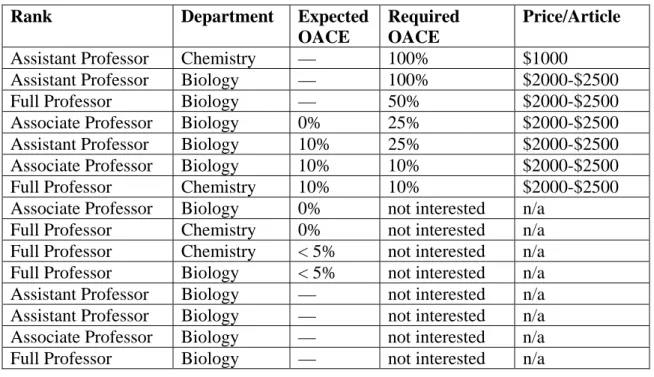
Of the fifteen biology and chemistry faculty members interviewed, seven said that they would consider making their article OA based on an OA citation effect. Two of the seven are chemists, and five are biologists; two are Full Professors. A closer look at these seven, however, reveals dramatically different expectations with respect to the OA citation effect. One faculty member was not willing to pay more than $1000 per article, and for this amount would require the expected number of post-publication citations to double. The other six faculty members discussed the OA citation effect under the
assumption that they would be paying PLoS-level prices ($2000-$2500 per article). One faculty member would require that the citations double, and another would require a 50% increase. Two others would require a 25% increase. One of these two, however, does not believe an OA citation effect exists for their field, and the other believes it would be closer to 10%. The remaining two faculty members expect a 10% OA citation effect in their field and are willing to participate in an OA publishing model at this level. One of these two, however, is already an enthusiastic supporter of the OA publishing model and publishes in OA journals as often as possible. Hence, only one (Full Professor,
Rank Department Expected OACE
Required OACE
Price/Article
Assistant Professor Chemistry — 100% $1000
Assistant Professor Biology — 100% $2000-$2500
Full Professor Biology — 50% $2000-$2500
Associate Professor Biology 0% 25% $2000-$2500 Assistant Professor Biology 10% 25% $2000-$2500 Associate Professor Biology 10% 10% $2000-$2500 Full Professor Chemistry 10% 10% $2000-$2500 Associate Professor Biology 0% not interested n/a
Full Professor Chemistry 0% not interested n/a Full Professor Chemistry < 5% not interested n/a Full Professor Biology < 5% not interested n/a Assistant Professor Biology — not interested n/a Assistant Professor Biology — not interested n/a Associate Professor Biology — not interested n/a Full Professor Biology — not interested n/a Table 1. Details of faculty opinions concerning the OA citation effect.
The remaining eight biology and chemistry faculty members interviewed were not interested in an increase in the number of citations to their work as a result of
participation in an OA publishing model. Two of the eight are chemists, the other six are biologists; four are tenured professors. Five of the eight faculty members expressed the opinion that the number of post-publication citations are not important. Three of these five are tenured faculty members, and two of them specifically mentioned being at the stage of their career when citations are not important. A sixth faculty member stated that a “combination of factors”, not just citation counts, are needed to evaluate the quality of a scientist’s work. The remaining two faculty members were much more concerned that their papers be read than cited.
important to examine their views on three areas that overlap with the OA citation effect: (1) What factors do they take into account when deciding where to submit a manuscript for publication?; (2) What are their attitudes concerning citations?; and (3) What is their opinion of the OA publishing model?
Publication Decisions
The factors that influence where to submit a manuscript for publication were uncovered via questions about two or three of the faculty member’s most recent
“quick review times”, “want your papers to be read”, and “rejected from first choice.” All three of the “format allows short papers” responses came from early career biology faculty members. None of the chemists mentioned being rejected from their first choice journal.
Post-Publication Recognition
A number of questions were asked about post-publication recognition in order to understand a faculty member’s attitudes concerning citations to their work. The most common response to these questions was “invitations to give departmental
talks/seminars.” Ten of the fifteen faculty members (eight out of eleven biologists, two out of four chemists) mentioned this as a form of recognition from their peers. It was mentioned across both early-career and tenured faculty members. Other popular forms of peer recognition were “invitations to give talks at conferences” (five out of fifteen), “face-to-face compliments” (five out of fifteen), “email compliments” (four out of fifteen), “invitations to review manuscripts” (three out of fifteen), “invitations to review grants” (three out of fifteen). “Invitations to give talks at conferences” was also
The second most common response during the discussion of citations was “citations are not important” (six out of fifteen). Four of the six responses came from Full Professors, and all three of the fully tenured biology faculty members were of this opinion. The five next most common responses were “difficult to know how many citations a paper will receive”, “field moves slowly”, “checks citations every couple of months”, “knows 2/3 to 3/4 of citers,” and “not surprised by most cited article.” Four of the five “difficult to know how many citations a paper will receive” responses came from early career biology faculty members. The observation that their “field moves slowly” was much more likely to be voiced by a biology faculty member than one from
chemistry. Early career biology faculty members check the number of citations to their papers more frequently than their fully tenured colleagues. Almost half of the biology faculty members reported knowing a significant number of the people citing their work whereas none of the chemistry faculty members reported knowing more than a minority of the people citing their work. All four of the faculty members to mention not being surprised by their most cited article have tenure (Associate and Full Professors). Two of these four have an article with over 2500 citations.
from biology faculty members. Three Full Professors mentioned that citations were used in tenure discussions. On the other hand, an Associate Professor stated that citations were not discussed in the three or four tenure committees in which he or she had participated. Of the faculty members who mentioned the h-index, all of them have tenure. Pageviews and pdf downloads were of interest to three members of the Biology Department—an Assistant, Associate, and Full Professor. All three of the responses that publishing in good journals is more important than citations came from tenured faculty members.
Open Access
participated in the author-pay model. Taking this into account, six of the remaining seven biology faculty members are interested in the author-pay model compared to only one of the four chemistry faculty members. Also, five of the remaining six early career faculty members are interested in the author-pay model compared to only two of the remaining five fully tenured faculty members. The two next most common responses both concerned access. Six faculty members believe that “the people that [sic] matter have access” while five of them stated that “anyone anywhere can access the literature.” Analyzed separately, there are no clear trends in these two sets of responses. Six
additional responses were mentioned by at least three faculty members each: “support OA for altruistic reasons”, “does not believe in OA citation effect in their field”, “expects a 10% OA citation effect in their field”, “not interested in an increase in citations due to OA citation effect”, “more people read OA articles”, and “systematic change in scholarly publishing is required.” The three faculty members who noted that they “support OA for altruistic reasons” are early career members of the biology faculty. The three responses stating that “more people read OA articles” also came from biology faculty members.
Data
particular, standard formats were deemed necessary to facilitate reuse. It was also suggested that the supplementary/supporting information should include the data behind the figures present in the article.
Tenure
Comments related to tenure came up in ten of the interviews. These comments were dispersed among early career and fully tenured faculty members and chemistry and biology faculty members. The vast majority of the tenure-related comments were voiced while discussing citations. The remainder of the comments occurred while discussing publication decisions. While there were no overall trends in the tenure data, only Assistant Professors mentioned tenure while talking about publication decisions.
Impact Factor
Comments related to the impact factor came up in thirteen of the interviews. The impact factor was mentioned almost exclusively during discussion of publication
DISCUSSION
Publication Decisions
Faculty responses to questions concerning the factors that influenced where two or three of their most recent manuscripts were submitted for publication were grouped axially into four categories: Reputation, Audience, Editorial and Review Process, and Format. Of these four categories, Editorial and Review Process contained the largest number of participants’ responses, followed by Reputation, Audience, and Format.
Reputation was mentioned by every faculty member. Twelve of the fifteen faculty members were coded in “reputation of journal.” The three faculty members who did not explicitly mention a journal’s reputation are all Full Professors. Two of them, both members of the Biology Department, described a somewhat difficult, multi-step process to publication and were coded in “appropriate place for the topic.” A couple of the coded responses indicate the difficultly involved with trying to deconstruct the thought process that goes into deciding where to submit a manuscript: “high profile for the audience” and “high impact but will not get bogged down in the editorial process.” Reputation, Audience, and Editorial and Review Process are all interrelated. Two notable outlying responses from the faculty members include “journal publishes more speculative ideas” and “journal is a suitable place for publishing preliminary data for a grant.”
included in the code “want your papers to be read.” In particular, one of them mentioned publishing in a journal because people still subscribe to the print copy and keep it lying around the lab [Associate Professor, Biology]. The importance of this category in deciding where to submit a manuscript for publication was emphasized by an Assistant Professor in Biology who stated that the specialization and audience of a journal is more important than the Impact Factor.
The Editorial and Review Process was mentioned by eleven of the fifteen faculty members. This category was particularly popular amongst the early career faculty members. Twenty of the twenty-eight responses came from them, and five of the remaining eight responses were mentioned by the same Full Professor in the Chemistry Department. Eight of the nine early career faculty members mentioned the editorial and review process as a factor in deciding where to submit a manuscript whereas only three of the six fully tenured faculty members mentioned it. Two-thirds of the codes
corresponded to the editorial process. The responses corresponding to the review process focused exclusively on the quality and timeliness of the reviews. The coded responses categorized as the Editorial Process show that this aspect of the publication process can either add or subtract from the journal’s reputation. A good editor running a well-oiled machine can attract manuscripts that could have been submitted to “better” journals whereas a bad editor who provides authors with a bad experience will see quality manuscripts head elsewhere.
responses favoring a short format were from the early career faculty members. In addition to article length, Format also includes the structure of the article (e.g., no methods section) and the distribution mechanism (print vs. electronic). Electronic articles allow this inclusion color images, video, sound, and other multimedia formats. While the article is usually tailored to the format of the journal chosen for submission, these responses show that occasionally a journal is chosen primarily for its format.
Post-Publication Recognition
The responses to questions relating to citations to the faculty member’s work were grouped into six categories: Importance of Citations, Peer Recognition, Other Metrics, Citation Properties, Checking Citations, and Citers. Of these six categories, Peer Recognition contained the largest number of participants’ responses, followed by Checking Citations, Importance of Citations, Citation Properties, Citers, and Other Metrics.
Because every faculty member was specifically asked about forms of recognition from their peers, they all had a response for this category. A total of twenty-two different kinds of peer recognition were mentioned. The responses indicate recognition both at the article (email and face-to-face compliments, article requests, protocol and reagent
requests) and career level (asked to be an editor, receive a chair, win an international award). The intent of this question was to identify ways other than citations in which faculty members receive recognition from their peers. As can be seen from the
his or her work. How some of these other forms of peer recognition compare to citations were grouped in the Importance of Citations category.
The Checking Citations category includes three main topics: the frequency with which faculty member’s check their citations, citation projections for recently published articles, and reasons for a large or small number of citations to older articles. All of the faculty members discussed the frequency with which they check the citations to their work. Twelve of the fifteen faculty members discussed citations with respect to their current and older work. Not surprisingly, faculty members who identified their field as moving slowly reported that they check their citations only once or twice a year.
Interestingly, three of the five faculty members who felt it was “hard to know how many citations a paper will receive” were “not surprised by [their] most cited paper.” In other words, citations make more sense in relative terms than they do in absolute terms. To drive this point home one faculty member mentioned being “surprised at the number for the highest cited paper but not that it is high.” [Full Professor, Biology] There were only two examples of the citation checking extremes. One faculty member stated that he or she never checked the citation indices [Full Professor, Biology] while another discussed checking them every week [Associate Professor, Biology]. However, citation checking is not always an exercise in vanity. They are frequently used by faculty members to keep up with current work in their particular field.
The Importance of Citations was discussed by fourteen of the fifteen faculty members. Nineteen of the thirty-five responses came from the six Full Professors. Six of the seven faculty members who stated that citations are not important are also not
effect sufficiently high that participation in an OA publishing model is unlikely for citation-based reasons. This faculty member has already published a paper in a Public Library of Science journal, however. One faculty member deemed citations “much more important than pageviews or pdf downloads.” [Associate Professor, Biology] Otherwise, many of the responses had to do with things that were more important than citations— quantity and quality of publications being the most important thing. There was some disagreement amongst the tenured faculty members in the Biology Department about whether or not citations were used in tenure discussions. The confusion seemed to hinge on when citations were consulted. While citations may not have been discussed during meetings of the tenure committee, each individual member had checked the publication record and citations of the candidate prior to the meeting. As a Full Professor in the Chemistry Department stated, “citations are good for judging a candidate when you don’t know the field.” Or put another way, citations “are not a perfect metric but they are good for showing how someone’s work is impacting the field.” [Associate Professor, Biology]
Citation Properties were mentioned by twelve faculty members. The faculty members identified review papers, methods papers, and papers that are in some important way wrong as being the most highly cited articles. This category was interesting for some of the opinions expressed about citations: “citations are stochastic” [Assistant Professor, Biology], “if it sticks around long enough, it will generate citations” [Assistant Professor, Biology],“citations don’t mean that they read your paper” [Associate
who cite an article was to see if knowing a large or small percentage of citers
corresponded with an interest in the OA citation effect. It turns out, however, that the answer to the initial question was article-dependent. Three biology faculty members mentioned knowing a majority of the citers for some articles while knowing only a minority of citers for other articles. This exemplifies the split between publications that reach an international audience and those that are tailored to a regional audience. As one faculty member noted, “the more people I know citing my work, the less important the paper is.” [Full Professor, Biology] Four of the seven faculty members in the OA citation interest group reported knowing only a minority of the people who cite their work. One other member of the OA citation interest group reported knowing a majority of citers but also mentioned that the field was small. While this is an interesting correlation, there are much more important factors that determine participation in an OA publishing model, as discussed below. Only one faculty member reported not looking at who is citing his or her work [Full Professor, Chemistry]. This particular faculty member felt that he or she knew the community well enough to keep current. Five other faculty members concurred with the comment that citations are a good way “to see who is using your work and how they are using it.” [Associate Professor, Biology]
members expressed interest in the pageview and pdf download statistics for their articles (an Assistant, Associate, and Full Professor, all in the Biology Department). Only one of these three has published in a Public Library of Science journal where this information is made public for every article. Another, however, had access to this information in the role of editor. The general consensus seems to be that these other article-level metrics are interesting but that no one knows how meaningful they are or what to do with them. As one faculty member stated, pageviews and pdf downloads “are useful but you have to think about them carefully.” [Full Professor, Biology]
Open Access
The responses of the faculty members to questions concerning the OA publishing model were grouped into four categories: Access Issues, Financial Issues, OA Citation Effect, and OA vs. For-Profit. Of these four categories, Financial Issues contained the largest number of participants’ responses, followed by OA Citation Effect, OA vs. For-Profit, and Access Issues.
Financial Issues were mentioned by thirteen of the fifteen faculty members. The two faculty members who did not mention financial issues are tenured members of the Biology Department. Every mention of financial issues by chemistry faculty members was in the context of not being able to afford to participate in an OA publishing model. Many of the responses had to do with who would supply the funds for OA
participation—individual faculty members, their institution, and/or the federal
to highlight this issue. For the OA enthusiasts, however, these topics only serve to
emphasize that the decision to publish via an OA model, according to one of them, “is not a straight-forward cost-benefit analysis” [Associate Professor, Biology]. This particular faculty member believes in the OA movement and “will pay if the money is there.” For other faculty members, money is not an issue. Publishing fees are not a barrier but “a cost of doing business” [Assistant Professor, Biology]. A great deal of this mindset probably comes from the fact that page charges are still common in biology journals (mentioned by seven of eleven biology faculty members) whereas many chemistry and physics journals eliminated page charges a decade ago. The challenge is to bring these two costs closer together. As one faculty member said, “There is a big difference between $500 and $2500.” [Professor, Biology]
Issues concerning OA vs. For-Profit journals were mentioned by ten of the fifteen faculty members. Many of the codes corresponded to a response from just one faculty member. There were no obvious trends in this category other than the fact that it was dominated by four biology faculty members (one Assistant Professor, two Associate Professors, and one Full Professor). They generated seventeen of the twenty-four
the quality of OA options: “reputation stamp is the key,” “need a good filtering system,” “the most prestigious journals in the field are not OA.” These responses are further proof of just how important journal reputation is when faculty members decide where to submit a manuscript for publication.
Access Issues were mentioned by ten of the fifteen faculty members. All four of the chemistry faculty members mentioned access compared to only six of the eleven biology faculty members. The chemistry faculty members, however, were unanimous in their belief that access is not a problem. Five of six fully tenured faculty members mentioned access issues compared to five of nine early career faculty members. This category is most clearly summarized with the following two coded responses: “anyone anywhere can access the literature” and “the people that matter have access.” Nine of the ten faculty members represented in this category said one or the other. The tenth gave the slightly more tempered response that “most institutions have access to the journals.” [Full Professor, Chemistry] Coupled with the belief that everyone has access to the literature is the assumption that should someone not have access to a particular journal at their institution, an email to a colleague or the author of the article will quickly result in a copy. The difficulty convincing faculty members to publish via an OA model becomes a little easier to understand upon reflection on their views about access to the literature.
likely to seriously consider the OA citation effect when deciding where to submit their next manuscript for publication. The responses of the seven faculty members (hereafter referred to as the “OA citation interest group”) who acknowledged that they would consider the OA publishing model if the OA citation effect was at or above a certain level—citation increases of 100% [2x], 50%, 25% [2x], 10% [2x]—were practically indistinguishable from those of the eight faculty members not interested in the OA citation effect. There was only one situation where this was not the case: “difficult to know how many citations a paper will receive” was mentioned by five faculty members, three of whom are members of the OA citation interest group. Although the majority of those responses came from the OA citation interest group, the majority of the OA citation interest group did not give that response. There is one interesting case where the
Unlike the situation described in the previous paragraph, there were quite a few responses from the eight faculty members (hereafter referred to as the “ambivalent about OA group”) not interested in the OA citation effect that were appreciably different from those of the seven faculty members comprising the OA citation interest group. As mentioned above, five of the ambivalent about OA group expressed the opinion that citations are not important. Only one member of the OA citation interest group
concurred. One possible explanation for the lack of interest in citations is that the faculty member conducts research in a slowly moving field. Four members of the ambivalent about OA group, and three of the five who stated that citations are not important, identified their fields in this way. Five of the six faculty members who mentioned the format of the article as an important consideration are part of the ambivalent about OA group. All five of the responses for “quality of review process,” and all three of the responses for “good review times/quick turnaround” came from of the ambivalent about OA group. Six of the eight members of the ambivalent about OA group mentioned the review process. Both responses for “editors are scientists not professional editors,” and all three of the responses concerning the “quality of editorial process” came from the ambivalent about OA group. Four members of the ambivalent about OA group mentioned the editorial process. In total, six of the eight members of the ambivalent about OA group mentioned either the review or editorial process.
to believe that the number of times they are cited will be dramatically affected by the OA citation effect.
Two members of the ambivalent about OA group have published via an OA publishing model. Both of these faculty members had articles published by the Public Library of Science. Three other members of the ambivalent about OA group expressed an interest in the author-pay model for future publications. In addition, two of these five faculty members expressed the opinion that more people read OA articles. One of the three remaining faculty members explained that their field moved slowly and that they were thus disinclined to pay to eliminate any embargo period imposed by a journal, and that the Public Library of Science did not publish in their line of research—one of four faculty members interviewed who either explicitly or implicitly dismissed publishing in PLoS ONE. The last two faculty members in the ambivalent about OA group are Full Professors in the Chemistry Department.
The lack of interest in the OA citation effect does not appear to stem from a negative opinion of OA publishing. Is it something else about OA (access issues or financial reasons), something related to publication decisions, or something in particular about citations? In all likelihood it is some combination of the three. From the responses of the biology and chemistry faculty members interviewed for this study, journal
manuscript for publication. It is an iterative process that requires “weighing what’s the best way to convey your research results.” [Professor, Biology]. Perhaps the best summation of this is left to the faculty members themselves:
“You want to find the right audience. You want a high impact but you also don’t want to get bogged down in the editorial process.” [Professor, Biology]
“Highest tiered, broadest readership journal we could get the article into.” [Associate Professor, Biology]
For many of the faculty members, there are also elements of time and effort that go into the decision:
“You target the best journal you can for what you think you’ve got. Maybe you could better but there is an amount of time you want to invest in getting it there, too. You have to balance these things, impact and the time required” [Professor, Biology]
“We have a paper that we could submit to Macromolecules today and get accepted. Maybe we could do more and submit it to a better journal like JACS. But maybe it takes a year for us to do that work. It just isn’t worth it. Ultimately, it doesn’t matter if it is JACS or Macromolecules—it will get cited if it is good science, regardless of where it is.” [Assistant Professor, Chemistry]
that concerned about citations to their work. They also did not see the number of
citations as being independent of article and journal quality. The following quotes given by untenured faculty members exemplify many of the opinions expressed during the interviews:
“Citations are important but not that important…The time lag makes them not terribly useful for tenure, and once you’ve got tenure it doesn’t matter how many times you are cited.” [Assistant Professor, Chemistry]
“You’re in a bad place if citations matter for tenure.” [Assistant Professor, Biology]
Discussions centered around OA journals and paying a fee to make an article in a traditional journal OA—the gold road to OA. There was no mention of making an article OA by self-archiving it—the green road to OA. The closest any of the faculty members came was when one of them mentioned that upon receiving an email request for an article, a copy of the version sent to the publisher will be sent in reply. It is possible that because the University of North Carolina at Chapel Hill does not have an existing digital repository, self-archiving is not being advocated across campus resulting in faculty members who are unfamiliar with the concept. It is also possible that the faculty
Data
As one faculty member put it, “[Open] data is a tricky question.” [Associate Professor, Biology] The fact that this came from someone who “routinely, when there is an OA option for the journals that I publish in, select that option,” should serve to
reinforce the complicated nature of this topic. The sentiments on this issue ranged from the release of data prior to publication, especially for tax-payer funded research, because “It is incumbent upon us to make progress as fast as we can” [Associate Professor, Biology] to “I am not sure why people would want strings and strings of numbers.” [Professor, Biology] Immediate release of data seems to be restricted to the field of genetics, at least for the faculty members interviewed for this study. Two Assistant Professors in the Biology Department stated that the length of the embargo period will be an important consideration. No one wants to be scooped as a result of making their data freely available, and that includes not just the initial publication but subsequent
publications based on the same data. The difficulty is balancing this mindset with that of “making progress as fast as we can.”
Tenure
Not surprisingly, when tenure came up during discussion of publication decisions, it was mentioned by the untenured, the Assistant Professors. The prevailing sentiment here seemed to be “quantity vs. quality: quantity initially, quality later.” [Assistant
material to publish in a very good journal. In other words, one must keep in mind a kind of scholarly law of diminishing returns. Other notable comments included “…because senior professors in the department publish there” [Assistant Professor, Biology] and, from an interdisciplinary researcher in the Biology Department, “I am not rewarded for publishing in [another discipline’s] journals.” [Assistant Professor, Biology]
The vast majority of the references to tenure occurred during discussion of citations. Many of the comments compared citations to other forms of recognition. The list of items deemed more important than citations included publishing in good journals, outside letters of reference, the number of papers and where they were published, invitations to give talks, having a paper reviewed in Faculty of 1000, and having one or two really good papers. It was also acknowledged that citations and other forms of recognition are not independent of one another—a history of highly cited work leads to more grants, invitations to give talks, more exposure, more citations, etc.
Impact Factor
It was clear from the interviews that when it comes to journal reputation and impact, faculty members have a “[tiered] hierarchy in the mind” [Professor, Biology] as to how they relate to one another. The first tier includes multidisciplinary journals like Science and Nature (IF = 28.1 and 31.4, respectively). The second tier includes journals
member mentioned, reputation can often be based more on historical considerations than Impact Factor. Only one of the faculty members interviewed for this study consults the Impact Factor when deciding where to submit a manuscript for publication, and that is only to make sure that it is not too low, i.e., there is a minimum standard below which one cannot be seen to publish. The most frequent mention of impact factor came from faculty members who are also editors of journals. The Impact Factor (and other metrics like pageviews and pdf downloads) are much more important to them as editors than as scientists.
CONCLUSION
In answer to the first research question of this study, the OA citation effect has very little influence on the decision-making of tenure-track science faculty concerning where to submit a manuscript for publication. Only one of the fifteen faculty members interviewed is likely to seriously consider the OA citation effect the next time a
choose an OA option. Similarly, if the faculty member believes that everyone (who matters) already has access to the subscription-based journal, the OA option will probably not be chosen. The answers to research questions 2C and 3 are available in Table 1. Briefly, citation increases of 100% [2x], 50%, 25% [2x], and 10% [2x] are expected by the seven faculty members who expressed an interest in the OA citation effect. All but one of the faculty members answered under the assumption that they would be paying prices similar to those charged by the Public Library of Science ($2000-$2500/article). The remaining faculty member expected the number of citations to double for $1000/article. The final research question inquired about the general attitude among tenure-track science faculty concerning citations and OA. In general, the faculty members interviewed for this study were not particularly concerned about the citations to their articles. It should be remembered, however, that each one of them is a heavily cited research scientist. Their opinions of OA are favorable. Six of the faculty members have already published an article via an OA publishing model, and an additional five members are interested in doing so in the future.
This study points the way to further work. As noted above, it would be
future work were suggested by one of the faculty members during the discussion of the OA citation effect. First, “does it [the OA citation effect] increase the variance in the kinds of institutions?” [Professor, Biology] Namely, what percentage of citations to OA articles come from first-, second-, and third-tier institutions? How does this compare to traditional articles locked behind a subscription wall? Second, “does it [the OA citation effect] impact the hit level of major scientists?” [Professor, Biology] In other words, who is citing OA articles compared to non-OA articles? These questions get to the heart of the ambivalence about the OA citation effect displayed by the fifteen faculty members interviewed for this study, echoed in the following statement: “Modern tools are
expensive. It takes rich countries and rich universities [to advance the field].” [Professor, Chemistry]
If this study is going to be used to inform library outreach of OA issues, I think the main conclusion to be drawn from it for practicing librarians and administrators is “Know your faculty.” How many faculty members in your department have published in an OA journal? How many have paid to make an article in a subscription-based journal OA? Are any of them editors for OA journals? Find out what issues are most important to them, e.g., maintaining control of copyright, OA citation effect, increased readership, a change in the scholarly communication landscape, etc. Do any of them advocate OA within their department?: “By supporting OA myself that encourages my colleagues to do the same thing.” [Associate Professor, Biology] As far as outreach with respect to data is concerned, concrete examples of actual data reuse by faculty members at the same
computational science (Hey, Tansley, and Tolle, 2009). Have any of them shared their data? Do they know if it has been reused? Have any of them reused someone else’s data? If the library community felt really ambitious it would join forces and petition the various publishers to standardize the formats of their supplemental/supporting
WORKS CITED
BMJ (2009a). About BMJ. [http://resources.bmj.com/bmj/about-bmj] Accessed November 4, 2009.
BMJ (2009b). Open access policy.
[http://resources.bmj.com/bmj/about- bmj/policies/press-release-greater-openness-is-the-future2014the-bmj-and-open-access] Accessed November 4, 2009.
Craig, I. D., Plume, A. M., McVeigh, M. E., Pringle, J., & Aminb, M. (2007). Do open access articles have greater citation impact? A critical review of the literature. Journal of Informetrics 1:239–248.
Davis, P. M. (2009). Author-choice open-access publishing in the biological and medical literature: A citation analysis. Journal of the American Society for Information Science and Technology 60(1):3–8. doi:10.1002/asi.20965
Davis, P. M., & Fromerth, M. J. (2007). Does the arXiv lead to higher citations and reduced publisher downloads for mathematics articles? Scientometrics 71(2):203– 215. doi:10.1007/s11192-007-1661-8
Davis, P. M., Lewenstein, B. V., Simon, D. H., Booth, J. G., & Connolly, M. J. L. (2008). Open access publishing, article downloads, and citations: Randomised controlled trial. BMJ 337:a568. doi:10.1136/bmj.a568
Evans, J. A. (2009). Response. Science 325:266–267.
Eysenbach, G. (2006). Citation advantage of open access articles. PLoS Biol 4(5):e157. doi:10.1371/journal.pbio.0040157
Flanagan, J. C. (1954). The Critical Incident Technique. Psychological Bulletin 51(4):327-358.
Frandsen, T. F. (2009). Attracted to open access journals: A bibliometric author analysis in the field of biology. Journal of Documentation 65(1):58-82.
doi:10.1108/00220410910926121
Harnad, S., Brody, T., Vallières, F., Carr, L., Hitchcock, S., Gingras, Y., Oppenheim, C., Stamerjohanns, H., & Hilf, E. R. (2004). The access/impact problem and the green and gold roads to open access. Serials Review 30(4):310–314.
Harnad, S., Brody, T., Vallières, F., Carr, L., Hitchcock, S., Gingras, Y., Oppenheim, C., Hajjem, C., & Hilf, E. R. (2008). The access/impact problem and the green and gold roads to open access: An update. Serials Review 34(1):36–40.
Hey, T., Tansley, S., & Tolle, K. (Eds.). (2009). The Fourth Paradigm: Data-Intensive Scientific Discovery. Redmond, WA: Microsoft Research.
Ioannidis, J. P. A. (2006). Concentration of the most-cited papers in the scientific literature: Analysis of journal ecosystems. PLoS ONE 1(1):e5.
doi:10.1371/journal.pone.0000005
Kyrillidou, M., & Young, M. (Eds.). (2005). ARL statistics 2003-04: A compilation of statistics from the one hundred and twenty-three members of the association of research libraries. Washington, D.C.: Association of Research Libraries.
Kurtz, M. J., Eichhorn, G., Accomazzi, A., Grant, C., Demleitner, M., Henneken, E., & Murray, S. S. (2005). The effect of use and access on citations. Information
Processing and Management 41:1395–1402.
Lawrence, S. (2001). Free online availability substantially increases a paper’s impact. Nature 411:521.
Moed, H. F. (2007). The effect of “open access” on citation impact: An analysis of ArXiv’s Condensed Matter section. Journal of the American Society for Information Science and Technology 58(13):2047–2054. doi:10.1002/asi.20663
Nicholas, D., Huntington, P., & Rowlands, I. (2005). Open access journal publishing: The views of some of the world’s senior authors. Journal of Documentation 61(4):497-519. doi:10.1108/00220410510607499
Norris, M., Oppenheim, C., & Rowland, F. (2008). The citation advantage of open-access articles. Journal of the American Society for Information Science and Technology 59(12):1963–1972. doi:10.1002/asi.20898
Piwowar, H.A., Day, R.S., & Fridsma, D.B. (2007). Sharing detailed research data is associated with increased citation rate. PLoS ONE 2(3):e308.
doi:10.1371/journal.pone.0000308
Savage, C.J., & Vickers, A.J. (2009). Empirical study of data sharing by authors publishing in PLoS journals. PLoS ONE 4(9):e7078.
Schroter, S., & Tite, L. (2006). Open access publishing and author-pays business models: A survey of authors’ knowledge and perceptions. Journal of the Royal Society of Medicine 99:141–148.
Schroter, S., Tite, L., & Kassem, A. (2006). Financial support at the time of paper acceptance: A survey of three medical journals. Learned Publishing 19(4):291-297. Seglen, P. O. (1992). The Skewness of Science. Journal of the American Society for
Information Science 43(9):628-638.
Schroter, S., Tite, L., & Smith, R. (2005). Perceptions of open access publishing: Interviews with journal authors. BMJ doi:10.1136/bmj.38359.695220.82 Shieber S.M. (2009). Equity for open-access journal publishing. PLoS Biol
7(8):e1000165. doi:10.1371/journal.pbio.1000165
APPENDIX A. Initial Recruitment Email
Professor [last name],
My name is Chris Doty, and I am a Master’s student in the School of Information and Library Science here at UNC. For my Master’s research I am investigating faculty attitudes about common post-publication metrics (citations, downloads, and page views) that may serve as proxies for article quality. I would like to know the extent to which faculty are concerned with and actively follow post-publication metrics for their articles. Several alternative publishing models have emerged over the past several years, and I am also interested in your perceptions of how these new alternatives might affect these post-publication metrics.
You have been chosen as a candidate for this study by virtue of your status as a tenure-track faculty member in the Department of [Biology or Chemistry] who has published at least one research article in a peer-reviewed journal at some point in the last two years. Your role in this study would consist of participating in an individual 30-minute
interview during which we would talk about post-publication metrics with respect to your most recent publication(s). Your responses will be kept confidential. To the extent possible, results will be reported in the aggregate so as to prevent indirect identification of your participation. Any direct quotes used when reporting the results of this study will be scrubbed of identifying details.
Should participation in the study described above interest you, I would be more than happy to discuss the project in more detail and arrange logistical details for an interview. Should participation in this study not interest you, communication of such will ensure that you do not receive any subsequent follow-up emails.
All the best,
Chris Doty
Master of Science in Information Science School of Information and Library Science University of North Carolina at Chapel Hill
APPENDIX B. Follow-Up Recruitment Email
Professor [last name],
About a month ago, I sent you a recruitment email for my Master’s research project on post-publication metrics for scholarly articles. Since I have not heard from you, I have included the text of that message below in the hope that you will consider participating in this study. Should participation in this study not interest you, communication of such will ensure that you do not receive any additional follow-up messages.
Thank you, Chris Doty
_______________________________________________________
My name is Chris Doty, and I am a Master’s student in the School of Information and Library Science here at UNC. For my Master’s research I am investigating faculty attitudes about common post-publication metrics (citations, downloads, and page views) that may serve as proxies for article quality. I would like to know the extent to which faculty are concerned with and actively follow post-publication metrics for their articles. Several alternative publishing models have emerged over the past several years, and I am also interested in your perceptions of how these new alternatives might affect these post-publication metrics.
You have been chosen as a candidate for this study by virtue of your status as a tenure-track faculty member in the Department of [Biology or Chemistry] who has published at least one research article in a peer-reviewed journal at some point in the last two years. Your role in this study would consist of participating in an individual 30-minute
interview during which we would talk about post-publication metrics with respect to your most recent publication(s). Your responses will be kept confidential. To the extent possible, results will be reported in the aggregate so as to prevent indirect identification of your participation. Any direct quotes used when reporting the results of this study will be scrubbed of identifying details.
Should participation in the study described above interest you, I would be more than happy to discuss the project in more detail and arrange logistical details for an interview. Should participation in this study not interest you, communication of such will ensure that you do not receive any subsequent follow-up emails.
All the best, Chris Doty
School of Information and Library Science University of North Carolina at Chapel Hill
APPENDIX C. Informed Consent Form
University of North Carolina-Chapel Hill Consent to Participate in a Research Study Adult Participants
Social Behavioral Form
________________________________________________________________________ IRB Study #10-0118
Consent Form Version Date: January 26, 2010
Title of Study: Citations, downloads, and page views: Faculty expectations of post-publication metrics
Principal Investigator: R. Christopher Doty
UNC-Chapel Hill Department: School of Information and Library Science UNC-Chapel Hill Phone number: (919) 357-3655
Email Address: [email protected]
Faculty Advisor: Phillip M. Edwards
UNC-Chapel Hill Department: School of Information and Library Science UNC-Chapel Hill Phone number: (919) 962-8068
Email Address: [email protected]
Study Contact: R. Christopher Doty
Study Contact telephone number: (919) 357-3655 Study Contact email: [email protected]
________________________________________________________________________ What are some general things you should know about research studies?
You are being asked to take part in a research study. To join the study is voluntary. You may refuse to join, or you may withdraw your consent to be in the study, for any reason, without penalty.
Research studies are designed to obtain new knowledge. This new information may help people in the future. You may not receive any direct benefit from being in the research study. There also may be risks to being in research studies.
Details about this study are discussed below. It is important that you understand this information so that you can make an informed choice about being in this research study. You will be given a copy of this consent form. You should ask the researchers named above any questions you have about this study at any time.
What is the purpose of this study?