ABSTRACT
CYNTHIA ANN SALMONS. A Comparison Between Alum and Polyaluminum Chloride for Drinking Water Coagulation.
(Under the direction of DR. PHILIP C. SINGER).
Concern about the health effects of trihalomethanes,
one product of the reaction between chlorine and organic
compounds such as fulvic acids, has led to the establishment
of a Maximum Contaminant Level of 100 ug/L in drinking
water. One way of reducing trihalomethane concentrations in
finished water is by reducing the concentration of organic
compounds by coagulation prior to chlorination. Aluminum
salts are often used as coagulants, but recently concern has
been expressed about the health effects of aluminum in drinking water.
The objective of this study was to compare alum and
polyaluminum chloride as coagulants, with emphasis on
residual aluminum concentrations and the removal oftrihalomethane formation potential (THM FP). The removal of
total organic carbon (TOC) and of ultraviolet absorbing
substances (UV absorbance) was also studied. The
experiments in this research were jar tests using a fulvic
acid solution (prepared from an extract of Black Lake, N.
C.) or Durham, N. C. raw drinking water.
The results of this research indicated that
organics occurred at lower coagulant doses for alum than for
polyaluminum chloride. The three parameters used to
represent the removal of organics (TOC, UV absorbance, and
THM FP) were consistent with each other throughout the
study. Residual aluminum values of less than 50 ug/L were
achieved with both coagulants under optimal pH and dose
conditions. The residual aluminum data from this research
supports the conclusion of other researchers that
TABLE OF CONTENTS LIST OF FIGURES
LIST OF TABLES
ACKNOWLEDGEMENTS
CHAPTER I. INTRODUCTION
CHAPTER II. LITERATURE REVIEW
VI
vii viii
1
3
NATURALLY-OCCURRING ORGANICS IN WATER AND THE TRIHALOMETHANE PROBLEM 3
REMOVAL OF ORGANICS BY COAGULATION 6
THE PROCESS OF COAGULATION 8
ALUMINUM CHEMISTRY 13 POLYALUMINUM CHLORIDE 16
ALUMINUM IN DRINKING WATER 17
CHAPTER III. METHODS AND MATERIALS 20
APPROACH
EXPERIMENTAL MATERIALS EXPERIMENTAL PROCEDURES ANALYTICAL PROCEDURES
Aluminum
Ultraviolet Absorbance
Total Organic Carbon
Trihalomethanes CHAPTER IV. RESULTS AND DISCUSSION
20 20 22 23 23 24 24 26 27
FULVIC ACID SOLUTIONS 27
•
Alum Results 27Polyaluminum Chloride Results 34
DURHAM RAW WATER 41
ALUMINUM RESIDUALS AND ALUMINUM
SOLUBILITY 44
TOC/THM CORRELATIONS 50
TOC/ALUMINUM CORRELATIONS 52
CHAPTER V. CONCLUSIONS AND RECOMMENDATIONS 54
CONCLUSIONS 54
RECOMMENDATIONS FOR FURTHER RESEARCH 55
REFERENCES 57
APPENDIX-ANALYTICAL RESULTS 62
LIST OF FIGURES
II.1. Aluminum Solubility Diagrams 14
IV.1. The Effect of pH on Alum Coagulation 29 IV.2. The Effect of Dose on Alum Coagulation-pH 5.5 31 IV.3. The Effect of Dose on Alum Coagulation-pH 6.5 32 IV.4. Residual TOC After Alum Coagulation 33
IV.5. Residual TOC After Alum Coagulation, Settling,
and Filtration of Black Lake Fulvic Acid 35
IV.6. The Effect of pH on PACl Coagulation 36 IV.7 The Effect of Dose on PACl Coagulation-pH 4.5 37 IV.8. The Effect of Dose on PACl Coagulation-pH 5.5 38 IV.9. Residual TOC After PACl Coagulation 42 IV.10. Results for Raw Water Coagulated with Alum 45 IV.11. Results for Raw Water Coagulated with PACl 46
IV.12. Comparison of Residual Aluminum Data with Al(OH)^
Solubility 47 IV.13. Residual Aluminum Concentrations as a Function
of pH for Lake Tjernsmotjern Water 49 IV.14. Correlation Between THM FP and TOC After
Coagulation 51
IV.15. Correlation Between Log Residual Aluminum 53 and TOC After Coagulation
LIST OF TABLES
III.l. Atomic Absorption Program for Aluminum Analysis 25 IV.1. Characteristics of BLFA Test Solutions 28
IV.2. Characteristics of Durham Raw Water 43
ACKNOWLEDGEMENTS
I would like to thank the EPA for funding the "alt-ox" project that supported me for these two years. I
would also like to thank my advisor. Dr. Philip Singer,
for his invaluable input into this project and into this report. Thanks also go to Dr. Francis DiGiano and Dr.
Russell Christman for serving on the committee.
Many of my fellow graduate students have provided
technical, as well as moral, support. These include
Margi Martin-Goldberg, Richard Brown, David Chang, Karen
Werdehoff, and Bill Dowbiggin. A cast of millions,
including C.L. Lassiter, Linda Home, Sharon Long, Wendy
Fuscoe, Mary Beth Hibbs, and Jim Jensen, deserves special
thanks for their reassurances that I would finish one day.
On the homefront, thanks go to our renters (Judy,
Linda, Mike, Cliff, and Candace), whose rent money made
this possible. Most importantly, THANKS to my husband, Dick, who has learned to love tuna casserole, peanut
butter, and canned spaghetti sauce. May we never eat this way again!!!!!!!
I. INTRODUCTION
Trihalomethanes (THMs) are one product of the
reaction between naturally-occurring organic matter, such
as humic material, in water and the chlorine which is
added to drinking water for disinfection. Concern about the health effects of THMs has led to the establishment of a maximum contaminant level (MCL) of 100 ug/L in finished drinking water. One method for lowering the THMs in finished water is to remove the humic material by coagulation before chlorination. Coagulation has
traditionally been used to reduce color and turbidity and has often involved salts of hydrolyzing metals, such as
alum and ferric chloride.
A new coagulant, polyaluminum chloride (PACl), has received much attention lately. In studies directed at turbidity and organic color removal, PACl has been shown to work more effectively in some pH regions than alum. The work reported in the literature thus far has not
examined chlorination after PACl coagulation to determine
its impact on subsequent THM formation.
Aluminum -in drinking water has also been the focus of attention in recent years. Some studies have suggested a link between aluminum and central nervous system damage such as Alzheimer's disease. There is no
MCL for aluminum at present, but work has indicated that
concentrations of less than 50 ug/L (Miller et al, 1984). Thus, an additional water quality characteristic that must be evaluated when use of a new aluminum salt is
considered is residual aluminum in the finished water.
The objective of this research was to compare PACl and alum as drinking water coagulants. The parameters examined were total organic carbon (TOC), ultraviolet
absorbance at 254 nanometers (UV), trihalomethane (THM) formation after a standard chlorination step, and
residual aluminum. This evaluation involved both an
aquatic fulvic acid extract and a real water. Various coagulant doses and pHs were used to determine which
coagulant will be most effective in different regions of
II. LITERATURE REVIEW
A. NATURALLY-OCCURRING ORGANICS IN WATER AND THE
TRIHALOMETHANE PROBLEM
Bellar et al (1974) identified several
trihalomethanes, including chloroform,
bromodichloromethane, and dibromochloromethane, in finished drinking water with GC-FID and GC-MS. They
found a noticeable correlation between source water
quality (organic content) and finished water THM
concentrations. Only very low concentrations of THMs (0.9 ug/L) were observed in raw waters, but the finished waters had concentrations of up to 150 ug/L. With each
addition of chlorine in the treatment plants, there was
an observed increase in THMs.
To further explore this problem, the National
Organics Reconnaissance Survey for Halogenated Organics, NORS,(Symons et al, 1975) was conducted. NORS had three objectives: to determine the extent of THM contamination of finished waters, to evaluate the effect of raw water
quality and water treatment practices on this
amounts of chloroform (the one utility which used ozone
exclusively as a disinfectant had less than 0.1 ug/L).
The main factor influencing THM formation waters was observed to be the organic content of the raw water, as long as sufficient chlorine was added to maintain a
residual. Waters that were pretreated with chlorine were found to have higher THM concentrations. Thus, the THM
problem was found to be widespread and related to
chlorination practices.
Stevens et al (1976) outlined three ways to lower
THM concentrations: reduce the concentration of
precursor compounds before chlorine addition, change to a
disinfectant other than chlorine, or remove the THMs after their formation. They observed an apparent
first-order rate dependence on the initial humic concentration at higher pHs and saw that the reaction went faster at higher pHs. They noted that THM precursors were a
"complex mixture of humic substances and simple
low-molecular weight compounds containing the acetyl moiety"
and suggested that conventional coagulation and sedimentation might be sufficient to reduce the
concentration of precursor compounds.
Edzwald (1978) described humic material as
"amorphous, acidic, predominantly aromatic, hydrophilic, chemically-complex polyelectrolytes that range in
molecular weight from a few hundreds to tens of
basis of their infrared absorption spectra that fulvic
acid is a hydroxy carboxylic acid. Infrared spectra of the ether-soluble portion of the paraperiodic acid
oxidation products of fulvic acid suggested that the
original compounds contained either an a,b-hydroxy or an
a-hydroxy ketone group.
Oliver and Visser (1980) explored the nature of THM
precursors by isolating and chlorinating various
fractions of humic substances. Humic substances can be divided into two major categories: the base-soluble humic acid (HA) and the acid- and base-soluble fulvic
acids (FA). They further separated humic material on the
basis of molecular weight to yield sixteen fractions
(eight for FA and eight for HA). They found that the main THM precursors were the moderate molecular weight
(1000-10,000) FA fractions.
Edzwald et al (1984) discussed the use of
ultraviolet absorbance at 254 nanometers as a surrogate
parameter for total organic carbon and THM formation
potential. The basis for this is that aromatic compounds and those containing double bonds absorb light in the UV region. Since water supplies contain organic compounds that do not absorb UV light, the TOC/UV correlation will
not go through zero. They noted some inorganic
interferences, such as nitrate and bromide. UV
absorbance was found to provide a good estimate of TOC
absorbance removal correlated well with the removal of
TOC and THM precursors in treatment plants. Singer et al (1981) had previously found that UV absorbance correlated well with TOC and THM formation potential in their work
with North Carolina waters.
Oliver and Lawrence (1979) found that alum coagulation followed by sand filtration removed
approximately two-thirds of the THM precursors, with less of a drop in TOC. They conducted chlorinations on some of the more significant organic compounds found in
natural waters: humic materials, tannins, phenolics, amino acids, hydrocarbons, and fatty acids. Hydrocarbons
and fatty acids do not produce much chloroform upon
chlorination. Humic acid, fulvic acid, and phenol gave the highest yields of the compounds tested, but phenol is
not present in natural waters at high enough
concentrations to be a significant contributor to the THM problem. The yields for amino acids and tannins are high when the chlorinations are conducted at higher pH, e.g.
11, but their levels in natural waters are not
sufficiently high for them to be major precursors. Thus,
they concluded that humic materials are the main THM
precursors.
B. REMOVAL OF ORGANICS BY COAGULATION
THM formation as a function of raw water quality and chlorination practices. For a given nonvolatile total
organic carbon concentration (NVTOC), higher THM
formation was observed for the two municipalities in this study (Durham and Chapel Hill, NC) than was observed for the municipalities in NORS. This was concluded to be due
to the use of more prechlorination and warmer water
temperatures. They found that conventional coagulation,
flocculation, and settling with alum removed considerable
amounts of the THM precursors (up to 60%), with a slight preference for precursors over TOC. The optimal alum dose for turbidity removal was found to be effective for
the removal of precursors and TOC as well. Moving the point of chlorination in the Durham plant to a location after coagulation and settling was found to reduce THM
concentrations in the finished water by approximately 50%.
Kavanaugh (1978) explored ways of modifying
coagulation for improved precursor removal. He noted that fulvic acids are more prevalent than humic acids in natural waters since they are more soluble. Fulvic acids
have a higher charge density than humic acids, which, as will be discussed later in this review, means they will require higher coagulant doses. He found that pHs
better at higher pH. He found that, allowing for a 20-hour contact time, the TOC of the water needed to be 2.5 mg/L or less to keep the THM concentration below 100 ug/L, the current MCL.
Babcock and Singer (1979) found that fulvic acids were harder to remove by coagulation than humic acids. FA required higher doses of coagulant, and a more
substantial portion of TOC and THM precursors persisted in the water after the coagulation of FA based on color removal. The THM yield upon chlorination for HA was found to be higher than that for FA. Color removal
correlated better with chloroform precursor removal than TOC removal did. Johnson and Randtke (1983) observed that organic chlorine precursors and TOC were removed in significant amounts by coagulation and softening.
Increases in pH during lime treatment were observed to hydrolyze a significant amount of the organic chlorine compounds, leading to higher THM concentrations.
C. THE PROCESS OF COAGULATION
Black and Willems (1961) studied the removal of
organic color by coagulation. They found that the pH and dose regions of good color removal were those where the zeta potential of floe particles reversed. They found that the hydrolysis products of metals were more
important than the free metal ions for coagulation and that the optimal removal of color by alum was at pHs
Stumm and Morgan (1962) also pointed to the metal
hydrolysis products of the coagulant ions as responsible
for coagulation. The functional groups on the colloids being coagulated were found to be important, as was the pH of coagulation. Alkalimetric titrations showed that coordinating anions displaced the aquo-groups around the metal ions. If other anions are not present, hydroxides
will fill the coordination sites. With other anions
present, the pH of optimal coagulation will be lower.
Both iron and aluminum hydroxides precipitate as
polynuclear complexes. pH was found to be important for
governing the charge of the colloidal particles.
Stumm and O'Melia (1968) discussed four zones for coagulation. Zone 1 is at very low coagulant doses, and no colloidal destabilization is observed. Zone 2 is the destabilization-adsorption zone, with an observed
stoichiometry between coagulant dose and the surface area of organics. Zone 3 is a region of restabilization
(charge reversal), where the stoichiometric dose of metal
ion has been exceeded and effective coagulation does not occur. Zone 4 is the region of sweep floe. Metal
hydroxides precipitate, and coagulation occurs but is no longer stoichiometric. For suspensions with high
concentrations of colloidal surface area, the sweep
coagulation zone and the stoichiometric coagulation zone
10
Packham (1962, a and b) studied the region of sweep coagulation of clays. He found that the type of clay had little effect on the removal of turbidity for a fixed suspended solids concentration and that the presence of organic matter caused a slight shift in the removal curve to more acidic values. He concluded that the clays were removed by enmeshment in the mass of precipitating
Al(OH)^ solid. The best pH region for this removal was
neutral. Hall and Packham (1965) investigated the
removal of humic and fulvic acids by coagulation. They found that the required coagulant dose was proportional to the concentration of HA or FA and that FA required higher doses than HA. They concluded that removal was by precipitation of a polynuclear complex with the empirical
formula A1(0H)_ ^, which interacts with an ionic group on
the FA or HA molecule This explains why FA (with a
higher charge density) would require more coagulant. The best observed removals by this mechanism were at pHs near 5. The increasing ionization of organics at pH above 5 leads to a progressive increase in required coagulant
dose. Matijevic et al (1961) and Matijevic and Stryker
+ 3
(1966) had also proposed an Al : OH ratio of 1:2.5 with an ionic charge of 4. They assigned this species the
structure [Alg (OH) 2q ]'*''*.
Further investigations of the interaction between
HA, as anionic polyelectrolytes, reacted chemically with the polycationic coagulant that they used. In solutions
with both clays and organics, the coagulant reacts first
with the humic substances and only with the clays after that reaction is complete. Edwards and Amirtharajah
(1985) found that, except for at very low concentrations of color, simultaneous color and turbidity removal
required only slightly higher coagulant doses than for
color removal alone. Further work (Narkis and Rebhun, 1977) indicated a stoichiometric relationship between the concentration of ionic groups on the organic molecules and the coagulant demand. Better coagulation was
observed at lower pH; the degree of dissociation
decreased and the coagulant demand decreased.
Edzwald (1978) discussed several mechanisms of
coagulation. With alum at pH near 5, coagulation occurs
by charge neutralization with a definite stoichiometry
between humic concentration and alum dose. In other
regions, humic substances may be precipitated by
incorporation into the aluminum hydroxide solid or
coprecipitation as aluminum humate. Formation of the
floe with polymers involves charge neutralization followed by crosslinking between polymers and humic molecules. Edzwald recommended use of high molecular weight polymers with alum to take advantage of
interparticle bridging to form larger floe.
Matijevic and Allen (1969) presented four categories of counterions capable of interacting with colloids.
+ +2
Simple ions, such as Na and Ba , strictly obey the Schulze-Hardy rule. Small compact complex ions, such as
Also.", will work by neutralizing charge, but, at higher
concentrations, charge reversal will occur. This can lead to restabilization. Large, complex ions orodd-shaped ions, such as metal chelates with bulky ligands, coagulate oppositely-charged colloids, but without a stoichiometry to the actual ionic charge. Polymers and
polyelectrolytes have branches that can attach to the
colloids and cause aggregation.
Various physical considerations of coagulant
addition can affect coagulation efficiency. Semmens and
Field (1980) found that mixing time was important for the
removal of turbidity, but not for the removal of organics. The kinetics of the association between
organics and alum are fast so time is not an important parameter. They also found that several-stage additions
of coagulant and the absence or presence of sludge
recycle had little effect on organics removal. Jeffcoat and Singley (1975) noted that more dilute, less viscous
solutions of coagulants produced better results, probably because of better dispersion throughout the water. They found better turbidity removal when lime was added before alum, but noted that, with good mixing, simultaneous
i3
(1982) found that the intensity of mixing was not
important when sweep floe coagulation was the primary mechanism for removal. When coagulation is occurring in
the adsorption-destabilization range, high intensity mixing was found to be optimal.
D. ALUMINUM CHEMISTRY
To understand the aqueous chemistry of aluminum
that is important for coagulation, many studies have been
conducted in the absence of organics or clays. An
aluminum solubility diagram is provided in Figure II-l to aid understanding of this material. Sullivan and Singley
(1968) titrated solutions of aluminum perchlorate with
sodium hydroxide, then used computer models to explain
the titration data. They were able to explain the -3 -4
results for 10 to 10 molar solutions adequately with a model using only mononuclear species. The predominant
+3
species that they found were: up to pH 4.5, Al ; from
pH 4.5 to 8.0, Al(0H)2(s); and, above pH 8.0, Al(OH) ".
Smith and Hem (1972) prepared a series of solutions with aluminum and varying amounts of base. They
determined the composition and pH of the solutions after
various periods of aging (up to two years). They found
that the concentration of monomers formed
(Al"^^,Al(0H)'^^,Al(0H)2'^,and Al(OH)^") was a function of
0H:A1 and remained fairly constant with age. The
(O 00
jd 'uoijeJiuaouoD
6o|-U7 00
^d 'uouejiugouoa
6o(-K O v^ ^ •rt QJ ͣ u n) 4-1 •H a •H U <u ;^ Ph >./-N .H o JS 00 CO en m i-H u h #* to /-N C Cfl •H \-^AS c U (U o 1-1 Uh -o CO c B ffl u ,« M c CO •H •H >^ n (U O >. c +j w ͣ H 's-^ iH •n (U XI 4J P •H r-f to o ^ w ^ •H i c:) c M •H I'V s tn 3 ^-^ iH ro < >-s X o • <^ iH iH • < M M V Q) <U W) ^^ <d 3 6C^^
•H ^
15 aluminum atoms) decreased with age, while the
concentration of Al(OH)^(s) increased with aging time.
Within a few weeks of aging, the Al(OH)_(s) had the structure of gibbsite.
In their studies of Al(N0^)2 solutions, Hayden and
Rubin (1974) found that aluminum in solution was
colloidally-dispersed in the acidic region, but above neutrality, formed a rapidly-settling precipitate. The
+ 3 +2 principal species that they detected were Al , AlOH ,
A1(0H).~, and Alg (OH) 2q"'^'* • (Note that this is the same
polymeric species proposed by Matijevic et al (1961) and Matijevic and Stryker (1966)). Adding sulfate to the system shifted the pH at which precipitation occurred to lower values; sulfate was found to be incorporated into the precipitate (as found by Stumm and Morgan, 1962).
Bottero et al (1980a and 1982) studied the 27
hydrolysis of aluminum chloride solutions with Al NMR, pH titration, and small angle X-ray scattering. Under the conditions that they studied (10 M Al, 25 degrees C, and 0H:A1 from 0 to 2.5), the main hydrolysis species
were A1''"^,A10H''"^,A1(0H)2'*", Al (OH)^ ^ ^"^^ ,and
+ 3Al^^(OU)^qO. . In addition, there was some evidence of
+ 4
Al2(OH)2 and a non-settling A1(0H)_ solid. Baes and
Mesmer (1976) concluded that the main hydrolysis products
16
solubility, ultracentrifuge, and potentiometric measurements.
E. POLYALUMINUM CHLORIDE
Polyaluminum chloride (PACl) is a solution of
partially-hydrolyzed aluminum chloride that is produced
by adding base to a concentrated AlCl^ solution. It has
been used as a drinking water coagulant in othercountries (e.g., Japan, France, and West Germany), but
not extensively in the United States. Bottero et al
(1980b) studied the relationship between the preparation of PACl solutions, the composition of the solutions, and
their efficiency as coagulants. They found that
solutions with a high degree of neutralization and those that were aged more than 24 hours were more effective. Various species were identified (see section above), but
coagulant efficiency was found to correlate best with
gel-like particles of Al(0H)2(s).
O'Melia and Dempsey (1981) found that PACl was a less effective coagulant than alum for dilute fulvic acid
solutions at pH 6 to 7. This is probably because the polymeric species in PACl will form solid A1(0H)_ more slowly than alum solutions. They found that PACl worked well for dilute fulvic acid solutions at pH 5.1 to 5.7. Dempsey et al (1984) concluded that, at low pH, PACl is a better coagulant than alum; less coagulant is required,
17 is greater. They found that alum worked better in the pH
region of sweep flocculation, but that PACl worked better
in the pH region more basic than the sweep floe zone. They concluded that polyaluminum chloride works over a broad pH range by precipitating fulvic acid directly viacharge neutralization.
Dempsey et al (1985) found that, as the
concentrations of contaminants such as fulvic acid
increased, the advantage of PACl over alum diminish. PACl was found to have a larger range of effective
coagulant concentrations than alum. They also noted that PACl floe was more dependent on carefully-controlled
rapid mix conditions than alum floe. The PACl floe was found to be sensitive to shear when the rapid mix
conditions were not properly set.
F. ALUMINUM IN DRINKING WATER
The use of aluminum salts for drinking water coagulation may be important from a health effects
standpoint for reasons other than those associated with the THM problem. There is some concern about the health effects of aluminum itself (Safe Drinking Water
Committee, National Academy of Sciences, 1982). Aluminum
in dialysis water has been implicated in "dialysis
dementia," a progressive type of dementia that usually
18
disease, but there is insufficient evidence to draw a
conclusion at this time. In studies with other animal
species, central nervous system damage, including
epilepsy, lethargy, and anorexia, has been observed.
There is no evidence of mutagenicity, carcinogenicity, or
teratogenicity, and the Safe Drinking Water Committee's
SNARL (suggested no-adverse-response levels) of 5 mg/L for 7-day exposure are higher than the solubility of aluminum in near-neutral solutions. There is
insufficient data on chronic exposure for a chronic SNARL
to be calculated.
Miller et al (1984) analyzed water from 186 water
utilities for aluminum and iron. They found that aluminum concentrations are higher in surface water
supplies than in ground water supplies. For 43% of the
utilities that used alum for coagulation, the aluminum
concentrations in the water increased during water
treatment. They noted that rapid-sand-filtered water should have aluminum concentrations of no more than 50
ug/L, according to Standard Methods (1985). They found
that 69 percent of the finished surface waters that had undergone alum coagulation exceeded this 50 ug/L level. They observed no variation in aluminum concentrations
with seasons and did not attempt to correlate the
residuals with the pH and dose used for coagulation.
Vik et al (1985) measured residual aluminum after
19
pH range, they found that the coagulant dose giving the
best removal of TOC was also the best for removal of
aluminum. On a log Al concentration-pH diagram, they
found that the residual aluminum concentration followed +3
the equations for the solubility of ^(OH)^ solid, Al ,
and Al(OH). . Sung and Rezania found that the minimum residual aluminum concentration after alum coagulation ofraw water was approximately 30 ug/L and occurred at pH 6.4 to 6.5.
In summary, much is known about the aqueous
chemistry of aluminum and of alum as a coagulant. PACl, a new coagulant, has been evaluated so far by looking at the removal of turbidity and organics. There is concern
about the health effects associated with chronic exposure
to aluminum and with exposure to trihalomethanes in drinking water, but the impact of PACl coagulation on
residual aluminum concentrations and actual
III. METHODS AND MATERIALS
A. APPROACH
To compare polyaluminum chloride and alum, a series of
jar tests was conducted with each coagulant using a fulvic acid extract. These jar tests were performed to determine the optimal pH and dose regions for the removal of TOC, THM formation potential, and UV absorbance, with a minimum of
residual aluminum. The results of these experiments were
tested by further jar tests which used a real raw drinking
water.
B. EXPERIMENTAL MATERIALS
The fulvic acid used in this work was extracted from
Black Lake, North Carolina, by a procedure that involved adsorption on XAD-8 resin, a cation exchange step, and a freeze-dry step. This extraction was performed by Trudy Osman-Sigg, Bernard Legube, and J.A. Felix-Filho
(Felix-Filho, 1985), according to the procedure given by Thurman
and Malcolm (1981) and Christman et al (1981). Solutions were prepared by adding 10 mg of the extract per liter of distilled deionized water. The pH of the solution was
raised to 10 with NaOH, and the solution was allowed to stir
21
The raw water used for this work was collected on March 4, 1986, at the Durham Infinity Road water treatment plant.
The source of the water at the plant is Lake Michie. The jar tests with this water were all performed within 28 hours of each other and within 48 hours of collection. The alum dose used at the treatment plant during that time was 20 to
2 5 mg/L.
An 1 M as Al PACl stock solution was prepared according to the procedure given by Dempsey et al (1985). A1C1-,
(Baker analyzed) was dissolved in distilled deionized water by heating to approximately 70 degrees C and stirring. Dry
NaHCO^ (Fisher certified) was added to the solution in
increments (approximately every 5 minutes) through the
course of one hour. Initial experiments indicated that
adding the NaHCO^ slowly produced a better coagulant, but
this point was not fully explored. Sufficient NaHCO^ was
added so that the [HCO^"] to [Al"*"^] ratio would be 1.8. The
solution was then stirred for several hours over low heat
(approximately 40 degrees C). The same PACl stock solution was used for all the experiments (stock solutions of 1 M or greater are stable for several months, according to Dempsey, 1985b), but a working solution of one-to-a-hundred dilution of the stock solution was prepared the day before each
experiment.
22 distilled deionized water. The stock solution was prepared
fresh the day before each experiment.
C. EXPERIMENTAL PROCEDURES
The standard jar test procedure used in this work began
with pH adjustment to the desired level with HNO^ and
Na^CO^. An Orion 701A pH meter was used and was calibrated
daily with Fisher Certified buffer solutions (pH 4 and 7). In the rapid-mix step, a known volume of coagulant was added to 900 mL of solution in a dropwise manner. This step
lasted for 4 minutes and took place at a mixing intensity
(G) of 380 sec" and a rotational velocity of 275 RPM. A
flat, 3-inch paddle was used. The pH was maintained at the desired level during the addition of coagulant by
concurrently adding Na_CO-,.
The slow-mix step lasted 30 minutes and took place on a Phipps and Bird Jar Test apparatus with a flat, 3-inch
paddle. The rotational velocity was 30 RPM. After this step, the beakers were covered and were left undisturbed for 60 minutes of quiescent settling. The supernatant was
filtered through Gelman A/E glass-fiber filters. These filters were pre-rinsed with at least 250 mL of distilled
deionized water.
solution and rinsed thoroughly with distilled deionized
water before use. Samples for aluminum analysis were stored
in plastic bottles and were acidified by the addition of
0.5% HNO^. The plastic bottles were soaked in a 30% HNO^
bath for at least one week and then were rinsed thoroughly with distilled deionized water before use. Aluminum samples
were stored in a refrigerator and were analyzed within 3
days of collection. All glassware that came in contact with
the solutions before aluminum analysis (beakers, etc.) was
rinsed with concentrated HNO^ and distilled deionized water.
Samples for the analysis of THM formation potential
were mixed with 15 mg/L Cl^ and 1 mL of pH 7 phosphate
buffer per 40 mL sample in a Pierce glass vial (see above
for cleaning procedure). They were stored headspace-free in
the dark and at room temperature for seven days. At the end
of seven days, the residual CI2 was quenched by adding an
excess of sodium sulfite. The samples were stored in a refrigerator headspace-free until analysis. Samples were
analyzed for THMs within 5 days of quenching.
D. ANALYTICAL PROCEDURES
1. Aluminum
Aluminum was analyzed according to Method 202.2 in
Methods for Chemical Analysis of Water and Wastes (EPA,
1979). A Perkin Elmer 560 Atomic Absorption
24
Deuterium background corrector (Perkin Elmer, Norwalk, Conn.) was used. Standards were prepared by dilution of a Fisher Certified Atomic Absorption Standard (1000 mg/L). The standards, like the samples, were acidified with 0.5% HNOt. Standard additions were performed in the beginning of
the aluminum analysis to verify that there was no
substantial matrix effect. At least two, and usually three or four, injections were made for each standard or sample.
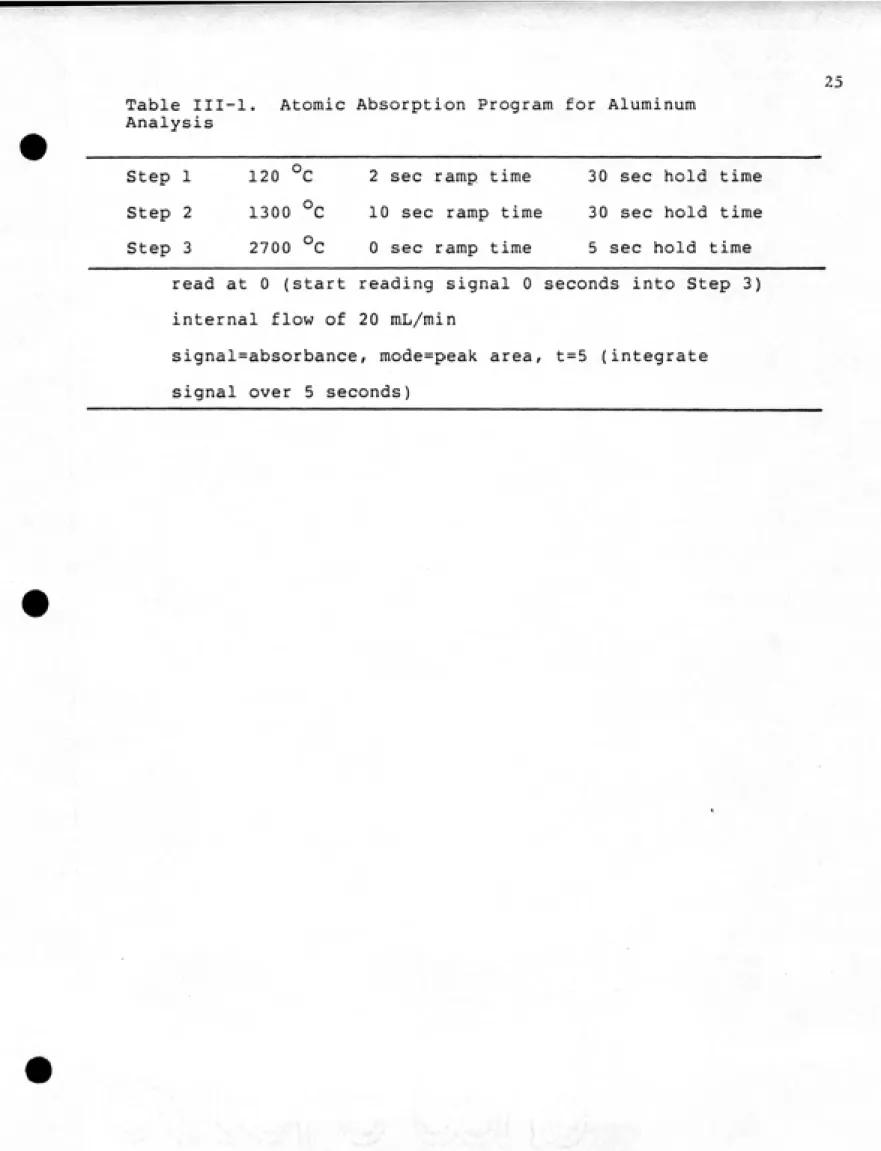
Four standards (20 ug/L to 200 ug/L) and a blank were run to establish a calibration curve. Argon was used as the purge gas. The program for this analysis is given in Table III-l.
2. Ultraviolet Absorbance
The absorbance of solutions at 254 nm was measured
using one-cm quartz sample cells and a slit width of 0.5 nm.
The spectrophotometer used was a Varian Techtron 635
(Varian, Melbourne, Australia). Distilled deionized water
was used as the blank.
3. Total Organic Carbon
The TOC concentration of the filtrate was measured with
a 915B Tocamaster (Beckman Instruments, Fullerton, CA)
25
Table III-l. Atomic Absorption Program for Aluminum
Analysis
Step 1 120 °C 2 sec ramp time 30 sec hold time
Step 2 1300 °C 10 sec ramp time 30 sec hold time
Step 3 2700 °C 0 sec ramp time 5 sec hold time
read at 0 (start reading signal 0 seconds into Step 3)
internal flow of 20 mL/min
signal=absorbance, mode=peak area, t=5 (integrate
were sparged with nitrogen gas for 15 minutes to remove 25
inorganic carbon before analysis. Standards for thecalibration of the instrument (0, 5, and 10 mg/L) were prepared from Fisher certified potassium biphthalate. At
least two, and usually three, injections were made for each
sample.
4. Trihalomethanes
THM analyses were performed according to the methods given in Richard and Junk (1977), EPA (1980), and Reckhow
(1984). Liquid-liquid extraction with Fisher
pesticide-grade n-pentane was used. Carbon tetrachloride (Fisher
certified) was added to the solvent as an internal standard. Five mL of sample, an excess of diethyl ether-extracted
sodium chloride, and three mL of solvent were shaken for five minutes. An injection was then made into the gas
chromatograph (GC). The GC used for this work was a Perkin Elmer Sigma 1 analyzer (Perkin Elmer, Norwalk, Conn.) with a
Ni electron capture detector. The column was 3% SP-1000 on 100/120 mesh Supelcoport (Supelco, Bellefonte, PA).
Standards (20 to 200 ug/L) were prepared using Aldrich (97% or greater purity) chloroform, bromodichloromethane, and
chlorodibromomethane by dilution with distilled deionized
IV. RESULTS AND DISCUSSION
A. FULVIC ACID SOLUTIONS
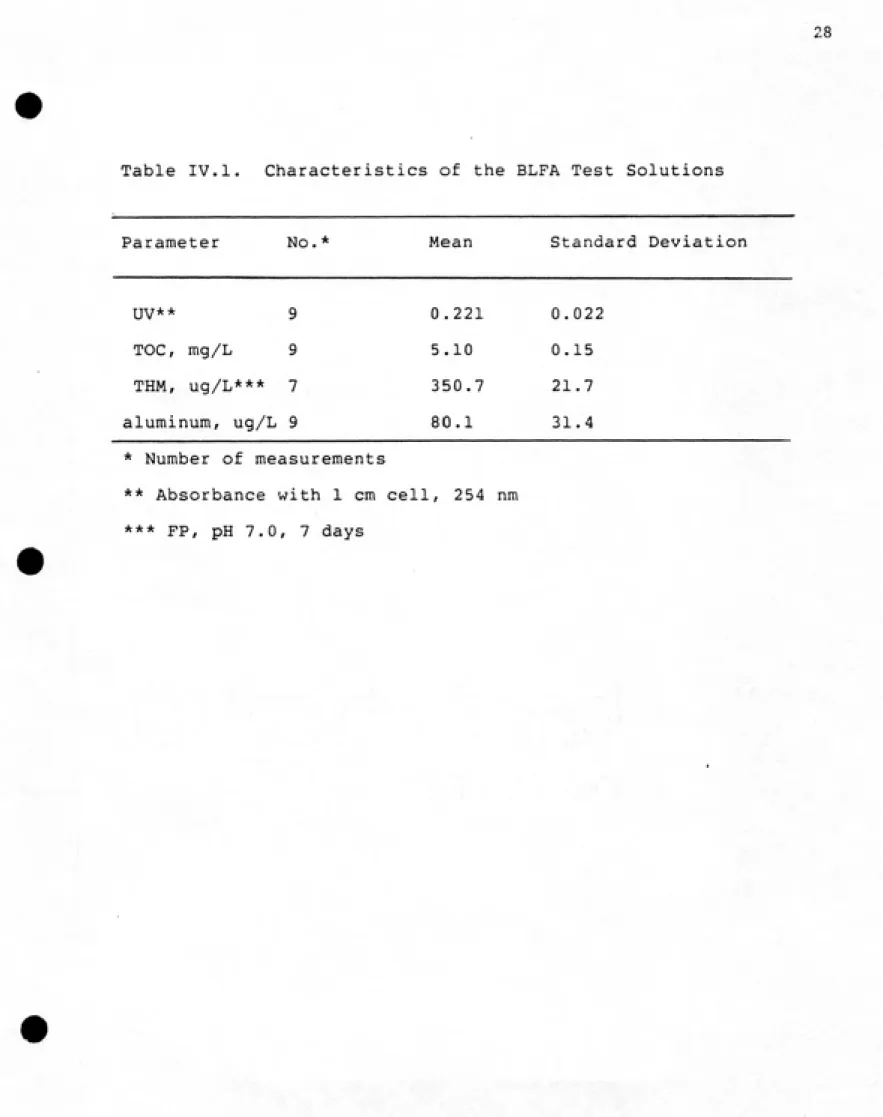
The characteristics of the Black Lake Fulvic Acid
(BLFA) solutions (uncoagulated controls) are given in Table IV. 1. Ten mg/L of BLFA extract yielded a solution with approximately 5 mg/L total organic carbon. Upon
chlorination (pH 1, 7 days), THM concentrations of 350 ug/L were produced. The aluminum concentrations of the test
solutions were high (80 ug/L, in excess of the 50 ug/L level that has been discussed as a possible MCL), and the results
for this parameter were quite variable.
1. Alum Results
The effect of pH on alum coagulation is shown in Figure -4 12
IV.1. At an alum dose of 10 * M as aluminum (25 mg/L as alum), the optimal pH range for the removal of organics is from 5.0 to 6.0. This agrees with the optimal pH ranges found by previous researchers, including: 5.0 to 5.7 by Black and Willems (1961) for the removal of color, pH 5.0 to 6.0 by Kavanaugh (1978) for the removal of total organic carbon, pH 5.0 to 5.3 by Semmens and Field (1980) for the removal of THM precursors, and pH 5.0 to 5.5 by Reckhow
(1984) for the removal of THM precursors in his work with
Table IV.1. Characteristics of the BLFA Test Solutions
Parameter No.* Mean Standard Deviation
UV** 9 0.221 0.022
TOG, mg/L 9 5.10 0.15
THM, ug/L*** 7 350.7 21.7
aluminum, ug/L 9 80.1 31.4
* Number of measurements
60 S CO M O CO 4.50 4.00 3.50 3.00 2.50 2.00 1.50 1.00 0.50 0.00 0.24 D.20 0.16 0.12 0.08 0.04 0.00 300.00 29 _ D 250.00
200.00
g 150.00
-00 3 100.00 50.00 0.00 1000.00 -r 900.00 800.00 700.00 600.00 500.00
:J 400.00
M 300.00
"^ 200.00
< 100.00
-0.00 D IT \ a D D D -D -a D D D
Figure IV. 1,
1 —I---1
4.40 4.80 5.20 5.60 6.00 6.40 6.80
pH
30
The three parameters that represent the removal of
organics (TOC, UV absorbance, and THM formation potential) show the same trends. Removal of as much as sixty percent of UV absorbance, TOC, and THM FP was achieved. The
residual aluminum concentration was at a minimum from pH 5.5 to 6.5, and pH was seen to have a greater impact on residual aluminum than on residual organics (an order of magnitude variation as opposed to decreases of fifty or sixty
percent). Residual aluminum concentrations were below the 50 ug/L level at pH 6.0 and 6.5.
The effect of alum dose on the removal of organics at
pH 5.5 and 6.5 is demonstrated in Figures IV. 2 and IV. 3,
respectively. At pH 5.5, doses of 10~^*^^ to 10"'*'°^ M Al
(20 to 30 mg/L as alum) gave the best removals of organics. Removals of greater than 50 percent of the organic material
(TOV, THM FP, and UV absorbance) were achieved. Residual -4 22 -4 05
aluminum was at a minimum from 10 ' to 10 ' M Al. The
aluminum concentration was below the 50 ug/L level only at
-4 12
an alum dose of 10 ' M Al. At pH 6.5, the maximum
-4 12
removal of organics occurred with doses starting at 10 M Al (25 mg/L). Removal of forty to fifty percent of the organics was reached at this pH. Residual aluminum
concentrations of below 50 ug/L were obtained at 10~ ' M
60 6 O O H 0) o o
4.00 3.50 3.00 2.50 2.00 1.50 -1.00 ͣ
0.50 •
0.00 ͣ 0.18 ͣ
0.16 • 0.14 0.12 0.10 0.08 0.06
^ 0.04
" 0.02
0.00 200.00 180.00 1 60.00 140.00 ^ 120.00 >„ 100.00
3 80.00
0. 60.00
g 40.00
I 20.00
0.00 1000.00 900.00 800.00 700.00 600.00 500.00 2" 400.00 "m 300.00
^ 200.00
^ 100.00 0.00 D 31 D D ͣ D D D D DD -JZL.
TP"
D
D D
D
Figure IV. 2.
-4.40 -4.30 -4.20 -4.10 -4.00 -3.90
log Alum Dose (M Al)
The Effect of Dose on Alum Coagulation
Oq
C
i-i
(jO O
O
O O O O O O O
O O O O O o o
b b b b b b b
o o o o o o o
03 CD o
THM FP
(R?/k^ OJ OJ -f'
o o o tn "^o CJi o en o Oi c o p oo o o o o o p o Co
b b <='9 b b b b b b b ob
o o oo o o o o o o o Oo
UV absorbance TOC (mg/L)
O
b
o o
b ^
03 ho o
en ro o
P o -*
ro OJ -f>- <Si O)
ͣ ^ o b o b o § b o b o b o ͣ a H C5> W • Hi Ui h+i ^' (D O rt O Hi W O CO ro o >ͣ O O OP O 00 > o 3 O o
-1—I—I—I—I________I I
33
-3.95
-4.00 H
-4.05 H
CO
o
:5_
bO O
-4.10 ^
4.15H
-4.20H
-4.25-1
-4.30 4
-4.35
/
5.60
4.40 4.80
5.20
6.00 6.40
6.8i PH
34 (1984) is provided in Figure IV. 5. Reckhow's data were
also generated using Black Lake Fulvic Acid and show similar trends.
Comparison of Figure IV. 2 and IV. 3 indicates that higher doses of coagulant are required at higher pH. This agrees with the observations of Narkis and Rebhun (1977).
2. Polyaluminum Chloride Results
The effect of pH on PACl coagulation for a dose of
-4 35
10 ^'-'•' M Al is presented m Figure IV. 6. The general
upward trend of the parameters with increasing pH agrees with the observations by O'Melia and Dempsey (1981) whoconcluded that PACl works by the direct precipitation of FA. As pH increases, the charge on the FA increases and
additional coagulant is required to neutralize the charge to
achieve the same extent of removal. It should be noted that
Figure IV. 6 and Figure IV. 1 are quite different. With alum coagulation, the minimum for the parameters is at higher pH (5.0 to 6.0) than for PACl (pH 4.5 to 5.5). Removal of up to 40 percent of the organics was obtained with PACl coagulation; residual aluminum of less than 50
ug/L was observed at pH 4.5.
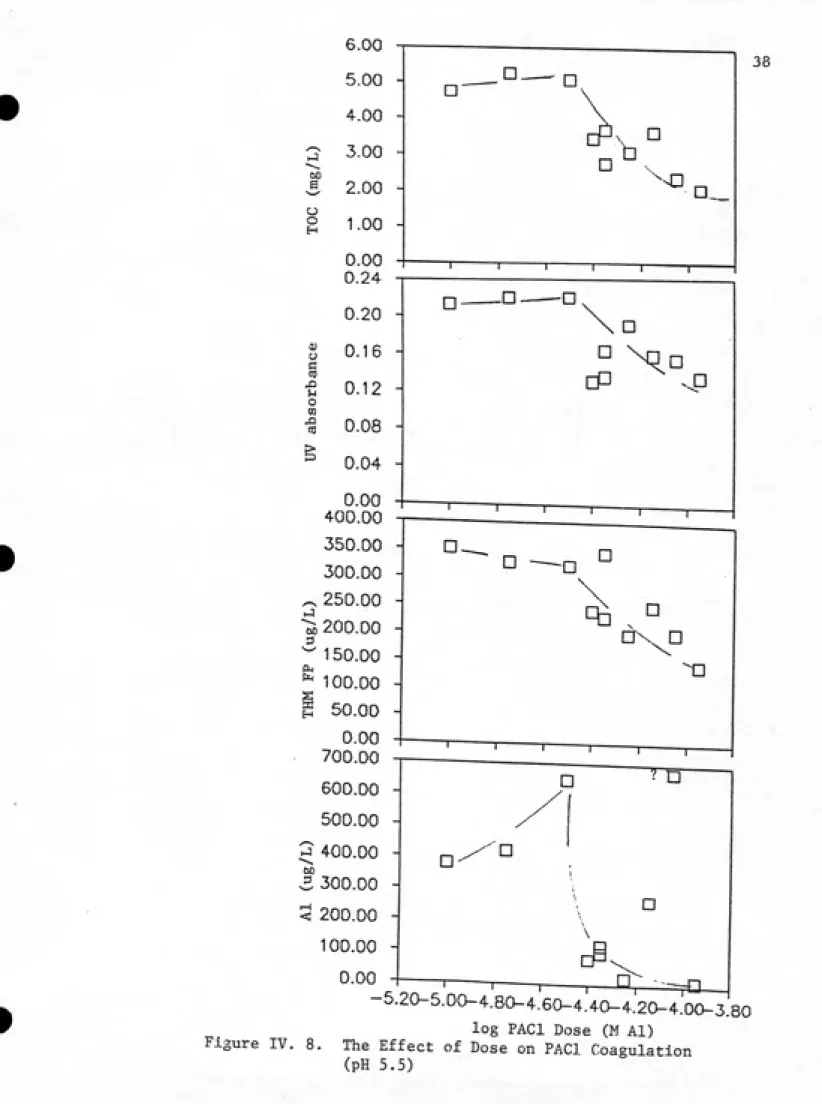
The effect of PACl dose on coagulation at pH 4.5 and 5.5 is demonstrated in Figures IV. 7 and IV. 8,
respectively. At pH 4.5, the optimal doses for the removal
of organics are from lO"'**'^^ to lo"'^'^*^ M Al. Removal of up
3.5
100
as 2.5
0.0
C3 o
1.5
5.0
0.0 5.0
6.0 Pll
30
13 tu 10
o
n
3
10
7.0 8.0
Figure IV. 5. Residual TOC After Alum Coagulation, Settling, and Filtration of
4.50 37 4.00
-nnn"i-i
2.50 2.00
0.05 -0.00 400.00 350.00 300.00 250.00 M 200.00
3
150.00 100.00 50.00 0.00 3000.00 2500.00 2000.00 1500.00 1000.00 500.00
Figure IV. 7.
-4.80 -4.60 -4.40 -4.20 -4.00 -3.80
log PACl Dose (M Al)
The Effect of Dose on PACl Coagulation
60 B u o H 6.00 5.00 4.00 3.00 2.00 1.00 0.00 0.24 0) •s o 0.20 0.16 0.12 0.08 -0.04 0.00 400.00 350.00 300.00 ^250.00 -ͣ ^200.00
3 150.00
^ 100.00
-I 50.00
0.00 700.00 -r— 600.00 500.00
g 400.00
-00 3 300.00 < 200.00 100.00 0.00 D. D n,_n .ͤ -a
a
D
N^a
aa.
a -a a
0\D "XI a t---r D a a CH--r-Or
-5.20-5.00-4.80-4.60-4.40-4.20^00^3.
log PAC1 Dose (M Al)
Figure IV. 8. The Effect of Dose on PAC1 Coagulation
(pH 5.5)
38
region. Residual aluminum reached a minimum of 51 ug/L at a
dose of lO"'*'-^^ M Al.
For PACl at pH 5.5, good removal of organics was
observed from 10"'**'*° to 10~^'^^ M Al (greater than 50
percent); higher doses were not tested. It is not clear that the optimal dose had been reached. Residual aluminum
~4 25 values of less than 50 ug/L were achieved at 10 * and
-3 95
10 * M Al. As was seen with alum results, the parameters
of TOC concentration, UV absorbance, and THM FP show the same trends. The residual aluminum data shows the same
trends as the residual organic data, but again with order of magnitude differences. As was observed with alum. Figures
IV. 7 and IV. 8 demonstrate that higher coagulant doses are required at higher pH. For pH 4.5, the optimal dose was
-4 0
exceeded at 10 ' M Al; for pH 5.5, the optimal dose was
-4 0
probably just reached at 10 ' M Al.
Comparison of Figures IV. 7 and 8 with Figures IV. 2 and 3 indicates that good removal can be achieved with
either coagulant. Only for PACl at pH 4.5 (Figure IV. 7)
were removals of at least fifty percent not achieved.
The results in Figure IV. 8 are particularly variable.
In addition to the variability introduced by the analytical
methods, there are some sampling and handling aspects of
these experiments that may have introduced variability into
this study. Many of the studies discussed in the literature
review (e.g., Edwards and Amirtharajah, 1985; Black and
40
flocculation step or recorded the pH at the end of the
settling step. For this study, pH was maintained through the end of the rapid-mix step. The system was open to the
atmosphere, and no measurements of pH were made after
sedimentation or filtration. No attempt was made to control
temperature during coagulation and sedimentation and from experiment to experiment; room temperature varied during the
course of these experiments from 21.4 to 26.5 degrees C.
The UV measurements were observed to be more variable
than those for the other organic parameters. Edzwald et al (1984) discussed problems with inorganic interferences,
which may be responsible for this variation, but, in this research, attempts were made to minimize variability by measuring at a consistent pH (2) and confining measurements
to the filtered waters.
Other factors which are important in jar test
experimentation, such as rate of addition of coagulant and mixing during the course of coagulant addition, were kept as
reproducible as possible, as described in Chapter 3. All of the PACl experiments were conducted with
dilutions made from a single concentrated stock solution so that there would not be appreciable variation in the
aluminum concentration or the composition of the aluminum
polymers. However, this meant that the PACl stock solution was anywhere from 1 day to 2 months old during the
41
found that PACl stocks of greater than 1 M Al are stable for
several months, but Smith and Hem (1972) concluded that the
age of PACl solutions is important for determining their
composition.
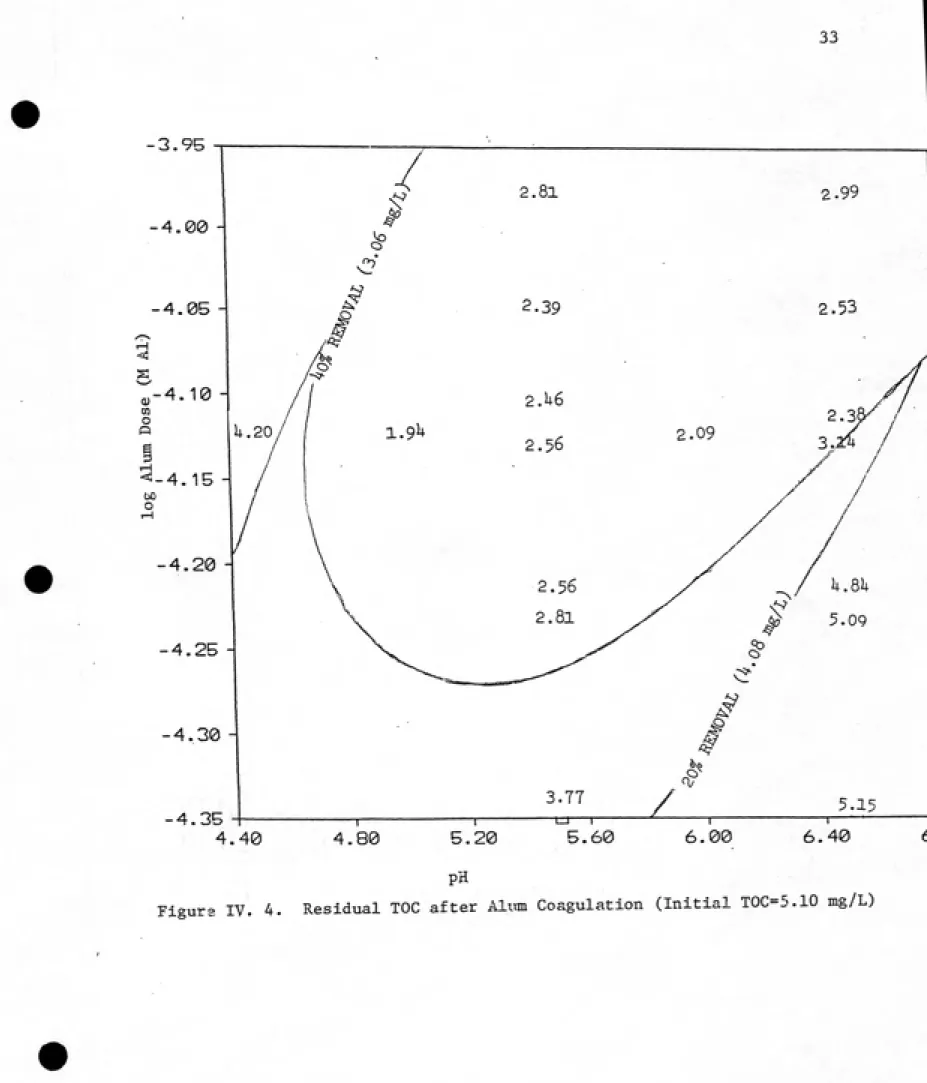
The regions of 20 and 40% removal of TOC on a log PACl dose versus pH diagram are shown in Figure IV.9. Comparison
of this diagram with Figure IV. 4 indicates that PACl
performs better than alum at low pH (less than 5.0), but that alum performs better at higher pH (5.5 to 6.5). This agrees with the results reported by Dempsey et al (1984). O'Melia and Dempsey (1981) concluded that the polymeric species in PACl will form solid Al(OH). more slowly than alum solutions. Thus, alum is a better coagulant in the sweep flocculation zone than PACl.
The floe produced in all the jar tests involving fulvic acid solutions was small and light-colored, and settled
poorly.
B. DURHAM RAW WATER
In order to test the results from the model fulvic acid
solution on a real water, a sample of Durham's raw drinking
water was collected and treated in a parallel fashion. To insure that the water used was consistent from jar test to jar test, the water was collected just once and the testswere conducted within 28 hours of each other. The
42
-3.80
-4.00
-4.20
Q)-4.40 A
«^4.60 -J
-4.80 -^
-5.00 ^
-5.20 .
4.50 5.00
Figure IV. 9. Residual
5.50 pH
6.00 6.50
7.00
TOC after PACl Coagulation (Initial TOC=
7.50
Table IV.2. Characteristics of Durham Raw Water
43
Parameter No.* Mean Concentration
UV** 2
TOC, mg/L 2 THM, ug/L*** 2
aluminum, ug/L 2
0.345 5.56 391 119
* Number of measurements
** Absorbance with 1 cm cell, 254 nm
44
much more noticeable floe (larger and gold-colored) than those involving the FA solutions.
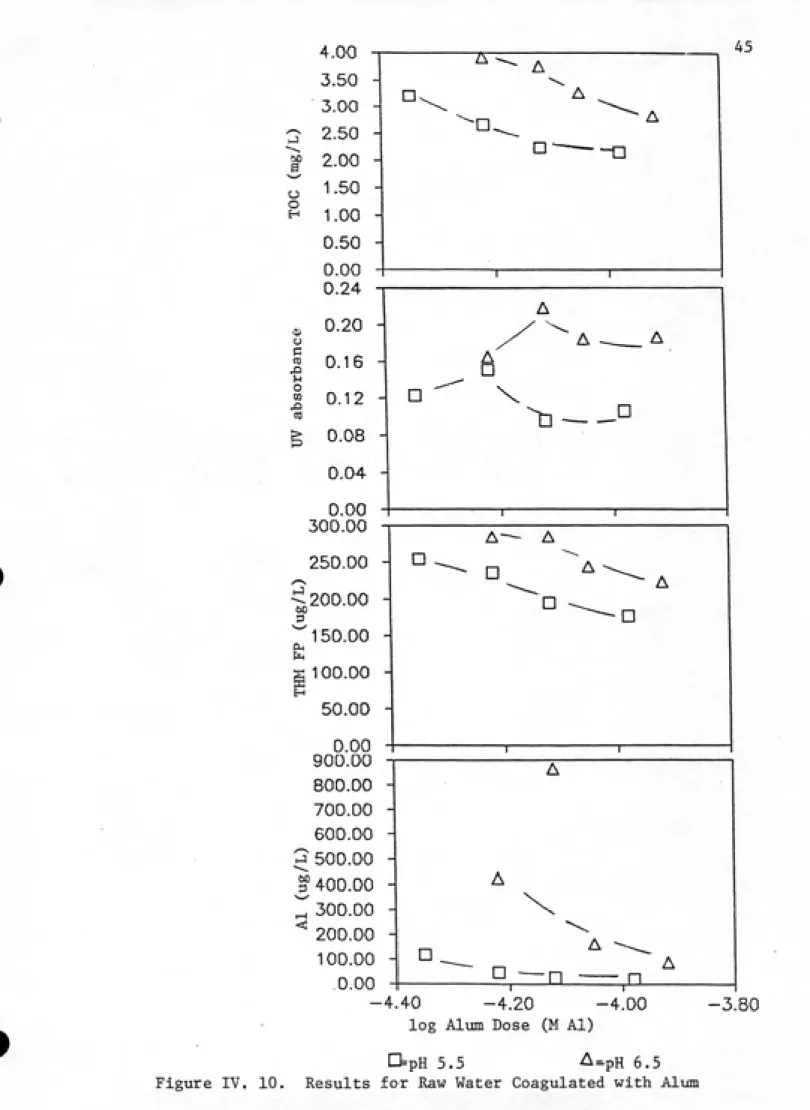
The results for jar tests involving alum are shown in
Figure IV.10. For this water and these coagulant doses,
better removal of organics was achieved at pH 5.5 than at pH 6.5, and lower coagulant doses were required to effect this removal. At pH 5.5, three out of four of the TOC values and
two out of four of the THM FP values represent greater than
fifty percent removal; three out of four of the aluminum
values are below 50 ug/L. Thus, a broader dose region of
good removal is observed for the real water than was observed for the model fulvic acid solution.
The results for the raw water coagulated with PACl are
shown in Figure IV.11. Although it is difficult to draw
conclusions based on only eight jar tests, it appears that
in this dose range and with this water, better removal of
organics is achieved at pH 5.5 than at pH 4.5. The results for residual aluminum at pH 4.5 suggest that the doses used
for these four jar tests may have been higher than the
optimal dose. Removals of up to 50% of the organic material
were observed; residual aluminum of less than 50 ug/L was
observed for two of the jar tests at pH 5.5.
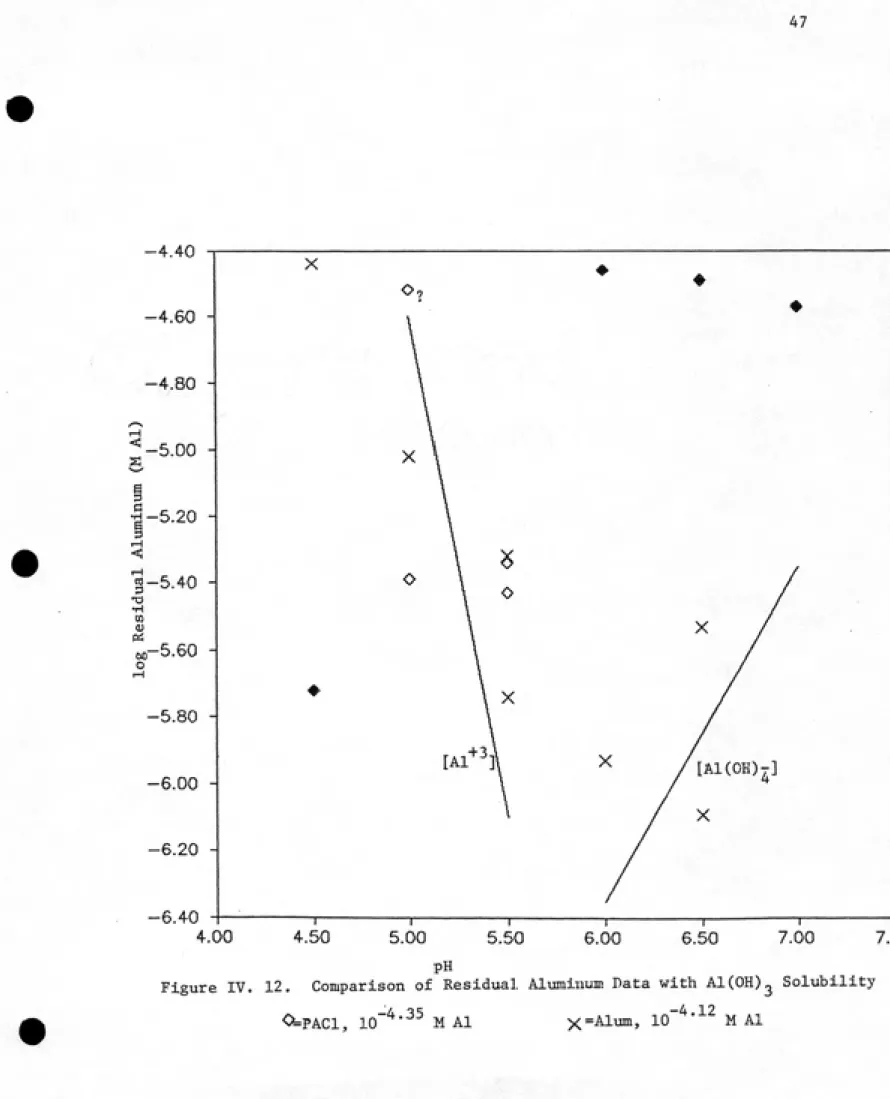
C. ALUMINUM RESIDUALS AND ALUMINUM SOLUBILITY
A comparison of the residual aluminum results with the + 3
solubility lines for A1(0H)2 solid with respect to Al and
60 e o H 4.00 3.50 3.00 2.50 2.00 1.50 1.00 0.50 0.00 0.24 45
0. 0.20
-u C
to
O CO
0.16 H
0.12 0.08 0.04 P 0.00 300.00 250.00
,200.00 H
150.00 H
g 100.00
50.00 0.00 900.00 800.00 700.00 600.00g 500.00
J 400.00
Z 300.00
"^ 200.00 100.00 ,0.00 D D •n. D---ͤ A D V-d-~-^°
A-D DD —EL
XL
-4.40 -4.20
log Alum Dose (M Al)
-4.00 -3.80
Figure IV. 10.
D=pH 5.5 A=pH 6.5
60 o 0) o e: M o CO cd 4.00 3.50 3.00 2.50 2.00 -1.50 1.00
0.50 -\
0.00 0.20 0.18 0.16 -0.14 0.12 0.10 H 0.08 0.06 0.04 0.02 -0.00 300.00
250.00
200.00
-Ml50.00 ^
^ 100.00 ^
§ 50.00 H
0.00 1 200.00 1000.00
-800.00
"^ 600.00
-I
400.00
-00
200.00 - ͤ
0.00 D Q-TT 46 A D A-._, TT D D .D -Q-D / / /ͤ A-—A I---T
-4.60 -4.40 -4.20 -4.00 -3.80
log PACl Dose (M Al)
Figure IV. 11. Results for Raw Water Coagulated with PACl
47
-4.40
4.60
--4.80
-5.00
•d-5.20
g-5.40
-5.60
-5.80
IA1(0K)t] -6.00
-6.20
-6.40
4.00 4.50 5.00 5.50 6.00 6.50 7.00 7.5C
PH
Figure IV. 12. Comparison of Residual Aluminum Data with A1(0H)„ Solubility
48
that plotted in Figures IV. 1 and IV. 6 and represents a
particular dose for each coagulant. A similar diagram from Vik et al (1985) is provided in Figure IV. 13. As Vik et al
found, the residual aluminum data for coagulation with alum
follow these solubility lines reasonably well. The data for
residual aluminum after PACl coagulation does not follow these solubility lines, particularly the three darkened
points above the lines (pH 6.0 to 7.0) and the one darkened point below the lines (pH 4.5). (The point marked with a
question mark at pH 5.0 was thought to be an outlier
originally when compared with the trend indicated by the other points; see Figure IV. 6; the jar test was repeated
and the other point at pH 5.0 was obtained).
The PACl data point below the solubility line at low pH
supports the conclusion that other mechanisms for the
removal of organics are important here. The conclusion put
forth by O'Melia and Dempsey (1981) that PACl works by
direct precipitation of FA is supported by this aluminum data; aluminum appears to be precipitating because of its
interaction with FA and not because the solubility of
Al{OH)g(s) in water has been exceeded.
The unexpectedly high residual aluminum concentrations
for PACl at pH 6.0 to 7.0 may be due to the slower kinetics
of the transformation of the polymeric species to solid
49
- le.o
3.4 mg Al/L
4.5 mg M/L
4.5 mg Al/L (10 mm rapid mix) lO.a mg Al/L
18.0 mg Al/L
50.0 mg Al/L
o Critical coagulation concaniration
0.01
Figure IV. 13. Residual Aluminum Concentration as a Function of pH
50
D. TOC/THM CORRELATIONS
The correlation between post-coagulation TOC and the
subsequent formation of THMs for the two coagulants studied is depicted in Figure IV. 14. This line, which includes all
of the jar tests in this study for which there is both TOC and THM FP data (for six of the initial jar tests with alum,
THM FP was not analyzed), has a correlation coefficient of
0.834. Thus, the relationship between TOC and THM FP, with the fulvic acid solution or Durham raw water and with alum or polyaluminum chloride coagulation at all doses tested, is
expressed by the equation:
THM FP = 56.0 TOC +60.3
(THM FP in ug/L and TOC in mg/L)
This equation (especially the slope) compares favorably with
the equation Edzwald et al (1984) found for Oneida water:
THM FP = 55.7 TOC +34.2
Coagulation with PACl did not show any more or less
preference for THM precursors relative to organic carbon
than coagulation with alum did. Thus, the results for TOC
removal by PACl coagulation discussed in Chapter 2 would be
51
400.00
360.00 -\
320.00 H
280.00 H
CD
3240.00 U
200.00 -\
160.00 H
120.00
D=Aliiiii, FA
A=PAC1, FA
<^Alum, Raw Water
>f=PACl, Raw Water
CORRELATION COEFFICIENT=0.834 THM FP = 56,0 TOC + 60.3
X
o
X o
o x^
A X
A
X
X
D
/v-D D
D A
D
TOC (mg/L)
Figure IV. 14. Correlation Between THM FP and TOC After Coagulation
52
Studying the TOC to THM FP ratio, the Black Lake Fulvic Acid
solution was a good model for the Durham raw water.
E. TOC/ALUMINUM CORRELATIONS
The correlation between post-coagulation TOC and
residual aluminum is depicted in Figure IV. 15. The graph includes all of the jar tests in this study. Although this
relationship is not as clear as that between TOC and THM FP
(Figure IV. 14), one can conclude that residual aluminum and
3.60
3.20
2.80
-00
3
£2.40
(§2.00
-O
1.60
-1.20 D D D D D D D D D D a D
D D D D D D n D D
D ͤͤ nn
D D [P
D D
D
D D
ͤ D n ͤ D ͤ n Dn o D D D 0.80
1.50 2.00 2.50 3.00 3.50
TOC (mg/L)
4.00 4.50 5.00
Figure TV.15. Correlation Between Log Residual Aliiminiun and TOC
After Coagulation
V. CONCLUSIONS AND RECOMMENDATIONS
A. CONCLUSIONS
The three parameters used to represent the removal of organics due to coagulation (TOC, UV absorbance, and THM FP)
in this work were consistent with each other for the Black
Lake Fulvic Acid solutions and Durham raw water.
Coagulation with PACl did not show any more or less
preference for THM precursors relative to organic carbon
than alum did. Fifty percent removal of TOC, UV absorbance,
and THM FP was observed in several regions of the log
coagulant dose-pH diagrams for both coagulants.
As pH was increased (up to 7.0 in this study), higher coagulant doses were generally required for effective
coagulation for both coagulants. This is probably due to the higher charge density of the fulvic material at higher pH. More coagulant is required to neutralize the charge.
PACl works better than alum with regard to the removal
of organic carbon in the low pH region (less than pH 5.0). .
At pH 4.5, 10~'^*-'-° M Al PACl removed 30% of the THM FP,
while lO"^""^^ M Al alum removed only 20% of the THM FP at
the same pH. At pH 5.5 and higher, alum worked as well or better than PACl for the doses tested in this work. For pH
5.5, lo"^'"*"^ M Al alum removed 55% of the THM FP, while
The data for residual aluminum versus pH is consistent with the results of others that PACl works by a different mechanism than alum. The alum results follow the solubility
of A1(0H)t{s), indicating that removal is predominantly by
sweep floe in the region of the log concentration versus pH diagram examined in this study (pH 4.5 to 6.5; alum doses of
lO"'**^^ M Al to lO""^*^^ M Al). The PACl data do not follow
the solubility lines for Al(OH)^(s), which supports the
hypothesis that PACl works by direct precipitation of fulvic
acid.
Under optimal pH conditions (pH 5.5 to 6.5 for alum and
pH 5.5 for PACl), residual aluminum concentrations of less than 50 ug/L can be achieved. Should a MCL of 50 ug/L for
aluminum be set, both of these coagulants could still be used, but doses would have to be carefully controlled and
monitored.
B. RECOMMENDATIONS FOR FURTHER RESEARCH
Further research into the advantages and disadvantages of these two coagulants should include jar tests at alkaline pH values. Dempsey et al (1985) have shown that PACl
performs better than alum for the removal of TOC at pHs
above the sweep floe zone, but this issue was not addressed
in the work presented here.
Also, the effect of temperature during coagulation needs to be researched, particularly relative to the
56
residual aluminum). Dempsey et al (1985) have mentioned
that PACl works better than alum at cold temperatures. This
is probably due to the slow hydrolysis reaction of alum at colder temperatures.
Some jar tests should be conducted without artificially
maintaining a constant pH. PACl is less acidic than alum and has less of an effect on solution pH than alum does. An evaluation of the coagulation of various types of organic carbon and various concentrations needs to be conducted.
REFERENCES
Amirtharajah, A., and Mills, K.M., "Rapid-Mix Design for Mechanisms of Alum Coagulation", Journal of the American
Water Works Association, Vol. 74, pp. 210-216 (April, 1982).
Babcock, D., and Singer, P. C, "Chlorination and
Coagulation of Humic and Fulvic Acids", JAWWA, Vol. 71, pp.149-152 (March, 1979).
Baes, C.F., Jr., and Mesmer, R. E., The Hydrolysis of
Cations, John Wiley and Sons, New York (1976).
Bellar, T. A., Lichtenberg, J. J., and Kroner, R. C,
"The Occurence of Organohalides in Chlorinated Drinking Waters", JAWWA, Vol. 66, pp. 703-706 (Dec, 1974).
Black, A. P., and Willems, D. G., "Electrophoretic Studies of Coagulation for Removal of Organic Color", JAWWA, Vol. 53,pp. 589-604 (May, 1961).
Black, A.P., and Christman, R. F., "Chemical
Characteristics of Fulvic Acids", JAWWA, Vol. 55, pp. 897-912 (July, 1963).
Bottero, J.Y. a. Cases, J. M., Fiessinger, F., and
Poirier, J. E., "Studies of Hydrolyzed Aluminum Chloride
Solutions. 1. Nature of Aluminum Species and Composition of Aqueous Solutions", Journal of Physical Chemistry, Vol. 84, pp. 2933-2939 (1980).
Bottero, J. Y. b, Poirier, J. E., and Fiessinger, F., "Study of Partially Neutralized Aqueous Aluminum Chloride Solutions: Identification of Aluminum Species and
Relation Between the Composition of the Solutions and Their Efficiency as a Coagulant", Water Science
Technology. Vol. 12, pp. 601-612 (1980).
Bottero, J. Y., Tchoubar, D., Cases, J.M., and
Fiessinger, F., "Investigation of the Hydrolysis of
Aqueous Solutions of Aluminum Chloride. 2. Nature and Structure by Small Angle X-ray Scattering", Journal of Physical Chemistry, Vol. 86, pp. 3667-3673 (1982).
Christman, R. F., Liao, W. T., Millington, D. S., and Johnson, J. D., "Oxidative Degradation of Aquatic Humic Material", Advances in the Identification and Analysis of Organic Pollutants in Water, Vol. 2 (editor L. H. Keith) Ann Arbor Publishers, Ann Arbor, MI (1981).
Dempsey, B. A., Sheu, H., Tanzeer Ahmed, T. M., and
Mentink, J., "Polyaluminum Chloride and Alum Coagulation of Clay-Fulvic Acid Suspensions", JAWWA, Vol. 77, pp.
74-80 (March, 1985).
Dempsey, B. A., Ganho, R. M., and O'Melia, C. R., "The
Coagulation of Humic Substances by Means of Aluminum
Salts", JAWWA, Vol. 76, pp. 141-150 (April, 1984). Edwards, G. A., and Amirtharajah. A., "Removing Color
Caused by Humic Acids", JAWWA, Vol. 77, pp. 50-57 (March, 1985) .
Edzwald, J. K., "Coagulation of Humic Substances", AIChE
Symposium Series, Water-1978, No. 190, Vol. 75, pp.
54-62.
Edzwald, J. K., Becker, W. C, and Wattier, K. L.,
"Surrogate Parameters for Monitoring Organic Matter and Trihalomethane Precursors in Water Treatment", manuscript to the JAWWA (March, 1984).
Enviromental Protection Agency, "The Analysis of Trihalomethanes in Drinking Water by Liquid/Liquid
Extraction: Method 501.2" (1980).
Felix-Filho, J. A., "The Effect of Aquatic Humic
Substances and Ozonation on the Stability of Particles", Ph.D. dissertation, UNC-CH (1985).
Hall, E. S., and Packham, R. F., "Coagulation of Organic Color with Hydrolyzing Coagulants", JAWWA, Vol. 57, pp. 1149-1166 (Sept., 1965).
Hayden, P., and Rubin, A.J., "Systematic Investigation of the Hydrolysis and Precipitation of Aluminum (III)", pp. 317-381, Chapter 9, Aqueous Environmental Chemistry of
Metals (editor A.J. Rubin) Ann Arbor Publishers, Ann
Arbor, MI (1974).
Jeffcoat, W. B., and Singley, J.E., "The Effect of Alum
Concentration and Chemical Addition Times on
Coagulation", JAWWA, Vol. 67, pp. 177-181 (April, 1975).
Johnson, D. E., and Randtke, S. J., "Removing Nonvolatile Organic Chlorine and its Precursors by Coagulation and
Softening", JAWWA, Vol. 75, pp. 249-253 (May, 1983).
Kavanaugh, M., "Modified Coagulation for Improved Removal of Trihalomethane Precursors", JAWWA, Vol. 70, pp.
613-620 (Nov., 1978).
Matijevic, E., and Stryker, L. J., "Coagulation and Reversal of Charge of Lyophobic Colloids by Hydrolyzed
59
Metal Ions. III. Aluminum Sulfate", Journal of Colloid
and Interface Science, Vol. 22, pp. 68-77 (1966). Matijevic, E., Mathai, K. G., Ottewill, R. H., and
Kerker, M., "Detection of Metal Ion Hydrolysis by
Coagulation. III. Aluminum", Journal of Physical Chemistry, Vol. 65, pp. 826-830 (May, 1961). Matijevic, E., and Allen, L. H., "Interaction of
Colloidal Dispersions with Electrolytes", Environmental
Chemistry and Technology, Vol. 3, pp. 264-268 (March, 1969) .
Methods for Chemical Analysis of Water and Wastes, EPA 600/4-79-020, 202.2-1-202.2-2 (1979).
Miller, R. G., Kopler, F. C, Kelty, K. C, Stober, J.A., and Ulmer, N. S., "The Occurrence of Aluminum in Drinking
Water", JAWWA, Vol. 76, pp. 84-91 (Jan.,1984).
Narkis, N., and Rebhun, M., "The Mechanism of
Flocculation Processes in the Presence of Humic
Substances", JAWWA, Vol. 67, pp. 101-108 (Feb., 1975).
Narkis, N., and Rebhun, M.,"Stoichiometric Relationship
Between Humic and Fulvic Acids and Flocculants", JAWWA, Vol. 69, pp. 325-328 (June, 1977).
Oliver, B. G., and Lawerence, J., "Haloforms in Drinking
Water: A Study of Precursors and Precursor Removal", JAWWA, Vol. 71, pp. 161-163 (March, 1979).
Oliver, B. G., and Viser, S. A., "Chloroform Production
from the Chlorination of Aquatic Humic Material: The Effect of Molecular Weight, Environment, and Season", Water Research, Vol. 14, pp. 1137-1141 (1980).
O'Melia, C. R., and Dempsey, B. A., "Coagulation of
Natural Organic Substances in Water Treatment", Progress
Report at the State-of-the Art Research Seminar in
Environmental Engineering, US EPA, Cincinnati, Ohio (July
23, 1981).
Packham, R. F. a, "The Coagulation Process. I. Effect of
pH and the Nature of Turbidity", Journal of Applied
Chemistry, Vol. 12, pp. 556-564 (Dec, 1962).
Packham, R. F. b, "The Coagulation Process. II. Effect of
pH on the Precipitation of Aluminum Hydroxide", Journal of Applied Chemistry, Vol. 12, pp. 564-568 (Dec, 1962). Packham, R. F., "Some Studies of the Coagulation of
60
Reckhow, D. A., "Organic Halide Formation and the Use of
Preozonation and Alum Coagulation to Control Organic
Halide Precursors", Ph.D. dissertation, UNC-CH (1984).
Richard, J.J., and Junk, G. A., "Liquid Extraction for
the Rapid Determination of Halomethanes in Water", JAWWA,
Vol. 69, pp. 62-64 (1977).
Safe Drinking Water Committee, National Academy of
Sciences, "Toxicity of Selected Inorganic Contaminants in Drinking Water", Drinking Water and Health, Vol. 4, pp. 155-167 (1982).
Semmens, M., and Field, T., "Coagulation: Experiences in
Organics Removal", JAWWA, Vol. 72, pp. 476-483 (Aug.,
1980).
Singer, P.C., Barry, J. J., Ill, Palen, G. M., and
Scrivner, A. E., "Trihalomethane Formation in North Carolina Drinking Waters", JAWWA, Vol. 73, pp. 392-401
(Aug., 1981).
Smith, R. W., and Hem, J.D., "Chemistry of Aluminum in Natural Water: Effect of Aging on Aluminum Hydroxide Complexes in Dilute Aqueous Solutions", USGS Water Supply Paper 1827D, GPO, Washington, D. C. (1972).
Snoeyink, V. L., and Jenkins, D., Water Chemistry, John Wiley and Sons, New York, (1980).
Standard Methods for the Examination of Water and
Wastewater, APHA, AWWA, WPCF, 16th Editon (1985).
Stevens, A. A., Slocum, C. J., Seeger, D. R., and Robeck,
G. G., "Chlorination of Organics in Drinking Water", JAWWA, Vol. 68, pp. 615-620 (Nov., 1976).
Stumm, W., and Morgan, J.J., "Chemical Aspects of
Coagulation", JAWWA, Vol. 54, pp. 971-994 (Aug., 1962).
Stumm, W., and O'Melia, C. R., "Stoichiometry of
Coagulation", JAWWA, Vol. 60, pp. 514-539 (May, 1968). Sullivan, J. H.,Jr., and Singley, J. E., "Reactions of Metal Ions in Dilute Aqueous Solution: Hydrolysis of Aluminum", JAWWA, Vol. 60, pp. 1280-1287 (Nov., 1968).
Sung, W., and Rezania, S., "The Effects of pH and Fluoride on the Soluble Fraction of Aluminum in Water Coagulated with Alum", unpublished manuscript.
6.1
J., Smith, B. L., and Stevens, A. A., "National Organics
Reconnaissance Survey for Halogenated Organics", JAWWA,
Vol. 67, pp. 634-664 (Nov., 1975).
Thurman, E. M., and Malcolm, R. L., "Preparative
Isolation of Aquatic Humic Substances", Environmental
Science and Technology, Vol. 15, pp. 463 (1981).
Vik, E. A., Carlson, D. A., Eikum, A. S., and Gjessing, E. T., "Removing Aquatic Humus from Norwegian Lakes",
JAWWA, Vol. 77, pp. 58-66 (March, 1985).
Young, J- S.,Jr., and Singer, P. C, "Chloroform Formation in Public Water Supplies: A Case Study",