Meredith L. Hale. Searching for Art Records: A Log Analysis of the Ackland Art Museum’s Collection Search System.A Master’s Paper for the M.S. in I.S. degree. August, 2015.88pages.Advisor: Diane Kelly.
Search log data from the Ackland Art Museum’s online collection search system was analyzed in order to determine the search categories most frequently employed by users of the system. The data consisted of a total of 16,729 actions and 3,459 search sessions. It covered a three-month time period from February 19 to May 19, 2015. Analysis of actions associated with the Ackland’s advanced search feature suggest that the
department, classification, and artist fields have the highest usage while searchers rarely submit queries relating to a work’s particular medium (2.55%). Review of the most common queries submitted by users reveals that search terms most commonly relate to representational subjects visually presented in a work of art rather than formal titles. Investigation into how users alter the queries they submit throughout a search session indicates that users often do not change categories during a search session, but primarily make parallel changes (68.11%).
Headings:
Art museum websites -- Use and access
Server-side user study -- Art museum online collection search system
Information needs -- Art historians, artists, and humanities scholars
SEARCHING FOR ART RECORDS:
A LOG ANALYSIS OF THE ACKLAND ART MUSEUM’S COLLECTION SEARCH SYSTEM
by
Meredith L. Hale
A Master’s paper submitted to the faculty of the School of Information and Library Science of the University of North Carolina at Chapel Hill
in partial fulfillment of the requirements for the degree of Master of Science in
InformationScience.
Chapel Hill, North Carolina
August 2015
Approved by
T
ABLE OFC
ONTENTSAcknowledgements ... 2
List of Figures & Tables ... 3
Introduction ... 4
Overview of Art Museum Collection Search Systems ... 7
Description of the Ackland Art Museum’s Search System & Collection ... 14
Literature Review ... 22
Methods ... 34
Method Selection: Log Analysis and its Strengths & Weaknesses ... 34
Documentation of Decisions for Data Cleaning & Analysis ... 36
Results & Discussion ... 42
General Characteristics of the Log Data ... 42
Analysis of Advanced Search Category Usage ... 49
Corpus of Queries ... 54
Query Reformulation ... 64
Conclusions ... 69
Recommendations ... 71
Limitations ... 76
Postscript ... 78
Bibliography ... 80
ACKNOWLEDGEMENTS
Thanks to:
Dr. Diane Kelly for teaching me what a log analysis is, instigating my interest in information retrieval, and making me see how valuable user-centered research can be
Joan Boone for introducing me to programming and helping me apply my knowledge to the world of art
Patrick Golden for making me realize how messy data can be and suggesting tools to clean it up
LISTS OF FIGURES
&
TABLESList of Figures
Figure 1 - Example collection highlights page from the Dayton Art Institute (DAI) Figure 2 - Detroit Institute of Art’s collection search system
Figure 3 - The Indianapolis Museum of Art’s (IMA) collection search page Figure 4 - Dallas Museum of Art’s (DMA) collection search page
Figure 5 - San Francisco Museum of Modern Art (SFMOMA) ArtScope search feature Figure 6 - Layout of the Ackland’s collection search system
Figure 7 - Detailed view of the Ackland’s advanced search feature Figure 8 - Ackland’s collection highlights page
Figure 9 - Example action from the log submitted by a robot to illustrate its structure Figure 10 - Timeline of the Ackland’s search log created using OpenRefine
Figure 11 - Percentage of search sessions by action total
Figure 12 - Distribution of search sessions with less than 50 actions Figure 13 - Percentage of actions associated with the three search types
Figure 14 - Percentage of advanced search categories associated with terms found within unique queries by session
Figure 15 – Maximum number of advanced search categories per search session by percentage
Figure 16 - Word cloud of the top 49 search terms unique to a search session
Figure 17 - Richard Westall, The Sword of Damocles, oil on canvas, 1812, Ackland Art Museum.
Figure 18 - Categorical query reformulation types by percentage
Figure 19 - Works in the Ackland’s collection with the highest number of search terms related to them
List of Tables
Table 1 - Duration and additional characteristics of search sessions with over 100 search actions
Table 2 – Queries associated with the most actions
I
NTRODUCTIONIn the development of a search system, detailed attention is frequently given to
understanding and representing the “documents” a system will need to retrieve, but less
consideration is often accorded to determining how the needs of potential users of a
system will match with this document-focused metadata. Ultimately having a proper
understanding of both users and the items they seek to retrieve is essential to creating an
effective search system. The writings of Nicholas Belkin support this, especially
emphasizing the importance of the user in system development. He writes, “the corpus of
needs is at least as important as the corpus of documents in producing rules for
representation and perhaps more so” (Belkin, 1980, p. 136). Request- or user-oriented
approaches to indexing have also been forwarded by scholars such as Dagobert Soergel
and Raya Fidel and have become increasingly prominent in collection management and
information retrieval today (Fidel, 1994, p. 574).
Following in this vein, this study aims to increase understanding of the needs of
users of the Ackland Art Museum’s collection search system. The main research question
is to determine the types of search categories (artist name, date, etc.) most frequently
submitted by users. In order to achieve this, log data from the Ackland Art Museum was
collected and evaluated to uncover patterns in the type of content typically sought and the
search methods frequently used by visitors to the site. The search URLs found within the
associated with in some instances, which can be used to indicate the types of information
users are seeking. While these queries are not equivalent to an information need, they are
indicative of these needs. The queries can be best understood as examples of Robert
Taylor’s definition of a compromised need (Taylor, 1968, p. 182). When a user must alter
his or her actual information need in order to make it acceptable to the structure of a
particular system, this need is defined as compromised. Almost any need that is recorded
in some way is necessarily compromised because of the “translation” that occurs in
formalizing a visceral need. Yet, while this analysis documents compromised needs, they
are real needs. The use of log data in this study makes this authenticity possible. Using
log data, rather than interviewing users about their needs retrospectively or using
task-based scenarios to elicit genuine information-seeking behaviors, has value because of its
ability to unobtrusively document the actual queries of current users of an existing search
system. Further discussion of the strengths and weaknesses of log analysis as a research
method is included in the “Methods” section.
While uncovering user needs is always challenging, studying these needs in an
online art museum collection has its own particular set of trials to be overcome due to its
emphasis on visual information retrieval (VIR). While a visitor to an art museum’s online
collection search system may be interested in searching the system to gather either visual
or textual material, both the text found in an art historical record and the visual
representation of the object are tied to a visual rather than a textual source. Central to any
study concerned with image retrieval is the largely unexplained phenomenon of how
people perceive and verbalize their need for visual information. This process still remains
entity. This failure of language is the cause of the primary challenge faced by visual
information retrieval researchers today – the semantic gap. This term refers to the lack of
coherence between an item’s visual characteristics and the interpretation of these
characteristics by a user (Smeulders, Worring, Santini, Gupta, & Jain, 2000, p. 1353).
Unlike text retrieval, “visual materials have broader and less well-defined access points
because they can be described by a variety of factors within them” (Choi & Rasmussen,
2003, p. 498). Search systems, like the one used by the Ackland, must strive to predict
how users will perceive and interpret images in order for retrieval to be effective.
While this study primarily aims to help close the semantic gap and better
understand user needs, it is impossible to fully understand these needs without also
having knowledge about the search system. In search, a balancing act is constantly taking
place between users and systems. Especially in systems that do not permit natural
language queries, users must alter how they would phrase their need in order to make it
match existing search parameters. In theory, system designers are also always analyzing
how users interact with their systems in order to find ways to make these systems more
effective. In order to address this relationship, an overview of some of the current trends
in the design and structure of art museum collection search systems follows. The
Ackland’s collection search system will then be described and situated in relation to these
broader general trends. Because the structure of a search system has the potential to
greatly influence the behaviors of users and dictate the type of information for which
users can search, this information is essential to have as a foundation before delving into
Overview of Art Museum Collection Search Systems
Art museums typically focus their gallery spaces narrowly on collection strengths and
duplicate this practice on their websites through the widespread use of “collection
highlights” features (Fig. 1). Often when multiple highlights pages are made for a single
collection, cultural categorizations are used to organize the materials, despite the
ideological controversy this can cause. While highlights pages arguably focus the
attention of web visitors on the highest quality works, they are also often used without
any additional features as a replacement for a more interactive and comprehensive search
system. Highlights pages typically feature a handful of works from the collection and,
because they do not usually include links or search boxes, do not encourage users to
explore further. According to a study by Peacock, Ellis, and Doolan in which 100
museums were surveyed, 53 percent of museums only have static collection highlights
pages (2004, p. 14). Several state universities, such as San Jose and Colorado, rely upon
proprietary systems like EmbARK Web Kiosk to go beyond the limited access offered by
collections highlight pages, but these systems also have drawbacks and aesthetically
appear dated.1 Still, more robust museum search systems do exist, especially in large
Figure 1 – Example collection highlights page from the Dayton Art Institute (DAI)
More contemporary museum websites often support user-inputted queries as well
as browsing through the use of facets or images. While some museums still have complex
advanced search options with many fields for user queries (Fig. 2), this kind of feature is
not common. Instead the use of a single query box in conjunction with other features is
more typical. The Indianapolis Museum of Art’s home search page for their collection
(Fig. 3), is an extreme example of how many institutions are replacing multiple search
input fields with a single search box similar to search engines like Bing and Google.
Further influence of commercial websites can also be seen in the growing prevalence of
faceted search features. Categories frequently used for facets include date, culture,
artist/maker, and object type/material. In addition, many museums have department and
classification categories that reflect divisions that are standard in The Museum System
(TMS) database. The Yale University Art Gallery, as well as the Ackland, have these
Figure 2 – Detroit Institute of Art’s collection search system, which features categories like accession number that are similar to those found on the Ackland’s system
In addition to the standard art historical categories emphasized on both art
museum websites and established thesauri like the Art and Architecture thesaurus (AAT),
subject description is seen as a possible way to enrich access to art materials (Lunin,
1994, p. 67). According to Jörgensen, “abstract concepts, emotions, stories, and
‘people-related’ information such as social status would be useful in image retrieval” (Jörgensen,
1999, p. 348). Search systems that feature subject searching, while rare, are now offered
by a few museums to provide users with ways to access the collection that are not
specific to the discipline of art history. The best example of this is the Tate Museum and
its subject thesaurus which includes broad categories like “emotions and human
qualities” that allow the user to search for works that display ideas like “frustration,”
“shyness,” or “wisdom.”2 Including access points like these demonstrates a desire to
make collections more open to those without specific art or art historical knowledge.
Other museums that provide subject access often rely on their users to generate
terms in a kind of folksonomy. Among the most successful of these crowdsourcing
efforts is the Walters Art Museum “tags” page.3 While some folksonomies have
struggled with getting enough participation, the Walters Art Museum has successfully
gathered thousands of tags from users. Submissions range from art historical terms like
“mannerism” to more abstract feelings like “love.” Misspellings are common, for
instance there are five different tags of the word “awesome,” but it may be worth wading
through some contributions of limited value for the unique access points this method
offers.
In addition to starting to incorporate subject access, museum collection search
navigation. One very specific example of a visual development just beginning to be
implemented on art museum collection search systems is the use of Content-Based Image
Retrieval (CBIR). CBIR allows users to search for images within the collection by visual
features, such as color, shape, and texture. CBIR is an alternative to textual keyword
retrieval. In addition to the unique access points this technology creates, its ability to
automate indexing through using similarity matching makes CBIR a compelling retrieval
option. Yet, the visual features it focuses on are considered to have low semantic
meaning when compared to text (Hare, Lewis, Enser, &Sandom, 2006, p. 2). This type
of retrieval is relatively new, having been first implemented in 1994 with Query by
Image Content (QBIC) (Liu, Zhang, Lu, & Ma, 2007, p. 262). Examples of the few
museums that have incorporated this technology into their search systems include the
Dallas Museum of Art (DMA), the Victoria and Albert Museum (V & A), the
Rijksmuseum, the Indianapolis Museum of Art (IMA), and the Cooper-Hewitt Museum
(Fig. 4).4 The Cooper-Hewitt Museum is the only system that currently supports searches
for CBIR features beyond color. The State Hermitage Museum of Russia piloted IBM’s
QBIC in 2004 on their collection website, which allowed users to search by form in
addition to color, but this feature is longer available on the museum’s website
(Wells-Angerer, 2005, p. 20). While CBIR offers unique access points into collection records, its
Figure 4 - Dallas Museum of Art’s (DMA) collection search page featuring CBIR color search technology - https://www.dma.org/collection
In addition, images have become increasingly important to navigating online
collection search systems. Mosaic pages, like those found on Pinterest and Tumblr, seem
to have also influenced museum collection search pages. The San Francisco Museum of
Modern Art (SFMOMA) recently developed ArtScope, which allows users to visually
browse a wall of continuous images that represent a selection of the museum’s larger
collection (Fig. 5). Another feature that aims to increase the interaction between website
visitors and museum objects through visual means is a random generator that showcases
various art objects without taking into account any specific user need besides variety.
These generators attempt to provide website visitors with a sense of serendipity as they
navigate through the collection search system. All of these search features that focus on
offer many alternatives for a diverse population of users if offered as the sole means of
navigating the collection.
Figure 5 – San Francisco Museum of Modern Art (SFMOMA) ArtScope search feature - http://www.sfmoma.org/projects/artscope/
Finally, several museums have implemented new facets or search categories that,
while less broad in their scope than subject searching or CBIR, are also significant. For
instance, the Los Angeles County Museum of Art (LACMA) includes facets to let users
search by the work’s location within the museum. The Yale Center for British art also has
a search category particularly focused on frames that allows users to look for a frame’s
maker or ornamental types included in the work.5
Whether CBIR, subject thesauri, or specific search parameters like accession
number or medium should be included on online art museum collection search systems is
ultimately dependent upon a system’s users. If interviews with museum users or log data
collected through interaction with a particular system reveal that online visitors want to
be able to support these needs. Ideally, in order to both accurately document the
collection and meet user needs, records on museum search systems should support a
range of meanings for a single work that in turn provide users with multiple access points
(Cameron, 2012, p. 228). Yet this must also be tempered with the reality that creating
access points, especially through keyword indexing, is an extremely time-consuming
process. Research on which access points are utilized most are therefore critical to using
staff time effectively while achieving the ultimate goal of access. This research also
serves the more theoretical goal of augmenting current knowledge on how people
perceive art.
Description of the Ackland Art Museum’s Search System & Collection
While the primary focus of this study is the user rather than system, the search
system people interact with has the potential to greatly influence their search behaviors
and dictate the types of information for which they can search. This, in turn, also affects
what information can be gathered to study and which methods would be appropriate to
analyze this data. It was decided to particularly focus on how users search for art objects
on the Ackland Art Museum’s online collection search system due to the museum’s
willingness to share their search log data with the primary investigator. That a study had
never been conducted previously using the Ackland’s search log also supported this
decision. In order to address how the Ackland Art Museum’s search system may affect
the methods and results of this study, a brief overview of the system’s history, a
description of its current structure and capabilities, and an overview of its collection
The Ackland Art Museum has had three different search interfaces in its history.
That a smaller university-affiliated museum like the Ackland has a search system instead
of only a static collection highlights page is commendable. The museum developed its
website around 1999 and in the year 2000 the museum purchased its first collection
management system, Multi MIMSY (Beard, 2004, pp. 1, 11). In 2004 a UNC Information
Science student, Carmen Beard, created the first online collection search system as a
Master’s project (Beard, 2004, p. 1). In response to a staff survey conducted by Beard,
the interface was made with the intention of supporting known-item searching over
browsing (Beard, p. 43). This can especially be seen in the advanced search feature that
will be described later in this section. The interface’s exclusively textual retrieval system
also continues to encourage known-item retrieval over exploratory search. A second
search system had to be created in 2008 after the museum switched their database from
MIMSY to The Museum System (TMS). An internal staff member created this system.
An outside web developer was later hired to develop the Ackland’s current search system
during the 2010-2011 school year (Scott Hankins (Registrar at the Ackland Art Museum),
personal communication, June 5, 2015). This “new” system built upon, but also
improved, the existing search system.
The Ackland Art Museum’s website supports three different ways for users to
submit queries to retrieve records from the collection. While these three methods all rely
upon the same PHP code, they do have notably distinct visual and functional features that
have the potential to influence user searches. The museum’s collection search page has
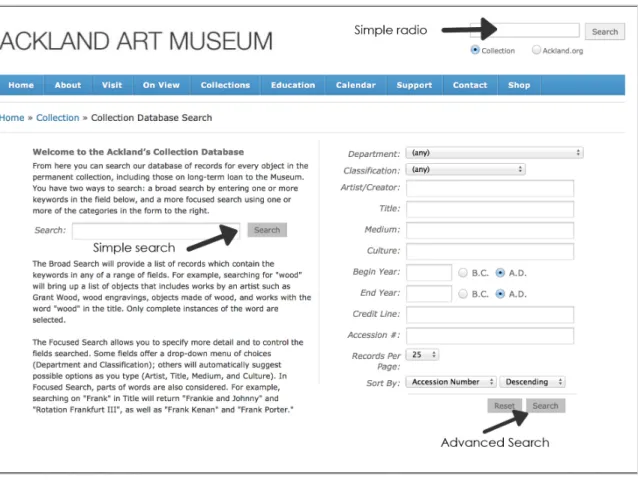
two main search features: a simple (broad) search with a single-search box and an
on the website describes these two features as broad and focused, I will be using the
alternative terms “simple” and “advanced,” which reflects the terms used in the web log
to describe these types of searches, when referencing these features for this study. The
collection can additionally be queried from any page on the Ackland’s website by typing
into a single-search box found in the upper-right-hand corner of each page and selecting a
radio button named “Collection.” This search type will be referred to as “simple radio”
throughout this paper because it runs the same basic keyword search algorithm as the
simple search but differs in its presentation.
Figure 6 - Layout of the Ackland’s collection search system indicating the three types of searches: simple radio, simple, and advanced.
The categories in the advanced search feature are department, classification
accession number. While these are all distinct categories, two sets of fields are closely
connected. Both the department and the culture fields primarily focus on the national and
geographical origin of art. The department field focuses on broad categories like “Asia,”
while the culture field lists specific nationalities and regions, like “Japanese, Osaka.” The
classification and medium fields are also related in that they both are concerned with the
form of a work of art. Like the department and culture fields, these fields also can be
distinguished by their degree of specificity. While a user could search for “Photographs”
generally with the classification field, the medium field would allow one to specify what
kind of photograph the individual is seeking, such as an “albumen print from wet
collodion,” instead of only its format. Of these nine total categories, two feature
drop-down menus (department and classification) and four provide the option of query
completion (artist, title, medium, culture) (Fig. 7). Both of these features help to reduce
the possibility of users submitting a query that retrieves no results. If a user’s submission
returns zero hits, this may have the effect of discouraging users from continuing to search
the collection, which makes the query completion a positive feature. Especially since art
collections are never truly comprehensive, even very standard searches for a particular
artist may retrieve no results. Many other art museums today account for this by having
hierarchical faceted search systems that directly provide users with terms to pick from
rather than asking users to select their own terms since self-selected terms cannot be
guaranteed to match collection holdings. While query completion and browsable facets
are very useful from a practical standpoint in that they make users aware of potential
search topics that will result in retrieval on a particular search system, they can
query is truly representative of a user’s needs or if it is primarily the result of one of these
features.
Figure 7 - Detailed view of the Ackland’s advanced search feature showing the department and classification drop-down menu options
Although the Ackland Art Museum’s search system does not feature faceted
browsing or navigation through images as is often common today for collection search
systems, there are several renowned art museums that have search systems that are
similar to the Ackland’s in structure. The most notable comparison can be drawn with the
National Gallery of Art in Washington D.C. Like the Ackland, its search interface
includes extensive textual instructions. While these instructions have the potential to
increase effective retrieval rates, there is also considerable evidence that users avoid
opportunities to learn how to best use systems, especially by neglecting to read
instructions posted online (Markey, 2007, p. 1078). The Ackland’s search system also
includes accession number and credit line as search categories, which are not commonly
similar categories and drop-down menus include the University of Chicago’s Smart
Museum and the Detroit Institute of Arts (Fig. 2).6 These search characteristics diverge
from those featured on other art museum collection search systems today, but this is not
to suggest that these features are not widely or effectively used. The search log data will
provide the evidence needed to determine the usefulness of these search categories.
Beyond the structure of the search system, the type of art objects that are in the
museum’s collection is also noteworthy because this will likely affect what users search
for as well as what they are able to retrieve. The Ackland museum holds approximately
18,000 works of art, with strengths in Asian art, seventeenth to nineteenth-century
western European painting, and European and American prints.7 Prints account for
approximately sixty percent of the collection. While less extensive, the museum also has
a strong photography collection made up of around 2,300 images. The William Meade
Prince collection is the largest compilation of works by a single artist owned by the
museum, consisting of nearly 1,800 pieces of art.
While the collection can only be searched by text, images are important to the
collection search system. The museum received an IMLS grant in 2010 to digitize all of
the works held by the Ackland; the project was recently completed in 2014 (Scott
Hankins (Registrar at the Ackland Art Museum), personal communication, June 5, 2015).
While not all of these images have been added to the museum’s database and collection
search feature yet, the vast majority of records found through the search system are
accompanied by images. Several studies have found that thumbnail images are effective
as access points and aid in browsing (Hastings, 1994, p. 62; Skov & Ingwersen, 2014, p.
In addition to the collection search system, the museum’s website also features a
static collection highlights page that features some of the institution’s most prized
holdings (Fig 8). Featured works include Delacroix’s Cleopatra and the Peasant (1838),
Sadeler’s Triumph of Wisdom over Ignorance (1600), and Gilbert’s Nina Cust (1894).
While not a central focus of this study, the recommendations section will note some of
the most highly searched for works of art in the collection and compare them with those
pictured below. Knowing what works are of particular interest to visitors, either online or
in person, can help museum staff select works to put on display that have public appeal
and also help inform decisions on which traveling exhibitions might be best suited for the
museum’s particular audience. The collection highlights page is also notable because it
contains the hyperlink to the online collection search system. From the museum’s home
page, it takes two clicks to get the search system.
This introduction to the Ackland’s search system has established both what kinds
of categories users are prompted to search for when using the system and the types of
artwork that might typically be retrieved. While neither the search parameters nor the
museum’s holdings completely prevent users from searching for specific kinds of art
objects or approaching search in a particular manner, they do limit the retrieval
possibilities and therefore will likely have a significant influence on search behaviors. In
the literature review that follows additional search categories are defined based upon
human subjects research. Rather than aiming to validate search categories found on
existing systems, this research attempts to classify the needs of those interested in art
objects to understand their behaviors. They strive towards a user-centered ideal and
follow Belkin’s charge to concentrate on developing a corpus of needs.
Notes
1 http://uamcollection.libarts.colostate.edu/ 2 http://www.tate.org.uk/art/search
3 http://art.thewalters.org/browse/?type=tags 4 DMA - https://www.dma.org/collection, V&A
http://collections.vam.ac.uk/information/information_fabricvisualiser, Rijksmuseum https://www.rijksmuseum.nl/en/search?f=1&p=1&ps=12, IMA
http://collection.imamuseum.org/results.html, Cooper-Hewitt https://collection.cooperhewitt.org/
5 http://britishart.yale.edu/collections/search/frames 6 http://www.dia.org/art/search-collection.aspx
7 http://ackland.org/collections/about-the-collection/ - Note that many of these values were
LITERATURE REVIEW
Understanding the needs of the users of a particular system necessarily requires
one to have some knowledge about the users. For the purposes of this study, it is essential
to have a conception of who uses online collection search systems if the categories of
queries they enter to retrieve information are to be assessed. It is assumed that museum
employees are significant users of these search systems because they are helpful to them
in performing their job responsibilities, but the search systems also have a much broader
appeal. While museum collections databases “have traditionally functioned as internal
documents, tailored to the needs of museums registrars and curators,” there is increasing
evidence that the public actively seeks information from these systems (Cameron, 2012,
p. 226).
The public that uses online art museum collection search systems cannot be
definitively determined, but these individuals are likely to be associated with one or more
of the following groups. Most broadly, individuals seeking visual information are often
identified as users of online collection search systems. In addition, art historians, artists,
and humanities scholars also have been the focus of numerous studies on both textual and
visual information retrieval in the context of the Web, digital libraries, and museums.
Specific analyses of art museum websites show that the majority of visitors are not art
professionals, yet these individuals are still significant system users. For instance, a study
by the San Francisco Museum of Modern Art (SFMOMA) determined that 18.56% of its
historians, and museum professionals each only composed between three and eight
percent of users (Mitroff, 2007, para. 19). While these percentages are not indicative of
museums broadly, they do show that these websites attract a range of users. In this
literature review, the most recognized categorical frameworks associated with the various
groups typically associated with visual information seeking will be identified and then
subsequent studies that used these frameworks for analysis will be discussed. Additional
research of note that does not utilize the most standard categories, as well as literature
focusing specifically on the needs of artists and the contributions of log analysis to the
field, will close the section.
Before the specific categories are discussed, two theoretical works will be
mentioned that are essential to understanding how people understand and use images.
Building off of Panofsky’s three levels of meaning within art (pre-iconography,
iconography, and iconology), Sara Shatford simplified these categories into two major
groupings – what an object is Of and what an object is About (1986, p. 43). The author
argues that all “pictures are simultaneously generic and specific” and that what a picture
is of and about can be understood in both generic and specific terms (p. 47). For instance,
while a painting may be of a lily, it may actually be about femininity, religion, or purity.
The multiplicitous meaning of images is part of what makes it so hard for users to
consistently classify them in the same way.
In addition, the research of Raya Fidel indicates the complexity of an image’s
essence as well as its use. Fidel developed the concept that all end uses of retrieved items
are on a continuum between the Data Pole and the Objects Pole (Fidel, 1997, p. 189).
uses that characterize the Objects Pole entail using an image as an image. Browsing
behaviors are very typical for behaviors associated with the Objects Pole because users
looking for a visual image do not know which image they will pick from a set of
retrieved results until they have seen the other images in the set (Fidel, 1997, p. 193).
Fidel also notably remarks that art historians are unique among users because they often
need to retrieve images as both objects and information sources and therefore systems
designed for them cannot focus on a single type of retrieval (p. 189-190). Again, defining
and understanding images in categorical terms is difficult because they can be interpreted
and accessed in more than one way.
Of all the categories of image descriptions generated through user studies,
Jorgensen’s 12 image classes and Hollink, Schreiber, Wielinga and Worring’s three
image categories (conceptual, nonvisual, and perceptual) are the most prominent in the
literature (Jörgensen, 1995; Hollink, Schreiber, Wielinga, & Worring, 2004). The
attributes developed by Jörgensen and Hollink et al. have often been reused in subsequent
research. In both the initial studies that developed these categories as well as the research
that later emulated these studies, the user keywords that formed the foundation for the
image classes were typically generated through description of images selected by
researchers rather than through active search. While generating descriptions that are not
indicative of an actual need is a potential weakness, this approach also allows users to
express their needs without being limited by the constructs of an existing system. In
addition, these categories have been applied to data gathered from picture databases and
logs, while other studies have focused on naturalistic search to develop findings distinct
Of the two groups of categories, Jörgensen was the first to develop a scheme for
image descriptions. The 12 category names are objects, people, color, content/story,
location, description, visual elements, art historical information, people attributes,
external relation, viewer response, and abstract (Jörgensen, 1996, p. 211). These can be
grouped into the three larger categories of perceptual (the physical content of an image),
interpretive (requires a user’s intellect to perceive), and reactive (emotional response).
These categories were developed in response to 82 participants’ interactions with
randomly selected images from the twenty-fifth edition of the Society of Illustrators
Annual for Jörgensen’s doctoral dissertation. Descriptions of the images by participants
were the primary source of the categories, but the subjects also participated in a sorting
task of the images to further establish appropriate groupings. Regardless of the task, the
object class was the most frequently used by participants (Jörgensen, 1996, p. 211). The
object class includes objects that can be literally perceived in an image. People,
content/story, and color were also ranked highly, though their ranking differed by task.
One study that uses Jörgensen’s categories is Chen’s analysis of the search
methods of 29 undergraduate art history majors. These students were enrolled in one of
two courses on medieval art and needed to retrieve twenty images for their final term
paper. The author conducted both a presearch questionnaire with the participants that
collected the terms students planned to use to search for images for their paper topic as
well as a postsearch questionnaire and interview that collected the actual words and
phrases they used. A total of 534 queries were gathered from the two questionnaires and
coded using Jörgensen’s 12 image classes. The location class was the most frequently
included objects (17.65%), art historical information (10.52%), and people (7.46%)
(Chen, 2001, p. 270). This differs from Jörgensen’s original study in which the Objects
class was the most popular. In addition, the participants in Chen’s study very rarely used
content-based features, like color, in their queries. Finally, the queries submitted revealed
that refiners, such as a specific time period or material, were rarely included in the
students’ search terms (Chen, 2001, 269).
Even more recently, Jörgensen’s classes were used in a Master’s paper by Heather
Lowe that utilized log analysis to evaluate search log data released by ARTstor in 2009
(2013). While the data mostly consisted of user submitted queries and did not include the
full range of fields typically associated with a search log, the total of 10.75 million
queries that were submitted over a five-year period provided a wealth of information
(Lowe, 2013, pp. 2, 33). Of these queries, 4,620 queries from 12 different institutions
were selected to be manually coded according to Jörgensen’s 12 image classes as well as
the Enser-McGregor uniqueness/complexity scheme (p. 36). Of particular note were the
study’s findings on the use of artists’ names and the changes in query composition over
time. Lowe found that frequency of queries for artists’ names has progressively increased
over time. The study found that “Over all queries sampled, the average percent of queries
judged to be artist information was 28.77% in 2005, 37.53% in 2007 and 40.26% in 2009
(Lowe, 2013, p. 59). When only art historical queries alone were considered, these
percentages were even more pronounced. Queries related to artists’ names went from
composing 49.61% of art historical queries in 2005 and rose to 73.55% in 2009 (Lowe,
2013, p. 59). The data also indicated that the way in which queries for artists were being
search for artists rather than more formally using the individual’s last or complete name
(Lowe, 2013, p. 58). To summarize the queries as a whole according to Jörgensen’s
attributes, the following percentages were reported: 60.65% (art historical information),
13.83% (people), 9.913% (locations), and 8.23% (objects) (p. 64). Percentages for visual
elements and color were both less than 1%.
In addition to Jörgensen’s classes, Hollink, Schreiber, Wielinga, and Worring also
developed a classification system for image descriptors that has been widely used. Their
study aimed to determine what non-expert users look for in images (2004). This study is
unique in that it used text rather than images to generate descriptors. In the study, textual
selections from a children’s book, an historical novel, and a newspaper, were provided to
thirty participants who then used these selections in two ways. First, participants were
asked to write a description of a mental image that the text generated in their minds.
Second, they composed queries to find a similar image on the Alta Vista search engine.
While two tasks were conducted in this study, the researchers were more concerned with
the description task and claimed that image descriptors could be used as both query and
indexing terms (Hollink et al., 2004, p. 605). Results from both tasks were categorized as
conceptual (semantic meaning), perceptual (formal visual characteristics), or nonvisual
(contextual associations) by the researchers as well as two additional reviewers to ensure
consistency. Conceptual terms were used most frequently, with 87.2% of the terms fitting
in this category (p. 619). Perceptual terms accounted for 11.9% of the words generated by
users. These terms describe the features typically targeted by CBIR. Within this category
37.1% of the terms were associated with spatial relationships or composition and 32.1%
0.9% dealt with nonvisual descriptive information like date or creator (p. 619). These
percentages differed significantly based on which textual source was used to generate the
terms. Finally, the article found that when generating a query, participants used more
specific terms with fewer perceptual words than when describing a mental image.
A subsequent study by Isemann and Ahmad (2011) used the categories developed
by Hollink et al. and came to comparable conclusions. In this study 48 participants took a
survey that asked them to provide the keywords they would use to find three
representational paintings online. Twenty-one of these participants were considered
experts due to their education in art history. One of these participants had a PhD in art
history, but the minimum requirement to be considered an “expert” was a year of art
history classes at the university level. The images described by these participants
included a landscape by Monet and figural paintings by Schiele and Pallaiolo. After
coding these descriptions, this study found that the conceptual level was the most
frequently used with 65.6% of the terms assigned to this category (2011, p. 148).
Nonvisual terms were used 25% of the time, which is a great increase from 0.9% reported
in the original study by Hollink et al. This can perhaps be explained by the fact that this
study included art experts who were familiar with specialized terms while the previous
one was limited to nonexperts, though the difference in the stimulus for description
between the two studies could have also altered this. Finally, 9.4% of the terms were
perceptual. The breakdown of percentages among the perceptual subcategories was as
follows: technique (50%), color (39.6%), composition (8.3%), and texture (2.1%) (2011,
p. 149). Comparing the different user groups, the findings suggested that “Laypersons
not directly visible in a painting and also more abstract categories” (2011, p. 150). There
was not a significant difference in the usage of perceptual terms between the two user
groups, though the authors question the validity of this finding.
Beyond those studies that adhere to the frameworks developed by Jörgensen and
Hollink et al., others deserve mention because of their context, methods, or the unique
nature of their findings. Hastings’s (1994) doctoral thesis focused on how art historians
looked for paintings in a digital library collection. The collection participants interacted
with was the William L. Bryant Collection of West Indies art, which contains 66
paintings. Eight art historians at the University of Florida who were experts in Haitian art
volunteered for this study. The study asked the participants to interact with both an online
collection of the works and physical photographs of these art objects to create queries.
Because the queries generated by the participants had limited amounts of conceptual
overlap, the study was primarily exploratory in nature rather than conclusive. The author
concludes that “The major classes of queries in order of frequency [were] Identification,
Subject, Text, Style, Artist, Category, Compare, and Color” (p. 86). As with many of the
previously mentioned studies, visual characteristics, like color, were not essential to
descriptions.
A study conducted by Bates, Wilde, and Siegfried at the Getty’s Art History
Information Program (AHIP) is especially unique because it focused broadly on
humanities scholars, rather than a particular set of academics within this category. The 22
scholars who took part in this two-year project created a total of 165 natural language
statements (NLS) and 1068 queries submitted directly to DIALOG that were later
study used the work of Stephen Wiberley, who did an extensive study on coding the types
of terms found in seven humanities indexes, as a foundation. Wiberley (1988, p. 3) found
that singular proper terms, or words that designate a particular person or creative work
that can be connected to a certain moment in time and space, constituted more than half
of the vocabulary found within humanities indexes. Aligning with the structure of these
indexes, the Getty study found that 91% of NLSs were for a subject search, and subjects
related to individuals composed 45% of the total NLSs (Bates et al., 1993, p. 15). This
was the second highest subject category after common terms. A comparison between
Tefko Saracevic’s 1988 NSF study of science queries and the queries collected from the
scholars in this study was completed. The use of proper names, such as the names of
individuals and works, were completely absent from the search statements submitted by
scientists in the NSF study (as reported in Bates et al., 1993, p. 16). In contrast, over half
of the queries submitted by humanities scholars referred to the names of people or their
creations. Because the humanities focus so strongly on the works of people, such an
emphasis is logical. Less expected findings included the rare use of movements as queries
(“nationalism” or “impressionism”) and few occurrences of classes of creators
(“painters”) (Bates et al., 1993, p. 22).
Like Bates et al., Enser’s study of image requests submitted to the Hulton Deutsch
Collection found that known-item searching is important in image retrieval (Enser, 1993).
This research determined that for users “The need to retrieve images which depict a
specific person, event, location, or object is greater than that to retrieve pictures of
generic items in all user categories” (Enser, 1993, p. 31). This suggests that image
common terms. In addition, approximately 69% of the queries gathered were for unique
entities, indicating that image retrieval systems must be equipped to deal with a broad
range of specific queries (p. 27).
While art historians, historians, humanities scholars, students, and individuals
with no expertise in art have been subjects in the studies mentioned so far, one group that
has been absent from the research on perception and categorization of images that one
might expect to be more prominently featured are artists. Although visual artists are often
conceptually grouped with art historians, in actuality they have vastly different
information needs (Cobbledick, 1996, p. 347). While some may assume that artists
primarily consult works from the accepted canon of art history, this assumption is not
supported by research. The types of sources artists use for inspiration, visual reference,
technical artistic knowledge, and marketing vary widely (Hemmig, 2009, p. 683). Rather
than seeking information in art-specific institutions, like museums or art libraries, artists
actually typically prefer more popular sources, like public libraries or Google (Hemmig,
2009, p. 695; Gregory, 2007, p. 63). Still, the visual perception of artists is a significant
area of research. Hekkert and Van Wieringen conducted two studies to determine how art
experts (industrial design and fine arts students) view works of art compared to
non-experts by having both groups view works of art created by young artists in one study
(1996a) and rate mechanically-manipulated works in regards to their aesthetic value in
the other (1996b). Both studies found that artists were focused on analyzing a work’s
formal qualities while non-experts were most absorbed by representational objects
Jörgensen’s findings, while the attention given to visual elements by experts could be
accounted for through the use of artists as the study’s subjects.
Finally, while both the Getty study and Lowe’s Master’s paper utilized log data,
there are not a great deal of log analysis studies with which this project can be directly
compared. Log analyses of art museum websites are rare and emphasize evaluation of
particular systems rather than the broader needs of their users. A study conducted by the
São Paulo Museum of Art Library is one of the only research projects of its kind that can
be found in published literature. This library completed a log analysis in 2010 using
Montalog software that evaluated a year of searches gathered from two of their database
systems. For both databases, 25% of the queries retrieved no results (Di Grazia Costa,
Napoleone, & Da Rocha, 2012, pp. 32, 34). Notably, it found that among the successful
searches, the most common queries involved the names of artists (2012, p. 34). This
suggests that search systems are properly equipped to handle these specific requests for
proper names. Similar to the São Paulo Museum of Art Library’s more evaluative
approach, log data was studied by McLaughlin et al. using WebTrends to assess the
usefulness of an online chat system called “Curator on Call” for the USC Interactive Art
Museum website while also gathering some statistics on their online visitors
(McLaughlin, Goldberg, Ellison, & Lucas, 1999).
More broadly, log analysis has been used for many studies on image searching in
commercial web environments. While not directly applicable because of its context,
Goodrum and Spink’s analysis of 1,025,908 queries from the Excite search engine helps
to suggest some characteristics typical of image queries. The uniqueness of these queries,
suggesting categories of interest, this study indicates that queries submitted to find
images typically only occur once and that they often exhibit a high degree of query
modification due to their lack of precision (Goodrum & Spink, 2001, pp. 295, 303).
These various user-focused studies, set in different contexts and concentrating on
a number of different user groups, provide valuable frameworks by which visual
information can be categorized as well as benchmarks for the degree to which these
categories have been important to users in the past. From Jörgensen to Lowe, user interest
has especially focused upon Jörgensen’s object class and Hollink et al.’s concept class
with little attention being given to the formal elements of art. Perhaps the disinterest in
visual elements is a result of the particular user groups researched in these studies. Log
analysis has played a role in better understanding how searchers seek visual information,
though it is typically used to analyze commercial web searches rather than those that are
strictly art historical in nature. It is hoped that future research will continue to employ this
research method, in addition to the more traditional interview and survey approaches, to
come to a better understanding of the needs of those that use art databases and museum
METHODS
Method Selection: Log Analysis and its Strengths & Weaknesses
Transaction log analysis (TLA) was selected as the primary research method for
studying how users describe and search for art because of the method’s ability to capture
users pursuing real information needs and record the searches of exponentially more
individuals than could be observed through a lab search study conducted in person
(Dumais et al., 2014, p. 351). One of the shortcomings of several studies described in the
preceding literature review on how users search for art images is that the data gathered
was not the result of a real information need (Hollink et al., 2004; Isemann & Ahmad,
2011). Especially in studies that focus exclusively on retrieving images, there seems to be
a tendency to accept an image description as the same thing as a visual information need.
Unfortunately reverse engineering searches does not actually work since a user may not
use the same terms to describe an image that he or she uses to describe a need for one of
these items. Furthermore, it is uncertain if the image provided by researchers to be
described is one the user would actually want to search for and retrieve. Log analysis
circumvents these problems by providing real instances of users searching, often using
their own words, for information they actually want for a specific purpose. Finally, there
is no possibility of researchers influencing user behaviors because they have no actual
interaction with the participants. Rather than studying the people themselves, log analysis
Despite the strengths of log analysis as a method, it also leaves researchers with
many unknowns, especially in regards to the identity of the system users and their goals
for search (Dumais et al., 2014, p. 352). While differentiating how various user groups
searched for art objects and their associated informational records is the focus of a
considerable amount of literature (Hekkert & Van Wieringen, 1996b; Chen, 2001;
Isemann & Ahmad, 2011), identifying distinct individuals on a search log is impossible
without having additional information. Internet Protocol (IP) addresses can be used to
identify a group of searches submitted from the same computer, but it is difficult to say
for certain whether the individual querying the system is the same throughout a series of
searches (Wildemuth, 2009, p. 169), even those close together in terms of time. An IP
address cannot be substituted as the equivalent of a person. Therefore details about the
individual submitting the search, like their expertise in the field of art history, cannot be
known. Not being able to know characteristics like the age, educational background, and
profession of the searcher is a notable disadvantage of the method for this study, but this
drawback does not overshadow the method’s other benefits.
Another weakness of log analysis is that there is no way of deciphering the
purpose of a user’s search and whether or not the individual’s search was successful. The
log data documents what terms were used to search for art records as well as when a
record has been clicked on, but there is no indication provided in the log as to why certain
words were used for search or whether the list of retrieved records met the user’s needs.
For instance, in the case of the Ackland’s log it cannot be determined if a user began a
search in order to retrieve an image (Object Pole) or textual information (Data Pole) and
assumed that a click on a link or object suggests genuine interest, log data does not
provide researchers with the opportunity to follow up with searchers on their actions to
determine if this is truly the case, except in very special circumstances in which more
data than given in the log is known about the participants. Likewise, the meaning of
terminating a search is unclear. While a user may decide to end a search when the desired
information is found, searches may also be discontinued due to user frustration or
circumstantial factors unrelated to the search itself, such as having to go to a previously
scheduled appointment.
While log data leaves researchers with many uncertainties, such as user identity
and search goals, it does provide a wealth of information on real search behaviors that
can be gathered conveniently and rapidly. Especially with the short timespan one is given
to write a Master’s paper, log analysis is an effective method because it allows one to
spend more time on analysis rather than collection. Logs actually provide one with so
much information that it is impossible to pursue all the relationships between different
variables that they present. Due to this, it is critical for researchers to identify the
information within the logs that will help most with their particular research questions
and for them to have specific plans for analyzing this data.
Documentation of Decisions for Data Cleaning & Analysis
In the final results user queries were the unit of analysis given the most attention,
but before this analysis could begin a considerable amount of effort had to be expended
to obtain the data as well as extract and organize the desired information from the data
set. The staff at the Ackland Museum were extremely helpful in streamlining the data
investigator’s initial request. Because the Ackland’s online collection search system is
not hosted on the museum’s ackland.org domain but is instead found on the general
unc.edu domain, it was necessary for staff at the Ackland to contact UNC’s Information
Technology Services (ITS) to retrieve the data. The search system is the only museum
feature or page not found on the Ackland’s website. Because ITS retains only the most
current ninety days of searches, this study was constrained to using requests submitted to
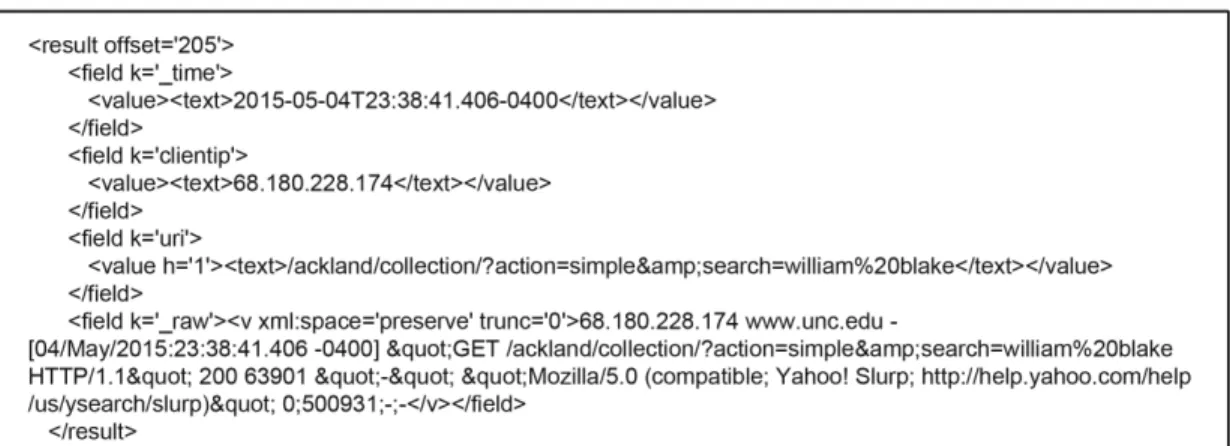
the system in the previous three months. The data was provided in XML format and
included tags for the date and time a search was submitted, the IP address associated with
the search, the search URI (uniform resource identifier) that was entered, and a summary
tag (<field k=’ _raw’>) that included information from all of the previous tags as well as
the referring page (if applicable) and the user agent string that indicates the browser used.
This structure is typical of most transaction logs (Fig. 9).
Figure 9 – Example log action (simple radio query) submitted by a robot to illustrate its structure
After obtaining this data, as well as submitting a research proposal to the
University of North Carolina Institutional Review Board (IRB) (Study# 15-0535), a
Python program was created to parse the file, extract the data into categories, and
along with instructions, was also shared with the Ackland Museum so that they would
have the ability to analyze their search data in the future. Element Tree was used to parse
through the XML structure and separate the tags into different variables.8 While some
variables, such as IP address, required no further alterations after being parsed, others
necessitated being broken down into additional variables. Special attention was given to
the URI variable in order to extract the query associated with the link, determine the
search type used (simple radio, simple, or advanced), and define the action type (query,
results page view, or object click).9
After this was achieved, the final step before writing the data to a tab separated
value file was to exclude all the actions that were not the result of a user actively
querying the system. These excluded actions consisted primarily of robot or web crawler
requests. Robots are used primarily to locate and download web pages automatically,
often so these pages can be indexed (Croft, Metzler, & Strohman, 2009, p. 32). These
actions were identified in one of four ways. First, the xml file was searched to find any
occurrences of the word “bot,” “spider,” or “crawler” in the raw summary tag. The entire
name of any robot found (e.g. Baiduspider) was inputted into the Python program for
exclusion rather than simply the key search terms ‘bot’ or ‘spider’ because these strings
could potentially appear in the raw field of a valid search action submitted by a user. For
instance, actions that would have been incorrectly excluded if the string ‘bot’ had been
used for exclusion include those with queries for “bottle shaped” and “Henry Fox
Talbot.” Second, if the raw field contained the symbol “@,” indicating that an email was
included in the user agent string, the associated action was also excluded. Because there
first exclusion step, the complete email rather than just “@” was entered into the Python
program (ex: [email protected]).
Two additional exclusions were not made in Python initially, though the program
could potentially be updated to reflect them. Google’s OpenRefine was used to identify
the user agent strings that did not begin with ‘Mozilla.’ Due to the historical development
of web browsers, almost all of the descriptive names of browsers today found in logs
begin with ‘Mozilla’ so user agents that lack this warrant suspicion.10 Groups of actions
in which this term was absent were identified by OpenRefine and then deleted (ex:
MetaURI API/2.0). Finally, actions involving HEAD requests were also eliminated from
the data since this kind of request would be atypical of most users who would instead
generally be submitting GET requests. Both GET and HEAD are HTTP requests
submitted to a web server to retrieve a web page, but HEAD requests also retrieve the
time stamp of when a page was last modified (Croft et al., 2009, pp. 33, 38). Knowing
this can be helpful in determining a page’s update frequency, but this additional
information has no potential to help someone better fulfill an information need for art
resources. While the exclusion process was very lengthy, being certain that robot or
administrative actions were not included in the final data file was essential to the validity
of the final research results. These exclusions eliminated 7,849 actions from the original
set of 24,578 actions, leaving a total of 16,729 search actions for analysis.
Following the completion of this process, the information was analyzed using
both Excel and OpenRefine. While some of the specific decisions for portions of the
analysis will be not be described until the actual results section, there are some broader
Throughout this project, focus was especially paid to the search session as a unit. For the
purposes of this study, a search session was defined as the collection of search actions
associated with a single IP address with less than thirty-minutes of inactivity between
requests. If a user submits a request more than thirty minutes after his or her last request,
this action is separated from the prior actions as the beginning of a new session. This
decision to define sessions based on time is justified because even if it could be
determined that the user is the same for two actions separated by this threshold, the
searcher likely will have a different information need in the latter of these two actions or
will approach the information need in a different manner. A session is often equated with
a unique visitor even though there may be multiple sessions associated with the same IP
address (Jansen, 2006, p. 419). Previous studies have set the threshold at various lengths,
but several have used thirty minutes as an unofficial standard (McLaughlin et al., 1999, p.
8; Chau, Fang, & Sheng, 2005, p. 1367).
While a strictly temporal threshold was chosen for this study, session definition
can be a very complex process. Standards for defining sessions are still developing and
have changed greatly over time. In one of the first published log analyses of a
commercial search log conducted by Jim Jansen in 1997, sessions were defined solely
based on unique users rather than on time (Gayo-Avello, 2009, p. 1825). Later
researchers such as Silverstein used five minutes as the threshold, while others set the
maximum time limit as any searches submitted within the same day by the same person
(Gayo-Avello, 2009, p. 1826). Currently work is being done to incorporate query
clustering and search patterns with temporal analysis to more accurately define actions
Due to an interest in how the Ackland’s search system is broadly used by various
users, defining sessions greatly influenced the majority of the analysis. One way of
measuring interest across users was to focus analysis on unique queries in each session.
While a raw count of a query term can show general interest in an idea or category, it is
also possible for a single user who is particularly dedicated to a search topic or unusually
active on a search system to skew the results to reflect his or her singular interests rather
than the interests of searchers as a whole. Because of this, counts of query terms for
analyzing both the corpus of queries as a whole and the queries associated with the
advanced search method more specifically privileged unique queries per session over raw
counts.
Notes
8 https://docs.python.org/2/library/xml.etree.elementtree.html
9 During analysis it was discovered that the progression of action types within a search session
were not always logical – See the Limitations section for more information.
RESULTS
&
DISCUSSION
General Characteristics of the Log Data
Using the preceding methods, the original data set was curated into a collection of
information yielding many avenues for productive analysis. To begin, broad observations
that apply to the entire log will be noted in order to provide the reader with a foundation
to better understand the more granular analysis that will follow.
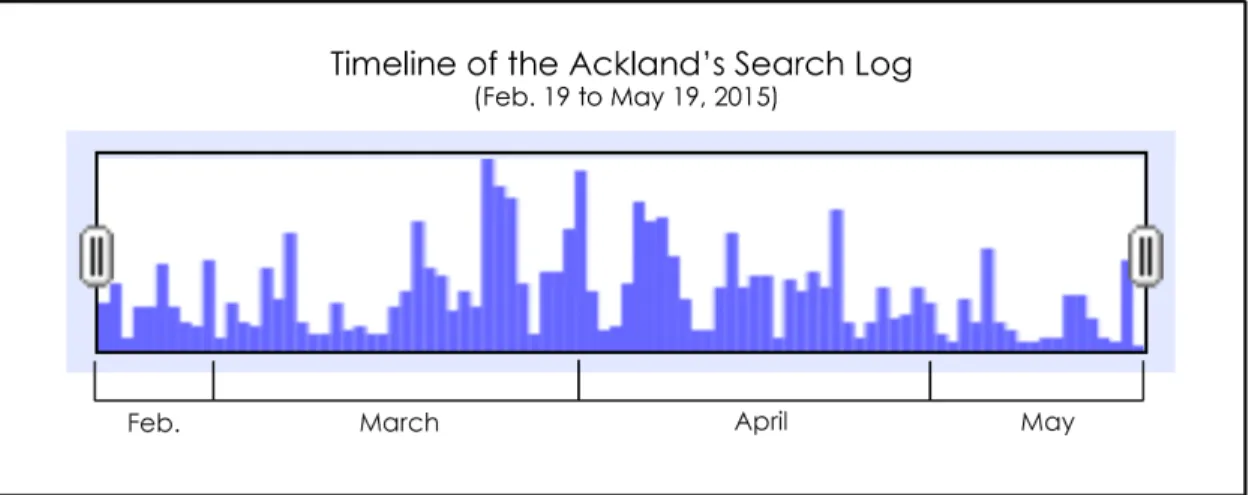
First, a timeline was created to capture the frequency and modulation of activity
on the Ackland’s online collection search system (Fig. 10). This timeline, created using
OpenRefine, maps the total number of actions (queries, results page views, and object
clicks) recorded in the log each day from February 19th to May 19th during the year 2015.
There is no log data previously captured by the Ackland to determine if the type and
amount of searches in the 2015 log is typical, but it is assumed that the museum website
is most active during the school year because students account for the majority of their
in-person visitors. As mentioned by Marty, there is some indication that online museum
visitors are also physical visitors, though further research is merited to corroborate this
finding (Marty, 2007, p. 339). The museum was closed for the month of June in 2015, so
avoiding this uncharacteristic time period was best for assuring a more characteristic
Figure 10 - Timeline of the Ackland’s search log created using OpenRefine
The Ackland’s timeline demonstrates, in accordance with previous studies, that
the amount and type of searches can be affected by the time of the day, week, or year. For
instance, for popular web search engines like Bing, Yahoo, and Google, Tuesdays
typically have the most search requests, while only a quarter of the activity on this peak
day occurred on Saturdays and Sundays (Taghavi, Patel, Schmidt, Wills, & Tew, 2012, p.
167). Similar generalizations can be made about the activity on the Ackland’s online
collection search system by analyzing the timeline. The two peak days of activity were
March 24th (Tuesday) and April 1st (Wednesday). Fridays, Saturdays, and Sundays had
noticeably less activity than the other days of the week. This weekly undulation aligns
with other studies despite the fact that the Ackland’s search system has a much more
specialized purpose than those analyzed previously. The museum also has different hours
of operation than is typical for most businesses as it is open to the public Tuesday
through Sunday. Museum staff still generally work a typical 9-5 work week Monday
through Friday. Recognizing that Saturdays and Sundays typically have lower amounts of