THE ACCESSIBILITY OF NETWORKED ELECTRONIC JOURNALS FOUND ON THE INTERNET
By
Maria Davidson De Palma Collins
A Master's paper submitted to the faculty of the School of Information and Library Science of the University of North Carolina at Chapel Hill
in partial fulfillment of the requirements for the degree of Master of Science in
Library Science
Chapel Hill, North Carolina April, 1999
Approved by:
This study examines the controls in place to facilitate access to the article level of
networked electronic journals. Findings indicate that this type of electronic journal is not easily accessible in terms of access to the URL, access to journal titles and access to the articles. A scale of accessibility measuring these three factors was developed and utilized in order to come to this conclusion. There are two elements or characteristics that appear to be connected with an electronic journal's accessibility including having an ISSN and inclusion in ARL's Directory of Electronic Journals, Newsletters and Academic
Discussion Lists. Perhaps with further study, these two factors may prove to be
instrumental components of a new infrastructure designed to provide access to electronic journals. Overall, the data gathered from this study serve as a starting point for further research on networked electronic journals by identifying and describing the accessibility of this population.
Headings:
Access – Electronic journals Electronic journals – Cataloging Electronic journals – Directories
Table of Contents
Introduction 1
Literature Review 3
Methodology 17
Results and Analysis 25
Conclusion 41
Bibliography 43
Appendix A – Raw Data 46
Introduction
One of the primary responsibilities for any library is to ensure that patrons can effectively access the collection. Previously, this access was provided through the bibliographic information found in a card catalog and the citation information found in print indexing/abstracting services; now we have online public access catalogs (OPACs) and indexing/abstracting services online or on CD-ROM that provide this same
information. Likewise, many of the library materials such as journals and newsletters previously in print are now found in electronic form. Many of these electronic journals are being created specifically for the World Wide Web with no ties to any print
publications; these titles are considered to be networked electronic journals since they are accessible through an electronic network such as the Internet. Lacking the tangibility of print, networked electronic journals are forcing libraries and patrons to re-conceptualize ideas of ownership and access. In electronic form there are no volumes to shelve or mark with a property stamp; maintaining a system that provides both citations and location pointers and/or links to the actual documents is the only way to ensure continued, long-term access to this medium. Consequently, understanding how libraries are now providing access to the contents of networked electronic journals through
indexing/abstracting services, online catalogs and the maintenance of URLs is a first step toward the development of an effective searching and retrieval system.
This study will attempt to accurately describe how academic libraries are
2
following question. How accessible are the contents of networked electronic journals available through the Internet in terms of connectivity through a URL and bibliographic tools such as indexing/abstracting services, indexing features provided by each journal and online public access catalogs (OPACs)? This question will be answered by concentrating on three types of access: access to the title, access to the article, and physical access through a URL. Restricting the sample population to networked
electronic journals is necessary to investigate how libraries and information services are providing bibliographic control for electronic sources not tied to the established
cataloging and indexing traditions of print. Ulrich's Serials Directory, which provides a comprehensive, international listing of both popular and scholarly titles, is the source of the systematic sample used in this study. Most users unfamiliar with the titles from this sample would require information from each of the three categories mentioned above, (title, article and URL) in order to reach the article level of an electronic journal.
Therefore, each of these elements is considered equally important in terms of measuring accessibility to articles from each title. In the end, networked electronic journals are dependent on online directories, online catalogs, and indexing and abstracting services to ensure that they are included in the information loop provided by libraries and
Literature Review The E-Journal
4
World Wide Web (WWW), where a desktop client such as Mosaic connects to a Web server." (Woodward and McKnight, 1995).
Increasingly, networked electronic journals published on the World Wide Web are becoming more popular than e-mail or listserv titles. Rowland (1996) points to "the availability of hypertext links, the ability to display graphics on the user's screen, and the superior typographical quality the WWW offers over e-mail" as primary considerations in favor of this type of electronic journal. Also, publishing on the web is not just for
alternative or eclectic publications. Lynch (1997) discusses the fact that many "major scientific and technical publishers are now becoming access providers and each of them is setting up their own Web site." Often these sites have no traditional print counterpart, but provide access to journal titles in electronic format only. Providing "patron access to journals on such Web sites, rather than scenarios where libraries license and locally mount contents for use by their patrons" (Lynch, 1997) is one of the difficult tasks librarians face today.
Issues of Access
Much of the literature surrounding electronic journals deals with the issue of access in terms of both the searching and physical retrieval of the article. Woodward and McKnight (1995) point out "the ultimate objective of all library and information services: namely, to facilitate access to information." Due to the electronic format of these
used by the library. However, other important factors concerning access center around the effectiveness of the bibliographic control and indexing of the electronic journal on a national and local level. Bierbaum (1997) addresses the importance of all of these concerns in her discussion of electronic journals for special collections.
Control of these journals is necessary to ensure that they are available to the members of organizations who need them. The concept of control includes not only bibliographic control –that is, 'cataloging' in its broadest sense – but inventory, indexing and physical access by various means.
Again the references to access in this statement deal with the librarian or information professional's ability to create an effective path via bibliographic records to the actual contents of the electronic journal. Indexing is another required step for facilitating this pathway since it allows a patron to arrive at the desired citation that will be searched in the library catalog. Finally, once a pathway has been determined for accessing an e-journal article, the patron must be able to physically access the item.
Access to the Title – Bibliographic Control
Of the three factors considered in this study, access to the title, access to the article and physical access through a URL, the concept of accessing a title through the bibliographic control of an online catalog (OPAC) dominates the literature. Early on the literature debates whether or not OPACs should include catalog records for remote access materials. McMillan writes in 1992 that online catalogs should contain both print and electronic resources since it continues to be "the best integrated source of information to lead readers to the vast resources available to them." She argues that "traditional
6
Stoller (1992) has a similar point of view about electronic journal cataloging but for different reasons. Stoller's (1992) emphasis is on the acceptance of these journals as mainstream serials literature. "Without bibliographic control, these journals can never be more than arcane tools available to those who are literate in the online listserv experience or at least in the portion of that experience associated with their own field of interest." In this instance, the online catalog not only provides access through directional pointers, but it also facilitates acceptance of a new medium.
Even though electronic journals became a more accepted medium for
communication in the mid-1990's, bibliographic control still remains a concern for library practitioners. An article edited by Duranceau (1995) provides insight to how five
access. Ford and Harter's (1998) emphasis of this viewpoint is evident in the following statement: "The need for directories and catalogs does not appear to have faded as publications have become available on the Internet; if anything, the need appears to have become more acute."
8
we would logically include data from bibliographic journal article indexes in the OPAC as well." In a sense, OPACs would be taking on the role of the indexing and abstracting services. Bierbaum (1997) makes such a claim about the eventual holdings of special collections. She states that the special libraries' OPACs will eventually provide bibliographic records for all their serials, "each record showing not only the library's holdings and locations at the volume and issue level, but also providing variously searchable indexing for the contents of each issue at the article level."
Accordingly, the bibliographic records themselves have had to evolve in order to facilitate better access to electronic journals through online catalogs. Establishing
location and access pointers through the additional 856 field has been the most important addition to the bibliographic record. Recommendations to add the 856 field were made by OCLC in 1992 to the American Library Association's committee on representation in Machine Readable Bibliographic Information (MARBI) (Weston, etc,, 1995; Woodward and McKnight, 1995). The "MARC field 856 is proposed to contain all the information necessary for subscribing to, transferring, or otherwise accessing the electronic resource" (Woodward and McKnight, 1995). One further addition to information included in the 856 field, the URL, has expanded the catalogs access capabilities. With this information properly coded in the MARC records, online catalogs can now directly link "from the bibliographic record in the online catalog to an Internet resource at a different host" (Woodward and McKnight, 1995).
reviewed or had ISSN's; a total of 254 titles were examined. "The success rate of locating a bibliographic record in OCLC was 46% (118 titles of 254 titles)." This percentage is "relatively low, at least compared to that of general research materials." Parks identifies a study for comparison conducted by Leazer and Rohdy (1995) where they examined the extent of bibliographic control for general library material and foreign monographs. For general research materials, Leazer and Rohdy noted a 92% hit rate in OCLC (Parks, 1996). Possible reasons noted by Parks for lower accessibility in OCLC include the recent emergence of this medium to serials literature and the "difficulties of evaluating and managing electronic information resources" (Parks, 1996).
Access to the Title – Directories, et al.
Directories are another resource used by many patrons and scholars to find information on electronic journal titles. An extensive body of literature was not found exploring the issues of directories. Online catalogs are, after all, the more traditional searching tool used to locate library resources. However, as libraries continue to slowly explore what titles should be added to their online catalogs, many directories are quickly and systematically including entries for titles they have noted as well as user suggestions for addition through feedback requests on their web sites. Therefore, many of these directories have become useful access tools for the often-evasive medium of electronic journals.
10
directories and guides as "a relatively good indication of the type and scope of currently available electronic journals on the Internet, as well as the different procedures of retrieving the information therein." They also suggest two directories used in this study that they found to be useful: ARL's Directory of Electronic Journals, Newsletters and Academic Discussion Lists as well as the WWW Virtual Library's Electronic Journal site. Woodward and McKnight (1995) also promote ARL's Directory as "the most widely available and best known listing of bibliographic information" for electronic journals. They also stress the difficulty of accessing or even just locating information about electronic journals. "A large proportion of e-journals are published by enthusiastic individuals and made available, via the Internet, free at the point of use; this is one reason why access and bibliographical control can be so difficult" (Woodward and McKnight, 1995). Directories can prove to be useful tools in facilitating access to these types of problematic titles that may never be included in online catalogs.
Unfortunately, locating the directory to use is only half of the battle. Users and/or librarians still need to determine the quality of the information found in the directory being used. Ford and Harter (1998) have conducted such a study to determine the "usefulness of online directories and catalogs in providing access to e-journals." They examined 36 titles (three other titles were discarded from the sample) in four "widely recognized online directories." These included the following: ARL's Directory of Electronic Journals, Newsletters and Academic Discussion Lists, CIC Electronic
computed the percentage of URL's found in each resource that were functional and current. These percentages are as follows: ARL at 57.5%, CIC Index at 71.7%, University of Houston at 95.2%, Ejournal at 61.5%, RLIN at 50.3%, and OCLC's WorldCat at 53.5%. Note that these percentages do not reflect the hit rates for finding titles in each of these resources, but they reflect the ability of the user to connect to the electronic journal using the URLs listed in each directory or catalog. The varying and often low percentages illustrate the changing nature of URLs and the need for standards to stabilize locations on the web. Physical access to electronic journals through URL's will be discussed further in the later part of this literature review. Directories and online catalogs must deal with this issue in order to provide accurate information in their
bibliographic entries. The transient nature of URLs in a cataloging record has been noted by many catalogers and is often cited as reason enough to forego cataloging electronic journals until some kind of standard is in place (Ford and Harter, 1998). Online directories do not have the luxury of waiting for a standard since the two primary considerations for their usefulness are the number of titles carried and their ability to provide the most current titles. Ford and Harter (1998) point out that "those seeking to maintain directories for e-journals can improve the situation by checking URL's
periodically (using software and even checking in person to make sure that the URL that appears to function is not really a page with a forwarding address)."
12
through library home pages. He presents an overview of several library home pages from universities like the University of Tennessee-Knoxville and Stanford University. These descriptions should "give librarians solid ideas for designing effective links to electronic journals from their home pages." Hudson and Windsor (1998) also point out the
usefulness of library home pages as access points to electronic journal titles. In fact they stress that a library home page "creates a virtual stacks which people can browse." Additional suggestions for locating electronic journal titles are provided by Woodward and McKnight (1995). They suggest that national ISSN centers, citations from both print and electronic articles, and "subject-specific discussion lists and bulletin boards" are all useful resources for finding titles.
Access to the Article – Indexing and Abstracting
Another issue receiving less attention, but still very relevant to providing effective access to electronic journals is indexing and abstracting. "Many libraries rely on abstracting and indexing services, published by commercial or government
organizations, for bibliographic control of periodical articles" (Mount, 1995). As electronic journals become a more prevalent part of serials literature, they will also have to be included in these indexing and abstracting services. Many authors who write of the need for indexing/abstracting services for electronic journals are at the same time
isolated vehicle for the distribution of information." Electronic journals are more susceptible to this isolation since they have not been quickly incorporated into the infrastructures created over the last century to support print publications. Furthermore, scholars are less likely to publish in a medium that appears to be unstable. Rapple (1995) emphasizes the point that "though this indexing and abstracting deficiency will
undoubtedly improve, in the meantime scholars may be reluctant to write articles which readers may find difficult to locate." These indexing and abstracting services are
imperative for promoting publication and facilitating access to the article level. Rowland (1996) stresses that since online catalogs do not provide access to the article level of journals they hold, "the user has to use indexing and abstracting services to identify individual articles of interest." Understandably, indexing and abstracting services are being very selective about the titles they choose to add to their service. For example, Reutschler (1998) writes about the criteria of selection for the few electronic journals that have been added to library literature. These criteria include "archiving of published issues", "articles of reference and research value" and the length of time the title has been in publication. Interestingly enough, vendors, subscription agents, and other types of aggregators are beginning to fill in this void that indexing and abstracting companies have created by their slow incorporation of this medium.
14
actually held" (Beddal, Malin and Hallett, 1998). Heady (1998) provides a useful
definition and explanation of whom these aggregators, like the Blackwell example above, usually are and the types of access services they can provide. The information provided by Heady is based on a presentation made by Sharon McKay, then the Electronic Sales Manager for Blackwell’s Information Services. An aggregator is an organization that "provides services related to electronic journal subscriptions." These organizations may include subscription agents, indexing and abstracting services, vendors, publishers or library consortia. Services that may be provided by aggregators to facilitate access include "searching, browsing, …access to citations/abstracts, …and access to multiple formats and necessary software" (Heady, 1998). The aggregator’s willingness to provide a wide array of access services for electronic journals has allowed them to take on
responsibilities previously the domain of indexing and abstracting services only. McKay (1999) does discuss in her latest article the benefits indexing and abstracting services might still have over the aggregators appearing ready to offer any service. Many of the systems provided by aggregators "take a simple approach to indexing, based on retrieving words in the article title, abstract, journal title, and publisher." The features provided by indexing and abstracting services still prioritize a greater level of detail and a controlled environment for their bibliographic entries. "Bibliographic databases for index and abstract providers furnish the user with more sophisticated search techniques, supporting precise retrieval based on controlled
developed. "Disturbing gaps in access information" provided by these services often fail to point out electronic from print articles, methods for obtaining the articles in electronic form, or even a URL (Woodward and McKnight,1995). Academic libraries need to stress the importance of providing complete access information to all services they subscribe to. For the moment, aggregators may provide more useful information at a quicker rate than publishers even if their search features fail to match the level of complexity found in traditional indexing and abstracting services. "To gain access to every e-journal now published, a library would have to subscribe to multiple aggregator services as well as multiple publishers" (McKay, 1999).
Physical Access through the URL
One major barrier to the physical access of electronic journals remains the URL. Morgan (1995) underscores the "dynamic nature of the Internet, and therefore, the dynamic nature of serials on the Internet" as the primary cause for the shifting nature of URLs (Duranceau, et al., 1995). Not only do users need to be aware that URLs can change, they need to also be aware that many sites can have numerous URLs leading to a particular page. Ford and Harter (1998) discuss the large numbers of URLs that existed for the 36 titles of their sample in directories, online catalogs and listed on the page itself. They state that "while it may be possible to use reference sources to identify the most commonly listed URL for a given e-journal, this is usually not the only current,
16
Methodology
Sample Selection and Rationale
The electronic journals chosen for this study were all networked electronic journals found on the Internet. Titles were systematically selected from Ulrich's Serials Directory's (Ulrich's on Disc, 1998) population of "online only" journals. Initially, these 1,280 titles were reviewed through to ensure that all titles at least contained a URL. Several titles were available only through online searching services such as Dialog; other titles were only available electronically through e-mail and/or some type of mailing list software. This initial review brought the total population down to 1,176. From this population, every eighth title was selected for inclusion in the sample. The total number of titles selected was 147, which was determined to be a manageable sample size for the scope of an exploratory study. Some titles selected were actually only available through e-mail; the websites listed in Ulrich's were usually promotional sites. If a title was determined to be e-mail only, then this title was removed from the sample. A title four places before or four places after the location of this title in the original list of 1,176 was chosen as a replacement. The sample size was thus maintained at 147.
18
used for print serials. A wide variety of titles were included in the sample from popular to scholarly and from newsletters to journals in order to describe this medium as a whole without restrictions as to the type of publication. Ulrich's Serials Directory, from which the sample was taken, was selected because it provided a wide range of international titles of varying quality, length and purpose. Other well-known directories such as ARL's Directory of Electronic
Journals, Newsletters and Academic Discussion Lists appear to be more selective about the titles incorporated into their publications.
Scale Development and Rationale
Several elements have been examined relating to the accessibility of the titles in this sample including access to the title, access to the article and physical access to the item. These elements were categorized and assigned a value. Each value was entered into a tool of
measurement or scale designed to determine the level of access for each electronic journal in the sample. This scale determined the level of accessibility for each title by weighing the following variables: internal indexing, indexing and abstracting services, connectivity of URLs,
bibliographic control in WorldCat and inclusion in three online directories.
allows the user to search the entire contents of the journal for articles of interest. Unfortunately, if this is the only indexing of this title, users will have to be aware that the title exists in order to take advantage of this feature. Three levels of internal indexing were assigned a value in terms of the scale. Several titles could not be located to determine if they included any internal
indexing features; missing values were assigned to these titles. Titles not including any indexing features were assigned a zero value. If traditional indexes used for print publications were adapted for any of these titles, a one value was assigned. A value of two was assigned for search engines with keyword or advanced searching options. This last feature was assigned the highest value because it allows for searching of the title in multiple ways whether through words found in the title, author, or text. The traditional indexes found were usually linear subject or author indexes that may not facilitate as quick or in-depth of a search as the search engines provided.
20
very popular undergraduate service was chosen for similar reasons. OCLC's Electronic Collections Online is newer to the scene, but it was also searched since it specializes in electronic journals. For every indexing and abstracting service that carries a title from the sample, a value of one was assigned for the scale of measurement. Each service was noted and assigned an individual value since each one provides an additional avenue of access to the title. The rationale for this decision being that the more indexing and abstracting services carrying a title, the more accessible that title is overall.
may be necessary if electronic journals are under a license that restricts access to a particular location. Another possible need for document delivery of an electronic journal may come if the title is ceased and no longer available or maintained on the web. Potentially, the local library could have maintained an archivable copy either in print or electronic form for the volumes collected of that journal title.
Online directories are another way of locating information about a serial, especially a networked electronic serial. Since many libraries are still debating about what kinds of
electronic journals should be added to the collection, online catalogs may leave out many titles that may be of interest to users. A directory's purpose is not to qualify journals, but to include a comprehensive listing of all categories of journals considered appropriate for the scope of the directory. The three directories searched for this study were ARL's Directory of Electronic Journals, Newsletters and Academic Discussion Lists (7th edition, 1998), Ebsco's Serials Directory (1998), and the WWW Virtual Library's Ejournal website. Both ARL's Directory and the Ejournal website have both been noted as comprehensive sources for locating electronic journals throughout much of the literature written on electronic journals. Ebsco's Serials
22
Physical access to the journal was examined using only one criterion, access through the URL. Having the correct URL is a necessary condition for accessing the electronic journal at the title and article level. If a URL has been broken, the user may no longer be able to directly link to that resource from an online directory or an online catalog. Incorrect URLs typed directly into the Internet will not facilitate the access of electronic journals either. Until a standard address can be assigned to electronic journal titles, URLs will continue to be a stumbling block preventing physical access to the item. In terms of the scale for this project, URL's that directly linked to or provided reference pages that directly linked to the correct site were assigned a value of two points. If a title was assigned an incorrect URL, but the title was still able to be found using a web search engine then the title was given one point. Titles unable to be located at all were given zero points.
Data collected from all of the various elements of the scale were typed into an SPSS file. Scale totals were calculated for each title. Levels of accessibility were determined beginning with an inaccessible level having a score of zero, a low level of accessibility with scores from one through four, a moderate level from five to nine, and the highest level from ten and greater. The highest level parameter of ten took into consideration all the elements of the scale that should be included for a highly accessible title. These elements included two points for direct access to the URL, two points for internal indexing, at least one point for an indexing and
level of access. These elements included two points for direct access to the URL, one point for internal indexing, one point for an indexing/ abstracting service, and one point for inclusion in either a directory or WorldCat. The low level of the scale was established for any title not meeting the moderate level, and the inaccessible level was set for zero. Each score tabulated using the scale was then categorized based on these established ranges. Information gathered from the scale, data obtained about the scale elements and data obtained from a comparison of the scale to characteristics of the sample population were used for data analysis.
Descriptive Characteristics of the Sample Population
Characteristics of the sample population were gathered to provide additional insight about the sample. This data was collected from the bibliographic details provided for each entry in Ulrich's as well as additional searching of the accessible electronic journal sites. E-mails were also written to publishers and contacts to find out details about the publications that could not be determined elsewhere. The five characteristics searched included ARL status (whether or not the title was found in ARL's Directory), cost (free or paid), the year of publication for the first
24
Table 1 – Scale Values
Element vs. Value URL Internal Indexing Indexing and Abstracting Services
Infotrac Ebsco Directories WorldCat Local holdings listed in WorldCat
Null or N/A
Title not found or located
Title not listed in WorldCat
0 No access No internal indexing features
None listed Title not included Title not included Title not included Title not included
No local holdings listed
1 Search
necessary
Traditional indexing
1 point per service listed Title included Title included
1 point per directory with listing
Title included
Results and Analysis
Frequencies for Scale Elements
26
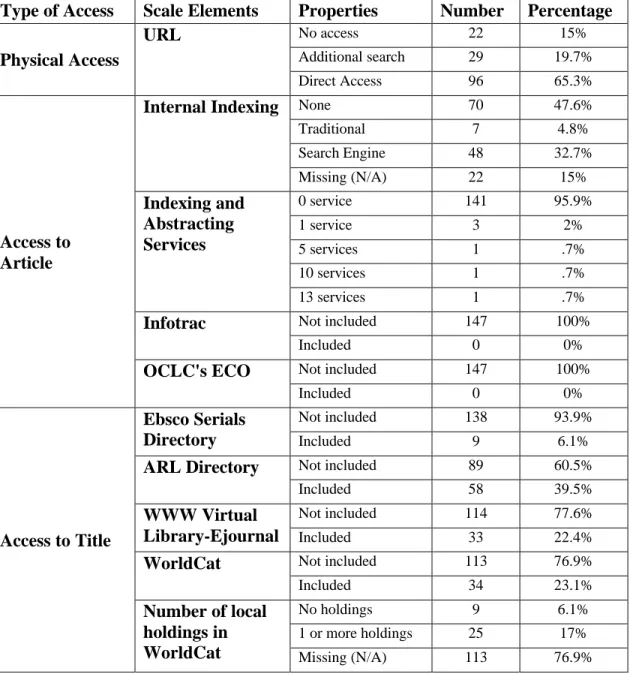
this sample including 58 or 39.5% of the sample titles. The last two elements of the scale deal with bibliographic control as represented through OCLC's WorldCat. A total of 34 (23.1%) titles had cataloging records in WorldCat. Of these 34 titles, 9 (6.1%) listed no holdings locations. Twenty-five (17%) list one or more locations for the given title.
In searching for the data for each of the scale elements, it was interesting to note the various problems or complications associated with each search. The URL element provided the most interesting scenarios for why the sample titles were at times physically inaccessible. As noted above, about 65.7% of the titles were directly accessible. This includes going directly to the intended site from the URL as well as being directed to the correct URL through a referring page. Even though this element recorded the highest percentages for accessibility, these percentages are still not enough. Due to the nature of the medium, networked electronic journals depend on the efficiency of technology in order for anyone to access their contents whatsoever. Therefore, it is imperative that the connectivity of URL's be extremely high in order to facilitate the level of access needed to safely incorporate these titles into a library collection.
First, however, in order to improve access, one needs to identify the problems that are inhibiting access. There were quite a few problems evident within these sample titles that are a product of their electronic format. Several of the titles were inaccessible due to servers being down or not located. Often these titles were found a few days later when another search was conducted. This indicates a problem with the reliability and
continued to not connect to the site, the university was contacted about the problem with accessing the title. Unfortunately, a hacker had recently gotten access to the archives of this title and completely destroyed the data. This title can no longer be accessed through the Internet. Another problem that occurred when trying to access the electronic journal
Janes's Xine was the retrieval of a completely different site. In this instance, Jane's Xine
had ceased and was later found through a search as part of another title. The site that took over Jane's Xine's old URL was actually a porno site. Unfortunately, without established standards for maintaining one address per page, this type of mix-up will remain possible. Finally, as illustrated with the last example concerning Jane's Xine, many of the titles required additional searching using the web's search engines in order to locate their sites. No referring pages were created to lead the user to the new URL for the title. If networked electronic journals prioritize access by their users, then they will have to ensure that resources such as directories are notified of these changes and that referring pages are created to point to new titles and /or URL changes when a title moves to a new address.
28
title sample had some form of internal indexing as one of their features. The majority (48) of the titles actually indexed utilized the capabilities of the Internet by including some kind of search engine that allowed for keyword and/or advanced search options such as searching for a phrase or incorporating Boolean operators 'and' or 'or' into a search. The traditional indexing provided usually took the form of an alphabetical list of subjects or authors. A few of these indexes listed the article titles with hotlinks under the appropriate author or subject term.
designed to handle print will evolve to handle electronic journal publications. Truly understanding why publishers and authors are not including internal indexing features for electronic journals definitely requires further study.
Obviously, in terms of indexing and abstracting services, the print infrastructure for providing access has been inflexible. Networked electronic journals from the sample are still not being indexed and abstracted by these services. In fact, 95.9% of the sample were not included in even one indexing and abstracting service (including Infotrac and OCLC's Electronic Collections Online). This percentage may reflect the indexing and abstracting services' reticence to include new publications from such an unstable medium. As noted in the article by Reutschler (1998) describing Library Literature's
selection criteria for indexing, these publications may have to be archivable, of research value, and published for an extended period of time before they can be included. This is at least the case for inclusion in Library Literature. The absence of the electronic journals from this study sample in indexing and abstracting services is problematic. Users commonly know these types of services. If they go to a service such as Infotrac and look up a topic, they will not be referred to any of these titles. Potentially, this may be the only type of resource that a patron may use to find articles about their topic. If this is the case, then any articles of interest contained in the electronic journals used for this study will remain inaccessible.
30
specific directories including ARL's Directory of Electronic Journals, Newsletters and Academic Discussion Lists as well as the WWW Virtual Library's Ejournal page. ARL's Directory covered the most titles at 58 with the Ejournal page following in second covering 33 titles. The more general serials directory Ebsco's Serials Directory only covered 9 titles of 147. Still these percentages remain low in terms of accessing the majority of the sample for this study. At most, ARL's Directory covered 39.5% of the titles. However, the online medium specific directories appear to be more flexible than the indexing and abstracting services based on the percentage of titles included. Even comparing Ebsco's Serials Directory, which only covered 6.1% of the sample titles, the indexing and abstracting services still covered a lower percentage at 4.1%. Furthermore, the Ejournal page for the WWW Virtual Library allowed user feedback or suggestions on what titles should be added to the page. This directory, therefore, appeared very willing to add titles of interest to users that may have escaped the notice of the personnel who maintain this site. This also creates an opportunity for publishers or authors to have their own sites added to this directory. Once titles are added, however, one problem still exists as indicated by Ford and Harter (1998) concerning online directories. Due to constantly changing URLs, these directories will need to be continuously updated. Unfortunately, for directories not updated, this can lead to inaccurate information being displayed. For
bibliographic utility WorldCat. WorldCat proved to be almost as effective at providing access to the title of networked electronic journals as the online directories examined in this study. This online catalog contained 34 or 23.1% of the titles from the sample, one more title than WWW Virtual Library's Ejournal page and 24 less that ARL's Directory. The percentage for inclusion in WorldCat still did not include a majority of the titles from this sample, and therefore, provided a low level of access to this population of networked electronic journals. Out of the 34 electronic journal covered in WorldCat from the study sample, 25 listed local holdings. This is an interesting statistic considering that
networked e-journals are not location specific. Potentially these locations could be used for ILL or Document Delivery services if permission is given by the publisher and access has been restricted to the location in question. As libraries and publishers continue to struggle with issues of access vs. ownership it will be interesting to see if this trend continues for adding local holdings for electronic publications.
Accessibility Scores for Sample Titles
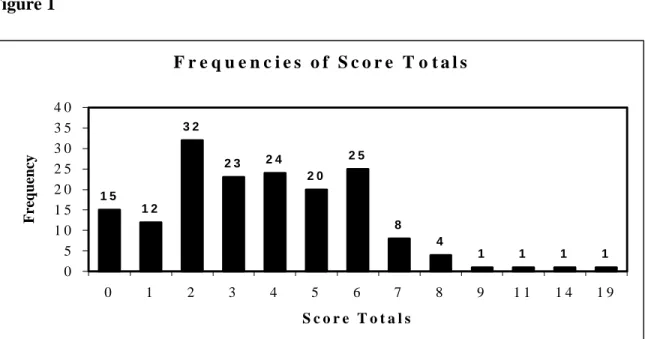
Frequencies were also determined for the total accessibility score given to each title. These scores are tied to pre-set ranges or levels of accessibility as discussed in the methodology section 'Development of the Scale.' Titles with a score of zero were
32
scored in the moderate range, and 3 (2.1%) titles scored highly. For a complete breakdown of each scale score see Figure 1.
Table 2 - Frequencies for Scale Elements
Type of Access Scale Elements Properties Number Percentage
No access 22 15%
Additional search 29 19.7%
Physical Access
URL
Direct Access 96 65.3%
None 70 47.6%
Traditional 7 4.8%
Search Engine 48 32.7%
Internal Indexing
Missing (N/A) 22 15%
0 service 141 95.9%
1 service 3 2%
5 services 1 .7%
10 services 1 .7%
Indexing and Abstracting Services
13 services 1 .7%
Not included 147 100%
Infotrac
Included 0 0%
Not included 147 100%
Access to Article
OCLC's ECO
Included 0 0%
Not included 138 93.9%
Ebsco Serials
Directory Included 9 6.1%
Not included 89 60.5%
ARL Directory
Included 58 39.5%
Not included 114 77.6%
WWW Virtual
Library-Ejournal Included 33 22.4%
Not included 113 76.9%
WorldCat
Included 34 23.1%
No holdings 9 6.1%
1 or more holdings 25 17%
Access to Title
Number of local holdings in
factors measuring physical access, access to the title as well as access to the article. The percentages reported do not indicate which of these three factors is strongest, because one of the premises behind this study is that all three factors for access are necessary to reach the article level for a user unfamiliar with these titles. The user will need to identify the articles they are interested in, how to locate the titles containing those articles, as well as the URL that will provide immediate access to the title. Each of the elements of the scale provides information leading to the article, title or physical location of electronic journals in some way. In terms of the overall accessibility of this sample almost three quarters or 71.4% of the titles are either inaccessible or not easily accessed. Only three titles are included within the highly accessible range; these three titles are IDCR Reports, AGARD Reports and Nonlinear Science Today. A closer examination of these three titles reveals that all three were once associated with a print publication. This is important to note because the indexing and abstracting Services listed for these titles in Ulrich's could potentially be for the print instead of the electronic versions of these publications.
34
titles from this sample were inaccessible. Further studies need to be conducted to
determine if this is a trend that extends across larger populations of networked electronic journals.
Figure 1
F r e q u e n c i e s o f S c o r e T o t a l s
1 5 1 2
3 2
2 3 2 4 2 0
2 5
8 4
1 1 1 1
0 5 1 0 1 5 2 0 2 5 3 0 3 5 4 0
0 1 2 3 4 5 6 7 8 9 1 1 1 4 1 9
S c o r e T o t a l s
Frequency
Table 3 - Summary of Accessibility Scores
Range in Scale Number of titles Percentage of titles
Inaccessible 15 10.2%
Low access 90 61.2%
Moderate access 39 26.5%
36
Figure 2
Frequencies for Publication Date
1 1 1 3 3
8 9
42 41
19
7 1 0
1 0 2 0 3 0 4 0 5 0
1984 1985 1990 1991 1992 1993 1994 1995 1996 1997 1998 1999
Publication Date
Frequency
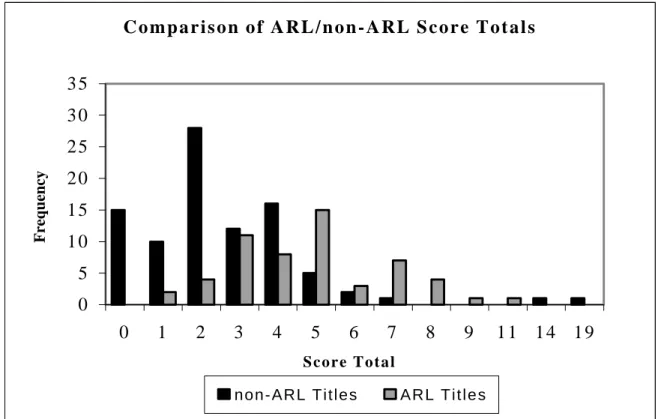
Relationships between Descriptive Elements and Accessibility Total Scores Several different kinds of tests were conducted to determine if there were any relationships between the accessibility scores and the descriptive elements. A chi-square test was used to examine a possible relationship between inclusion in ARL's Directory
and the scale total. A significance value of .000 was given rejecting the null hypothesis that these two groups are related by chance (See Figure 3). The average score for non-ARL titles was 2.67, while the average score for non-ARL titles was much higher at 4.80.
C o m p a r i s o n o f A R L / n o n - A R L S c o r e T o t a l s
0 5 1 0 1 5 2 0 2 5 3 0 3 5
0 1 2 3 4 5 6 7 8 9 1 1 1 4 1 9
S c o r e T o t a l
Frequency
non-ARL Titles ARL Titles
Figure 4
C o m p a r i s o n o f I S S N / n o n - I S S N S c o r e T o t a l s
0 5 1 0 1 5 2 0 2 5 3 0 3 5
0 1 2 3 4 5 6 7 8 9 1 1 1 4 1 9
S c o r e T o t a l
Frequency
38
The remaining three descriptive elements of publication date, cost, and country of publication all reflected insignificant relationships in connection with the accessibility scores. Spearman's Correlation was used to examine the publication dates. Chi-square was used to determine if there was any significance connected to the cost element. T-tests were used to determine the significance of the country of publication. The results from the tests used to produce this data can be found in Appendix B.
After examining both the scale and descriptive elements used to describe the electronic journal sample, a correlation test was conducted to determine if any potential relationships could be determined among or between the elements of each of these groups. Nine possible relationships were identified using the correlation test. Seven of the nine correlations determined to be significant were connected either with the
inclusion of an ISSN or inclusion in ARL's Directory of Electronic Journals, Newsletter and Academic Discussion Lists. These include the following relationships: the inclusion of an ISSN and Internal Indexing, a positive correlation significant at the .01 level; inclusion in ARL's Directory as well as the WWW Virtual Library's Ejournal page, a positive correlation at the .01 level of significance; inclusion in WorldCat as well as ARL's Directory, a positive correlation at the .08 level; the number of local holdings in WorldCat and inclusion in ARL's Directory, a positive correlation of .407 (Pearson's Correlation) at a .017 level of significance; the inclusion of an ISSN as well as Ebsco's Serial's Directory, a positive correlation at the .000 level of significance; inclusion in WorldCat as well as an ISSN, a positive correlation of .450 (Pearson's Correlation) at a .000 level of significance, and finally, the publication date in combination with the ISSN element, a negative correlation at a .004 level of significance. The other two
40
Conclusion
The primary purpose of this study was to provide a descriptive analysis of accessibility for networked electronic journals to the article level. Three levels of accessibility deemed necessary for providing access to electronic journal articles were studied and described in detail. These areas included access to the article, access to the title, and physical access through the URL. A user unfamiliar with the titles in this sample would need information concerning all three of these areas in order to discover and access the desired article of interest. This study illustrated that for this sample, the majority of titles were either inaccessible or not easily accessible. Also, the two
descriptive elements of inclusion in ARL's Directory of Electronic Journals, Newsletters and Academic Discussion Lists and having an ISSN are significantly related to a title's accessibility score assigned through the scale created in this study.
The findings of this study are important for several reasons. At the most basic level, this paper provides a description of the levels of accessibility for this sample of networked electronic journals as of March 1999. The descriptions of this new medium could provide the foundation for further studies on this topic. Furthermore, this study identifies possible variables from the scale itself as well as five descriptive elements or characteristics of these journals that could be examined further individually or in
42
ARL directory of electronic journals, newsletters and academic discussion lists (7th edition), [Online]. (1998). Association of Research Libraries (producer). Available: http://www.arl.org:591/ [1999, March 10].
Beaney, Sandie and Leona Carpenter. (1996). The indexing and retrieval of digital items. Information Services and Use, 16, 209-221.
Beddall, Jane, Sue Malin and Kim Hallett. (1998). Seamless and integrated access to the world of electronic journals. Serials Librarian, 33 (3/4), 233-241.
Bierbaum, Ester Green. (1997). Bibliographic control of serials in the special library.
Serials Librarian, 32 (1/2), 163-176.
Duranceau, Ellen Finnie. (1995). Cataloging remote-access electronic serials: Rethinking the role of the OPAC. Serials Review, 21, 67-77.
EBSCO host serials directory, [Online]. (1998). Ebsco Publishing (producer). Available: NCLive [1999, March 10].
Ford, Charlote E. and Stephen P. Harter. (1998). The Downside of scholarly electronic publishing: Problems in accessing electronic journals through online directories and catalogs. College and Research Libraries, 59 (4), 335-346.
Getz, Malcolm. (1997). An Economic perspective on e-publishing in academia. Journal of Electronic Publishing [Online], 3 (1). Available:
http://www.press.umich.edu/jep/archive/getz.html [1998, Nov. 24]. Heady, Donna M. (1998). Implementing access to electronic journals. Library
44
Hudson, Laura and Laura Windsor. (1998). Providing access to electronic journals: The Ohio University experience. Against the Grain, 10 (3), 1, 16, 18.
Lynch, Clifford. (1997). Technology and its implications for serials acquisition. Against the Grain, 9 (1), 34, 36-37.
McKay, Sharon Cline. (1999). Accessing electronic journals. Database, 22 (2), 16-23. McMillan, Gail. (1992). Technical processing of electronic journals. Library Resources
and Technical Services, 36 (4), 470-477.
Moothart, Tom. (1996). Providing access to e-journals through library home pages.
Serials Review, 22 (2), 71-77.
Mount, Ellis. (1995). Special libraries and information centers: An Introductory text.
3rd ed. Washington, DC: Special Libraries Association.
Park, Taemin Kim. (1996). Survey of electronic journals in OCLC: The Extent and quality of cataloging. Proceedings of the ASIS Annual Meeting, 59, 193-197. Rapple, Brendan A. (1995). Electronic journals: Benefits and difficulties. Catholic
Library World, 66 (2), 30-34.
Rentschler, Cathy. (1998). Indexing electronic journals. Serials Librarian, 33 (3/4), 319-324.
Rowland, Fytton. (1996). Electronic journals: Delivery, use and access. IFLA Journal, 22 (3), 226-228.
Library Trends, 40 (4), 647-666.
Thorburn, Colleen. (1992). Cataloging remote electronic journals and databases. Serials Librarian, 23 (1/2), 11-23.
Tuttle, Marcia. (1996). Managing Serials. Greenwich, Conn.: JAI Press Inc.
Ulrich's on disc, [CD-ROM]. (1998). Available: R.B. Bowker [1999, January 20]. Van der Walt, P.W. and P.A. van Brakel. (1995). Access methods to electronic journals
via the Internet. South African Journal of Library and Information Science, 63
(2), 56-64.
Weston, Beth, Christa Reinke, Eric Lease Morgan and Pat Sullenger. (1995). Methods for collecting, processing, and providing access to electronic serials. Serials Librarian, 25 (3/4), 327-331.
46
47 Australian Adverse Drug
Reactions Bulletin
URL: Reference provided to search feature leading to a new URL.
None listed in Ulrich's None listed in Ebsco
Yes, provides subject index to articles, no search feature, no hyperlinks from index.
no no Ebsco – yes (notes URL)
ARL – yes, ISSN, first electronic issue – 2/95, WWW Virtual Library - no
No, print record exists
N/A
Broadcastaway
URL: E-mailed editor for new URL
None listed in Ulrich's No no no Ebsco- no
ARL – no
WWW Virtual Library – no
No N/A
Compute-Ed
URL: direct access
None listed in Ulrich's No No no Ebsco-no
ARL – yes, first issue 6/95 WWW Virtual Library – no
No N/A
Globe E-Journal of Contemporary Art
URL: direct access
None listed in Ulrich's No No no Ebsco-no
ARL – yes, ISSN, first electronic issue – 6/95 WWW Virtual Library – yes
No N/A
Ibn Qirtaiba
URL: Conduct search to find new URL,
None listed in Ulrich's Yes, keyword searching, Table of Contents (TOC)
No no Ebsco – no
ARL – yes, ISSN, first issue Nov. 1995
WWW Virtual Library – no
48
Title/URL Indexing/Abstracting Services
(Ulrich’s and Ebsco)
Individual Indexing
Infotrac OCLC-ECO
Directories – Ebsco Serials, ARL, WWW Virtual Library WorldCat Record # of locations listed in WorldCat Jazzchord
URL: direct access
None listed in Ulrich's No No no Ebsco – no
ARL- yes, ISSN, first issue – 1/93
WWW Virtual Library – no
No N/A
Limen
URL: cannot access due to hackers
None listed in Ulrich's Unknown No no Ebsco – no
ARL – no
WWW Virtual Library – yes
No No
Online World
URL: Takes you to different page, unable to locate title. Email message = user unkown.
None listed in Ulrich's Unknown No no Ebsco – no
ARL – no
WWW Virtual Library – no
No N/A
Timeoff
URL: conduct search to find new URL
None listed in Ulrich's No No no Ebsco – no
ARL – yes
WWW Virtual Library – no
No N/A
Cinetext
URL: direct access
None listed in Ulrich's No No no Ebsco – no
ARL – no
WWW Virtual Library – no
49 Offshore
URL: Referring page to new URL
None listed in Ulrich's No No no Ebsco – no
ARL – no
WWW Virtual Library – no
No N/A
A F H R C Factsheets
URL: direct access
None listed in Ulrich's Yes, provides subject index, no search feature
No no Ebsco – no
ARL – no
WWW Virtual Library – no
No N/A
British Columbia Snow Survey Bulletin
URL: direct access
None listed in Ulrich's None listed in Ebsco
Yes, keyword, boolean
No no Ebsco – yes (Does not note
URL, correct ISSN, print record)
ARL – no
WWW Virtual Library – no
No, records for individual print items (ceased) N/A
EVA: The Electronic Visual Arts Journal
URL: direct access
None listed in Ulrich's No No no Ebsco – no
ARL –yes
WWW Virtual Library – no
Yes 1
I D C R Reports
URL: direct access
13 listed in Ulrich's Yes,
Keyword, Boolean
No no Ebsco – no
ARL – no
WWW Virtual Library – no
50
Title/URL Indexing/Abstracting Services
(Ulrich’s and Ebsco)
Individual Indexing
Infotrac OCLC-ECO
Directories – Ebsco Serials, ARL, WWW Virtual Library WorldCat Record # of locations listed in WorldCat K.L Smith’s CruiseLetter
New title – SeaLetter Cruise Magazine
URL: Conducted search to find new URL (had referring page to another URL)
None listed in Ulrich's Yes,
keyword, advanced search options
No no Ebsco – no
ARL – no
WWW Virtual Library – no
No N/A
OS/2 E-Zine!
URL: Referring page to new URL
None listed in Ulrich's Yes, keyword No no Ebcso - no
ARL – yes, ISSN, first issue 10/95
WWW Virtual Library – yes
No N/A
Surfaces
URL: direct access
None listed in Ulrich's None listed in Ebsco
Yes, keyword, advanced searching options
No no Ebsco – yes (Print record,
notes other format, Internet) ARL – yes, ISSN, first electronic issue 1990 WWW Virtual Library – yes
Yes 1
Worldprofit Online Magazine
URL: direct access
None found in Ulrich's No No no Ebsco – no
ARL – no
WWW Virtual Library – no
No N/A
Kudos
URL: not located on server
None listed in Ulrich's Unknown No no Ebsco – no
ARL – yes, first electronic issue 5/96
WWW Virtual Library – yes
51 Probability & Statistics
URL: direct access
None listed in Ulrich's No No no Ebsco – no
ARL – no
WWW Virtual Library – no
No N/A
Airbrush-Zeitung
URL: direct access
None listed in Ulrich's Yes,
keyword, advanced search options
No no Ebsco – no
ARL – no
WWW Virtual Library – no
No N/A
M E M I
URL: direct access
None listed in Ulrich's No No no Ebsco – no
ARL – no
WWW Virtual Library – no
No N/A
Universitaet Hohenheim. Forschungsbericht
URL: Unable to locate specific title on site
None listed in Ulrich's Unknown No no Ebsco – no
ARL – no
WWW Virtual Library – no
No N/A
Modest Proposals
URL: Conduct search to find new URL
None listed in Ulrich’s No No no Ebsco – no
ARL – no
WWW Virtual Library – no
52
Title/URL Indexing/Abstracting Services
(Ulrich’s and Ebsco)
Individual Indexing
Infotrac OCLC-ECO
Directories – Ebsco Serials, ARL, WWW Virtual Library WorldCat Record # of locations listed in WorldCat Another Windows 95 Links
and Resources Newsletter New title:
AnotherWin95.com Newsletter
URL: conducted search to find new URL
None listed in Ulrich's Yes, keyword No no Ebsco – no
ARL – yes under old title, diff. URL: http://
www.geocities.com/Silicon Valley/Heights/1094/, first electronic issue 5/97 WWW Virtual Library – no
No N/A
Korea Economic Weekly
URL: Conducted search to find new URL
None listed in Ulrich's Yes,
keyword, advanced search options
No no Ebsco – no
ARL – yes, diff URL: http://www.ked.co.kr , first electronic issue 10/95 WWW Virtual Library – no
No, record for print
N/A
Electronic Journal of Comparative Law
URL: direct access
None listed in Ulrich's Yes, keyword No no Ebsco – no
ARL – no
WWW Virtual Library – no
Yes No libraries
listed
Asian Migration News
URL: Conducted search to find new URL
None listed in Ulrich's No No no Ebsco – no
ARL – no
WWW Virtual Library – no
No N/A
It’s Online
URL: direct access
None listed in Ulrich's Yes,
keyword, advanced search options
No no Ebsco – no
ARL – no
WWW Virtual Library – no
53 Swedish Example
URL: direct access
None listed in Ulrich's No No no Ebsco – yes (URL not
noted , print record, correct ISSN)
ARL – no
WWW Virtual Library – no
No N/A
Vision
URL: direct access
None listed in Ulrich's No No no Ebsco – no
ARL – no
WWW Virtual Library – no
No N/A
Biosafety
URL: could not access directly, password required
None listed in Ebsco Unknown No no Ebsco – yes
ARL – no
WWW Virtual Library – no
No N/A
Chartered Surveyor Monthly
URL: direct access
None listed in Ulrich's Yes, keyword No no Ebsco – no
ARL – no
WWW Virtual Library – no
No, record for print
N/A
Corporate IT Update
URL: direct access
None listed in Ulrich's No No no Ebsco – no
ARL – no
WWW Virtual Library – no
54
Title/URL Indexing/Abstracting Services
(Ulrich’s and Ebsco)
Individual Indexing
Infotrac OCLC-ECO
Directories – Ebsco Serials, ARL, WWW Virtual Library WorldCat Record # of locations listed in WorldCat Environment Today
New title: Chemistry and Industry Magazine URL: direct access
None listed in Ulrich's Yes,
Keyword, index of terms
No no Ebsco – no
ARL – no
WWW Virtual Library – no
No N/A
Highlander Web Magazine
URL: direct access
None listed in Ulrich's Yes,
keyword, advanced search options
No no Ebsco – no
ARL – yes, diff. URL: http://www.highlanderweb.c o.uk/
First electronic issue 1/96 WWW Virtual Library – no
No N/A
Journal of Information, Law and Technology
URL: direct access
One listed in Ulrich's Yes,
keyword, advanced search options
No no Ebsco – no
ARL – yes, ISSN, first issue 1/96
WWW Virtual Library – yes
No N/A
Lumiere
URL: direct access
None listed in Ulrich's No No no Ebsco – no
ARL – yes, first issue 10/95 WWW Virtual Library – no
No N/A
Protein Profile Online
URL: Cannot link to yet, not yet published
None listed in Ulrich's Unknown No no Ebsco – no
ARL – no
WWW Virtual Library – no
55 Sub-Contract News
URL: received e-mail about new URL, still under construction
None listed in Ulrich's Unknown No no Ebsco – no
ARL – no
WWW Virtual Library – no
No N/A
Vintage News
URL: direct access
None listed in Ulrich's Yes, keyword No no Ebsco – no
ARL – no
WWW Virtual Library – no
No N/A
1st Steps in the Hunt URL: direct access
None listed in Ulrich's No No no Ebsco – no
ARL – yes, first issue 12/95 WWW Virtual Library – no
No N/A
A G A R D Reports
URL: direct access
10 listed in Ulrich's Yes, keyword No no Ebsco – no
ARL – no
WWW Virtual Library – no
No, record for print
N/A
Ad Infinitum
URL: direct access
None listed in Ulrich's No No no Ebsco – no
ARL – no
WWW Virtual Library – no
56
Title/URL Indexing/Abstracting Services
(Ulrich’s and Ebsco)
Individual Indexing
Infotrac OCLC-ECO
Directories – Ebsco Serials, ARL, WWW Virtual Library WorldCat Record # of locations listed in WorldCat Aerospace Medicine and
Biology
URL: Have to conduct search on NASA search engine to find URL
One listed in Ulrich's Yes,
keyword, advanced
No no Ebsco – yes (Print record,
no mention of URL or Internet format) ARL – no
WWW Virtual Library – no
Yes, Print ceased in 1995 1 Agrichemical and Environmental News
URL: direct access
None listed in Ulrich's No No no Ebsco – no
ARL – no
WWW Virtual Library – no
Yes, print record w/ note about URL 1 Alsirat
URL: Reference page to new URL
None listed in Ulrich's No No no Ebsco – no
ARL – yes, first issue 9/95 WWW Virtual Library – yes
No N/A
American Newspeak
URL: direct access
None listed in Ulrich's No No no Ebsco – no
ARL – yes, first issue 6/96 WWW Virtual Library – yes
No N/A
Architronic
URL: direct access
None listed in Ulrich’s Yes,
keyword, advanced search options
No no Ebsco – no
ARL – yes, ISSN, first issue 12/92
WWW Virtual Library – yes
57 Art Daily
URL: Direct access
None listed in Ulrich's No No no Ebsco – no
ARL – no
WWW Virtual Library – yes
Yes 1
Astrophysicist’s Tango Partner Speaks
URL: Reference to new URL
None listed in Ulrich's No No no Ebsco - no
ARL – no
WWW Virtual Library – no
No N/A
Be Your own Therapist Newsletter
URL: Unable to locate title
None listed in Ulrich's Unknown No no Ebsco – no
ARL – no
WWW Virtual Library – no
No N/A
Beyond Eternity
URL: Reference to new URL
None listed in Ulrich's No No no Ebsco – no
ARL – yes, ISSN 1203-5416, first issue 12/95 WWW Virtual Library – no
Yes 1
Bitsifter Digest
URL: direct access
None listed in Ulrich's Yes, subject index, no search engine
No no Ebsco – no
ARL – no
WWW Virtual Library – no
58
Title/URL Indexing/Abstracting Services
(Ulrich’s and Ebsco)
Individual Indexing
Infotrac OCLC-ECO
Directories – Ebsco Serials, ARL, WWW Virtual Library WorldCat Record # of locations listed in WorldCat Black Powder Journal
URL: direct access
None listed in Ulrich's No No no Ebsco – no
ARL – no
WWW Virtual Library – no
No N/A
BlueShingles Journal
URL: Unable to locate title, email = user unknown
None listed in Ulrich's Unknown No no Ebsco – no
ARL – no
WWW Virtual Library – no
No N/A
Business Power Magazine
URL: Server down
None listed in Ulrich's Unknown No no Ebsco – no
ARL – yes, first issue 3/96 WWW Virtual Library – no
Yes No libraries
listed
Cal Law
URL: direct access
None listed in Ulrich's Yes, various kinds of searching for individual pages
No no Ebsco – no
ARL – yes, first issue ? WWW Virtual Library – no
No N/A
Catholic Family Perspectives
URL: direct access
None listed in Ulrich's No No no Ebsco – no
ARL – yes, first issue 6/96, entry for previous title Catholic Family Perspectives Weekly WWW Virtual Library- no
59 Chemical and Biological
Defense Information
URL: direct access
None listed in Ulrich's No No no Ebsco – no
ARL – no
WWW Virtual Library – no
No N/A
ChipNet Readings
URL: direct access
None listed in Ulrich's No No no Ebsco – no
ARL – no
WWW Virtual Library – yes
No N/A
Circular File
URL: direct access
None listed in Ulrich's No No no Ebsco – no
ARL – no
WWW Virtual Library – no
No N/A
Color Slides Newsletter
URL: direct access
None listed in Ulrich's No No no Ebsco – no
ARL – no
WWW Virtual Library – no
No N/A
Commodore Hacking
URL: Server move, expected to be up soon
None listed in Ulrich's Unknown No no Ebsco – no
ARL – yes, first issue 92 WWW Virtual Library – no
60
Title/URL Indexing/Abstracting Services
(Ulrich’s and Ebsco)
Individual Indexing
Infotrac OCLC-ECO
Directories – Ebsco Serials, ARL, WWW Virtual Library WorldCat Record # of locations listed in WorldCat Computer Industry Forecasts
URL: direct access
None listed in Ulrich's Yes,
keyword, advanced search options, pay for feature
No no Ebsco – no
ARL – no
WWW Virtual Library – no
No, record for print (ceased)
N/A
Convergence
URL: direct access
None listed in Ulrich's No No no Ebsco – no
ARL – no
WWW Virtual Library – no
No N/A
Cranberry Winters
URL: direct access
None listed in Ulrich's No No no Ebsco – no
ARL – no
WWW Virtual Library – yes
No N/A
Current Government Reports – City Employment
URL: Unable to locate
None listed in Ulrich’s Unknown No no Ebsco – no
ARL – no
WWW Virtual Library – no
No N/A
Current Research in Social Psychology
URL: direct access
None listed in Ulrich's No No no Ebsco – no
ARL – no
WWW Virtual Library – no