Timely Access to Neonatal Intensive Care Units: Non-metropolitan Premature Infants at Risk
By
Angela Gantt, MD
A Master's Paper submitted to the faculty of The University of North Carolina at Chapel Hill
In partial fulfillment of the requirements for The degree of Master of Public Health in
The Public Health Leadership Program
Chapel Hill
Timely Access to Neonatal Intensive Care Units: Non-metropolitan Premature Infants at Risk
Angela Gantt MD, Norma Gavin PhD, Carol Porter BS and Katherine Hartmann MD PhD
Abstract:
Introduction
Infants born at 34 weeks or less gestation are at increased risk of neonatal mortality and morbidity. Neonatal intensive care units (NICUs) are
capable of effectively managing the sequelae of prematurity and improving outcomes. Our objective was to evaluate the proportion of Medicaid-insured infants who delivered in NICU hospitals and determine if maternal residence influenced the ability to access such facilities.
Methods
We linked American Hospital Association annual survey data to an
existing health services database that included birth certificate data, CMS State Medicaid Research Files of Georgia and Area Resource Files. Delivery in a NICU hospital was our primary outcome and maternal residence was our main exposure variable. Covariates were constructed to reflect the plethora of risk factors associated with preterm delivery or NICU access including maternal and fetal demographic characteristics, maternal medical conditions and antenatal care factors. We performed Chi-square and Students t tests when appropriate for bivariate
comparisons between women living in metropolitan versus non-metropolitan areas. A p value of< 0.05 was considered statistically significant. We calculated risk ratios for delivering in a NICU hospital and each covariate. A multivariate logistic regression model was fit with significant covariates to determine the influence of maternal residence on delivery in a NICU hospital.
Results
All Medicaid-insured women who delivered an infant at 34 weeks or less were included in our study (n=2065). Sixty-seven percent of our
population lived in metropolitan areas and nearly 75% delivered in NICU hospitals. Even when adjusting for significant risk factors,
non-metropolitan women had 3.16 (95% Confidence interval: 2.72, 3.67) times the risk of not delivering in a hospital without a NICU compared to women living in metropolitan areas.
Discussion
Timely Access to Neonatal Intensive Care Units: Non-metropolitan Premature Infants at Risk
Angela Gantt MD, Norma Gavin PhD, Carol Porter BS and Katherine Hartmann MD PhD
Introduction:
The complications of premature birth are costly and devastating. Infants
born at less than 37 weeks gestation comprise nearly 12% of births in the
United States while over two-thirds of the infant mortality rate is
attributable to complications of premature birth.1·2 Short- and long-term
morbidities such as respiratory distress syndrome, sepsis, cerebral palsy
and retinopathy are more common among preterm infants, particularly
those born at 34 weeks or less gestation.3-5
One intervention known to improve and effectively manage the sequelae
associated with prematurity is delivery in a hospital with immediate access
a neonatal intensive care unit (NICU): NICUs are defined as units
"separate from the newborn nursery providing intensive care to all sick
infants including those with the very lowest birth weight (less than 1500
grams)."6 Several studies have demonstrated improved neonatal survival
such facilities?-10 Not only is mortality improved, but also these studies
show decreased incidence of neonatal morbidity such as intraventricular
hemorrhage, pulmonary complications and shorter lengths of
hospitalization.9-11
Both the American College of Obstetricians and Gynecologists (ACOG)
and the American Academy of Pediatrics (AAP) recommend the delivery
of premature infants "less than 34 weeks gestation in hospitals with
NICUs."12 In addition, these organizations endorse the establishment of
perinatal regional networks capable of linking NICU hospitals with
community hospitals that service large populations but lack the facilities to
manage the complications of prematurity. Because NICUs tend to be
clustered in urban areas, these networks are crucial to providing intensive
services to isolated regions.
The state of Georgia has a well-established regional perinatal network
system connecting community hospitals to NICU hospitals.13 Their
Recommended Guidelines for Perinatal Care in Georgia are "intended to
be a blueprint ... that will improve the quality of reproductive health care
for women and perinatal health care for pregnant women and infants."13
In 1995, the Georgia Medicaid program covered approximately 52% of
This study had two objectives. The primary objective was to evaluate the
proportion of Medicaid-insured women who delivered preterm infants in
NICU hospitals in order to determine whether the proportion differed for
women living in metropolitan versus non-metropolitan areas. We
hypothesized that maternal residence would influence delivery in NICU
hospitals. Specifically, we believed that women living in non-metropolitan
areas were at increased risk of delivering in hospitals without a NICU. A
second objective of this study was to determine if other maternal factors
influenced delivery in a NICU hospital. We postulated that certain medical
conditions such as pre-eclampsia and preterm labor would predict delivery
in NICU hospitals compared to other conditions such as antenatal
bleeding or diabetes. We hypothesized that even adjusting for relevant
clinical factors associated with preterm delivery, maternal residence would
remain a significant influence on delivering in a NICU hospital.
Methods:
Data Source
We used a population-based retrospective cohort study design to
determine the influence of maternal residence on delivery in an NICU
hospital. We merged American Hospital Association (AHA) annual survey
data6 with an existing database that linked birth certificate data, CMS
State Medicaid Research Files (SMRFs) for Georgia claims information
comprehensive information on both maternal and hospital characteristics
for nearly 90% of women whose deliveries were covered by the Georgia
Medicaid program during 1995 (total deliveries = 51 ,525).
Outcome and Exposure Variables and Covariates
Our main outcome variable was delivery in a NICU hospital. We used
birth certificate information to identify delivery hospitals. The AHA annual
survey, which is completed voluntarily by hospitals, provides descriptive
information about hospital characteristics and services. The survey allows
determination of which hospitals have on-site NICU facilities.
Furthermore, we used AHA data to supplement our knowledge of other
services offered in the hospital including intermediate newborn services,
obstetrical services, designated obstetrics level unit and emergency
department facilities.6
The 1995 AHA survey was matched to delivery hospitals identified from
birth certificate data. We were able to link information to 75 of 99 delivery
hospitals. Additional information on eighteen hospitals was matched with
AHA survey data from 1993-1994 and 1996-1997. Three hospitals not
completing an AHA survey during these five years were contacted by an
author (AG) for hospital information. We excluded three delivery hospitals
because we were unable to obtain any information on the services offered
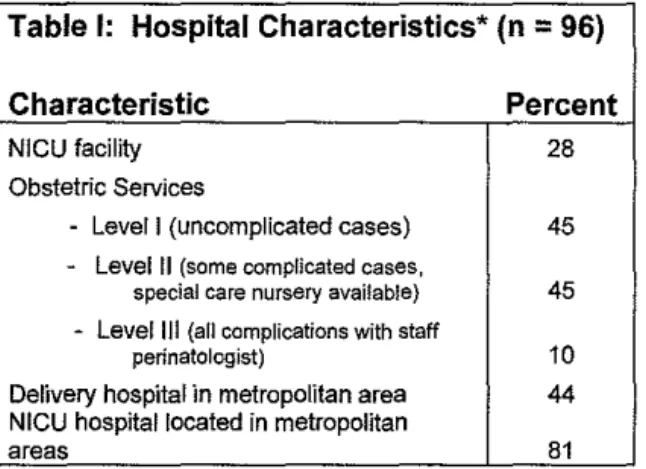
Twenty-eight percent of participating hospitals met AHA standards for
NICU designation (Table 1). While all offered obstetrical services, only
55% offered services for complicated pregnancies. Eighty-one percent of
hospitals equipped with an NICU were located in metropolitan areas.
Table 1: Hospital Characteristics* (n
=
96)Characteristic Percent
NICU facility 28
Obstetric Services
- Level I (uncomplicated cases) 45
- Level II (some complicated cases,
special care nursery available) 45 - Level Ill {all complications with staff
perinatologist) 10
Delivery hospital in metropolitan area 44
NICU hospital located in metropolitan
areas 81
* Based on American Hospital Association survey data
Our main exposure variable, metropolitan versus non-metropolitan
location of maternal residence, was derived from birth certificate
information. County of residence was recorded for each mother and
linked to ARF data. Geographic designation was assigned using
rural-urban continuum codes. Using standard reduction methodology, we
dichotomized the rural-urban continuum codes into metropolitan versus
non-metropolitan status. Thus, a mother was classified as living in a
metropolitan area if the county population was 250,000 or greater and a
non-metropolitan area if the population in the county was less than
We postulated there were several covariates representing identifiable risk
factors for preterm delivery that could also influence delivery in an NICU
hospital. Birth certificate data provided pertinent maternal demographic
and antenatal care information. Age, ethnicity and education were
identified from birth certificate information; as was obstetric history such as
parity, prior pregnancy losses and gestational age at delivery. Tobacco
use was identified via self-reported information on birth certificate data,
although we suspected underreporting to interfere with accuracy.
Using the SMRF we were able to formulate variables reflecting maternal
medical conditions that might contribute to early delivery and/or
necessitate delivery in an NICU hospital. The SMRF data identifies
chronic and/or pregnancy-related medical conditions in inpatient and
outpatient claims. We classified chronic medical conditions such as
diabetes mellitus if the mother was diagnosed at anytime during the
pregnancy or the delivery episode. Similarly, we used combined
antenatal care and delivery episode claims information to identify the
following pregnancy-related conditions: multiple gestation, and premature
rupture of membranes. For other pregnancy-related conditions such as
vaginal bleeding/placental previa, pre-eclampsia, and preterm labor, we
Prenatal care utilization is considered a possible risk factor for preterm
delivery. The Georgia Medicaid antenatal and delivery care
reimbursement system is based on global fee assessment. Thus,
initiation of care and number of visits cannot be assessed from the SMRF
data. We used the Revised Graduated Prenatal Care Utilization Index
(R-GINDEX) from birth certificate data to assess the initiation of prenatal
care, number of visits and adequacy of care.16 The R-GINDEX is one of
several classification tools to describe the quality of prenatal services
received. This index uses six categories to describe the quality of prenatal
services including a category labeled "intensive" for women who received
more than the expected number of prenatal care visits. It has been
suggested that the R-GINDEX is best for gestational age-specific
research.16 We grouped our observations into those receiving intensive or
adequate care compared to those receiving inadequate care. We
postulated that women receiving adequate or intensive care would imply
better observation to detect potential pregnancy complications.
Our final covariate was insurance status. Durbin et al. have suggested
that insurance status might influence delivery hospital and access to NICU
facilities.17 While all of our participants were Medicaid-insured at the time
of delivery, many of the women were not insured at the beginning of their
pregnancies. We constructed a variable that identified women who were
not insured prior to receiving Medicaid coverage. We postulated that
f
women who lacked insurance coverage for any period in their pregnancy
might be at higher risk for preterm delivery or pregnancy complications
that require more intense interventions. In 1995, there was no health
maintenance organization penetration. Women who had private insurance
prior to Medicaid enrollment or were enrolled in Medicaid for the nine
months prior to delivery were considered to have full medical coverage
throughout the pregnancy.
Statistical Analysis
We first performed a univariate analysis to describe our study population.
We included information on all characteristics that might be associated
with preterm delivery. In accordance with our hypothesis, we conducted
our bivariate analysis using Chi-square test and Students t test. We
considered delivery hospital (NICU versus non-NICU) as the dependent
variable. Our bivariate analysis compared the dependent variable to each
independent variable postulated to influence delivery location. A p value
of< 0.05 was considered statistically significant. Next, we determined the
unadjusted risk ratio (RR) of delivering in an NICU hospital between
maternal residence and each covariate. A 95% confidence interval was
calculated for each bivariate pair.
We formulated a multivariable logistic regression model to examine the
delivery in an NICU hospital compared to all other significant variables.
Our baseline regression model was fit with covariates that we found to be
associated with the dependent variable in bivariate analysis (p < 0.1 ). We
checked for interaction between maternal residence and other covariates
in the model. The model was reduced by eliminating all non-significant
risk factors (p >0.1) by using likelihood ratio tests. The final model
included only covariates that significantly influenced the relationship of the
dependent variable to the main exposure variable. Thus, covariates that
were significant in the model but had minimal effect on the relationship
between delivery in an NICU hospital and maternal residence were
removed from the model. We calculated a 95% confidence interval for
each model. Stata 8.0 (College Station, Texas) was used for statistical
analysis.
This study was supported by the Center for Medicaid and Medicare
Services and approved by the Internal Review Board at The University of
North Carolina School of Medicine.
Results:
For this study, we included all women who delivered an infant greater than
22 weeks gestation but less than 35 weeks gestation (n=2081) as these
preterm infants are most likely to benefit from NICU access.15 We
lack of delivery hospital information (3 women) and missing maternal
residence data (16 women). In total, the analysis included 2,065 women.
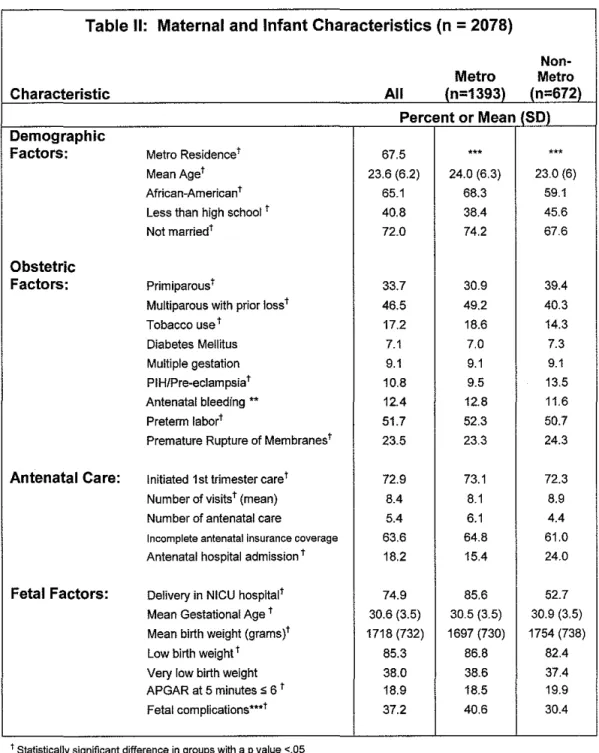
The characteristics of the women and infants are shown in Table II.
Sixty-seven percent of our study population lived in metropolitian areas. Most
often, the women were in their early twenties, African-American and not
married. Most women were multiparous and nearly half of whom had
experienced a prior pregnancy loss. A large proportion had evidence of
spontaneous idiopathic preterm delivery as is evident by 52% having
preterm labor and 24% suffering from premature rupture of membranes.
Nearly 73% of women initiated prenatal care in the first trimester and
received a mean of 8.4 visits during the pregnancy. Sixty-four percent of
patients were uninsured and/or enrolled in Medicaid prior to pregnancy.
While most infants had immediate access to a NICU at birth, 25 percent of
preterm infants delivered in a non-NICU hospital. The median gestational
age was 32 weeks (lnterquartile Range: 28-34) and the mean infant birth
weight was 1718 grams (SO ± 732). Eighty-five percent of infants
weighed less than 2500 grams, meeting criteria for low birth weight.
Thirty-seven percent were thought to have fetal complications such as
intrauterine growth restriction, oligohydraminios, chorioamnionitis or fetal
There were significant differences among women living in metropolitan
and non-metropolitan areas. Women living in metropolitan areas were
more likely to be older, unmarried and African American compared to
women living in non-metropolitan areas. Non-metropolitan women were
more likely to be primiparous and to have a diagnosis of pre-eclampsia.
There was no difference in antenatal bleeding, occurrence of preterm
labor or premature rupture of membranes. While prenatal care initiation
and number of visits were similar, women living in non-metropolitan areas
were hospitalized more frequently.
Gestational age at birth was similar in both groups women from
non-metropolitan regions had fewer low birth weight infants. Both groups had
similar proportions of infants weighing less than 1500 grams. There was a
significant difference between the two groups in the occurrence of fetal
complications. Women from metropolitan areas were more often
diagnosed with fetal complications (41%) than women whose residence
was in non-metropolitan areas (30%) (p <.001 ). Finally, metropolitan
mothers were significantly more likely to deliver their preterm infants in
NICU hospitals (86%) compared to non-metropolitan mothers (53%)
Table II: Maternal and Infant Characteristics (n
=
2078)Non-Metro Metro
Characteristic All (n=1393) (n=672l
Percent or Mean (SOl Demographic
Factors: Metro Residencet 67.5
...
...
Mean Aget 23.6 (6.2) 24.0 (6.3) 23.0 (6)
African-American t 65.1 68.3 59.1
Less than high school t 40.8 38.4 45.6
Not marriedt 72.0 74.2 67.6
Obstetric
Factors: Primiparoust 33.7 30.9 39.4
Multiparous with prior loss t 46.5 49.2 40.3
Tobacco use t 17.2 18.6 14.3
Diabetes Mellitus 7.1 7.0 7.3
Multiple gestation 9.1 9.1 9.1
PIH/Pre-eclampsiat 10.8 9.5 13.5
Antenatal bleeding ** 12.4 12.8 11.6
Preterm !abort 51.7 52.3 50.7
Premature Rupture of Membranest 23.5 23.3 24.3
Antenatal Care: Initiated 1st trimester caret 72.9 73.1 72.3
Number of visitst (mean) 8.4 8.1 8.9
Number of antenatal care 5.4 6.1 4.4
Incomplete antenatal insurance coverage 63.6 64.8 61.0
Antenatal hospital admission t 18.2 15.4 24.0
Fetal Factors: Delivery in NICU hospitalt 74.9 85.6 52.7
Mean Gestational Age t 30.6 (3.5) 30.5 (3.5) 30.9 (3.5)
Mean birth weight (grams)' 1718 (732) 1697 (730) 1754 (738)
Low birth weight t 85.3 86.8 82.4
Very low birth weight 38.0 38.6 37.4
APGAR at 5 minutes s 6 t 18.9 18.5 19.9
Fetal complications***t 37.2 40.6 30.4
t Statistically significant difference in groups with a p value <.05
*Antenatal bleeding included placenta previa and all episode of bleeding prior to delivery
**R-GINDEX classification system characterizes as intensive, adequate, intermediate and inadequate prenatal services ***fetal complications include intrauterine growth restriction, oligohydramnios, chorioamnionitis and fetal
We performed a bivariate analysis examining the risk ratio for each
maternal characteristic identified as a risk factor for preterm birth with
delivery in an NICU hospital (Table Ill). The unadjusted risk ratio indicated
that mothers delivering infants prematurely and from non-metropolitan
areas had 3.29 (CI: 2.83, 3.83) times the risk of delivering in a non-NICU
facility. African American mothers were more likely to deliver in NICU
hospitals. Each of the following obstetric factors was significantly
associated with delivery in an NICU hospital: lower gestational age, prior
pregnancy loss, tobacco use, pre-eclampsia, preterm labor and premature
rupture of membranes, and fetal complications. Adequate prenatal care
was positively associated with delivery in a NICU hospital. Hospitalization
Table Ill: Bivariate Comparison of NICU hospital and Preterm Delivery Risk Factors
Characteristic Risk Ratio 95% Cl
Demographic Factors:
Non-metropolitan maternal residence 3.30 2.83, 3.83
African American race 0.70 0.6, 0.8
Increasing maternal age 0.98 0.97, 0.99
Obstetric Factors:
Increasing Gestation 1.04 1.02, 1.07
Primiparous 1.06 0.91, 1.25
Prior pregnancy loss 0.79 0.65, 0.94
Tobacco use 1.23 1.03, 1.48
Twins or multiple gestation 0.97 0.74, 1.26
PI Hi Pre-Eclampsia 0.53 0.38, 0.74
Antenatal bleeding or placental
bleeding• 1.01 0.81, 1.27
Preterm labor 0.82 0.70, 0.95
Premature rupture of membranes 0.66 0.54, 0.81
Fetal Complications** 0.60 0.51, 0.72
Antenatal Factors:
Adequate PNC*** 1.31 1.12, 1.54
NoPNC 1.00 0.72, 1.40
Full insurance coverage 0.97 0.83, 1.13
Antenatal hospital admission 1.06 0.88, 1.29
* Antenatal bleeding included placenta previa and all episodes of bleeding prior to delivery
**Fetal complications include intrauterine growth restriction, oligohydramnios, chorioamnionltis and fetal distress
ruR~GINDEX classification system characterizes as intensive, adequate, intermediate and inadequate prenatal services
Our fully adjusted model confirms that living in a metropolitan area was
protective for delivering a preterm infant in an NICU hospital (Table IV).
Our final model included race, maternal age, gestational age and obstetric
complications such as pre-eclampsia, preterm labor, premature rupture of
membranes and fetal complications as covariates. This model
demonstrated the crude relationship is minimally confounded suggesting
that residence is the major determinant to NICU hospital access 3.16 (CI:
Table IV: Unadjusted and Adjusted Odds Ratio of Delivery in a NICU Hospital for a Mother Living in a
Non-Metropolitan Area
Risk Ratio 95% Cl
Non-metropolitan vs.
Unadjusted: Metropolitan 3.29 2.83, 3.83
Non-metropolitan vs.
Adjusted•: Metropolitan 3.16 2.86, 3.85
"Adjusted for gestational age, fetal complications, maternal race, maternal age, the occurrence of preterm labor, premature rupture of membranes and pregnancy induced hypertensive disorders
Discussion:
This study demonstrates that access to NICU facilities is strongly
influenced by maternal residence in a Medicaid-insured population of
mothers delivering preterm infants. The infants of women living in
non-metropolitan areas have over three times the risk of not having access to
NICU facilities at birth compared to premature infants of metropolitan
women. Certainly, some obstetrical factors such as lower gestational age,
pre-eclampsia, preterm labor and premature rupture of membranes were
predictors of delivery in NICU hospitals. However, we found that even
adjusting for these predictors, maternal residence was the driving force for
NICU accessibility.
This study is consistent with a 2001 Georgia Epidemiology Report that
evaluated geographic disparities and access to specialized neonatal
certificate data on infants less than 1500 grams born from 1994-1996.
They categorized the infants into three groups based on proximity of
maternal residence to a "subspecialty" hospital; defined as hospitals with a
state-certified NICU. Their results indicated that 89% of women with
VLBW infants and living in counties with NICUs delivered at these
hospitals. However, mothers living outside of these counties were less
fortunate. Seventy-one percent of VLBW infants from adjacent counties
and only 53% of those residing in non-adjacent counties delivered in
subspecialty hospitals. The group found similar results when birth
certificate data from 1997-1998 was used for analysis.18
Identifying risk factors that impede the delivery of preterm infants in NICU
hospitals highlights vulnerable populations in need of specific attention as
well as establishes new focal points for improvement and resource
allocation in the perinatal regional network system. We were fortunate to
have access to demographic information from birth certificates as well as
information from the SMRF of Georgia, AHA and ARF databases. This
information provides a more complete picture of population characteristics
then previous studies on this topic. Yet, despite the enhanced patient
information regarding medical conditions, insurance status, etc., the
proximity of a NICU hospital to maternal residence remains the most
The literature clearly supports the concept that delivery in an NICU
hospital can be lifesaving for premature infants.9-11·19-22 Modanlou et al.
designed a prospective study to determine the benefits of delivery in an
NICU hospital versus neonatal transport to NICU faciltity after birth.9 They
found a lower incidence of respiratory complications and decreased length
of hospitalization compared to neonates transported after birth. The
Collaborative Project on Preterm and Small for Gestation Age Infants is a
Dutch study that follows a 1983 cohort of infants for long term outcomes.10
Similar to Modanlou, the Dutch study reported decreased neonatal
mortality and morbidity associated with delivery in NICU hospitals in the
short term. However, long-term data indicated no significant difference in
outcomes such as disability in children born in NICU hospitals versus
children managed in non-NICU settings.10
Several recent studies have confirmed these earlier findings. Chien et al.
examined infants less than 32 weeks gestation in Canada and postulated
that severity of illness and maternal risk factors might partially explain the
improved neonatal outcome of infants born in NICU hospitals compared to
neonates transported to NICU hospitals after birth.19 Even adjusting for
these risk factors, infants born in non-NICU hospitals had increased
incidence of intraventricular hemorrhage, respiratory distress syndromes
Warner et al. published a study examining a cohort of VLBW infants
delivering in the Cincinnati region.20 They found that even when
controlling for demographic characteristics, VLBW infants were at 2.64
(CI:1.7,4.2) times the odds of dying or suffering major morbidity if
delivered in a nonsubspecialty perinatal center. Similarly, Menard et al.
examined vital records of VLBW infants from 1993-1995 in South
Carolina.21 Neonatal mortality rates were significantly lower for infants
delivered in Level Ill NICU hospitals compared to either
intermediate-NICU or community hospitals. The adjusted neonatal mortality rates were
146 per 1000 live births in NICU hospitals compared to 232 per 1000 live
births in intermediate NICU hospitals.21
The supply of NICUs and neonatologists has increased exponentially over
the past two decades;23 this suggests improved access for those in need
of such services. However, there is evidence that the distribution of
providers and units are not based on need.23·24 David Goodman et al.
study the distribution of neonatologists and NICUs with the association of
neonatal mortality in the United States. Using birth weight as an indicator
of need, they determined that neonatologists were or equitably distributed.
Regions with the highest rates of VLBW infants had similar numbers of
neonatologists as regions with the lowest rates of VLBW infants.23 "With
neonatal capacity expressed as the number of VLBW infants per bed or
fourfold"23 Furthermore, in a different study, Goodman et al. explained
that increasing neonatalogists beyond a threshold of 4.3 per 10,000 live
births did not improve neonatal survival.24
Recently, hints of "deregionalization" of perinatal network systems raise
concerns regarding access for vulnerable regions lacking NICU
facilities.16•25•26•28 Regionalized perinatal network systems were derived in
order to offset disparities in NICU access. These networks offer not only
NICU facilities but also "the concept of perinatal regionalization ...
includes a large array of services with a fully integrated system of
consultation, referral, and transport."27 Embry Howell and others describe
deregionalization in urban areas: Using AHA annual survey of hospitals
they found an increase in NICUs in metropolitan areas from 1980-1995
but limited expansion of larger sized NICUs that are best for management
of prematurity.25 The authors suggest the increasing number of NICUs
has improved access in smaller geographic areas but disproportionately
benefited areas that already had NICU facilities.
Several studies postulate that deregionalization of perinatal networks
might be influenced by managed care organizations, insurance
reimbursement patterns and local community forces. Bronstein et al. used
vital statistics on VLBW infants in Alabama from 1998-2000 to conduct a
that race, prenatal care utilization and insurance status influenced type of
delivery hospital.28 Minority women with early, adequate prenatal care
delivered in NICU hospitals and Medicaid-insured women received
antenatal transport to NICU hospitals more frequently then other insured
women.27 Durbin et al. report on neonatal interhospital transport rates for
all infants born in southeastern Pennsylvania. They question if perinatal
network systems are evolving into a financially motivated tool of managed
care organizations as they found that Medicaid-insured and self-insured
infants were more likely to be transported to NICU facilities compared to
privately insured infants.17
Our study was able to locate NICU hospitals by regions in Georgia and
found further evidence that NICU hospitals are not distributed equally.
Only 19% of NICU hospitals were located in non-metropolitan regions.
Yet, nearly 33% of our population lived in non-metropolitan areas. The
proportion of VLBW infants was equal in both regions. Although our study
did not evaluate the number of neonatologist per live birth, we suspect that
non-metropolitan areas in Georgia will be below the critical threshold
thought to improve neonatal survival. Thus, strengthening instead of
weakening perinatal networks are crucial to maximizing access to the best
The application of our study to other populations might be limited since we
evaluated only Medicaid covered deliveries. In 1995, Medicaid covered
52% of all deliveries in Georgia.14 Nationally, over 40% of antenatal
services and deliveries are covered by Medicaid which makes it the
largest insurer of pregnancy care. We expected our data to have a higher
proportion of premature infants since preterm delivery risk factors such as
low socioeconomic status, minority race and medical conditions are
over-represented in a Medicaid population. Yet, the prevalence of premature
delivery was similar to state and national rates. Further studies would be
necessary to determine if maternal geographic proximity to NICU hospitals
is similar in other regions and populations.
Another potential limitation to our study was the inability to access key
patient and physician decision-making factors that surely influence the
events surrounding the delivery episode. The literature has shown
improved neonatal outcomes associated with immediate NICU access for
premature infants. Yet physician awareness of these benefits, efficiency
of the perinatal network system to access NICU facilities, urgency of
delivery and unique doctor-patient dynamics dictate decisions surrounding
delivery. From the patient perspective, delivery in a NICU hospital may
lead to isolation from established support systems since access to such
factors need probing to further the discussion of equal access to care and
improve regionalized perinatal network systems.
Our analysis is based on a 1995 cohort of premature infants. It is possible
that access to NICU hospitals has improved for non-metropolitan women
living in Georgia over the past several years. The 2001 Georgia
Epidemiology Report on VLBW infants during the same period suggests
similar findings to our study. In addition they found no improvements
when they evaluated infants born in the late 1990s.18 If restructuring of
the Georgia perinatal network system to address this disparity has
occurred in the interim then it is important to reassess the influence of
maternal residence and access to NICU hospitals. Using a
comprehensive dataset such as the one used in our study will provide the
most information on both maternal and hospital characteristics.
Surely, not all preterm deliveries can be prevented from occurring in
non-NICU hospitals. Inevitably women will present in active, rapidly
progressive labor or unstable medical condition precluding safe, efficient
transfer to NICU hospitals. Yet, the preponderance of NICU hospitals in
metropolitan regions exposes non-metropolitan women and infants to
disparate health care. Perinatal network systems are designed to
increase the accessibility of high risk services to communities without such
risk of delivering in non-NICU hospitals. Next steps should begin
examining system and provider level factors that impede best medical
practice.
Current national survey data indicates that 73% of premature infants are
delivered in hospitals with NICU facilities.29 Healthy People 2010 sets a
90% goal of premature infants delivering in NICU hospitals.29 Our data
show that among a cohort of Medicaid-insured women delivering infants
less than 34 weeks gestation, 75% were born in NICU hospitals. Maternal
residence significantly influences delivery in a NICU hospital and the
ability to achieve Healthy People 2010 goals. The unequal distribution of
neonatal intensive services requires coordinated network systems that
efficiently link non-metropolitan women presenting to local hospitals with
regional NICU facilities. Tailoring current policies and outreach efforts to
Acknowledgements
The views expressed in this manuscript are those of the authors and do
not necessarily reflect the views of the University of North Carolina, the
Research Triangle Institute or the Center for Medicare and Medicaid
Services. The research in this article was supported by CMS under
contract number 500-00-0018, Delivery Order #2 and the Robert Wood
References:
1. March of Dimes. Perinatal statistics and prematurity.
www.marchofdimes.com. Last accessed- February 16, 2004. 2. National Center for Health Statistics. Final natality data 1991-2001.
www.cdc.gov/nchs. Last accessed Februarv 16, 2004.
3. Slattery MM, Morrison JJ. Preterm delivery. Lancet. 2002;360:1489-1497.
4. Iannucci TA, Tomich PG, Gianopoulos JG. Etiology and outcome of extremely low-birthweight infants. Am J Obstet Gynecol.
1996; 17 4:1896-1902.
5. Olsen P, Laara E, Rantakillio Petal. Epidemiology of preterm delivery
in two birth cohorts with an interval of 20 years. Am J Epidemiology.
1995;142:1184-1193.
6. American Hospital Association. 1995 Annual Su!Vey. American Hospital Association 1995.
7. Kirby RS. Perinatal Mortality: The role of hospital of birth. J Perinatal. 1996;16:43-49.
8. Cordero L, Backes CR. Zuspan FP. Very low birthweight infant:
influence of the place of birth on survival. Am J Obstet Gynecol.
1982;143:533-537.
9. Modanlou HD, DorchesterW, Freeman RK, Rommal C. Perinatal transport to a regional perinatal center in a metropolitan area: Maternal versus neonatal transport. Am J Obstet Gynecol. 1980;138:1157-1164.
10. Kollee LA, Brand R, Schreuder AM, Ens-dokkum MH, et al. Five year outcome of preterm and very low birth weight infants: A comparison between maternal and neonatal transport. Obstet Gynecol.
1992;80:635-638.
11. Towers CV, Bonebrake R, Padilla G, Rumney P. The effect of
transport on the rate of severe intraventricular hemorrhage in very low birth weight infants. Obstet Gynecol. 2000;95:291-295.
12.American Academy of Pediatrics and the American College of Obstetrics and Gynecology. Guidelines for Perinatal Care. 5th ed. Washington, DC: American Academy of Pediatrics and the American College of Obstetrics and Gynecology; 2002.
13. Georgia Department of Human Resources. Recommended Guidelines
for Perinatal Care in Georgia. 2nd ed. The Council of Maternal and Child Health- Division of Public Health; 1999.
14. National Governors' Association. State Medicaid coverage of pregnant women and children; Table 2: Medicaid births as a percentage of total births, 1994 and 1995. www.nga.org Last accessed- April 6, 2004. 15.Gavin Nl, Adams EK, Berkman ND. Racial disparities in health
Unpublished report to Centers for Medicaid and Medicare Services. 2003.
16.Aiexander GR, Kotelchuck M. Quantifying the adequacy of prenatal care: A comparison of indices. Public Health Rep. 1996; 111 :408-418. 17. Durbin DR, Giardino AP, Shaw KN, Harris MC, Silber JH. The effect of
insurance status on likelihood of neonatal interhospital transfer.
Pediatrics. 1997; 100:
18. Samuelson J, Buehler J Norris D, Sadek
R.
"Geographic disparities inaccess to recommended delivery site for very low birth weight infants in Georgia 1994-1996." Georgia Epidemiology Report. 2001 ;17(7). 19.Chien L, Whyte R, Aziz K, Thiessen P, Matthew D, Lee SK. Improved
outcome of preterm infants when delivered in tertiary care centers.
Obstet Gyneco/. 2001 ;98:24 7-5 2.
20. Warner B, Musial MJ, Chenier T, Donovan E. The effect of birth hospital type on the outcome of very low birth weight infants.
Pediatrics. 2004;113:35-41.
21. Menard MK, Liu Q, Sappenfield WM. Neonatal mortality for very low birth weight deliveries in South Carolina by level of hospital perinatal
services. Am J Obstet Gyneco/. 1998; 179:37 4-381.
22. Cifuentes J, Bronstein J, Phibbs CS, Phibbs RH, Schmitt SK,
Waldemar AC. Mortality in low birth weight infants according to level of neonatal care at hospital of birth. Pediatrics. 2002;109:745-751.
23.Goodman DC, Fisher ES, Little GA, Stukel TA, Chang C. Are neonatal intensive care resources located according to need? Regional
variation in neonatologists, beds, and low birth weight newborns.
Pediatrics. 2001 ;108:426-431.
24.Goodman DC, Fisher ES, Little GA, Stukel TA, Chang C, Shoendorf KS. The relation between the availability of neonatal intensive care and neonatal mortality. N Eng/ J Med. 2002;346: 1538-44
25. Howell EM, Richardson D, Ginsburg P, Foot B. Deregionalization of
neonatal intensive care in urban areas. Am J Public Health.
2002;92:119-124.
26. Yeast JD, Peskin M, Stockbauer JW, Shaffer S. Changing patterns in regionalization of perinatal care and the impact on neonatal mortality.
Am J Obstet Gynecol. 1998; 178:131-135.
27. McCormick MC, Richardson OK. Access to neonatal intensive care.
Future Child. 1995;5:162-175.
28. Bronstein JM, Capilouto E, Carlo WA, Haywood JL, Goldenberg RL. Access to neonatal intensive care for low-birthweight infants: the role of maternal characteristics. Am J Public Health. 1995;85:357-61. 29. Healthy People 2010 Objectives. Maternal infant and child