Amanda R Vinogradov. Evidence-Based Veterinary Medicine Education in the U.S. and Canada: Roles for Librarians. A Master’s Paper for the M.S. in L.S degree. April, 2011. 44 pages.Advisor: Joanne Gard Marshall
This study describes the roles of veterinary librarians in Evidence-Based Veterinary Medicine (EBVM) education. An online survey, with questions adapted from a previous survey of dental librarians, was distributed to veterinary librarians in the U. S. and Canada. It received a 78% (n=25) response rate. The results of this survey revealed that veterinary librarians are involved in a variety of roles within EBVM education. The most frequently cited barrier to involvement in EBVM education was a low level of interest from the veterinary faculty, students, or school. Although the majority of respondents reported feeling competent about their ability to support EBVM education, several
suggested that there was a need for more continuing education opportunities for librarians related to EBVM.
Headings:
Veterinary medical education
Veterinary librarian
Evidence Based Veterinary Medicine (EBVM)
Evidence Based Practice (EBP)
by
Amanda R Vinogradov
A Master’s paper submitted to the faculty of the School of Information and Library Science of the University of North Carolina at Chapel Hill
in partial fulfillment of the requirements for the degree of Master of Science in
Library Science.
Chapel Hill, North Carolina
April 2011
Approved by
_______________________________________
Acknowledgements
Table of Contents
Introduction ... 3
Literature Review ... 6
Roles for Librarians in Evidence-Based Medicine ... 6
Roles for Librarians in Evidence-Based Veterinary Medicine ... 7
Importance of Study ... 8
Methods ... 9
Study Rationale ... 9
Subject Recruitment ... 10
Survey Development ... 11
Survey Distribution ... 12
Data Analysis ... 12
Results ... 13
Survey Response Rate ... 13
Participant Background ... 13
EBVM Educational Opportunities for DVM Students ... 14
Librarian Roles in Teaching EBVM Courses ... 15
Librarian Involvement in Other EBVM Services ... 16
Frequency of EBVM Literature Search Assistance ... 17
Competency in Providing EBVM Services... 18
Methods Used to Gain EBVM Knowledge ... 18
Barriers to Involvement in EBVM Education ... 19
Perceptions of EBVM ... 21
Discussion ... 22
EBVM Survey Results ... 22
Surveys of EBVM and EBD Librarians: A Comparison ... 24
Limitations ... 25
Conclusion ... 26
References ... 27
List of Figures ... 32
Introduction
The purpose of this study is to assess the status of veterinary librarians’ roles in
evidence-based veterinary medicine (EBVM) education. The study surveyed veterinary
librarians in the U. S. and Canada in order to answer the following questions: 1) what
level of knowledge do veterinary librarians have of EBVM, 2) how do veterinary
librarians perceive EBVM, and 3) what level of involvement do veterinary librarians
have in EBVM education. The primary investigator found no previous empirical studies
on this topic currently published in the literature.
The phrase “evidence-based medicine” (EBM) has been used since the early 1990’s
to describe a paradigm shift taking place in medicine. Traditionally, physicians have
based medical decision-making on “clinical experience…pathophysiologic rationale…
medical training and common sense” (Evidence-Based Medicine Working Group, 1992).
In contrast, EBM de-emphasizes the reliance on these traditional assumptions and
stresses the importance of independently assessing the evidence. EBM does not imply a
rejection of what one can learn from colleagues who may have years of experience in
techniques that cannot be learned from formal scientific investigation. EBM does suggest
that physicians should consult the literature and be able to appraise both the methodology
and results of a study. Practicing EBM requires physicians to learn new skills in order to
apply the formal rules of evidence in evaluating the literature (Evidence-Based Medicine
The process of EBM has been formalized into the following five steps: 1) create a
focused and answerable question from the case, 2) search for evidence using appropriate
resources, 3) critically appraise the evidence, 4) apply results to a current practice, and 5)
assess the outcome of the practice and modify if necessary (Cook, Jaeschke, & Guyatt,
1992; Gray & Pinson, 2003). Librarians can participate in all but the fourth step, which
requires clinical experience (McKibbon & Bayley, 2004). EBM can now be found in
many fields of healthcare and other professions, including library science (Eldredge,
2000) (Gu, 2010, p. 4-6).
EBM and Veterinary Medicine
The veterinary profession has begun to apply the EBM concept to veterinary
medicine. In 2003, the EBVM standard was developed from the EBM standard
(Cockcroft & Holmes, 2003). The practice of EBVM is defined as "the use of the current
best evidence in making clinical decisions" (Cockcroft & Holmes, 2003). The Evidence
Based Veterinary Medicine Association (EBVMA), formed in 2004, states that while
EBVM and EBM are fundamentally the same concept, there are significant differences
between the veterinary medical profession and the human medicine profession that make
EBVM particularly challenging in practice (Evidence-Based Veterinary Medicine
Association, 2010).These differences are also cited as the reasoning behind the less
exacting standard for EBVM in comparison to EBM (Cockcroft & Holmes, 2003). For
example, Cockcroft suggests that EBVM does not currently have the same amount of
evidence or resources to draw on and its literature base is much smaller (as cited in
Pelzer, 2006). Implementation of EBVM also requires veterinarians to find relevant
Association, 2010). While many are advocating for veterinarians to implement EBVM in
research and clinical practice, these factors present significant barriers to the achievement
of this goal. Additionally, EBVM requires veterinarians to develop new skills in question
development, literature searching, and critical appraisal (Cockcroft & Holmes, 2003).
EBM, Veterinary Medicine, and Roles for Librarians
Librarians have an important opportunity to contribute to the adoption of EBVM in
their institutions. Previous studies have indicated that librarians are involved in many
aspects of veterinary medical education, (Bruce, 1992; Fajt, Brown, & Scott, 2009;
Olmstead, et. al, 2001; Kok, 1998; Pelzer, 1998; Pelzer, 2006).However, the researcher
found no empirical studies in the literature on the status of veterinary librarian’s
knowledge of EBVM, their perceptions of EBVM, or their current involvement in EBVM
Literature Review
Evidence Based Medicine and Roles for Librarians
Librarians have been heavily involved in the development and implementation of
EBM. While some have stated that librarians should only be involved in the second step
of the EBM process, Haines argued as early as 1994 that librarians should not simply
“play only a supporting role” in EBM (Eldredge, 2000; Haines, 1994). In fact, McKibbon
and Bayley (2004) argued that librarians can participate in all but the fourth step of the
EBM process. The fourth step would require clinical expertise. McKibbon and Bayley
(2004) also argued that librarians could support the EBM education of health sciences
students. Similar arguments had been made previously (McCarthy, 1996; Scherrer &
Dorsch, 1999).
Librarians have had a unique opportunity to be involved in EBM education and
demonstrate the value of EBM education in a variety of settings. For example, librarian
expertise in EBM is now being used to assist in the development of patient safety
guidelines (Garcia & Wells, 2009). These developments suggest that librarians should
market the value of their work in EBM education (Rose, 1998). This can only be done
with good evidence. There have been many individual case reports on the involvement of
librarians in EBM as well as a few empirical studies (Bradley, Rana, Martin &
Evidence Based Veterinary Medicine and Roles for Librarians
Librarians are involved in many aspects of veterinary medical education,
including bibliographic instruction, clinical librarian rotations, and other aspects (Bruce,
1992; Fajt, Brown, & Scott, 2009; Olmstead, et. al, 2001; Kok, 1998; Pelzer, 1998;
Pelzer, 2006). As the veterinary profession as a whole begins to incorporate the ideas
found in EBM into veterinary education and practice, veterinary librarians have the
opportunity to participate in developing educational opportunities for veterinary students,
faculty, and practitioners in EBVM skills.
As early as 1980, Texas A&M veterinary librarians have been assigned to a
clinical librarian position on rotation with a small animal clinic. This clinical rotation is
similar in nature to those provided by clinical medical librarians. The librarians note that
an important aspect of the rotation is that it “enables students to formulate and refine
clinical questions, and it makes them evaluate the quality of retrieved information”
(Olmstadt, W., Foster, C. L., Burford, N. G., Funkhouser, N. F., & Jaros, J., 2001).
Veterinary professionals themselves have emphasized the importance of learning
EBVM during case-based pharmacology rounds as a means to improve EBVM in
practice (Fajt, V. R., Brown, D., & Scott, M. M., 2009). Several books and articles have
been written by veterinary practitioners and researchers about EBVM, but the researcher
did not find articles in which these professionals engaged in a significant discussion of
librarians as part of the EBVM educational process (Hardin, L. E. & Robertson, S., 2006;
Importance of Study
Veterinary librarians have the opportunity to use their professional knowledge in
support of veterinary education in EBVM. However, there have been no empirical studies
conducted to investigate the current role of veterinary librarians in EBVM education.
This study investigates the involvement of veterinary librarians in EBVM education and
their perception of EBVM by conducting online questionnaires among veterinary
librarians who serve veterinary programs in the U.S. and Canada.
Results from this online survey are relevant to both the veterinary and library
professions. This study could identify potential educational needs of both veterinary
librarians and library science students interested in veterinary librarianship. It could also
provide the veterinary profession with further knowledge about EBVM education and the
Methods
Study Rationale
The Institutional Review Board (IRB) at the University of North Carolina at
Chapel Hill (UNC-CH) approved the survey methodology used in this study. A
confidential online survey was sent to veterinary librarians in the U. S. and Canada in
order to assess the role of veterinary librarians in EBVM education. One librarian was
chosen from each of these institutions by using the Medical Library Association (MLA)
directory to acquire email contact information. Where there were multiple librarians
listed for a single institution, the researcher chose the librarian listed as a veterinary
librarian or, if one was not specified, the first listed librarian. The study surveyed
veterinary librarians in the U. S. and Canada in order to answer the following questions:
1) what level of knowledge do veterinary librarians have of EBVM, 2) how do veterinary
librarians perceive EBVM, and 3) what level of involvement do veterinary librarians
have in EBVM education. These research questions were adapted from a previous study
of the role of dental librarians in evidence-based dental education (Gu, 2010).
The survey questions were also adapted from the previous survey of dental
librarians (Gu, 2010). In order to better compare the results of this study to the results of
Gu's study, the target population was limited to veterinary librarians in the U. S. and
Canada. A comparison of the two studies was desired in order to investigate similarities
evidence-based educational opportunities in their respective disciplines. If similarities are
found, then further collaboration or discussion between these groups might be beneficial.
Gu's survey questions were reviewed by selected veterinary librarians, who
agreed that with alterations Gu's survey questions would be applicable to veterinary
librarians and EBVM education. Gu's survey questions were then altered to better fit
veterinary librarianship. For the question determining the nature of EBVM opportunities
available to DVM students, the "standalone for credit course" option was further broken
down into "standalone for credit course (selective)" and "standalone for credit course
(elective)". Membership in the Evidence-Based Veterinary Medicine Association was
included as an additional option in another question. Additionally, all instances of
"evidence-based dentistry" were changed to "evidence-based veterinary medicine".
Subject Recruitment
The target population of this study includes academic librarians who provide
service to Doctor of Veterinary Medicine (DVM) programs in the U.S. and Canada. Each
potential participant was chosen from an institution accredited by the American
Veterinary Medical Association (AVMA).Using both the AVMA accredited schools list
and the Medical Library Association (MLA) veterinary library directory, the researcher
determined that there were 33 AVMA accredited veterinary schools in the U. S. and
Canada. As the study is intended to establish knowledge about the involvement of
veterinary librarians in EBVM education, current employment as a veterinary librarian is
a requirement for participation. However, it is assumed that every potential participant in
Vreeland, veterinary librarians at North Carolina State University (NCSU), were involved
in pre-testing the survey and have thus been excluded from the study.
The official website of the Medical Library Association (MLA) Veterinary Libraries
Section provides a list of veterinary libraries with contact information for the veterinary
librarians in the U.S. and Canada (http://www.vmls.mlanet.org/index.htm). By using the
contact information provided by the MLA Veterinary Libraries Section, this study should
reach the majority of the target population. This method of subject recruitment provided
the study with a total of thirty-three potential participants.
Because of the small size of the target population, no sampling was conducted. A
high response rate was achieved by sending a pre-notification message (Appendix B). No
email messages were bounced back. The contact information provided on the MLA
Veterinary Libraries Directory was verified on institutional web pages. One potential
participant asked to withdraw from the study due to the fact that their job no longer
involved veterinary librarianship. The final count of potential participants was thirty-two.
Survey Development
This study relied on an adapted version of Xiaomei Gu’s study, “Librarians’
Roles in Evidence Based Dentistry Education in the U. S. and Canada” (Gu, 2010). Her
survey questions on dental librarianship and evidence-based dentistry (EBD) education
were modified to reflect the field of veterinary librarianship and evidence-based
veterinary medicine education. In order to ensure this, the survey was pre-tested with
Kristine Alpi, Carol Vreeland, and Joanne Marshall. Kristine Alpi, who is the director of
the NCSU veterinary library, also made suggestions for better adapting the survey to
multiple-choice questions and one open-ended response question. Like Gu’s survey, the question
categories include “basic work experience, involvement in [EBVM] education, and
training on and perceptions of [EBVM]” (Gu, 2010).
Survey Distribution
The survey was programmed and distributed online through Qualtrics (Provo,
UT). One week after pre-notification email messages were sent, the Qualtrics Survey
Mailer feature sent a survey invitation email containing a unique survey URL to each
potential participant (Appendix C). A first reminder message was sent one week later to
those that had not responded. A final message was sent six days later (one day before
closing the survey) with a deadline for survey completion.
Data Analysis
Qualtrics was used to generate qualitative data for the multiple choice questions.
Responses to the open-ended questions and optional text entries were analyzed for
content. They were then placed in appropriate categories by topic, such as barriers to
EBVM involvement or roles in teaching EBVM to students. The results of this study
were compared to Xiaomei Gu's study of librarian roles in evidence-based dentistry (Gu,
2010). Further content analysis was used to compare the responses to the open-ended
question in this study with the responses to the nearly identical open-ended question in
Results
Survey Response Rate
Out of 33 potential survey participants, one was found to be ineligible due to the
fact that their job responsibilities no longer included veterinary librarianship. This person
was withdrawn from the study. Twenty-five veterinary librarians responded out of the
remaining 32 potential participants, yielding a response rate of 78%. These 25
participants came from 25 different institutions in the U.S. and Canada. Gu's study had a
response rate of 71% with 46 out of 65 dental librarians responding to the survey (Gu,
2010, p. 15). All of the following figures show the number of respondents on the vertical
axis.
Participant Background
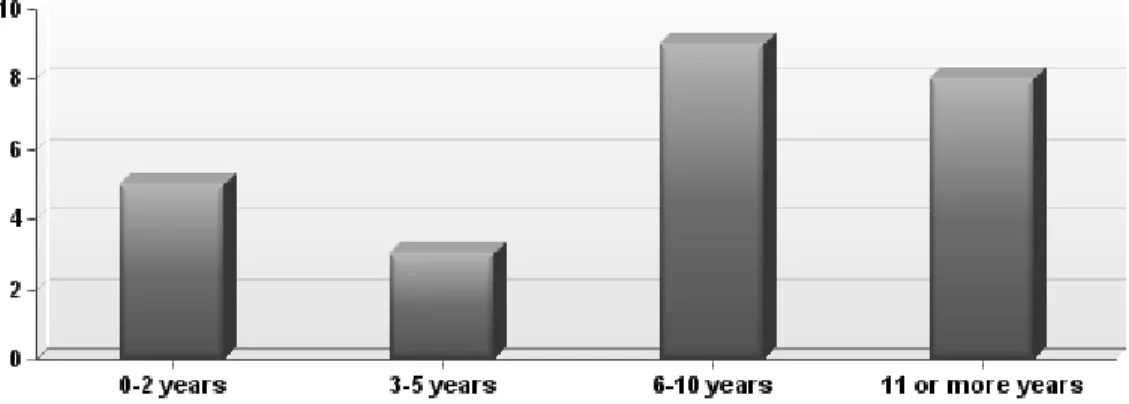
Nine participants(36%, n=9/25) reported having worked in their current libraries
for six to10 years. Eight participants (32%) reported 11 or more years, five participants
(20%) reported zero to two years, and three participants (12%) reported three to five
years. A majority of the participants (76%, n=19) responded that they also serve as the
primary contact librarian for programs other than veterinary medicine. Six participants
(24%) serve as primary contact librarians for DVM programs only.
In Gu's study, more than half of the dental librarians had worked in their current
librarians than veterinary librarians reported serving as primary contact librarians for
programs other than a Doctor of Dental Surgery (DDS) program (Gu, 2010, p. 15).
Figure 1: Number of years that the participants have worked in their current library.
See Also: Appendix A contains the complete questionnaire.
EBVM Educational Opportunities for DVM Students
Twenty-four out of 25 participants responded to the question regarding the kinds
of EBVM educational opportunities offered to DVM students at their respective
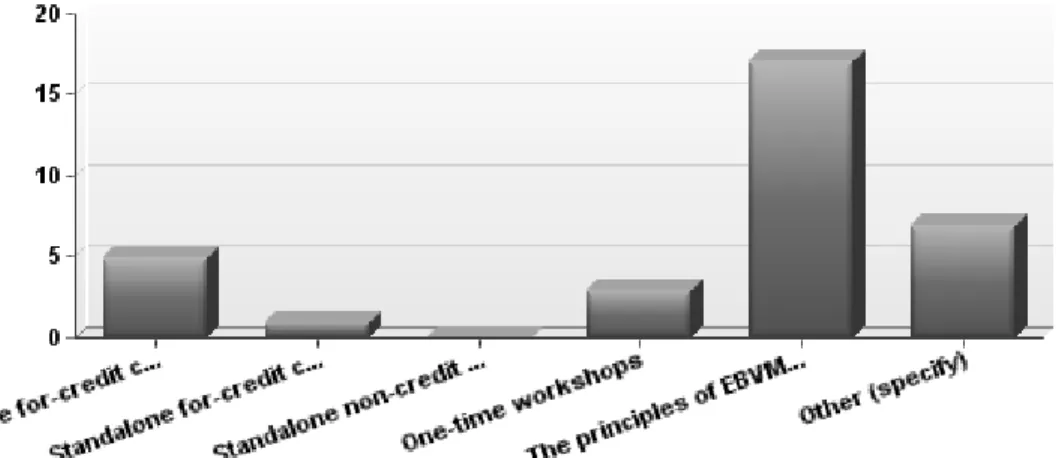
institutions. The most frequently cited educational opportunity was “the principles of
EBVM are integrated throughout the curriculum” (71%, n=17/24). One-time workshops
were the least cited with three participants (13%) reporting this as an option for DVM
students.Six participants (25%) reported that standalone EBVM courses are available at
their institution, with five respondents reporting “standalone for-credit course
(selective)”, one respondent reporting “standalone for-credit course (elective)” and no
respondents reporting “standalone non-credit course”. Respondents reporting a
standalone EBVM course offering at their institution were then asked if students were
“no”, and one answered “do not know”. Seven respondents (29%) also cited “other
(specify)”, but no additional educational opportunities were identified after content
analysis.
Similar results were reported in Gu's study. The majority of dental librarians in
Gu's study cited an integration of EBD principles throughout the curriculum (Gu, 2010,
p. 16). However, a larger percentage of dental librarians than veterinary librarians
reported that students were required to take standalone EBD courses when offered (Gu,
2010, p. 16).
Figure 2: EBVM educational opportunities available for DVM students.
Librarian Roles in Teaching EBVM Courses
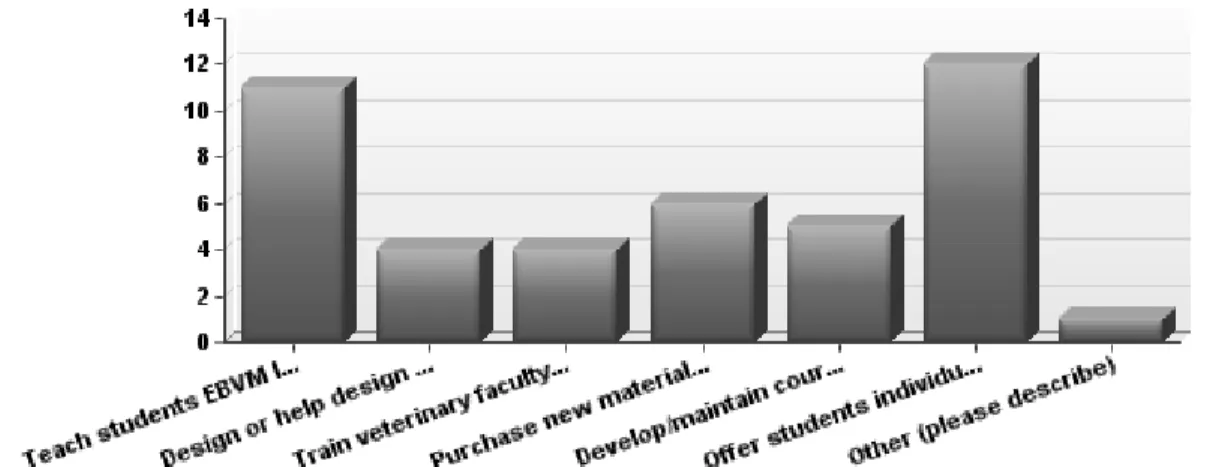
A majority of the participants (52%, n=13/25) indicated that they are involved in
teaching EBVM to veterinary students. The most frequently cited response was “offer
students individual or group consultations upon request (92%, n=12/13). This was closely
followed by “teach students EBVM literature searching skills” (85%, n=11/13). Other
reported roles included “design or help design course syllabus” (31%, n=4/13), “train
materials or maintain specific materials to support the course” (46%, n=6/13), and
“develop/maintain course-tailored instructional materials” (38%, n=5/13). One
participant reported that they “serve on curriculum committee”.
Similarly, a majority of participating dental librarians in Gu's study indicated their
involvement in teaching EBD courses (Gu, 2010, p. 17). The most frequently cited roles
were also similar, with 97% of those involved in teaching EBD courses citing "teaching
students EBD literature searching skills" and 88% citing "offering students individual or
group consultations upon request" (Gu, 2010, p. 17).
Figure 3: Librarian roles in teaching EBVM to veterinary students.
Librarian Involvement in Other EBVM Services
Twenty-four out of 25 participants responded to the question regarding the
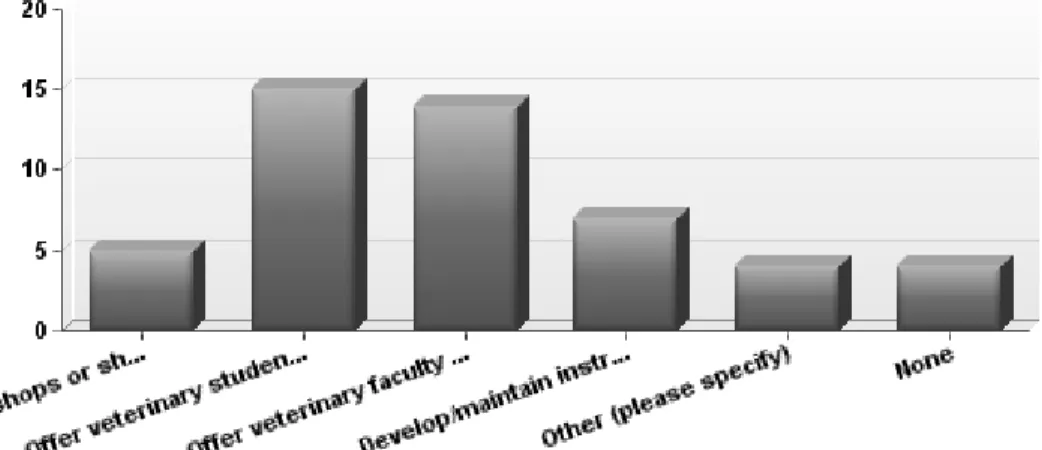
provison of other services related to EBVM. The most frequently cited service was “offer
veterinary students consultations on EBVM literature searching skills upon request”
(63%, n=15/24). This was closely followed by “offer veterinary faculty consultations on
EBVM literature searching skills upon request” (58%, n=14/24). Respondents also cited
and “develop/maintain instructional materials” (29%, n=7/24). Four participants indicated
that they have no involvement in other services related to EBVM. Additional EBVM
services reported by respondents included 1) giving EBVM talks at veterinary
conferences and 2) providing an EBM session in a required clinical course.
The two most cited services by veterinary librarians were also the most cited
services by dental librarians (Gu, 2010, p. 18). However, approximately half of the
participating dental librarians responded that they developed or maintained instructional
materials (Gu, 2010, p. 18).
Figure 4: Librarian involvement in EBVM beyond teaching courses.
Frequency of EBVM Literature Search Assistance
Ten respondents (42%, n=10/24) reported that they assisted students with EBVM
literature searching at least once or twice a year. Three respondents (13%, n=3/24)
reported that they assisted at least once or twice a month. Eleven respondents (46%,
n=11/24) reported that they never assisted DVM students with EBVM literature
Respondents reported similar frequencies of assisting veterinary faculty with
EBVM literature searching. Nine respondents (38%, n=9/24) reported that they assisted
at least once a year, four respondents (17%, n=4/24) reported that they assisted at least
once or twice a month, and one respondent reported at least once or twice a week. Ten
respondents (42%, n=10/24) reported that they had never assisted veterinary faculty with
EBVM literature searching.
In Gu's study, 52% of the participating dental librarians indicated that they
assisted DDS students with literature searching at least once or twice a year and 57%
indicated that they assisted dental faculty with literature searching at least once or twice a
year (Gu, 2010, p. 19).
Competency in Providing EBVM Services
A majority of the participants (63%, n=15/24) felt competent in providing EBVM
services. Of those who indicated that they did not feel competent in providing EBVM
services, a content analysis of the open responses revealed that five respondents noted a
lack of hands-on experience.Two cited a lack of knowledge, one cited competence in
teaching general searching skills but did not feel qualified to teach critical appraisal, and
one felt reasonably qualified in providing EBVM services.
Similarly, a majority of dental librarians reported feeling competent in providing
EBD services (Gu, 2010, p. 20). All dental librarians who responded that they did not feel
competent also noted that they lacked enough hands-on experience (Gu, 2010, p. 20).
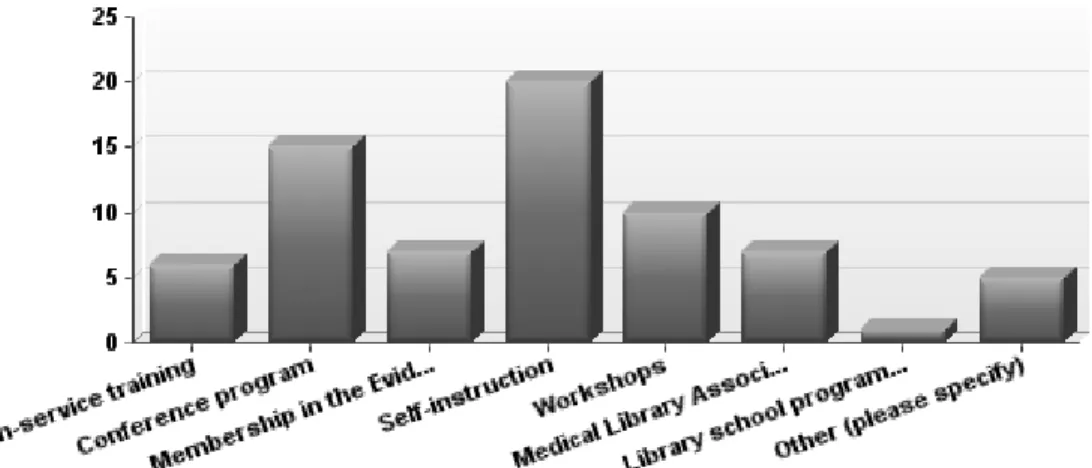
Methods to Gain EBVM Knowledge
Twenty-four out of 25 participants answered the question regarding methods used
n=20/24), followed by the use of conference programs (63%, n=15/24) and workshops
(42%, n=1-/24). Respondents also cited in-service training (25%, n=6/24), membership in
the Evidence-Based Veterinary Medicine Association (EBVMA) Libraries’ group (29%,
n=7/24), use of Medical Library Association (MLA) Continuing Education (29%,
n=7/24), and one respondent cited library school programs. Participants indicated other
sources of EBVM knowledge, including EBVMA membership, collaboration with other
health sciences librarians, and previous experience with or knowledge of EBM. Likewise,
dental librarians most frequently cited self-instruction as a method of gaining EBD
knowledge (Gu, 2010, p. 20).
Figure 5: Methods used by librarians to gain EBVM knowledge.
Barriers to Involvement in EBVM Education
Lack of interest from veterinary students and faculty
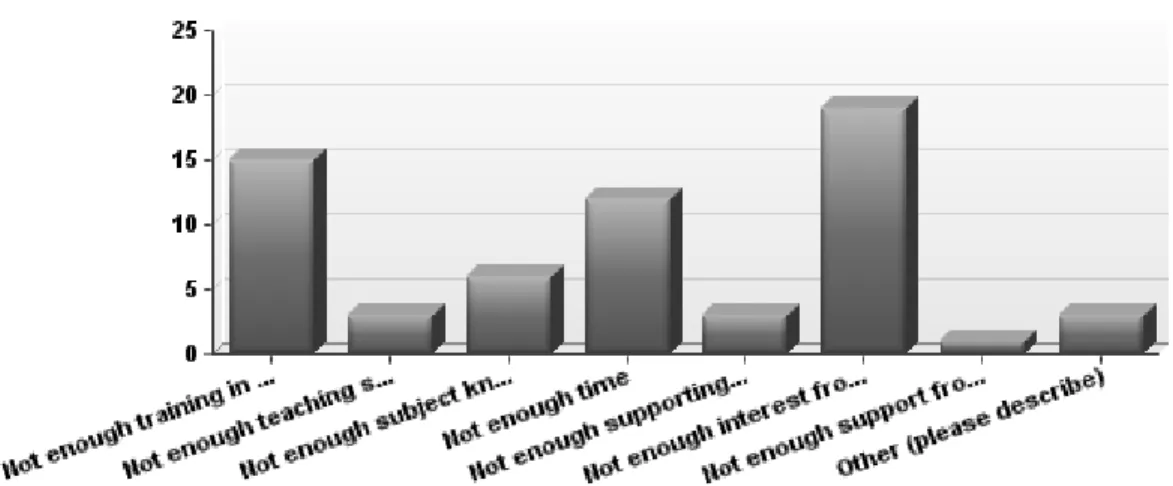
Twenty-four out of 25 participants answered the question regarding barriers to
desired level of involvement in EBVM education. The most frequently cited barrier was
“not enough interest from the veterinary school or veterinary faculty” (79%, n=19/24),
the open-ended response question provided at the end of the survey. All three respondents
mentioned that the veterinary profession does not seem to place the same emphasis on
EBVM education as human medical schools place on EBM education. Two of these
respondents also noted that there is little high-level evidence in EBVM when compared
to EBM, and one respondent suggested that EBVM education is not considered a priority
by veterinarians. Similarly, lack of interest from dental school or faculty was the most
frequently cited barrier by participating dental librarians (Gu, 2010, pg. 21).
Figure 6: Barriers to librarian involvement in EBVM education.
Lack of training in EBVM skills
Fifteen respondents indicated that “not enough training in EBVM” was a barrier.
Six respondents cited “not enough subject knowledge” and three cited“not enough time”
as barriers to their level of involvement in EBVM education. Three participants also
indicated that “not enough teaching skills” was a barrier as well. When compared to the
results found in Gu's study concerning dental librarians' desired level of involement,
veterinary librarians were less likely than dental librarians to indicate that teaching skills
Veterinary curriculum
One participant noted that the crowded veterinary curriculum is a barrier to
librarian involvement in EBVM education. In the final open-ended response, three
participants had similar comments. One respondent noted that there is a “lack of
information infrastructure supporting EBVM”. Two participating dental librarians made
similar comments about the crowded dental school curriculum in Gu's open-ended
response question (Gu, 2010, p. 23).
Other barriers
Respondents also cited other barriers, including “not enough supporting staff”,
and “not enough support from library administration in professional development”
(Figure 6).
Perceptions of EBVM
Twelve participants responded to the final open-ended response question. Their
comments demonstrated a passion for and commitment to promoting EBVM education.
One participant commented that their institution was “conscious of the need for EBVM
thinking in their didactic instruction”. Six responses specifically indicated that EBVM is
currently not as integrated into veterinary medicine as EBM is into human medicine. One
participant commented on the importance of librarians receiving training in EBVM skills
in order to better assist students and faculty, as “they are the ones who are in the best
Discussion
EBVM Survey Results
Study participants came from 25 different institutions. Twenty-one participants
were from the U. S. and 4 participants were from Canada. As there are 28
AVMA-accredited institutions that offer the DVM program in the U. S. and five in Canada, this
study can be seen as representative of the veterinary profession in North America.
More than half of the participants have worked for more than six years at their
current library. Many of the participants also indicated that they serve as the primary
contact librarian for programs other than DVM. A majority of the respondents participate
in EBVM education and feel competent in providing EBVM-related services. Of those
that participate in teaching EBVM to veterinary students, many teach students EBVM
literature searching skills during EBVM courses well as offer individual or group
consultations upon request.
Besides being involved in teaching, veterinary librarians also fulfill other roles
including the development and maintenance of instructional materials, individual student
and faculty assistance in EBVM literature searching skills, and serving on curriculum
committees. Veterinary librarians also provide EBVM related services that are not
necessarily connected to an EBVM course offering. A majority of the participants offer
both veterinary students and faculty consultations in EBVM literature searching skills
The current study found that the most cited barrier to desired level of involvement
in EBVM by veterinary librarians was “not enough interest from the veterinary school or
veterinary faculty”. This low level of interest may explain the low frequency of EBVM
consultation requests. Despite a majority of veterinary librarians offering individual
consultations, the most reported frequencies were “never” and “once or twice a year”.
Another barrier is a lack of training in EBVM skills. Both veterinarians and
veterinary librarians need to develop new skills to implement EBVM (Scherrer &
Dorsch, 1999). This suggests that continuing education opportunities need to be
developed for veterinary librarians. The majority of participants cited self-instruction as a
method used to gain knowledge of EBVM.
The veterinary profession has discussed potential barriers to the acceptance and
practice of EBVM, including a smaller literature base to draw from in comparison to
EBM and a lack of training in EBVM skills (Cockcroft & Holmes, 2003; Evidence-Based
Veterinary Medical Association, 2010). Additionally, a recent pilot study suggests that
practicing veterinarians themselves have positive attitudes towards EBVM but various
barriers may prevent them from implementing it in practice (McKenzie, 2011).
Veterinary librarians who participated in the current study mentioned these
obstacles identified by veterinary professionals. This suggests that veterinary librarians
are up-to-date with the current status of EBVM in the veterinary profession.
Interest in EBVM is growing within the veterinary profession. Several of the
respondents cited the existence of standalone courses in EBVM being offered at their
institutions. While the majority of veterinary librarians felt competent in EBVM, many
because of the veterinary profession's continuing interest in EBVM, veterinary librarians
may want to consider the development of EBVM continuing education opportunities.
Surveys of EBVM and EBD Librarians: A Comparison
A striking similarity between the results of the current study and Gu’s study is
that the most cited barrier to involvement in EBVM or EBD for both veterinary librarians
and dental librarians was a low level of interest from students and faculty, despite a
majority of both groups offering individual consultations upon request (Gu, 2010). There
were several other similarities, including: 1) a crowded curriculum, 2) a lack of training
in EBD or EBVM skills, 3) most cited methods used to gain EBD or EBVM knowledge,
4) reported competency in providing EBD or EBVM services, and 5) involvement in
teaching EBD or EBVM to students (Gu, 2010).
Several differences also exist between the results of the two studies. A majority of
dental librarians had worked in their current library for more than 11 years. A larger
percentage of dental librarians than veterinary librarians reported that teaching skills and
subject knowledge was a barrier. Additionally, a larger percentage of dental librarians
reported that students were required to take offered EBD courses (Gu, 2010).
Similarities may be related to a number of factors. Both EBD and EBVM have
similar obstacles to implementation being discussed in their respective professions. There
appears to be a “lack of high-quality evidence from high-quality clinical trials” (Gu,
2010). A participant in the current study similarly noted that “there’s so little high-level
Limitations
This study has several limitations. The results of this survey are based on
veterinary librarians reporting on their own involvement in EBVM education. It would be
beneficial for future studies to gather data on how veterinary students and faculty
perceive the roles of librarians in EBVM education. Another possible limitation is that
multiple choice questions can restrict responses or influence a participant’s thinking
process. Optional text entry answers were provided when applicable. The survey also
concluded with an open-ended response question to allow participants to include
Conclusion
Twenty-five veterinary librarians from 32 different institutions in the U. S. and
Canada participated in this study. Despite a low level of interest in EBVM from some
veterinary schools and students, veterinary librarians are committed to supporting EBVM
and are actively pursuing additional educational opportunities for themselves in EBVM
skills. In the majority of the participants’ institutions, the librarians felt competent in their
provision of EBVM services, while also serving in other roles. Veterinary librarians are
cognizant of the challenges facing their involvement in EBVM education and are
enthusiastically pursuing multiple avenues for involvement. Similarities were found
between the results of the current study and Gu’s 2010 study of dental librarian
involvement in EBD education, suggesting that perhaps similar training opportunities
References
American Veterinary Medical Association. (2011). Veterinary Colleges Accredited by the
AVMA. Retrieved July 22, 2010 from
http://www.avma.org/education/cvea/colleges_accredited/colleges_accredited.asp
Anderson, K., Toews, L., & Johnson, D. (2008). Roles of librarians in advancing
evidence-based veterinary medicine. Poster Presentation at the Evidence-based
Veterinary Medicine Association 3rd Symposium, Athens, GA.
Bradley, D. R., Rana, G. K., Martin, P. W., & Schumacher, R. E. (2002). Real-time,
evidence-based medicine instruction: A randomized controlled trial in a neonatal
intensive care unit. Journal of the Medical Library Association, 90(2), 194-201.
Brown, J. F., & Nelson, J. L. (2003). Integration of information literacy into a revised
medical school curriculum. Medical Reference Services Quarterly, 22(3), 63-74.
Cockcroft, P. D., & Holmes, M. A. (2003). Handbook of evidence-based veterinary
medicine. Malden, MA: Blackwell Publishing.
Cook, D. J., Jaeschke, R., & Guyatt, G. H. (1992). Critical appraisal of therapeutic
interventions in the intensive care unit: Human monoclonal antibody treatment in
Eldredge, J. D. (2000). Evidence-based librarianship. Medical Reference Services
Quarterly, 19(3), 1-18.
Evidence-Based Medicine Working Group. (1992). Evidence-based medicine. A new
approach to teaching the practice of medicine. Journal of the American Medical
Association, 268(17), 2420-2425.
Evidence-Based Veterinary Medicine Association. (2010). Our history. Retrieved August
2, 2010 from http://www.ebvma.org/
Fajt, V. R., Brown, D., & Scott, M. M. (2009). Practicing the skills of evidence-based
veterinary medicine through case-based pharmacology rounds. Journal of Veterinary
Medical Education, 36(2), 186-195.
Garcia, J. L., & Wells, K. K. (2009). Knowledge-based information to improve the
quality of patient care. Journal for Healthcare Quality, 31(1), 30-35.
Geyer, E. M., & Irish, D. E. (2008). Isolated to integrated: An evolving medical
informatics curriculum. Medical Reference Services Quarterly, 27(4), 451-461.
Gray, G. E., & Pinson, L. A. (2003). Evidence-based medicine and psychiatric practice.
Psychiatric Quarterly, 74(4), 387.
Gu, X. (2010). Librarians’ roles in evidence based dentistry education in the U.S. and
Canada. (Unpublished Masters). University of North Carolina at Chapel Hill,
http://dc.lib.unc.edu/cdm4/item_viewer.php?CISOROOT=/s_papers&CISOPTR=11
72&CISOBOX=1&REC=1
Haines, M. (1994). Evidence-based practice: New opportunities for librarians. Health
Libraries Review, 11(4), 221-225.
Hardin, L. E., & Robertson, S. (2006). Learning evidence-based veterinary medicine
through development of a critically appraised topic. Journal of Veterinary Medical
Education, 33(3), 474-478.
Kastelic, J. P. (2006). Critical evaluation of scientific articles and other sources of
information: An introduction to evidence-based veterinary medicine.
Theriogenology, 66(3), 534-542.
Keene, B. W. (2000). Towards evidence-based veterinary medicine. Journal of
Veterinary Internal Medicine., 14(2), 118-119.
Kok, V. T., & Lee, J. C. (1998). Establishment of bibliographic instruction as an
independent course in a veterinary medical college. Proceedings of the Second
International Conference of Animal Health Information Specialists, Frederiksberg,
Denmark. 22-26.
Kronenfeld, M., Stephenson, P. L., Nail-Chiwetalu, B., Tweed, E. M., Sauers, E. L.,
McLeod, T. C., ... Ratner, N. B. (2007). Review for librarians of evidence-based
practice in nursing and the allied health professions in the United States. Journal of
McKenzie, B. (2011). Practitioner Survey: Evidence-Based Veterinary Medicine
Association. Evidence Based Veterinary Medicine Association. Retrieved from
http://ebvma.org/sites/default/files/EBVMA_Practitioner_Survey-McKenzie-2011.pdf
McKibbon, K., & Bayley, L. (2004). Health professional education, evidence-based
health care, and health sciences librarians. Reference Services Review, 32(1), 50-53.
Olmstadt, W., Foster, C. L., Burford, N. G., Funkhouser, N. F., & Jaros, J. (2001).
Clinical veterinary librarianship: The Texas A & M University experience. Bulletin
of the Medical Library Association, 89(4), 395-397.
Pelzer, N. L., & Wiese, W. H. (2006). Veterinary medical libraries in the 21st century.
Retrieved from http://www.lib.iastate.edu/services1/ref/VetMedLib.pdf
Pelzer, N. L., Wiese, W. H., & Leysen, J. M. (1998). Library use and information-seeking
behavior of veterinary medical students revisited in the electronic environment.
Bulletin of the Medical Library Association, 86(346), 355.
Roper, T. (1998). Evidence-based medicine. Veterinary Record., 143(23), 644.
Rose, S. (1998). Challenges and strategies in getting evidence-based practice into primary
health care—what role the information professional? Health Libraries Review,
15(3), 165-174.
Scherrer, C., & Dorsch, J. (1999). The evolving role of the librarian in evidence-based
Schmidt, P. L. (2007). Evidence-based veterinary medicine: Evolution, revolution, or
repackaging of veterinary practice? The Veterinary Clinics of North America. Small
Animal Practice., 37(3), 409-417.
Thomson, J. U. (2004). The building blocks in the professional education process that
lead to best practices and quality medicine. Journal of Veterinary Medical
Education., 31(1), 1-6.
Whitaker, S. (2009). An Evidence-Based Medicine Bibliography. Retrieved July 21,
2010, from http://www.ebvma.org/?q=node/590
List of Figures
Figure 1: Number of years that the participants have worked in their current library... 14
Figure 2: EBVM educational opportunities available for DVM students. ... 15
Figure 3: Librarian roles in teaching EBVM to veterinary students. ... 16
Figure 4: Librarian involvement in EBVM beyond teaching courses. ... 17
Figure 5: Methods used by librarians to gain EBVM knowledge. ... 19
Appendix
Appendix A. Roles for Librarians in EBVM: Survey Questions
How long have you been working in your current library? __0-2 years
__3-5 years __6-10 years __11 or more years
Do you also serve as the primary contact librarian for programs other than veterinary medicine within your institution?
____Yes ____No
Now I will ask you some questions about your involvement with Evidence-Based Veterinary Medicine Education.
Which of the following EBVM educational opportunities are available for veterinary students in your institution?
___Standalone for-credit course (selective) ___Standalone for-credit course (elective) ___Standalone non-credit course
___One-time workshops
___The principles of EBVM are integrated throughout the curriculum ___Other (specify)
Are the EBVM students in your institution required to take the standalone EBVM course?
Note: Only asked if answered yes to standalone course.
___Yes ___No
___Do not know
Are you involved in teaching EBVM to veterinary students in your institution? ___Yes
___No
Note: Only asked if answered yes to previous question.
___Teach students EBVM literature searching skills ___Design or help design course syllabus
___Train veterinary faculty on EBVM literature searching
___Purchase new materials or maintain specific materials to support the course ___Develop/maintain course-tailored instructional materials
___Offer students individual or group consultations upon request ___Other (please describe)
Do you provide any other services related to EBVM? Please select all that apply. ___Offer workshops or short classes on EBVM literature searching skills
___Offer veterinary students consultations on EBVM literature searching skills upon request
___Offer veterinary faculty consultations on EBVM literature searching skills upon request
___Develop/maintain instructional materials ___Other (please specify)
___None
How often do you assist veterinary students with EBVM literature searching? ___Never
___At least once or twice a year ___At least once or twice a month ___At least once or twice a week
___More often than once or twice a week
How often do you assist veterinary faculty with EBVM literature searching related to instruction?
___Never
___At least once or twice a year ___At least once or twice a month ___At least once or twice a week
___More often than once or twice a week
How often do you assist veterinary faculty with EBVM literature searching related to their own clinical work?
___Never
___At least once or twice a year ___At least once or twice a month ___At least once or twice a week
___More often than once or twice a week
Do you feel competent providing EBVM-related services? ___Yes
Finally, we will ask you some questions about your training and perspectives on Evidence Based Veterinary Medicine (EBVM).
What method have you used to gain knowledge on EBVM? Please choose all that apply. ___In-service training
___Conference program
___Membership in the Evidence Based Veterinary Medicine Association Libraries' group ___Self-instruction
___Workshops
___Medical Library Association (MLA) Continuing Education ___Library school programs
___Other (please specify)
Please indicate which, if any, of the following pose barriers to your desired level of involvement in EBVM education in your institution. Please choose all that apply. ___Not enough training in EBVM
___Not enough teaching skills ___Not enough subject knowledge ___Not enough time
___Not enough supporting staff
___Not enough interest from the veterinary school or veterinary faculty
___Not enough support from library administration in professional development ___Other (please describe)
APPENDIX B: FIRST EMAIL
Dear {FirstName},
I would like to invite you to participate in a research study on the role of librarians in evidence-based veterinary medicine (EBVM) education. I am currently pursuing an MSLS degree at the School of Information and Library Science at University of North Carolina at Chapel Hill (UNC-CH). I am conducting this research study for my Master's Paper and have a strong interest in veterinary librarianship.
The research study's objectives are as follows:
a. To describe U.S. and Canadian veterinary librarian's perception and
knowledge of evidence-based veterinary practice.
b. To describe if and how they are involved in EBVM education for veterinary
faculty and students.
I will be emailing the survey to you this week and it should take about 5 minutes to complete.
Your responses to this survey will be kept strictly confidential and only aggregate data will be shared. No individual responses will be identified.
Researcher: Amanda Rowley Vinogradov [email protected] Supervisor: Dr. Joanne Marshall, Faculty Advisor [email protected] Sincerely,
APPENDIX C: SECOND EMAIL
Dear ${m://FirstName},I would like to ask you to participate in a research study about the role of librarians in supporting evidence-based veterinary medicine education. I am a student from the University of North Carolina at Chapel Hill, completing my Master’s degree from the School of Information and Library Science. I am conducting this study for my Master’s paper under the supervision of Dr. Joanne Marshall.
Your participation in this survey is completely voluntary.
The purpose of this research study survey is to look at the roles of librarians in evidence-based veterinary medical education. By sharing your experiences and opinions, you will contribute to a greater understanding of the role of librarians in EBVM education. This understanding could lead to the development of future continuing education opportunities for veterinary librarians. We estimate that approximately 30 people will enroll in this study.
You cannot return to previous pages after you click the submit button found on each page. If you are interrupted or need a break, you can resume the survey at a later time by clicking on the link found in this email.
Follow this link to the Survey: ${l://SurveyLink?d=Take the Survey}
Or copy and paste the URL below into your internet browser: ${l://SurveyURL}
Follow the link to opt out of future emails: ${l://OptOutLink}
Responding to the survey indicates your consent to participate in the study. You don’t have to answer any questions that you don’t feel like answering. You can choose to not answer any question at any time for any reason. Your responses will be kept strictly confidential and only aggregate data will be shared. No individual responses will be identified. There are no anticipated risks or benefits to you. However, there will be benefits to society in general.
Summaries of the study results will be available in my Masters Paper, which will be accessible from http://sils.unc.edu/itrc/mpi/after I graduate.
All research on human volunteers is reviewed by a committee at UNC that works to protect your rights and welfare. If you have questions or concerns about your rights as a research subject you may contact, anonymously if you wish, the Institutional Review Board at 919-966-3113 or by email to [email protected].
Thank you,
APPENDIX D: THIRD EMAIL
Dear ${m://FirstName},
I'm writing to remind you of the unique research study I am conducting on the role of librarians in evidence-based veterinary medicine education. I would like to encourage you to participate in the study and respond to the survey as soon as possible. Your participation in this survey is completely voluntary.
The purpose of this research study survey is to look at the roles of librarians in evidence-based veterinary medicine education. By sharing your experiences and opinions, you will contribute to a greater understanding of the role of librarians in EBVM education. This understanding could lead to the development of future continuing education opportunities for veterinary librarians. We estimate that approximately 30 people will enroll in this study.
You cannot return to previous pages after you click the submit button found on each page. If you are interrupted or need a break, you can resume the survey at a later time by clicking on the link found in this email.
Follow this link to the Survey: ${l://SurveyLink?d=Take the Survey}
Or copy and paste the URL below into your internet browser: ${l://SurveyURL}
Follow the link to opt out of future emails: ${l://OptOutLink}
Responding to the survey indicates your consent to participate in the study. You don’t have to answer any questions that you don’t feel like answering. You can choose to not answer any question at any time for any reason. Your responses will be kept strictly confidential and only aggregate data will be shared. No individual responses will be identified. There are no anticipated risks or benefits to you. However, there will be benefits to society in general.
You can also call me at 479-264-3656 with questions about the research study. Summaries of the study results will be available in my Masters Paper, which will be accessible from http://sils.unc.edu/itrc/mpi/after I graduate.
protect your rights and welfare. If you have questions or concerns about your rights as a research subject you may contact, anonymously if you wish, the Institutional Review Board at 919-966-3113 or by email to [email protected].
Thank you,
APPENDIX E: FOURTH EMAIL
Dear ${m://FirstName},
I'm writing to remind you of the unique research study I am conducting on the role of librarians in evidence-based veterinary medicine education. I would like to encourage you to participate in the study and respond to the survey as soon as possible. This survey will be closed by 12:00 pm (Central Standard Time) Friday, March 3rd. Your
participation in this survey is completely voluntary.
The purpose of this research study survey is to look at the roles of librarians in evidence-based veterinary medicine education. By sharing your experiences and opinions, you will contribute to a greater understanding of the role of librarians in EBVM education. This understanding could lead to the development of future continuing education opportunities for veterinary librarians. We estimate that approximately 30 people will enroll in this study.
You cannot return to previous pages after you click the submit button found on each page. If you are interrupted or need a break, you can resume the survey at a later time by clicking on the link found in this email.
Follow this link to the Survey: ${l://SurveyLink?d=Take the Survey}
Or copy and paste the URL below into your internet browser: ${l://SurveyURL}
Follow the link to opt out of future emails: ${l://OptOutLink}
Responding to the survey indicates your consent to participate in the study. You don’t have to answer any questions that you don’t feel like answering. You can choose to not answer any question at any time for any reason. Your responses will be kept strictly confidential and only aggregate data will be shared. No individual responses will be identified. There are no anticipated risks or benefits to you. However, there will be benefits to society in general.
You can also call me at 479-264-3656 with questions about the research study. Summaries of the study results will be available in my Masters Paper, which will be accessible from http://sils.unc.edu/itrc/mpi/after I graduate.
All research on human volunteers is reviewed by a committee at UNC that works to protect your rights and welfare. If you have questions or concerns about your rights as a research subject you may contact, anonymously if you wish, the Institutional Review Board at 919-966-3113 or by email to [email protected].
Thank you,