Advisor: Joanne Gard Marshall.
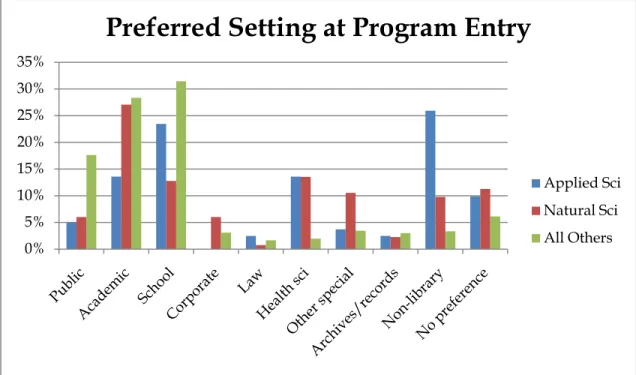
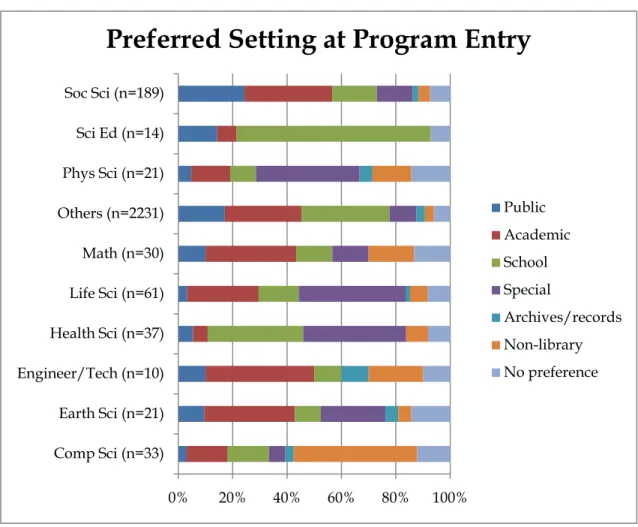
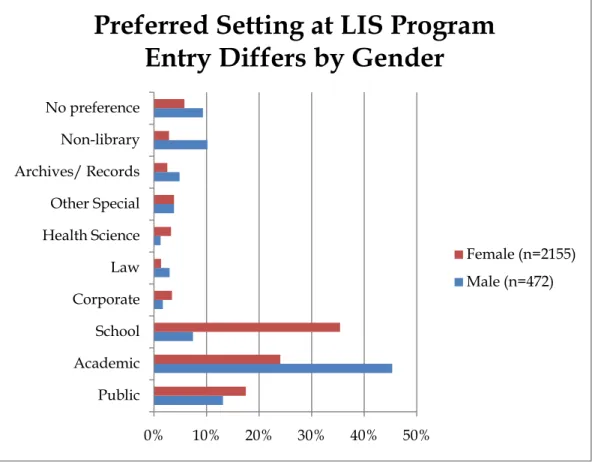
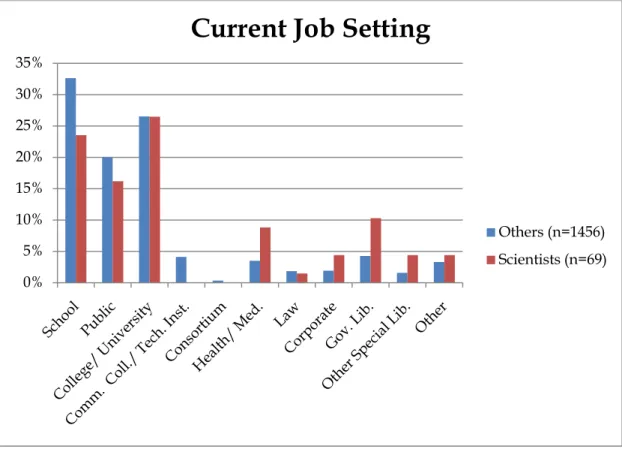
Why might someone with science training pursue an information career? This secondary analysis of the Workforce Issues in Library and Information Science (WILIS) study compares those who earned a natural science degree prior to the LIS program with others who did not. The results point to more similarities than differences. All LIS graduates showed broad agreement on job motivations, values, and satisfaction; however, some differences were found. Science majors were less interested in school libraries and more in special libraries. Scientists were more likely to self-identify as “information
professional” alone or in tandem with “librarian” and more likely to cite computer interest as one motivation. Science graduates were significantly more likely to claim responsibilities for academic research and publications, database development, and “other” IT and consulting. Very few entrants to LIS programs have science degrees, but the potential exists to attract more.
Headings:
Surveys/Librarians Librarians/Careers
Librarianship as a profession Special librarianship
FROM SCIENCE TO LIBRARIANSHIP: CAREER MOTIVATIONS OF THE SCIENTIST-TURNED-LIBRARIAN
by
Shannon A. Walker
A Master’s paper submitted to the faculty of the School of Information and Library Science of the University of North Carolina at Chapel Hill
in partial fulfillment of the requirements for the degree of Master of Science in
Library Science.
Chapel Hill, North Carolina April 2010
Approved by
Acknowledgements
It is rare that one manages to engage in a voyage of personal discovery and academic research at the same time. I have been very fortunate in this project to have done so, and to have received tremendous support from a number of individuals past and present that brought me to this place. Some but not all of these individuals are associated with the School of Information and Library Science (SILS).
I was introduced to the Workforce Issues in Library and Information Science (WILIS) project as Graduate Research Assistant for SILS Professor Joanne Gard Marshall at the UNC Institute on Aging. I cannot begin to thank her enough for her willingness to provide me with substantive assignments in that role and for her nourishment of my growth as a professional. I know that dealing with a strong-willed individual such as myself can be a real challenge, and we have had many stimulating conversations!
The WILIS team has gone the extra mile for me personally and professionally, and I thank them all. Susan Rathbun-Grubb endured my vacillations and ruminations and provided inspirations. Jennifer Craft Morgan introduced me to qualitative methodologies and exhibited a refreshing Zen-like calm in the midst of chaos. Cheryl Thompson proved that the little things really do add up to something big; I hope she knows she isn’t taken for granted. Deborah Barreau took the role of advisor to a new level, and I thank her.
could also never have happened without significant funding and a strong research team. The WILIS 1 and 2 studies were supported by grants from the Institute of Museum and Library Services (IMLS). The primary research team from the School of Information and Library Science at UNC Chapel Hill and the UNC Institute on Aging consisted of Joanne Gard Marshall, Lead Principal Investigator; Victor W. Marshall, Co-Principal
Investigator; Jennifer Craft Morgan, Principal Investigator; Deborah Barreau, Co-Investigator; Barbara Moran, Co-Co-Investigator; Paul Solomon, Co-Co-Investigator; Susan Rathbun-Grubb, Graduate Research Assistant; and Cheryl A. Thompson, Project Manager.
My choice of topic for this work was inspired as much by navel-gazing as by
academic rigor. Thirteen years ago I was a chemistry graduate looking for direction, and UT Chattanooga professor Tom Rybolt put me in contact with Virginia Brown at
Chattem, who took a chance and offered me a job as a solo librarian. She went on to serve as mentor and friend even after I moved to other roles within the company and beyond. She has seen me go from scientist to librarian to various iterations of scientist and now back to librarian again, and I’d like to thank her for her wit and her grit over the years.
Contents
Acknowledgements ... 1
Contents ... 3
Introduction ... 4
Background ... 5
Purpose of this analysis ... 11
Data source ... 11
Research questions ... 12
Methods... 13
Research design ... 13
Data subset ... 14
Data analysis ... 15
Analysis Results and Commentary ... 17
Demographics ... 17
Degree earned: Scientific specialization ... 21
Degree earned: MLS/LIS versus IS ... 23
A caveat about the “prior” job ... 25
Supporting self and family: Linked lives and shared security ... 26
Practical considerations in transition ... 36
LIS as a profession: Exposure and opinions ... 38
Work environment ... 45
Social/belongingness needs, social good, and service ... 48
Personal accomplishment/growth/advancement ... 56
Intrinsic rewards: applying skills/interests ... 61
Technology ... 63
Professional identity and job responsibilities ... 66
Job setting ... 71
Job and career satisfaction ... 92
Discussion of Common Themes and Implications ... 94
Summary of findings ... 94
Analysis limitations and suggestions for further research ... 98
Conclusion ... 101
Works Cited ... 103
Introduction
“Many students, particularly women—for whom job opportunities in the sciences are usually not as attractive as for men—may find careers in the literature of chemistry more rewarding and interesting than careers in the laboratory." (Waddington, 1962, p. 196)
“The shortage of science librarians, however, is not a new phenomenon. There has been a shortage since the 1950s, or earlier, and yet the problem has still not been adequately resolved.” (Pellack, 2007, p. 55)
“Excellent interpersonal and communication skills, ability to work well with colleagues, enthusiasm for the profession, and management and leadership skills are essential to the librarian in the fast-changing world of library and information technology. Enlightened library administrators of the future will look for and prefer these capabilities, mindful that relevant knowledge about science can be learned. It is much more difficult to teach a new librarian how to work on a team or get along with his or her peers. Though some progressive sci/tech librarians and directors realize this, most have not yet adopted this view.” (Storm & Wei, 2007, p. 38)
(LIS)1 work? By learning the values and experiences of scientists who have already become librarians, we can get to the truth behind the stereotype of the scientist-turned-librarian. Should the truth prove worthy, perhaps such understanding could be used in recruiting others with science background to take this unconventional path to a rewarding career.
Background
The American Library Association (ALA) has noted a long-standing shortage of librarians with science, business, or engineering background, and others have noted that in the absence of improved recruiting the situation will only worsen due to an aging workforce. (Heim K. M., 1988; Kim, Chiu, Sin, & Robbins, 2007; Level & Blair, 2007) Nearly a third of physical science librarians responding to a survey conducted by Ortega and Brown (2005) had more than 20 years experience in the field, while another third had 11-20 years. Winston (2000) found that 60% of science-technology librarians were older than 45. In Hooper-Lane’s (1999) research, 46% of chemistry librarians claimed more than 11 years experience. In previous studies, only about 5-6% of library students held an undergraduate degree in science. (Brown L. B., 1988; Moen, 1988) The draw of science majors to specialized subject librarianship is strong but not automatic. While 47% of science librarians in Hackenberg’s (2000) study stated a desire to be a science librarian
because of subject background, interestingly, another 14% did not originally seek science library work but eventually reconsidered.
1
The high average age for librarians reflects in part the fact that many librarians enter the field as a second career. (Lipscomb, 2003) Career change is impacted by many variables, including dissatisfaction with the current career, anticipated benefits of a new career, and personal/family context. (Rhodes & Doering, 1983) Many previous studies of librarian career motivation comprised multiple-choice questionnaires of anticipated benefits for the field as a whole without putting them into context of personal history, personality preferences, and interpersonal needs. (Ard, et al., 2006; Gordon & Nesbeitt, 1999; Kim, Chiu, Sin, & Robbins, 2007; Matarazzo & Mika, 2006; Moen, 1988) Some researchers, however, have recognized that personality differences can influence the selection of different job settings (e.g., academic versus public), functions (children’s services versus cataloging), membership organizations (American Library Association [ALA], American Society for Information Science and Technology [ASIST], or the Special Libraries Association [SLA]), or degree type (library science [LS], library and information science [LIS], or information science [IS]); they have compared work values or job satisfaction across one or more of these different groups. (David & Scherdin, 1994; Duff, Cherry, & Singh, 2006; Scherdin, From children's, 1994; Scherdin, Librarians and information, 1994; Scherdin, Vive la difference, 1994; Williamson, Pemberton, & Lounsbury, 2005) Given that the typical science major shows different personality traits compared with the typical humanities major (Huang & Healy, 1997; Myers & Myers, 1995), one might expect that career motivation differs as well; some studies have compared work aspirations, values, and satisfaction by major. (Horn & Zahn, 2001)
included all those working in science libraries, not only those with science background. Second, almost all were distributed via listserv, limiting ability to generalize to those not active in such forums. Third, most exclude those science graduates who chose to work in other types of libraries, those who become “embedded” information workers less strongly identifying with LIS, or those who left the field entirely. Many researchers have
vigorously debated whether a science degree is absolutely necessary for science
librarianship, but they agree that domain knowledge, including continuing education, is beneficial for search performance and prestige/rapport with patrons. (Hallmark & Seidman, 1998; Krietz & Devries, 2007; Bowden & Olivier, 1995; Charton, 1992; Morris-Knower, 2001; Petersen & Kajiwara, 1999)
Those with science backgrounds are not only of use in subject specialized libraries. Patrons in all types of libraries have questions about the sciences. When such questions arise, librarians without much domain knowledge may face what Belkin (1980) called an anomalous state of knowledge, where they “don’t know what they don’t know.” As explained by one academic librarian who gave “bootstrap training” to humanities majors working the reference desk, “Fear of science can be exacerbated when non-science librarians work with non-science majors. Neither party has an extensive subject
background and neither may be able to formulate flexible search strategies.” (Petersen & Kajiwara, 1999) With training, non-specialists may adequately serve students,
Some researchers have examined factors motivating people to choose science librarianship. (Eells, 2007; Beck & Callison, 2007; Hackenberg, 2000; Hallmark & Lembo, 2003) Several studies have found that former scientists represent a far larger proportion of science librarians than the 5-6% of librarians as a whole, finding also that biologists and chemists are more represented than physicists and engineers. (Hallmark & Lembo, 2003; Hooper-Lane, 1999; Ortega & Brown, 2005; Winston, 2000)
As the rhetoric has asserted for some time, the well-paid sciences are not “job-starved disciplines like history, English, American Studies, and other departments than have an overload of graduates for the number of available positions.” (Ard, et al., 2006) In 1983 an Associate of Research Libraries (ARL) librarian with five years experience typically earned less than an entry-level (bachelor of science, BS) science job. (Bidlack, 1983) Yet the current picture may be more nuanced. Horn and Zahn’s (2001) longitudinal study found that salaries for both bachelor’s-only humanities and biology majors were significantly lower than the average bachelor’s-only salary five years after earning the degree. Financial prospects differed significantly by gender as well. While male scientists and mathematicians made healthy salaries, earnings for females with humanities and biology majors were low and comparable to one another.
Factor(s) other than salary seem to come into play in career change for scientists, as shown in several studies. Of science and engineering graduates out of college more than 5 years before taking the Graduate Record Exam (GRE) and presumably preparing to enter graduate studies, 0.8% were pursuing library science and only 61% were continuing in science. (Grandy, 1998) Those who left science (albeit mostly to pursue
interest to work with people. Leavers valued having a variety of tasks more but technical challenge and opportunities for advancement less than those who remained. Farmer, Wardrop, Anderson, & Risinger (1995) found that women most committed to career growth were most likely to leave science-related careers for other fields. Female science majors with greater self-efficacy and less perceived role conflict show higher career aspirations. (Nauta, Epperson, & Kahn, 1998)
Practicing librarians do not appear to be engaging sufficiently often or effectively in outreach to scientists, and this might adversely affect recruitment. Hallmark and Lembo (2003) found that “the most compelling, consistent theme running through the comments of scientists-turned librarians was that they had no idea that the LIS profession was so interesting, challenging, and enjoyable, nor were they aware of the revolution brought about by information technology.”
Two studies limited to former scientists who became librarians both relied on email discussion lists for recruitment. Former health scientists found that “going into medical librarianship allowed them to stay in the health care field but with better hours, better quality of life, more pleasant environment, less stress, and no patient care responsibility.” (Fikar & Corral, 2001) Of science librarians in another study, 67% of those with science degrees held only a bachelor’s, usually in chemistry or biology. Only a quarter had left science because they were dissatisfied with their previous career; most were “pulled” by positive qualities of librarianship such as autonomy, quality of work life, and the
Better understanding of career motivation can come from examining a wide range of career motivating factors for a large set of LIS graduates. Salary and basic job security are not enough; people have needs above and beyond survival and security, including social needs, esteem needs, and for some, the opportunity for self-actualization. (Maslow, 1970) In a classic article in the HARVARD BUSINESS REVIEW, Herzberg asserted that
improving work policies, salary, quality of management, and interpersonal interaction can only accomplish so much. Herzberg called such maintenance of the work
environment the fulfillment of “hygiene” needs that prevent dissatisfaction, bringing workers to a point of neutrality but not to a positive affect. Satisfied workers are
motivated by factors intrinsic to the job itself, such as opportunities for accomplishment and advancement, recognition of effort and a job well done, and the character of the work itself. (Herzberg, 1968)
Career values must also be balanced in context of the “linked lives” of family
members. (Marshall, Rathbun-Grubb, & Marshall, 2009) Family responsibilities and dual careers may place limits on working hours, travel, or relocation, which in turn can set bounds on realistic opportunities for compensation and advancement.
Factors influencing the decision to change career are reviewed by Rathbun-Grubb (2009) in a discussion of reasons people left librarianship; her analysis of occupational turnover is particularly salient as it is drawn from the same data set as this paper.
Purpose of this analysis
By studying the career patterns and motivations of scientists who became librarians, and by comparing/contrasting them with patterns for the “average” librarian (typically a liberal arts or education major), we can accomplish several goals. We can
• broaden perspective on the benefits of a career in librarianship,
• learn what aspects of librarianship specifically attract science graduates; and
• translate research into practice recruiting a diverse workforce of the future. This paper uses data from the Workforce Issues in Library and Information Science (WILIS) study conducted at the University of North Carolina at Chapel Hill from 2005-2009 under the direction of Joanne Gard Mashall, Principal Investigator. While prior studies have been weighted toward academic science librarians (of any undergraduate major) who participate in listservs, conducting a secondary analysis of WILIS data facilitated assessment of a wide variety of factors over a more diverse sample of science graduates with LIS degrees, including those who do not work in science libraries.
Data source
The WILIS study (Marshall, et al., 2009) surveyed librarians of all undergraduate majors who graduated from five North Carolina LIS master’s programs; the study was unique in that it targeted all alumni, including workers from all types of libraries and those who had left the library field altogether. The survey instrument was designed collaboratively by librarians and sociologists with expertise in workforce issues, helping to ensure validity. Extensive multiple-choice measures of career satisfaction and
educational background and position held before pursuing the LIS degree. A number of the WILIS measures were derived from the Workforce Aging in the New Economy (WANE) study, in which some of the WILIS investigators were involved. (McMullin & Marshall, 2010)
In the present supplemental analysis, respondents were coded for a binary variable which reflected at least one “pure science” degree (i.e., excluding applied sciences such as engineering, health science, or science education.) Further details are given in the Methods section which follows.
Research questions
The following research questions formed the focus of this analysis:
1. What are the similarities and the differences in factors motivating the decision to seek an LIS career for individuals holding undergraduate degrees in the natural sciences versus those who do not?
2. Which factors linked to anticipated and experienced job satisfaction were valued differently by scientists who became librarians?
Methods
Research design
The WILIS study had 2,653 respondents who received LIS degrees in North Carolina between 1964 and 2007, a 35% response rate. Invitation was via postal mail and email which provided the web address for the survey. Methodological details may be found in a toolkit (Workforce Issues in Library and Information Science Team, 2008) and in several articles devoted to the study appearing in a special issue of LIBRARY TRENDS.
(Marshall, Solomon, & Rathbun-Grubb, 2009)
The web-based survey was quite long, 98 pages when printed, and covered the following topics:
• Education (Section A)
• Career Outline (Section B)
• Job Detail (Sections C, D, E, F, G, H, I)
• Life and Work (Section J)
• Overall Career (Section K)
• Continuing Education (Section L)
• Future of LIS (Section N,M, P, Q, R)
Data subset
Specific degrees held were recorded in a series of questions, thus several variables in the survey could hold the free-text undergraduate major field. The author reviewed the full list of majors for each respondent and hand-coded each as a binary variable: presence or absence of a pure science degree earned prior to the LIS degree. In addition, a column was hand-coded to classify respondents who held a science degree by the type of science as given below.
During the first round of recoding, columns A11a-15a (holding the text response for each degree’s major) were examined; subjects were classified into the following
groupings: physical science, math, life science, earth science (including environmental science), and others. During the review/coding of the Degree: Highest Science column, potential science candidates were verified individually to exclude miscoded individuals (e.g., science education/educational technology marked not science.) Ambiguous cases were resolved in favor of scientific status (e.g. “biology/teaching cert” respondent with a BS degree was classified as life science since the student could have received dual degrees/double major.) Degrees pursued but with missing end dates were included. The science degree need not have been the degree immediately prior to the MLIS; however, to focus on the concept of leaving science for LIS, only degrees prior to the LIS were counted. It should be noted that some respondents entered degrees out of sequence, so all had to be verified for timing.
For the purposes of this analysis, only those holding at least one degree in the so-called pure natural (“hard”) sciences were classified as “scientists”: life science,
science degrees often held additional degrees or double-majors in other fields. Not included in the “scientists” group for the present study were those in other sciences, including applied scientists with majors such as engineering, health science, computer science, social sciences, and science education. These applied scientists might be expected to differ from the typical LIS graduate as well, but the question will be left for another study. [For a very few questions, explicitly noted, exceptions to this rule were made to include applied scientists as well. Unless otherwise specified, “scientists” refers only to natural scientists as described above.] Based on prior literature, 5-6% of
respondents were expected to be natural science graduates, or approximately 130-150; the actual figure of 133 fell within this expected range.
Data analysis
Although items throughout the survey were included in this supplemental analysis, focus was heaviest on the following areas, comparing responses of those in the “science” group to the remainder:
• reasons to seek an LIS career
• relative importance of work values
• factors contributing to anticipated and experienced job satisfaction (overall career values, characteristics of job prior to seeking the LIS degree, and characteristics of current job)
• preferred and actual specialization/work setting
In addition, qualitative responses related to the above factors were examined for science graduates only, both to triangulate findings from statistical comparison and also to discover any factors not captured well by other questions.
of responses, the return from planned qualitative coding with NVivo software was judged not worthy of the investment of effort that formal coding would have required.
Statistical analysis was conducted using SAS JMP software, version 7. Most questions consisted of Likert-scale responses; analysis of such categorical data was performed via chi squared analysis, citing JMP-calculated Pearson p values for statistical significance. The customary p=0.05 minimum criterion for statistical significance was followed. As the number of respondents to each question decreased, statistical power was reduced so that differences of some magnitude could not be classified as statistically noteworthy. In addition, skip patterns meant that not every respondent received every question. The reader is recommended to consider sample size for each question in interpreting results. On the other hand, one should also note that there has been no reduction of significance level to account for multiple comparisons (e.g., Bonferonni adjustment), primarily due to the complexity of calculation in the context of the WILIS survey.
Analysis Results and Commentary
In order to facilitate understanding, responses have been grouped by conceptual categories rather than the sequence of the survey. For example, the importance of salary might be assessed as a general value, as reason to leave the job prior to seeking the LIS degree, and as important in the current job.
Due to the number and variety of topics covered in this analysis, literature pertinent to specific variables will be discussed in context rather than left for a separate discussion chapter. Integrative discussion for observations across variables, and implications of such, will be left for the final chapter.
Demographics
In comparing those with and without a degree in the sciences, it is important to make sure that any differences that arise are not artifacts of demographic differences between the two groups. Before beginning comparisons, then, let us compare demographics.
Age
Age at graduation
Figure 1: Age at Graduation: Others
20 30 40 50 60 70
Figure 2: Age at Graduation: Scientists
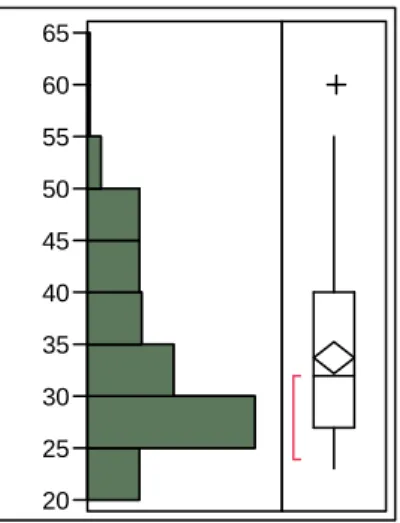
20 25 30 35 40 45 50 55 60 65
In both cases there was a skewed distribution with a mode in the late twenties and a median in the early thirties. Science graduates completed the LIS degree at a mean age of 34 (median 32), while others graduated at a mean age 33 (median 30.) These differences are not statistically significant. Age at graduation need not be considered a confounder in comparisons of scientists with others.
Age at survey completion
Oneway Analysis of Age By Nat-Sci/Others
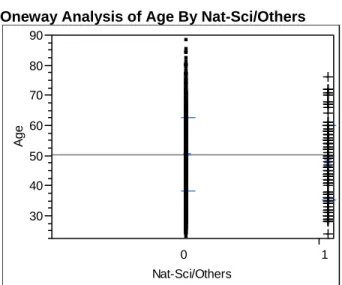
Figure 3: Age at Survey Completion
30 40 50 60 70 80 90
Ag
e
0 1
Nat-Sci/Others
Missing Rows 41
Means and Std Deviations
Level Number Mean Std Dev Std Err Mean Lower 95% Upper 95%
Others 2481 50.3527 12.1315 0.2436 49.875 50.830
Scientists 131 47.5496 12.3258 1.0769 45.419 49.680
Wilcoxon / Kruskal-Wallis Tests (Rank Sums)
Level Count Score Sum Score Mean (Mean-Mean0)/Std0
Others 2481 3264943 1315.98 2.796
Scientists 131 147636 1126.99 -2.796
2-Sample Test, Normal Approximation
S Z Prob>|Z|
147635.5 -2.79624 0.0052
1-way Test, ChiSquare Approximation ChiSquare DF Prob>ChiSq
7.8193 1 0.0052
Older respondents experienced a highly gendered society for much of their lives, and librarianship was and remains a gendered profession. The frequency with which women pursued a science degree has been constrained and still remains so in certain fields of science.
Gender
are not statistically significant. As a result, gender need not be considered a confounder in comparisons between the large groups, although some questions are in fact gendered in their response.
A20: What is your sex? Frequency
Male Female Responses
Others 442 2053 2495
Scientists 30 102 132
-All- 472 2155 2627
Share of Responses
Male Female Responses
Others 0.1772 0.8228 2495
Scientists 0.2273 0.7727 132
-All- 0.1797 0.8203 2627
Test Response Homogeneity
Test ChiSquare Prob>ChiSq
Likelihood Ratio 2.0140 0.1559
Pearson 2.1365 0.1438
Gender and disciplinary differences within the sciences
It is known that graduation rates differ by gender among the sciences. While qualitative sciences such as life and earth sciences now succeed in attracting women, there still remain large gender gaps in the more quantitative sciences such as math, physics, and chemistry. Such imbalances can negatively affect the ability of women to feel welcome and even their self-perception. For instance, personal ability and role-models more strongly influenced self-efficacy for women studying the male-dominated physical sciences as compared with the more gender-equal biological sciences. (Nauta, Epperson, & Kahn, 1998)
Sci Degree before LIS? (Nat Sci only) Frequency
A20: What is your sex?
Earth Sci Life Sci Math Phys Sci Responses
Male 10 6 9 5 30
Female 11 55 21 15 102
. 21 61 30 20 132
Share of Responses A20: What is your
sex?
Earth Sci Life Sci Math Phys Sci Responses
Male 0.3333 0.2000 0.3000 0.1667 30
Female 0.1078 0.5392 0.2059 0.1471 102
. 0.1591 0.4621 0.2273 0.1515 132
Test Response Homogeneity
Test ChiSquare Prob>ChiSq
Likelihood Ratio 14.0648 0.0028
Pearson 14.1435 0.0027
Degree earned: Scientific specialization
As shown in the table above, for the WILIS set significantly more scientists who became librarians had a background in the life sciences versus the other sciences.
As mentioned in the introduction, salaries for bachelor’s level biologists, particularly for women, are somewhat low. After controlling for variables other than major
(demographics, parental education, grades), biologists were more likely (p<0.05) to pursue some form of graduate study than any other undergraduate major. (Nevill & Chen, 2007) LIS faces stiff competition, however. Between 5 and 10 years after the bachelor’s, biologists find it easy to transition to careers in the health care field with little additional training and much higher incomes, and many make that choice; half of the biologists in one study who were working as researchers/scientists (presumably in a lab) five years after receiving the bachelor’s had transitioned to health careers five years later. (Choy & Bradburn, 2008)
The survey sample may make an important difference. It is possible that academic science librarian surveys over- or under-represent chemists. With respect to the WILIS data set, North Carolina programs might attract a slightly different mix of majors than the national sample. For instance, while the University of North Carolina offers a certificate in bioinformatics (http://sils.unc.edu/programs/certificates/bioinformatics.html), Indiana University offers a program in chemical informatics
(http://cheminfo.informatics.indiana.edu).
Hallmark and Lembo (2003) reported results of a survey of 194 librarians with science or engineering degrees, recruited via science librarian discussion lists, and found that for 67% their highest science degree was a bachelor’s; 25% had a master’s and 8% a PhD. The most frequent background represented was chemistry at 36%; 30% had a background in the life sciences and 22% had majored in geology. No other science contributed more than 10% of the sample.
Winston’s (2000) survey of Association of College and Research Libraries (ACRL) Science and Technology Section members found a similar affinity of biologists and chemists for science librarianship; 20% of those surveyed had a biology bachelor’s degree, 12% physics or chemistry, and only 3% engineering. The only other major to top 10% was history (11%). Since nearly a third indicated that they entered librarianship after having held a professional or paraprofessional position in sciences or engineering,
librarianship is clearly a second career for many science graduates.
biological sciences, 13% physics/astronomy, and other fields each made up less than 10%. (Ortega & Brown, 2005)
Beaubien (2007) has noted the strong relationship between chemistry and
librarianship, pointing to references to librarianship on the American Chemical Society (ACS) resource page. The strong support of the ACS Chemical Information section may be why 17% of physical science librarians in one survey maintained membership in the ACS.
A recent book on alternative careers in chemistry highlighted a changing view of the information profession. It explains that librarians now conduct far fewer searches, instead teaching users how to search on their own. Now that per-minute database charges have been eliminated, end users can search more easily, and “even more knowledge of
chemistry is required to use search tools efficiently.” (Balbes, 2007, p. 39) The text seems to draw a sharp contrast between the scientific librarian and the information professional. The term “librarian” is used more in conjunction with instruction and the warehousing functions, storage and retrieval of collections. By contrast, “information scientists not only locate but also interpret, summarize, manage, and organize information.” (Balbes, 2007, p. 41)
Degree earned: MLS/LIS versus IS
by a previous WILIS researcher and performed additional coding to consolidate degree types.
There were highly statistically significant differences (p<0.001) in the highest LIS-related degrees received by natural scientists and others.
type_of_degree 2 Frequency
BS EdS/MEd MIS Missing MLIS MLS PhD Responses
Others 74 43 147 2 294 1922 38 2520
Scientists 0 0 22 0 22 88 1 133
-All- 74 43 169 2 316 2010 39 2653
Share of Responses
Others 0.0294 0.0171 0.0583 0.0008 0.1167 0.7627 0.0151 2520 Scientists 0.0000 0.0000 0.1654 0.0000 0.1654 0.6617 0.0075 133 -All- 0.0279 0.0162 0.0637 0.0008 0.1191 0.7576 0.0147 2653
Test Response Homogeneity
Test ChiSquare Prob>ChiSq
Likelihood Ratio 32.9746 <.0001
Pearson 33.7343 <.0001
The higher rate of IS versus LS/LIS degrees among science graduates may be reflective of a higher interest in computers among those with a science background. See the section on computer interest later in this document for further information.
A caveat about the “prior” job
When “prior” job term is used in this paper, it refers to the survey section covering aspects of the job held immediately prior to beginning LIS studies. The author of this analysis had hoped to compare “prior job” answers with corresponding questions for the first job after LIS graduation, as some indicator of experiences in the scientific workplace versus the typical LIS workplace. On examining the data, however, the number working outside of science was surprising, as was the number who had already in some way transitioned to an LIS career before seeking the degree. While some science graduates were expected to hold jobs outside of the sciences, the percentage was quite high.
In examining job titles before entering the LIS program for science graduates, it becomes clear that the decision to “leave science” (if, in fact, a respondent had ever worked in the field) was made well before LIS program entry. Only 26 of 133 (20%) were in science-related roles (researcher, technician, science teacher) immediately prior to entering the LIS program.
specific research interests,” and “Wanted to stay in my field of study, but do something different. Science without the lab work.”
Overall, a third of respondents were working in libraries before entering an LIS program, as coded by another member of the WILIS team. This proportion held true equally for science graduates and others before beginning LIS graduate studies. Because such a large share of LIS program entrants might have already come to a career decision, the power of the “job before LIS” portion of the survey to uncover career change
motivation is diminished.
Supporting self and family: Linked lives and shared security
Several survey items concerned some of the most basic requirements for any job: the income and other benefits that allow one to support oneself and one’s family. Because the lives and fortunes of family members are “linked,” relocation is discussed in this section as well. Science graduates did not show any differences in the family and security context of their career decision-making as compared with other LIS graduates.
Relocation prior to LIS program entry
The survey asked about two types of relocation: moving in general and immigrating to a new country in particular. The reasons for moving were not specified, but trailing a spouse might be one reason.
Immigrating to a new country
Moving to a new location
Science graduates cited relocation as slightly less relevant to their decision to leave the job prior to LIS studies, but the difference did not reach statistical significance.
C14E: Moving to another location Frequency
Not a
reason
Minor reason
Major reason
No answer or not working for pay immediately before LIS program entry
Total respondents
Others 1185 93 396 131 1805
Scientists 66 5 13 13 97
-All- 1251 98 409 144 1902
Share of Responses
Others 0.6565 0.0515 0.2194 0.0726 1805
Scientists 0.6804 0.0515 0.1340 0.1340 97
-All- 0.6577 0.0515 0.2150 0.0757 1902
Test Response Homogeneity
Test ChiSquare Prob>ChiSq
Likelihood Ratio 7.4344 0.0593
Family considerations
Number of children
There was no statistically significant difference in the number of children for LIS graduates who do or do not hold a science degree.
0% 5% 10% 15% 20% 25% 30% 35% 40% 45%
0 1 2 3 4 5 6 7 8
Percent of
Respondents
Children
Number of Children
Others Scientists
Figure 4: Number of Children
J1
Frequency
0 1 2 3 4 5 6 7 8 Responses
Others 847 376 637 168 74 22 5 1 1 2131
Scientists 39 19 34 12 1 3 0 0 0 108
-All- 886 395 671 180 75 25 5 1 1 2239
Share of Responses
Nat-Sci/Others 0 1 2 3 4 5 6 7 8 Responses
Others 0.3975 0.1764 0.2989 0.0788 0.0347 0.0103 0.0023 0.0005 0.0005 2131 Scientists 0.3611 0.1759 0.3148 0.1111 0.0093 0.0278 0.0000 0.0000 0.0000 108 -All- 0.3957 0.1764 0.2997 0.0804 0.0335 0.0112 0.0022 0.0004 0.0004 2239
Test Response Homogeneity
Test ChiSquare Prob>ChiSq
Likelihood Ratio 7.1044 0.5254
Career breaks to care for children
Those who had children were asked if they had ever taken a break of more than six months to care for them. Most had not, and this proportion did not differ between LIS graduates who did and did not possess a science degree.
J2
Frequency
Yes No No Answer Not
applicable
Responses
Others 444 838 2 847 2131
Scientists 24 45 0 39 108
-All- 468 883 2 886 2239
Share of Responses
Nat-Sci/Others
Yes No No Answer Not
applicable
Responses
Others 0.2084 0.3932 0.0009 0.3975 2131
Scientists 0.2222 0.4167 0.0000 0.3611 108
-All- 0.2090 0.3944 0.0009 0.3957 2239
Test Response Homogeneity
Test ChiSquare Prob>ChiSq
Likelihood Ratio 0.7843 0.8532
Pearson 0.6823 0.8774
Career breaks to care for other family members or household responsibilities
Extremely few LIS graduates have taken career breaks for caretaking responsibilities. This was equally true for science graduates and others.
“Fits with family responsibilities” as a reason to seek LIS degree
Analysis of the WILIS data set showed that those with science degrees were no more likely to cite family obligations as a motivator than those with degrees in other fields. While this factor is strong anecdotally, including in qualitative responses from this study, in the aggregate the data do not bear out strong importance for this factor for LIS
graduates.
Consistent with traditional gender norms, however, women weighted this factor more than men (p<0.0001).
A7G: An LIS career fits with my family responsibilities Frequency
A20: What is your sex?
Not at all A little A moderate amount
A lot Responses
Male 287 85 66 32 470
Female 999 321 423 407 2150
. 1286 406 489 439 2620
Share of Responses
Male 0.6106 0.1809 0.1404 0.0681 470
Female 0.4647 0.1493 0.1967 0.1893 2150
. 0.4908 0.1550 0.1866 0.1676 2620
Test Response Homogeneity
Test ChiSquare Prob>ChiSq
Likelihood Ratio 66.9115 <.0001
Pearson 59.6003 <.0001
Family factors as a reason to leave the job before LIS program entry
Grandy (1998) found that women who left science careers frequently cited personal or family reasons for the change; however, they were more likely to shift to health careers than to other fields such as librarianship.
others to experience difficulty taking time off from work to take care of personal or family matters.
Importance of the ability to balance work and family responsibilities
Grandy (1998) also found that science graduates who began graduate work in a non-science field valued flexible scheduling more those who continued non-science studies.
The importance of work/family balance as a general job factor did not differ between groups in the WILIS study.
Personal health or disability
Poor health or disability can constrain career choices whether one is living alone or supporting a family. In the WILIS study, extremely few respondents had taken career breaks due to poor health, and science graduates did not differ from others in the proportion having done so. As with poor health, short breaks in career due to disability were extremely uncommon and no less so for scientists than others.
Employment security
Overall shape of career path
K3
Frequency
2+ jobs,
moving up 2+ jobs, moving laterally and up 2+ jobs, moving laterally only 2+ jobs, moving laterally and down 2+ jobs, moving down 3+ jobs, moving up and down
Only 1 or no job moves
Don’t know
Others 635 743 158 26 6 427 73 38
Scientists 35 41 3 2 0 24 1 1
-All- 670 784 161 28 6 451 74 39
Share of Responses
Others 0.3015 0.3528 0.0750 0.0123 0.0028 0.2028 0.0347 0.0180 Scientists 0.3271 0.3832 0.0280 0.0187 0.0000 0.2243 0.0093 0.0093 -All- 0.3028 0.3543 0.0728 0.0127 0.0027 0.2038 0.0334 0.0176
Test Response Homogeneity
Test ChiSquare Prob>ChiSq
Likelihood Ratio 8.7963 0.2676
Pearson 6.8252 0.4473
Career breaks due to involuntary unemployment
When asked about involuntary unemployment lasting more than 4 weeks but less than 6 months, there was no statistically meaningful difference between experiences of those with and without a science degree. Most respondents (90% of science graduates and 87% of others) had experienced no such break.
Job security-related reasons to leave the pre-LIS program entry job
Reason to leave a prior job and pursue LIS studies
Subgroup Not a
reason Minor reason Major reason No answer or not working for pay immediately before LIS program entry Total respondents Leaving self-employment*
Others 0.9119 0.0066 0.0089 0.0726 1805
Scientists 0.8247 0.0206 0.0206 0.1340 97
Downsizing or company closing*
Others 0.9003 0.0111 0.0166 0.0720 1805
Scientists 0.8144 0.0309 0.0206 0.1340 97
Layoff Others 0.9053 0.0061 0.0166 0.0720 1805
Scientists 0.8351 0.0103 0.0206 0.1340 97
Leaving temporary/ contract work
Others 0.8493 0.0211 0.0576 0.0720 1805
Scientists 0.7526 0.0206 0.0928 0.1340 97
Promotion within my employer
Others 0.7967 0.0327 0.0981 0.0726 1805
Scientists 0.7216 0.0619 0.0825 0.1340 97
*Significant at p<0.05
Job availability/security
In the span of one’s career, science graduates did not differ from others in the importance placed on job security as a general job characteristic. Job availability played an equal role as a motivator to enter an LIS program for science graduates and others.
Flexible career options
Much of the work in science is highly specialized, and mismatched specialization might in some cases constrain one’s career growth. While science majors cited the need for more flexible career options somewhat more often as a motivator to pursue an LIS degree, differences did not reach statistical significance.
A7F: Flexible career options Frequency
Not at all A little A moderate amount
A lot Responses
Others 602 571 832 506 2511
Scientists 22 31 43 37 133
Share of Responses
Others 0.2397 0.2274 0.3313 0.2015 2511
Scientists 0.1654 0.2331 0.3233 0.2782 133
-All- 0.2360 0.2277 0.3309 0.2054 2644
Test Response Homogeneity
Test ChiSquare Prob>ChiSq
Likelihood Ratio 6.6014 0.0857
Pearson 6.6161 0.0852
An interesting trend emerged when the “flexible career options” variable was
examined by gender. Prior research has suggested than in many heterosexual dual-income households, a man’s career takes priority and the woman must be more flexible in her career. (Gilbert & Kearney, 2006) For the full set of librarians, however, findings were highly significant in the opposite direction. Men more strongly cited the need to have flexible options.
A7F: Flexible career options Frequency
A20: What is your sex?
Not at all A little A moderate amount
A lot Responses
Male 78 101 177 115 471
Female 541 494 690 426 2151
. 619 595 867 541 2622
Share of Responses
Male 0.1656 0.2144 0.3758 0.2442 471
Female 0.2515 0.2297 0.3208 0.1980 2151
. 0.2361 0.2269 0.3307 0.2063 2622
Test Response Homogeneity
Test ChiSquare Prob>ChiSq
Likelihood Ratio 20.8278 0.0001
Pearson 19.9922 0.0002
Salary
Salary as a reason to pursue an LIS degree
(From children's, 1994) found that special for-profit and government librarians were more motivated by income considerations as compared with public librarians. Not surprisingly, she also reported that desire for greater income was a predictor of dissatisfaction among the full set of librarians. Even satisfied librarians were least satisfied with income as compared with all other aspects of their current job.
In the WILIS study, about 74% stated that salary was only “a little” or “not at all” a motivating factor in the decision to pursue an LIS degree, and there was no difference between those with and without a science background.
There was a slight but statistically significant difference between men and women pursuing the LIS degree (p=0.001). Only 69% of men stated that salary was “a little” or “not at all” a factor in their career choice.
Better salary as reason to leave the job before LIS
As common legend would have it, those with a science background would have to sacrifice earnings to pursue an LIS degree. When asked about the job held just prior to LIS studies, however, statistically equivalent proportions of science graduates and others stated that they were leaving the prior job in hopes of a better salary.
Not a
reason
Minor reason
Major reason
No answer or not working for pay immediately before LIS program entry
Total respondents
Others 633 314 730 219 1896
Scientists 28 18 40 14 100
-All- 661 332 770 233 1996
Share of Responses
Others 0.3339 0.1656 0.3850 0.1155 1896
Scientists 0.2800 0.1800 0.4000 0.1400 100
Test Response Homogeneity
Test ChiSquare Prob>ChiSq
Likelihood Ratio 1.5063 0.6808
Pearson 1.4938 0.6837
Importance of “good pay” as a general job characteristic
Though few pursue an LIS degree for the money, nearly everyone agrees that “good pay” is generally important as a job characteristic. Fewer than 5% thought good pay was only “a little” or “not at all” important. No difference emerged between groups.
Benefits
There is no reason to suspect that science graduates would value benefits differently, and the data confirmed a lack of difference between the groups in three separate
measures: 1) benefits as a motivation to pursue LIS, 2) “importance of fringe benefits” as a general job characteristic, and 3) “better benefits” as a reason for leaving the pre-LIS degree job.
Practical considerations in transition
Once someone has determined that a new LIS career will not conflict with family responsibilities and is likely to provide financial security and peace of mind, one must still obtain the LIS degree. While factors important for choosing a particular LIS program will not be considered here, two general elements important in the transition were
Length of training
Training length was not considered important by most in the decision to pursue LIS studies. While science respondents did seem to consider training length more important than others, the difference fell just shy of statistical significance.
A7A: Length of training Frequency
Not at all A little A moderate amount
A lot Responses
Others 1200 513 575 218 2506
Scientists 47 34 38 13 132
-All- 1247 547 613 231 2638
Share of Responses
Others 0.4789 0.2047 0.2294 0.0870 2506
Scientists 0.3561 0.2576 0.2879 0.0985 132
-All- 0.4727 0.2074 0.2324 0.0876 2638
Test Response Homogeneity
Test ChiSquare Prob>ChiSq
Likelihood Ratio 7.8314 0.0496
Pearson 7.7213 0.0521
Flexible education options for working adults
As with the above question, science graduates seemed slightly more inclined to consider this practical concern important, but the difference failed to reach statistical significance and could have appeared by chance.
A7B: Flexible education options for working adults Frequency
Not at all A little A moderate amount
A lot Responses
Others 1214 286 425 584 2509
Scientists 50 21 29 33 133
-All- 1264 307 454 617 2642
Share of Responses
Others 0.4839 0.1140 0.1694 0.2328 2509
Scientists 0.3759 0.1579 0.2180 0.2481 133
-All- 0.4784 0.1162 0.1718 0.2335 2642
Test Response Homogeneity
Test ChiSquare Prob>ChiSq
Likelihood Ratio 6.9361 0.0740
Because flexible education options for working adults might also correlate with flexible options for those with family responsibilities, this variable was examined by gender (for the full data set, not only the science graduates). As anticipated, flexibility was far more important for women than for men, a highly statistically significant result.
A7B: Flexible education options for working adults Frequency
A20: What is your sex?
Not at all A little A moderate amount
A lot Responses
Male 217 62 105 85 469
Female 1037 241 343 529 2150
. 1254 303 448 614 2619
Share of Responses
Male 0.4627 0.1322 0.2239 0.1812 469
Female 0.4823 0.1121 0.1595 0.2460 2150
. 0.4788 0.1157 0.1711 0.2344 2619
Test Response Homogeneity
Test ChiSquare Prob>ChiSq
Likelihood Ratio 17.6475 0.0005
Pearson 17.8722 0.0005
LIS as a profession: Exposure and opinions
Recommendations by others
The literature generally reports that personal recommendation may be important as a reason to pursue librarianship; however, the proportion varies between studies. In an LIS student survey conducted in the 1980s, most respondents stated that other people had little to no influence in their decision to pursue librarianship. (Heim & Moen, 1989) The initial motivator to pursue science librarianship for 13% in another study was
WILIS results show recommendations to be of modest but significant importance.
Guidance counselor in high school
High school guidance counselors were equally irrelevant for librarians with or without a science degree. More than 97% stated they were not at all a factor. Men were given such guidance as often as women.
A family member or friend in LIS
Despite a concern that science majors might not have as much library exposure, they were equally likely to state that a family member or friend working in LIS had some influence on them. Over half said this was not at all a factor.
Family member or friend recommended LIS
There were no differences between groups. Just over half of respondents stated that this was not at all a factor for them. There was no reported difference by gender.
Recruited by LIS program
The literature has lamented the poor job of marketing done by LIS programs. One pre-Web study of LIS students found that only 13% chose the field based on a program brochure. (Moen, 1988) The WILIS study shows results far below that figure. Over 90% of WILIS respondents stated that LIS recruitment mattered “not at all” in their motivation to pursue an LIS degree, despite the presence of five LIS programs in the state of North Carolina. On a positive note, marketing does not discriminate by undergraduate
Programs did appear to be making some headway in addressing gender imbalance. More men than women (p=0.04) stated they had been recruited by an LIS program.
A6i. Recruited by LIS program Frequency
A20: What is your sex?
Not at all A little A moderate amount
A lot Responses
Male 414 26 18 9 467
Female 1967 94 40 38 2139
. 2381 120 58 47 2606
Share of Responses
Male 0.8865 0.0557 0.0385 0.0193 467
Female 0.9196 0.0439 0.0187 0.0178 2139
. 0.9137 0.0460 0.0223 0.0180 2606
Test Response Homogeneity
Test ChiSquare Prob>ChiSq
Likelihood Ratio 7.4423 0.0591
Pearson 8.4341 0.0378
Always wanted to be a librarian
The “always wanted” factor shows the influence of a larger group of people,
essentially society’s image of librarianship passed on to children. The role of stereotype in career selection is well studied. The reader is referred to Magrill (1969) and Slater (1979) for older but substantive treatments of the topic.
For the WILIS respondents, this variable shows highly significant differences between groups.
A6D: Always wanted to be a librarian Frequency
Nat-Sci/Others
Not at all A little A moderate amount
A lot Responses
0 1073 581 406 442 2502
1 81 28 16 7 132
-All- 1154 609 422 449 2634
Share of Responses
0 0.4289 0.2322 0.1623 0.1767 2502
1 0.6136 0.2121 0.1212 0.0530 132
-All- 0.4381 0.2312 0.1602 0.1705 2634
Test Response Homogeneity
Test ChiSquare Prob>ChiSq
Likelihood Ratio 25.6085 <.0001
Because librarianship has been a highly gendered profession, and because women who pursue science may be more likely to defy gender norms, this question was analyzed for gender differences for the full set of respondents, again with highly statistically significant results.
A6D: Always wanted to be a librarian Frequency
A20: What is your sex?
Not at all A little A moderate amount
A lot Responses
Male 287 105 46 30 468
Female 848 501 374 418 2141
. 1135 606 420 448 2609
Share of Responses
Male 0.6132 0.2244 0.0983 0.0641 468
Female 0.3961 0.2340 0.1747 0.1952 2141
. 0.4350 0.2323 0.1610 0.1717 2609
Test Response Homogeneity
Test ChiSquare Prob>ChiSq
Likelihood Ratio 102.056 <.0001
Pearson 94.1731 <.0001
Importance of having a profession that is recognized and respected
In popular surveys of career prestige, scientist jobs often rank fairly high. While not specific to librarianship, those leaving science for graduate study in other fields were significantly less likely to believe their new field was “prestigious” compared to those continuing graduate study in the sciences. (Grandy, 1998)
One wonders, then, whether science graduates who turned to LIS might consider prestige less important. Survey results showed no significant difference between groups.
K2A Frequency
Not at all important
A little important
Somewhat important
Very important
Responses
Others 60 218 955 872 2105
Scientists 2 11 52 42 107
Share of Responses
Others 0.0285 0.1036 0.4537 0.4143 2105
Scientists 0.0187 0.1028 0.4860 0.3925 107
-All- 0.0280 0.1035 0.4552 0.4132 2212
Test Response Homogeneity
Test ChiSquare Prob>ChiSq
Likelihood Ratio 0.7417 0.8634
Pearson 0.7000 0.8732
These findings are surprising given previous literature. Moen (1988) found that only one third of librarians cited status as an important reason to pursue librarianship. Students in an LIS/IS/Archives program rated librarians as roughly equal in status to social
workers but less prestigious than computer professionals (computer engineering and information architecture) and doctors. (Duff, Cherry, & Singh, 2006) Scherdin (From children's, 1994) found that special librarians were less optimistic than ALA librarians about the public prestige for librarianship.
Not everyone may view the profession in a positive light. A survey of health scientists turned librarians found that 16% experienced negative reactions and 20% experienced mixed reactions from friends and family about their decision to change careers to librarianship. (Fikar & Corral, 2001)
Scherdin (From children's, 1994) found that those who chose librarianship out of a belief that people respect the profession were more likely to be satisfied. Numerous science librarians note the additional prestige/respect that science background affords them with the faculty. (Hackenberg, 2000)
LIS experience
Worked as an assistant in a library/information center
Heim and Moen (1989) found that over half of LIS students they surveyed claimed prior experience in a library was in the top two tiers of importance as a reason to pursue the career. Nearly a quarter (22%) of science librarians in Eells’s (2007) study said they first became interested in science librarianship while working in a library. Two general studies of librarianship indicate that experience in a library was a strong motivator to attend library school. (Ard, et al., 2006) (Moen, 1988)
This trend was replicated in the WILIS results. More than half of all LIS graduates stated that work experience in a library was at least a little important in motivating pursuit of an LIS degree. Scientists were no less likely to cite this experience as a motivating factor than others, and men and women cited such experience in similar proportions.
A6j. Worked as an assistant in a library or information center Frequency
Not at all A little A moderate amount
A lot Responses
Applied Sciences 49 4 9 18 80
Natural Sciences 59 9 13 51 132
Others 1094 210 299 824 2427
-All- 1202 223 321 893 2639
Share of Responses
Applied Sciences 0.6125 0.0500 0.1125 0.2250 80 Natural Sciences 0.4470 0.0682 0.0985 0.3864 132
Others 0.4508 0.0865 0.1232 0.3395 2427
-All- 0.4555 0.0845 0.1216 0.3384 2639
Test Response Homogeneity
Test ChiSquare Prob>ChiSq
Likelihood Ratio 10.9744 0.0892
Pearson 10.7625 0.0960
Library or Non-Library (Prior job) Frequency
Non-library Library 66 Responses
Others 1056 690 150 1896
Scientists 55 34 11 100
-All- 1111 724 161 1996
Share of Responses
Non-library Library 66 Responses
Others 0.5570 0.3639 0.0791 1896
Scientists 0.5500 0.3400 0.1100 100
-All- 0.5566 0.3627 0.0807 1996
Test Response Homogeneity
Test ChiSquare Prob>ChiSq
Likelihood Ratio 1.1750 0.5557
Pearson 1.2816 0.5269
Given such high percentages, it would be useful to find out how individuals gained library assistant positions. It is not unusual for students to be assigned to library work as part of work-study in a financial aid package. Clearly this is a valuable resource for library recruitment. Librarians may not recruit family members or friends to become librarians, but they seem more clearly to encourage those who work with them as students or paraprofessionals.
There was no difference between science graduates and others in whether LIS skills/knowledge applied in the prior job.
C1: Which of the following best describes this job? This job was a position... Frequency
In a
library/ info center using LIS skills/ knowledge In a library/ info center NOT using LIS skills/ knowledge
In a NON-library/info center using LIS skills/ knowledge
In a NON-library/ info center NOT using LIS skills/ knowledge Self-employed
Other N/A: Not employed immed. prior to LIS program Responses
Others 539 147 195 690 25 150 150 1896
Scientists 25 9 9 38 2 6 11 100
-All- 564 156 204 728 27 156 161 1996
Share of Responses
Others 0.2843 0.0775 0.1028 0.3639 0.0132 0.0791 0.0791 1896 Scientists 0.2500 0.0900 0.0900 0.3800 0.0200 0.0600 0.1100 100 -All- 0.2826 0.0782 0.1022 0.3647 0.0135 0.0782 0.0807 1996
Test Response Homogeneity
Test ChiSquare Prob>ChiSq
Likelihood Ratio 2.5978 0.8574
Volunteered in a library/information center
Volunteerism was not a key driver toward librarianship; 69% said it was “not at all” a factor in the decision. There was no difference between natural scientists and others on this measure. In keeping with gender norms for females to be more involved in
volunteerism, women were more likely (p<0.0001) to cite this factor than men, with 67% of women but 81% of men claiming no influence at all from volunteering.
Work environment
Most information professionals did not go straight from high school to undergraduate education to a master’s program. The decision to seek a career in LIS was made with comparison to other job options and experience; the perceived benefits offered by an LIS career presumably outweighed both the benefits of another career and investment of time and money to earn the LIS degree. The following sections will discuss findings about occupational needs/values. These values will be grouped into thematic clusters partially inspired by motivational aspects identified by Maslow (1970) and Herzberg (1968) as discussed in the introduction.
Work schedule
Prior job: Hours and scheduling control
One former scientist who became a librarian was thrilled at the change: “I can
continue research in science! I can find a great job that doesn’t run my life!” (Hallmark & Lembo, 2003)
In the WILIS study, however, fewer than half of respondents, scientists and others alike, cited a desire for better working hours as a reason to leave the job before LIS studies. On the experience of personal control over scheduling work hours and when to take breaks at the prior job, no difference emerged between groups.
Time “to get the job done”
Employees may feel pressured to work more hours if they do not feel they have sufficient time to accomplish required tasks. Such pressure could conceivably cause one to seek a less stressful workplace. While most found this factor important, no difference between groups emerged. This was true for the job prior to entering the LIS program, the current job, and the importance of “having enough time to get the job done” as a general job characteristic.
Importance of a lot of leisure time (e.g., time for hobbies)
Respondents (with and without science background) rated leisure time as only a little or somewhat important in general.
Management support
that supervision/feedback issues formed the second-most important reason for job dissatisfaction among librarians, just behind salary.
Several WILIS survey items addressed quality of management. Whether related to general values, experience at the job prior to entering LIS studies, or the current position, science graduates did not indicate significant difference of opinion from their peers. Over 80% felt that having “good enough support and equipment to get the job done” was very important. While not judged as critical, still more than 85% felt that having clearly defined job responsibilities was somewhat or very important. When thinking about the job held prior to beginning LIS studies, the majority disagreed that they had too much work to do everything well. Respondents were roughly evenly split on whether hopes for a better working environment were a factor in leaving the “prior” job.
The final, broadest question in this category is reported even though it did not reach statistical significance (p=0.06). There was a trend toward management at the “prior” job being somewhat better for science graduates than others; more said “better quality of management” was not at all a reason to leave the prior job.
C13H: Seeking better quality of management Frequency
Not a
reason
Minor reason
Major reason
No answer or not working for pay immediately before LIS program entry
Total respondents
Others 999 335 338 224 1896
Scientists 62 16 8 14 100
-All- 1061 351 346 238 1996
Share of Responses
Others 0.5269 0.1767 0.1783 0.1181 1896
Scientists 0.6200 0.1600 0.0800 0.1400 100
-All- 0.5316 0.1759 0.1733 0.1192 1996
Test Response Homogeneity
Test ChiSquare Prob>ChiSq
Likelihood Ratio 8.5497 0.0359
Personal autonomy
Autonomy is an often-cited contributor to job satisfaction. Lim (2008) found that autonomy was positively associated with job satisfaction in academic library IT workers.
When it came to measures of personal control and input in the workplace, no
differences emerged between science graduates and others in the WILIS study. Over 60% felt it was very important in general that supervisors value your opinion. While the information professions are praised as social and collaborative, solo work is also valued. Nearly 90% agreed that it was somewhat or very important to have a job that allows one to work independently. In their current roles, only about 6% disagreed that “it is basically my own responsibility to decide how my job gets done.”
As to experiences in the “prior” job, few in either group had strong feelings of agreement or disagreement that they had “a lot of say about what happened at my job” at the “prior” job.