Pedaling
Into
the
Future
Marcia
D.
Lowe
The
bicyclehas
the potential
tohelp free the
citiesof
the
world
from
choking
on
the pollution
and
trafficcongestion
of
the
automobile,
and
to offer short-range,individualized
travelata
low
cost tothe
billionswho
will
never
be
able
toafford
a
car.A
growing
number
of
nations are
realizingthat
ina world
of
finiteresources-petroleum,
land,and
clean air—the
bicycleisthe
vehicle ofthefuttire.Traffic noise in Beijing
means
the whirring ofbicyclewheels
and
tinklingofbells.The
streetsofNew
Delhicome
alivewiththousands ofbicycle
commuters
eachday.Officeworkersin
New
York
Citydepend
on
bicyclemessengersto cruisepastbumper-to-bumper
trafficand
deliver parcelson
time.And
policeofficers inSeattle often findbicyclesbetterthan
squad
carsforapprehending
criminalson
grid-locked
downtown
streets.Outsidethecity, bicyclesalsoplayavital role.
Kenyan
dairyfarmerscyclethrough
remote
regionswith milk deliv-eries,and Nicaraguan
healthworkerson
bikesnow
reachfourtimesas
many
ruralpatients asthey didon
foot.Whether
a cycle rickshaw inJakarta or a ten-speed inBoston, pedal
power
plays akeyroleintransportation.The
bicycle is fast
becoming
the onlyway
tomove
quicklythrough congested
urban
traffic,and
theonlyaffordablepersonaltransportinthedevelopingworld,
where an
auto-mobilemay
costmore
thanaworker
earnsinadecade.Despite its
demonstrated
utility, the bicycle hasbeen
formallyneglectedby transport planners inalmost every countryon
the globe.Only China and
a fewWestern
European
nations collect transportation data that countbicycles
among
forms oftransport. Inthe caseoftheUnited
StatesDepartment
ofCommerce,
neglectmightbe
apro-motion
in status for the bicycle; thedepartment
refersinquiries
on
bicycletrade toitsDivision ofToys
and
Games.
The World
Bank,
themain
source ofurban
transportinvestmentinthedevelopingworld,publisheda1985 study
on
theChinese
transport sector thatdoes not evenmention
theword
bicycle,although theoverwhelming
majorityoftrips inChina'scitiesare
made
bybike. Thisissadlytypicalofa policy
environment
inwhich
onlymotor
vehicles aretakenseriously.
High
Price
for
Mobility
The
automobile
haslongbeen
consideredthe vehicleofthefuture. Indeed,ithas
brought
industrialsociety into themodern
age withadegree ofindividualmobilityand
con-venience notknown
before.But
overrelianceon
the carisbackfiring as too
many
cars cluttercitystreetsand
high-ways,bringingrush-hour traffic to a standstill.The
sideeffects ofmassiveoil use
show up
not only ineconomy-draining importbillsbutindeadlyairpollutionincities,
acid rain in dyinglakes
and
forests,and
hastened globalwarming.
Intheirenthusiasmforengine power,transportplanners have overlookedthevalueof
human
power.With
conges-tion,pollution,
and
debt threateningboth
the industrialand
developing worlds,the vehicle ofthe future clearly rideson
two
wheelsratherthanfour.The
bicycle'sascentwould
not eliminate automobiles, orany othervehicle,butwould
instead integrate bicycleswithcarsand mass
transit.A
well-balanced, diversetransportsystem could helpsaveprecious oil
and
other resources, reduce pollutants,and
providemobility topeople with few or
no
alternatives to walking.Beforethiscanhappen,
though,ashiftinattitudesmust
takeplace.More
Bikers
Than
Drivers
Bicycles already
outnumber
carsworldwide
bytwo
to one, withmost
ofthe 800-million-bicycle fleetconcen-tratedintheThird
World,
particularlyChina and
India. In theUnited
States,where
one
of everytwo
peopleowns
an
best,
supplementary
transportation.At
theotherextremeisChina,with
one
privatelyowned
carforevery seventy-fivethousand
people.Chinese
commuters
havelittle choice buttomake
themost
oftheirbikes.By
bicyclestandards,China
is ina class byitself,withsome
270
million bicycles,orroughlyone
forevery four people. Inurban
areas, halfthe residents havebicycles.Trafficmonitorsat
an
intersectioninthenorthernindus-trialcityofTianjin
once counted
more
thanfiftythousand bicyclespassinan
hour.The
bicyclefleetinChina
hasnearlytripledsince 1979,largelyas aresultofrisingincomes.
Domestic
bikesales in1987 reachedthirty-fivemillion units,actuallyexceeding
total
worldwide automobile
sales. BicyclesarepopularinChina
because,likecarsinindustrialcountries,theyofferthe luxury ofindividualmobility
and
independence,and
door-to-doortravelwithout detours orextrastopsforother
passengers.
When
thesame
tripwould
takeequaltime bybicycleor
mass
transit,Chinese
prefer tobike.Bicycles are also popular because Chinese transporta-tion plannersin thesixties
and
seventies used subsidies,Cycle trishawsinCanton (Guangzhou), China
paying
commuters
amonthly
feeforbicycling towork,to relieve the pressureon
crowded
busesand
topostpone
publictransitinvestment. Thispolicy,however,failedtoforeseethe bicycle
boom
oftheeighties.Now
Chinese
citiesface aphenomenon
inwhich
people's appetiteforindividual mobilityisbecoming an
obstacle tomass
mobility. Likecarcommuters
intheindustrialcoun-tries,bicycle
commuters
arenow
officiallyencouraged
tousethe
expanded
fleetofpublicbusesforlongertrips.Bicycles transport
more
people in Asia alone thando
automobiles inall countriescombined.
Throughout
thecontinent, ingeniously rigged two-
and
three-wheelersaccomplish
much
ofwhat
automobilesdo
elsewhere.With
thehelp oftrailers,basketsand
loadplatforms,pedalpower
haulseverythingfrom
sacksofricetopilesofbricks. Cycle rickshaws are the taxis of Southeast Asia, while sturdytricyclesare thelighttrucks thathaulloadsof
up
to halfaton. In Bangladesh,cyclerickshaws transport
more
ton-nage
thanallmotor
vehiclescombined.
In
urban
areas, bicyclesare theprimarymeans
ofcom-muting. Inthe countryside,theyhelp peasantsdrastically
cut
down
on
thetimeneeded
to transportwaterand
fuel-wood.
Inmany
Asian
cities,two-thirdsofthe vehicleson
theroad during rush hoursarebicycles.Shunned, Feared
and
Neglected
The
restofthedeveloping worldlags farbehind
Asiainusingbicycles. ParticularlyinLatinAmerica,the prestige
and power
ofautoownership
hashypnotizedgovernments
into ignoring pedalpower and
led citizens to scorn the bicycleasa vehicleforthepoor.African farmers
depend
heavily
on
bicycles, but rela-tivelyfewurban
residents do.The
fewwho
are able tobuy
a bicyclearediscouragedby offi-cial disdain or even banson
their use. In
some
Africancountriesit istaboofor
women,
themain
haulersoffood,wa-ter,fuel
and
children, toride bicycles.Several heavily polluted
Eastern
European
countries aretaking
modest
stepstoexpand
• thebicycle'sroleineasing theburden
on
the environment.InPoland,aplanfora bicycle
system in the city of
Poznan
callsfora 124-mile
network
ofbicyclepathsby1990. Bicycle
productioninPolandhas
more
thandoubled
in the lasttwo
decades,and
demand
still exceeds supply. In 1979, theLithuaniancityofSiauliailauncheda
comprehensive
pro-gram
toencourage
cycling,theSovietUnion'sfirst,which
includeda bicycle-pathsystem
and
extensiveparking facili-ties.A
surprising share ofthe world's bicycles is found indevelopedcountries, surprising,onlybecause ofthe small
number
found
on
typical city streets. In severalEuropean
countries,among
them Denmark, West Germany
and
the1985,
second
onlytoChina.Bicycleownership
intheindus-trialworld does notnecessarily
mean
bicycleuse.One
infourBritonshasabicycle,yetonly
one
transporttripout ofthirty-threeis
made
bybike.Only
one
out offiftybicyclesinthe
United
Statesisusedforcommuting;
most
oftherestareriddenbychildren
and
sports enthusiasts,orcollecting dustinthebasement.A
comparison
ofbicycleand automobile ownership
by countryshows
therelativedependence
on
the bicycle (seeTable1).
The
United
States,forexample, hasmore
thantwice as
many
bicycles as India, but only a fraction ofAmerican
bicyclesget asmuch
use. India'sgrowing middleclassofoffice
and
factoryworkers
ismore
likelytogettowork
bybicyclethanany
otherform
oftransport.Table 1. Bicycles
and Automobiles
inSelectedCountries,circa1985(InMillions)
Cycle/Auto
Country
BicyclesAutos
RatioChina
1 300.01.2 250.0
India 45.0 1.5 30.0
South
Korea
6.0 .3 20.0Egypt
1.5 .5 3.0Mexico
12.0 4.8 2.5Netherlands 11.0 4.9 2.2
Japan
160.0 30.7 2.0
W. Germany
45.0 26.0 1.7Argentina 4.5 3.4 1.3
Tanzania
.5 .5 1.0Australia1
6.8 7.1 1.0
U.S.1 103.0 139.0 .7
Sources:WorldWatch Institute,basedonMotorVehicle Manufacturers Association,FactsandFigures (Detroit,Mich:variouseditions);
MVMA,
various private communications; United Nations, Bicycles andComponents:
A
PilotSurveyofOpportunities forTradeAmong
Developing Countries(Geneva:InternationalTradeCentreUNCTAD/GATT,1985); JapanCycle Press International,variouseditions;and othersources.x
1988
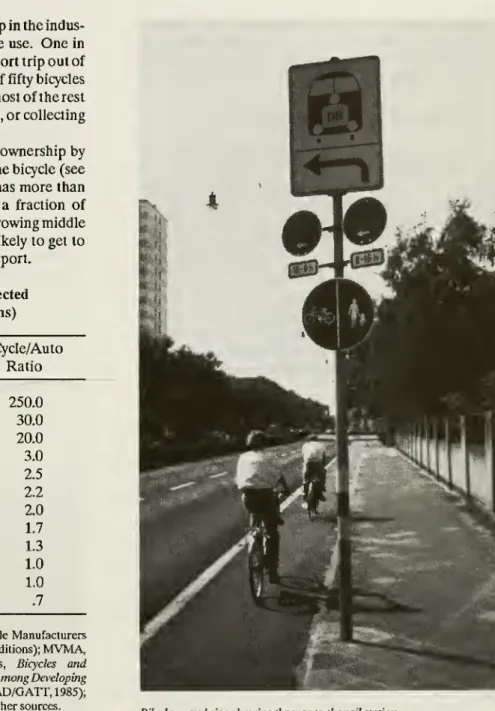
Bikelaneandsignshowingthewaytotherail station, Karlsruhe,WestGermany
Planning
Makes
a
Difference
Likethe
United
States,most
otherindustrialcountrieshave all but
abandoned
the bicycle for the automobile. Suburbanization has sprawled jobs,homes
and
servicesoversuch longdistances thatautomobilesarelessa
conven-iencethana necessity.
Only
ahandful ofNorth
American
citieshaveextensivebikepaths,
and most major
citieshavebecome
bicycle-proof,theirroadwaysand
parkingfacilitiesdesignedwith only
motor
vehiclesinmind.Three
outstandingmodels
ofnationwide bicycleplan-ningare theNetherlands,
West
Germany
and
Japan. Localgovernments
inthese countries,spurredbytrafficjams
and
airpollution,aredemonstrating
how
public policycanbe
usedto
make
cycling a safeand
convenientalternativetothecar.
The
Netherlands has over ninethousand
miles ofbi-cyclepaths,
more
than any othercountry. Insome
Dutch
cities,halfofalltripsare
made
bybike.The West
German
town
ofErlangen
hascompleted
anetwork
of paths cov-eringone hundred
miles,about
halfthelengthofthecity's streets. Bicycleuse hasmore
thandoubled
asaresult.Bicycle-orientedcitiesin
Europe
and Japan have boosted bothbicycleand
publictransitridershipwithfacilitiesforcarrying bicycles
on
busesand
trains,and
forparkingthem
advantage of this bike-to-rail option that train stations
need
parking towers.The
city ofKasukabe
now
has a twelve-story structure that usescranestopark overfifteenhundred
bicycles.Most
Efficient
Vehicle
Ever
Built
Renewable
fuelsarea hottopicintransportationcirclestoday,withconcern
deepening
overdependence
on
scarceand
expensiveoil. Intherushtorun engineson
gasoline alternatives such as corn-based ethanol, transportationplannershave overlookedatechnologythat convertsfood
directlyintofuel.
A
bikercanridethreeand
one-halfmileson
the caloriesfound
inan
earofcorn,and
there isno
distillingorrefining involved.Bicycles
consume
lessenergy per passenger mile thanany otherform
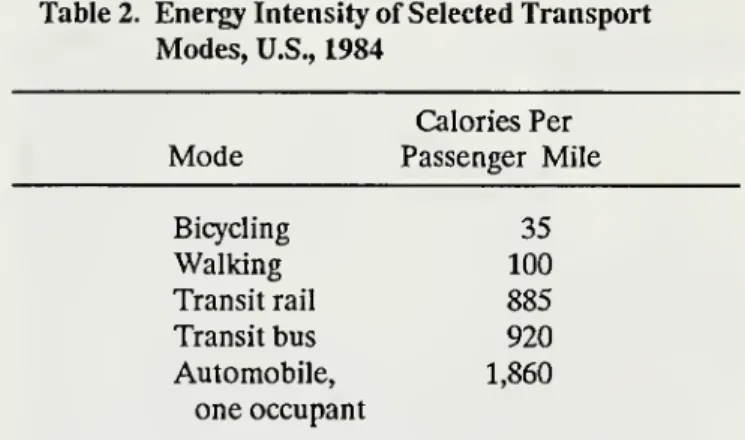
oftransport,includingwalking(seeTable2).A
ten-mile,round-trip
commute
by
bicyclerequires350
calo-riesofenergy,orthree-quartersofa
cup
ofmacaroni.The
same
tripintheaverageAmerican
carusesmore
thanhalf a gallonofgasoline.Table2.
Energy
IntensityofSelectedTransport
Modes,
U.S., 1984In 1986,anational
campaign
inthe Netherlands encour-ageddrivers toswitch to bicycles fortripswithin athree-mileradiusof
home.
Policymakersfiguredthiswould
saveeach motoristat least
$400
ayearin fuel costs.A
1980studyin
Great
Britain calculated that ifjusttenpercent ofcartrips
under
ten mileswere
made
by
bicycle, the countrywould
savefourteenmillion barrelsofoilayear.A
1983 study ofAmerican
commuters
revealedthatjustgetting to publictransitbybicycleinsteadofcar
would
saveeach
commuter
roughly 150 gallons of gasoline a year.When
amotoristwho
otherwisedrivesalltheway
towork
switches to thisbike-and-ridemethod,
hisor her annualgasolineusedropsby
some
fourhundred
gallons, halftheamount consumed
bythetypicalcarinayear. Iftenpercent oftheAmericans
who commute
by carswitchedto bike-and-ride,more
than $1.3 billion couldbe
shaved offthe U.S.oilimportbill.Urban Bane
In 1983, a
unique
experimentbegan
to unfold in thestreetsofBogota,
Colombia. Every
Sunday morning
thirty-sevenmilesofarterialroads
were
closed tomotor
trafficMode
CaloriesPer Passenger
Mile
Bicycling
35
Walking
100Transitrail 885
Transitbus
920
Automobile,
1,860one occupant
Sources:MaryC.Holcombetal.,TransportationEnergyDataBook,Edition 9(OakRidge,Tenn.,OakRidge NationalLaboratory, 1987); President's CouncilonPhysicalFitnessandSports, privatecommunication,June23, 1988.
A
lookatnationalfuelbillsmakes
astrongcaseforusingbicycles.In 1987, U.S.oilimportscost$43billion,ornearly aquarterofthe country's$171billiontradedeficit.
Of
the country'stotalannualoilconsumption,
nearly two-thirdsisburned
up
in transportation.With
world oil productiondeclining, a country's car
dependence
heightens its vul-nerabilitytoimpending
oilpricehikes.The
debt-ridden ThirdWorld
isespeciallyburdened
byforeignoildependence. Severaldevelopingcountries
al-ready
spend
one-thirdtoone-half oftheirexport earningson
imported
petroleum,on
averageabouthalfofitgoingtothe transportsector.Byshifting to
nonmotorized
transportwhere
possible, debtor nations could freetheirfinancial resourcesforotherinvestments.Man
on abikeinNicaraguaand
halfa millioncitydwellerstooktothestreets tobicycle, rollerskateand
stroll.Now
in itssixth year,theweeklyritualtransformsacityscape
dominated
bysmog
and
honk-ing cars into atranquil,cleanenvironment.
cry
from Bogota
on
Sunday.Dependence
on
the car exacts atollon
human
health,theenvironment and
qualityoflife inurban
areas.Industrialworldcitiestypicallyrelinquishat least
one-third oftheir land-two-thirds in
Los Angeles~to
motor
vehiclesintheform
of roadsand
parkinglots. IntheUnited
States, this totals 38.4 millionacres,
more
area than the entirestate of Georgia. ResearchersGeorge
Work
and
Lawrence
Malone
havecompared
the spacedemands
ofvariousvehicles,
and
accordingtotheircalculations,fora bridge of a given size toaccommodate
forty thousand peopleinone hour
would
requiretwelvelanesfor cars,four lanesforbuses,two
for trains,and
one
for bicycles.With
mounting
pressureson
ThirdWorld
countries tohouse
and
feedtheirswelling populations, theyhavelittleroom
tospare forroadsand
parkinglots.Where
peopleand
good
croplandare concentrated ina relativelysmall areaofa country, asinChina,choicesarenarrow. IfChina
had
thesame
carownership
rate astheUnited
States-onecarforevery
two
people-itwould need
todevotearound
eighteen million acrestoparkingfacilitiesalone,anamount
equaltoeightpercent ofthe country's arableland.
The
automobile
isverymuch
the victimofitsown
suc-cess,
jamming
urban
centersand
suburbs alike. Trafficcongestioniserodingthe qualityoflifein
urban
areas,and
theamount
oftime wastedintrafficcontinuestoexpand
inthe world's cities.
London
rush-hour trafficcrawlsatan
average ofeight miles
an
hour. InLos
Angeles,motoristswaste 100,000 hoursadayintrafficjams. Trafficengineers estimatethat bythe turnofthe century, Californianswill
losealmost
two
millionhoursdaily.Urban
residentsfrom
Sao
Paulo toLondon
face eye,nose,
and
throatirritation, asthma, headaches,and
chestdiscomfortbrought
on
by car-produced smog. Emissionsfrom
gasolineand
diesel fueluseareannuallylinked toasmany
as thirtythousand
deathsintheUnited
States alone.It isshort
automobile
trips-precisely theonesbike-ridingcould replace-thatcreate the
most
pollution, becausea coldengine does notfireeffectivelyand
releases unburnt hydrocarbonsintotheair. IntheUnited
States,where an
estimatedfortypercentofurban
commuters
drivelessthanfour miles,pedalingto
work
would
haveadramaticeffecton
air quality.Both
cityand
countrydwellers areendangered
inother ways by theautomobile.Some
100,000 peopleinNorth
America,
Western Europe, Japan and
Australia died in trafficaccidentsin1985.Developing
countries-with fewer automobilesbutmore
pedestriantrafficand no
provisionsforseparating the
two-have
fatalityratesasmuch
astwentytimeshigherthanindustrialcountries.
Bicycle ridingisnot withoutitsrisks.Bicycleaccidents
do
accountfor
many
trafficinjuries,particularlyinAsia,butare unlikely to kill people unless
motor
vehicles arein-volved.
But
thatissmallconsolationforwould-be
bicyclistswho
areintimidatedoff the road.Latin
America
has itsurban
cyclists-includingyoung
boysdeliveringnewspapers andcraftspeople hauling goods-butmany
potentialridersaredeterredby dangeroustrafficconditions. Nairobistreetsthat
once were
fullofbicyclesnow
areonlysafefor cars.Where
it canbe
done
safely, cyclingimproves public health.The
popularityofstationary exercisebikesisproofthatpeople enjoycycling to
keep
fit; the ironyisthatsomany
peopledrive tothehealthclubinorderto ridethem.Cyclistsare lessvulnerableto heart attacksorcoronary
diseasethan sedentary
commuters, and
they arriveatwork
more
alertand
lessstressedby rush-hourtraffic.An
Equitable
Technology
Bicycles havea hard timegetting the respectthey
de-serve,evenincountries
where
theygivecrucialmobilityand
employment
to millions.The
cityofJakarta,Indone-sia,forexample, hasconfiscated tensofthousands ofcycle
rickshawsoverthe past several years
and
dumped
them
intothe seainorderto"reducetrafficcongestion." Last year
more
than 100,000pedicabdriversinDacca, Bangla-deshfaced a potentialban
oftheirpedal-powered
cabsfor safetyreasons.Publicbusesare the
main
mode
oftransport inmost
developingcountries
and
oftentheonlyone poor
people canafford.But
transitsystemshave
proved incapable of keeping pace withexplosiveurban growth
rates.Even
where mass
transitsystemsareadequate,theydo
notserve certain crucial needs.
A
passenger bus cannot haulaGhanaian
farmer'sproduce
to market, orcarry aColombo
streetvendor'shot lunchestoafactory.Nor
can ithelpruralpeoplewho
livea day'swalk from
the nearest road.With
bicycles,thepoor
and
unemployed
can earnalivingbygetting
homemade
craftstourban
markets,vend-ingwares inthestreets,ortakingpassengersforhire.
A
bicycledemands
atinyfractionofthecapital neces-sary toown
and
operatean
automobile. InBrazil,theleastexpensivedomesticcar costs
an
averageworker
roughlysixyears'wages, whilea bicycle requires nearlysixweeks'
pay-Though
many
of thosewho
would most
benefit by a bicycle are toopoor
toown
one, the bicycleis still thecheapest
mode
oftransportoutsideurban
cores.Govern-ments
couldencompass
rural areas in their transportplanningbysubsidizingbikepurchases, a
much
lesscostlyapproach
than extending roadsand
buslines. Inaddition, bicycle production is a low-riskventure for developingcountries thathavelittleor
no
industrialbase.Asmall
assemblyplantand
repairshop
canrunon
about$200 worth
oftools.One
hundred
bicyclescanbemanu-facturedforthe materialsittakes to builda
medium-sized
India has
demonstrated
how
anearlyself-sufficient bi-cycle industrycanbe
createdby firstassemblingbicycleswith
imported
parts,thenproducing framesinlocalwork-shops
and
gradually establishingsmallfactoriestoproduce
parts domestically.From
amodest
beginningfivedecadesago,Indiahas
become
amajor world
producer,second onlytoChina. Itdirects
more
thanninetypercent ofitsbicycle exportstootherdevelopingcountries,and
throughjoint-venture
and
licenseagreements
issharingits small-scale, labor-intensivetechniqueswithcountriesthroughoutAsia, Africa,and
theCaribbean.Subsidized
Auto Dependency
The
economic and
environmentalconsequences of auto-mobileoverdependence
may
eventually necessitate bicycleuse,even without
government
help.But
fornow,
publicpolicies that ignore bicycles perpetuate private attitudes against using them. Thus, the transport planner's office
seems
the best place forthe philosophical reorderingtostart.
A
major
barrier to bicyclingisthefactthat driversarein effectpaidtouse automobiles. DriversintheUnited
Statesmay
receiveasmuch
as$300
billion insubsidieseach yearBikelanesinTokyo,Japanare separatedfromtrafficlanesbyplanters.
in the
form
of public funds to pay for road repairand
construction, policeand
fireservices,and
healthcare.In the private sector, free parking provided by
many
employersin effectpaysthe gasoline costsofcommuting.
The
U.S.Environmental
ProtectionAgency
hasconcludedthatif
employees
were
directlyhanded
thissubsidy,publictransitridership
and
bicycleusewould
go up,while autotraffic
would
declinebytwenty-five percent.Severalcitieshave
made
motoristspayforthe privilegeofdrivingautomobiles. Singapore chargesprivate cars
carry-ingfewer thanfouroccupants "congestionfees"for enter-ing the
downtown
area during rush hours, a decade-oldscheme
thathasraiseddowntown
trafficspeeds by twenty percentand
reduced traffic accidents bytwenty-fiveper-cent.
Inconvenience~a
general absence ofsafe parkingand
lockerroom
facilities-keepsmany
commuters from
bicy-clingtowork, butthereareprecedentsfordealingwiththis.InChina,bicycleparkinglotsare
guarded
againsttheftbyattendants. PaloAlto, Californiahassuccessfullypasseda
number
of innovative regulations requiring builders oflargeofficestoprovideshowers
and
bicycleparking.Table3. Productionof Bicycles
and
Automobiles,SelectedCountries, 1987 (InMillions)
Country
BicyclesAutomobiles
China
41.0 .OO1Taiwan
9.9 .20Japan
7.8 7.89 U.S. 5.8 7.10USSR
5.42 1.33India 5.3 .15
W.
Germany
2.9 4.37South
Korea
2.6 .79Brazil 2.5 .68
Italy 1.6 1.71
Poland
1.3 .30U.K.
1.2 1.14Canada
1.2 .81Others 10.5 6.54
World
Total 99.0 33.01Sources:WorldWatchInstitute,basedonMotorVehicleManufacturers Association,FactsandFigures'89(Detroit,Mich.: 1989);JapanCycle Press,variouseditions;and othersources.
*In1987,Chinaproduced4,045automobiles. 2 1986estimate.
All that aside,
commuters
arestill notlikelytochoosebicycling
when
itmeans
takingtheir livesintotheirhandson
busycity streets. Insome
situations, effectivebicyclepromotion
calls for bike paths separatefrom
roadsand
space
on
regular roadways devoted to bicycles.More
importantly,though,traffic
management
and
drivertrain-ingshouldreflectbicycles'role aslegitimatevehicles.
Along
Pedaling Into the
Future
Interms of sheer
number
ofvehicles,theworldiswell-equippedtoletbicyclestake
on
a largershareofthetrans-portationburden.
Around
theworld,nearly 100millionbicycles are
made
each year-three times thenumber
of automobiles (see Table 3).The
big bicycle producers,especially inAsia,aresureto
keep upping
their capacities.With
or without bike-oriented planning, financialim-peratives
may
forceashifttothebicycle.For
starters,most
peopleintheworldwillneverbeable to
buy an
automobile, andpublictransitsystemsinmany
citiescannotkeep
pace with explosive population growth.When
the next oilcrunchhits,perhaps within thenextdecade,even those
who
can
now
afford to drivewill be looking for alternatives.With
relativelymodest
publicinvestment inparkingand
roadspacefor bicycles,transportation choiceswould
multi-plyquickly.
Environmental
degradationmay
alsochange
planners'thinking.
The
by-productsoffossilfuelcombustion-deadly urban air pollution, acid rainon
lakesand
forests,and
globalwarming~as
well as the paving of valuable land, point to theneed
foran
alternative to engines.The
bicycleistheonlyvehicle thatcan help addressallofthese prob-lems
and
stillprovide convenientand
affordablepersonaltransportation.
While
transport plannersremain
fixatedon
the auto, congestionand commuting
costsarealreadyspurringpeopletoswitch tobicycling.
The number
ofbicyclecommuters
inthe
United
Statesreached2.7millionin1988,which
isstill lessthan3percent ofallcommuters,
but representsmore
than a quadrupling inone
decade. Thishappened
withvirtually
no
public policy push, suggesting that officialencouragement
couldinspireamore
dramatic changeover.Just
how
rapidlythe bicycle willexpand
transportop-tions,
check
environmentaldamage,
and
restoreurban
qualityoflifedepends
on
how
quicklyitmoves
from
indi-vidualpreference
onto
the publicagenda.ManiaD.Loweisa researcherattheWorldWatchInstitute.
TheauthorwouldliketothankKen Hughesand Michael Replogleof the Institute forTransportation and Development Policy in Washington, D.C., fortheirhelp withthis article.
ThisarticlefirstappearedintheJuly/August1988issueofWorldwatch magazine.
Solid
Waste
Resource Center
Offers
Timely Information
The
SolidWaste
Resource
Center,locatedinAsheville, N.C.,isanew
information clearinghouseforsolidwasteplanning.The
Centerwas
establishedbytheLand
ofSky
Regional Council, throughagrantfrom
theTennessee
ValleyAuthority,inresponsetothe
growing
needs oflocalgovernments,development
districts,and
otherswho
need
timelyinformationon
allaspectsofsolidwaste
management.
The
council maintainsasolidwastelibrary,and
aweightand
composition database developed duringone and
one-halfyearsoffield
work
withmember
communities
inNorth
Carolina'sRegion
B
planningarea.The
Center
providesameans
fortheCounciltoshareitsexperience
and
knowledge
withothers insideand
outsidethe region.To
usetheResource
Center,writeorcallwithyourrequestorquestion. Councilstaff willprovideconsultationoverthephone
tonarrow
down
requests,and
willhelpyou
findtheinformationyou
need,orreferyou
totheappropriateresources.Staffconsultation
and
libraryusearefree. Chargesaremade
onlyfor actual costofprinted materials,or databasesearches.The
Center maintains alargecollectionofperiodicalsand
also hassome
videoson
selected topics.A
resourcelist isavailable freeof charge
from
theLand
ofSky
Council. Thislist isupdated
twice a year, asnew
materials are received.The
currentlistoftopicscovered bythelibraryincludes:
General
SolidWaste
Management
Education
and
PublicInvolvementWeight and Composition
Studies PollutionPrevention PaysIncineration
and Waste-to-Energy
Household Hazardous Wastes
Used
Oiland
TiresRecycling
Landfilling