The Association of Single Sport Specialization and Overuse Injury in Youth
Athletics
By
Danny Taylor, PA-S, MEd, LAT, ATC
A Capstone Paper submitted to the faculty of the University of North Carolina at Chapel Hill in partial fulfillment of the requirements for the degree of Master of Health Sciences in the
Physician Assistant Program
Chapel Hill
December 2017
____ __
Name and title of First Reader ____________________ Date
_________________________________ Name and title of Second Reader
11/16/2017 ____________________
BACKGROUND
Youth sports in today’s society has come to represent a microcosm of the highly visible
and overtly publicized professional world of sports. Children and adolescents are inundated by
an unprecedented and ubiquitous sociocultural saturation not experienced by previous
generations; from the most recent current global news events trending on our Twitter feeds to
the latest player to sign a $200 million professional sports contract. While the former is
newsworthy, the latter is what often catches the eyes of not only kids, but their parents,
coaches, and other individuals that are involved with different athletic programs at the youth
level. There is an evolving perception that if kids are put into the right situations at an early
age, identifying a niche and “specializing” in a sport, they can advance and develop a skill set
that will allow them to obtain higher social status, possibly receive college athletic scholarships,
and even become professional athletes with high earning potential. This perception is not a
geographically isolated concept. In China, there are over 3000 government-affiliated
sports-based schools1, of which there are approximately 100 boarding schools dedicated to allowing
children ages 5-16 years old to work and develop sport-specific athletic skills in hopes of being
selected to train at Olympic training facilities. The amount of pressure being placed on young
athletes is certainly high, and has a large impact physically and mentally.
What is Sports Specialization?
There have been varying definitions of sport specialization in the literature. There are
often discrepancies about level of intensity (practice versus competition) and volume of
review2 discusses Cote’s description of “deliberate practice” versus “deliberate play” in the
framework of characterizing intensive training, with the former having a goal of improving
performance and the latter with a goal of simply having fun. However, sports specialization is
best defined as participation in intensive training and/or competition in a single sport at the
exclusion of all others, often year-round, but at least 8 months of the year3. Jayanthi et al4
further sub-categorize the classification of specialization into low, moderate, or highly
specialized based on a 3-point scale by providing answers to the following questions: “Can you
pick a main sport?” (single sport – 1 point), “Did you quit other sports to focus on a main
sport?” (exclusion of other sports – 1 point), and “Do you train > 8 months in a year?”
(year-round training – 1 point). Low specialization is determined by a score of 0 or 1, moderate by a
score of 2, and high by a score of 3. It can become even more refined, with early specialization
occurring before puberty (7th grade or roughly 12 years old) and late specialization occurring
after puberty3,5.
The hopes of parents, coaches and other stakeholders of athletes capturing, excelling
and capitalizing on the rare but lucrative opportunities such as athletic scholarships or
professional recognition has provided the impetus behind single sport specialization and its
ongoing prominence. Of all those that participate in high school sports, few go on to play their
sport at the National Collegiate Athletic Association (NCAA) level. Of the 3-11% that do
advance and play in college, only 1% of those will be offered a scholarship3. Taking it further
still, a scarce 0.2-0.5% of high school athletes will make it to the professional ranks6. This would
lead one to believe that while these goals are achievable for a select few, they are far more the
shown that early sport specialization may or may not be necessary to achieve success and high
skill level7. Additionally, the question has been asked, is single sport specialization safe for the
young athlete?
PATHOPHYSIOLOGY
Overuse injuries can be defined as injuries that occur when repeated mechanical loads
are placed on tissues that exceed the capability of those tissues to remodel over a period of
time8. The child and adolescent athlete is much different from the skeletally mature athlete,
and is more susceptible to overuse type injuries. Articular and epiphyseal cartilage in children is
much more fragile and prone to injury due to a myriad of forces1,7–9, including compressive,
shear and traction, which can lead to osteochondrosis. Common locations of injury to the
epiphysis include the proximal humerus (little leaguer’s shoulder), capitulum (Panner’s disease)
and the distal radius9. During adolescent growth spurts, athletes are at particularly increased
risk of apophyseal osteochondrosis due to increased tension of the myotendinous unit at the
apophysis in conditions such as Osgood-Schlatter’s (tibial tuberosity) and Sever’s disease
(calcaneus)9. During this time adolescents are also at increased risk of fracture due to extensive
epiphyseal growth1, which causes a relative decrease in bone density due to the lack of calcified
and mature bone formation at the growing and developing epiphysis. Other intrinsic and
extrinsic factors, such as biological versus actual age, anatomical variations, training technique,
and training volume and intensity also illustrate how the risk for overuse injury in the child and
Single sport specialization brings with it a focus on defined skill sets in which there is
opportunity for numerous repetitive movements over time to place stress on tissues and cause
tissue breakdown. There is limited data thus far in the literature addressing the impact of
single sport specialization on injury rates in youth sports participants. The specific focus of this
paper is two-fold. Primarily, this paper will examine the impact of single sport specialization on
injury rates, specifically musculoskeletal overuse injuries, in youth sports participants 18 years
of age or younger when compared to those who do not specialize in a single sport.
Additionally, it will review and discuss the most current evidence based recommendations for
and areas of further interest regarding single sport specialization.
EPIDEMIOLOGY
In the 2015-2016 school year, there were approximately 7.9 million participants in high
school sports per the High School Athletics Participation Survey, given by the National
Federation of State High School Associations10, which is an increase of 1.2 million from
2000-2001. Considering youth aged 6-18 years, it is estimated that approximately 27 million play
organized team sports outside of school, while roughly 60 million engage in at least some kind
of organized sports recreationally7. The National Council for Youth Sports also reports a 6%
increase in children younger than 6 years old participating in recreational sports11. While
numbers have increased globally, there is still a significant attrition, with about 70%
withdrawing from organized sport by the age of 133. This dropoff can be attributed to a
multitude of factors, including overscheduling, financial burdens, burnout, loss of interest and
In data taken from 2011-2012 school year12 from 174 American high schools, the overall
injury rate for high school athletes was shown to be 1.8 injuries per 1000 athlete exposures,
where an athlete exposure represents either a single practice or competition for one
participating athlete. Overuse injuries have increased along with increased participation, and
an estimated 46-54% of all youth sports injuries3,7 are overuse type injuries. This has been
shown to vary among sports, with ranges found between 37% in skiing and handball, to 68% in
running7. The sheer volume of injuries incurred presents a substantial burden on the
healthcare system, and can be seen in primary care, pediatric, orthopedic and hospital settings.
SAFE Kids reports that 2.6 million children are seen in emergency departments every year for
sports and recreational injuries13. Being able to implement preventive measures along the
continuum of youth sports at all levels to help decrease injury risk would serve to decrease the
physical burden on athletes and decrease the financial burden on families and the healthcare
system as a whole.
Is specialization needed for success?
While there is a large movement and trend toward single sport specialization in youth
athletics, one might ask if there is any benefit from this. Does specializing early, or at all, help
achieve elite status in one’s sport? The current evidence is suggestive of the contrary. In fact,
numerous studies of Olympic level athletes from Germany and Russia have showed that early
specialization or adolescent success did not increase odds of achieving elite level or
international level status and did not predict senior-level success14. They also found that
specialized later in adolescence than their near elite counterparts14. In a study of NCAA Division
I athletes15, 88% of athletes surveyed participated in 2-3 sports during childhood, and 70% of
those did not specialize in their sport until after the age of 12. Jayanthi2 discusses the transfer
of pattern motor skills in high-level basketball, netball, and field hockey players and the less
sport-specific work required to achieve expertise when exposed to more diverse activities in
the developing years. Smucny15 references a study of boys aged 10 to 12 years of age that
shows better performance on standing broad jump in those participating in multiple versus a
single sport.
The exception to the advantages provided by multisport participation seems to be in
sports that require high levels of technical skill and where the peak performance is reached
before full maturation2,14. Early specialization is noted to be helpful in gymnastics, dance,
tennis, and swimming and diving, where these parameters are often seen.
Volume versus specialization: an independent risk factor
Training volume is a key component of the definition of single sport specialization. It is
identified as an extrinsic risk factor for overuse injuries7,8,16 and, along with prior injury, is the
most consistent predictor of overuse injury17. There are multiple ways that volume can be
measured, frequently noting hours or days per week of participation, total practice or
competition exposures, or even months of the year participated. While the most recent and
comprehensive definition to date of single sport specialization recognizes a rather broad
version of volume, participation for greater than 8 months of the year, others have been
is consistently viewed as a marker for increased overuse injury risk. Another hour-based
algorithm examined hours per week spent on sport based on age, where participating more
hours per week than stated age demonstrated increased risk of serious overuse injury4. One
recent case-control study of athletes age 12 to 18 showed increased likelihood of reporting
history of any injury and overuse injuries of the upper and lower extremity in the previous year
when any volume-based parameters (>8 months of the year, >16 hrs/week, >hours than age in
years) were exceeded19.
Single Sport Specialization and Overuse Injury Risk
There is a paucity of literature analyzing the effect of single sport specialization and
injury risk in youth athletes. In a 2016 systematic review, Fabricant et al20 looked at youth sport
specialization and association with risk of overuse and acute injury. They found significant
associations not only between sports specialization and overall patellofemoral pain (OR = 1.5, p
= 0.038) and total injury rate (OR = 1.27, p < 0.01), but also with overuse injuries, specifically
Osgood-Schlatter disease and patellar tendinopathy (OR = 4.0, p < 0.005). Additionally, serious
overuse injuries, classified as those requiring at least 1 month rest from sports and including
spondylolysis, osteochondritis dissecans, elbow ligament injuries, stress fractures or physeal
reactions, were also significantly associated (OR = 1.36, p < 0.01) with specialization20. Bell et
al21 surveyed 302 Wisconsin high school students aged 13-18, and those classified as highly
specialized by Jayanthi’s 3-Point scale2,4 were more likely to report history of overuse knee
injuries when compared to those in moderate or low specialization groups (P = 0.048). In
further at the relationship between team and individual sports specialization on injury risk.
1190 athletes were surveyed to assess level of sport specialization utilizing the 3-point scale,
involvement in team or individual sport, and history of injury in their sport over the previous 6
months. Electronic medical records were made available for diagnosis evaluation and
classification as acute, overuse, or serious overuse injuries. They found after adjusting for age,
gender and weekly sport hours, single-sport-specialized athletes in individual sports
proportionately suffered significantly more overuse (44.3% vs 32.2%, OR = 1.67, p = 0.037) and
serious overuse (23.4% vs 11.6%, OR = 2.38, p = 0.011) injuries than compared with their
team-sport counterparts 22. In a study of athletes aged 12-18 participating in organized summer
sports and active over the previous 12 months, authors examined the association of single
sports specialization with injury history over the previous 12 month period19. Injury history was
grouped regionally (upper and lower extremity and head/neck) and was placed categorically as
overuse injury, acute contact injury or acute non-contact injury. Again, using the 3-point scale
for specialization and adjusting for age, gender and weekly sport hours, athletes classified as
highly specialized were more likely to report history of any injury (OR = 1.59, P < 0.001),
overuse injury (OR = 1.45, P < 0.05), and upper extremity overuse injury (OR = 1.91, P < 0.05)
when compared to those in the low specialization category19. Moderately specialized athletes
were also more likely to report history of any injury (OR = 1.32, P < 0.05) and overuse injury (OR
= 1.39, P < 0.05) when compared to the low specialization group19. Finally, McGuine et al23
prospectively analyzed a cohort of over 1500 high school students and the association of sport
specialization with the incidence of lower extremity injury (LEI). LEI was defined as any injury
medical provider, occurred during interscholastic practice or competition, and was classified as
acute, gradual or recurrent-onset injury. Lacerations, abrasions and contusions were excluded.
The overall incidence of LEI was increased in moderate (Cox HR, 1.51 [CI 95%, 1.04-2.20], P =
0.03) and highly (Cox HR, 1.85 [CI 95%, 1.12-3.06], P = 0.02) specialized groups compared to the
low specialized group, but the incidence of non-acute LEI was also increased in moderate (Cox
HR, 2.61 [CI 95%, 1.34-5.07], P = 0.005) and highly (Cox HR, 4.74 [CI 95%, 2.04-11.05], P < 0.001)
specialized groups compared to the low specialized group23.
DISCUSSION
The role of single sport specialization and musculoskeletal overuse injury risk is
multifactorial and complex. Current research in the literature is superficial and suffers from
methodological flaws in its design and focus and leaves many unanswered questions regarding
its overall effects. One must consider many variables when analyzing these associations. For
instance, it has not been until recently that there has been a widely-accepted definition of sport
specialization. Within the individual studies and systematic review that were evaluated in this
paper, defining specialization varied. Most recent studies utilized a 3-point scale4,19,21,22 to
classify athletes as low, moderate, or highly specialized. Others assessed specialization based
on playing only a single sport24, or by volume (hours per week, number of exposures) or age of
specialization25. Even when utilizing the 3-point scale, there is a possibility of exclusion of a
subset of athletes who may be highly specialized, but would not be considered so because they
have never quit a sport to participate in their primary sport simply due to lack of exposure. This
research to date has been observational in nature, utilizing survey tools and self-report
measures. Studies of focus in this paper included case-control, cross-sectional, and cohort
studies and often relied on self-report measures4,19–22,24,25. Study design and methodology
again contributes to heterogeneity within the sample population. Many of the studies
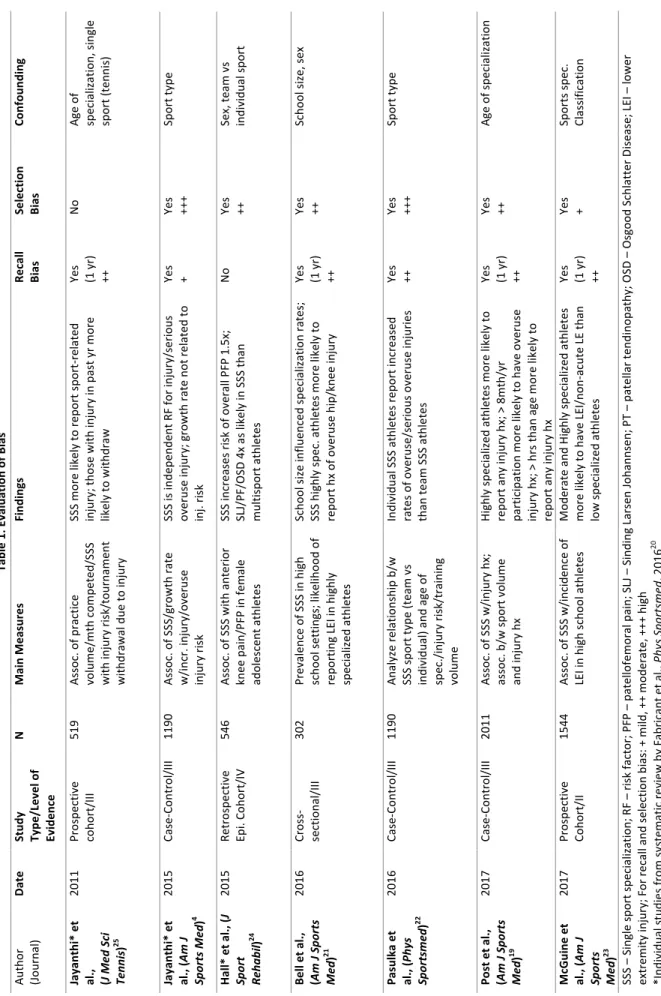
evaluated in this paper produce sample and recall bias based on survey methods and recall of
previous injury history as well as previous participation (see Table 1). Ultimately, the nature of
the studies also allow only association without causation. While variables such as age, gender
and sport hours were often adjusted for, consistent analysis of other potential confounders
such as age of specialization, socioeconomic status, athletic setting or sport type would be
helpful to elucidate the extent and impact of specialization on injury risk. Further research
would also be most beneficial if conducted prospectively.
Risk of injury is inherent in participation in all types of sporting activities. While there
seems to be a logical connection between single sport specialization and increasing injury risk,
this has not been fully established in the literature. Despite this fact, medical societies and
other physician organizations have made best practice recommendations based largely on
empirical evidence and concerns over increasing injury rates and an accumulation of
epidemiological information. Of major concern is age of specialization. It is known
physiologically that adolescent athletes are at higher risk of overuse injury, especially during the
adolescent growth spurt, due to changes and imbalances in bone and tendon growth 1,7–9.
One study of young gymnasts supports this, showing more prevalence of wrist pain in gymnasts
between 10 and 14 years of age than groups older and younger26. This is echoed in another
than in stages 1, 4, or 52. There is little evidence to support increased levels of success in those
who specialize at a young age, and it is also thought that early specialization in a single sport
can prevent proper motor skill development7,14. This series of findings has led to the
recommendation that young athletes diversify their sport participation and delay specialization
until late adolescence in sports where peak performance occurs in adulthood2,5,7,17.
Another issue of concern is volume and time spent participating in sports. Increased
workload and higher intensity of sport activities are well-known risk factors for injury.
Numerous investigations into little league baseball pitchers have shown increased likelihood of
time-loss injury with increased number of pitches per game, innings pitched per year and
months of the year playing the sport7,27. While there is evidence to support implementation of
pitch counts and restrictions on innings pitched, there has not been evidence to date that
shows a significant decrease in injury rates or that recommendations already in place have
been successful. Thought to contribute significantly to single sport specialization is the
abundance of external opportunities for young athletes to play their chosen sport in the form of
travel, challenge, and AAU teams. Playing on multiple teams in a single sport may predispose
to overscheduling of competitions5–7, which presents issues not only from the standpoint of
hours of sport per week but also intensity of participation, as intensity is expected to be higher
during competition when compared to practice18. While participating in multiple sports
year-round accrues similar risk, single-sport specialized athletes may be more likely to participate in
their sport year-round18. The NATA Position Statement on Prevention of Pediatric Overuse
Injuries17recommends limiting the amount of repetitive loads placed on the pediatric athlete
American Medical Society for Sports Medicine and the American Orthopaedic Society for Sports
Medicine follow suit with similar guidelines, recommending weekly and yearly time limits and
volume limits be placed on sport-specific repetitive movement7, and that children specializing
in a single sport and participating more than 16 hours per week or more hours per week than
their age should be monitored for overuse injury5. The American Academy of Pediatrics council
on Sports Medicine and Fitness varies slightly, recommending 1-2 days off per week from
organized, competitive or sport-specific activity, and 2-3 months off during the course of the
year3,6.
Foundational movement development is key for success in competitive athletics, and is
also paramount in physical fitness and injury prevention. However, while there has been a
marked increase in organized athletics as a whole, there has simultaneously been a vast
decrease in school based physical education programs, with only 29% of high school students
participating in daily PE classes15. When combined with a generally sedentary lifestyle, this can
impact not only cardiovascular and muscular fitness levels, but can leave athletes susceptible to
injury. Integrative neuromuscular training (INT) is a combination of general strengthening
exercises and movement-specific conditioning activities that has been shown to improve overall
fitness and motor skill development14. It is applied in an age-related manner and can be utilized
as part of a normal physical activity regimen or as an adjunct. INT has been shown to provide
benefits to all youth athletes, including the single-sport specialized athlete, by reducing injury
risk and improving performance14. The NATA and AOSSM have both endorsed INT and
INT-based programming as beneficial to all youth and recommend incorporating it as a preseason
The effects and ramifications of single sport specialization are poised to be at the
forefront of sports medicine and beyond for the foreseeable future. Organized youth athletics
continues to grow, while at the same time the American youth lifestyle continues to be rather
sedentary, creating more opportunity for injury. In summary, youth athletes are physiologically
at increased risk of injury, specifically overuse injury, when compared to fully developed adults.
The fact that overuse injuries alone account for roughly half of all youth sports injuries supports
this statement. While the notion that specialization increases the chances of reaching elite
status is prevalent, the evidence has been equivocal, and in some instances in opposition to
that stance. Even though the majority of literature has been observational in nature, there
appears to be a significant association between single sport specialization and increased injury
rates, specifically overuse injuries, in youth athletes. In addition, levels of specialization and
volume of participation also appear to be very influential in increasing the likelihood of
sustaining an overuse injury. This information can be valuable for medical providers and
parents and youth athletes alike for use in the prevention of musculoskeletal overuse injuries.
Further future research of prospective design, utilizing universal definitions of sport
specialization, and including more objective outcome measures is certainly warranted.
Focused studies further analyzing aspects of training volume and endpoints for hours per week
or weeks per year played could be advantageous in helping delineate more appropriate
limitations for preventing injury. Whether recreational or interscholastic, quantifying playing
time in competition versus practice could help identify subgroups of individuals within
improve our understanding of the effect of single sport specialization on musculoskeletal
Appendix A: Methods
Data Sources: PubMed, Cochrane Database of Systematic Reviews, and the TRIP medical
database were queried using search terms sports specialization, youth sport specialization,
overuse injury, pediatric overuse injury, youth sport specialization and injury, youth sport
specialization and overuse injury, sports specialization and overuse injury, sport specialization
and pediatric overuse injury, youth sports and epidemiology, and overuse and youth injury and
specialization. Included in the search were systematic reviews, randomized controlled trials,
case reports, cohorts and clinical reviews. Search dates were from January 2000 – Dec 2017.
Additional resources were sought from the citation lists of the articles found in the original
search. All studies were evaluated for individual quality using the STROBE Statement checklist28
and Strength of Recommendation Taxonomy (SORT) criteria were used to evaluate the
summary of the literature29.
Appendix B: Results:
STROBE Checklist scores (in descending order beginning with most recent): 18, 21, 19, 17, 17,
13, 11 (maximum of 22 points)
Strength of Recommendation Taxonomy (SORT)29
A: consistent, good-quality, patient oriented evidence B: inconsistent or limited-quality patient-oriented evidence
C: consensus, disease-oriented evidence, usual practice, expert opinion, or case series
The strength of recommendation grade pertaining to single sport specialization and increased
musculoskeletal overuse injury rates in youth sports participants is SORT grade B: based on
Bibliography
1. Caine D, Maffulli N, Caine C. Epidemiology of injury in child and adolescent sports: injury rates, risk factors, and prevention. Clin Sports Med 2008;27(1):19-50, vii.
doi:10.1016/j.csm.2007.10.008.
2. Jayanthi N, Pinkham C, Dugas L, Patrick B, Labella C. Sports specialization in young athletes: evidence-based recommendations. Sports Health 2013;5(3):251-257. doi:10.1177/1941738112464626.
3. Brenner JS, COUNCIL ON SPORTS MEDICINE AND FITNESS. Sports specialization and intensive training in young athletes. Pediatrics 2016;138(3). doi:10.1542/peds.2016-2148.
4. Jayanthi NA, LaBella CR, Fischer D, Pasulka J, Dugas LR. Sports-specialized intensive training and the risk of injury in young athletes: a clinical case-control study. Am J Sports Med 2015;43(4):794-801. doi:10.1177/0363546514567298.
5. LaPrade RF, Agel J, Baker J, et al. AOSSM early sport specialization consensus statement.
Orthop J Sports Med 2016;4(4):2325967116644241. doi:10.1177/2325967116644241.
6. Brenner JS, American Academy of Pediatrics Council on Sports Medicine and Fitness. Overuse injuries, overtraining, and burnout in child and adolescent athletes. Pediatrics
2007;119(6):1242-1245. doi:10.1542/peds.2007-0887.
7. DiFiori J, Benjamin H, Brenner J, et al. Overuse Injuries and Burnout in Youth Sports: A Position Statement from the AmericanMedical Society for Sports Medicine. Clinical Journal of Sports Medicine 2014;24(1):3-20.
8. DiFiori JP. Evaluation of overuse injuries in children and adolescents. Curr Sports Med Rep
2010;9(6):372-378. doi:10.1249/JSR.0b013e3181fdba58.
9. Launay F. Sports-related overuse injuries in children. Orthop Traumatol Surg Res
2015;101(1 Suppl):S139-47. doi:10.1016/j.otsr.2014.06.030.
10. 2015-16 HIGH SCHOOL ATHLETICS PARTICIPATION SURVEY. Available at:
http://www.nfhs.org/ParticipationStatistics/PDF/2015-16_Sports_Participation_Survey.pdf.
11. National Council of Youth Sports Report on Trends and Participation inOrganized Youth Sports 2008 Edition. National Council of Youth Sports (NCYS). Available at:
12. Injury Research and Policy RIOTM Study Reports :: Nationwide Children’s Hospital,
Columbus, Ohio. Available at: http://www.nationwidechildrens.org/cirp-rio-study-reports. Accessed July 1, 2017.
13. Safe Kids Worldwide: Sports and Recreation Safety Fact Sheet (2015). Available at:
https://www.safekids.org/sites/default/files/documents/skw_sports_fact_sheet_feb_201 5.pdf.
14. Myer GD, Jayanthi N, DiFiori JP, et al. Sports specialization, part II: alternative solutions to early sport specialization in youth athletes. Sports Health 2016;8(1):65-73.
doi:10.1177/1941738115614811.
15. Smucny M, Parikh SN, Pandya NK. Consequences of single sport specialization in the pediatric and adolescent athlete. Orthop Clin North Am 2015;46(2):249-258.
doi:10.1016/j.ocl.2014.11.004.
16. Magrini D, Dahab KS. Musculoskeletal overuse injuries in the pediatric population. Curr Sports Med Rep 2016;15(6):392-399. doi:10.1249/JSR.0000000000000303.
17. Valovich McLeod TC, Decoster LC, Loud KJ, et al. National Athletic Trainers’ Association position statement: prevention of pediatric overuse injuries. J Athl Train 2011;46(2):206-220. doi:10.4085/1062-6050-46.2.206.
18. Myer GD, Jayanthi N, Difiori JP, et al. Sport specialization, part I: does early sports specialization increase negative outcomes and reduce the opportunity for success in young athletes? Sports Health 2015;7(5):437-442. doi:10.1177/1941738115598747.
19. Post EG, Trigsted SM, Riekena JW, et al. The association of sport specialization and training volume with injury history in youth athletes. Am J Sports Med 2017;45(6):1405-1412. doi:10.1177/0363546517690848.
20. Fabricant PD, Lakomkin N, Sugimoto D, Tepolt FA, Stracciolini A, Kocher MS. Youth sports specialization and musculoskeletal injury: a systematic review of the literature. Phys Sportsmed 2016;44(3):257-262. doi:10.1080/00913847.2016.1177476.
21. Bell DR, Post EG, Trigsted SM, Hetzel S, McGuine TA, Brooks MA. Prevalence of Sport Specialization in High School Athletics: A 1-Year Observational Study. Am J Sports Med
2016;44(6):1469-1474. doi:10.1177/0363546516629943.
22. Pasulka J, Jayanthi N, McCann A, Dugas LR, LaBella C. Specialization patterns across various youth sports and relationship to injury risk. Phys Sportsmed 2017:1-9. doi:10.1080/00913847.2017.1313077.
the effect of sport specialization on lower extremity injury rates in high school athletes.
Am J Sports Med 2017:363546517710213. doi:10.1177/0363546517710213.
24. Hall R, Barber Foss K, Hewett TE, Myer GD. Sport specialization’s association with an increased risk of developing anterior knee pain in adolescent female athletes. J Sport Rehabil 2015;24(1):31-35. doi:10.1123/jsr.2013-0101.
25. Jayanthi N, Dechert A, Durazo R, Dugas L, Luke A. Training and Sports Specialization Risks in Junior Elite Tennis Players. J Med Sci Tennis 2011;16(1):14-20.
26. DiFiori JP, Puffer JC, Aish B, Dorey F. Wrist pain in young gymnasts: frequency and effects upon training over 1 year. Clin J Sport Med 2002;12(6):348-353.
27. Olsen SJ, Fleisig GS, Dun S, Loftice J, Andrews JR. Risk factors for shoulder and elbow injuries in adolescent baseball pitchers. Am J Sports Med 2006;34(6):905-912. doi:10.1177/0363546505284188.
28. Elm E von, Altman DG, Egger M, et al. The Strengthening the Reporting of Observational Studies in Epidemiology (STROBE) statement: guidelines for reporting observational studies. Epidemiology 2007;18(6):800-804. doi:10.1097/EDE.0b013e3181577654.