Private Investment and Terrorism in African States
By Noam Argov
Senior Honors Thesis Political Science
University of North Carolina at Chapel Hill
Abstract
The African continent is a region of increasing economic opportunity and threats of terrorism. What accounts for these seemingly contradictory trends? This study argues that the recent terrorism rise is partly due to increasing investment by multinational corporations (MNCs) in Africa. I examine MNC investment in infrastructure through the mechanism of Private
Participation in Infrastructure (PPI). I argue that greater infrastructure investment gives African states the incentive and military capacity to reassert control over territories previously lost to violent non-state actors. MNCs introduce a third party into the bargaining between militants and governments over resource control. Since MNC investment empowers the state, the resulting territorial contestation may induce non-state actors to respond with terrorism. I argue that African states will experience increasing terrorist attacks as PPI increases and furthers the process of state consolidation. Increasing PPI gives terrorist campaigns an initial burst of resolve to prolong their initiatives. However, I ultimately assert that if this PPI investment is allowed to appreciate through initial periods of increased violence, African states can eventually use this new power to accelerate the demise of terrorist groups. Sustained MNC investment will
strengthen African governments and decrease the survivability of terrorist campaigns. I test these predictions on terrorist attacks and campaigns in the post Cold War period from 1990-2006.
INTRODUCTION
The modern African continent is a region abounding with contradictions of economic development and state stability. In May 2000, the cover of The Economist featured a gun-wielding African militant and the title, “The Hopeless Continent.” In December 2011, however, the cover of The Economist once again featured Africa, but this time with an image of a rainbow kite and the title “Africa Rising.” This attitudinal shift speaks to the emergence of seemingly paradoxical developments on the African continent. Many countries on the continent are seeing tremendous interest for economic investment, while simultaneously undergoing a surge in high profile terrorist activity. In 2011, for example, Nigeria saw its GDP surpass that of Egypt and South Africa. Yet, in 2011 the country also experienced an intense surge in the Boko Haram terrorism campaign, which peaked with the Chibok schoolgirl kidnappings. As recently as 2013, The Economist published articles warning about the dangers of Jihadist terrorism in Africa (“Jihad in Africa” 2013) and the Obama administration declared Africa a potential center for the “War on Terror.” However, media also simultaneously exalted Africa as the “hottest frontier” for business (“Investing in Africa” 2013), while the Obama administration launched its “Doing Business in Africa Campaign” and pledged $14 billion of American private sector investment in Africa (White House Office of the Press Secretary 2014). How can we reconcile these seemingly contradictory narratives?
To unpack this paradox between investment and terrorism, I want to examine how the investment of multinational corporations (MNCs) in the African continent is altering the dynamic between governments and militant groups that threaten state stability. Ultimately, my research argues that a key reason for the increase in terrorism in Africa is the recent surge in MNC investment and the resulting strengthening and consolidation of African states.
terrorism. Therefore, I hypothesize that increased MNC investment will breed increased terrorism in Africa in the short term. However, since the increased investment allows African states to consolidate and strengthen, I ultimately anticipate that the cumulative effect of
investment will increase state capacity to accelerate the demise of sub-state terrorism campaigns. Thus, my research attempts to offer an explanation that explores the relationship between microeconomic decisions of individual firms, state expansion into territory, and state
consolidation of power in the face of sub-state challengers. First, my study develops a theory about the relationship between terrorism and territorial contestation. Ultimately, I explain how infrastructure investment can lead MNCs to become influential players in the bargaining between terrorist groups and the state. Then, I statistically examine the influence of MNC investment on the number of terrorist attacks and the duration of terrorist campaigns on the African continent. Finally, I qualitatively examine the data findings within a case study of energy infrastructure investment and terrorism in the Niger Delta. Throughout my paper, I aim to develop and test a theory that explains how the investment decisions of MNCs in African infrastructure impact terrorism levels and the survivability of terrorist groups in African states. After decades of slow growth on the African continent, these findings and their policy implications are particularly crucial during a time when economists and investors see huge potential in the “rise” of Africa. In this moment of optimism and opportunity, the aggregate destabilization of numerous African countries due to terrorism could foster increased violence and economic stagnation.
BACKGROUND
Economic Restructuring on the African Continent
I first turn to a brief historical analysis of the economic developments on the continent from the 20th to the 21st centuries. In the post-colonial era, many African states were left with
groups and militants took control of territories beyond the reach of African governments (Rabasa et al., 2007). With minimal state strength, governments found it difficult to reclaim control over these anarchic and “ungoverned” territories, even after the civil wars ended (Rabasa et al., 2007). Over time, however, militants controlling these territories set up governing and policing systems (Rabasa et al., 2007). Key examples include the frontier-like Kenyan border with Somalia, or Tanzania’s Zanzibar island that basically conducted its own internal affairs under Sharia law. Moreover, sub-state groups in these areas could take advantage of the resource-wealth in their territories, giving incentive and ability to sustaining militant control and keeping the national government out (Fearon 2003).
Simultaneously, near the end of the Cold War there was also an increase in foreign investment. With the weakening USSR, mounting African debt crisis, need for economic restructuring, and accumulation of conditional loans, MNCs saw an opportunity to invest in and appreciate African resources at relatively low up-front costs. Specifically, MNCs looked to invest in African markets and minerals. Finding largely weak and fragmented African
governments to support them, however, MNCs and their governments sought to increase African state capacity. This would yield a better return on investment and less investment risk. Similarly, in the late 1980s and early 1990s, there was a major push among international finance
institutions (i.e. IMF and World Bank) to enact economic reforms on the African continent. Anticipated benefits of such economic restructuring programs were increases in GDP, decreases in unemployment, transfer of new technology, formation of capital markets, etc. (World
Development Report 1994, 11). All of these improvements were seen as signs of “successful states,” beneficial to the global economy and global security at large.
Moreover, much of these privatization partnerships were directed at the infrastructure sector (Foster and Briceño-Garmendia 2010).1 With an emphasis on energy, transport,
communication, and water, infrastructure development was crucial for economic development and state capacity building. According to a 1994 World Bank report on infrastructure
development, the success and failure of a country is determined by the “adequacy” of its infrastructure (World Bank 1994). Furthermore, the report cites the benefits of increased competition, maintenance, and expertise that result from opening infrastructure to the private sector (World Bank 1994, 10). The general argument was that infrastructure development must be driven by private participation. According to the 2005 Commission for Africa, private participation in African infrastructure was also introduced in order to integrate African
economies into the global economy, “offset geographical dislocation,” and strengthen African states in the face of “sovereign fragmentation” (Foster and Briceño-Garmendia 2010, 31). Unsurprisingly, the private sector remains the largest source of all official development assistance for African infrastructure to date (Foster and Briceño-Garmendia 2010, 9).
Into the post-9/11 era, investment through private participation in infrastructure (PPI) continued to be a primary method of promoting economic and political stability in African states. Infrastructure has fueled more than half of the recent improvement in growth on the African continent (Foster and Briceño-Garmendia 2010, 1). Without the private sector, African states would have to spend 25% of their GDPs to eliminate the “infrastructure gap” (Foster and Briceño-Garmendia 2010, 11). PPI investment efforts have been generally successful in Africa, as the African continent averaged a 4.9% annual growth rate from 2000 to 2008 (Leke et al., 2010).
In terms of state consolidation overall, PPI allowed African governments to strengthen
while shouldering less of the economic growth burden (Foster and Briceño-Garmendia 2010, 14). Since 1990, the trend of increased MNC investment increased profits for state governments, which allowed for increased urbanization, job creation, and eventually an enlarged tax base (Slantchev 2012). Thus, the MNC investment increased state power by allowing African
governments to finance public projects, enhance spending on security, and in some cases pay off
1 The sector includes energy infrastructure (generation and distribution of oil, natural gas, and electricity),
allies and foes for their support. This growth in state stability created a positive feedback loop that in turn fueled greater MNC investment. Nevertheless, many of the most lucrative areas for MNC infrastructure investment remained in militant-controlled, “ungoverned” territories. Increased PPI investment therefore created a situation in which MNCs had incentives to penetrate into ungoverned territories and African states (as their partners) had incentives to infiltrate and reclaim these territories from militant group control.
Insurgency and Terrorism in Africa since 1990
Figure 1. Terrorist Events in Africa 1970 - 2011
Surprisingly, multiple data sources indicate that Africa has experienced relatively low terrorism in comparison to other regions. For example, the RAND Database of Worldwide Terrorism Incidents (RWTI) demonstrates that Africa comprises of only 5% of global terrorist attacks between 1969 and 2009 (Jones and Libicki 2008).2 Nevertheless, internally the terrorist attack frequency on the continent is rising (See Figure 1). Anecdotally, a few of the post-9/11 accounts of terrorism on the continent are the 2002 bombings in Mombasa, Kenya, the 2008 Al-Shabaab bombings at a sporting event in Kampala, Uganda, the attacks on tourists and the US embassy bombing in Yemen from 2007 to 2009, and the Nigerian college campus bombings by Boko Haram in 2013 (U.S. Department of State 2013).
Contextualizing the history of African economic reform within African geopolitics sheds light on the mixed narratives of economic hope and political despair that currently circulate across the continent. What is causing these patterns in African terrorism? Are African states prepared to counter these internal threats? In this backdrop of economic and geopolitical history,
2 RAND Database of Worldwide Terrorism Incidents. 2013. Available at:
it is pertinent and interesting to examine the connections between private investment, infrastructure, and terrorism on the African continent.
LITERATURE REVIEW
Most studies on economic factors and terrorism occur on the macro scale (i.e. examining foreign direct investment) and largely focus on the effect that terrorism has on incoming
investments. My study not only aims to understand whether investment can instead affect terrorism, but also approaches the issue from a microeconomic perspective. By examining investment decisions of individual MNCs between 1990 and 2006, I aim to better understand the relationship between investment and terrorism in Africa. To outline my contribution to the field, I would like to briefly survey the previous academic literature linking economic indicators and terrorism.
A foundational work for this area of research is Fearon and Laitin’s 2003 study about GDP per capita and civil war. While not specifically about terrorism, the study found a positive relationship between low levels of GDP per capita (often indicative of low growth and standard of living) and high levels of civil war, paving the way for identifying a relationship between a state’s economy and its susceptibility to destabilization by sub-state violence. Building on this literature and narrowing it to the African continent, Miguel et al. (2004) found a positive connection between exogenous shocks that negatively affect a state’s economic growth and the likelihood for civil conflict in a sample. My research draws upon this cross-country approach, as well as this notion that a factor external to the state can affect the relationship between a state’s economy and its level of violence.
Beyond political violence that ends in civil conflict, I also draw on more recent literature that analyzes relationships between economic indicators and terrorism. This body of work mainly discusses terrorism in the context of poverty levels indicated by macroeconomic
education/wealth and the propensity to join a terrorist organization on an individual level. Piazza (2006) similarly finds little significance of inequality, unemployment, and poor economic growth as predictors of terrorism. These studies generally conclude that terrorism is caused by political and social cleavages, rather than economic factors. The conflicting results surrounding the link between poverty and terrorism mean that other economic indicators beyond measures of wealth must be explored more deeply, not that economics should be left out of terrorism analysis. As stated above, a model that is more focused on microeconomic indicators may reveal more about the decision of a group to use terrorism over other strategies. For this reason, my research aims to analyze economic indicators beyond aggregate measures of wealth and to focus on terrorism as a group strategy, rather than terrorism in terms of recruitment, population control, or
individual choice.
Moreover, to inform my research I also examine studies that analyze relationships between economic integration/globalization and terrorism. Kurrild-Klitgaard et al. (2006) show that terrorism levels are significantly reduced in developing countries with higher levels of trade openness (ratio of exports and imports to GDP), as international trade raises the difficulty of militant groups to secure funds and finance terrorism. The study, however, analyzes these relationships at a specific point in time. Therefore, I draw on the pooled time series method used by Li and Schaub (2004) in their examination of the relationship between terrorism and trade, foreign direct investment (FDI), and portfolio investment. Li and Schaub (2004) find that indicators of economic integration have “no direct positive effect on transnational terrorist incidents within countries,” and that FDI and trade reduce terrorism to the extent that they promote economic development (232). Yet, the African continent has seen increased terrorism during a period of continuously increasing economic integration. Perhaps the Li and Schaub (2004) study fails to capture part of the development story by overlooking economic decisions below the macro level.
After examining this body of work, it appears that the literature is limited in a few key ways. Previous studies tend to analyze economic indicators and terrorism without
groups is largely missing. By looking at the investment behavior of MNCs, specifically in the infrastructure sector, I aim to develop a theory that links microeconomic indicators and struggles over territory and resource control. I want to offer a nuanced explanation of the propensity to use terrorism and the survivability of a terrorist group over time. As a spatial analysis, my research contextualizes the relationship between terrorist groups and the state in a geopolitical setting of territorial contestation. The microeconomic component examines how the behaviors of
multinational firms engaging in private investment add a third party to the dynamic between governments and terrorist groups, influencing the behavior of these groups. As a temporal
analysis, I aim to account for the dynamic nature of power and control. Overall, I hope to capture the interaction among decisions of MNCs to invest, decisions of sub-state groups to employ terrorism, and the consolidation and success of a government over a terrorist campaign. THEORY
The following section will explain two main assertions. First, I investigate how MNC investment, specifically through private participation in infrastructure (PPI), can cause territorial contestation and ultimately result in terrorism by sub-state challengers. Second, I explore how this investment appears to initially increase the lifespan of terrorist campaigns, but the
accumulation of this investment over time can ultimately enhance the ability of the state to succeed in facilitating the cessation of terrorist campaigns. Consequently, the theory will explain that PPI investment can lead to increased terrorism levels in the short run, but if given a chance to accumulate can decrease the survivability of groups threatening the state.
To better understand the modern threat of terrorism in African states, I examine the use of indiscriminate violence during civil conflict, and the relation that this tactic has to territorial power struggles. In studying when militant groups indiscriminately target civilians during a civil war, Weinstein (2007) explains the use of indiscriminate violence in terms of geographic
militant control and minimal state penetration, the militants behave much in the way the state would: “they collect taxes, organize policing, administer justice, and conscript fighters” (Kalyvas 2006, 218). Due to the state’s lack of influence in these regions, militant groups determine rules of daily life, “individuals may look to warlords, mullahs, or tribal leaders rather than state entities for judicial processes,” and militants “may offer the only health care or other social services available to individuals” (Rabasa et al. 2007, 7). Territorial control is crucial because it creates power through monopolies on violence and resources (Kalyvas 2006, 218). The state cannot accrue sufficient GDP revenues from these territories, nor can it provide physical
infrastructure, social infrastructure, and security to the people residing there (Rabasa et al. 2007, 152). As mentioned in the background section, many of these areas still exist in African states today.
Analysts consider these militant-controlled regions as the breeding grounds for the recent rise in terrorism on the African continent (Rabasa et al. 2007, 8). I use this framework of
territorial contestation during civil wars to understand why ungoverned territories would
suddenly experience a rise in terrorist activity. Since ungoverned regions are usually remote and underdeveloped, governments have little incentive to “develop the infrastructure necessary to maintain a robust state presence” in these territories (Rabasa et al. 2007, 8). Lack in physical infrastructure is specifically crucial to the concept of ungoverned territories because it sustains the severed links between militant regions and the “political and economic heart of the state” (Rabasa et al. 2007, 8). Since areas of secure militant control correlate with relative peace and areas of territorial contestation correlate with high levels of indiscriminate violence, the increase of terrorism from these regions indicates that militant groups perceive a new threat to their monopoly on power (Kalyvas 2004).
additional party (MNCs) to the bargaining between governments and militant groups on the topics of territorial control and overall power monopolization. Militant groups were not only angered that their de facto sovereignty over a region was dwindling, but also felt like the regions’ resources were being redistributed to foreign beneficiaries and national governments.
MNC investment through private participation in infrastructure consequently involved MNC-government partnerships that expanded the power of the state and threatened militant groups’ ability to survive as ruling entities.
Finally, what is the logic of terrorism in the context of MNC investment and territorial contestation? In other words, why would militant groups use terrorism as a strategy to regain territorial control? Just as the areas with the most violence during a civil conflict are the territories of “contested control” (Kalyvas 2006, 88), PPI in a territory with militant group control can create a contested area that breeds high levels of terrorism. Indiscriminate violence is often used as a “strategy of manipulating expectations to shape collaboration and thus shift control in contested areas” (Kalyvas 2006, 231). This is known as shifting the “balance of fear” (Elliott 2003 as cited in Kalyvas 2006, 231). Thus, the decision to use terrorism attests to the external and physical nature of the threat posed by PPI investment, and the resulting desire of militant groups to facilitate a change in the behavior of investing MNCs. As militant group power is jeopardized by PPI-facilitated state consolidation, the group uses terrorism to create an intolerable climate for MNC investment. Ultimately, the groups use terrorism to communicate that the ungoverned territories in question are not worthwhile investments and that the central government in question is not a powerful partner capable of protecting projects and investments. In the face of increased PPI, I theorize that terrorism is heightened to increase the political risk of public-private partnerships and to scare private investment out of ungoverned territories.
Hypothesis 1: There is a positive relationship between PPI investment and the number of terrorist attacks in an African state.
of the terrorist campaign, a group might be initially bolstered in its resolve to destroy these clear and visible signs of MNC investment and territorial infringement. For instance, initial terrorist attacks following PPI often focus on clear signs of investment within the territory, such as bombing oil pipelines or kidnapping workers of new infrastructure projects. There is typically no initial motivation for the group to disband, nor settle with the government. From the perspective of the state, there is no need to invoke a settlement with a terrorist group in its outset, nor will to forcefully crush the terrorist campaign at this level. This is because the terrorist attacks are often isolated to a specific territory and therefore not brazen enough to warrant a crushing response or persuade the government towards brokering a deal with the terrorist campaign. In any case, the mere existence of MNC investment does not necessarily mean that the government is strong enough to crush a campaign or to immediately pay off the group in a bargain.
Nevertheless, over time the increasing MNC investment also increases state resources, which can be converted into an increased capacity to subvert terrorist campaigns. Also, with sustained PPI investment in the long run, it is reasonable to conclude that terrorist groups will lose so much territory and influence that they will no longer be able to operate as a substantial threat to the state. The state in turn may gain enough economic backing to adequately diminish threats to its power. Thus, when I examine long-term cumulative PPI investment in African states, I expect to see the cumulative effect of the investment pressure on terrorist groups. As investment accumulates in the region, it entrenches itself beyond merely visible project
developments. The cumulative effects of the PPI investments year after year are manifest in the transfer of land and resources in the ungoverned territory from the terrorist group to the MNCs and eventually to the government. The cumulative effect is also manifest in bolstered state strength, fostered by support from the third party MNC actor. This support is visible through increased financial resources for the government due to profit splitting in a public-private partnership agreement, as sub-state groups observe lucrative resources being funneled out of their region. It can also be observed through heightened state legislative and judicial presence in the region, usually through law enforcement, census taking, etc.
ability to target and sustain a campaign (i.e. due to dwindling resources and vague attack targets) either facilitates collapse or makes a government settlement look increasingly appealing.
Ultimately, while I expect PPI investment to initially increase the probability of group survival, I expect the cumulative effect of PPI investment over time to bolster the state and increase the probability of government success over a terrorist organization in the long term.
Hypothesis 2: Initial increases in PPI investment increase the potential for terrorist campaign survival, but over time the cumulative effect of these investments accelerates the termination of campaigns.
ANALYSIS
In this section I will design an empirical analysis that tests the potential for a significant effect of MNC investment on terrorism in the African continent. For Hypothesis 1 the unit of analysis is the country year, and the sample covers 53 countries from 1990-2006. In total, the data include 901 country years consisting of 53 African states. For Hypothesis 2 the sample will focus on terrorist groups active in African states between 1990 and 2006. The unit of analysis is the campaign year because I am measuring terrorist group survivability, or the hazard rate of “government success” over a terrorist group. A terrorist group is defined as “a collection of individuals belonging to a non-state entity that uses terrorism to achieve its objectives” (Jones and Libicki 2008). The sample covers 196 campaign years, encompassing 26 campaigns of terrorism against 11 states. In an effort to conduct cross-national comparisons among African countries over time, I employ a pooled time series, cross sectional analysis.
Explanatory Variables
The key explanatory variable is the total investment in infrastructure projects with private participation per African country year or per campaign year. For Hypothesis 1, I define PPI as the US Dollar amount (in millions) of “PPI Investment” per country year.3 For Hypothesis 2, I test PPI both as “PPI Investment” as defined above and as “Cumulative PPI Investment,” or the cumulative amount of PPI investment with each added year per country in USD millions. Since
3 I express PPI investment as a dollar amount rather than a count of the number of PPI firms investing per country
Hypothesis 2 focuses on a hazard rate over time, I test both the level of PPI Investment each year and the accumulated PPI Investment over time.4
I obtained these data from the Private Participation in Infrastructure Database generated by the World Bank Group (World Bank 2013b). There are several reasons that I chose private participation in infrastructure as the measure of multinational corporation investment in Africa. First of all, PPI does not measure the level of private sector investment alone, but rather the total investment for projects with private sponsorship. A private sponsor is a company that is
controlled or majority owned by a private party, and a project has private participation if a private sponsor has equity participation of at least 15 percent in the project.5 All private sponsors of projects in the database in the case of the African continent come from major companies that are multinational in scope.6 Private sponsors either invest in the form of physical assets or in payments to the government.
As stated above, not all projects are entirely privately owned, operated, or financed, and many also have public participation. The four different types of PPI projects captured in the database are management and lease contracts, concessions (or management and operation contracts with major private capital commitments), greenfield projects, and divestitures.7
Extending beyond private investments alone, PPI better captures the interaction between multinational corporations and host governments, and therefore is more applicable to the endeavor of analyzing the role multinational corporations play in state consolidation. The database includes only projects that have reached financial closure, and for most projects the investment is recorded in the year of financial closure.8
Finally, I chose PPI as a measure of MNC investment in Africa because of its focus on investment in the infrastructure sector. Most infrastructure projects by their nature are tied to territory, meaning that increased private participation in infrastructure is linked to the need for
4 The data are all logged to smooth the distribution. The log is calculated by taking the ln(PPI+1).
5 State-owned enterprises or their subsidiaries are also considered private investors only in projects located in
foreign countries. In these cases they are coded as multinational corporations.
6 These companies are not, however, all headquartered outside of the African continent. The goal is to capture MNC
involvement in Africa and its relation to terrorism levels. While this is relevant to the broader concept of
globalization, I do not attempt to draw conclusions specifically about foreign influence in Africa, but rather about MNC private investment influence.
7 Please see the database in “References” for an extended explanation.
8 Exceptions are made for investments recorded during the year the transaction took place if there are phased
control over land on which projects are built. Thus, PPI incorporates elements of territorial contestation, which are linked to increased levels of indiscriminate violence as outlined in the “Theory” section. The infrastructure sectors included in the PPI database are energy,
telecommunications, transport, and water.9 Dependent Variables
There are two dependent variables, one for each hypothesis. The “Number of Terrorist Attacks” is the dependent variable for Hypothesis 1, measured as a count in an African country each year. As previously stated, the logic behind Hypothesis 1 is that increased PPI will increase state penetration into previously ungoverned territories, leading to issues of territorial
contestation, and consequently to higher levels of terrorism. Data are collected from the RAND Database of Worldwide Terrorism Incidents (Jones and Libicki 2008). The data on the number of attacks committed by each terrorist group have been aggregated to display total number of attacks per country year. The database shows the number and location of terrorist attacks committed by each terrorist group for each year the group remained active. It draws on a compilation of publicly available data from open source material, such as media reports. The database defines terrorism as “violence calculated to create an atmosphere of fear and alarm to coerce others into actions they would not otherwise undertake, or refrain from actions they desired to take. Acts of terrorism are generally directed against civilian targets. The motives of all terrorists are political, and terrorist actions are generally carried out in a way that will achieve maximum publicity.” (RDWTI as cited in Jones and Libicki 2008). Lastly, RAND includes both domestic and transnational attacks in its database, which is in line with the aims of my research. I use both transnational and domestic attacks because the theory indicates that both foreign
workers and domestic nationals may be targeted in an effort to oust MNC investment. At the state level, terrorism could be the result of selective attacks against workers in contested areas or indiscriminate attacks, such as bombings in the capital. I make no distinction between the effect of PPI Investment on transnational and domestic attacks, though it can be argued that
transnational attacks are more significant in affecting the decisions of MNCs. I leave these topics open for future research.
In Hypothesis 2, I conduct a duration analysis and the dependent variable is the hazard rate of a government victory over a terrorism campaign, or the chance of “Government Success.”
Data are taken from the RAND Corporation study titled “How Terrorists Groups End: Lessons for Countering al Qa’ida” (cited in Jones and Libicki 2008), providing 26 terrorism campaigns. Data are also taken from the National Consortium for the Study of Terrorism and Responses to Terrorism Group profiles, identifying an additional 99 terrorism campaigns on the African continent between 1990 and 2006.10 The data show the number of years a terrorist group
remained operational, the reason that the group ceased operation, and the year in which it ceased operation.
An instance of “Government Success” is coded as 1 for the year a terrorist group ends operations. This is measured by the hazard rate until the terrorist group collapses, is forcefully suppressed by the state, or disbands due to a negotiation with the state.11 An increase in the hazard rate corresponds to an increase in the chance of government victory, indicating acceleration in the termination of a terrorism campaign. Using hazard rate allows me to test whether MNC investment can bolster the state and decrease terrorist group survival over time.
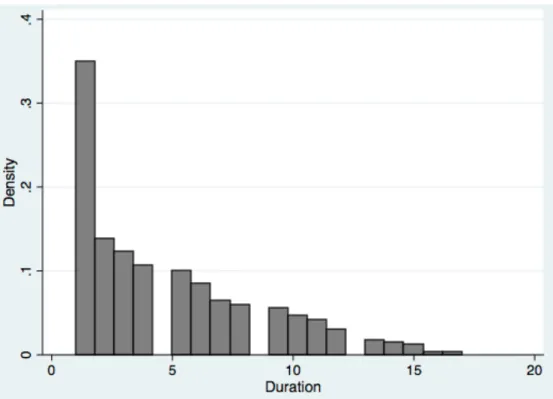
The data show 88 cases in which the government is victorious, which in turn accounts for about 73% of the terrorism campaigns. On average, the survival time of a terrorist group is 4.68 years, with a standard deviation of 3.74, and a 17-year maximum survival time (roughly the entire period studied). Please see Figure 2 for a graph of the duration of terrorist campaigns in Africa 1990-2006.
10 Available at http://www.start.umd.edu/tops/
Figure 2. The Duration of Terrorist Campaigns in Africa 1990-2006 Control Variables
For Hypothesis 1, I draw on the following works for my control variables: Li and Schaub (2004), Li (2005), Piazza (2008), Young and Findley (2011), and Aksoy and Carter (2014). Based on these studies, the continuous control variables I identify are: GDP per capita and country size (land). The dichotomous control variables I identify are: oil production, democracy (political participation [from Polity]), geographic location (North Africa or Sub-Saharan), and presence of civil war. Below I explain the decision to control for these variables.
To better isolate the effect of PPI on terrorism levels, I control for GDP per capita because the literature shows possible links between the developmental level of a country and terrorism levels. Drawing from Fearon and Laitin (2003) and Hegre and Sambanis (2006), I use the logs of the GDP per capita in 2014 USD. These data are also lagged by one year. I obtain these measures from the World Bank’s “Africa Development Indicators 2013” data set. Lastly, I also control for the logged land size of each state in squared kilometers (Marshall et al. 2012).
Thus, an oil producer is a state with over 6.66 million barrels of proven oil reserves. I use data from British Petroleum Statistical Review of World Energy.12 Additionally, I control for whether
a state is a democracy. Deferring to the Polity IV data set (Marshall et al. 2012), states with a polity score greater than 6 are coded as democracies (coded with a 1), while all other states are considered non-democratic (coded with a 0). This attempts to control for the possibility that the extent to which a regime is democratic affects terrorism count due to media coverage level etc. (Li 2005). Also, I use a dichotomous variable to control for a state being in North Africa.13 Lastly, I control for whether a civil war is going on through the use of a dummy variable.
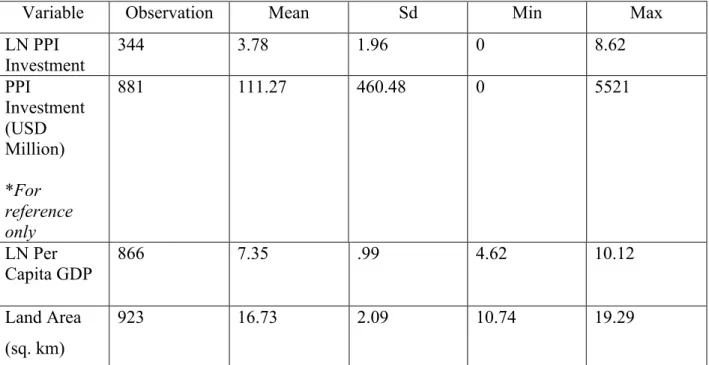
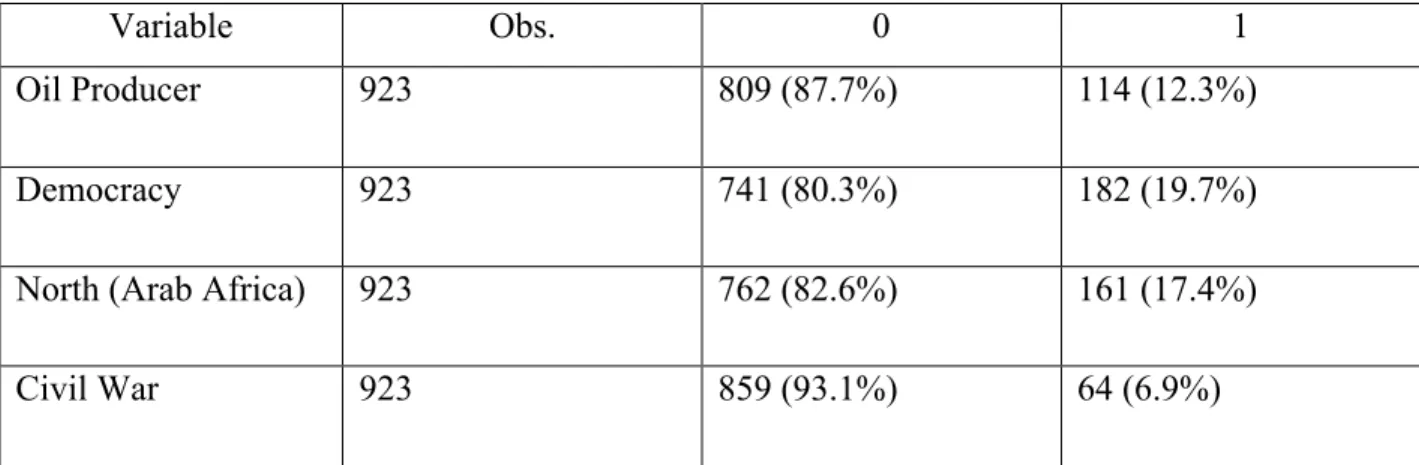
Drawing from the UCDP/PRIO dataset, I code a country with a 1 if there is an ongoing civil war and 0 if there is not (Gleditsch et al., 2002). Descriptives for Hypothesis 1 can be found in Tables 1a and 1b below. While the key explanatory variable is logged PPI Investment, I include the PPI Investment in USD Millions for reference.
Table 1a. Hypothesis 1 Descriptive Statistics (Continuous Variables)
Variable Observation Mean Sd Min Max
LN PPI Investment
344 3.78 1.96 0 8.62
PPI
Investment (USD Million) *For reference only
881 111.27 460.48 0 5521
LN Per Capita GDP
866 7.35 .99 4.62 10.12
Land Area (sq. km)
923 16.73 2.09 10.74 19.29
Table 1b. Hypothesis 1 Descriptive Statistics (Dichotomous Variables)
12 Available at: http://www.bp.com/en/global/corporate/about-bp/energy-economics/statistical-review-of-world-
energy-2013.html
13 The variable “North” also controls for areas where al Qaeda affiliates later emerged. Although the dataset only
Variable Obs. 0 1
Oil Producer 923 809 (87.7%) 114 (12.3%)
Democracy 923 741 (80.3%) 182 (19.7%)
North (Arab Africa) 923 762 (82.6%) 161 (17.4%)
Civil War 923 859 (93.1%) 64 (6.9%)
For Hypothesis 2 and the duration/survival of terrorist campaigns, I control for fewer variables due to the smaller data set. Again, I control for land area and civil war for similar reasons to those outlined for Hypothesis 1 above. However, I also control for military personnel (a measure of military capacity) instead of GDP per capita. While military capacity is a function of GDP, it is a more nuanced variable that illustrates the ability of a government to end a
terrorism campaign, which therefore may affect the duration of these campaigns. I include this military personnel variable by logging the indicator for the size of each military from the Correlates of War database (Singer et al., 1972). Finally, I also control for infant mortality, which acts as one of the best predictors of state failure and could also affect the duration of terrorism campaigns (Rotberg 2003). Descriptives for Hypothesis 2 can be found in Tables 2a and 2b below. Again, I include the variables of PPI Investment and Cumulative PPI Investment in USD Millions for reference, though the logged versions of these variables are the main indicators in the analysis.
Table 2a. Hypothesis 2 Descriptive Statistics (Continuous Variables)
Variable Observation Mean Sd Min Max
LN PPI
Investment 425 2.41 3.02 0 8.62
LN
Cumulative PPI
Investment
425 3.65 3.66 0 10.09
PPI
(USD Millions) *For reference only
Cumulative PPI
Investment (USD Millions) *For reference only
425 1977.16 4123.69 0 24126
Land Area (sq. km)
425 17.78 2.09 10.74 19.29
LN Military Personnel
398 4.02 .91 .69 6.15
Infant Mortality
425 74.50 32.00 18.30 164.50
Table 2b. Hypothesis 2 Descriptive Statistics (Dichotomous Variables)
Variable Obs. 0 1
Civil War 425 356 (83.76%) 69 (16.24%)
Statistical Method
I conduct multivariate statistical analyses to test my hypotheses. For the first hypothesis, I want to capture terrorism as a count of incidents, while capturing the phenomenon of contagion that is often associated with terrorism (Cliff and First 2013), so I use a negative binomial
regression to model the count of terrorist attacks per African country year in relation to the USD amount of PPI Investment (Table 3).
use the Cox Model to test the rate of group disintegration. This is known as a non-parametric survival model with a probability distribution and is often used to flexibly model the failure rate of a product over time or the survivability of a sick patient over time. In this case, I model terrorist group survivability over time and expect to find the coefficient for PPI Investment to be significant and negative at the .05 level and the coefficient for the Cumulative PPI Investment to be significant and positive at the .05 level. In accordance with Hypothesis 2, I expect that PPI investment in its outset will increase the chance of prolonging terrorism campaign duration, but over time the cumulative effect of PPI investment will enhance the chance of the state prevailing over terrorist groups. For robustness, I also test the explanatory variables with Probit and Logit models including a cubic polynomial to control for temporal dependence (see Table 4 below). I use robust standard errors clustered by country to estimate the models.
Results Hypothesis 1
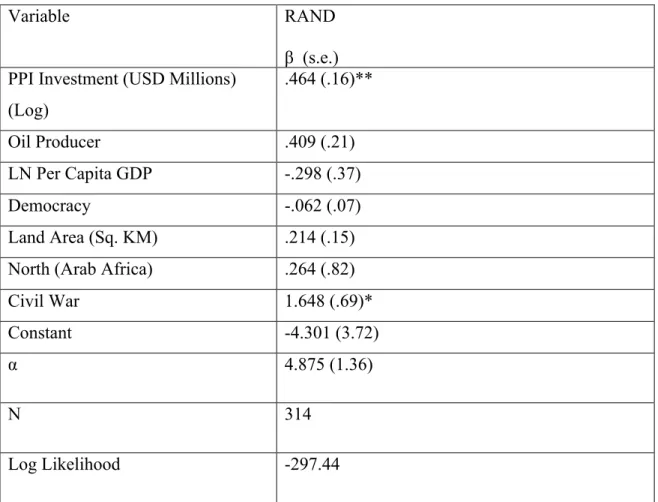
Table 3. The Effect of PPI Investment (USD Millions) on Terrorist Attacks
Variable RAND
β (s.e.) PPI Investment (USD Millions)
(Log)
.464 (.16)**
Oil Producer .409 (.21)
LN Per Capita GDP -.298 (.37)
Democracy -.062 (.07)
Land Area (Sq. KM) .214 (.15)
North (Arab Africa) .264 (.82)
Civil War 1.648 (.69)*
Constant -4.301 (3.72)
α 4.875 (1.36)
N 314
Pr. > chi2 .00 *p<.05; **p<.01
Table 4 displays the results of the test for Hypothesis 1. By examining the table we see that PPI Investment (USD Millions) has a positive and statistically significant coefficient when tested on the RAND Database of Worldwide Terrorism Incidents. If I look at the Incidence Rate Ratio, I can examine the substantive effect of increasing PPI Investment. Using the RAND indicator, a one unit increase in logged PPI Investment associates with a 137% increase in the chance of a terrorist event. Increasing PPI Investment therefore substantially increases the likelihood of an additional terrorist event in the African states.
Figure 3. The Effect of PPI Investment (USD Millions) on Terrorist Attacks
increasing Logged PPI Investment past the mean of 3.8 has an exponential effect on the number of predicted terrorist attacks. The mean is associated with .4 predicted attacks, one standard deviation away from the mean corresponds to 1.4 predicted attacks, and 2 standard deviations from the mean correspond with roughly 5 predicted attacks. Increasing PPI Investment by 1 standard deviation above the mean leads to an approximate 350% increase in the probability of an attack, while increasing PPI Investment by 2 standard deviations enlarges this percent increase by a factor of 4.
These findings are in accordance with Hypothesis 1 and the theory. The additional state power and penetration into previously ungoverned territories, which is associated with the PPI Investment, appears to instigate a rise in terrorist attacks.
Hypothesis 2
Table 4. The Effect of PPI Investment on the Hazard of Government Success
Variable Cox
β (s.e.)
Probit β (s.e.)
Logit β (s.e.) PPI Investment
(USD Millions) (Log)
-.11 (.05)* -.10 (.04)* -.17 (.07)*
Cumulative PPI Investment (USD Millions) (Log)
.12 (.05)* .10 (.04)* .18 (.07)*
Land Area (Sq. KM)
.31 (.09)** .15 (.06)* .33 (.13)*
Military Capacity
-.45 (.18)* -.29 (.15)* -.53 (.29)
Infant Mortality .00 (.00) .00 (.00) .00 (.01)
Constant -.75 (1.14) -2.03 (2.19)
N 396 396 396
Log Likelihood -309.64 -146.27 -144.56
Pr. > chi2 .00 .00 .00
*p<.05; **p<.01
Let us now look at Table 4, which shows the results from my test of Hypothesis 2. The PPI Investment variable and the Cumulative PPI Investment variable are both statistically significant across the Cox, Probit, and Logit models. Moreover, we can see that the PPI
Investment variable is negative, while the Cumulative PPI Investment variable is positive. This supports the argument of Hypothesis 2, which states that on the surface an increase in PPI Investment decreases the ability of the government to defeat or negotiate with a terrorist group, but the cumulative impact of PPI Investment will overall increase the probability that a terrorist campaign terminates in the face of the state government.
Look to the Cox distributions in Figures 4a and 4b (below) for an illustration of these phenomena. First of all, I want to call attention to the shape of the two graphs. In the terrorism campaigns studied, over time the hazard rate of government success decreases, hits a low point, and then increases again. This indicates that terrorism campaigns tend to lose steam if too much time has passed and they are still conducting attacks, rather than having transitioned to simply governing a territory without violence etc.
survival is roughly 1.33 times more likely. Thus, an initial increase in PPI Investment increases the chance of terrorist campaign survival as stated in part 1 of Hypothesis 2. However, in Figure 4b we see the effect of increasing Cumulative PPI Investment from the mean (Cumulative PPI Investment = 3.6) to one standard deviation above the mean (Cumulative PPI Investment = 7.3). In this case, we see that overall the hazard of terrorist group termination increases by about 150% as Cumulative PPI Investment increases on the African continent. In other words, in Figure 3b we see that as cumulative investment (logged) increases by one standard deviation above the mean the government is 1.5 times more likely to prevail over a terrorist group. This is evidence in support of the prediction made in the second part of Hypothesis 2.
Figure 4b: The Effect of Increasing Cumulative PPI Investment on the Hazard of Government Success in Terrorism Campaigns
Taken together with the theory, we see that PPI Investment initially seems to decrease the probability of government success. However, Cumulative PPI Investment creates and captures a far-reaching effect on the relationship between governments and terrorist groups, which
eventually increases the probability of government success.
CASE STUDY: MEND AND ENERGY INFRASTRUCTURE IN THE NIGER DELTA PPI and Terrorist Attacks
Nigeria is ranked as the largest oil producer in Africa and the world’s eighth largest oil exporter (EIA 2014). Nigeria’s economy is also largely oil dependent and 40% of Nigeria’s GDP, 90% of foreign exchange earnings, and 80% of government revenues can be attributed to the oil industry (Omeje 2006, 44). Most significantly, Nigeria’s energy industry is primarily located in the Niger Delta (EIA 2014). MNCs operate in joint ventures with the state-owned Nigerian National Oil Corporation (NNPC) (EIA 2014) to control most of the oil and energy infrastructure in the region. There are over a dozen domestic crude oil pipelines that funnel oil to export terminals and domestic refineries, most of which are jointly owned by major MNCs and the Nigerian government (EIA 2014). The leading MNC in the Delta is Royal Dutch Shell, and other major players include ExxonMobil, Chevron, Total, Eni, Addax Petroleum,
ConocoPhillips, Petrobras, and StatoilHydro (EIA 2014).
Nevertheless, the Niger Delta is also home to over 20 ethnic groups that comprise over 1,600 autonomous communities (Omeje 2006, 45). Historically, rebel militias dominated the Niger Delta and the government had minimal state penetration into the territory (Suarez 2005). During the Cold War, oil companies even used rebel militias for security and protection over their investment projects. Specifically among the Ijaw and Ogoni populations in the region, this led to heightened autonomy for militant groups. However, with the end of the Cold War and the adoption of neoliberal reforms in the 1990s, the Nigerian central government and the U.S.
increased cooperation, leading to an overall strengthening of the Nigerian government and a vote of confidence for the private sector looking to invest in the country. With state strength on the rise, MNCs transitioned towards dealing with the central government (instead of militant groups) for security on infrastructure investments. Nevertheless, with the central government and MNCs largely focused on profit maximization, income inequality and environmental degradation increased in the region over time.
Many Delta populations began to feel that indigenous control of the territory’s energy and oil infrastructure would yield poverty relief (Omeje 2006, 45). Militant groups in the Niger Delta began to issue low level attacks against the territory’s public-private oil facilities (EIA 2014), with the main grievance being the control of the energy infrastructure and ultimate control of exports and oil revenues (EIA 2014). In light of the rising political unrest, the state responded by pushing even further into the territory. To mitigate social grievances in the Delta, the
a surge in public-private partnerships between MNCs and the Nigerian National Oil Corporation (NNOC). The previously militant-controlled territory was seeing a decrease in local autonomy, with the government and MNCs enjoying a lion-share of the profits. Most of the MNCs were from the U.S., China, and Europe, making the support for the Nigerian government’s resource control in the Delta seem unstoppable.
In early 2006, however, a militant group called MEND started a campaign of terrorism against MNCs in the region, with the aim of obtaining greater control of the territory’s oil and energy infrastructure (Omeje 2006, 44). A major impetus for MEND’s emergence and shift towards violence was likely the 2005 sale of public lands to MNCs. 2005 marked the peak of public-private energy infrastructure expansion and oil production in the Niger Delta. Exploration peaked at the drilling of over 20 exploratory wells, and production peaked at 2.63 million barrels per day (EIA 2014, 3-4). In August 2005 the largest recorded number of private oil and gas industry players gathered to bid in the first parceling of Nigerian territory for investment since 2000 (Nigerian National Petroleum Corporation 2010). The bid round offered over 70 blocks of land in the Niger Delta (Nigerian National Petroleum Corporation 2010), which threatened MEND’s monopoly on power and resources. Thus, MEND’s stated aim was to “destroy the capacity of the Nigerian government to export oil” (Howden, 2006). Its attacks intended to sever the agreements between MNCs and the NNOC, ultimately ousting PPI investment from the region and ending central government penetration. In a statement to MNCs in the region, MEND asserted, “It must be clear that the Nigerian government cannot protect your workers or assets. Leave our land while you can or die in it” (Howden 2006). This reaction of terrorism escalation in the face of MNC investment explains how PPI can yield militant violence against state penetration in previously ungoverned territories. In other words, the MNC investment and state penetration leads to increased territorial and resource contestation, which can cause militant groups to escalate violence and invoke terrorism campaigns as a strategy to oust investment and regain territorial control (Hypothesis 1).
PPI and Terrorist Group Survivability
Furthermore, the MEND case is interesting from the perspective of terrorism campaign duration analysis. As PPI investment initially increased in the Delta, the lifespan of MEND’s terrorism campaign seemed strong. With a clear list of grievances against specific PPI
industry. One of its first attacks came in January 2006 when militants stormed a Shell Oil facility and killed 17 people (Howden 2006). Other attacks in response to this initial increased PPI investment came in the form of car bombings, pipeline vandalism, and killing of foreign oil workers (Howden 2006). The campaign appeared both sustainable and successful (“Shell, Others Flee Offshore Amid Onshore Woes” 2013). From the perspective of the Nigerian state, during the early stages of investment the government was still trying to ride the line between
incentivizing MNC investment and mitigating escalating social grievances in the region. The spikes in terrorism between 2006 and 2009 hurt the Nigerian economy, the Niger Delta MNCs, and the countries that import Nigerian oil. Shell evacuated nearly 100 employees in 2008 and Nigerian oil revenues fell by a third during this time period (“Oil Workers Flee Attacks by Militants in Nigeria” 2008). As PPI investment increased each year, the probability of government success over the MEND campaign seemed to decrease.
However, overall PPI Investment did not fall in the Niger Delta between 2006 and 2009. MNCs were not easily intimated into departure and instead opted for alternative methods of energy development and oil revenue. For example, the MNCs brokered temporary deals with smaller oil companies on their riskier onshore blocks. They also temporarily moved oil infrastructure to deep-sea offshore fields, yet maintained access to key onshore pipelines and refineries in the Delta region (“Shell, Others Flee Offshore Amid Onshore Woes” 2013). Most MNCs decided that it was more cost-efficient to maintain control of energy infrastructure in the Niger Delta, and they worked to out-last MEND’s terrorism campaign.
With sustained PPI investment over time, the resources pouring into the region
accumulated. This caused the strength and penetration of the Nigerian government to accumulate in the Delta as well, in accordance with the sustained backing from the MNCs. Cumulative PPI Investment had a substantive impact in the Delta over time, manifesting in the increased power of the Nigerian government to end the MEND terrorism campaign. MEND felt this increased state power as displayed by a shift in targets near the end of their campaign. As PPI investment accumulated and Nigerian state capacity became more threatening and intrusive in the Delta, MEND began attacking the state’s center. In early 2009 it attacked Nigerian soldiers in the Delta region and in July 2009 it carried out its first attack on Lagos. During this time, MEND’s
MEND efforts towards the state center is indicative of the strengthening of the Nigerian government with sustained and accumulating PPI investment. Thus, as PPI Investment accumulated between 2006 and 2009, the Nigerian government’s probability of successfully disbanding MEND increased as well.
Though the Nigerian government launched a military campaign to crush MEND, in late 2009 it granted MEND an amnesty deal that dissolved the organization (Rice 2009). 10,000 MEND militants were offered an unconditional pardon and cash payments, as well as the freeing of leader Henry Okah. In exchange, MEND leaders agreed to lay down arms and basically disappear from the Delta (Rice 2009). MEND officials have vocally and adamantly asserted that the militant group is “dead” (Amaize 2013). In light of sustained MNC presence in the region, the impact of PPI investment accumulated throughout the terrorism campaign, which
strengthened the state. With its increasing monopoly on resources, territory, and power in the Delta, the Nigerian government became increasingly capable of either forcefully or peacefully disbanding MEND (Hypothesis 2). Ultimately, MEND could not sustain its campaign in the face of the Nigerian government bolstered by MNC engagement. While initial increases in PPI investment seem to reduce the likelihood of state success over terrorism campaigns, as PPI investment accumulates over time the likelihood of government success over the survival of terrorist campaigns increases.
CONCLUSION
however, cumulative and sustained PPI will lead to greater state strength and a greater probability of government victory over terrorism campaigns.
Still, my research has some limitations that also raise interesting implications for future studies. The analysis is limited in that it focuses on statistical methodology, but is lacking in case studies. Further research should employ narratives and country examples to test the theoretical argument against additional specific incidents of investment and terrorism on the continent.. Moreover, for certain case studies, Geographic Information Systems (GIS) modeling would add to the analysis by creating a concrete and visual representation of PPI and state expansion in relation to sub-state territorial control and terrorism over time. Also, infrastructure is only one major sector of African economies, and further research should examine whether the theory presented here is applicable to other sectors of MNC African investment, such as agribusiness and healthcare.
REFERENCES
Abrahamsen, Rita. 2004. Review of African Political Economy. Agendas, Past & Future 31(102): 677–684. http://www.jstor.org/stable/4007037.
Amaize, Emma. 2013. “Nigeria: Warri Refinery Explosion - MEND Died in 2009 - Ex-Militant Leaders.” All Africa, October 24. http://allafrica.com/stories/201310240235.html. “Africa Rising: The Hopeful Continent.” 2011. The Economist, December 3.
http://www.economist.com/node/21541015.
Aksoy, Deniz, and David B Carter. 2014. Electoral Institutions and the Emergence of Terrorist Groups. British Journal of Political Science 44 (01) (January): 181–204.
http://journals.cambridge.org/abstract_S0007123412000282.
Azam, Jean-Paul, and Véronique Thelen . 2008. The Roles of Foreign Aid and Education in the War on Terror. Public Choice 135 (3-4): 375–397. doi:10.1007/s11127-007-9268-4. Berrebi, Claude, and Darius Lakdawalla. 2007. How Does Terrorism Risk Vary Across Space
and Time? An Analysis Based on the Israeli Experience. Defense and Peace Economics 18 (2): 113–131.
Clapham, Christopher. 1996. Africa and the International System: The Politics of State Survival. Cambridge: Cambridge University Press.
Cliff, Christina and Andrew First. 2013. Testing for Contagion/Diffusion of Terrorism in State Dyads, Studies in Conflict & Terrorism 36 (4): 292-314. DOI:
10.1080/1057610X.2013.763599.
EIA: U.S. Energy Information Administration. 2014. Country Analysis Brief: Nigeria. Washington, D.C. U.S. EIA. http://www.eia.gov/countries/cab.cfm?fips=ni.
Enders, Walter and Todd Sandler. 2004. An Economic Perspective on Transnational Terrorism. European Journal of Political Economy 20 (2): 301–316.
http://www.sciencedirect.com/science/article/pii/S0176268003001046.
FACT SHEET: The Doing Business in Africa Campaign. 2014.The White House Office of the Press Secretary, August 5. Retrieved from http://www.whitehouse.gov/the-press-office/2014/08/05/fact-sheet-doing-business-africa-campaign.
Foster, Vivien, and Cecilia Briceño-Garmendia. 2010. Africa’s Infrastructure: A Time for Transformation. The International Bank for Reconstruction and Development/The World Bank Group.
http://infrastructureafrica.org/library/doc/552/africa%E2%80%99s-infrastructure-time-transformation.
Gleditsch, Nils Petter, Peter Wallenstein, Mikael Eriksson, Margareta Sollenberg, and Havard Strand. 2002. Armed Conflict 1941-2001: A New Dataset. Journal of Peace Research 39(5): 615-637.
Hegre, Havard and Nicholas Sambanis. 2006. Sensitivity Analysis of Empirical Results on Civil War. Journal of Conflict Resolution 50(4): 508-535. Retrieved from
http://search.proquest.com/docview/224556662?accountid=14244.
Howden, Daniel. 2006. “NIGERIA: Shell May Pull Out of Niger Delta After 17 Die in Boat Raid.” CorpWatch, January 17. http://www.corpwatch.org/article.php?id=13121. Illife, John. 2007. Africans: The History of a Continent. Second Edition. Cambridge.
International Institute for Strategic Studies (IISS). 2014. “The Military Balance 1990-2006.” Sub-Saharan Africa and North Africa. ISSN: 1479-9022 (online). Retrieved from: http://www.tandfonline.com/toc/tmib20/current#cited.
“Investing in Africa: The Hottest Frontier.” 2013. The Economist, April 6.
http://www.economist.com/news/finance-and-economics/21575769-strategies-putting-money-work-fast-growing-continent-hottest.
“Jihad in Africa: The Danger in the Desert.” 2013. The Economist, January 26.
http://www.economist.com/news/briefing/21570720-terrorism-algeria-and-war-mali-demonstrate-increasing-reach-islamist-extremism.
Jones, Seth G, and Martin C Libicki. 2008. How Terrorist Groups End: Lessons for Countering Al Qa’ida. RAND Corporation. http://www.rand.org/pubs/monographs/MG741-1.html. Kahn, Jospeh, and Tim Weiner. 2002. “World Leaders Rethinking Strategy on Aid to Poor.” The
New York Times, March 18. http://www.nytimes.com/2002/03/18/world/world-leaders-rethinking-strategy-on-aid-to-poor.html.
Kalyvas, Stathis N. 2006. The Logic of Violence and Civil War. Cambridge: Cambridge University Press.
Krueger, Alan B, and Jitka Malečková. 2003. Education, Poverty and Terrorism. The Journal of Economic Perspective 17 (4): 119–144. http://www.jstor.org/stable/3216934.
Kurrild-Klitgaard, Peter, Mogens K Justesen, and Robert Klemmensen. 2006. The Political Economy of Freedom, Democracy and Transnational Terrorism. Public Choice 128(1-2): 289–315. http://www.jstor.org/stable/30026646.
Lai, Brian. 2007. Draining the Swamp: An Empirical Examination of the Production of International Terrorism, 1968–1998. Conflict Management and Peace Science 24(4): 297–310. doi:10.1080/07388940701643649.
Leke, A., Lund, S., & van Wamelen, A. 2010. What’s Driving Africa’s Growth. McKinsey & Company: Insights and Publications. Retrieved from
http://www.mckinsey.com/insights/economic_studies/whats_driving_africas_growth. Li, Quan. 2005. Does Democracy Promote or Reduce Transnational Terrorist Incidents? The Journal of Conflict Resolution 49(2): 278–297. http://www.jstor.org/stable/30045112. Li, Quan, and Drew Schaub. 2004. Economic Globalization and Transnational Terrorism: A
Pooled Time-Series Analysis. The Journal of Conflict Resolution 48(2): 230–258. http://www.jstor.org/stable/3176252.
Marshall, Monty G. and Keith Jaggers. 2012. Polity IV Dataset Version 2007 and Dataset Users’ Manual. Fairfax: VA: Center for Systemic Peace and the Center for Global Policy.
George Mason University. http://www.systemicpeace.org.
Miguel, Edward, Shanker Satyanath, and Ernest Sergenti. 2004. Economic Shocks and Civil Conflict: An Instrumental Variables Approach. Journal of Political Economy 112(4): 725–753. http://www.jstor.org/stable/10.1086/421174.
Narsiah, Sagie. 2002. Neoliberalism and Privatization in South Africa. GeoJournal 57(1-2): 3– 13. doi:10.1023/A:1026022903276.
“Oil Workers Flee Attacks by Militants in Nigeria.” 2008. The New York Times, September 15. http://www.nytimes.com/2008/09/16/world/africa/16nigeria.html?_r=0.
Omeje, Kenneth. 2006. “Oil Conflict and Accumulation Politics in Nigeria.” Environmental Change and Security Program: Wilson Center.
http://www.wilsoncenter.org/publication/oil-conflict-and-accumulation-politics-nigeria. National Consortium for the Study of Terrorism and Responses to Terrorism (START). 2012.
Piazza, James A. 2006. Rooted in Poverty?: Terrorism, Poor Economic Development, and Social Cleavages. Terrorism and Political Violence 18(1): 159–177.
doi:10.1080/095465590944578.
Piazza, James A. 2008. Incubators of Terror: Do Failed and Failing States Promote Transnational Terrorism? International Studies Quarterly 52(3): 469–488.
http://www.jstor.org/stable/29734247.
Rabasa, Angel, Steven Boraz, Peter Chalk, Kim Cragin, Theodore W Karasik, Jennifer D Moroney, Kevin A O’Brien, and John E Peters. 2007. Ungoverned Territories: Understanding and Reducing Terrorism Risks. RAND Corporation.
http://www.rand.org/pubs/monographs/MG561.html.
Rice, Xan. 2009. “Nigeria Begins Amnesty for Niger Delta Militants.” The Guardian, August 6. http://www.theguardian.com/world/2009/aug/06/niger-delta-militants-amnesty-launched. Rotberg, R. (Ed.). 2003. When States Fail: Causes and Consequences. Princeton University
Press.
Sandler, Todd, and Harvey E. Lapan. 1988. The Calculus of Dissent: An Analysis of Terrorist Choice of Target. Synthese 76: 245-261.
“Shell, Others Flee Offshore Amid Onshore Woes.” 2013. The Nation, August 1. http://thenationonlineng.net/new/shell-others-flee-offshore-amid-onshore-woes/. Singer, J. David, Stuart Bremer, and John Stuckey. 1972. Capability Distribution, Uncertainty,
and Major Power War, 1820-1965. in Bruce Russett. Ed. Peace, War, and Numbers, Beverly Hills: Sage, 19-48.
Siqueira, Kevin, and Todd Sandler. 2006. Terrorists Versus the Government: Strategic Interaction, Support, and Sponsorship. The Journal of Conflict Resolution 50(6): 878– 898. http://www.jstor.org/stable/27638529.
Slantchev, B. L. 2012. Borrowed Power: Debt Finance and the Resort to Arms. The American Political Science Review 106(4), 787–809.
doi:http://dx.doi.org.libproxy.lib.unc.edu/10.1017/S0003055412000378.
Suarez, Ray. Interview with Steve Inskeep. 2005. “Tension Over Oil in Nigeria.” PBS, August 25. http://www.pbs.org/newshour/bb/africa/july-dec05/oil_8-25.html.
U.S. Department of State, Office for the Coordination of Counterterrorism. 2013. Country Reports on Terrorism 2012. Chapter 2 (May 30). Washington, D.C. U.S. Department of State. http://www.state.gov/j/ct/rls/crt/2012/209979.htm.
Weinstein, Jeremy M. 2007. Inside Rebellion. Cambridge: Cambridge University Press. Wood, Reed. 2010. Rebel Capability and Strategic Violence Against Civilians. Journal for
Peace Research 47 (5): 601–614. doi:10.1177/0022343310376473.
World Bank. 1994. World Development Report 1994: Infrastructure for Development. Washington D.C., World Bank. License: CC BY 3.0 IGO.
https://openknowledge.worldbank.org/handle/10986/5977.
World Bank. 2013a. Africa Development Indicators 2013. Washington, D.C., World Bank. Retrieved from: http://data.worldbank.org/data-catalog/africa-development-indicators. World Bank: Infrastructure Policy Unit of the World Bank’s Sustainable Development Network,
and the Public-Private Infrastructure Advisory Facility. 2013b. Private Participation in Infrastructure Database. Washington, D.C. World Bank. Retrieved from
http://ppi.worldbank.org/.
World Bank. 2014. World Development Indicators. Washington, D.C. World Bank. http://www.worldbank.org/data.