BACKGROUND
The current landscape of health-system pharmacy practice is rapidly changing. As
pharmacists are further integrated into the medical team, their time is increasingly consumed
with clinical services including, but not limited to, participating in daily rounds and using
specialized knowledge to improve overall healthcare through consultation with other medical
professionals. This move away from traditional pill counting and prescription dispensation has
made pharmacists much more vital to daily operations of the healthcare system, especially in a
hospital setting.
This increased need for pharmacist presence can create a hardship for institutions when these
professionals must miss work to participate in a conference where they need to obtain continuing
education (CE) in order to maintain an active license. For example, currently in the state of
North Carolina, 8 of the 15 CE credits that a pharmacist must complete each year to maintain
licensure must be considered “live”.1
A live CE course must offer the opportunity for live, two-way communication between the
presenter and attendee.1 As such, this is not a course that historically could be taken in the midst
of patient care. If the individual is attending a conference, the pharmacist must take, at minimum,
a day away from work in order to complete the course, more if travel is involved. In addition to
time away from work, there is often significant cost to the institution for which the pharmacist
works if the organization reimburses for attendance (Table 1). Even if they do not, there is still
the cost for covering that individual’s patient care responsibilities.
Travel is commonly a factor in obtaining live CE hours, as many pharmacists receive their
hours by attending a professional conference. This method allows the pharmacist to register
typically requires several days away from the hospital. It would be beneficial for many
healthcare systems if these pharmacists were able to complete their required CE hours without
taking time from their practice sites. While this is possible at some institutions, this opportunity
does not occur at all due to lack of presenters or ability to get CE. Even if a hospital does offer it,
there are many employee schedules (nights, evenings, weekends, part-time, etc) where this is not
reasonable for them to attend. Therefore, on-line CEs or webinars are used to provide a different
medium. Depending on how they are structured, they might not be qualified as live CE or require
one to listen but not view the presenter.
Table 1
Example cost to a healthcare institution to send a pharmacist to a professional conference3,4,5,6
ASHPa NCAPb
Cost ($) Cost/Day ($) Cost ($) Cost/Day ($)
Registration 630.00 126.00 325.00 108.33
Hotel 740.00 185.00 489.00 163.00
Fill-in Hospital Personnel 2,252.40 450.48 1,351.44 450.48
Travel 282.35 56.47 15.00 5.00
Total 3,844.75 768.95 2,180.44 726.81
aASHP: American Society of Health-System Pharmacists (national conference)
bNCAP: North Carolina Association of Pharmacists (statewide conference)
In an attempt to satisfy the two-way communication required of a live CE course, and to
CE courses have been developed. These courses exist in two main formats, webinar and
webcast. A webinar is defined as “a live online educational presentation during which
participating viewers can submit questions and comments.”7 This format typically contains a
presentation of slides accompanied by simple audio (Figure 1). A webcast is defined as “a
transmission of sound and images (as of an event) via the World Wide Web.”8 In addition to the
visual aides of a webcast, a webinar also captures the image of the presenter, more closely
recreating an in-person learning experience (Figure 2). Past studies have come to a general
conclusion that there is no difference in the ability of a live program vs. a mediated (print, audio,
internet) program to successfully transmit knowledge.2
Figure 1
Screen shot from a webinar presentation.
Figure 2
Screen shot from a UNC Pharmacy Grand Rounds webcast.
A study by Buxton and De Muth compared an in-person CE course in Wisconsin to the same
course delivered to distance learners as a webinar. They collected surveys from 14 local and 15
distance participants. They found that participants felt more satisfied with the content when they
attended the lecture in-person. Local participants felt more confident in their knowledge
(median=5 vs. 4; p=0.005) and felt the attendance fee was more justified (median=5 vs. 4;
p=0.002).9
Pharmacy Grand Rounds, as put on by the University of North Carolina at Chapel Hill in
partnership with American Society of Health-System Pharmacists (ASHP), is one program that
pharmacist. Membership is institutional and the per participant cost decreases as enrollment
increases. For example, with 1 participant, in 2016 the institution would pay $125. However,
with 60 participants, the cost per participant decreases to $33.75.10 Fees give access to up to 12
hours of live CE/participant and 18 hours of archived content, as well as eliminate travel and
shift coverage fees associated with traditional live CE courses found at conferences.
Unlike the webinar format used in the Wisconsin study, Pharmacy Grand Rounds
incorporates video of the presenter(s), bringing the information to the learner in webcast format.
The majority of live CE offered to pharmacists is in the webcast format. Due to this difference, it
is important to assess whether or not this specific format can effectively and reliably transmit the
necessary knowledge to justify use as a tool in place of an actual, in-person live CE course. The
authors are unaware of any study evaluating these methods within pharmacy. This
investigational study was conducted to examine the perceptions of effectiveness of PGR as
compared to the current standard of live CE courses as provided at the ASHP Midyear Clinical
Meeting (MCM).
METHODS
This was a 12-month retrospective, observational, institutional review board-approved cohort
study examining the quality of learning that is obtained from UNC Pharmacy Grand Rounds
online CE webcast courses. The purpose of this study was to determine the effectiveness of
information acquisition by the professionals who have taken the UNC Pharmacy Grand Rounds
courses as compared to that of professionals who attended the ASHP MCM in-person live CE
Following a CE course, participants were given questionnaires in which they rated the quality
of the presentations and the information obtained. Surveys for both formats had 10 identically
worded questions that were used for format comparison. One question collected demographic
information relating to the participant’s professional role. The remaining 9 questions were rated
using a Likert-type scale with answer choices from strongly disagree (0) to strongly agree (5).
(Table 3)
For inclusion in this study, participants must have attended a 2014 ASHP MCM live CE
course OR a 2014-2015 UNC Pharmacy Grand Rounds live CE course and returned a post-CE
survey for the relevant course. All analyses were done using JMP Pro software. Answers were
assumed to be continuous, and compared using means, medians, and standard deviations.
Table 2
Lectures paired for comparison
Topic MCM UNC
Pharmacogenomics Pharmacogenomics:
Demystifying the Science and Evidence Through Successful Practices
Pharmacogenomics 101: What Every Health-System
Pharmacist Should Know
Drug Shortage Where Have All the Drugs Gone? Patient Safety in the Face of Drug Shortages
Strategies for Managing Drug Shortages
Medication in Renal
Dysfunction Management Case Study: Using Patient-Specific Data to Drive Dynamic Order
Suggestions in Renally Dosed Medications
Medications and Management in the Renal Failure Patient
Toxicology Tox Tale Trio – Prescription Drugs, Occupational Hazards, and Household Toxic
Exposures
Let’s Tox: Overview and Management of Common Ingestions and Exposures
Resistance Prodigal Pathogens: Optimal Management of Highly Resistant Pathogens
Antibiotic Resistance: Origins, Mechanisms, and Responses
Anticoagulation Riding the Wave of Change: Caring for Anticoagulation Patients
Anticoagulation in Cancer Patients
Cardiology Demystifying Acute
Management of Atrial Fibrillation
Chronic and Acute Heart Failure: A Brief Update
Accreditation The Joint Commission Update for 2015
Foundational Topics in Hospital Pharmacy:
Accreditation and Medication Safety
Medication Reconciliation Pharmacy-Managed Medication Reconciliation Programs: Performance Strategies and Lessons Learned
Table 3 Survey questions answered after UNC Pharmacy Grand Rounds and MCM CE lectures
Question
I am likely to recommend this activity to a friend or colleague
I am satisfied with the educational content of this activity (topics, activities, and level of content) My learning needs were met in this activity
The learning objectives were met
Teaching methods were effective (examples: demonstrations, cases, polling questions) Educational materials were useful (examples: slides, handouts)
I was able to assess my learning during the activity (example: answered polling/self-assessment questions)
Please indicate the extent to which you disagree or agree with the following statement: “Faculty statements and therapeutic recommendations in this activity were based on supported evidence or professional opinion and did not evidence commercial bias.”
RESULTS
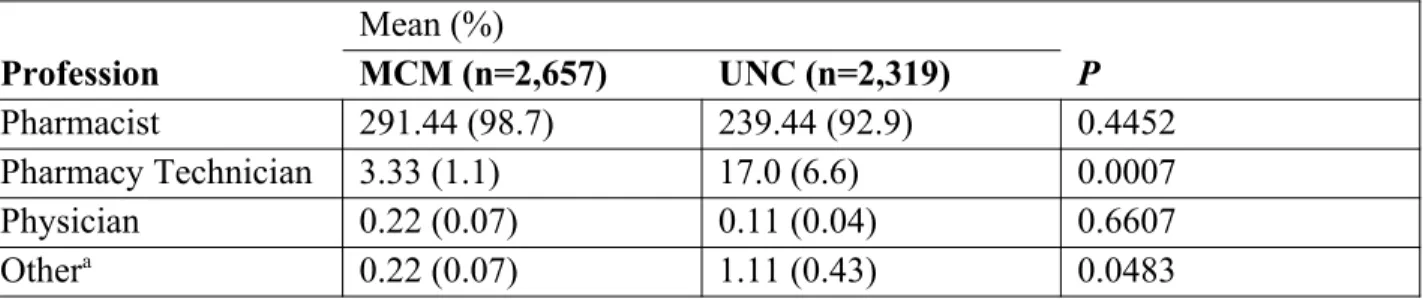
Surveys were collected from 2,657 MCM participants and 2,319 UNC Pharmacy Grand
Rounds participants. Pharmacists were the main participants in both the MCM and UNC
Pharmacy Grand Rounds groups (98.7% vs. 92.9%, p=0.4452). In the Pharmacy Grand Rounds
arm, there was a larger percentage of participants identifying as pharmacy technicians (6.6% vs.
1.1%; p=0.0007) and “other” (0.43% vs. 0.07%; p=0.0483). (Table 4)
The mean result for all answers for both platforms was greater than “Agree”, but less than
“Strongly Agree”, with a median score of 4 (Agree) for each question. There was a statistically
significant difference in favor of the face-to-face platform of MCM live CE for each question, as
illustrated in Table 5. The overall results of all pooled answers revealed the same. (Figure 3)
Mann Whitney U revealed a true between group difference at alpha 0.05 with p<0.0001. (Table
Table 4
Baseline characteristics
Mean (%)
Profession MCM (n=2,657) UNC (n=2,319) P
Pharmacist 291.44 (98.7) 239.44 (92.9) 0.4452
Pharmacy Technician 3.33 (1.1) 17.0 (6.6) 0.0007
Physician 0.22 (0.07) 0.11 (0.04) 0.6607
Othera 0.22 (0.07) 1.11 (0.43) 0.0483
aincludes nurses, nurse practitioners, residents, students, faculty, and other not listed
Table 5
Results by question
Mean + SD; Median
Question MCM
(n=2,657) UNC (n=2,319) P I am likely to recommend this activity to a friend
or colleague 4.39 + 0.62; 4 4.20 + 0.70; 4 <0.0001
I am satisfied with the educational content of this
activity (topics, activities, and level of content) 4.37 + 0.62; 4 4.22 + 0.68; 4 <0.0001 My learning needs were met in this activity 4.36 + 0.63; 4 4.20 + 0.68; 4 <0.0001 The learning objectives were met 4.38 + 0.60; 4 4.28 + 0.62; 4 <0.0001 Teaching methods were effective (examples:
demonstrations, cases, polling questions) 4.36 + 0.61; 4 4.18 + 0.67; 4 <0.0001 Educational materials were useful (examples:
slides, handouts) 4.34 + 0.62; 4 4.20 + 0.65; 4 <0.0001
I was able to assess my learning during the activity (example: answered polling/self-sassessment questions)
4.34 + 0.62; 4 4.18 + 0.66; 4 <0.0001
Please indicate the extent to which you disagree or agree with the following statement: “Faculty statements and therapeutic recommendations in this activity were based on supported evidence or professional opinion and did not evidence commercial bias.”
4.44 + 0.59; 4 4.38 + 0.63; 4 0.0009
Figure 3a
Overall pooled results by format
aMean + SD; Median: MCM 4.37 + 0.62; 4, UNC 4.23 + 0.67; 4 (p<0.0001)
Table 6
Mann Whitney U results
Variable Observations Minimum Maximum Mean Standard Deviation
MCM 23978 1.000 5.000 4.375 0.62
UNC 20852 1.000 5.000 4.228 0.67
U -23.68
P <0.0001
alpha 0.05
This study found that, while a statistically significant difference existed in favor of the MCM
educational platform, the median results were the same across all questions are platforms. This
median response was “agree”, which illustrates a similar overall participant satisfaction between
the differing learning environments.
There were several limitations to this study. Most notably, unlike the Wisconsin study,
matched lectures were neither identical nor given by the same presenter, although topics were
similar. In addition, the subjectivity of post-CE surveys may be influenced by presenter
perception, rather than information supplied. Other non-informational influences include
personal preference for type of learning, as well responder bias.
Despite the limitations, this study was meant to be exploratory to begin to examine
pharmacist perception of this type of CE delivery in the constantly evolving professional and
educational landscape. Although there were statistically significant differences in favor of MCM
delivery, it was the general consensus that both groups were mostly satisfied with their given
information delivery, with minimal “Disagree” or “Strongly Disagree” responses on each side.
It is also important to note the higher percentages of pharmacy technicians and “other” (non
pharmacist) participants in the UNC Grand Rounds group. As these educational experiences are
aimed at pharmacists, it is possible that the information was not delivered at a level beneficial to
these participants. Unfortunately, as answers were provided in aggregate form, it was impossible
to determine if these participants were, in fact, contributing to the group’s slightly lower
satisfaction ratings.
The field of pharmacy continues to expand, and there is an increasing need to deliver
effective live learning opportunities to pharmacists without removing them from their practice
for several days at a time.
It is important to note that median satisfaction scores for both groups were the same in this
study. Although differences were shown to be present between the two lecture formats, overall
satisfaction was similar in both groups. Additionally, there were more technicians in the UNC
Grand Rounds group, which may have impacted results due to differing base levels of
knowledge.
Future studies comparing identical lectures, delivered by the same presenter in both formats
would eliminate many of the limitations faced with this study. To remove perception bias and
subjectivity, it would be interesting to see a study comparing the results of knowledge-based
quizzes delivered at the end of studied lectures. Further studies are needed to fully elucidate the
effectiveness of UNC Pharmacy Grand Rounds as an educational tool for pharmacy
professionals.
REFERENCES
1. Ncbop.org. NCBOP - Pharmacist FAQs. 2016. Available at:
http://www.ncbop.org/faqs/Pharmacist/faq_ContEducation.htm. Accessed February 15,
2016.
2. D.E. Moore, Jr. et al Achieving Desired Results and Improved Outcomes: Integrating
3. Connect.ashp.org. Meeting Registration - MidYear. 2016. Available at:
http://connect.ashp.org/midyear/registration-travel/meeting-registration. Accessed
February 14, 2016.
4. NCpharmacists.org. 2016 NCAP Chronic Care Practice Forum Meeting. 2016. Available
at: http://www.ncpharmacists.org/ev_calendar_day.asp?date=3/16/2016&eventid=6.
Accessed April 4, 2016
5. News Observer. Salaries at UNC Hospitals. 2016. Available at:
http://www.newsobserver.com/news/databases/article11857613.html?
appSession=3908840070358499562447441150577291521625081605348474538819010
8311754214357705238292445434878558848732744055695346284854011115878.
Accessed February 14, 2016.
6. Delta.com. Airline Tickets and Flights to Worldwide Destinations: Delta Air Lines. 2016.
Available at: http://delta.com. Accessed February 10, 2016.
7. “webinar.” Merriam-Webster.com. Merriam-Webster, 2011. Web. 8 May 2011.
8. “webcast.” Merriam-Webster.com. Merriam-Webster, 2011. Web. 8 May 2011.
9. Buxton EC, De Muth JE. Pharmacists' perceptions of a live continuing education
program comparing distance learning versus local learning. Res Social Adm Pharm. 2013
Mar-Apr;9(2):230-5.
10. UNC Pharmacy Grand Rounds. Subscription Details. 2016. Available at: