Abstract
Herein we report a metal-free, acid initiated living cationic polymerization of 4-methoxystyrene mediated by a methanol additive. A study using alcohols of different nucleophilicity indicated that the molecular weight and dispersity of the synthesized polymers varies inversely with the nucleophilicity of the alcohol additive, with the best control imparted via methanol. Further studies on the effect of the loading of the acid initiator and methanol additive indicate that the molecular weight and dispersity of the synthesized poly(4-methoxystyrene) are controlled by the concentration of methanol rather than concentration of protonic acid initiator. We propose that methanol acts as a reversible chain-transfer agent, analogous to reversible addition fragmentation chain-transfer (RAFT) polymerization, regulating the equilibrium between the propagating active cation chain and the resulting oxonium intermediate. The molecular weights of the synthesized polymers were in good agreement with theoretical molecular weights, assuming that each molecule of methanol generates one polymer chain.
Introduction
However, achieving a high degree of control over this interchange between active and dormant species is difficult, particularly in cationic polymerizations.
Cationic polymerization is a type of chain growth polymerization that utilizes a carbocation as the propagating species. These polymerizations are characterized by rapid rates of propagation, greater than that of radical or anionic, as well as an increased sensitivity to solvent effects, trace impurities, and chain transfer of the propagating active site. The high reactivity of the growing carbocation chain and its inherent instabilities cause there to be a greater probability for uncontrolled termination of the polymer chains, making it almost impossible to synthesize structurally well-defined polymers in a “living” fashion.4 To overcome these challenges and achieve the reversible activation and deactivation process vital to controlled polymerizations, researchers have focused on methods to “control” the side reactions (e.g., chain termination and chain transfer) prevalent in cationic polymerizations.
ammonium salts with non-nucleophilic anions such as PF6-, BF4-, and CF3SO3- , also known as activators, are then required to activate the labile carbon halogen bond present in the acid adducts which generates the propagating carbocation site (Figure 1).7,19-22 The use of a strong activator requires the addition of a Lewis base to mediate the polymerization and stabilize the growing polymer chain, as does the use of a strong acid, such as CF3SO3H and H3PO4, to initiate the polymerization.24-26 While these tunable initiating systems allow for the living cationic polymerization of monomers of varying reactivity, they require the removal of metal catalyst residues which are toxic and present a significant problem for potential commercial applications.
Figure 1. Initiation of cationic polymerization
without methanol. This discovery allowed for the initial hypothesis that the methanol additive was providing control over the system. After determining that the effect of the alcohol additive on the polymerization was nucleophilic in nature, additional studies were conducted to investigate the effect of methanol loading on the Mn and Đ of the system. The degree of methanol loading was shown to exhibit a strong influence over Mn and Đ, with increased methanol loadings associated with decreased Mn and Đ, while the pyrillium loading was shown to have a minimal influence on the Mn of the synthesized polymers. From these data and other kinetic studies, it was concluded that methanol acts as a reversible chain transfer agent, similar to the role of dithiocarbamates in reversible addition-fragmentation chain transfer (RAFT) free radical polymerization.31
cationic RAFT chemistry by introducing an oxonium (O+) species as the key intermediate in the RAFT mechanism. The ultimate goal of our investigation is to further explore and establish an alcohol mediated living cationic polymerization, proceeding through a mechanism similar to that of radical RAFT polymerization. We will explore the mechanistic details of this new metal-free, protonic acid initiated and alcohol mediate living cationic polymerization and investigate how the nature of the cationic chain transfer agent will impact the living nature of the polymerization by expanding the system into thiols as simplistic sulfonium based chain transfer agents. This will potentially establish a simple and effective methodology for achieving living cationic polymerizations utilizing mild reaction conditions that allows for future innovations in polymer synthesis.
Experimental Details
Figure 2. Reaction scheme for living cationic polymerization of styrene, 4-methylstyrene with triflic acid initiator and methanol catalyst.
Methods and Materials
Gel permeation chromatography (GPC) was carried out using a Waters Alliance 2695 instrument equipped with a refractive index detector (Waters 2414). Samples were passed through three columns (Waters Styragel HR5, HR4, and HR2) using THF as the mobile phase. All molecular weights (Mn, Mw) and molecular weights distributions (dispersities, Mw/Mn, Ɖ) were determined by calibration to known, standard polystyrene samples purchased from Polyscience Corporation. Proton magnetic resonance spectra (1H NMR) were recorded on a Bruker model DRX
OMe
TfOH (0.5 mM)
MeOH (X mM)
DCM [0.50 M]
0 °C, 24 hrs OMe
400 spectrometer with internal standard. All reagents were purchased from Sigma-Aldrich corporation, Fisher Scientific corporation, or Acros corporation and were used without additional purification unless otherwise noted. Anhydrous dichloromethane was dried further over an activated alumina plug; 4-methoxystrene was distilled under calcium hydride before use and stabilized with tert-butbutylcatechol as an inhibitor;
Example standard polymerization of poly(4-methoxystyrene)
To a clean, oven-dried scintillation vial was added a Teflon coated stir bar, before being degassed and backfilled with Argon three times. Once under Argon atmosphere, the reaction vial was cooled to 0 °C. While stirring, anhydrous dichloromethane (2.7 mL) was added to the reaction vial using a 1 mL gas-tight syringe under a constant pressure of Argon. Deinhibited 4-methoxystyrene (200 µL, 1.51 mmol), followed by anhydrous methanol, were then added to the reaction mixture via a gas tight Hamilton syringe. Finally, a separate gas-tight syringe was used to add triflic acid stock solution to the reaction vial. The reaction mixture was stirred at 0 °C for 24 hours before trimethylamine (5 µL) was added to quench the polymerization. The synthesized polymer was precipitated into cold methanol and the resulting precipitate isolated by vacuum filtration. Any samples that were not able to be isolated via vacuum filtration were isolated via rotary evaporation. As much of the white, powder precipitate as possible was transferred to weighed scintillation vials, and dried overnight under high vacuum before analysis.
Sample Preparation
through a 0.2 TFE micron filter. All molecular weight and dispersity data are the average of three trials unless otherwise noted.
Results and Discussion
We commenced our study with an investigation into optimization conditions for the polymerization utilizing a constant initial concentration of monomer [M0 = 500 mM] and methanol [MeOH = 5 mM], while systematically varying the acid loading, temperature, and time of the polymerization. Through these studies, it was determined that the polymerizations run at a temperature of -78°C, typical for cationic polymerization, yielded no polymers, even with high acid loadings (12.5 mM) and polymerizations run at -40 °C yielded polymers only at very high acid loadings (12.5 mM) and prohibitively long reaction times (>24 h). The optimal temperature condition was found to be 0 °C, which yielded polymer with well controlled molecular weights at all acid loadings (1 mM, 5 mM, 10 mM), as in the polymerizations run at room temperature a loss of control over molecular weight was observed. Subsequent experimentation indicated that, as expected, the time necessary for the reaction to reach full conversion was related to the amount of acid loading, with increased acid loadings resulting in shorter reaction times. Therefore, to ensure continuity between trials, polymerizations were run for 24 hours to achieve 100% conversion at all acid loadings.
poly(4-methoxystyrene), suggesting that methanol may be acting to control the system.
Table 1. Alcohol Additive Study.
Entry Additive Mn (kg/mol)a Đ a Yield (%) b
1 -- 20.31 2.37 94
2 MeOH 9.67 1.17 93
3 EtOH 12.51 1.36 97
4 i-PrOH 16.40 1.65 98
5 t-BuOH 19.03 1.95 95
6 CF3CH2OH 23.01 2.00 92
aDetermined by GPC, relative to polystyrene standards, average of three experiments. bYield after precipitation, average of three experiments
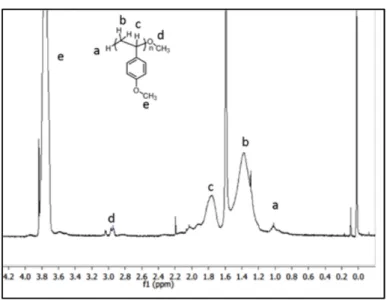
Figure 3. 1H NMR spectra of poly(4-methoxystyrene) showing methoxy end groups at the chain termini.
nucleophilic in origin rather than simply steric, trifluoroethanol, an alcohol of a similar steric environment around the hydroxyl group to ethanol but with decreased nucleophilicity was employed. A loss of control over the polymerization was observed when using trifluoroethanol rather than ethanol as the alcohol additive, the former being much less nucleophilic than ethanol due to the electron withdrawing character of the trifluoromethyl group. The observed loss of control despite the steric similarities and the decreased nucleophilicity of trifluoroethanol confirms that the effect of the alcohol additive is nucleophilic rather than steric in nature.
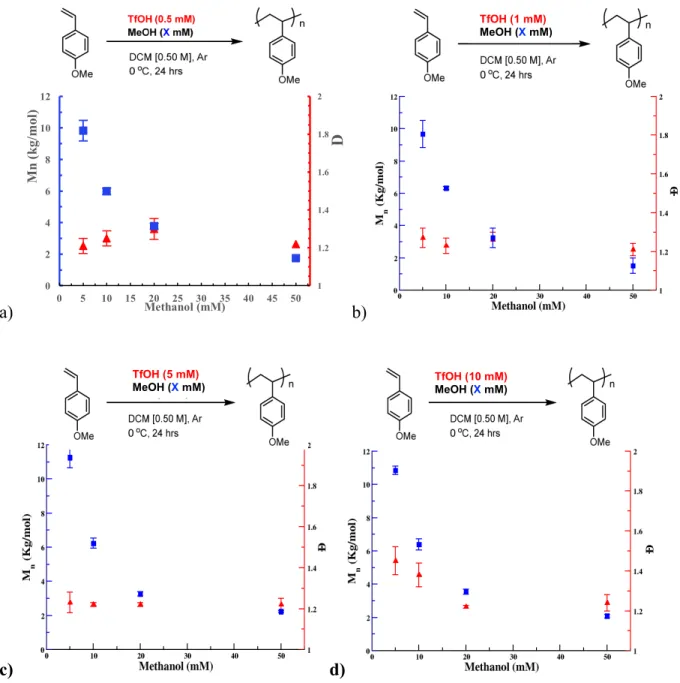
A detailed study was then undertaken to clarify the polymerization mechanism utilizing the protonic acid initiator. To understand the role of methanol in controlling chain length, and therefore molecular weight, the effect methanol and triflic acid loading were investigated at variety of conditions. The effect of methanol loading at constant TfOH concentrations were first investigated (Figure 4). As expected, in the absence of MeOH, the polymerization was uncontrolled, resulting in a broad distribution of molecular weights (Đ > 2). The MeOH
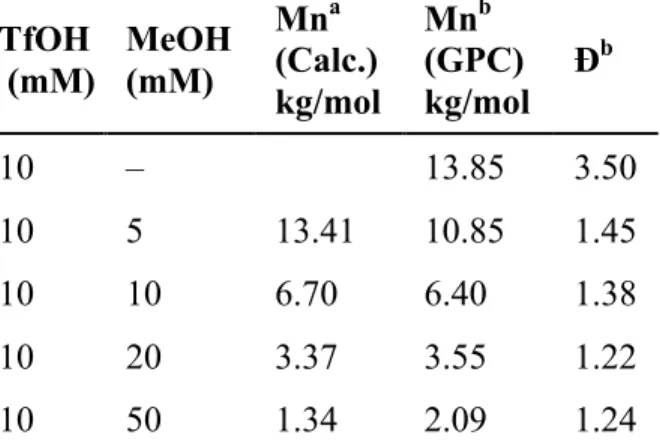
of chains initiated. Additionally, the observed experimental molecular weights are in good agreement with the theoretical molecular weights calculated assuming that each molecule of MeOH generates one polymer chain.
a) b)
c) d)
Figure 4. Effect of methanol loading on Mn and Đ of poly(4-methoxystyrene). All data were obtained as the average of 3 experiments, Mn and Đ determined by GPC, relative to polystyrene standards. Conditions: a) 0.5 mM TfOH, b) 1 mM TfOH, c) 5 mM TfOH, d) 10 mM TfOH
0 2 4 6 8 10 12
1 1.2 1.4 1.6 1.8 2
0 5 10 15 20 25 30 35 40 45 50
M
n
(k
g/
m
ol
)
D
Methanol (mM)
TfOH (5 mM)
Table 2. Effect of MeOH Loading on Control of Polymerization Results TfOH
(mM)
MeOH (mM)
Mna (Calc.) kg/mol
Mnb (GPC) kg/mol Đ
b
10 – 13.85 3.50
10 5 13.41 10.85 1.45
10 10 6.70 6.40 1.38
10 20 3.37 3.55 1.22
10 50 1.34 2.09 1.24
a Calculated based on the assumption that each polymer chain is terminated by one molecule of methanol bDetermined by GPC, relative to PS standards, average of 3 experiments
a b
c d
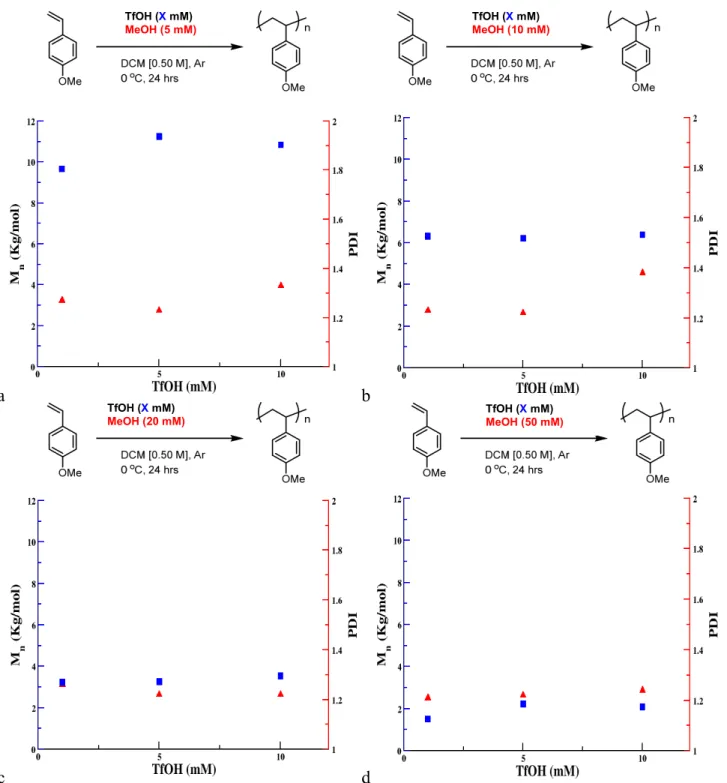
Figure 5. Influence of loading of TfOH on Mn and Đ of poly(4-methoxystyrene). All data were
obtained as the average of 3 experiments, Mn and Đ determined by GPC, relative to polystyrene standards. Conditions: a) 1 mM MeOH, b) 5 mM MeOH, c) 20 mM MeOH, d) 50 mM MeOH
Proposed Mechanism
TfOH (X mM) MeOH (10 mM) TfOH (X mM)
MeOH (5 mM)
TfOH (X mM)
Based on these preliminary results and observations, we propose a plausible mechanism for this living cationic polymerization initiated by a protonic acid and mediated by methanol (Scheme 1). This new living cationic polymerization is mechanistically analogous to radical RAFT but utilizes methanol as a simpler chain transfer agent rather than the traditional substituted thiocarbamates. Triflic acid acts as the protonic initiator, which generates a styrenyl cation as the propagating carbocation species by protonating the monomer in solution (Scheme 1, i). The use of the strong protonic acid provides fast initiation and eliminates the induction period before propagation of the chains occurs. Once a carbocation has been generated, methanol undergoes nucleophilic addition to the carbocation species and generates an additional proton capable of protonating another monomeric unit (Scheme 2, ii). The newly protonated monomer can then also undergo nucleophilic attack by methanol creating a cycle of rapid chain transfer that continues until all methanol has been converted into methoxy endgroups with very few active chain ends remaining (Scheme 2, ii). This proposed mechanistic step accounts for the prior data that indicates the concentration of methanol determines the number of chains activated rather than the concentration of initiator.
of another dormant chain. This nucleophilic recombination regenerates an oxonium intermediate capable of undergoing further fragmentation and recombination. The transient formation of the oxonium intermediate provides a fast activation/deactivation process between the active and dormant species, where the majority of chains remain dormant and propagation is well controlled. This control over propagation imparts control over both molecular weight and dispersity.
Given that this cationic RAFT mechanism is analogous to that of radical RAFT, the polymerization should be considered “living” in that the chain ends remain active even after all initial monomer has been consumed. To verify the living nature of the polymerization, chain extension studies were conducted. After 100% conversion of initial feed monomer had completed, verified via proton NMR analysis, an additional equivalent of monomer was added to the reaction mixture. GPC analysis indicated a monomodal shift toward higher molecular weight, while maintaining a narrow D (Figure 6). The almost doubling of molecular weight from the mother polymer to the chain extended polymers and the narrow D value, are indicative that the chain ends remain active after initial consumption of monomer and that the polymerization can be considered living.
Figure 6. GPC traces showing a monomodal shift toward a high molecular weight after addition of monomer.
Initiation
Rapid Chain Transfer
Reversible Chain Transfer via Oxonium Intermediate
Scheme 1. Mechanistic proposal
Figure 7. Reaction scheme for living cationic polymerization of styrene, 4-methylstyrene with triflic acid initiator and propanethiol additive.
20 22 24 26 28 30 32 34 36 38 40 Retention Time (min)
B
A
PMP
CF3SO3H
H PMP
CF3SO3
PMP H PMP
H + CH
3OH
PMP H O H
CH3 PMP
PMP H OCH3
OCH3 OCH3
H n
TfOH PrSH
DCM (0.50 M) 0 °C, 8 hrs
B M
n: 5.97 kg/mol
Đ: 1.35 A M
n: 2.17 kg/mol
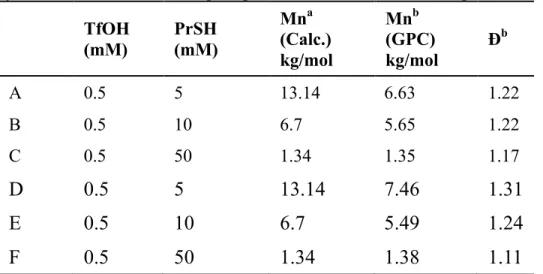
Initial trails were then run to investigate the effect of the thiol loading at constant concentration of TfOH to determine if it acts in an analogous role to methanol. The PrSH concentration was varied at 5, 10 and 50 mM, while the Triflic acid loading was kept constant at 0.5 mM (Table 3). A decrease in the molecular weight was observed as the loading of PrSH was increased, similar to the trend seen in the MeOH trials (Figure 8). However, there is less agreement at lower PrSH loadings between the experimental molecular weights, determined via GPC, and the theoretical molecular weights calculated under the assumption that each molecule of PrSH generates one polymer chain as the proposed mechanism suggests. Despite the lack of good agreement at lower loadings of PrSH, the lower Đ values of the synthesized polymers (Đ < 1.3), indicate that the reaction is controlled. These initial data that show a decrease in the molecular weight as the loading of PrSH is increased suggests that the PrSH is acting to control the number of active chains within the reaction and therefore the molecular weight.
Table 3. Polymerization Results utilizing Propanethiol as Chain Transfer Agent TfOH
(mM)
PrSH (mM)
Mna (Calc.) kg/mol
Mnb (GPC)
kg/mol Đ b
A 0.5 5 13.14 6.63 1.22
B 0.5 10 6.7 5.65 1.22
C 0.5 50 1.34 1.35 1.17
D
0.5
5
13.14
7.46
1.31
E
0.5
10
6.7
5.49
1.24
F
0.5
50
1.34
1.38
1.11
Figure 8. Effect of propanethiol loading on Mn and Đ of poly(4-methoxystyrene). All data were obtained as the average of 3 experiments, Mn and Đ determined by GPC, relative to polystyrene standards. Conditions: 0.5 mM TfOH
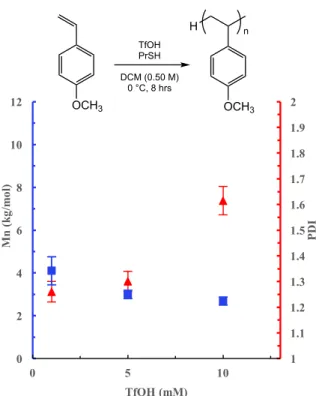
Studies were also conducted using PrSH to determine the effect of TfOH loading on the molecular weight and dispersity of the resulting polymers. For a PrSH concentration equal to 10 mM, increases in the acid loading from 1 to 5 to 10 mM had a non-negligible effect on the molecular weight. Unlike the MeOH system, increases in the concentration of TfOH resulted in larger dispersity values as well as lower molecular weights (Figure 9). These initial data must be reproduced for further conformation, but suggest that there may be some effect from the TfOH on the control of the polymerization in the thiol system that is not present in the MeOH system. Based on the studied utilizing propane thiol and the prior investigations on the effect of the nucleophilicity of the alcohol additive on the control of the system, we desired to study the effects of a longer, less nucleophilic thiol on the control of the system.
0 2 4 6 8 10
1 1.2 1.4 1.6 1.8 2
0 5 10 15 20 25 30 35 40 45 50
M
n
(kg/
m
ol
)
PD
I
PrSH (mM)
OCH3 OCH3
H n
TfOH PrSH DCM (0.50 M)
Figure 9. Effect of TfOH loading on Mn and Đ of poly(4-methoxystyrene). All data were obtained as the average of 3 experiments, Mn and Đ determined by GPC, relative to polystyrene standards. Conditions: 10 mM PrSH
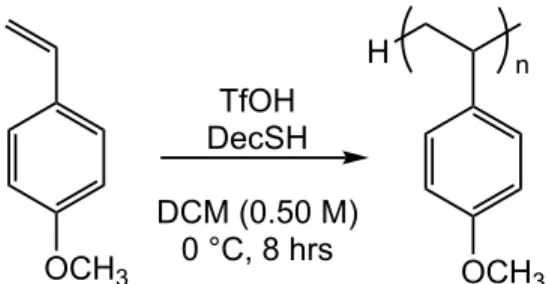
Decanethiol was then utilized as a chain transfer agent to test the impact of the thiol additive itself on the mechanistic control (Figure 10). Initial studies were run to see if decanethiol presented the same trends of a loss of control as TfOH loading in the system was increased. Preliminary data indicates that the loss of control when utilizing decanethiol as the chain transfer agent is not as pronounced as when propanethiol is used as the chain transfer agent (Table 4). There remains a small increase in the dispersity as the loading of TfOH is increased, but it is less than that seen in PrSH. These data indicate that, despite the lessened nucleophilicity of decanethiol as the chain transfer agent, there is potentially an increase in the control of the reaction. These data are preliminary, but suggest that the thiol based chain transfer agent system differs than that of the methanol mediated system.
0 2 4 6 8 10 12 1 1.1 1.2 1.3 1.4 1.5 1.6 1.7 1.8 1.9 2
0 5 10
Mn ( kg /m ol ) PD I TfOH (mM)
OCH3 OCH3
H n
TfOH PrSH
Figure 10.Reaction scheme for living cationic polymerization of styrene, 4-methylstyrene with triflic acid initiator and decanethiol additive.
Table 4. Polymerization Results utilizing Propanethiol as Chain Transfer Agent TfOH
(mM)
PrSH (mM)
Mna (Calc.) kg/mol
Mnb (GPC) kg/mol
Đb
A 1 10 6.7 5.34 1.26
B 5 10 6.7 4.31 1.37
C 10 10 6.7 4.24 1.34
Mn values both experimentally determined and calculated for [TfOH]=0.5mM a Calculated based on the assumption that each polymer chain is terminated by one molecule of methanol bDetermined by GPC, relative to PS standards.
Conclusions and Summary
We have carried out initial studied into the metal free acid-initiated living cationic polymerization of 4-methoxystyrene using methanol as an alcohol additive. The continued polymerization upon monomer addition from chain extension studies as well as the narrow Đ values obtained indicate the controlled/living nature of the polymerization. Investigations into the effect of methanol and TfOH loading on the control of the reaction suggest that methanol plays a key role in the control of the polymerization and that for the methanol system the loading of TfOH does not affect the control of the reaction. Based on the collected data, we have proposed that the mechanism of the polymerization follows a cationic RAFT mechanism, analogous to that of radical RAFT, where methanol acts as the reversible chain transfer agent. The control of the
OCH3 OCH3
H n
TfOH DecSH
polymerization is imparted via the reversible activation and deactivation of an oxonium intermediate generated through nucleophilic attack of the alcohol additive on the propagating cationic center. Studies of alcohol nucleophilicity indicate that the control of the reaction is inversely related to nucleophilicity of the alcohol additive, with stronger nucleophiles providing in a greater degree of control over the reaction. Given this nucleophilic control, thiols were explored as a potential chain transfer agent. Propane thiol presented similar results to the methanol system, with preliminary data suggesting that propanethiol rather than TfOH imparts control over the reaction. Preliminary trials with decanethiol indicate that there may be a loss of control with increasing acid loading not seen in the methanol or propanethiol studies, indicating the thiol based system may not adhere to the same mechanistic pathway as the methanol system. Further studies will be conducted utilizing decanethiol to support or refute these initial data.
Further development of this methodology will focus on elucidating the kinetics of the methanol mediated system to determine whether first order kinetic behavior is observed. Additionally, expansion of the scope of this methodology to further monomers has been initiated but will be developed more fully in the future. Given the controlled, living nature of the polymerization, future goals are to extend the synthetic methodology to the preparation of block copolymers and polymers or more complex architectures that could previously not be achieved.
Acknowledgments
References
(1) Matyjaszewski, K.; Müller, A. H., Controlled and living polymerizations: from
mechanisms to applications. John Wiley & Sons: 2009.
(2) Matyjaszewski, K., Atom Transfer Radical Polymerization (ATRP): Current Status and Future Perspectives. Macromolecules 2012, 45 (10), 4015-4039.
(3) Moad, G.; Rizzardo, E.; Thang, S. H., Toward Living Radical Polymerization. Acc.
Chem. Res. 2008, 41 (9), 1133-1142.
(4) Aoshima, S.; Kanaoka, S., A Renaissance in Living Cationic Polymerization. Chemical Reviews 2009, 109 (11), 5245-5287.
(5) Stenzel, M. H.; Barner-Kowollik, C., The living dead - common misconceptions about reversible deactivation radical polymerization. Materials Horizons 2016, 3 (6), 471-477. (6) Jenkins, A. D.; Jones, R. G.; Moad, G., Terminology for reversible-deactivation radical
polymerization previously called "controlled" radical or "living" radical polymerization (IUPAC Recommendations 2010). Pure Appl. Chem. 2010, 82 (2), 483-491.
(7) Miyamoto, M.; Sawamoto, M.; Higashimura, T., Living polymerization of isobutyl vinyl ether with hydrogen iodide/iodine initiating system. Macromolecules 1984, 17 (3), 265-268.
(8) Higashimura, T.; Miyamoto, M.; Sawamoto, M., Mechanisms of living polymerization of vinyl ethers by the hydrogen iodide/iodine initiating system. Macromolecules 1985, 18 (4), 611-16.
(9) Faust, R.; Kennedy, J. P., Living carbocationic polymerization. III. Demonstration of the living polymerization of isobutylene. Polym. Bull. (Berlin) 1986, 15 (4), 317-23.
(10)Puskas, J. E.; Kaszas, G., Living carbocationic polymerization of resonance-stabilized monomers. Prog. Polym. Sci. 2000, 25 (3), 403-452.
(11)Kanazawa, A.; Kanaoka, S.; Aoshima, S., Heterogeneously catalyzed living cationic polymerization of isobutyl vinyl ether using iron (III) oxide. J. Am. Chem. Soc. 2007, 129 (9), 2420-1.
(12)Matyjaszewski, K., Cationic Polymerizations: Mechanisms, Synthesis & Applications.
CRC Press: 1996.
(13)Kennedy, J.; Iván, B., Designed polymers by carbocationic macromolecular engineering.
Oxford University Press 1992.
(14)Sawamoto, M., Modern cationic vinyl polymerization. Prog. Polym. Sci. 1991, 16 (1), 111-72.
(15)Wu, Y.-b.; Han, L.; Zhang, X.-q.; Mao, J.; Gong, L.-f.; Guo, W.-l.; Gu, K.; Li, S.-x., Cationic polymerization of isobutyl vinyl ether in an imidazole-based ionic liquid: characteristics and mechanism. Polym. Chem. 2015, 6 (13), 2560-2568.
(16)Motoyanagi, J.; Miyabara, R.; Suzuki, M.; Miki, S.; Minoda, M., A novel [60]fullerene-appended initiator for living cationic polymerization and its application to the synthesis of [60]fullereneend-capped poly(vinyl ether)s. Polym. Chem. 2012, 3 (2), 329-331. (17)Kim, Y. H., Nucleofugality of halogenated acetates for mechanism study of vinyl ether
polymerization. Macromolecules 1991, 24 (8), 2122-3. 2
(18)Sawamoto, M.; Okamoto, C.; Higashimura, T., Hydrogen iodide/zinc iodide: a new initiating system for living cationic polymerization of vinyl ethers at room temperature.
(19)Kojima, K.; Sawamoto, M.; Higashimura, T., Living cationic polymerization of isobutyl vinyl ether by hydrogen iodide/Lewis acid initiating systems: effects of Lewis acid activators and polymerization kinetics. Macromolecules 1989, 22 (4), 1552-7.
(20)Schappacher, M.; Deffieux, A., Activated α-chloro ether and α-bromo ether end groups as propagating species for the living cationic polymerization of vinyl ethers.
Macromolecules 1991, 24 (8), 2140-2.
(21)Nuyken, O.; Kroener, H., Living cationic polymerization of isobutyl vinyl ether. 1. Initiation by hydrogen iodide/tetraalkylammonium salts. Makromol. Chem. Phys. 1990, 191 (1), 1-16.
(22)Cramail, H.; Deffieux, A.; Nuyken, O., Polymerization of isobutyl vinyl ether in the presence of mixed α-chloro- and α-iodo ethers with tetrabutylammonium perchlorate.
Macromol. Chem., Rapid Commun. 1993, 14 (1), 17-27.
(23)Kanazawa, A.; Hirabaru, Y.; Kanaoka, S.; Aoshima, S., Fast living cationic
polymerization of vinyl ethers with iron(III) chloride in the presence of a cyclic ether: most active and environmentally benign catalyst for the living cationic polymerization of vinyl ethers. J. Polym. Sci., Part A: Polym. Chem. 2006, 44 (19), 5795-5800.
(24)Goethals, E. J.; Du Prez, F., Carbocationic polymerizations. Prog. Polym. Sci. 2007, 32 (2), 220- 246.
(25)Cho, C. G.; Feit, B. A.; Webster, O. W., Cationic polymerization of isobutyl vinyl ether: livingness enhancement by dialkyl sulfides. Macromolecules 1990, 23 (7), 1918-23. (26)Kanazawa, A.; Hashizume, R.; Kanaoka, S.; Aoshima, S., Design of Benign Initiator for
Living Cationic Polymerization of Vinyl Ethers: Facile in Situ Generation of Vinyl Ether-Hydrogen Halide Adducts and Subsequent Controlled Polymerization without a Lewis Acid Catalyst. Macromolecules 2014, 47 (5), 1578-1585.
(27)Higashimura, T.; Kojima, K.; Sawamoto, M., Living cationic polymerization of pmethoxystyrene by hydrogen iodide/zinc iodide at room temperature. Polym. Bull.
(Berlin) 1988, 19 (1), 7-11.
(28)Higashimura, T.; Kojima, K.; Sawamoto, M., Living cationic polymerization of 4-tertbutoxystyrene and synthesis of poly(4-vinylphenol) with narrow molecular weight distribution. Macromol. Chem., Suppl. 1989, 15, 127-36.
(29)Uchiyama, M.; Satoh, K.; Kamigaito, M., Cationic RAFT Polymerization Using ppm Concentrations of Organic Acid. Angew. Chem., Int. Ed. 2015, 54 (6), 1924-1928. (30)Uchiyama, M.; Satoh, K.; Kamigaito, M., A phosphonium intermediate for cationic
RAFT polymerization. Polym. Chem. 2016, 7 (7), 1387-1396.