The University of North Carolina at
Chapel Hill
Senior Honors Thesis
Department of Computer Science
Exploring the Efficiency of
First-Order Proving Methods
Author:
Mark
Molinaro
Supervisor:
Dr. David
Plaisted
Abstract
Many automated theorem proving applications rely on the DPLL algorithm for deciding the satisfiability of a set of propositional logic formulae. For first-order logic formulae, ground clauses within the Herbrand universe may be exhaustively enumerated below an incre-menting size-bound and fed as input to DPLL. From even a cursory investigation of these enumerated clauses, it is evident that many of them have multiple repeated terms. Here, we explore a potential method for exploiting the size-bound by “cheating in” larger clauses with many repeating terms that may be relevant to the proof.
1
Introduction
Automated theorem proving is all about efficiency. The first proposed provers could never realistically be used in any meaningful capacity because they would have been too inefficient. Over the past few decades, new and im-proved techniques have enabled such provers to be effectively implemented for real applications. Even so, further improvements in efficiency would boost both the performance and viability of those current applications. Here, we will start with a survey of automated theorem proving history, applications, and methods. Then I will present a previously unexamined method for po-tentially improving the efficiency of first-order logic provers. Though this method may not be entirely feasible, understanding the underlying idea and implementation problems may provide insight for future exploration.
2
Background
Before diving into the particulars of the project, it is important to understand both the history and applications of automated theorem proving to get a more wholistic understanding of the importance of the subject and its development.
2.1
History
col-lection of his works, entitled The Oraganon [13], details much of the same concepts still taught today, though with differing notation.
Moving quite a ways forward in history to the late 19th century, Gottlob Frege [5] and Giuseppe Peano [14] introduced early modern logical nota-tions. In 1921, Emil Post [16] further formalized the concepts and notations of propositional logic. Later, in 1960, John McCarthy [9] presented a hypo-thetical “Advice Taker” to give and receive advice represented declarative (first-order) knowledge using predicate notation and relations.
Around the same time, many individuals started to conceptualize and develop automated proving techniques. Gilmore [7], Prawitz [17], and Davis and Putnam [4] developed proving methods by exhaustively checking all ground clauses based on Herbrand’s theorem (a topic we will revisit later). These initial attempts shown inefficient, Robinson [18] developed resolution-based proving methods which utilized the power of unification and the reso-lution inference rule. The Argonne group first implemented resoreso-lution-based provers with much success. While resolution methods seemed to thrive at first, many inefficiencies were discovered that researchers were unable to fully overcome.
Various approaches were attempted in order to improve the efficiency of proving procedures, giving rise to powerful languages and provers such as Prolog, Vampire [8], Otter [10], its successor Prover9 [12], and various higher-order and interactive provers.
2.2
Applications
Interactive provers supplement a human’s endeavor to construct a proof. In such systems, an individual will supplement the proof search by (heuristi-cally) determining intermediate steps to guide procedure in the right direc-tion. Non-interactive provers are simply given a starting set of axioms and a goal statement to prove by manipulations of those axioms. Both classes of provers have found to be very useful in a variety of applications, including mathematics, formal verification, and software development.
2.2.1 Robbins Problem
The basis for Boolean algebra consists of commutativity, associativity, and the Huntington equation.
x∨y ⇐⇒ y∨x [commutativity]
(x∨y)∨z ⇐⇒ x∨(y∨z) [associativity]
¬(¬x∨y)∨ ¬(¬x∨ ¬y) ⇐⇒ x [Huntington equation]
Herbert Robbins conjectured that the Huntington equation could be re-placed by the following, known as Robbins equation.
¬(¬(x∨y)∨ ¬(x∨ ¬y)) ⇐⇒ x[Robbins equation]
The problem was to determine whether every Robbins algebra was Boolean. For many years, it stood only as conjecture. Neither Huntington, Robbins, nor anyone else could find a proof until 1997 when William McCune [11] finally presented one. McCune was able to find the solution with a successful search by the EQP theorem prover, which completed its search in about 8 days.
2.2.2 Verification
ATP methods have shown to be vital in formal hardware and software ver-ification. As very-large-scale integration (VLSI) design became prominent, a formal method for ensuring correctness in chips became essential. These automated methods allowed developers to test their designs despite the im-possibility of manually testing for every possible set of inputs. Had such methods been more developed and widely used earlier, the Pentium FDIV floating-point bug [1] may have been caught and prevented.
2.2.3 Software Development
3
Definitions
3.1
Propositional Logic
Propositional logic is the branch of logic that describes simple propositions and the compositions of such. First, we will define the syntax used when discussing and reasoning with propositional logic.
Propositional Signature– A (nonempty) set of symbols, calledatoms
(or variables). This set should contain all objects on which we can do our reasoning.
Connectives– Formulas are formed from the composition of atoms and connectives. The connectives available are as follows:
• 0-place Connectives: >,⊥
• Unary Connective: ¬
• Binary Connectives ∨,∧,→,↔
Well-Formed Formula (wff )– A Well Formed Formula can be recur-sively defined as follows:
1. Any atom,>, or ⊥is a well-formed formula.
2. If ℵ is a well-formed formula, ¬ℵis a well-formed formula.
3. Ifℵandβare both well-formed formula,ℵ⊕β is a well-formed formula, where ⊕ is one of the binary connectives listed above.
4. Nothing that cannot be constructed by steps 1-3 is a well-formed for-mula.
Interpretations – An interpretation of a formula F is a mapping of F
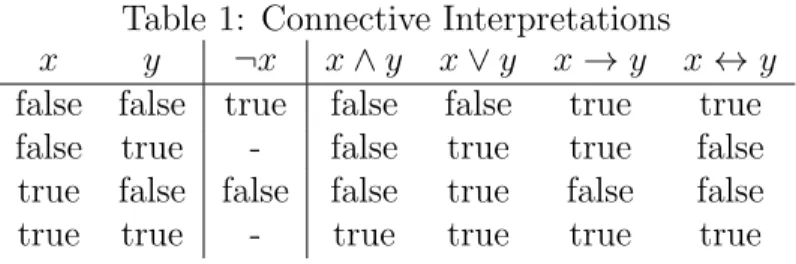
to a truth value, true or f alse. The 0-place connectives > and ⊥ always map to true and f alse, respectively. Individual atoms can be interpreted as either true or f alse. To map an arbitrarily complex formula to a truth value, a similarly recursive definition to that of wffs can be used, following the base truth values of each connective of wffs below.
Table 1: Connective Interpretations
x y ¬x x∧y x∨y x→y x↔y
false false true false false true true false true - false true true false true false false false true false false true true - true true true true
A set of formulas (or knowledge base) Γ is satisfiable if there exists at least one interpretation that satisfies all formulas within Γ. If every interpretation that satisfies Γ also satisfies another formula F, then Γ entails F (Γ|=F).
Γ can be extended by an explicit definition to include new formulas – using atoms within the original signature that were otherwise not part of the knowledge base. The extended knowledge base is satisfiable iff the original knowledge base is satisfiable.
Natural Deduction – Natural Deduction is a process of deriving for-mulas (or sequents) from a finite knowledge base Γ. A formula F can be derived from Γ using the inference rules of propositional logic, described, in German, by Gentzen [6]. These can loosely be described as a group of rules for introduction, a group of rules for elimination, a contradiction rule, and a weakening rule. Sequents can be discovered by iteratively applying these rules to formulas within a knowledge base.
This deductive system is sound and complete. A logical system is sound iff it only yields formulas that are valid under the system. A logical system is complete if every formula that is valid can be derived by the set forth inferences.
Formulas can be proved under Γ by constructing or chaining together axioms, formulas in Γ, and the sequents implied by it. Once a sequent is constructed, it may be used further in the proof as if it is part of the original knowledge base.
3.2
First-Order Logic
First-Order Logic is an extension on the propositional signature that includes function symbols, constant symbols, quantifiers, and predicate constants. For brevity, the syntax and semantics of these symbols are presented together.
and returns an element in the domain. As an examplemother of(x), a 1-ary function, takes an element in the domain of discourse as input and returns another.
Constant Symbols – An individual constant symbol represents a fixed element in the domain. These can also be interpreted as 0-ary functions.
Logical Quantifiers – Quantifiers are used to specify the number of elements within the domain of discourse that satisfy a formula. The two tra-ditional quantifiers are the universal (“for all”) ∀quantifier and the existen-tial (“there exists”)∃quantifier. Quantification is restricted only to objects; the quantification of formulae and sets of objects exists only in higher-order logics.
Predicate Constants – Predicates, also with an arity n, take n ele-ments as parameters and represents a relationship between those eleele-ments. Instead of an element, predicates output a truth value. As an example,
are f riends(M ark, M att) will either returntrueorf alse, depending on the friendship status of Mark and Matt.
Terms– Terms can be recursively defined as follows:
1. Any variable is a term.
2. Any constant is a term.
3. If t1, ..., tn are terms, and f is a function symbol of arity n, then
f(t1, ..., tn) is a term.
4. Nothing that cannot be constructed by steps 1-3 is a well-formed for-mula.
Formulae – Formulae can be recursively defined as follows:
1. If t1, ..., tn are terms, and P is a predicate constant of arity n, then
P(t1, ..., tn) is a formula.
2. If ℵ is a formula, then¬ℵ is a formula.
3. If ℵ and β are both formulae, then ℵ ⊕β is a formula, where ⊕ is one of the binary connectives.
4. If ℵ is a formula andx is a variable, then ∃xℵ and ∀xℵ are formulae.
Formulae of the form dictated in Rule 1 are called atomic formulae. A
literalis an atomic formula or its negation. If a variablexis within the scope of a quantifier (∀x or ∃x), x is bound, otherwise, it is free. A formula is a
sentenceif it contains no free variables. For a sentenceF and interpretation
I, FI is a truth value assigned by I to F.
Just as with propositional logic, deduction can be done with first-order formulas using a set of inference rules (modus ponens & universal general-ization) and further identities. A sentence is provable in first-order logic if it can be derived from from successive applications of axioms. A sentence
F is provable with respect to a set of statements {a1, ..., an} if
V
ai →F is
provable in first-order logic.
4
Clausal Form
In order to utilize mechanical proving techniques, most algorithms require first-order formulas to first be converted to clausal form in order to more uniformly store and manipulate statements. Converting an arbitrary first-order formula requires five steps.
For this section, we will follow a formula of the form:
¬∀x¬(F(x)∧ ¬F(f(x)))
to the standardized clausal form.
4.1
Pushing Negations
The first step in the conversion is to push negations inward. To do this, we follow a set of negation pushing rules. The rules are applied iteratively until no more replacements can be made.
(A↔B)→(A→B)∧(B →A)
(A→B)→((¬A)∨B)
¬¬A→A
¬(A∧B)→(¬A)∨(¬B)
¬(A∨B)→(¬A)∧(¬B)
¬∃xA→ ∀x(¬A)
These rules are fairly obvious, as the first two are the definitions of ↔
and →, and the last four are De Morgan’s laws and first-order extensions of such.
In our example, we can first apply generalized De Morgan’s¬∀rule, then the double ¬ rule:
¬∀x¬(F(x)∧ ¬F(f(x)))
∃x¬¬(F(x)∧ ¬F(f(x)))
∃x(F(x)∧ ¬F(f(x)))
Moving forward to the next section, our formula stands as:
∃x(F(x)∧ ¬F(f(x)))
4.2
Pulling Universal Quantifiers
The next step is to pull all universal quantifiers to the front. Similar to pushing negations, we can achieve this by iteratively applying the following rules until no more can be applied:
(∀xA)∨B → ∀x(A∨B)
A∨(∀xB)→ ∀x(A∨B)
(∀xA)∧B → ∀x(A∧B)
A∧(∀xB)→ ∀x(A∧B)
Our example contains no universal quantifiers. As none of the above rules apply, this step is done with no modifications to the formula.
4.3
Skolem Functions
The third step in the conversion process requires replacing each existentially quantified variables by Skolem functions. To be more precise:
∃xP(x)→P(f(x1, ..., xn))
wheref is a newly contrived (and uniquely named) Skolem function with parameters including all universally quantified variables withinP’s scope. If there are no variables outside ofx, the Skolem function is of arity 0, or simply a Skolem constant. As a note, this conversion preserves the satisfiability of the formula – that is, the new formula is satisfiable iff the old formula is satis-fiable – but may not preserve equivalence. As our proving algorithm is based on determining satisfiability (discussed in more detail later), equivalency is not required.
Using our example, the only variable x is existentially quantified. We replace the existential quantifier with a new Skolem constant a.
F(a)∧ ¬F(f(a))
4.4
Conjunctive Normal Form
Conjunctive normal form (CNF) is a formula structured as a conjunction of disjunctions of literals, such as:
(A∨B∨ ¬C)∧(¬A∨B∨C)∧(¬A∨ ¬B∨ ¬C)
Normal forms such as this are useful as a standardized way of uniquely representing a formula. Converting propositional formulas with n clauses into CNF can, in the worst case, produce 2n clauses. There are methods to
potentially reduce the size of these formulas, including the addition of extra predicate symbols for sub-formulas – but such methods are not discussed here.
Conversion to CNF is done by iteratively distributing “or’s over and’s” until the formula satisfies the conditions for CNF. The rules, specifically, are:
(A∨(B∧C))→(A∨B)∧(A∨C)
Fortunately, our example is already in CNF, with each disjunction con-taining only one literal. We can rearrange parentheses to emphasize the structure.
(F(a))∧(¬F(f(a)))
4.5
Clausal Form
Clausal form is simply a syntactic change from CNF. Once in CNF, all uni-versal quantifiers are removed – as all variables at that point are either im-plicitly or exim-plicitly universally quantified – and the Boolean connectives are replaced in favor a structuring as a set of sets of literals. As an example,
(A1∨A2)∧(B1∨B2)∧(C1∨C2)
becomes
{{A1, A2},{B1, B2},{C1, C2}}
In our example, we finish our conversion to clausal form with:
{{F(a)},{¬F(f(a))}}
5
Mechanical Proving
Now that our input first-order formula is in the proper form, we will discuss proving techniques, specifically focusing on instance-based method utilizing DPLL.
5.1
Herbrand Interpretations
Using our prior example, we can construct a set of constant symbols S
and functions symbols F with subscripted arity. As there is now a constant
a in our formula, we no not need to add an arbitrary constant.
S :{a}
F :{f1, g1}
From this we can construct the domain as such:
D:{a, f(a), g(a), f(f(a)), g(f(a)), f(g(a)), g(g(a)), ...}
These interpretations are specifically interesting for mechanical theorem proving because to determine the satisfiability of a set of clauses, we only need to consider ground clauses constructed from the Herbrand Interpreta-tions. This is because a set of clauses C is satisfiable iff there is a Herbrand Interpretation I such that I |=C.
A substitution is defined as a mapping from variables to terms. For example, we can use the substitution {x ` a} on the formula P(f(x), x) to yield P(f(a), a). All instances of the variable x are replaced with a. In this case, we substituted in a ground term, but it is not necessary to do so – that is, we can use the substitution {x ` f(y)}. A literal that has undergone a substitution from its original form is called an instanceof that term.
5.2
Herbrand Sets
A Herbrand Set for a set of clauses C is an unsatisfiable set of ground clausesT such that for every clauset ∈T there is a clause inc∈Csuch that
t is an instance ofc. A set of clausesC is unsatisfiable iff there is a Herbrand Set for C (Herbrand’s theorem). This means that determining whether or not a Herbrand Set forC exists, consequently determines the satisfiability of C. Determining first-order satisfiability is now reduced to this ground instantiation problem, which lends itself much better to computation.
Our example is, in fact, satisfiable, meaning no Herbrand Set exists for its negation. Instead, we will use a constructed example. Given the set the clauses C:
{{Q(a)},{P(f(x)),¬Q(x)},{¬P(f(x))}}
A Herbrand Set forC is found after using the substitution {x`a}:
We can see that this is unsatisfiable because the second clause can not be true unless either the first or third is false.
Given a set of clausesC, we can enumerate all ground clauses of Cg and
check whether Cg is satisfiable. If Cg is unsatisfiable, then it is certain that
C is unsatisfiable as well. While there are a countable infinite number of such clauses – eliminating the possibility of checking all of Cg at once, we
can start with a set containing a small number of ground clauses Cg0. From there, we continually add one or more clause(s) toCg0, check for satisfiability, and repeat these steps until Cg0 is shown unsatisfiable. In fact, this method was outlined by Davis and Putnam [4].
To utilize this procedure for showing showing a first-order formula F is valid, F is negated (¬F) and converted to clausal form. Then this set of clause – in addition to any other usable/relevant clausesC (axioms, relevant theorems, etc.) – is used as input to a proving procedure (such as the one described above). A Herbrand Set from the clausal form of ¬F (∧C) exists (that is, ¬F is unsatisfiable) iff ¬F is not a satisfiable first-order formula. The unsatisfiability of ¬F implies that F is valid.
It is worth noting that this method is only semi-decidable. If the set of clauses is satisfiable, the prover above will continue on forever, as it will never encounter an unsatisfiable set of ground clauses.¬F is used as the input because we (presumably) expect that F is valid.
5.3
DPLL
In the preceding section, we outlined a procedure for determining satisfia-bility from ground clauses. It became apparent, however that an efficient algorithm for determining satisfiability is essential if this method is ever to be practical. Each unique atom produced from a clause set’s Herbrand In-terpretation can be mapped to a unique propositional variable. Thus, our first-order validity problem is now further reduced to a classic CNF-SAT problem. Boolean satisfiability is a classic NP-Complete problem, so it fol-lows that first-order satisfiability is also in the class NP.
While determining satisfiability is O(2n), these problems are often
solv-able within a reasonsolv-able amount of time in practice. The Davis-Putnam-Logemann-Loveland procedure (DPLL) [3] takes advantage of common heuris-tics to dynamically reduce the search space compared to a typical brute-force guess-and-check approach.
and pure literal elimination. The algorithm is presented below [21], where Φ is a set of clauses:
f u n c t i o n DPLL( Φ )
i f Φ i s a c o n s i s t e n t s e t o f l i t e r a l s t h e n r e t u r n t r u e
i f Φ c o n t a i n s an empty c l a u s e t h e n r e t u r n f a l s e
f o r e v e r y u n i t c l a u s e l i n Φ Φ ← u n i t−p r o p a g a t e (l, Φ )
f o r e v e r y l i t e r a l l t h a t o c c u r s p u r e i n Φ Φ ← pure−l i t e r a l−a s s i g n (l, Φ )
l ← c h o o s e−l i t e r a l ( Φ )
r e t u r n DPLL( Φ{l → >}) o r DPLL( Φ{l → ⊥})
Aunit clauseis a clause that contains only one literall. In the case that there exists at least one unit clause, theunit-propagateprocedure is called. This procedure removes all clauses containing l and removes all instances of
¬l in the remaining clauses. The existence of a unit clause implies that the literal within that clauselmust betrue, meaning any other clause containing
l is guaranteed to be true and any literals¬lare guaranteed to be false. Unit propagation improves the “goal-orientedness” of the algorithm by trimming the search space.
A pure literal is a literal whose complementary literal does not occur within any clauses in Φ. The pure-literal-assign procedure removes all clauses that contain a pure literal. It is worth noting that bothunit-propagate
and pure-literal-assign may spawn more unit clauses or pure literals, generally trimming the search space very quickly.
Thechoose-literalprocedure is especially interesting. The literal cho-sen for the next DPLL escho-sentially guides the search path. Assuming the input is satisfiable, a perfect selection of literals would theoretically reduce the runtime to linear. There has been extensive research in optimizing this step that will not be discussed here, so we’ll pretend a literal is chosen non-deterministically.
6
Growing the Clause Set
As reviewed earlier, ground clauses from the Herbrand Interpretation are incrementally added to some set Cg0 until a Herbrand Set is found. Davis and Putnam suggested adding only one clause at a time before rechecking for satisfiability. Each single clause, however, is unlikely to change the outcome of such a check. To reduce the number of potentially expensive DPLL calls, multiple clauses are added between each call.
In practice, the ground clause setCg0 grows by including all clauses below an incrementing size-bound s. The size-bound then starts small, and grows incrementally until a Herbrand Set is (hopefully) found.
We will define the sizes of terms t, literalsL, clauses C, and clause sets as follows:
s(¬L) =s(L)
s(P(t1, ..., tn)) =s(f(t1, ..., tn)) = 1 +s(t1) +...+s(tn)
s(L1∨...∨Ln) = s(L1) +...+s(Ln)
s(C1∧...∧Cn) = s(C1) +...+s(Cn)
s(x) = s(c) = 1
s({Q(a)}) = 2
s({P(f(x)),¬Q(x)}) = 5
s({¬P(f(x))}) = 3
As is evident in the constructed domain of an example Herbrand Inter-pretation in section 5.1 ...
s(D) :{s(a) = 1, s(f(a)) = 2, s(g(a)) = 2, s(f(f(a))) = 3, s(g(f(a))) = 3, s(f(g(a))) = 3, ...}
...a linear increase in the size-bound grows the ground clause set exponen-tially. Such explosion of clauses is useful in its early stages to quickly grow
Cg0. Conversely, if the size-bound grows too large, the number of clauses below it may become too numerous, potentially filling all available memory and drastically slowing down the DPLL procedure.
6.1
An Observation
If we order the formation of terms from Herbrand Interpretation to be used in creating ground clauses in such a way...
H0 :{all constants}
H1 :H0 ∪ {an application of each function to each permutation of terms in H0}
Hn:Hn−1 ∪ {an application of each function to each permutation of terms in ∪ni=0−1Hi}
...it becomes clear that terms are repeated many times as the size-bound grows. Using D as an example, we can see that every term in Hn is present
multiple times in Hn+1.
H0 :{a}
H1 :{a, f(a), g(a)}
H2 :{a, f(a), g(a), f(f(a)), g(f(a)), f(g(a)), g(g(a))}
6.2
Redefining Size
We will redefine the size function s0 to be exactly the same as stated pre-viously, except repeated sub-terms are replaced with pointers to their first occurrence. Future occurrences of the sub-term have a size of 0. For demon-stration, each sub-term will be assigned a number in order of appearance, and future occurrences will be replaced with that number. As an example:
C ={P(f(a), g(f(a))), P(f(a), g(f(a)))}
has a size s(C) = 12 using the formal definition. With our size reduction technique, we can rewrite C:
C={P(f(a), g(1)),2}
s0(C) = 4, much less than 12. In fact, for any clause L, s0(L)≤s(L). If this term was required for the proving procedure, it would become available once the size-bound reaches 4, instead of a drastically greater bound of 12.
Using s0 grows the clause set much faster than the s, causing the same problems noted above to happen much faster. However, if clauses needed in the proof typically become available for use much faster using s0, such a trade-off improve the overall efficiency of the proving procedure.
It should be noted that the pointers mentioned above could instead be assigned a size of 1. This change may slow the explosion of enumerated clauses under a given size-bound, as individual constants would never be reduced to a size of 0, regardless of repetitions.
7
Implementation
7.1
Notes about the Code
I chose to implement my project in Python as it allowed for fast prototyping and provided a simple work environment (with iPython Notebooks). Looking back, however, the class structure and strong typing of a language such as Java would have saved a lot of headaches in the long run.
Additionally, these structures were not built with efficiency in mind. To allow myself to work with higher levels of abstraction, namely with Python’s sets, I altered all hash methods to first serialize the object, then hash the resulting string. Identical objects are represented identically as strings, even if the objects are formed from different instances of objects. Two objects that should be the same hash to different values, but their string representations correctly hash to the same value. This workaround is especially useful given how often I use sets, but constant serialization has high overhead.
The structures I built have been connected with a Python implementation of the algorithms described inArtifical Intellegence: A Modern Approach [19], maintained on GitHub .
If shown useful, everything showcased here can be reimplemented much more efficiently within existing theorem proving infrastructure. The algo-rithm presented is well-suited for multithreading as each section of the search space can be explored separately.
7.2
Reduce Clause Size
The following code snippet takes a regular clause as input, and returns a new clause with repeated terms replaced with Repeat objects that have a size of 0. Callinglen() on the new clause returns the size of the clause based on the alternative s0 definition.
def r e d u c e S i z e ( s e l f ) : copy = deepcopy ( s e l f )
s u b t e r m s = s e t( copy . f i n d S u b t e r m s ( ) )
f o r i in range(len( copy . params ) ) : subterm = copy . params [ i ]
i f subterm in s u b t e r m s :
s u b t e r m s . remove ( subterm )
copy . params [ i ] . r e d u c e S i z e ( s u b t e r m s )
e l s e:
return copy
This method, on its first pass, finds all sub-terms within the clause and stores them in the set subterms. On the second pass through the clause, whenever a sub-term is encountered, it is removed from subterms. If a sub-term is found that is not in subterms, it must be a repeat, and is replaced with an instance of Repeat, which has a size of 0.
As an example, we use the clauseC from above to verify our findings. In-stead of the numbering system described above, asterisks are applied around repeated terms for clarity.
print( c l a u s e , len( c l a u s e ) )
print( c l a u s e . r e d u c e S i z e ( ) , len( c l a u s e . r e d u c e S i z e ( ) ) )
{P( f ( a ) , g ( f ( a ) ) ) ,P( f ( a ) , g ( f ( a ) ) )} 12
{P( f ( a ) , g (∗f ( a )∗) ) ,∗P( f ( a ) , g (∗f ( a )∗) )∗} 4
With this tool in the toolbox, I then developed an algorithm to enumerate all clauses with a reduced-size below a specified size-bound.
7.3
Enumerate Clauses
Constructing ground clauses below a specified size-bound is a relatively trivial procedure. With the altered definition of size, however, it becomes much more complex. There must be a way to “reach past” the given size-bound to explore larger terms that reduce down to be within the specified size. A naive approach would be to enumerate clauses well beyond the size-bound, check each of them, and add any that fit the criteria. This approach, however, requires checking a huge search space (shown by the exponential growth of ground clauses) of terms below a much larger (potentially infinite) size-bound – exactly the opposite of our goal.
implemented currently. If the clause is at the size-bound but not ground, each variable is replaced with already repeated terms (thus, not adding to the calculated reduced size). Ground clauses at or below the size-bound are added to the final set of clauses to be returned.
In order to preserve uniqueness of variable names, thegeneralizeFunctions
takes functions as inputs and returns those functions with new (uniquely names) variables as parameters.
def e n u m e r a t e C l a u s e s ( c l a u s e , s i z e , r p t s = s e t( ) ,
,→ c l a u s e S e t = s e t( ) ) :
c l a u s e R e d u c e d S i z e = len( c l a u s e . r e d u c e S i z e ( ) )
r e p e a t s = r p t s . u n i o n (s e t( c l a u s e . f i n d R e p e a t s ( ) ) )
i f c l a u s e R e d u c e d S i z e>s i z e :
return c l a u s e S e t
e l i f c l a u s e . isGround ( ) : c l a u s e S e t . add ( c l a u s e )
e l i f c l a u s e R e d u c e d S i z e==s i z e :
f o r x in c l a u s e . f i n d V a r i a b l e s ( ) :
f o r i in r e p e a t s :
e n u m e r a t e C l a u s e s ( c l a u s e . r e p l a c e ( x , i ) ,
,→ s i z e , r e p e a t s , c l a u s e S e t )
e l s e:
c o n s t a n t s = s e t( c l a u s e . f i n d C o n s t a n t s ( ) ) v a r i a b l e s = s e t( c l a u s e . f i n d V a r i a b l e s ( ) ) f u n c t i o n s = g e n e r a l i z e F u n c t i o n s ( c l a u s e .
,→ f i n d F u n c t i o n s ( ) )
f o r x in v a r i a b l e s :
f o r i in c o n s t a n t s . u n i o n ( r e p e a t s ) . u n i o n (
,→ f u n c t i o n s ) :
i f ( s i z e−c l a u s e R e d u c e d S i z e−len( i ) )>=0: e n u m e r a t e C l a u s e s ( c l a u s e . r e p l a c e ( x , i
return c l a u s e S e t
8
Example and Future Work
8.1
Example
The presented implementation relies too heavily on recursion to be written in a language with large stack frames such as Python. The original goal was to use example sentences that occur in the automatic proving testing problem set known as the Pelletier Problems [15]. Such examples are so large that the recursion depth limit is reached very quickly. Instead, below is a constructed example to showcase the difference in growth of clause sets betweensand s0. Beyond a size-bound of 6, the recursion limit reached.
The largest clauseC found by enumerateClauses(clause, 6) is:
{F(g(g(g(b, a, a, b), g(b, a, a, b), a, b), g(g(b, a, a, b), g(b, a, a, b), a, b), a, b))}
8.2
Future Work
8.2.1 Problems with the Algorithm
Unfortunately, my implementation utilizes excessive recursion. While pro-cessing large (or very repetitive) clauses, the enumerateClauses procedure frequently hits the recursion depth limit, making this implementation infeasi-ble in practice. To fix this proinfeasi-blem, bothreduceSizeandenumerateClauses
must be rewritten to better utilize iterative solutions. Given the formation of these structures, that would prove to be difficult. One potential improve-ment may be to port this algorithm to a functional programming language with proper tail call elimination. That being said, I have not been able to conceive of a way to rewrite the algorithm to be totally iterative. Obviously, the search space of all possible clauses is massive (growing much faster than that of the standard size definition). Even if this algorithm only needs to check some fraction of the whole space, it will still quickly surpass a size that can reasonably be searched with current computers. Because of this, I am not convinced that exploiting the size-bound is a feasible method for improving the efficiency of first-order provers – but I am excited to be proven wrong.
8.2.2 Assuming the Problems are Fixed
If, at some point, a method for this alternative enumeration of clauses is found, more experiments would be required still to determine if such a method is worth the additional cost. More testing would be required to decide if the additional processing time to find these clauses is less than the time saved from including them earlier.
9
Conclusion
Redefining the definition of size has shown to exponentially increase the number of clauses under a specified size-bound. Unfortunately, the enu-meration of such clauses requires reaching far into the search space of a large standardly-define size-bound. By recursively building clauses with
References
[1] E. M. Clarke, M. Khaira, and X. Zhao. Word level model checking - avoiding the pentium fdiv error. In Proceedings of the 33rd Annual Design Automation Conference, DAC ’96, pages 645–648, New York, NY, USA, 1996. ACM.
[2] S. A. Cook and D. G. Mitchell. Finding hard instances of the satis-fiability problem. In Satisfiability Problem: Theory and Applications: DIMACS Workshop, March 11-13, 1996, volume 35, page 1. American Mathematical Soc., 1997.
[3] M. Davis, G. Logemann, and D. Loveland. A machine program for theorem-proving. Commun. ACM, 5(7):394–397, July 1962.
[4] M. Davis and H. Putnam. A computing procedure for quantification theory. Journal of the ACM (JACM), 7(3):201–215, 1960.
[5] G. Frege. From frege to g¨odel: a source book in mathematical logic, 1879-1931. In J. Van Heijenoort, editor, Begriffsschrift, a formula lan-guage, modeled upon that of arithmetic, for pure thought, volume 9. Harvard University Press, 1967.
[6] G. Gentzen. Untersuchungen ¨uber das logische schließen. i. Mathema-tische zeitschrift, 39(1):176–210, 1935.
[7] P. C. Gilmore. A proof method for quantification theory: Its justification and realization. IBM Journal of Research and Development, 4(1):28–35, Jan 1960.
[8] L. Kov´acs and A. Voronkov. First-order theorem proving and vampire. In International Conference on Computer Aided Verification, pages 1– 35. Springer, 2013.
[9] J. McCarthy.Programs with common sense. RLE and MIT Computation Center, 1960.
[10] W. McCune. Otter 3.0 reference manual and guide, volume 9700. Ar-gonne National Laboratory ArAr-gonne, IL, 1994.
[12] W. McCune. Prover9 and mace4.
http://www.cs.unm.edu/~mccune/prover9/, 2005–2010.
[13] O. Owen. The Organon: Or Logical Treatises of Aristotle : with the Introduction of Porphyry. Number v. 1 in Bohn’s classical library. G. Bell, 1901.
[14] G. Peano. From frege to g¨odel: a source book in mathematical logic, 1879-1931. In J. Van Heijenoort, editor, The principles of arithmetic, presented by a new method, volume 9. Harvard University Press, 1967. [15] F. J. Pelletier. Seventy-five problems for testing automatic theorem
provers. Journal of automated reasoning, 2(2):191–216, 1986.
[16] E. Post. From frege to g¨odel: a source book in mathematical logic, 1879-1931. In J. Van Heijenoort, editor, Introduction to a general theory of elementary propositions, volume 9. Harvard University Press, 1967. [17] D. Prawitz. An improved proof procedure. Theoria, 26(2):102–139,
1960.
[18] J. A. Robinson. A machine-oriented logic based on the resolution prin-ciple. J. ACM, 12(1):23–41, Jan. 1965.
[19] S. Russell and P. Norvig. Artificial Intelligence: A Modern Approach. Pearson Higher Ed, 2016.
[20] M. Stickel, R. Waldinger, M. Lowry, T. Pressburger, and I. Under-wood. Deductive composition of astronomical software from subroutine libraries. In International Conference on Automated Deduction, pages 341–355. Springer, 1994.
A
Structure Implementations
#d e e p c o p y u s e d t o c r e a t e r e p e a t e d t e r m s w h i l e k e e p i n g
,→ t h e o r i g i n a l ( t h a t i s p o s s i b l y u s e d e l s e w h e r e )
,→ i n t a c t .
from copy import deepcopy
#The s t r u c t u r e s a r e c o n n e c t e d t o a aima l o g i c l i b r a r y
from u t i l s import ∗
from l o g i c import ∗
#I m p l e m e n t a t i o n o f c o n s t a n t .
#O v e r r i d e s s t r , l e n , eq , and h a s h .
c l a s s Constant :
r e g i s t r y = s e t( )
def i n i t ( s e l f , s ) : s e l f . sym = s
s e l f . a r i t y = 0 s e l f . l e n g t h = 1
Constant . r e g i s t r y . add ( s e l f )
def s t r ( s e l f ) :
return s e l f . sym
def l e n ( s e l f ) :
return s e l f . l e n g t h
def e q ( s e l f , o t h e r ) :
return s t r( s e l f ) == s t r( o t h e r )
def h a s h ( s e l f ) :
return hash(s t r( s e l f ) )
#Any r e p e a t s a r e r e p l a c e d by R e p e a t s .
i f subterm in s u b t e r m s :
s u b t e r m s . remove ( subterm )
e l s e:
s e l f = Repeat ( s e l f )
def r e d u c e d S i z e ( s e l f ) :
return s e l f . l e n g t h
#W i l l a l w a y s b e a ground term .
#Base o f h i g h e r l e v e l isGround r e c u r s i o n .
def isGround ( s e l f ) :
return True
#No v a r i a b l e s .
#R e t u r n s empty l i s t t o conform w i t h o t h e r
,→ s t r u c t u r e s u s e o f l i s t c o n c a c t s .
def f i n d V a r i a b l e s ( s e l f ) :
return [ ]
#I s a c o n s t a n t s .
#R e t u r n s o b j e c t wrapped i n l i s t t o conform w i t h
,→ o t h e r s t r u c t u r e s u s e o f l i s t c o n c a c t s . #Base o f h i g h e r l e v e l f i n d C o n s t a n t s r e c u r s i o n .
def f i n d C o n s t a n t s ( s e l f ) :
return [ s e l f ]
#I s i n h e r e n t l y a r e p e a t e d term once f o u n d . #Base o f h i g h e r l e v e l f i n d R e p e a t s r e c u r s i o n .
def f i n d R e p e a t s ( s e l f ) :
return [ s e l f ]
#No f u n c t i o n s .
#R e t u r n s empty l i s t t o conform w i t h o t h e r
,→ s t r u c t u r e s u s e o f l i s t c o n c a c t s .
def f i n d F u n c t i o n s ( s e l f ) :
return [ ]
#Base o f h i g h e r l e v e l f i n d S u b t e r m s r e c u r s i o n .
def f i n d S u b t e r m s ( s e l f ) :
return {s e l f}
#N o t h i n g t o r e p l a c e .
#Base o f h i g h e r l e v e l r e p l a c e r e c u r s i o n .
def r e p l a c e ( s e l f , var , r p t ) :
return s e l f
#Once we enumerate c l a u s e s , we must p r e p a r e them #t o b e i n t h e c o r r e c t form f o r t h e i m p o r t e d DPLL
,→ i m p l e m e n t a t i o n .
def p r e p a r e ( s e l f ) :
return Symbol (s t r( s e l f ) )
#I m p l e m e n t a t i o n o f r e p e a t .
#E n c a p s u l a t e s r e p l a c e d o b j e c t i n c a s e t h e i n f o r m a t i o n
,→ i s n e e d e d . #L e n g t h i s a l w a y s 0 .
#O v e r r i d e s s t r , l e n , eq , and h a s h
c l a s s Repeat :
def i n i t ( s e l f , o r i g i n a l ) : s e l f . sym = ’∗’
s e l f . o r i g i n = o r i g i n a l s e l f . l e n g t h = 0
#C u r r e n t l y shows t h e r e p e a t e d term s u r r o u n d e d by
,→ s t a r s .
#S w i t c h commented l i n e f o r more i n f o r m a t i v e p r i n t e d
,→ i n f o r m a t i o n .
def s t r ( s e l f ) :
return s e l f . sym + s t r( s e l f . o r i g i n ) + s e l f . sym
#r e t u r n s e l f . o r i g i n . sym
def l e n ( s e l f ) :
def e q ( s e l f , o t h e r ) :
return (s t r( s e l f ) == s t r( o t h e r ) ) or (s t r( s e l f .
,→ o r i g i n ) == s t r( o t h e r ) )
def h a s h ( s e l f ) :
return hash(s t r( s e l f . o r i g i n ) )
#S i z e a l r e a d y r e d u c e d .
#Implemented s o t h a t r e d u c e S i z e s t i l l works i f
,→ a c c i d e n t a l l y c a l l e d m u l t i p l e t i m e s .
def r e d u c e S i z e ( s e l f ) :
pass
def r e d u c e d S i z e ( s e l f ) :
return s e l f . l e n g t h
#Ground d e t e r m i n e d by e n c a p s u l a t e d o b j e c t . #Passed on t o t h a t f u n c t i o n .
def isGround ( s e l f ) :
return s e l f . o r i g i n . isGround ( )
#V a r i a b l e s d e t e r m i n e d by e n c a p s u l a t e d o b j e c t . #Passed on t o t h a t f u n c t i o n .
def f i n d V a r i a b l e s ( s e l f ) :
return s e l f . o r i g i n . f i n d V a r i a b l e s ( )
#C o n s t a n t s d e t e r m i n e d by e n c a p s u l a t e d o b j e c t . #Passed on t o t h a t f u n c t i o n .
def f i n d C o n s t a n t s ( s e l f ) :
return s e l f . o r i g i n . f i n d C o n s t a n t s ( )
#F i r s t i n s t a n c e o f t h i s r e p e a t a l r e a d y i n c l u d e d i n
,→ s e a r c h .
#Empty l i s t u s e d t o conform w i t h h i g h e r l e v e l
,→ f i n d R e p e a t .
def f i n d R e p e a t s ( s e l f ) :
#F u n c t i o n s d e t e r m i n e d by e n c a p s u l a t e d o b j e c t . #Passed on t o t h a t f u n c t i o n .
def f i n d F u n c t i o n s ( s e l f ) :
return s e l f . o r i g i n . f i n d F u n c t i o n s ( )
#I s a n o t a s u b t e r m . O r i g i n a l w i l l b e k e p t , n o t
,→ r e p e a t s . .
#Base o f h i g h e r l e v e l f i n d S u b t e r m s r e c u r s i o n .
def f i n d S u b t e r m s ( s e l f ) :
return {}
#No v a r i a b l e t o r e p l a c e .
#S h o u l d n o t r e p l a c e u n d e r l y i n g o b j e c t ( i f p o s s i b l e ) #b e c a u s e t h e r e i s some c l a u s e t h a t d o e s n o t h a v e
,→ t h i s a s a r e p e a t .
def r e p l a c e ( s e l f , var , r p t ) :
return s e l f
#R e p e a t s w i l l n e v e r b e i n any o f t h e f i n a l c l a u s e s , #s o t h e r e i s no need f o r p r e p a r e ( ) .
#I m p l e m e n t a i o n o f v a r i a b l e .
#F r e q u e n t l y r e p l a c e d w i t h o t h e r o b j e c t s i n enumerate
,→ a l g o r i t h m .
#O v e r r i d e s s t r , l e n , eq , and h a s h .
c l a s s V a r i a b l e :
t a l l y = 0
def i n i t ( s e l f , s =0) :
i f s ==0:
s e l f . sym = s e l f . name ( )
e l s e:
s e l f . sym = s
#Not s e l f . l e n g t h = 1 Use minimal p o s s i b l e s i z e .
s e l f . l e n g t h = 0
return s e l f . sym
def l e n ( s e l f ) :
return s e l f . l e n g t h
def e q ( s e l f , o t h e r ) :
return s t r( s e l f ) == s t r( o t h e r )
def h a s h ( s e l f ) :
return id(s t r( s e l f ) )
#S p e c i a l naming u s e d f o r g e n e r a l i z e F u n c t i o n s ( ) t o
,→ e n s u r e u n i q u e names .
def name ( s e l f ) :
V a r i a b l e . t a l l y +=1
return s t r( V a r i a b l e . t a l l y )
#Any r e p e a t s a r e r e p l a c e d by R e p e a t s .
def r e d u c e S i z e ( s e l f , s u b t e r m s ) : subterm = s e l f
i f subterm in s u b t e r m s :
s u b t e r m s . remove ( subterm )
e l s e:
s e l f = Repeat ( s e l f )
def r e d u c e d S i z e ( s e l f ) :
return s e l f . l e n g t h
#W i l l n e v e r b e a ground term .
#Base o f h i g h e r l e v e l isGround r e c u r s i o n .
def isGround ( s e l f ) :
return F a l s e
#I s a v a r i a b l e .
#R e t u r n s o b j e c t wrapped i n l i s t t o conform w i t h
,→ o t h e r s t r u c t u r e s u s e o f l i s t c o n c a c t s . #Base o f h i g h e r l e v e l f i n d V a r i a b l e s r e c u r s i o n .
return [ s e l f ]
#No v a r i a b l e s .
#R e t u r n s empty l i s t t o conform w i t h o t h e r
,→ s t r u c t u r e s u s e o f l i s t c o n c a c t s .
def f i n d C o n s t a n t s ( s e l f ) :
return [ ]
#I s I n h e r e n t l y a r e p e a t e d term once f o u n d . #Base o f h i g h e r l e v e l f i n d R e p e a t s r e c u r s i o n .
def f i n d R e p e a t s ( s e l f ) :
return [ ]
#No f u n c t i o n s .
#R e t u r n s empty l i s t t o conform w i t h o t h e r
,→ s t r u c t u r e s u s e o f l i s t c o n c a c t s .
def f i n d F u n c t i o n s ( s e l f ) :
return [ ]
#I s a s u b t e r m .
#Base o f h i g h e r l e v e l f i n d S u b t e r m s r e c u r s i o n .
def f i n d S u b t e r m s ( s e l f ) :
return {s e l f}
#R e t u r n s a copy o f t h e p r e d i c a t e w i t h ’ v a r ’
,→ r e p l a c e d w i t h ’ r p t ’ .
#S h o u l d n o t need t o copy , b e c a u s e i t was done by
,→ t h e c l a u s e .
def r e p l a c e ( s e l f , var , r p t ) :
#v a r i a b l e = d e e p c o p y ( s e l f )
v a r i a b l e = s e l f
i f s e l f==v a r :
return r p t
e l s e:
return v a r i a b l e
#I m p l e m e n t a t i o n o f f u n c t i o n .
#I n c l u d e s s y m b o l ( must b e u n i q u e ) and l i s t o f
,→ p a r a m a t e r s .
#R e g i s t r y c o n t a i n t s c o p i e s o f a l l f u n c t i o n s t h a t may b e
,→ a l t e r e d i n enumerate a l g o r i t h m . #C o n s i d e r i n c l u d i n g a r i t y p a r a m e t e r . #O v e r r i d e s s t r , l e n , eq , and h a s h .
c l a s s F u n c t i o n :
#L e n g t h c a l c u l a t e d by d e f i n i t i o n : 1 + l e n g t h o f
,→ e a c h p a r a m e t e r .
def i n i t ( s e l f , s , ∗a r g s ) : s e l f . sym = s
s e l f . params = l i s t( a r g s ) s e l f . a r i t y = len( a r g s )
s e l f . l e n g t h = 1+sum( [len( i ) f o r i in s e l f .
,→ params ] )
def s t r ( s e l f ) :
t o R e t u r n = s e l f . sym + ” ( ”
f o r i in s e l f . params :
t o R e t u r n += s t r( i ) + ” , ” t o R e t u r n = t o R e t u r n [ :−1 ] + ” ) ”
return t o R e t u r n
def l e n ( s e l f ) :
return 1+sum( [len( i ) f o r i in s e l f . params ] )
def e q ( s e l f , o t h e r ) :
return s t r( s e l f ) == s t r( o t h e r )
def h a s h ( s e l f ) :
return hash(s t r( s e l f ) )
#Any r e p e a t s a r e r e p l a c e d by R e p e a t s . #Then r e d u c e s s i z e o f e a c h p a r a m e t e r .
f o r i in range(len( s e l f . params ) ) : subterm = s e l f . params [ i ]
i f subterm in s u b t e r m s :
s u b t e r m s . remove ( subterm )
s e l f . params [ i ] . r e d u c e S i z e ( s u b t e r m s )
e l s e:
s e l f . params [ i ] = Repeat ( s e l f . params [ i ] )
#Scans e a c h p a r a m e t e r .
#I f any a r e n o t ground , t h e e n t i r e i n s t a n c e o f t h e
,→ f u n c t i o n i s n o t ground .
def isGround ( s e l f ) :
f o r i in s e l f . params :
i f not i . isGround ( ) :
return F a l s e
return True
#Scans e a c h p a r a m e t e r .
#F i n d s v a r i a b l e s i n e a c h p a r a m e t e r and a d d s a l l o f
,→ them t o t h e l i s t .
def f i n d V a r i a b l e s ( s e l f ) : v a r i a b l e s = [ ]
f o r i in s e l f . params :
v a r i a b l e s = v a r i a b l e s + i . f i n d V a r i a b l e s ( )
return v a r i a b l e s
#Scans e a c h p a r a m e t e r .
#F i n d s c o n s t a n t s i n e a c h p a r a m e t e r and a d d s a l l o f
,→ them t o t h e l i s t .
def f i n d C o n s t a n t s ( s e l f ) : c o n s t a n t s = [ ]
f o r i in s e l f . params :
c o n s t a n t s = c o n s t a n t s + i . f i n d C o n s t a n t s ( )
return c o n s t a n t s
#Scans e a c h p a r a m e t e r .
#F i n d s r e p e a t s i n e a c h p a r a m e t e r and a d d s a l l o f
def f i n d R e p e a t s ( s e l f ) : r e p e a t s = [ ]
f o r i in s e l f . params :
r e p e a t s = r e p e a t s + i . f i n d R e p e a t s ( )
i f s e l f . isGround ( ) :
r e p e a t s . append ( s e l f )
return r e p e a t s
#I s i n h e r e n t l y a f u n c t i o n .
#F i n d s f u n c t i o n s i n e a c h p a r a m e t e r and a d d s a l l o f
,→ them t o t h e l i s t .
def f i n d F u n c t i o n s ( s e l f ) : f u n c t i o n s = [ s e l f ]
f o r i in s e l f . params :
f u n c t i o n s = f u n c t i o n s + i . f i n d F u n c t i o n s ( )
return f u n c t i o n s
#I s a s u b t e r m .
#F i n d s a l l s u b t e r m s i n e a c h p a r a m e t e r and a d d s them
,→ t o t h e l i s t .
def f i n d S u b t e r m s ( s e l f ) : s u b t e r m s = {s e l f}
f o r i in s e l f . params :
s u b t e r m s = s u b t e r m s . u n i o n ( i . f i n d S u b t e r m s ( ) )
return s e t( s u b t e r m s )
#R e t u r n s a copy o f t h e p r e d i c a t e w i t h ’ v a r ’
,→ r e p l a c e d w i t h ’ r p t ’ .
#S h o u l d n o t need t o copy , b e c a u s e i t was done by
,→ t h e c l a u s e .
def r e p l a c e ( s e l f , var , r p t ) :
#f u n c t i o n = d e e p c o p y ( s e l f )
f u n c t i o n = s e l f
f o r i in range(len( f u n c t i o n . params ) ) : term = f u n c t i o n . params [ i ]
i f term==v a r :
f u n c t i o n . params [ i ] = r p t
f u n c t i o n . params [ i ] = term . r e p l a c e ( var ,
,→ r p t )
return f u n c t i o n
#Once we enumerate c l a u s e s , we must p r e p a r e them t o
,→ b e i n t h e c o r r e c t form f o r t h e i m p o r t e d DPLL
,→ i m p l e m e n t a t i o n .
def p r e p a r e ( s e l f ) :
return Expr ( s e l f . sym , ∗[ i . p r e p a r e ( ) f o r i in ,→ s e l f . params ] )
#I m p l e m e n t a t i o n o f p r e d i c a t e ( v e r y s i m i l a r
,→ i m p l e m e n t a t i o n t o f u n c t i o n ) .
#I n c l u d e s s y m b o l ( must b e u n i q u e ) and l i s t o f
,→ p a r a m a t e r s .
#O v e r r i d e s s t r , l e n , eq , and h a s h
c l a s s P r e d i c a t e :
#L e n g t h c a l c u l a t e d by d e f i n i t i o n : 1 + l e n g t h o f
,→ e a c h p a r a m e t e r .
def i n i t ( s e l f , s , t=True , ∗a r g s ) : s e l f . sym = s
s e l f . params = l i s t( a r g s )
s e l f . l e n g t h = 1+sum( [len( i ) f o r i in s e l f .
,→ params ] ) s e l f . t r u e = t
def s t r ( s e l f ) : t o R e t u r n = ” ”
i f not s e l f . t r u e : t o R e t u r n += ’ ˜ ’
t o R e t u r n += s e l f . sym + ” ( ”
f o r i in s e l f . params :
t o R e t u r n += s t r( i ) + ” , ” t o R e t u r n = t o R e t u r n [ :−1 ] + ” ) ”
return t o R e t u r n
return 1+sum( [len( i ) f o r i in s e l f . params ] )
def e q ( s e l f , o t h e r ) :
return s t r( s e l f ) == s t r( o t h e r )
def h a s h ( s e l f ) :
return hash(s t r( s e l f ) )
#Any r e p e a t s a r e r e p l a c e d by R e p e a t s . #Then r e d u c e s s i z e o f e a c h p a r a m e t e r .
def r e d u c e S i z e ( s e l f , s u b t e r m s ) :
f o r i in range(len( s e l f . params ) ) : subterm = s e l f . params [ i ]
i f subterm in s u b t e r m s :
s u b t e r m s . remove ( subterm )
s e l f . params [ i ] . r e d u c e S i z e ( s u b t e r m s )
e l s e:
s e l f . params [ i ] = Repeat ( s e l f . params [ i ] )
#Scans e a c h p a r a m e t e r .
#I f any a r e n o t ground , t h e e n t i r e i n s t a n c e o f t h e
,→ f u n c t i o n i s n o t ground .
def isGround ( s e l f ) :
f o r i in s e l f . params :
i f not i . isGround ( ) :
return F a l s e
return True
#Scans e a c h p a r a m e t e r .
#F i n d s v a r i a b l e s i n e a c h p a r a m e t e r and a d d s a l l o f
,→ them t o t h e l i s t .
def f i n d V a r i a b l e s ( s e l f ) : v a r i a b l e s = [ ]
f o r i in s e l f . params :
v a r i a b l e s = v a r i a b l e s + i . f i n d V a r i a b l e s ( )
return v a r i a b l e s
#F i n d s c o n s t a n t s i n e a c h p a r a m e t e r and a d d s a l l o f
,→ them t o t h e l i s t .
def f i n d C o n s t a n t s ( s e l f ) : c o n s t a n t s = [ ]
f o r i in s e l f . params :
c o n s t a n t s = c o n s t a n t s + i . f i n d C o n s t a n t s ( )
return c o n s t a n t s
#Scans e a c h p a r a m e t e r .
#F i n d s r e p e a t s i n e a c h p a r a m e t e r and a d d s a l l o f
,→ them t o t h e l i s t .
def f i n d R e p e a t s ( s e l f ) : r e p e a t s = [ ]
f o r i in s e l f . params :
r e p e a t s = r e p e a t s + i . f i n d R e p e a t s ( )
i f s e l f . isGround ( ) :
r e p e a t s . append ( s e l f )
return r e p e a t s
#Scans e a c h p a r a m e t e r .
#F i n d s f u n c t i o n s i n e a c h p a r a m e t e r and a d d s a l l o f
,→ them t o t h e l i s t .
def f i n d F u n c t i o n s ( s e l f ) : f u n c t i o n s = [ ]
f o r i in s e l f . params :
f u n c t i o n s = f u n c t i o n s + i . f i n d F u n c t i o n s ( )
return f u n c t i o n s
#I s a s u b t e r m .
#F i n d s a l l s u b t e r m s i n e a c h p a r a m e t e r and a d d s them
,→ t o t h e l i s t .
def f i n d S u b t e r m s ( s e l f ) : s u b t e r m s = {s e l f}
f o r i in s e l f . params :
s u b t e r m s = s u b t e r m s . u n i o n ( i . f i n d S u b t e r m s ( ) )
return s e t( s u b t e r m s )
,→ r e p l a c e d w i t h ’ r p t ’ .
#S h o u l d n o t need t o copy , b e c a u s e i t was done by
,→ t h e c l a u s e .
def r e p l a c e ( s e l f , var , r p t ) : p r e d i c a t e = s e l f
f o r i in range(len( p r e d i c a t e . params ) ) : term = p r e d i c a t e . params [ i ]
i f term==v a r :
p r e d i c a t e . params [ i ] = r p t
e l s e:
p r e d i c a t e . params [ i ] = term . r e p l a c e ( var ,
,→ r p t )
return p r e d i c a t e
#Once we enumerate c l a u s e s , we must p r e p a r e them t o
,→ b e i n t h e c o r r e c t form f o r t h e i m p o r t e d DPLL
,→ i m p l e m e n t a t i o n .
def p r e p a r e ( s e l f ) :
i f s e l f . t r u e :
return Expr ( s e l f . sym , ∗[ i . p r e p a r e ( ) f o r i
,→ in s e l f . params ] )
e l s e:
return Expr ( ’ ˜ ’ , Expr ( s e l f . sym , ∗[ i . p r e p a r e
,→ ( ) f o r i in s e l f . params ] ) )
#I m p l e m e n t a t i o n o f c l a u s e ( v e r y s i m i l a r i m p l e m e n t a t i o n
,→ t o f u n c t i o n and p r e d i c a t e ) . #I n c l u d e s l i s t o f p a r a m a t e r s . #O v e r r i d e s s t r , l e n , eq , and h a s h
c l a s s C l a u s e :
#L e n g t h c a l c u l a t e d by d e f i n i t i o n : sum o f l e n g t h o f
,→ e a c h p a r a m e t e r .
def i n i t ( s e l f , ∗a r g s ) : s e l f . params = l i s t( a r g s )
s e l f . l e n g t h = sum( [len( i ) f o r i in s e l f . params
def s t r ( s e l f ) : t o R e t u r n = ”{”
f o r i in s e l f . params :
t o R e t u r n += s t r( i ) + ” , ” t o R e t u r n = t o R e t u r n [ :−1 ] + ”}”
return t o R e t u r n
def l e n ( s e l f ) :
return sum( [len( i ) f o r i in s e l f . params ] )
def e q ( s e l f , o t h e r ) :
return s t r( s e l f ) == s t r( o t h e r )
def h a s h ( s e l f ) :
return hash(s t r( s e l f ) )
#F i r s t p a s s , f i n d s a l l s u b t e r m s w i t h i n t h e c l a u s e . #Second p a s s , removes s u b t e r m s when e n c o u n t e r e d . #Any s u b t e r m e n c o u n t e r e d t h a t i s n o t i n t h e s e t i s
,→ a r e p e a t .
#R e p e a t s a r e r e p l a c e d by R e p e a t s .
def r e d u c e S i z e ( s e l f ) : copy = deepcopy ( s e l f )
s u b t e r m s = s e t( copy . f i n d S u b t e r m s ( ) )
f o r i in range(len( copy . params ) ) : subterm = copy . params [ i ]
i f subterm in s u b t e r m s :
s u b t e r m s . remove ( subterm )
copy . params [ i ] . r e d u c e S i z e ( s u b t e r m s )
e l s e:
copy . params [ i ] = Repeat ( copy . params [ i ] )
return copy
#Scans e a c h p a r a m e t e r .
#I f any a r e n o t ground , t h e e n t i r e i n s t a n c e o f t h e
,→ f u n c t i o n i s n o t ground .
def isGround ( s e l f ) :
i f not i . isGround ( ) :
return F a l s e
return True
#Scans e a c h p a r a m e t e r .
#F i n d s v a r i a b l e s i n e a c h p a r a m e t e r and a d d s a l l o f
,→ them t o t h e l i s t .
def f i n d V a r i a b l e s ( s e l f ) : v a r i a b l e s = [ ]
f o r i in s e l f . params :
v a r i a b l e s = v a r i a b l e s + i . f i n d V a r i a b l e s ( )
return v a r i a b l e s
#Scans e a c h p a r a m e t e r . F i n d s c o n s t a n t s i n e a c h
,→ p a r a m e t e r and a d d s a l l o f them t o t h e l i s t . #Herbrand s t r u c t u r e s r e q u i r e a t l e a s t one c o n s t a n t . #I f t h e r e a r e no c o n s t a n t s , one a r b i t r a r y c o n s t a n t
,→ ’C ’ i s added .
def f i n d C o n s t a n t s ( s e l f ) : c o n s t a n t s = [ ]
f o r i in s e l f . params :
c o n s t a n t s = c o n s t a n t s + i . f i n d C o n s t a n t s ( )
i f not c o n s t a n t s :
c o n s t a n t s . append ( Constant ( ’C ’ ) )
return c o n s t a n t s
#Scans e a c h p a r a m e t e r .
#F i n d s r e p e a t s i n e a c h p a r a m e t e r and a d d s a l l o f
,→ them t o t h e l i s t .
#U n l i k e o t h e r s t r u c t u r e s , d o e s n o t i n c l u d e i t s e l f .
def f i n d R e p e a t s ( s e l f ) : r e p e a t s = [ ]
f o r i in s e l f . params :
r e p e a t s = r e p e a t s + i . f i n d R e p e a t s ( )
return r e p e a t s
#Scans e a c h p a r a m e t e r .
,→ them t o t h e l i s t .
def f i n d F u n c t i o n s ( s e l f ) : f u n c t i o n s = [ ]
f o r i in s e l f . params :
f u n c t i o n s = f u n c t i o n s + i . f i n d F u n c t i o n s ( )
return f u n c t i o n s
#I s k i n d o f a s u b t e r m − no harm i n i n c l u d i n g i t . #F i n d s a l l s u b t e r m s i n e a c h p a r a m e t e r and a d d s them
,→ t o t h e l i s t .
def f i n d S u b t e r m s ( s e l f ) : s u b t e r m s = {s e l f}
f o r i in s e l f . params :
s u b t e r m s = s u b t e r m s . u n i o n ( i . f i n d S u b t e r m s ( ) )
return s e t( s u b t e r m s )
#R e t u r n s a copy o f t h e c l a u s e w i t h ’ v a r ’ r e p l a c e d #w i t h ’ r p t ’ t o b e u s e d i n d e e p e r l e v e l s o f
,→ r e c u r s i o n .
def r e p l a c e ( s e l f , var , r p t ) : c l a u s e = deepcopy ( s e l f )
f o r i in range(len( c l a u s e . params ) ) : term = c l a u s e . params [ i ]
i f term==v a r :
c l a u s e . params [ i ] = r p t
e l s e:
c l a u s e . params [ i ] = term . r e p l a c e ( var ,
,→ r p t )
return c l a u s e
#Once we enumerate c l a u s e s , we must p r e p a r e them #t o b e i n t h e c o r r e c t form f o r t h e i m p o r t e d DPLL
,→ i m p l e m e n t a t i o n .
def p r e p a r e ( s e l f ) :
i f len( s e l f . params )>1:
return Expr ( ’| ’ , ∗[ i . p r e p a r e ( ) f o r i in ,→ s e l f . params ] )
return s e l f . params [ 0 ] . p r e p a r e ( )
def prepareDPLL ( s ) :
i f len( s )>1:
return Expr ( ’& ’ , ∗[ i . p r e p a r e ( ) f o r i in s ] )
e l s e:
B
Enumeration Algorithm
”””
F u n c t i o n :
e n u m e r a t e C l a u s e s Use :
Given a c l a u s e and s i z e b o u n d , e n u m e r a t e s a l l ground
,→ c l a u s e s whose s d a g − c a l c u l a t e d by l e n (
,→ r e d u c e S i z e ( ) ) −
i s l e s s t h a n t h e d e s i r e d s i z e b o u n d These r e s u l t s
,→ can t h e n b e f e d i n t o a DPLL i m p l e m e n t a t i o n t o
,→ d e t e r m i n e s a t i s f i a b i l i t y . I n p u t s :
c l a u s e ( C l a u s e ) : The d e s i r e d c l a u s e f o r ground
,→ i n s t a n c e s under a s i z e b o u n d t o b e enumerated
,→ from .
s i z e ( i n t ) : The s i z e b o u n d . C o n v e n t i o n a l l y compared
,→ t o s l i n . Compared t o s d a g h e r e .
r p t s ( s e t ) : The s e t o f r e p e a t s . I s empty t o s t a r t ,
,→ u s e d w i t h i n a l g o r i t h m . Do n o t p a s s a n y t h i n g
,→ h e r e .
c l a u s e S e t ( s e t ) : The s e t o f c l a u s e s t h a t a r e b o t h
,→ ground and under t h e s i z e b o u n d .
I s empty t o s t a r t , u s e d w i t h i n a l g o r i t h m . Do n o t
,→ p a s s a n y t h i n g h e r e . Output :
c l a u s e S e t ( s e t ) : The s e t o f c l a u s e s t h a t a r e b o t h
,→ ground and under t h e s i z e b o u n d a f t e r t h e
,→ t e r m i n a t i n g c o n d i t i o n . H e l p e r F u n c t i o n s :
g e n e r a l i z e F u n c t i o n s :
,→ r e p l a c e d by new v a r i a b l e s . I n p u t s :
f u n c t i o n s ( s e t ) : a s e t o f f u n c t i o n s . O u t p u t s :
g e n f u n c t i o n s ( s e t ) : t h e same s e t o f f u n c t i o n s w i t h
,→ a l l t e r m s r e p l a c e d w i t h new v a r i a b l e s . ”””
def e n u m e r a t e C l a u s e s ( c l a u s e , s i z e , r p t s = s e t( ) ,
,→ c l a u s e S e t = s e t( ) ) :
#Reduced c l a u s e l e n g t h . I n s t e a d o f r e c a l c u l a t i n g
,→ o f t e n , we ’ l l c a l c u l a t e i t once and s a v e i t .
c l a u s e R e d u c e d S i z e = len( c l a u s e . r e d u c e S i z e ( ) )
#C r e a t e an e f f e c t i v e c l o s u r e around r e p e a t s , (
,→ p o t e n t i a l l y ) g r o w i n g and s h r i n k i n g w i t h
,→ r e c u r s i o n d e p t h .
r e p e a t s = r p t s . u n i o n (s e t( c l a u s e . f i n d R e p e a t s ( ) ) )
#Base Case : C l a u s e s i z e i s l a r g e r t h a n s i z e bound .
,→ Does n o t h i n g t o c l a u s e S e t and r e t u r n s .
i f c l a u s e R e d u c e d S i z e>s i z e :
return c l a u s e S e t
#Base Case : The c l a u s e i s ground . Add i t t o
,→ c l a u s e S e t and r e t u r n .
e l i f c l a u s e . isGround ( ) : c l a u s e S e t . add ( c l a u s e )
return c l a u s e S e t
#Case 1 : The c l a u s e h a s r e a c h e d t h e s i z e b o u n d , b u t
,→ i s n o t ground . R e c u r s i v e l y c a l l
,→ e n u m e r a t e C l a u s e s w i t h o n l y #t e r m s o f s i z e 0 − r e p e a t s .
e l i f c l a u s e R e d u c e d S i z e==s i z e :
f o r i in r e p e a t s :
e n u m e r a t e C l a u s e s ( c l a u s e . r e p l a c e ( x , i ) ,
,→ s i z e , r e p e a t s , c l a u s e S e t )
return c l a u s e S e t
#Case 2 : The c l a u s e h a s n o t r e a c h e d t h e s i z e b o u n d
,→ and i s n o t ground . R e c u r s i v e l y c a l l
,→ e n u m e r a t e C l a u s e s w i t h
#any p o s s i b l e g o a l−o r i e n t e d term − c o n s t a n t s ,
,→ f u n c t i o n s , or r e p e a t s .
e l s e:
c o n s t a n t s = s e t( c l a u s e . f i n d C o n s t a n t s ( ) ) v a r i a b l e s = s e t( c l a u s e . f i n d V a r i a b l e s ( ) ) f u n c t i o n s = g e n e r a l i z e F u n c t i o n s ( c l a u s e .
,→ f i n d F u n c t i o n s ( ) )
f o r x in v a r i a b l e s :
f o r i in c o n s t a n t s . u n i o n ( r e p e a t s ) . u n i o n (
,→ f u n c t i o n s ) :
#Some s o r t o f branch−and−bound a p p r o a c h
,→ t o c u t u n n e c e s s a r y
,→ e n u m e r a t e C l a u s e s c a l l s may b e
,→ p o s s i b l e h e r e .
e n u m e r a t e C l a u s e s ( c l a u s e . r e p l a c e ( x , i ) ,
,→ s i z e , r e p e a t s , c l a u s e S e t )
return c l a u s e S e t
return c l a u s e S e t
def g e n e r a l i z e F u n c t i o n s ( f u n c t i o n s ) : g e n f u n c t i o n s = s e t( )
f o r f n in f u n c t i o n s : g e n f n = deepcopy ( f n )
f o r i in range(len( g e n f n . params ) ) :
i f i s i n s t a n c e( g e n f n . params [ i ] , V a r i a b l e ) : g e n f n . params [ i ] = V a r i a b l e ( )
g e n f u n c t i o n s . add ( g e n f n )